
Digital Genome Market Size, Share & Growth by 2034
Coverage: By Product (Sequencing Chips, DNA/RNA Analysis, Sequencing and Analyzer Instruments, Sequencing and Analysis Software, and Sample Prep Instruments,); Application (Diagnostics, Academic Research, Agricultural, Personalizes Medicine, Drug Discovery, and Others); End User (Diagnostics and Forensic Labs, Hospitals, Academic Research Institutes, and Others), and Geography
- Status : Data Released
- Report Code : TIPBT00002181
- Category : Life Sciences
- No. of Pages : 150
- Available Report Formats :


- Last update date : July 08, 2026


2025 Market Size
US$ 11.72 Bn
Base year value
2034 Forecast
US$ 27.99 Bn
Projected by 2034
CAGR 2026-2034
10.16 %
Growth rate
Addressable Market
US$ 176.51 Bn
(2026-2034)
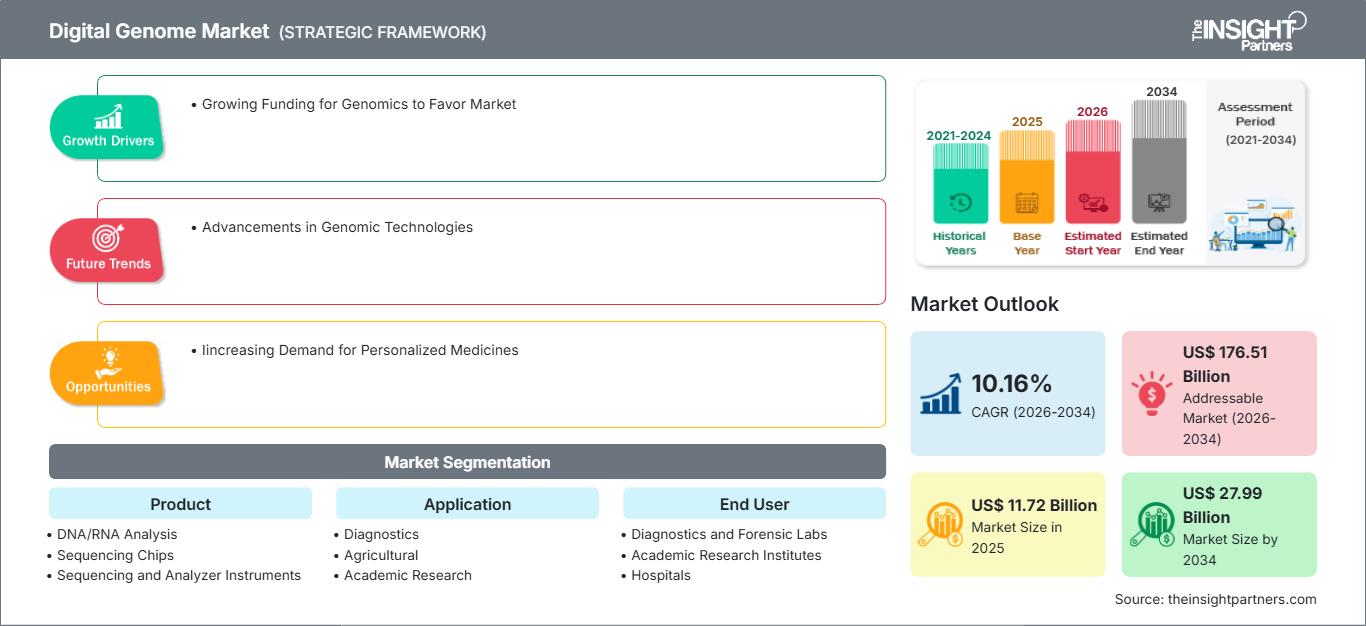
The Digital Genome Market is undergoing a transformative phase as genomic technologies become increasingly integrated into healthcare, life sciences, and precision medicine workflows. The market is estimated at US$ 11.72 billion in 2025 and is projected to reach approximately US$ 27.99 billion by 2034, reflecting a sustained expansion trajectory. Industry analysis indicates the market will advance at a CAGR of around 10.16% during 2026–2034, supported by continuous innovation in sequencing platforms, bioinformatics software, and large-scale genomic data interpretation.
Advancements across North America continue to shape the competitive direction of the Digital Genome Market. The region is anticipated to register a CAGR of approximately 9.8% through 2034, driven by extensive genomic research funding, rising adoption of precision diagnostics, and increasing integration of sequencing technologies into clinical decision-making. Expanding collaborations among biotechnology companies, healthcare providers, and research institutions are accelerating the commercialization of digital genomic solutions across multiple application areas.
Digital Genome Market Assessment and Insights
- North America: North America accounted for 38–41% of the digital genome market share in 2025 and is anticipated to expand at a CAGR of 9.7–10.4% during 2026–2034. A strong genomic research ecosystem, expanding precision medicine initiatives, and advanced sequencing infrastructure continue to support regional market leadership.
- U.S.: The U.S. represented 78–82% of the North American digital genome market size in 2025 and is projected to register a CAGR of 9.8–10.5% during 2026–2034, driven by increasing investments in genomic research, precision diagnostics, and large-scale sequencing programs.
- Europe: Europe held 27–30% of the market share in 2025 and is expected to grow at a CAGR of 9.2–10.0% during 2026–2034. Germany, the United Kingdom, and France remain leading markets, supported by national genome initiatives and expanding translational research activities.
- Asia Pacific: Asia Pacific accounted for 22–25% of the digital genome market share in 2025 and is forecast to expand at a CAGR of 11.2–12.0% during 2026–2034. China, Japan, India, and South Korea continue to lead regional demand, driven by growing healthcare genomics programs, biotechnology investments, and improving access to sequencing technologies.
- Largest Segment: Sequencing and Analyzer Instruments represented the largest digital genome market segment and is expected to record a CAGR of 9.8–10.6% during 2026–2034, reflecting growing demand for high-throughput genomic data generation across diagnostic and research laboratories.
- High Growth Segment: Personalized Medicine is projected to grow at a CAGR of 11.8–12.6% during 2026–2034, driven by increasing integration of genomic insights into clinical decision-making, precision therapeutics, and biomarker-guided interventions.
- Key companies analyzed in detail: Thermo Fisher Scientific Inc.; F. Hoffmann-La Roche Ltd.; Illumina, Inc.; QIAGEN N.V.; Becton, Dickinson and Company; bioMérieux SA; Revvity, Inc.; Agilent Technologies, Inc.; Pacific Biosciences of California, Inc.; Oxford Nanopore Technologies plc.
Source: The Insight Partners' analysis based on proprietary research, government publications, company annual reports, investor presentations, industry databases, and expert interviews.
The Digital Genome Market report has evolved from a research-centric industry into a critical component of modern healthcare and biotechnology ecosystems. Rapid reductions in sequencing costs, improvements in computational biology, and broader access to genomic datasets have expanded the utility of digital genome platforms across diagnostics, therapeutic development, and agricultural genomics.
Over the coming decade, market expansion will be shaped by increasing demand for precision medicine, decentralized genomic testing, and cloud-based genomic analytics. The convergence of sequencing technologies with artificial intelligence and advanced data management platforms is expected to improve genomic interpretation capabilities while creating new commercial opportunities for technology providers and healthcare organizations.
Digital Genome Market Report Scope
| Report Attribute | Details |
|---|---|
| Market size in 2025 | US$ 11.72 Billion |
| Market Size by 2034 | US$ 27.99 Billion |
| Global CAGR (2026 - 2034) | 10.16% |
| Historical Data | 2021-2024 |
| Forecast period | 2026-2034 |
Digital Genome Market Analysis
Growing adoption of genome sequencing technologies across clinical and research environments remains a central market catalyst. Healthcare systems increasingly rely on genomic information to improve disease diagnosis, identify therapeutic targets, and support personalized treatment strategies. Simultaneously, the agricultural and pharmaceutical sectors are expanding genomic applications to enhance crop development and accelerate drug discovery programs.
The digital genome market ecosystem encompasses sequencing instrument manufacturers, reagent suppliers, software developers, data analytics providers, hospitals, diagnostic laboratories, and academic institutions. Continuous improvements in sample preparation workflows, sequencing throughput, and data-processing efficiency have strengthened value creation across the genomic technology chain.
Competition within the Digital Genome Market is characterized by technological differentiation, platform scalability, and bioinformatics capabilities. Companies including Thermo Fisher Scientific, F. Hoffmann-La Roche Ltd, Illumina, Inc., QIAGEN, GenomeMe Inc., NanoString Technologies, BD, bioMerieux SA, GenMark Diagnostics, Inc., and Perkin Elmer, Inc. continue to expand their genomic portfolios through product innovation and strategic partnerships.
Investment activity increasingly targets software-driven genomic interpretation, AI-assisted variant analysis, and clinical genomics infrastructure. Organizations capable of combining sequencing hardware, genomic databases, and analytical software into integrated solutions are strengthening their market position while addressing evolving customer requirements.
● REPORT CUSTOMIZATION
Tailor This Report To Align With Your Specific Business Requirements
This report can be customized to align precisely with your business objectives, scope, and target markets. Customization options include tailored segmentation, geography, competitive analysis, and strategic insights to support informed decision-making.
Customize This Report →WHAT YOU CAN ADJUST
- ● Segmentations
- ● Geography
- ● Competitive Analysis
- ● Language Preferences
Digital Genome Market: Strategic Insights
Regional Insights
North America Digital Genome Market
North America maintains a leading position in the Digital Genome Market and is expected to expand at a CAGR of approximately 9.8% through 2034. Strong public and private investment in genomic research, advanced healthcare infrastructure, and widespread adoption of precision medicine continue to support market development across the region.
The presence of major sequencing technology providers, extensive clinical trial activity, and growing use of genomic testing in oncology and rare disease diagnosis contribute to sustained demand. Academic institutions and healthcare systems are increasingly implementing large-scale genomic initiatives, supporting both research and clinical adoption.
U.S. Digital Genome Market
The United States accounts for an estimated 68–72% share of the North American Digital Genome Market and is projected to record a CAGR of roughly 9.9% during the forecast period. The country's leadership is supported by robust biotechnology investment, substantial genomic research funding, and strong commercialization capabilities.
The clustering effect among industry leaders, research facilities, and healthcare innovators has driven rapid growth in diagnostics, personalized medicine, and drug discovery. Genomic initiatives continue to increase in oncology, pharmacogenomics, and rare diseases. The use of genomic platforms in the cloud and AI is adding to the nation's competitiveness on the global stage.
Europe Digital Genome Market
Europe represents a significant contributor to global market revenues, accounting for approximately 25–29% of worldwide demand. The region is expected to achieve a CAGR of nearly 9.4% through 2034, supported by increasing genomic research initiatives and expanding adoption of precision healthcare frameworks.
The United Kingdom remains a leading genomic innovation hub due to extensive national sequencing programs, strong academic research capabilities, and integration of genomic medicine within healthcare services. Public-sector support continues to facilitate broader access to genomic testing.
Advanced biotechnology infrastructure, pharmaceutical research, and industrial partnerships are the key drivers of Germany's market. The investments made in molecular diagnostics and bioinformatics platforms have further increased the acceptance of genomics.
The markets of France, Italy, and Spain are expected to grow consistently due to the expansion of genomics testing by healthcare organizations and the involvement of research organizations in global genomics projects. Increased awareness of personalized medicine and research investments is fueling market growth.
APAC Digital Genome Market
Asia Pacific is expected to emerge as the fastest-growing regional digital genome market, registering a CAGR of approximately 11.8% during the forecast period. The region currently contributes around 22–26% of global revenues, with significant growth potential arising from expanding healthcare investments and genomics research initiatives.
The high demand in the region can be attributed to genomic research, biotechnology investments, and increased sequencing capacity. The continued government investment in genomics and precision medicine is spurring industry growth.
In Japan, there is continued adoption in clinical genomics and pharmaceutical research. In South Korea, digital health systems and biotechnology innovations are driving demand. There is increased demand in India due to healthcare initiatives in genomic medicine. Australia continues to strengthen its position through research collaborations and publicly funded genomic medicine programs.
Middle East & Africa Digital Genome Market
The Middle East & Africa region is gradually expanding its footprint within the Digital Genome Market and is anticipated to achieve a CAGR of approximately 8.9% through 2034. Investments in healthcare modernization and biotechnology development are creating favorable conditions for genomic technology adoption.
Transformational initiatives in Saudi Arabia's healthcare sector drive regional growth. The country is actively developing genomic technologies to prevent disease, manage population health, and support precision medicine programs.
The UAE continues efforts to digitize healthcare and genomic research, while South Africa is considered one of the leading centers of genomics research in Africa. Further infrastructure development and digitalization in healthcare in the Rest of MEA will provide new growth opportunities.
Segmentation Analysis
Product
- DNA/RNA Analysis: Represents the largest revenue-generating category due to its widespread use in disease diagnosis, genetic profiling, biomarker discovery, and clinical research applications across healthcare and biotechnology environments.
- Sequencing Chips: Demand is increasing as laboratories seek higher throughput, improved accuracy, and cost-efficient processing capabilities to support large-scale genomic studies and population sequencing programs.
- Sequencing and Analyzer Instruments: Advanced sequencing systems continue to attract investments because of faster run times, enhanced scalability, and expanding clinical applications in precision medicine.
- Sample Prep Instruments: Automated sample preparation technologies improve workflow efficiency, reduce contamination risks, and support standardized genomic testing across high-volume laboratory environments.
- Sequencing and Analysis Software: Software platforms are gaining strategic importance as genomic datasets become increasingly complex, requiring advanced analytics, visualization tools, and AI-enabled interpretation capabilities.
Application
- Diagnostics: Increasing use of genomic testing for oncology, rare diseases, infectious diseases, and inherited disorders supports strong demand across clinical settings.
- Agricultural: Genomic technologies are improving crop breeding, disease resistance analysis, and livestock management, helping agricultural stakeholders enhance productivity and sustainability.
- Academic Research: Universities and research institutes continue to utilize sequencing technologies for genetic discovery, molecular biology studies, and translational research initiatives.
- Drug Discovery: Pharmaceutical companies increasingly integrate genomic information into target identification, biomarker development, and clinical trial optimization strategies.
- Personalizes Medicine: Personalized treatment planning based on individual genetic profiles is becoming a major healthcare trend, driving adoption of digital genomic solutions.
End User
- Diagnostics and Forensic Labs: High-volume genomic testing and molecular analysis activities make these laboratories major consumers of sequencing technologies and associated software solutions.
- Academic Research Institutes: Research organizations remain key adopters due to ongoing genomic investigations, collaborative studies, and government-funded scientific programs.
- Hospitals: Healthcare providers are increasingly integrating genomic testing into routine clinical workflows to support precision diagnostics and treatment decisions.
Opportunity Snapshot
| End User | Revenue Contribution | Trend Tag | Adoption Stage |
| Diagnostics and Forensic Labs | High | Precision Testing | Mature |
| Academic Research Institutes | High | Genomic Discovery | Mature |
| Hospitals | Medium | Clinical Genomics | Scaling |
| Others | Low | Data Integration | Emerging |
Digital Genome Market Growth Drivers and Impact Analysis
Expansion of Precision Medicine Programs
Advances in precision medicine are continuously reshaping healthcare delivery by enabling the development of individualized therapies based on one’s genotype. The growing investments in genomic testing made by governments, healthcare professionals, and drug manufacturers ensure enhanced accuracy in diagnosing diseases and treating patients. Digital genome platforms are used to identify disease-causing mutations, stratify patients, and select personalized treatments.
This approach extends beyond oncology to fields such as cardiovascular diseases, neurology, and genetic anomalies. With the increased focus on outcome-oriented healthcare systems, genomics is becoming an important component of clinical practice. This shift is creating sustained demand for sequencing technologies, analytical software, and genomic interpretation services across global healthcare markets.
Rapid Advancements in Sequencing Technologies
The constant innovation in sequencing technology has greatly improved throughput, accuracy, and cost-effectiveness. The new generation sequencing devices can produce much larger amounts of data at lower cost, thus making genomic study available to more organizations. The development of sample preparation procedures and automation has become even more advantageous.
Such improvements are promoting the use of sequencing technology in research, diagnostics, agriculture, and drug development. Organizations can conduct genomic studies faster and more accurately, making the application of digital genomes commercially viable. The technological improvements are also driving upgrades among organizations that require better sequencing equipment.
Growth of Genomic Data Analytics and AI Integration
The amount of genomic data produced globally has risen significantly, necessitating better analytical methods. Artificial intelligence (AI) and machine learning algorithms are contributing to enhanced variant identification, genomic data analysis, and clinical decision-making. These technologies assist organizations in deriving actionable knowledge from increasingly sophisticated data sets.
The use of AI in genomics makes genomics more efficient and reduces interpretation challenges. In the modern world, where health practitioners and scientists need speed and accuracy in genomic analysis, technology is of great significance. This development is driving investment in bioinformatics, cloud computing, and the genomic data ecosystem.
Digital Genome Market Future Trends
Convergence of Multi-Omics and Digital Genomics
The future of digital genomics is increasingly shaped by digital genome market trends, including integration with transcriptomics, proteomics, metabolomics, and epigenomics. Multi-omics approaches enable researchers and clinicians to obtain a more comprehensive understanding of biological systems and disease mechanisms. This convergence is expanding the scope of genomic applications beyond DNA sequencing alone.
As technology advances, it is anticipated that more and more companies will use integrated datasets for purposes such as biomarker discovery, drug development, and patient-specific medicine. Companies that provide products enabling multi-omic integration are likely to enjoy competitive advantages as customers seek deeper biological insights from complex datasets.
Cloud-Native Genomic Infrastructure and Collaborative Research
Genomics cloud platforms are revolutionizing the storage, analysis, and exchange of genomic data. Cloud technologies have become crucial for research organizations conducting large-scale sequencing projects in collaboration with peers worldwide. Scalability, security, and computational power continue to be key factors in adoption.
In the future, the genomics ecosystem will focus on interoperability and on enabling different healthcare facilities, biotech companies, and research organizations to share data. This will create new opportunities for software vendors and service providers due to improved cloud infrastructure.
Digital Genome Market Opportunities
Expansion of Clinical Genomics in Emerging Healthcare Systems
Healthcare modernization in emerging markets offers significant business potential for digital genome solution companies. Increasing investment in diagnostics infrastructure, rising healthcare spending, and awareness of precision medicine are making genomic technology adoption, strengthening the digital genome market forecast across developing countries and expanding long-term commercial potential.
Companies entering these markets can take advantage of collaborations with healthcare, research, and government organizations. Genome solutions that are affordable, scalable, and implementable locally will have particular appeal. Participating in the market early on could offer technology companies competitive advantages as genome technology usage increases.
AI-Driven Genomic Interpretation Platforms
With the increasing volume of genomic datasets, there is an ever-growing need for powerful tools to interpret these data. The development of platforms for automated variant analysis, discovery of clinically relevant biomarkers, and decision support is a lucrative area for software companies and genomics organizations.
Capitalizing on AI solutions that provide explainability, clinical-grade analysis, and regulatory compliance can create significant value. Those entities that integrate sequencing platforms with intelligent analytics will be able to meet emerging customer requirements across the healthcare, pharmaceutical research, and biotechnology sectors.
Recent Developments
- March, 2026: Basecamp Research, a frontier AI lab for biological design, announced the launch of the Trillion Gene Atlas, a landmark scientific initiative to generate and model biological data at the trillion-gene scale. Launched in collaboration with Anthropic, Ultima Genomics, and PacBio, and powered by NVIDIA AI infrastructure, the Trillion Gene Atlas aims to expand known evolutionary genetic diversity 100-fold by collecting genomic data from more than 100 million species across thousands of sites worldwide.
- February, 2025: Illumina, Inc. introduced a broad portfolio of multiomics innovations spanning genomics, spatial transcriptomics, single-cell analysis, methylation research, and integrated analytics platforms. The announcement expanded the company’s roadmap for next-generation genomic research and strengthened its position in advanced digital genome technologies.
- May, 2025: F. Hoffmann-La Roche Ltd announced a strategic collaboration with Broad Clinical Labs to advance clinical applications of SBX sequencing technology, initially focusing on critically ill newborns and whole-genome sequencing initiatives. The partnership seeks to accelerate the adoption of advanced genomic technologies within clinical settings.
Frequently Asked Questions

- Comprehensive Market Sizing and Forecast Analysis
- Detailed Segmentation Analysis
- In-Depth Market Dynamics Assessment
- Regional and Country-Level Insights
- Competitive Landscape and Company Benchmarking
- Strategic Business Intelligence
Recent Reports
Testimonials

The Insight Partners provided valuable market intelligence that supported our global go-to-market strategy. Their team was professional, responsive, and attentive to our feedback, providing thoughtful analysis and helpful methodological clarifications throughout the project.
Junmo Kim Chief Financial Officer (CFO), Enertech Co., Ltd.
The Insight Partners' SCADA System Market report is comprehensive, with valuable insights on current trends and future forecasts. The team was highly professional, responsive, and supportive throughout. We are very satisfied and highly recommend their services.
RAN KEDEM Partner, Reali Technologies LTDs
I requested a report on a very specific software market and the team produced the report in a few days. The information was very relevant and well presented. I then requested some changes and additions to the report. The team was again very responsive and I got the final report in less than a week.
JEAN-HERVE JENN Chairman, Future Analytica
We worked with The Insight Partners for an important market study and forecast. They gave us clear insights into opportunities and risks, which helped shape our plans. Their research was easy to use and based on solid data. It helped us make smart, confident decisions. We highly recommend them.
PIYUSH NAGPAL Sr. Vice President, High Beam Global
The Insight Partners delivered insightful, well-structured market research with strong domain expertise. Their team was professional and responsive throughout. The user-friendly website made accessing industry reports seamless. We highly recommend them for reliable, high-quality research services
YUKIHIKO ADACHI CEO, Deep Blue, LLC.
This is the first time I have purchased a market report from The Insight Partners.While I was unsure at first, I visited their web site and felt more comfortable to take the risk and purchase a market report.I am completely satisfied with the quality of the report and customer service. I had several questions and comments with the initial report, but after a couple of dialogs over email with their analyst I believe I have a report that I can use as input to our strategic planning process.Thank you so much for taking the extra time and making this a positive experience.I will definitely recommend your service to others and you will be my first call when we need further market data.
JOHN SUZUKI President and Chief Executive Officer, Board Director, BK Technologies
I wish to appreciate your support and the professionalism you displayed in the course of attending to my request for information regarding to infectious disease IVD market in Nigeria. I appreciate your patience, your guidance, and the fact that you were willing to offer a discount, which eventually made it possible for us to close a deal. I look forward to engaging The Insight Partners in the future, all thanks to the impression you have created in me as a result of this first encounter.
DR CHIJIOKE ONYIA MANAGING DIRECTOR, PineCrest Healthcare Ltd.Reason to Buy
- Informed Decision-Making
- Understanding Market Dynamics
- Competitive Analysis
- Identifying Emerging Markets
- Customer Insights
- Market Forecasts
- Risk Mitigation
- Boosting Operational Efficiency
- Strategic Planning
- Investment Justification
- Tracking Industry Innovations
- Aligning with Regulatory Trends






 Get Free Sample for