
Disinfection Equipment Market Growth, Demand & Size by 2034
Coverage: By Equipment Type (Disinfection Sprayers , Electrostatic Sprayers , UV Disinfection); Distribution Channel (Wholesalers/ Distributors, Online Retailers, Independent Small Stores, Other); End Use (Household, Commercial, Industrial) , and Geography (North America, Europe, Asia Pacific, and South and Central America)
- Status : Data Released
- Report Code : TIPRE00020751
- Category : Electronics and Semiconductor
- No. of Pages : 150
- Available Report Formats :


- Last update date : July 29, 2026


2025 Market Size
US$ 4.44 Bn
Base year value
2034 Forecast
US$ 8.13 Bn
Projected by 2034
CAGR 2026-2034
6.95 %
Growth rate
Addressable Market
US$ 56.76 Bn
(2026-2034)
The Disinfection Equipment Market was valued at US$ 4.44 Billion in 2025 and is projected to reach US$ 8.13 Billion by 2034, registering a CAGR of 6.95% during 2026–2034. The market includes disinfection sprayers, electrostatic sprayers, and UV disinfection equipment sold through wholesalers and distributors, online retailers, and independent small stores for household, commercial, and industrial end users.
North America Disinfection Equipment Market size is expected to advance at a CAGR of 6.4–7.2% during 2026–2034, supported by healthcare-associated infection prevention, EPA-regulated disinfectant application practices, and demand for touchless sanitation in public facilities. Structural demand is reinforced by healthcare, foodservice, schools, transit hubs, and commercial property managers seeking faster coverage, lower labor intensity, and documentation-ready hygiene programs.
Disinfection Equipment Market Assessment and Insights
- North America held 31–35% share in 2025 and is growing at a CAGR of 6.4–7.2% during 2026–2034, led by regulated disinfection protocols, healthcare spending, and institutional sanitation upgrades.
- US represented 77–81% of North American revenue in 2025 and is growing at a CAGR of 6.5–7.3% during 2026–2034, supported by hospitals, schools, foodservice, and commercial cleaning contractors.
- Europe accounted for 24–28% share in 2025 and is growing at a CAGR of 5.9–6.7% during 2026–2034, with Germany, the UK, France, Italy, and Spain leading adoption.
- Asia Pacific held 27–31% share in 2025 and is growing at a CAGR of 7.8–8.6% during 2026–2034, led by China, Japan, South Korea, India, and Australia.
- Largest Segment UV Disinfection held 38–42% market share in 2025 and is growing at a CAGR of 7.4–8.2% during 2026–2034 due to chemical-free operation.
- High Growth Segment Electrostatic Sprayers represented 24–28% market share in 2025 and is growing at a CAGR of 8.3–9.1% during 2026–2034, supported by rapid surface coverage.
- Key companies analyzed in detail: 3M Health Care; Advanced Sterilization Products Services Inc.; Belimed AG; Getinge AB; Matachana Group; Shinva Medical Instrument Co., Ltd.; Sotera Health Company; STERIS plc; Trojan Technologies Group ULC; Xylem Inc.
Source: The Insight Partners' analysis based on proprietary research, government publications, company annual reports, investor presentations, industry databases, and expert interviews.
Disinfection equipment is being redesigned to focus on the use of validated, application-specific systems that are capable of producing controlled droplets, exposure to UV-C, automation, and after-sale service support. Manufacturing will include lighter sprayers, rechargable platform, safety interlocks, high-output UV systems, and materials resistant to disinfectant exposure. Vendors will try to meet the demands of distributors, which will include clear labelling, consumable compatibility, product training support, and the limitations of their efficacy.
Future demand will be influenced by the development of new healthcare infrastructure, water purification, the recovery of the tourism industry, food safety regulations, and preparedness for infectious diseases outbreaks. Investments in disinfection equipment market share will be directed at the automation of room disinfection, water and air UV systems, and electrostatic sprayers that provide better surface coverage when used with approved disinfectants. The tailwinds from infection prevention, the control of the antimicrobial resistance, and occupational safety regulations will keep the market robust in both developed and emerging economies.
Disinfection Equipment Market Report Scope
| Report Attribute | Details |
|---|---|
| Market size in 2025 | US$ 4.44 Billion |
| Market Size by 2034 | US$ 8.13 Billion |
| Global CAGR (2026 - 2034) | 6.95% |
| Historical Data | 2021-2024 |
| Forecast period | 2026-2034 |
Disinfection Equipment Market Analysis
Disinfection Equipment Market growth is spurred by infection control in hospitals, requirement for safe public places, and hygiene standards in the food, pharmaceutical, and water industries. As per the WHO, health care associated infections occur in 7 out of 100 patients in high-income countries and 15 of 100 in low- and middle-income countries, thereby stressing on the necessity of reliable environmental disinfection solutions.
Value chain includes chemical formula manufacturers, UV light and LED suppliers, battery and pump suppliers, nozzle suppliers, equipment assembly companies, distributors, service organizations, and cleaning staffs of end-users. Factors influencing supply side are safety certification, compatibility of disinfectants, lamp replacement period, batteries' availability, and channel training. Buyers are more frequently judging total cost according to speed of coverage, labor savings, consumption of consumable components, and sufficient contact times evidence.
The Disinfection Equipment Market report reveals the competitive landscape between the sterilization solutions providers for the health care industry, water treatment providers and the sanitization equipment providers. STERIS plc, Getinge AB, Belimed AG, Matachana Group, and Advanced Sterilization Products Services Inc. have major activities in healthcare and life sciences market segment. Xylem Inc. and Trojan Technologies Group ULC enhance their competence in UV water treatment whereas 3M Health Care offers infection control products and improves its distribution channels.
Sotera Health Company and Shinva Medical Instrument Co., Ltd. grow their size through the provision of sterilization services and production of medical devices. Positive trends of investments relate to the validation cycles, connected monitoring systems, reduced exposure to chemicals and service-oriented lifecycle approach. Strategic positioning is based on clinical data, regulatory compliance, installed base, geographic and channel presence for household, commercial and industrial customers.
● REPORT CUSTOMIZATION
Tailor This Report To Align With Your Specific Business Requirements
This report can be customized to align precisely with your business objectives, scope, and target markets. Customization options include tailored segmentation, geography, competitive analysis, and strategic insights to support informed decision-making.
Customize This Report →WHAT YOU CAN ADJUST
- ● Segmentations
- ● Geography
- ● Competitive Analysis
- ● Language Preferences
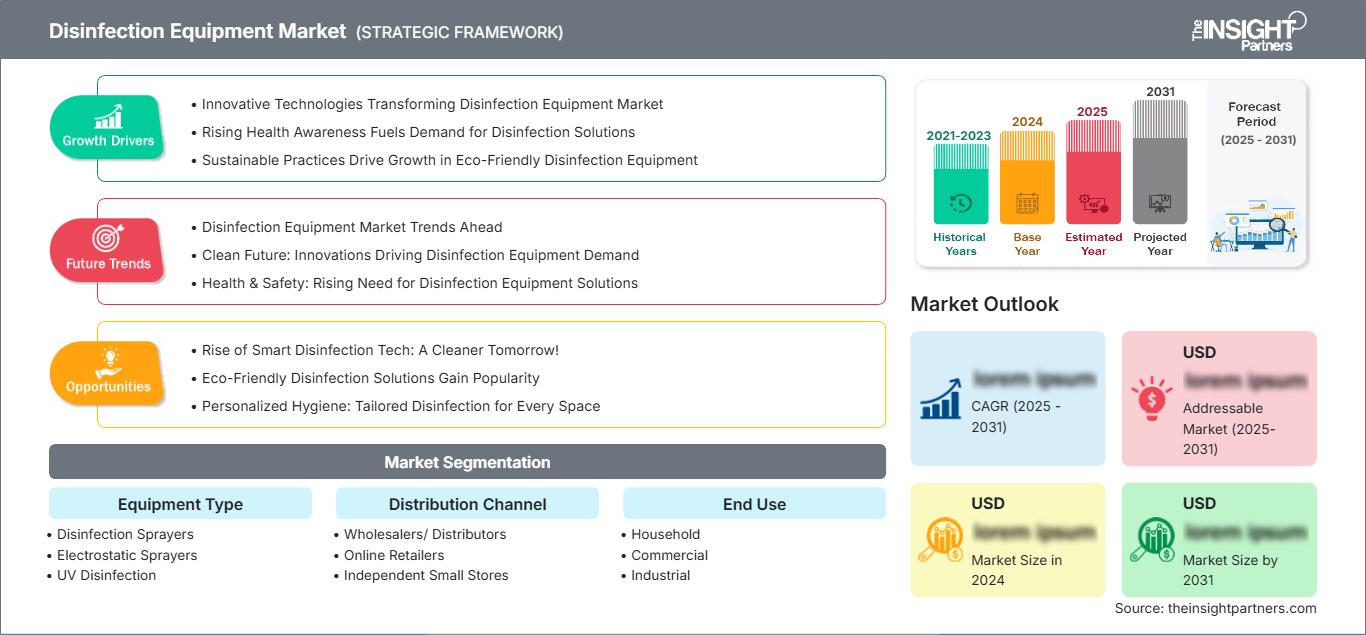
Disinfection Equipment Market: Strategic Insights
Regional Insights
North America Disinfection Equipment Market
The North American share in the market in 2025 was 31-35% and is expected to register growth with a CAGR of 6.4-7.2% in the forecast period between 2026 and 2034. The market will gain impetus from the healthcare sector, EPA compliant disinfection, sanitation in schools, public transport, and institutions' preference for quicker coverage with dwell-time control.
The replacement demand will grow owing to the shift from manual trigger sprayers to electrostatic and UV systems with less labor intensive. The Disinfection Equipment Market will be driven by the presence of efficient distribution channels, hospital buying practices, foodservice inspections, and commercial cleaning firms with standardized equipment fleet.
U.S. Disinfection Equipment Market
The U.S. contributed between 77 and 81% to the revenues from North America in 2025 and is forecasted to grow with a CAGR of 6.5–7.3% during 2026-2034. Hospitals, ambulatory facilities, schools, hotels, airports, and food processing plants are the sources of recurring demand, while individuals buy portable sprayers and UV systems via e-commerce.
STERIS plc, 3M Health Care, Advanced Sterilization Products Services Inc., Xylem Inc., and Trojan Technologies Group ULC have a definite presence in the U.S. market for the industries of healthcare, water, and hygiene. The trend of applications includes room cycle validation, electrostatic surface technology, UV water treatment, and auditing procedure standards.
Europe Disinfection Equipment Market
Europe accounted for 24–28% share in 2025 and is expected to grow at a CAGR of 5.9–6.7% for 2026–2034. Germany dominates through its hospitals, pharmaceutical manufacturing, industrial cleaning, and municipal water purification. UK provides growth through demands from healthcare estates, hospitality, labs, and facilities management outsourcing.
Growth is achieved in France, Italy, and Spain due to factors such as tourism, food processing, transport systems, and improvements in healthcare systems. When it comes to buying disinfecting equipment in Europe, people consider human health, residues of chemicals and sustainability; therefore, ultraviolet disinfection and control application systems are favored.
APAC Disinfection Equipment Market
The Asia Pacific region holds a 27-31% market share in 2025 and is expected to grow at a CAGR of 7.8-8.6% from 2026 to 2034. China dominates with building hospitals, manufacturing of electronics, food processing, and water treatment plants, whereas Japan and South Korea prefer high-reliability UV and automated systems.
India and Australia drive growth by developing their health care sector, cold-chain, airports, mining camps, and institution cleaning. The favorable policies for safer water, sanitation, and industry compliance drive adoption; however, pricing sensitivity drives wholesalers and e-commerce sales channel demand.
Middle East & Africa Disinfection Equipment Market
The Middle East & Africa market is projected to grow at a CAGR of 6.1–6.9% during 2026–2034. Saudi Arabia leads as healthcare, airports, hotels, water projects, and giga-project infrastructure require reliable sanitation equipment for high-traffic environments.
The UAE supports demand from hospitality, aviation, clinics, and commercial towers, while South Africa and Rest of MEA rely on hospitals, mining sites, schools, and food distribution. Harsh climates increase demand for rugged sprayers, protected electronics, and dependable service availability.
Segmentation Analysis
Equipment Type
Equipment Type is projected to grow at a CAGR of 6.9–7.7% during 2026–2034. The Disinfection Equipment Market scope covers manual spraying, charged-droplet application, and UV-based microbial control. Selection depends on surface complexity, operator safety, speed, disinfectant compatibility, validation needs, and whether the end user prioritizes broad-area coverage, chemical-free treatment, or low-cost routine sanitation.
- Disinfection Sprayers remain important for households, small stores, schools, and janitorial crews that need affordable, familiar equipment for routine surface treatment across rooms, vehicles, counters, and shared touchpoints.
- Electrostatic Sprayers support commercial and institutional users seeking faster wraparound coverage on complex surfaces, provided operators use compatible disinfectants and maintain label-required contact time.
- UV Disinfection leads where users value chemical-free treatment for water, air, equipment, and controlled spaces, especially when safety interlocks, exposure validation, and lamp maintenance are managed properly.
Distribution Channel
Distribution Channel is forecast to grow at a CAGR of 6.5–7.3% during 2026–2034. Wholesalers and distributors remain central for institutions that require training, service, and bundled consumables. Online retailers expand household and small-business access, while independent small stores serve localized demand where buyers value immediate availability, product demonstration, and trusted supplier relationships.
- Wholesalers/ Distributors dominate institutional procurement because they combine equipment supply, disinfectant compatibility guidance, service coordination, training, financing support, and replenishment programs for large facilities.
- Online Retailers are strategically important for compact sprayers, replacement parts, and household UV devices, offering broad assortment, transparent pricing, and rapid fulfilment.
- Independent Small Stores support local cleaning contractors, households, and small businesses that need quick access, practical demonstrations, and advice on product use.
End Use
End Use is expected to grow at a CAGR of 6.8–7.6% during 2026–2034. Commercial facilities account for the broadest deployed base because offices, hospitals, hospitality, schools, and transport assets require repeatable sanitation. Industrial users prioritize water, process, and cleanroom applications, while households adopt compact equipment for periodic hygiene and convenience.
- Household demand is shaped by convenience, compact design, price, and perceived safety, with online channels supporting small sprayers, UV boxes, and maintenance consumables.
- Commercial users require visible hygiene programs, faster turnaround, and consistent procedures across healthcare, hospitality, education, retail, transit, offices, and outsourced cleaning contracts.
- Industrial adoption focuses on water treatment, food processing, pharmaceutical production, laboratories, and controlled environments where contamination control supports safety, uptime, and compliance.
Opportunity Snapshot
| End Use | Revenue Contribution | Trend Tag | Adoption Stage |
| Household | Low | Compact UV | Emerging |
| Commercial | High | Rapid Coverage | Mature |
| Industrial | Medium | Process Hygiene | Scaling |
Disinfection Equipment Market Growth Drivers and Impact Analysis
Infection prevention standards increase equipment renewal
After continuous disruptions by infectious diseases, healthcare facilities, schools, transportation services, and hotels have begun formulating protocols for sanitization. WHO programs for prevention of infections and the guidelines issued by national authorities lay stress on regular environmental cleanliness, hand hygiene, and safe patient pathways, thus increasing the need for dependable methods of surface and air disinfection. As a result, there is a move from buying the equipment randomly to making plans for their regular replacement and even operator training.
Water and wastewater safety expands UV deployment
UV systems are being incorporated into municipalities and industries to improve microbial control without raising residual chemicals. Trojan Technologies Group ULC mentions that UV technology provides support in the areas of municipal drinking water, wastewater, industrial process water, and residences, while Xylem Inc. provides its UV solutions in water treatment systems. The effect on the market will be the highest where urbanization, water reclamation initiatives, and tougher discharge demands coincide. Equipment suppliers get benefits from the income generated from lamps, sleeves, sensors, controllers, and services, while users get an alternative low chemical disinfection method.
Labor efficiency pushes electrostatic adoption
The pressure on facility managers to disinfect more surfaces without increasing cleaning personnel has led to increased use of electrostatic sprayers. Electrostatic sprayers have the ability to charge liquid droplets such that the disinfectant adheres to the hard and non-porous surfaces within the environment where the liquid is compatible with the surface and stays wet for the recommended contact time. This driver has fueled the growth of electrostatic sprayer sales within schools, fitness centers, offices, transportation, and health care auxiliary areas.
Disinfection Equipment Market Future Trends
Connected validation will become a procurement filter
Disinfection Equipment Market trends point toward connected validation tools that document run time, operator identity, location, cycle status, and maintenance history. Future institutional buyers will expect digital evidence rather than paper logs, especially in healthcare, laboratories, airports, and food facilities. This transition will push suppliers to integrate sensors, mobile apps, cloud dashboards, and service alerts into equipment that was previously sold as standalone hardware. Vendors that simplify audit preparation and reduce human error will secure premium positioning.
Mercury-free UV-C systems will gain relevance
UV-C LED development is expected to reshape compact, point-of-use, and modular disinfection systems as output efficiency improves and sustainability restrictions tighten. Future products will use smaller form factors, instant switching, targeted wavelengths, and lower maintenance requirements compared with conventional lamp-based systems. Adoption will begin in household devices, cabinets, air handlers, and niche industrial applications before scaling to higher-flow water systems. Suppliers that manage thermal performance, lifetime, and validation evidence will benefit most from this transition.
Disinfection Equipment Market Opportunities
Service-backed commercial hygiene programs
Disinfection Equipment Market Forecasts support investment in bundled commercial hygiene programs for hospitals, hotels, schools, airports, offices, and retail chains. Vendors can package sprayers, UV equipment, compatible consumables, operator training, maintenance schedules, and documentation templates into multi-site contracts. This opportunity is attractive because customers need consistent procedures, faster room turnaround, and reduced procurement complexity. Suppliers with distributor coverage and service teams can convert one-time equipment sales into recurring revenue through parts, calibration, training refreshers, and consumable replenishment.
Industrial UV packages for water-intensive sectors
Food and beverage plants, pharmaceutical sites, microelectronics facilities, and municipal utilities need reliable microbial control in process water, wastewater, and reuse loops. Suppliers can target these users with modular UV reactors, monitoring sensors, automatic sleeve cleaning, and lifecycle service agreements. The opportunity extends beyond equipment installation because lamps, quartz sleeves, controls, and validation support create recurring value. Vendors that prove dose delivery, minimize downtime, and integrate with plant control systems can win higher-value industrial projects..
Recent Developments
- June 2026: MASSPHOTON has officially introduced its new MP-UVC-200LP series UVC LED water disinfection system, delivering a maximum flow rate of up to 200 LPM per unit—setting a new benchmark for high-flow UVC LED water disinfection technology. Featuring mercury-free UV disinfection, the product has obtained dual certification from HKCC and SGS, achieving a microbial inactivation rate exceeding 99.999%. The system fully complies with the latest EU RoHS Directive and mercury-free environmental regulations. Combining advanced semiconductor UV technology with sustainability, it is designed for a wide range of applications including industrial production lines, commercial water purification, and centralized water supply systems. This innovation accelerates the global transition from traditional mercury-based UV lamps to UVC LED solutions, offering an efficient, intelligent, and environmentally friendly disinfection alternative.
- May 2025: Nichia, the world's largest LED manufacturer and inventor of the high-brightness blue and white LED, is pleased to announce that a UV-C LED disinfection device manufactured by Mutoh Industries Ltd., equipped with Nichia's high-power 280nm UV LED (Part No. NCSU434D), has been adopted for the food and beverage filling machines of Shikoku Kakoki Co., Ltd.
- October 2024: ams OSRAM (SIX: AMS), a global leader in intelligent emitters and sensors, has unveiled its new OSLON UV 3535. This groundbreaking UV-C LED serves the growing demand for mercury-free and efficient UV-C disinfection and treatment solutions. It offers powerful 115 milliwatts out of a single chip at 265 nanometers, which is the emission wavelength providing the highest germicidal effectiveness. Combined with outstanding wall plug efficiency, this optimized system solution has been specifically designed for customers in the UV-C disinfection market.
Frequently Asked Questions

- Comprehensive Market Sizing and Forecast Analysis
- Detailed Segmentation Analysis
- In-Depth Market Dynamics Assessment
- Regional and Country-Level Insights
- Competitive Landscape and Company Benchmarking
- Strategic Business Intelligence
Recent Reports
Testimonials

The Insight Partners' SCADA System Market report is comprehensive, with valuable insights on current trends and future forecasts. The team was highly professional, responsive, and supportive throughout. We are very satisfied and highly recommend their services.
RAN KEDEM Partner, Reali Technologies LTDs
I requested a report on a very specific software market and the team produced the report in a few days. The information was very relevant and well presented. I then requested some changes and additions to the report. The team was again very responsive and I got the final report in less than a week.
JEAN-HERVE JENN Chairman, Future Analytica
We worked with The Insight Partners for an important market study and forecast. They gave us clear insights into opportunities and risks, which helped shape our plans. Their research was easy to use and based on solid data. It helped us make smart, confident decisions. We highly recommend them.
PIYUSH NAGPAL Sr. Vice President, High Beam Global
The Insight Partners delivered insightful, well-structured market research with strong domain expertise. Their team was professional and responsive throughout. The user-friendly website made accessing industry reports seamless. We highly recommend them for reliable, high-quality research services
YUKIHIKO ADACHI CEO, Deep Blue, LLC.
This is the first time I have purchased a market report from The Insight Partners.While I was unsure at first, I visited their web site and felt more comfortable to take the risk and purchase a market report.I am completely satisfied with the quality of the report and customer service. I had several questions and comments with the initial report, but after a couple of dialogs over email with their analyst I believe I have a report that I can use as input to our strategic planning process.Thank you so much for taking the extra time and making this a positive experience.I will definitely recommend your service to others and you will be my first call when we need further market data.
JOHN SUZUKI President and Chief Executive Officer, Board Director, BK Technologies
I wish to appreciate your support and the professionalism you displayed in the course of attending to my request for information regarding to infectious disease IVD market in Nigeria. I appreciate your patience, your guidance, and the fact that you were willing to offer a discount, which eventually made it possible for us to close a deal. I look forward to engaging The Insight Partners in the future, all thanks to the impression you have created in me as a result of this first encounter.
DR CHIJIOKE ONYIA MANAGING DIRECTOR, PineCrest Healthcare Ltd.Reason to Buy
- Informed Decision-Making
- Understanding Market Dynamics
- Competitive Analysis
- Identifying Emerging Markets
- Customer Insights
- Market Forecasts
- Risk Mitigation
- Boosting Operational Efficiency
- Strategic Planning
- Investment Justification
- Tracking Industry Innovations
- Aligning with Regulatory Trends





 Get Free Sample for