
Display Market Size, Demand & Growth by 2034
Coverage: By Panel Size (Microdisplays Small & Medium-sized Panels, Large Panels); Panel Type (Flat Panel Display, Flexible Display, Foldable Display, Curved Display, Others); Product Type (Smartphones and Tablets, Television Sets, Monitors and Laptops, Digital Signage and Large Format Displays, Automotive Displays, Wearables, Others); Industry Vertical (Consumer Electronics, Automotive, Sports and Entertainment, Retail, BFSI, Education, Healthcare, Aerospace and Defense, Others), and Geography (North America, Europe, Asia Pacific, and South and Central America)
- Status : Published
- Report Code : TIPRE00020752
- Category : Electronics and Semiconductor
- No. of Pages : 350
- Available Report Formats :


- Last update date : August 14, 2026


2025 Market Size
US$ 140.37 Bn
Base year value
2034 Forecast
US$ 223.60 Bn
Projected by 2034
CAGR 2026-2034
5.3 %
Growth rate
Addressable Market
US$ 1,650.11 Bn
(2026-2034)
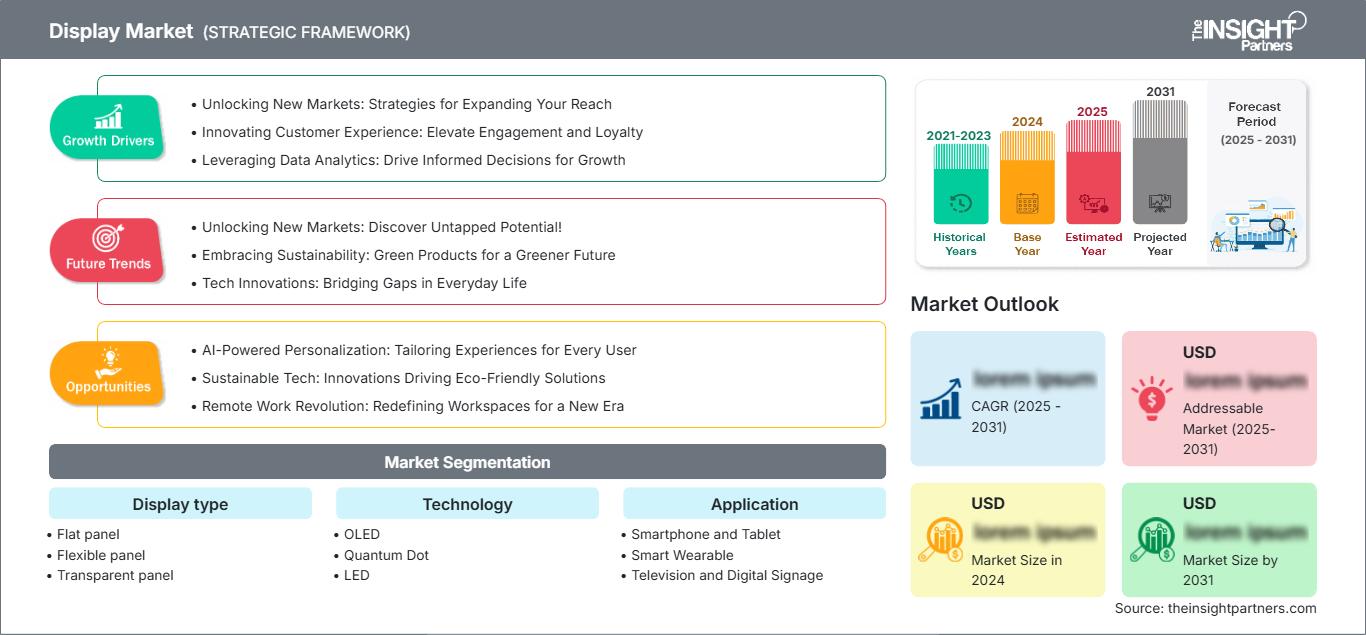
The Display Market was valued at US$140.37 billion in 2025 and is projected to reach US$223.60 billion by 2034, expanding at a CAGR of 5.3% during 2026–2034. The Display Market reflects rising demand for sharper, energy-efficient, thinner, brighter, and software-ready visual interfaces across consumer electronics, automotive cockpits, retail media, enterprise computing, healthcare imaging, and public information environments.
Asia Pacific is expected to expand at a 6.8% CAGR as premium televisions, OLED laptops, automotive cockpit screens, and digital signage modernization strengthen Display Market size. While enterprise replacement cycles and automotive electrification contribute to regional demand, public infrastructure, stadiums' media, healthcare visualization, and retail analytics drive growth in high-brightness displays and large commercial displays.
Display Market Assessment and Insights
- North America accounted for 28.89% share in 2025 and is growing at a CAGR of 4.5% between 2026–2034, supported by premium TVs, connected vehicles, signage, and healthcare imaging.
- US represented 86% of North America in 2025 and is growing at a CAGR of 4.7% between 2026–2034, led by commercial displays and automotive cockpit upgrades.
- Europe held 22.22% share in 2025 and is growing at a CAGR of 4.0% between 2026–2034, with Germany, the UK, France, Italy, and Spain leading adoption.
- Asia Pacific captured 40.00% share in 2025 and is growing at a CAGR of 6.8% between 2026–2034, led by China, South Korea, Japan, India, and Taiwan.
- Largest Segment LCD held 42.71% market share in 2025 and is growing at a CAGR of 5.1% between 2026–2034.
- High Growth Segment Micro-LED held 12.08% market share in 2025 and is growing at a CAGR of 6.4% between 2026–2034.
- Key companies analyzed in detail: Samsung Electronics Co., Ltd.; BOE Technology Group Co., Ltd.; LG Electronics Inc.; TCL Technology Group Corporation; Sharp Corporation; Panasonic Holdings Corporation; AUO Corporation; Everdisplay Optronics (Shanghai) Co., Ltd.; Innolux Corporation; and Truly International Holdings Limited.
Source: The Insight Partners' analysis based on proprietary research, government publications, company annual reports, investor presentations, industry databases, and expert interviews.
The development of technology is shifting the focus of the Display Market from commoditized screen replacement to optical performance differentiation and design engineering. Liquid Crystal Displays continue to dominate the scale in televisions, monitors, notebooks, and signage, whereas Organic Light Emitting Diodes increasingly feature in smartphones, premium IT devices, wearables, and automotive interiors. Meanwhile, Micro LEDs, direct-view LEDs, and quantum dots benefit from advances in brightness, toughness, contrast, and power savings, which are relevant to public places and premium consumers.
Future demand is created by panel manufacturers through their attempt at developing Gen 8.6 OLED, image processing through artificial intelligence, software-defined cockpits for automobiles, and localized manufacturing in Asia. The regulator’s concerns on energy efficiency, accessibility, safety, and medical display performance provide opportunities for those offering material technology and manufacturing solutions. New geographical areas offer replacement volume because of broadband availability, digital retail, and smart city developments.
Display Market Report Scope
| Report Attribute | Details |
|---|---|
| Market size in 2025 | US$ 140.37 Billion |
| Market Size by 2034 | US$ 223.60 Billion |
| Global CAGR (2026 - 2034) | 5.3% |
| Historical Data | 2021-2024 |
| Forecast period | 2026-2034 |
Display Market Analysis
Demand is growing due to screens becoming the main user interface for mobility, transactions, productivity, entertainment, and clinical visualization. Large Display Market growth is driven by upgrades to premium smartphones, bigger television screens, OLED monitor penetration, consolidation of automotive cockpit displays, and commercial digital signage solutions.
The supply chain involves glass substrates, backplanes, emitters, color conversion materials, driver chips, polarizers, backlight units, touch sensors, equipment providers, panel makers, device brands, and system integrators. The industry is capital-intensive in nature as the advanced fabs need to be run at high capacity and yield levels. The panel makers are shifting focus towards automotive, medical, and industrial segments that have longer qualification cycles, but more stable prices compared to consumer TVs.
Competitive intensity is led by BOE Technology Group Co., Ltd., Samsung Electronics Co., Ltd., LG Electronics Inc., TCL Technology Group Corporation, AUO Corporation, Innolux Corporation, Sharp Corporation, Panasonic Holdings Corporation, Everdisplay Optronics (Shanghai) Co., Ltd., and Truly International Holdings Limited. This Display Market analysis indicates that scale, OLED know-how, automotive quality systems, and customer diversification determine margin resilience.
Investments focus on OLED tandems for IT, printed OLEDs, oxide backplanes, mini LED backlighting, quantum dots for color conversion, and microdisplays for extended reality. The suppliers’ positioning is in line with their differentiated use case rather than pure volume increase in shipment area. Manufacturers that have panel production capability along with devices expertise will be able to capitalize on shortened qualification period and customer transitions facilitated by visual experience software.
● REPORT CUSTOMIZATION
Tailor This Report To Align With Your Specific Business Requirements
This report can be customized to align precisely with your business objectives, scope, and target markets. Customization options include tailored segmentation, geography, competitive analysis, and strategic insights to support informed decision-making.
Customize This Report →WHAT YOU CAN ADJUST
- ● Segmentations
- ● Geography
- ● Competitive Analysis
- ● Language Preferences
Display Market: Strategic Insights
Regional Insights
North America Display Market
North America held 28.89% share in 2025 and is expected to grow at a CAGR of 4.5% during 2026–2034. Display Market share is supported by high replacement spending for premium televisions, gaming monitors, medical imaging workstations, and commercial signage. Enterprise device refresh and automotive cockpit digitization add steady demand.
The region benefits from established semiconductor design, cloud computing, retail media networks, and public venue modernization. Automotive display revenues are moving toward LTPS LCD and OLED, with Omdia noting these technologies exceeded 50% of automotive display revenue in 2025. Suppliers serving regulated healthcare, aerospace, and automotive applications gain resilience against consumer electronics cycles.
U.S. Display Market Market
The US accounted for 86% of North America in 2025 and is projected to grow at a CAGR of 4.7% from 2026–2034. Demand is concentrated in large-format signage, premium gaming monitors, laptops, vehicle displays, healthcare imaging, defense visualization, and broadcast infrastructure. Commercial buyers prioritize brightness, uptime, serviceability, and image consistency.
Samsung Electronics Co., Ltd., LG Electronics Inc., Panasonic Holdings Corporation, Sharp Corporation, and TCL Technology Group Corporation maintain strong channel and product presence, while panel supply is connected to Asian fabs. Application trends include digital out-of-home networks, electric vehicle cockpit screens, OLED creator monitors, and hospital imaging displays where compliance and lifecycle support influence procurement.
Europe Display Market Market
Europe represented 22.22% share in 2025 and is forecast to grow at a CAGR of 4.0% through 2034. Germany leads because automotive cockpit engineering, industrial automation, medical devices, and premium retail formats require qualified display systems. The UK is advancing through retail media, transport signage, broadcasting, and enterprise monitor refresh.
France has access to visualization technology in aerospace, defense, and healthcare industries. Italy and Spain provide visualization through commercial signs, hospitality, education, and automotive logistics. Energy conservation laws in Europe favor low-energy panels and improved brightness management. Buyers demand products that last long, are easy to fix, and comply with documentation requirements.
APAC Display Market Market
APAC held 40.00% share in 2025 and is expected to grow at a CAGR of 6.8% during 2026–2034. China is the leading country, supported by large LCD capacity, OLED investment, smartphone brands, television assembly, and electric vehicle production. South Korea and Japan contribute advanced OLED, materials, and equipment expertise.
India, Australia, and Southeast Asian economies add demand through digital signage, education technology, consumer electronics penetration, and industrial displays. Policy support for electronics manufacturing and smart infrastructure strengthens regional sourcing. Display Daily cited 2025 large-area panel leadership by BOE, China Star, and Innolux, reinforcing Asia’s scale advantage.
Middle East & Africa Display Market Market
Middle East & Africa is projected to grow at a CAGR of 3.8% during 2026–2034, led by Saudi Arabia and the UAE. Demand is tied to smart-city programs, retail malls, airports, hospitality, sports venues, and energy-sector control rooms requiring durable signage and command displays.
South Africa and the remainder of MEA provide through educational technology, bank branches, advanced health care, and transport facilities. Tough outdoor conditions require screens with high brightness and thermal stability. Customers consider availability, dust-proofing, energy efficiency, and cost of ownership as key purchasing criteria.
Segmentation Analysis
Display Technology
Display Technology is projected to grow at a CAGR of 5.3% during 2026–2034. The Display Market scope across technologies is widening as LCD keeps cost leadership with 42.71% share and 5.1% CAGR, OLED expands premium value, and Micro-LED targets ultra-bright, modular, and long-life systems with 12.08% share and 6.4% CAGR. Quantum dot and direct-view LED formats improve color performance and commercial visibility.
- LCD remains the volume foundation for televisions, monitors, laptops, and signage because mature fabs, broad supplier availability, and predictable costs support mass-market procurement.
- OLED strengthens premium smartphones, wearables, monitors, tablets, televisions, and automotive displays where contrast, thinness, flexibility, and power optimization justify higher panel pricing.
- Micro-LED targets premium televisions, control rooms, luxury retail, and XR microdisplays by combining brightness, durability, modularity, and high contrast for demanding visual environments.
- Direct-view LED is strategically important for stadiums, command centers, outdoor advertising, corporate lobbies, and broadcast spaces requiring seamless large-format visual performance.
- Quantum Dot improves color volume and brightness in televisions, monitors, and signage, supporting premium LCD upgrades and emerging emissive display roadmaps.
Panel Size
Panel Size is expected to grow at a CAGR of 5.3% from 2026–2034. Demand is splitting between microdisplays for XR and imaging, small and medium panels for mobile devices and vehicles, and large panels for televisions, monitors, signage, education, and conferencing. Larger screen preferences increase area demand even when unit growth moderates.
- Microdisplays support AR, VR, medical optics, cameras, and defense systems where pixel density, brightness, power efficiency, and compact form factors determine product feasibility.
- Small & Medium-sized Panels serve smartphones, tablets, wearables, automotive clusters, and portable electronics, making them central to frequent replacement and premium feature upgrades.
- Large Panels remain critical for televisions, monitors, education boards, conference rooms, retail media, and public information systems, where screen area drives visual impact.
Panel Type
Panel Type is forecast to grow at a CAGR of 5.3% during 2026–2034. Flat panels dominate mainstream demand, while flexible, foldable, and curved formats add differentiation in smartphones, tablets, monitors, and vehicle interiors. Product design increasingly uses panel shape to improve ergonomics, portability, viewing immersion, and brand positioning.
- Flat Panel Display remains the dominant format because it fits established production lines, standardized device designs, commercial signage frames, and cost-sensitive consumer electronics.
- Flexible Display supports curved wearables, automotive interiors, and premium mobile devices where thin substrates allow new industrial design choices.
- Foldable Display creates value in smartphones, tablets, and portable productivity devices by combining compact storage with expanded screen area.
- Curved Display strengthens gaming monitors, vehicle dashboards, and immersive commercial systems where field-of-view comfort and premium aesthetics matter.
Product Type
Product Type is projected to grow at a CAGR of 5.3% during 2026–2034. While smartphones and TVs are big volume groups, monitors, laptops, signage, automotive displays, and wearables are high-tech migration groups. Consumers are looking at refresh rates, energy consumption, brightness, color precision, durability, and software compatibility for their display evaluation criteria.
- Smartphones and Tablets anchor high-volume demand, with OLED, foldable, and high-refresh panels supporting premiumization and regular replacement cycles across consumer device brands.
- Television Sets remain a major area-demand driver as larger screen sizes, Mini-LED backlighting, OLED, and quantum dot enhancements support premium upgrades.
- Monitors and Laptops benefit from hybrid work, gaming, creator workflows, and OLED adoption, making refresh rates and color accuracy important purchase factors.
- Digital Signage and Large Format Displays support retail media, transport hubs, campuses, stadiums, and corporate spaces where visibility and uptime shape purchasing decisions.
- Automotive Displays grow through digital clusters, center stacks, passenger screens, HUDs, and EV cockpits requiring brightness, thermal stability, and long qualification cycles.
- Wearables rely on compact, efficient, and durable displays for smartwatches, fitness devices, medical wearables, and emerging lightweight health-monitoring applications.
Industry Vertical
Industry Vertical is expected to grow at a CAGR of 5.3% during 2026–2034. Consumer electronics accounts for high volume, whereas automotive, health care, retail, education, aerospace, and defense account for high specifications. The vertical markets depend on reliability, certification, imaging quality, outdoor capabilities, and integration with mobility, cloud, and analytics computing platforms.
- Consumer Electronics remains the largest vertical, driven by smartphones, televisions, tablets, notebooks, gaming displays, and wearables that require frequent technology upgrades.
- Automotive uses displays as cockpit interfaces, safety information surfaces, passenger entertainment systems, and EV differentiation tools with stringent durability needs.
- Sports and Entertainment depends on direct-view LED, projection alternatives, broadcast monitors, and immersive venue displays for audience engagement and sponsorship value.
- Retail adopts signage, shelf-edge displays, interactive kiosks, and analytics-linked screens to support media monetization, wayfinding, and omnichannel merchandising.
- BFSI uses secure signage, branch displays, trading monitors, ATMs, and customer information systems where clarity, uptime, and compliance matter.
- Education expands through interactive boards, classroom displays, remote teaching infrastructure, and campus information systems designed for collaborative learning.
- Healthcare requires diagnostic monitors, surgical displays, patient infotainment, and wearable interfaces where color accuracy, hygiene, and certification are critical.
- Aerospace and Defense values rugged displays, cockpit panels, mission systems, simulation screens, and command-center visualization with long lifecycle support.
Opportunity Snapshot
| Industry Vertical | Revenue Contribution | Trend Tag | Adoption Stage |
| Consumer Electronics | High | OLED Upgrade | Mature |
| Automotive | High | Smart Cockpit | Scaling |
| Sports and Entertainment | Medium | Venue LED | Scaling |
| Retail | Medium | Retail Media | Scaling |
| BFSI | Low | Branch Signage | Mature |
| Education | Medium | Interactive Boards | Scaling |
| Healthcare | Medium | Diagnostic Imaging | Scaling |
| Aerospace and Defense | Low | Rugged Panels | Emerging |
Display Market Growth Drivers and Impact Analysis
Premium device refresh and larger screen preference
The consumer electronic product category will continue to provide stability of earnings due to constant refresh cycles of smartphones, tablets, laptops, monitors, TV, and wearables. The change is not limited to unit refresh but includes higher refresh rates, more vivid display quality, slimmer form factor, better color accuracy, and power efficiency. This is evidenced by Omdia projections in which AMOLED smartphone displays have beaten TFT LCD in 2024, demonstrating that premiumization is moving down to mass mobile devices. In terms of practical application, it means an increase in demand for OLED equipment, improved backplane, quantum dot technology, and better calibration.
Automotive cockpit digitization and EV platform redesign
Vehicles are becoming software-defined environments, and displays now handle navigation, instrument clusters, climate controls, passenger entertainment, camera views, and driver assistance information. Electric vehicles accelerate this shift because cockpit interfaces are used to differentiate brands and manage energy, charging, and safety data. This strengthens demand for automotive-qualified panels, curved designs, high brightness, low reflection, and long lifecycle supply agreements.
Commercial visualization and retail media monetization
Automobiles are now becoming software-defined vehicles, and the display systems perform navigation, instrument cluster, climate control, entertainment, camera views, and driver assistance systems. The introduction of electric automobiles is further pushing this trend since cockpit displays are being utilized by car manufacturers as a means of branding and managing the vehicle’s energy and safety information.
Display Market Future Trends
AI-tuned panels and software-defined visual experiences
Display Market trends will be focused more and more on AI-based display optimizations, which entail adjusting the display panels based on their content, ambient lighting, user interaction and workload of the device itself in terms of brightness, contrast, refresh rate, and power consumption. This trend is already clear in gaming monitors, high-end TVs, laptops, cockpit displays, and even commercial advertising signage. With AI-enabled processing being able to save on power while enhancing the quality of the image, this will also help make devices more sustainable and improve user experience.
Gen 8.6 OLED and printed manufacturing scale-up
The future investment on next-gen OLED is now moving towards large glass substrates and alternate processes that can make OLED manufacturing more economical for notebooks, tablets, monitors, and automotive displays. According to TrendForce, the development of Gen 8.6 OLED by Samsung Display, BOE, Visionox, and TCL CSOT is underway, while print and FMM-less technologies are gaining traction. In case of better yield rates, OLED may spread from mobile phones and luxury TVs to other categories of IT products.
Display Market Opportunities
Automotive and healthcare qualification-led value pools
The automotive and healthcare customer segments represent strong opportunities since the purchasing decision is based on reliability, certification, picture quality, and lifecycle security rather than temporary panel pricing. For vehicle panels, there is a need for heat stability, light visibility, low reflectivity, and service life, while in the case of diagnostic and surgical panels, there is a requirement for calibration and compatibility with hygienic requirements. Panel manufacturers have the potential to increase their profitability through custom design solutions, touch interface, optical bonding, and services. The Display Market would gain from suppliers' closer alignment with systems integrators and OEM engineering groups.
Localized commercial display ecosystems in emerging economies
The growth of emerging markets is seeing displays installed via educational technologies, transportation information systems, smart retail, health care upgrades, bank digitization, and public safety communications infrastructure. Local assembly, regional service centers, and financial friendly business packages will help overcome procurement challenges of schools, hospitals, cities, and medium-size retail establishments. Manufacturers should concentrate on durable LCD signs, modular direct view LED, interactive boards, and toughened industrial panels that can be remotely managed. The best chance lies in those countries where there is government investment in digital infrastructure and electronics production.
Recent Developments
- February 2025: Sharp Display Solutions Europe presented new ePaper display solutions at ISE 2026. The company highlighted its energy-efficient digital posters utilizing Sharp's proprietary IGZO technology, targeting retail, transportation, and corporate signage markets with ultra-low-power professional displays.
- February 2026: TCL China Star Optoelectronics Technology (TCL CSOT), a global leader in advanced display technologies and a subsidiary of TCL Technology (000100.SZ), unveiled its latest portfolio of professional and commercial display solutions at Integrated Systems Europe (ISE) 2026. The showcase demonstrated how TCL CSOT’s cuttingedge display technologies enhance efficiency, elevate user experiences, and create new possibilities for diverse industries.
- June 2026: Panasonic Showcases End-to-End Visual Experience Ecosystem at InfoComm 2026 Panasonic Projector & Display Americas showcased its latest professional display ecosystem at InfoComm 2026, highlighting new MEVIX-branded visual solutions for corporate, education, entertainment, and immersive AV applications. The company demonstrated cloud-based workflow solutions, HIVE Media Control integration, enhanced Visual Software Suite (VSS), and expanded support for remote monitoring of professional flat-panel displays through XYTE and RMS Pro platforms.
Frequently Asked Questions

- Comprehensive Market Sizing and Forecast Analysis
- Detailed Segmentation Analysis
- In-Depth Market Dynamics Assessment
- Regional and Country-Level Insights
- Competitive Landscape and Company Benchmarking
- Strategic Business Intelligence
Recent Reports
Testimonials

The Insight Partners provided valuable market intelligence that supported our global go-to-market strategy. Their team was professional, responsive, and attentive to our feedback, providing thoughtful analysis and helpful methodological clarifications throughout the project.
Junmo Kim Chief Financial Officer (CFO), Enertech Co., Ltd.
The Insight Partners' SCADA System Market report is comprehensive, with valuable insights on current trends and future forecasts. The team was highly professional, responsive, and supportive throughout. We are very satisfied and highly recommend their services.
RAN KEDEM Partner, Reali Technologies LTDs
I requested a report on a very specific software market and the team produced the report in a few days. The information was very relevant and well presented. I then requested some changes and additions to the report. The team was again very responsive and I got the final report in less than a week.
JEAN-HERVE JENN Chairman, Future Analytica
We worked with The Insight Partners for an important market study and forecast. They gave us clear insights into opportunities and risks, which helped shape our plans. Their research was easy to use and based on solid data. It helped us make smart, confident decisions. We highly recommend them.
PIYUSH NAGPAL Sr. Vice President, High Beam Global
The Insight Partners delivered insightful, well-structured market research with strong domain expertise. Their team was professional and responsive throughout. The user-friendly website made accessing industry reports seamless. We highly recommend them for reliable, high-quality research services
YUKIHIKO ADACHI CEO, Deep Blue, LLC.
This is the first time I have purchased a market report from The Insight Partners.While I was unsure at first, I visited their web site and felt more comfortable to take the risk and purchase a market report.I am completely satisfied with the quality of the report and customer service. I had several questions and comments with the initial report, but after a couple of dialogs over email with their analyst I believe I have a report that I can use as input to our strategic planning process.Thank you so much for taking the extra time and making this a positive experience.I will definitely recommend your service to others and you will be my first call when we need further market data.
JOHN SUZUKI President and Chief Executive Officer, Board Director, BK Technologies
I wish to appreciate your support and the professionalism you displayed in the course of attending to my request for information regarding to infectious disease IVD market in Nigeria. I appreciate your patience, your guidance, and the fact that you were willing to offer a discount, which eventually made it possible for us to close a deal. I look forward to engaging The Insight Partners in the future, all thanks to the impression you have created in me as a result of this first encounter.
DR CHIJIOKE ONYIA MANAGING DIRECTOR, PineCrest Healthcare Ltd.Reason to Buy
- Informed Decision-Making
- Understanding Market Dynamics
- Competitive Analysis
- Identifying Emerging Markets
- Customer Insights
- Market Forecasts
- Risk Mitigation
- Boosting Operational Efficiency
- Strategic Planning
- Investment Justification
- Tracking Industry Innovations
- Aligning with Regulatory Trends





 Get Free Sample for