
Diving Regulator Market Growth, Share & Trends by 2034
Coverage: by Type (Balanced, Unbalanced, Octopus); End-User (Civilians, Militants, Other) , and Geography (North America, Europe, Asia Pacific, and South and Central America)
- Status : Data Released
- Report Code : TIPRE00009571
- Category : Manufacturing and Construction
- No. of Pages : 150
- Available Report Formats :


- Last update date : October 26, 2026


2025 Market Size
US$ 8.12 Bn
Base year value
2034 Forecast
US$ 12.15 Bn
Projected by 2034
CAGR 2026-2034
4.58 %
Growth rate
Addressable Market
US$ 92.03 Bn
(2026-2034)
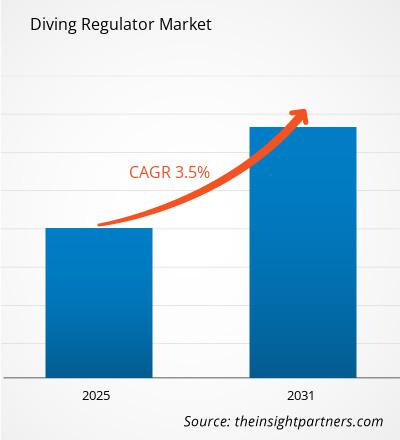
The Diving Regulator Market was valued at US$ 8.12 Billion in 2025 and is expected to reach US$ 12.15 Billion by 2034, registering a CAGR of 4.58% during 2026–2034. Demand reflects the regulator’s safety-critical role in reducing cylinder pressure to a breathable supply for recreational, commercial, scientific, public-safety, and defense diving. The market includes balanced, unbalanced, and octopus configurations sold to civilians, militants, and other professional users.
North America remains a high-value demand center, with an estimated ~4% CAGR through 2034. The Diving Regulator Market size in the region is supported by a mature certification ecosystem, established specialty retail and servicing networks, and recurring replacement demand from active divers, training operators, public-safety teams, and defense users. Premium materials, environmentally sealed first stages, cold-water performance, and integrated monitoring also sustain average selling values.
Diving Regulator Market Assessment and Insights
Regional Outlook
- North America: ~35% of the global Diving Regulator Market in 2025 | ~4% CAGR through 2034. Market position: The region ranks first, supported by established recreational participation, extensive dealer-service infrastructure, premium equipment purchasing, and recurring demand from public-safety and military diving programs.
- US: ~82% of North American market revenue in 2025 | ~4% CAGR through 2034. Market position: The US leads North America through broad training access, strong specialist brands, active coastal and inland diving communities, and procurement for rescue, scientific, commercial, and defense applications.
- Europe: ~30% of the global market in 2025 | ~4% CAGR through 2034. Market position: Europe combines a mature installed base with strong technical-diving expertise. The UK leads regional revenue, while Germany, France, Italy, and Spain support replacement, manufacturing, tourism, and training demand.
- Asia Pacific: ~24% of the global market in 2025 | ~6% CAGR through 2034. Market position: Asia Pacific is the fastest-growing region as coastal tourism, training capacity, local manufacturing, naval procurement, and expanding middle-class participation advance across China, Japan, South Korea, India, and Australia.
Segment Outlook
- Type: ~68% Share in 2025 | ~5% CAGR through 2034. Market position: Type leads because every open-circuit system requires pressure-control hardware, with balanced designs commanding premium demand and octopus units serving as essential alternate-air components.
- End-User: ~32% Share in 2025 | ~5% CAGR through 2034. Market position: End-user demand expands as civilian training and travel recover while militant, rescue, scientific, and infrastructure operators require rugged, serviceable, environmentally resistant systems.
Competitive Coverage
Atomic Aquatics, Apeks, Aqualung, Cressi S.p.A., Johnson Outdoors Inc., Oceanic, Poseidon Diving Systems AB, Sherwood Scuba, Tabata Co., Ltd., Tsun Kuang Hardware Mfg. Co., Ltd.
Methodology
The Insight Partners follows Data Collection & Secondary Research, Primary Research, Data Analysis, and Data Triangulation & Final Review to validate market estimates and insights.
Source: The Insight Partners' analysis based on proprietary research, government publications, company annual reports, investor presentations, industry databases, and expert interviews.
Regulator designs have advanced from basic downstream piston regulators to balanced piston and balanced diaphragm regulators that help keep the breathing effort constant as depth and tank pressure vary. Sealing in the environment, heat exchange functions, corrosion-resistant materials, reduced weight second stages, and better hose routing have expanded the operating ranges of the products. The manufacturing is still highly localized in companies with precision machining, mold making of elastomers, assembling, testing, and certification capabilities. Modular first-stage, second-stage, and alternate air source regulator designs enable the suppliers to address recreational, travel, technical, cold water, and professional needs.
The growth up to 2034 in the Diving Regulator Market will come from Asia Pacific tourist routes, the domestic ecosystem of equipment, and underwater capabilities for institutions, along with replacement in North America and Europe. Digital connections of the breathing apparatuses, diagnostics services, environmentally resistant designs, and local distribution will attract investments. Safety requirements increase development expenditures but create a base for the trusted brands and qualified servicing. Investments by the government in maritime security, search and rescue, marine research, offshore facilities, and diver training provide an offset to the seasonality of the leisure demand.
Diving Regulator Market Report Scope
| Report Attribute | Details |
|---|---|
| Market size in 2025 | US$ 8.12 Billion |
| Market Size by 2034 | US$ 12.15 Billion |
| Global CAGR (2026 - 2034) | 4.58% |
| Historical Data | 2021-2024 |
| Forecast period | 2026-2034 |
Diving Regulator Market Analysis
The growth for the Diving Regulator market is replacement based and not a one-off sale as life-sustaining equipment requires inspection, parts, and maintenance. The civilian demand is created by the certification bodies, diving centers, resort, specialty shops, and Internet commerce, while institutional demand is generated by contracts, qualifications, and standardization of fleets. Luxury consumers demand top-notch performance with regards to breathing, cold water capability, size, corrosion protection, and control.
The system includes alloy and plastic suppliers, component manufacturers, OEMs, testing labs, distributors, technicians, rental fleets, and end-users. Supply continuity depends on excellent seating, diaphragm, spring, hose, and machined body supply. Suppliers that secure a steady supply of parts and technical assistance can preserve their installed base revenue despite declining unit sales.
This competitive scenario in the Diving Regulator Market consists of wide product range and specialized engineering. Atomic Aquatics differentiates itself using high quality materials; Apeks and Aqualung target technical and mainstream markets; Cressi S.p.A. and Tabata Co., Ltd. use their global water-sports distribution network; Johnson Outdoors Inc. backs up SCUBAPRO; Oceanic and Sherwood Scuba cater to their dealer networks; Poseidon Diving Systems AB focuses on harsh conditions; and Tsun Kuang Hardware Mfg. Co., Ltd. adds production expertise.
According to Diving Regulator Market analysis, investments are moving towards networking devices, pneumatic innovations, sealing from environment, and digital configurators. Positioning depends not on specification but on compliance with regulations, servicing capabilities, channel education, and availability of components. Manufacturers could increase their margins combining regulators with computers, transmitters, buoyancy systems, maintenance services, and dealers' tools but should ensure reliability of electronics and preserve manual mode performance.
● REPORT CUSTOMIZATION
Tailor This Report To Align With Your Specific Business Requirements
This report can be customized to align precisely with your business objectives, scope, and target markets. Customization options include tailored segmentation, geography, competitive analysis, and strategic insights to support informed decision-making.
Customize This Report →WHAT YOU CAN ADJUST
- ● Segmentations
- ● Geography
- ● Competitive Analysis
- ● Language Preferences
Diving Regulator Market: Strategic Insights

Regional Insights
North America Diving Regulator Market
North America is projected to expand at ~4% CAGR through 2034. Its Diving Regulator Market share is indicative of its installed base of personal equipment, rental fleets, training facilities, technical diving communities, and public safety agencies. Specialty dealers are still relevant since configuration, testing, servicing, and installation play a role in buying decisions.
Growth drivers are high-end replacements, cold-water applications, light weight travel regulators, and integration with pressure transmitters and dive computers. The Canadian market provides cold-water applications, research, scientific and commercial diving, and resource industry needs, while Mexico and the Caribbean-connected channel provide destination diving opportunities. Experienced participation limits unit sales growth, but material cost and technology keeps revenue growing.
U.S. Diving Regulator Market
The US accounts for ~82% of North American Diving Regulator Market and is expected to post ~4% CAGR through 2034. The demand is wide-ranging, including coastal recreation, inland quarrying and lakes, technical caving and wreck diving, academic research, aquariums, fire rescue services, law enforcement, professional services, and military training.
There is a well-developed network of dealers and technicians for replacement and after-market parts. The following companies have significant brand or distribution presence: Atomic Aquatics, Johnson Outdoors Inc., Oceanic, and Sherwood Scuba; imported equipment widens pricing and performance alternatives. Application developments include environmentally-sealed first stage, travel regulators, alternative air delivery and consumption control systems.
Europe Diving Regulator Market
Europe represented ~30% of global Diving Regulator Market in 2025 and is forecast to grow at ~4% CAGR through 2034. The area offers mature recreational market ownership along with challenging cold-water, wreck, cave, commercial, scientific and military uses. Vendors’ access is defined by compliance to CE standards, competence of technicians and documentation of services, and the area allows for short-distance travel to Mediterranean and Red Sea destinations enabling portable premium systems.
The UK is the strongest nation within Europe due to its training tradition, technical/cold-water diving, as well as the engineering history of Apeks. High-end equipment and tough product requirements are provided by Germany. The Mediterranean tradition and the brand of Aqualung provide benefits for France. A large water sports community and Cressi S.p.A. as a specialist manufacturer combine in Italy, while Spain provides resort/island/coastal demand.
Replacements and services are more critical than new customers in northern nations, whereas the south of Europe has a tourist-related rental/instruction opportunity. Vendors’ differentiation across the region comes via the performance of breathing apparatus, freeze-resistance, low-profile hose routing, DIN capability, anti-corrosion features, and sustainable packaging. Combined portfolios may increase efficiency of distribution; however, specialist brands have more credibility among advanced customers.
APAC Diving Regulator Market
Asia Pacific held ~24% of global Diving Regulator Market in 2025 and is expected to achieve ~6% CAGR through 2034, making it the fastest-growing region. China stands out as the most dominant country in the Asia Pacific region in terms of modeled revenue, thanks to the size of manufacturing, growth in leisure activities, maritime organizations, and large pool of addressable consumers.
Japan has established mature specialized demand and Tabata Co., Ltd.; South Korea has technical consumption and marine leisure; India is building up training, tourism, military, and underwater localized equipment; and Australia has its advanced diving environment linked to reefs and research.
Middle East & Africa Diving Regulator Market
The Middle East & Africa Diving Regulator Market is projected to grow at ~5% CAGR through 2034. The UAE is the leading country in the Middle East & Africa, supported by tourism infrastructure, ports, commercial diving, and premium equipment channels. Saudi Arabia is building Red Sea tourism and maritime capacity, creating demand for training fleets and professional systems.
South Africa contributes cold-water, scientific, commercial, and recreational applications, while the Rest of MEA includes Red Sea resorts and offshore-energy markets. Procurement is project-led and channel availability varies. Durable, sand-resistant, corrosion-protected designs, dependable service kits, and technician training are critical where operating conditions and logistics make equipment downtime costly.
Segmentation Analysis
Type
Type is projected to register ~5% CAGR during 2026–2034. The Diving Regulator Market scope covers balanced, unbalanced, and octopus configurations used within open-circuit breathing assemblies. Purchasing reflects depth profile, water temperature, cylinder connection, breathing effort, redundancy, travel weight, maintenance access, and budget. Balanced architectures attract premium and technical users, while simpler designs remain relevant for training fleets and cost-sensitive buyers.
- Balanced: Balanced piston and diaphragm systems maintain more consistent intermediate pressure as cylinder pressure and ambient conditions change. They are strategically important in premium recreational, cold-water, deep, technical, scientific, and professional configurations.
- Unbalanced: Unbalanced designs emphasize simplicity, affordability, and straightforward servicing. Demand is strongest in entry-level packages, warm-water rental fleets, training centers, and users whose operating profiles do not require premium environmental or breathing-performance features.
- Octopus: Octopus second stages provide an alternate air source for emergency gas sharing. Their universal safety function supports replacement and attachment sales, with visibility, hose length, purge ergonomics, compactness, and integrated inflator alternatives shaping selection.
End-User
End-user revenue is expected to expand at ~5% CAGR during 2026–2034. Civilian purchases dominate unit demand through personal ownership, rental, instruction, tourism, scientific work, public safety, and commercial services. Militants require qualified, rugged equipment integrated with mission profiles and maintenance systems. Growth depends on training throughput, travel activity, public procurement, offshore work, and replacement of aging fleets.
- Civilians: Civilian demand spans beginners, experienced recreational divers, instructors, technical divers, researchers, rescue personnel, rental operators, and commercial contractors. Product choice ranges from economical training sets to premium balanced, sealed, travel, sidemount, and cold-water configurations.
- Militants: Military and security users prioritize reliability, low-temperature and contaminated-water suitability, standardized maintenance, low-profile routing, redundancy, and mission compatibility. Procurement cycles are longer, but qualification, training, spares, and lifecycle support create durable supplier relationships.
Opportunity Snapshot
| End Users | Revenue Contribution | Trend Tag | Adoption Stage |
| Civilians | High | Travel Systems | Mature |
| Militants | Medium | Mission Reliability | Scaling |
| Others | Low | Specialist Operations | Emerging |
Diving Regulator Market Growth Drivers and Impact Analysis
Expansion of Dive Training, Tourism, and Personal Ownership
Certification classes and destination diving establish a pathway for progression from rented use to personal equipment acquisition. Regulators are one of the most safety-conscious acquisitions, leading divers to focus more on comfort and breathing ease and less on the rental stock of equipment. Dive shops are constantly upgrading their high-use items for both safety reasons and customer satisfaction. This trend reaches its peak at resort corridors and metropolitan areas, as instructors, equipment retailers, and travel companies motivate participants. As new divers move forward, the need for entry level sets diminishes and the need for environmental, balanced, or travel sets increases.
Safety-Critical Replacement and Lifecycle Service Demand
As opposed to optional accessories, the regulator has control over the breathing gas supply. Seats, O-rings, diaphragms, hoses, and adjusting devices need examination and servicing, while salt, silt, storage environment, and intensive rental service impact service periods. This cycle ensures continuous requirements for overhaul kits, service time of technicians, replacement of second stages, and full upgrades in cases where spare part availability is questionable. Companies having reliable spare parts program and service training have competitive advantages owing to installed base. For fleet owners and institutional users, standardization of model range is important due to serviceability issues.
Growth in Professional, Public-Safety, and Defense Diving
The need for reliable breathing equipment is not limited to recreational periods for underwater inspections, marine construction work, aquaculture, research operations, emergency situations, port security, and defense-related activities. In many cases, such customers may find themselves operating in cold, silted, contaminated, deep, or difficult-to-access locations, thus increasing the need for sealed equipment, strong materials, reliable gas supply systems, and standardization of maintenance practices. Qualification and testing periods may increase procurement time, but positive results can ensure long-term supplier/customer cooperation. Increased spending on ports, offshore structures, maritime security, and environmental monitoring creates more regulator and commercial opportunities for training and spare parts.
Diving Regulator Market Future Trends
Connected Breathing Systems and Actionable Dive Data
Diving Regulator Market trends increasingly point toward integration of respiratory sensing, tank-pressure data, diver position, alerts, and post-dive analytics. Connected regulators can help users and instructors understand gas consumption and breathing behavior, while surface or buddy communication may improve situational awareness. Adoption will depend on battery reliability, underwater communications, intuitive interfaces, cybersecurity, and fail-safe mechanical operation. Premium systems are likely to emerge first, followed by modular features that work with existing computers and transmitters. Suppliers able to translate raw data into simple decisions, without increasing cognitive load, can create differentiated ecosystems and recurring software-enabled engagement.
Pneumatic Architectures, Lighter Materials, and Design Modularity
Future development will challenge conventional spring-and-lever arrangements through pneumatic valve concepts, refined airflow geometry, additive prototyping, and lower-mass corrosion-resistant materials. The commercial objective is smoother breathing with fewer adjustment points, easier maintenance, and consistent performance across depth and temperature. Modular ports, swivels, hose routing, color identification, and configurable packages will allow one platform to address travel, sidemount, twin-cylinder, stage, and training applications. Validation requirements will keep adoption measured, yet successful architectures could reset expectations for breathing effort, technician workload, and platform commonality through 2034.
Diving Regulator Market Opportunities
Build Service-Led Platforms in Fast-Expanding Dive Destinations
Manufacturers and distributors can capture value in Asia Pacific, the Red Sea, and selected African coastal markets by pairing equipment sales with technician certification, service benches, parts depots, rental-fleet programs, and instructor demonstrations. Diving Regulator Market Forecasts favor regions where participation and institutional capacity are expanding, but product availability alone will not secure adoption. Local service reduces downtime and reassures safety-conscious buyers. A staged model can begin with standardized training and rental packages, then add premium personal systems, cold-water variants, and institutional configurations. Partnerships with dive centers and maritime academies can create reference accounts and predictable replacement pipelines.
Develop Interoperable Premium Systems for Diverse Configurations
Suppliers can invest in a common regulator platform that supports yoke and DIN connections, multiple hose layouts, octopus options, integrated transmitters, and accessories for travel, technical, scientific, and public-safety use. Platform commonality lowers component complexity while allowing differentiated second stages, materials, and environmental protection. Commercial success requires backward compatibility, transparent servicing, and long-term parts support. Bundling configuration tools, digital manuals, maintenance records, and dealer advice can reduce purchase uncertainty and increase attachment revenue. This approach also gives specialists a route to premium positioning without competing solely on headline specifications.
Recent Developments
- October 2026: Poseidon Diving Systems launched its Regulator Configurator on Poseidon.com, plus an embedded version for dealer websites. It builds regulator setups by dive type (Standard, Streamlined, Long Hose, Doubles, Sidemount, Stage Tank) with the matching first stages, second stages, hoses and accessories. Buyers can pick a Poseidon Flagship Dealer to assemble, check and hand over the configured regulator.
- September 2026: Mares introduced the Planet 62X, a North America-exclusive regulator pairing the Planet second stage with the lightweight 62X first stage. The complete system is up to 29% lighter than the Planet 88X, and the 62X first stage weighs 464 g in DIN versus 786 g for the 88X. It is sold through authorized Mares dealers and sits alongside the 88X rather than replacing it.
Frequently Asked Questions

- Comprehensive Market Sizing and Forecast Analysis
- Detailed Segmentation Analysis
- In-Depth Market Dynamics Assessment
- Regional and Country-Level Insights
- Competitive Landscape and Company Benchmarking
- Strategic Business Intelligence
Recent Reports
Testimonials

The Insight Partners provided valuable market intelligence that supported our global go-to-market strategy. Their team was professional, responsive, and attentive to our feedback, providing thoughtful analysis and helpful methodological clarifications throughout the project.
Junmo Kim Chief Financial Officer (CFO), Enertech Co., Ltd.
The Insight Partners' SCADA System Market report is comprehensive, with valuable insights on current trends and future forecasts. The team was highly professional, responsive, and supportive throughout. We are very satisfied and highly recommend their services.
RAN KEDEM Partner, Reali Technologies LTDs
I requested a report on a very specific software market and the team produced the report in a few days. The information was very relevant and well presented. I then requested some changes and additions to the report. The team was again very responsive and I got the final report in less than a week.
JEAN-HERVE JENN Chairman, Future Analytica
We worked with The Insight Partners for an important market study and forecast. They gave us clear insights into opportunities and risks, which helped shape our plans. Their research was easy to use and based on solid data. It helped us make smart, confident decisions. We highly recommend them.
PIYUSH NAGPAL Sr. Vice President, High Beam Global
The Insight Partners delivered insightful, well-structured market research with strong domain expertise. Their team was professional and responsive throughout. The user-friendly website made accessing industry reports seamless. We highly recommend them for reliable, high-quality research services
YUKIHIKO ADACHI CEO, Deep Blue, LLC.
This is the first time I have purchased a market report from The Insight Partners.While I was unsure at first, I visited their web site and felt more comfortable to take the risk and purchase a market report.I am completely satisfied with the quality of the report and customer service. I had several questions and comments with the initial report, but after a couple of dialogs over email with their analyst I believe I have a report that I can use as input to our strategic planning process.Thank you so much for taking the extra time and making this a positive experience.I will definitely recommend your service to others and you will be my first call when we need further market data.
JOHN SUZUKI President and Chief Executive Officer, Board Director, BK Technologies
I wish to appreciate your support and the professionalism you displayed in the course of attending to my request for information regarding to infectious disease IVD market in Nigeria. I appreciate your patience, your guidance, and the fact that you were willing to offer a discount, which eventually made it possible for us to close a deal. I look forward to engaging The Insight Partners in the future, all thanks to the impression you have created in me as a result of this first encounter.
DR CHIJIOKE ONYIA MANAGING DIRECTOR, PineCrest Healthcare Ltd.Reason to Buy
- Informed Decision-Making
- Understanding Market Dynamics
- Competitive Analysis
- Identifying Emerging Markets
- Customer Insights
- Market Forecasts
- Risk Mitigation
- Boosting Operational Efficiency
- Strategic Planning
- Investment Justification
- Tracking Industry Innovations
- Aligning with Regulatory Trends





 Get Free Sample for