
Drag Reducing Agents Market Size, Share & Growth by 2034
Coverage: by Type (Polymers, Suspensions, Surfactants, Biomaterials); Product Type (Viscosity Glue, Low Viscosity Glue, Rubber Latex); End-user Industry (Oil and Gas, Chemicals, Others) , and Geography (North America, Europe, Asia Pacific, and South and Central America)
- Status : Data Released
- Report Code : TIPRE00011405
- Category : Chemicals and Materials
- No. of Pages : 150
- Available Report Formats :


- Last update date : August 04, 2026


2025 Market Size
US$ 764.49 Mn
Base year value
2034 Forecast
US$ 1,209.65 Mn
Projected by 2034
CAGR 2026-2034
5.23 %
Growth rate
Addressable Market
US$ 8,955.04 Mn
(2026-2034)
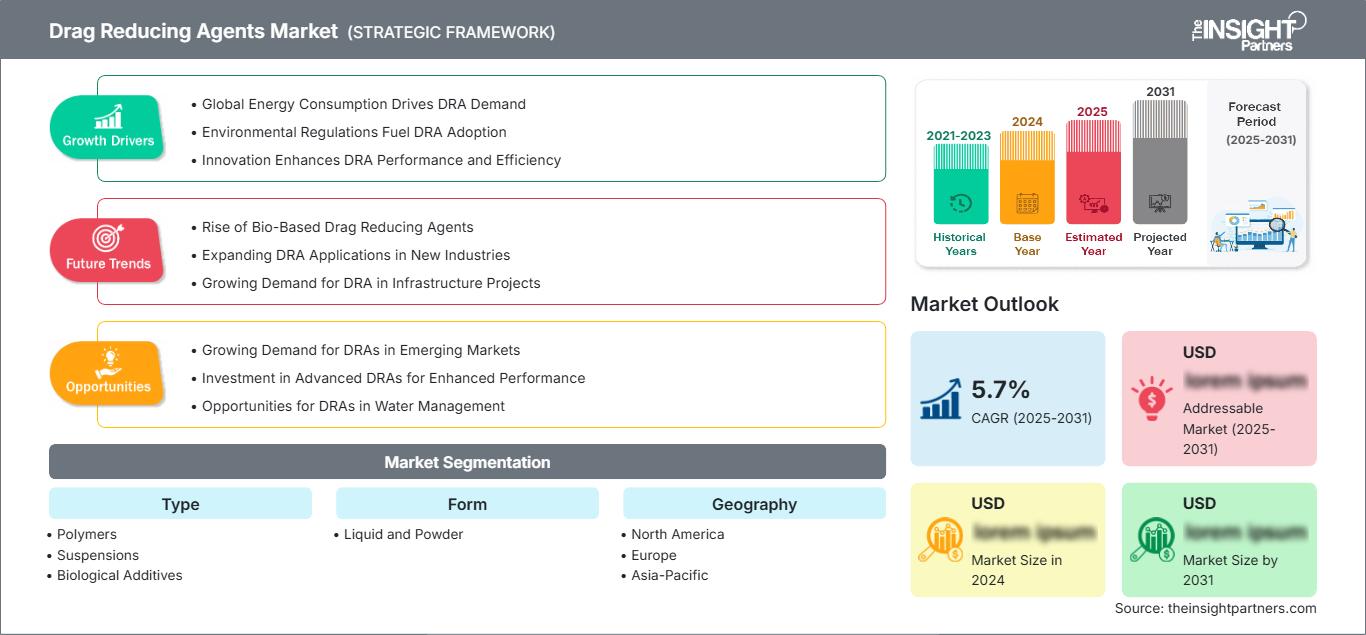
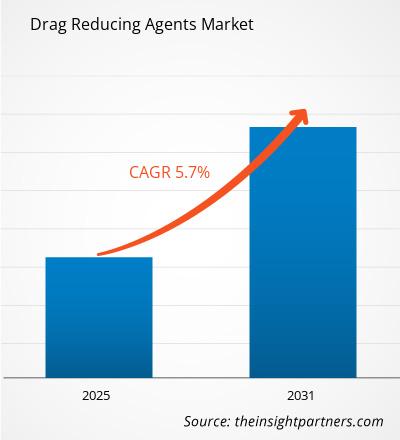
The Drag Reducing Agents Market was valued at US$ 764.49 Million in 2025 and is projected to reach US$ 1,209.65 Million by 2034, registering a CAGR of 5.23% during 2026–2034. Demand is supported by pipeline operators seeking higher throughput, lower pressure losses, and better energy efficiency across crude oil, refined products, and multiphase transportation systems.
North America remains a core demand center as shale-linked pipeline utilization, Gulf Coast offshore flows, and refinery connectivity sustain additive consumption. The Drag Reducing Agents Market size outlook is supported by an estimated regional CAGR of 4.8–5.8%, driven by midstream debottlenecking, aging pipeline networks, and operator preference for chemical optimization over new infrastructure.
Drag Reducing Agents Market Assessment and Insights
- North America: Share in 2025 of 34–38% and CAGR between 4.8–5.8%. Established crude and products pipelines, Gulf Coast exports, and capacity optimization programs support steady usage.
- US: Share in 2025 of 78–82% of North America and CAGR between 4.9–5.9%. Large shale basins, offshore pipelines, and refinery corridors sustain high additive consumption.
- Europe: Share in 2025 of 18–22% and CAGR between 3.9–4.9%. Germany, the UK, France, Italy, and Spain lead demand through refined-products logistics and energy-security upgrades.
- Asia Pacific: Share in 2025 of 24–28% and CAGR between 5.8–6.8%. China, India, Japan, South Korea, and Australia drive adoption through refinery expansion and pipeline modernization.
- Largest Segment: Polymers with market share of 72–76% in 2025 and CAGR of 5.0–6.0% during 2026–2034, reflecting proven performance in turbulent hydrocarbon flow.
- High Growth Segment: Suspensions with market share of 16–20% in 2025 and CAGR of 5.8–6.8% during 2026–2034, supported by handling efficiency and faster field deployment.
- Key companies analyzed in detail: Baker Hughes Company, Dorf Ketal Chemicals (India) Private Limited, Flowchem, Indian Oil Corporation Limited, Innospec Inc., Jiangyin Huaheng Auxiliary Co., Ltd., LiquidPower Specialty Products Inc., Oil Flux Americas LLC, Qingdao Zoranoc Oilfield Chemical Co., Ltd., The Lubrizol Corporation.
Source: The Insight Partners' analysis based on proprietary research, government publications, company annual reports, investor presentations, industry databases, and expert interviews.
Technology evolution in the Drag Reducing Agents Market has centered on high-molecular-weight polymers, improved carrier systems, and formulations designed for faster dissolution under variable crude quality, temperature, and turbulence conditions. Production dynamics are also shifting as suppliers expand regional manufacturing, skid-based injection support, and logistics models that reduce downtime for pipeline operators. These changes are improving product reliability while enabling more precise dosage control across long-distance and offshore pipeline assets.
Forward-looking demand is expected to strengthen in emerging pipeline corridors where refinery additions, product import terminals, and cross-country crude movements require higher flow efficiency. Investment tailwinds are strongest where operators can defer capital-intensive loop lines or pump-station expansions through chemical debottlenecking. Regulatory pressure to reduce energy consumption and emissions intensity also supports wider use of additives that lower pumping requirements while preserving pipeline safety and operating flexibility.
Drag Reducing Agents Market Report Scope
| Report Attribute | Details |
|---|---|
| Market size in 2025 | US$ 764.49 Million |
| Market Size by 2034 | US$ 1,209.65 Million |
| Global CAGR (2026 - 2034) | 5.23% |
| Historical Data | 2021-2024 |
| Forecast period | 2026-2034 |
Drag Reducing Agents Market Analysis
Pipeline operators are using chemical flow assurance to preserve throughput as crude grades diversify and refined-product logistics become more complex. The Drag Reducing Agents Market growth profile is tied to the ability of additives to reduce frictional pressure drop, increase flow at existing pump power, and improve asset utilization. Demand is strongest where operators face capacity constraints but cannot justify new lines.
The value chain includes polymer synthesis, carrier formulation, blending, logistics, field injection equipment, and performance monitoring. Suppliers compete on dissolution speed, dosage efficiency, product stability, and compatibility with crude oil, condensate, diesel, gasoline, and multiphase streams. Supply resilience has become important because pipeline outages or delayed chemical deliveries can quickly affect shipper commitments and refinery scheduling.
Current Drag Reducing Agents Market analysis shows a competitive landscape led by integrated oilfield chemical companies and specialist DRA manufacturers. Baker Hughes Company, LiquidPower Specialty Products Inc., Innospec Inc., and Flowchem emphasize field service, automated injection, and formulation depth, while Dorf Ketal Chemicals (India) Private Limited and Indian Oil Corporation Limited strengthen regional supply and licensing models.
Strategic positioning increasingly depends on application-specific performance rather than commodity pricing. The Lubrizol Corporation, Oil Flux Americas LLC, Jiangyin Huaheng Auxiliary Co., Ltd., and Qingdao Zoranoc Oilfield Chemical Co., Ltd. compete through customized chemistry, regional responsiveness, and export availability. Investment is expected to favor manufacturing capacity, digital dosing systems, and technical service networks close to high-volume pipeline corridors. Buyers are also placing greater weight on vendor qualification, regional stock availability, and documented field trials because DRA performance depends on fluid chemistry, shear conditions, and operating discipline. This preference is encouraging suppliers to maintain application laboratories, mobile technical teams, and closer coordination with pipeline control rooms. As procurement cycles become more evidence-driven, companies that can demonstrate repeatable pressure reduction, stable logistics, and rapid troubleshooting are likely to strengthen long-term supply agreements with midstream operators.
● REPORT CUSTOMIZATION
Tailor This Report To Align With Your Specific Business Requirements
This report can be customized to align precisely with your business objectives, scope, and target markets. Customization options include tailored segmentation, geography, competitive analysis, and strategic insights to support informed decision-making.
Customize This Report →WHAT YOU CAN ADJUST
- ● Segmentations
- ● Geography
- ● Competitive Analysis
- ● Language Preferences
Drag Reducing Agents Market: Strategic Insights
Regional Insights
North America Drag Reducing Agents Market
North America held 34–38% of global revenue in 2025 and is projected to expand at a 4.8–5.8% CAGR through 2034. The regional Drag Reducing Agents Market share reflects dense crude oil, natural gas liquids, and refined-product pipeline infrastructure, especially across Texas, Louisiana, Oklahoma, Alberta, and major refinery-connected corridors.
Growth is supported by operators seeking incremental capacity without lengthy permitting cycles for new infrastructure. Gulf Coast offshore flows and export terminal connectivity create recurring need for chemical debottlenecking. Baker Hughes Company’s 2025 agreement to supply DRAs for Genesis Energy’s Cameron Highway and Poseidon systems illustrates how additives can raise capacity in critical offshore pipelines.
U.S. Drag Reducing Agents Market Market
The U.S. accounted for 78–82% of North American revenue in 2025 and is expected to grow at a 4.9–5.9% CAGR. Demand is concentrated in shale-linked crude systems, refined-product pipelines, and offshore networks moving hydrocarbons toward Gulf Coast storage and refining facilities. Pipeline operators use DRAs to reduce pressure losses while preserving product quality.
Company presence is strong because the country combines large pipeline mileage, high-volume crude movements, and advanced service infrastructure. Baker Hughes Company, LiquidPower Specialty Products Inc., Flowchem, Innospec Inc., and Oil Flux Americas LLC serve operators requiring field support, injection equipment, and rapid replenishment. Applications increasingly include light crude, heavy crude, refined fuels, and offshore production evacuation.
Europe Drag Reducing Agents Market Market
Europe represented 18–22% of global revenue in 2025 and is forecast to register a 3.9–4.9% CAGR. Germany is the leading country due to refinery integration, petrochemical logistics, and central pipeline connectivity. Energy-security priorities after recent supply disruptions have increased attention on throughput flexibility across crude and refined-product transport networks.
The UK benefits from North Sea-linked infrastructure and terminal movements, while France supports demand through refined-product distribution and refinery supply chains. Italy and Spain contribute through import terminals, Mediterranean logistics, and fuel movement corridors. Operators are prioritizing lower energy intensity and fewer pressure-related bottlenecks, encouraging adoption where pump upgrades or new pipeline investments are less attractive.
APAC Drag Reducing Agents Market Market
Asia Pacific represented 24%–28% of total revenue in 2025 and is estimated to grow at a 5.8%–6.8% CAGR. China has the highest consumption in the region due to the need for improvements in refinery capacity, crude oil imports, and pipeline transportation infrastructure.
Japan and South Korea have sophisticated logistics infrastructure to facilitate refinery operations and terminal operations, respectively. On the other hand, Australia uses additives in selective long-distance hydrocarbon transportation applications. Support for energy security and refinery optimization will continue to drive the use of DRA in the Asia-Pacific region.
Middle East & Africa Drag Reducing Agents Market Market
The Middle East & Africa market is expected to grow at a CAGR of 4.6%-5.6% through 2034. Saudi Arabia retains its position as the dominant nation because large export-oriented crude pipelines and downstream assets require reliable flow assurance. The UAE helps drive demand through its storage, terminal, and refinery-linked assets.
South Africa will help by providing flow assurance for refined products and by importing logistics, whereas other nations in MEA will benefit from select crude export pipelines. Adoption in the region is driven by the need to increase pipeline capacities, manage high ambient temperatures, and reduce pumping power for long-haul systems.
Segmentation Analysis
Type
The segment is expected to grow at a CAGR between 5.0–5.8%. Polymers dominate due to superior performance in reducing turbulence, while biomaterials are gaining traction. The Drag Reducing Agents Market scope within this segment is expanding due to environmental regulations and technological advancements improving formulation efficiency.
- Polymers – Widely used due to high efficiency in reducing drag, offering significant throughput improvement and cost savings in long-distance pipelines
- Suspensions – Provide stability in specific applications, particularly in multiphase flows, supporting niche industrial requirements
- Surfactants – Used for specialized applications requiring lower concentration and improved dispersion properties
- Biomaterials – Emerging category driven by sustainability trends and regulatory push for eco-friendly solutions
Product Type
The segment is projected to grow at a CAGR between 5.1–5.9%. Product differentiation is based on viscosity and application requirements, with increasing focus on performance optimization and compatibility with varying fluid compositions.
- Viscosity Glue – Preferred for heavy crude applications where high viscosity reduction is required for efficient transport
- Low Viscosity Glue – Suitable for refined products and lighter hydrocarbons, offering improved flow characteristics
- Rubber Latex – Used in specialized applications requiring elasticity and durability in varying environmental conditions
End-user Industry
This segment is growing at a CAGR between 5.0–5.6%, led by oil and gas applications. Increasing industrialization is supporting demand across chemical processing industries.
- Oil and Gas – Dominates due to extensive pipeline networks and high demand for efficiency optimization in crude and refined product transport
- Chemicals – Growing adoption in chemical transport pipelines, supporting process efficiency and cost reduction
Opportunity Snapshot
| End-user Industry | Revenue Contribution | Trend Tag | Adoption Stage |
|---|---|---|---|
| Oil and Gas | High | Pipeline Efficiency | Mature |
| Chemicals | Medium | Process Optimization | Scaling |
Drag Reducing Agents Market Growth Drivers and Impact Analysis
Pipeline Debottlenecking Without Major Capital Expansion
Pipeline owners are under pressure to move higher volumes while avoiding long permitting processes, while facing construction risks and investing large amounts of money. In this regard, DRAs offer an ideal solution by decreasing friction losses and enhancing throughput using existing infrastructure. The benefits of DRAs will be more pronounced in congested crude pipelines, offshore gathering systems, and refined product pipelines, since any increase in capacity translates into greater revenue. Apart from that, there are additional advantages, including reduced pressure drop, more effective pump utilization, and improved scheduling capabilities. The effects can be seen in reduced congestion, improved shipper services, and the postponement of the addition of loop pipelines and pump stations.
Energy Efficiency and Lower Pumping Intensity
The energy required to run long-distance pipelines is one of the biggest operational expenses, especially when fluid viscosity, elevation differences, or demand for higher capacity increase pump loads. DRAs help save energy during the transportation of hydrocarbons by reducing turbulence losses. These factors make DRAs beneficial for achieving operators' objectives regarding expense management, emissions management, and asset efficiency improvement. The effect goes beyond just saving electricity or energy used to run pumps, since the reduction in pressure increases reliability and reduces stress on pipeline equipment. The unstable nature of energy costs implies that DRAs will be analyzed not only from the angle of increased capacity efficiency.
Rising Complexity of Crude and Refined Product Logistics
Global trade flows are becoming more complex as refiners process different crude slates and product flows follow changing demand centers. More flexible flow assurance solutions are needed as pipelines increasingly transport varying viscosities, temperatures, and blend characteristics. DRAs help operators maintain transport efficiency as crude quality changes or refined-product scheduling becomes more dynamic. This is especially true in export corridors, import terminals, and refinery-connected systems, where pipeline flexibility directly impacts downstream operations. Market impact is increased demand for custom formulations, field testing, and technical service support.
Drag Reducing Agents Market Future Trends
Digital Dosing and Performance Optimization
Future Drag Reducing Agents Market trends will include the use of digital-based dosing systems that can correlate pipeline operating data with chemical injection rates. Operators are supposed to shift from predefined dosage algorithms to those that account for flow rate, pressure, temperature, crude oil characteristics, and pumping capacity. The tendency is likely to facilitate optimizing chemical use, avoiding overdosing, and making credible claims about the product's performance. Automation enables remote monitoring of offshore and remote pipelines where manual adjustments are difficult. Manufacturers who incorporate chemistry with analytics, skid systems, and field services would have an advantage.
Lower-Toxicity and Sustainability-Aligned Formulations
Environmental screening is likely to become a bigger issue in additive selection as companies respond to higher standards for chemical management and internal sustainability goals. They are supposed to look for better-performing formulations with less hazardous solvents and more detailed stewardship documentation. Biological additives and more efficient surfactant systems can attract greater interest in use cases where traditional polymers come under environmental or regulatory scrutiny. However, this does not mean that performance requirements, but it adds another procurement dimension. Companies able to balance drag-reduction efficiency, stability, and a lower environmental burden can capture opportunities with operators seeking both operational and sustainability improvements.
Drag Reducing Agents Market Opportunities
Offshore Pipeline Capacity Enhancement
Production systems operating offshore offer great opportunities, as pipeline capacity constraints can limit field production and make it difficult to transport crude of varying qualities. DRAs can enhance evacuation from the offshore platform to the storage and refining centers without necessitating an expansion of subsea capacity in the short term. Investments made in accordance with Drag Reducing Agents Market Forecasts should include products that dissolve quickly, perform across a range of temperatures, and are compatible with automation in field production systems. The vendors will also be able to add value by offering services related to product supply, injection, and monitoring. Offshore operators are likely to prioritize partners with proven reliability, safety procedures, and logistics capability for remote or weather-sensitive operations.
Refined Products and Multiproduct Pipeline Expansion
Multiproduct pipeline solutions are becoming increasingly popular as changes in fuel demand dynamics mean that pipelines must now efficiently transport gasoline, diesel, aviation fuel, and other refined products. Pipeline companies require additives that increase capacity without affecting product quality and characteristics. This necessitates multiproduct-certified additives. Manufacturers of additives can grow by providing technical assistance with scheduling, dose calculation, and efficiency verification. The most rapid growth is expected in areas where refinery pipeline delivery systems are being improved, or additional connections to import terminals are being implemented. Companies that demonstrate low contamination risk and consistent drag reduction across product families can secure long-term customer relationships.
Recent Developments
- July 2025: Baker Hughes has secured a significant multi-year agreement with Genesis Energy to supply drag-reducing agents for two key offshore oil pipelines in the U.S. Gulf Coast. This partnership includes the provision of chemicals, management services, and the deployment of the Leucipa automated field production solution. The DRAs from Baker Hughes' FLO product line will enhance the capacity of the Cameron Highway Oil Pipeline and Poseidon systems, facilitating greater oil production and flexible crude transport to facilities in Texas and Louisiana.
- March 2025: Innospec Inc. announced the expansion of production capacity for its proprietary Drag Reducing Agent technologies at its Pleasanton, TX plant. These agents offer pipeline operators benefits such as increased throughput, reduced operating costs, and lower capital equipment upgrade requirements.
Frequently Asked Questions

- Comprehensive Market Sizing and Forecast Analysis
- Detailed Segmentation Analysis
- In-Depth Market Dynamics Assessment
- Regional and Country-Level Insights
- Competitive Landscape and Company Benchmarking
- Strategic Business Intelligence
Recent Reports
Testimonials

The Insight Partners' SCADA System Market report is comprehensive, with valuable insights on current trends and future forecasts. The team was highly professional, responsive, and supportive throughout. We are very satisfied and highly recommend their services.
RAN KEDEM Partner, Reali Technologies LTDs
I requested a report on a very specific software market and the team produced the report in a few days. The information was very relevant and well presented. I then requested some changes and additions to the report. The team was again very responsive and I got the final report in less than a week.
JEAN-HERVE JENN Chairman, Future Analytica
We worked with The Insight Partners for an important market study and forecast. They gave us clear insights into opportunities and risks, which helped shape our plans. Their research was easy to use and based on solid data. It helped us make smart, confident decisions. We highly recommend them.
PIYUSH NAGPAL Sr. Vice President, High Beam Global
The Insight Partners delivered insightful, well-structured market research with strong domain expertise. Their team was professional and responsive throughout. The user-friendly website made accessing industry reports seamless. We highly recommend them for reliable, high-quality research services
YUKIHIKO ADACHI CEO, Deep Blue, LLC.
This is the first time I have purchased a market report from The Insight Partners.While I was unsure at first, I visited their web site and felt more comfortable to take the risk and purchase a market report.I am completely satisfied with the quality of the report and customer service. I had several questions and comments with the initial report, but after a couple of dialogs over email with their analyst I believe I have a report that I can use as input to our strategic planning process.Thank you so much for taking the extra time and making this a positive experience.I will definitely recommend your service to others and you will be my first call when we need further market data.
JOHN SUZUKI President and Chief Executive Officer, Board Director, BK Technologies
I wish to appreciate your support and the professionalism you displayed in the course of attending to my request for information regarding to infectious disease IVD market in Nigeria. I appreciate your patience, your guidance, and the fact that you were willing to offer a discount, which eventually made it possible for us to close a deal. I look forward to engaging The Insight Partners in the future, all thanks to the impression you have created in me as a result of this first encounter.
DR CHIJIOKE ONYIA MANAGING DIRECTOR, PineCrest Healthcare Ltd.Reason to Buy
- Informed Decision-Making
- Understanding Market Dynamics
- Competitive Analysis
- Identifying Emerging Markets
- Customer Insights
- Market Forecasts
- Risk Mitigation
- Boosting Operational Efficiency
- Strategic Planning
- Investment Justification
- Tracking Industry Innovations
- Aligning with Regulatory Trends





 Get Free Sample for