
Dry Bulk Container Liners Market Share, Growth & Demand by 2034
Coverage: By Liner Type (Polyethylene (PE), Polypropylene (PP), High Density Polyethylene (HDPE), Others); End-User (Food and Beverage, Healthcare, Personal Care and Household Care, Industrial, Others) , and Geography (North America, Europe, Asia Pacific, and South and Central America)
- Status : Data Released
- Report Code : TIPRE00025581
- Category : Chemicals and Materials
- No. of Pages : 150
- Available Report Formats :


- Last update date : October 26, 2026


2025 Market Size
US$ 2.59 Bn
Base year value
2034 Forecast
US$ 4.30 Bn
Projected by 2034
CAGR 2026-2034
5.79 %
Growth rate
Addressable Market
US$ 31.21 Bn
(2026-2034)
The Dry Bulk Container Liners market size was valued at US$ 2.59 Billion in 2025 and is projected to reach US$ 4.30 Billion by 2034, expanding at a CAGR of 5.79% from 2026 to 2034. The market covers flexible liners installed inside freight containers to enable hygienic, efficient transportation of dry bulk materials, primarily differentiated by liner type and end-user requirements across food and beverage, healthcare, personal care, household care, and industrial applications.
North America is estimated to account for 28.00% of the global market in 2025, with a 5.10% CAGR from 2026 to 2034. Demand is supported by established containerized supply chains, food-grade bulk transport, and adoption of liners for grains, powders, polymers, and chemicals. The region also benefits from strong domestic manufacturing and distribution capabilities, while recent maritime freight volatility has increased attention to cargo protection, loading efficiency, and flexible container utilization.
Dry Bulk Container Liners Market Assessment and Insights
- North America: The region is estimated to hold a 28.00% global Dry Bulk Container Liners market share in 2025 and grow at a 5.10% CAGR, supported by mature intermodal logistics, food-grade bulk handling, and established liner manufacturing and distribution infrastructure.
- U.S.: The U.S. is estimated to represent 72.00% of North America's market in 2025, growing at a 5.20% CAGR, driven by food ingredients, chemicals, polymers, and containerized export logistics.
- Europe: Europe is estimated at 27.00% of the global market in 2025, with a 4.80% CAGR, led by Germany, the UK, France, Italy, and Spain, where stringent packaging, hygiene, and circularity requirements differentiate procurement.
- Asia Pacific: APAC is estimated at 30.00% of the global market in 2025, growing at a 7.00% CAGR, led by China and supported by manufacturing exports, food processing, chemicals, polymers, and expanding regional logistics infrastructure.
- Largest Segment: The Liner Type segment is estimated to be the largest segmentation dimension, with a 5.86% CAGR, reflecting broad material selection across food, chemical, agricultural, and industrial bulk cargo applications.
- High Growth Segment: The End-User segment is estimated to grow at a 6.12% CAGR, supported by increasing requirements for hygienic, contamination-controlled bulk transport and the adoption of liners across specialized industrial and healthcare supply chains.
- Key companies analyzed in detail: Bulk Corp International; Bulk Packaging Liners Private Limited; Eurolog Packing Group; Palmetto Industries International, Inc.; Southern Packaging, LP; Philton Polythene Converters Limited; BeFlexi; Bag Supplies (FIBC) Limited; TOPSACK PACKAGING PVT LTD; Thrace Group.
Source: The Insight Partners' analysis based on proprietary research, government publications, company annual reports, investor presentations, industry databases, and expert interviews.
Markets have moved away from basic polyethylene film protection towards liner systems tailored to the cargo flows and handling equipment, the loading and unloading of cargo, contamination risks and discharge requirements. Liners currently use combinations of PE films, woven PP, woven HDPE, antistatics, fluidizing properties and barrier coatings. In 2024 and 2025, cargo volatility and disruption of transport routes meant that liner systems became more important to ensure container capacity and cargo protection through longer cycles. Purchasers evaluate liners not just as packaging materials but also as systems components for loading, discharge, contamination control and container turn-around.
Over the 2024-2034 period, commercial deployment should expand further into new manufacturing and food export economies such as those in APAC, South America, and select Middle Eastern markets. Investments would be made in integrated extrusion, weaving, conversion, clean manufacturing and quality controls. Packaging circularity requirements will become more relevant in material choice, while food contact requirements will continue to be relevant for food exporters. Supply chain localization would drive regional liner production in proximity to ports, food processing centers, chemicals and polymer manufacturing centers.
Dry Bulk Container Liners Market Report Scope
| Report Attribute | Details |
|---|---|
| Market size in 2025 | US$ 2.59 Billion |
| Market Size by 2034 | US$ 4.30 Billion |
| Global CAGR (2026 - 2034) | 5.79% |
| Historical Data | 2021-2024 |
| Forecast period | 2026-2034 |
Dry Bulk Container Liners Market Analysis
The demand for such liners arises mainly because bulk shippers aim to use conventional shipping containers for bulk loading without the use of bags, barrels, and even dedicated bulk cargo vessels. The connection is quite obvious - the more powders, granules, grains, polymers, and minerals shipped, the more need for bulk loading; the more bulk loading there is, the more need to protect goods from contamination and moisture; the more contamination and moisture protection, the higher the demand for liners. The ecosystem includes polymer producers, film and fabric manufacturers, liners converters, FIBC specialists, logistics providers, container operators, loading equipment providers, and bulk cargo owners.
The Dry Bulk Container Liners market report shows that the supply is growing more diverse according to materials and handling requirements. For example, PE film liners allow flexible moisture protection and are used in food and flowable cargos, whereas woven PP and HDPE structures allow more mechanical strength when it comes to harsh industrial cargos. There is also an increased focus on such liner properties as antistatic, fluidization zones, special spouts, zippers, bulkheads, barriers. Thus, the competition becomes less about price but more about conversion capacity, material consistency, customizing options, food contact approval, and compatibility with customers’ filling/discharge equipment.
According to the Dry Bulk Container Liners market forecast, competition is still fragmented among the integrated global packaging companies versus the liner manufacturers. The Thrace Group offers container liner production alongside a wider range of technical packaging solutions, whereas the Palmetto Industries International, Inc. specializes in bulk container liner systems ranging from food grade liners, thermal liners, barless liners, and fluidized liners. On the other hand, Southern Packaging, LP competes through an extensive industrial bulk packaging solution with container liner options. Bulk Corp International and TOPSACK PACKAGING PVT LTD enhance the competitiveness of India as a manufacturing hub for FIBC and container liners.
The Dry Bulk Container Liners market trends show that capital investments have shifted more towards integration, quality control, and geographical supply stability rather than capacity expansion alone. Manufacturers that possess capability to control the conversion process of polymers, film extrusion, woven fabric production, and liner production are able to better specify the material specifications and lead times involved. The integrated manufacturing approach of Rishi FIBC is a representation of the direction that the industry is heading into while packaging groups like Signode expand their dry bulk liner options in food grade and industrial sectors.
● REPORT CUSTOMIZATION
Tailor This Report To Align With Your Specific Business Requirements
This report can be customized to align precisely with your business objectives, scope, and target markets. Customization options include tailored segmentation, geography, competitive analysis, and strategic insights to support informed decision-making.
Customize This Report →WHAT YOU CAN ADJUST
- ● Segmentations
- ● Geography
- ● Competitive Analysis
- ● Language Preferences
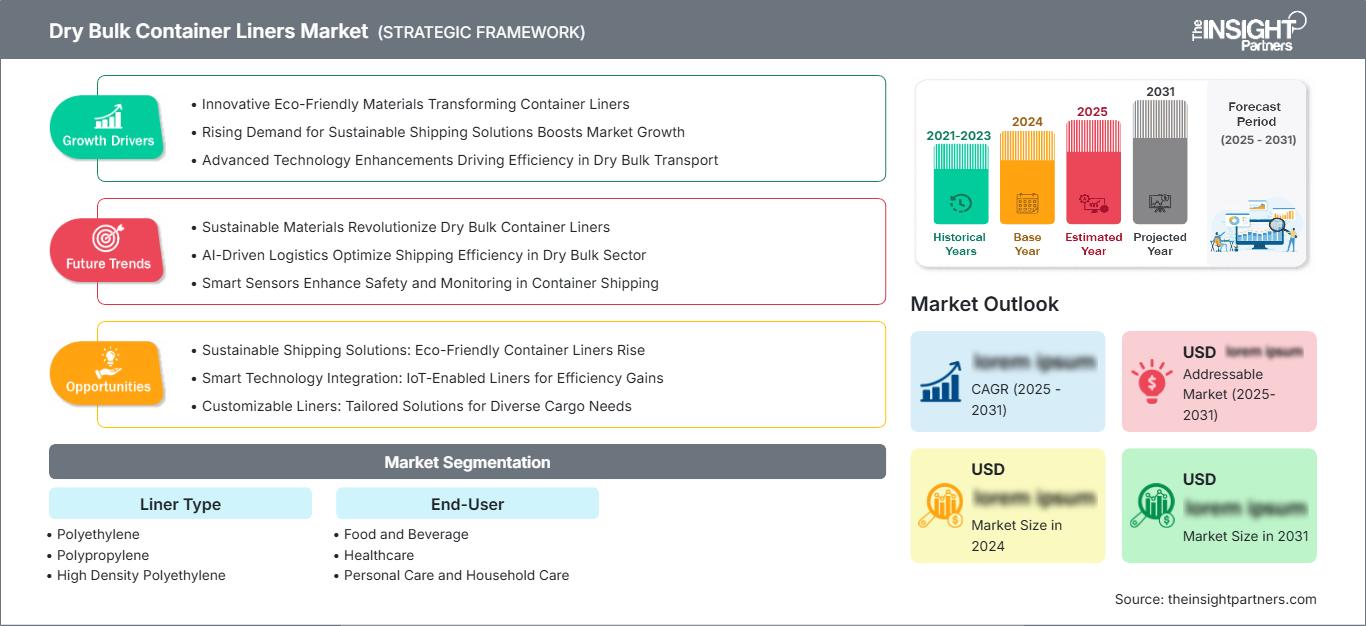
Dry Bulk Container Liners Market: Strategic Insights
Regional Insights
North America Dry Bulk Container Liners
North America is estimated to account for 28.00% of the global market in 2025 and is projected to grow at a 5.10% CAGR from 2026 to 2034. The U.S. dominates regional demand because of its large food-processing, agricultural, chemical, polymer, and industrial manufacturing base. Container liners are particularly useful where exporters need to move powders, granules, grains, resins, and other free-flowing materials through standard intermodal containers.
The supply chain network within the area includes both local bulk packagers and foreign producers. Palmetto Industries International Inc. is a company that is already well-established and runs business in the United States, while Southern Packaging, LP is engaged in supplying bulk containers, as well as FIBC and other industrial packaging services. The variability of freight in 2024 and 2025 makes it necessary to optimize freight performance and avoid contamination of goods. Canada’s influence on the region is related to agriculture and industry exports, while Mexico is involved in manufacturing and trading.
U.S. Dry Bulk Container Liners Market
The U.S. is estimated to represent 72.00% of North America's Dry Bulk Container Liners market in 2025 and is projected to grow at a 5.20% CAGR. Demand is concentrated in food ingredients, agricultural commodities, polymers, chemicals, minerals, and industrial powders. The country's extensive container, rail, road, and port infrastructure supports the use of liners for multimodal transportation.
Palmetto Industries International, Inc. and Southern Packaging, LP are key players in the domestic competitive environment with products used for food-grade and industrial purposes. U.S. buyers tend to assess liners based on such criteria as loading method, moisture resistance, static control, food contact, and discharge efficiency. FDA compliant food contact materials and quality management system are especially applicable in the case of food and pharmaceutical applications. The unique advantage of the country lies in its large downstream market, advanced logistics network, and manufacturing of bulk packaging.
Europe Dry Bulk Container Liners Market
Europe is estimated to hold 27.00% of the global market in 2025 and is projected to grow at a 4.80% CAGR from 2026 to 2034. The dominant player in the region is Germany, backed up by chemicals, food production, manufacturing, and export-oriented logistics. In the UK, there is demand provided by food, agriculture, chemicals, and international container traffic. France and Italy gain from food ingredients, agriculture goods, specialty chemicals, and industrial processing, whereas Spain brings demand due to food exports, agriculture, chemicals, and logistics based on ports.
Procurement practices in Europe are more and more governed by packaging circularity, food safety, traceability, and material efficiency demands. The EU adopted the Packaging and Packaging Waste Regulation in 2025, which confirms the direction towards packaging solutions that contribute to the decrease in waste and further development of circular economy goals. Such requirements are beneficial for the manufacturers who can control the material quality. The significance of Thrace Group comes from its European production base and specific portfolio of dry bulk container liners.
APAC Dry Bulk Container Liners Market
APAC is estimated to account for 30.00% of the global market in 2025 and is projected to grow at a 7.00% CAGR, making it the fastest-growing major region. China leads regional demand through its manufacturing, chemical, polymer, food-processing, and export industries. India follows with strong agricultural processing, pharmaceutical, chemical, cement, and FIBC manufacturing activity.
Japan and South Korea Dry Bulk Container Liners market contribute through high-value food, chemical, polymer, and industrial supply chains that require controlled bulk handling. Australia generates demand from agriculture, mining, minerals, and export logistics, with long-distance transportation increasing the value of moisture and contamination protection. China's implementation of updated food-contact plastic standards strengthens material-control requirements, while India's evolving food-packaging framework is increasing attention to food-contact compliance. The region's key advantage is the combination of manufacturing concentration, polymer availability, export activity, and rapidly developing logistics infrastructure.
Middle East & Africa Dry Bulk Container Liners Market
The Middle East & Africa is estimated to represent approximately 7.00% of the global market in 2025, with a 5.90% CAGR through 2034. Saudi Arabia and the UAE are important regional logistics and industrial hubs, supported by petrochemicals, food imports, re-export activity, and port infrastructure. South Africa contributes through mining, agriculture, chemicals, and food processing.
Demand in the Dry Bulk Container Liners market is particularly relevant where imported or exported bulk products travel through long logistics chains and require protection from contamination and moisture. Gulf investment in logistics and industrial localization can support liner adoption around ports and manufacturing zones. South Africa's agricultural and mineral supply chains provide a different demand profile from the Gulf markets. The remainder of the region remains more import-dependent, making distributor availability, technical support, and standardized container compatibility important competitive factors.
South & Central America Dry Bulk Container Liners Market
South & Central America are estimated to represent 8.00% of the global market in 2025, growing at a 5.70% CAGR. Brazil leads regional demand because of its agricultural exports, food processing, chemicals, mining, and extensive port network. Argentina contributes through grains, agricultural products, food ingredients, and industrial commodities.
Regional adoption is supported by the need to transport bulk products from production centers to ports while limiting handling steps and contamination exposure. Brazil's large export-oriented agricultural base distinguishes it from smaller regional markets, while Argentina's demand is closely tied to agricultural supply chains. The rest of South & Central America remains more fragmented and dependent on imported liner technologies and regional distribution networks.
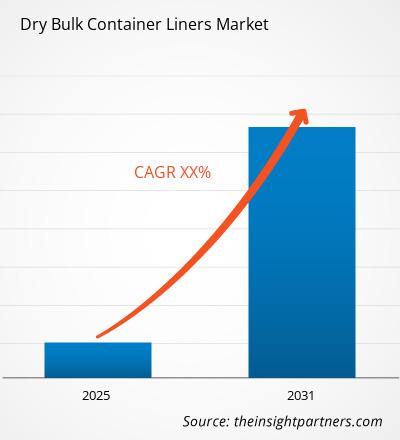
Segmentation Analysis
Liner Type
The Liner Type segment is estimated to expand at a 5.86% CAGR from 2026 to 2034. It encompasses polyethylene, polypropylene, and high-density polyethylene constructions serving different cargo protection and mechanical-performance requirements. Demand is shaped by food-grade requirements, moisture sensitivity, abrasion resistance, static control, and loading equipment compatibility. Competition increasingly centers on film quality, woven-fabric strength, sealing performance, customization, and integration with filling and discharge systems.
- Polyethylene: Provides flexible film-based protection with strong moisture-barrier characteristics and is widely suited to food ingredients, grains, powders, and free-flowing industrial materials requiring contamination control.
- Polypropylene: Woven PP offers greater structural strength and resistance to demanding handling, making it relevant for industrial bulk materials where mechanical durability and liner integrity are important.
- High-Density Polyethylene: HDPE supports robust liner structures for applications exposed to abrasion, puncture risk, and demanding handling, particularly where higher mechanical strength is prioritized.
End-User
The End-User segment is estimated to grow at a 6.12% CAGR from 2026 to 2034, reflecting expanding use across regulated and industrial bulk supply chains. Food and beverage remains a major application base, while healthcare requires controlled contamination conditions. Personal care and household care benefit from bulk ingredient logistics, and industrial users require liners for chemicals, polymers, minerals, and other dry materials.
- Food and Beverage: Uses liners to protect grains, sugar, flour, starches, ingredients, and other bulk food products from contamination and moisture during international transportation.
- Healthcare: Requires controlled packaging environments for pharmaceutical ingredients and related powders, with material cleanliness, traceability, and contamination prevention influencing procurement decisions.
- Personal Care and Household Care: Uses liners for bulk powders, chemical ingredients, detergents, and formulation materials where product purity and moisture control support manufacturing consistency.
- Industrial: Represents diverse applications across chemicals, polymers, minerals, construction materials, agriculture, and other dry bulk commodities where durability and efficient loading are key priorities.
Opportunity Snapshot
| End User | Revenue Contribution | Trend Tag | Adoption Stage |
|---|---|---|---|
| Food and Beverage | High | Hygiene Control | Mature |
| Healthcare | Medium | Purity Focus | Scaling |
| Personal Care and Household Care | Medium | Barrier Demand | Scaling |
| Industrial | High | Bulk Conversion | Mature |
Dry Bulk Container Liners Market Growth Drivers and Impact Analysis
Rising containerization of dry bulk cargo
Growth in containerized movement of grains, food ingredients, polymers, chemicals, minerals, and powders directly increases the addressable need for dry bulk liners. The mechanism is straightforward: exporters seek to use standard intermodal containers rather than specialized bulk equipment; this creates a requirement for an internal barrier that separates cargo from container surfaces and supports controlled loading and discharge. The resulting value-chain effect benefits liner converters, bulk-packaging manufacturers, loading-equipment providers, and logistics operators. UNCTAD's recent maritime analysis shows the continued structural importance of dry cargo in international seaborne trade, reinforcing the relevance of containerized bulk logistics. For liner manufacturers, this translates into demand for higher-capacity, cargo-specific, and installation-efficient designs.
Stricter contamination and food-contact requirements
Food, pharmaceutical, and specialty ingredient shippers increasingly require packaging that maintains product integrity across international transport conditions. The market mechanism begins with tighter hygiene and food-contact expectations, followed by buyer preference for virgin materials, controlled manufacturing environments, documented quality systems, and specialized liner constructions. This raises the value of certified PE, PP, and HDPE solutions and encourages manufacturers to strengthen traceability and process control. Updated food-contact requirements in major Asian markets and continued food-packaging regulation in India reinforce this direction. The implication is a shift from price-only purchasing toward specification-based procurement, creating advantages for manufacturers able to provide consistent material quality, clean production, and application-specific liner engineering.
Freight volatility and supply-chain efficiency requirements
Volatile freight rates and disruptions across major maritime routes are increasing the importance of extracting more logistics value from each container movement. The mechanism is that higher transport uncertainty encourages shippers to minimize packaging weight, reduce handling, prevent cargo contamination, and maximize usable container space. Dry bulk liners address several of these requirements by enabling direct bulk loading into standard containers while reducing dependence on individual bags or rigid packaging. Recent maritime disruptions, including rerouting around strategic waterways, have lengthened some supply chains and increased operating costs. The strategic implication is greater emphasis on liner reliability, fast installation, optimized discharge, moisture protection, and compatibility with existing loading infrastructure.
Dry Bulk Container Liners Market Future Trends
Shift toward engineered multi-function liner systems
Dry bulk liners are moving beyond basic containment toward engineered systems that combine moisture barriers, static control, fluidization, thermal protection, and optimized discharge. This change is occurring because cargoes are increasingly differentiated by flow behavior, sensitivity to humidity, electrostatic characteristics, and exposure duration during ocean transport. Food processors, chemical producers, polymer manufacturers, and mineral exporters are therefore specifying liners according to the complete handling process rather than material alone. Manufacturers are responding with co-extruded films, woven structures, barrier laminates, antistatic options, and tailored filling and discharge configurations. The likely implication is increased product specialization and a stronger competitive advantage for converters with advanced material and application-engineering capabilities.
Regulatory-driven movement toward recyclable packaging structures
Packaging regulation is increasingly shifting procurement toward materials and designs that can demonstrate lower waste intensity and better recyclability. The European Union's 2025 packaging regulation strengthens this direction, while manufacturers in Asia are also facing tighter food-contact and material-compliance requirements. The change affects liner producers, exporters, food processors, and multinational buyers that increasingly evaluate packaging through both product-protection and environmental criteria. Single-material PE or PP structures, recyclable film designs, controlled material use, and documented resin selection are likely to receive greater attention where technical performance permits. This trend will encourage manufacturers to balance barrier performance and mechanical strength with end-of-life considerations rather than treating recyclability as a secondary specification.
Dry Bulk Container Liners Market Opportunities
Regional manufacturing near export and processing clusters
A significant opportunity exists for localized liner production near major food-processing, polymer, chemical, agricultural, and port clusters in APAC, South America, and the Middle East. Customers in these markets often require customized dimensions, filling configurations, food-grade materials, and shorter replenishment cycles, while imported liners can introduce lead-time and logistics risks. Manufacturers can address this gap by establishing integrated film extrusion, woven-fabric conversion, and liner assembly capabilities close to major export corridors. India, China, Brazil, and Gulf logistics hubs are particularly relevant because they combine downstream bulk-product production with expanding international trade. Regional manufacturing can improve responsiveness while reducing dependence on long-distance liner shipments.
Specialized liners for sensitive powders and regulated products
Specialized applications represent an opportunity where standard liners cannot fully address moisture, static, contamination, flow, or discharge requirements. Pharmaceutical ingredients, high-value food powders, polymer resins, fine chemicals, and moisture-sensitive household-care materials can justify engineered liners with antistatic, barrier, fluidizing, or controlled-discharge features. The unmet need is not simply additional containment but predictable product behavior from loading through discharge. Manufacturers can capture this opportunity by developing application-specific liner specifications jointly with customers and equipment providers. The strongest commercial prospects are likely to come from suppliers that combine food-contact or pharmaceutical-grade production controls with technical customization and documented compatibility with automated bulk-handling systems.
Frequently Asked Questions

- Comprehensive Market Sizing and Forecast Analysis
- Detailed Segmentation Analysis
- In-Depth Market Dynamics Assessment
- Regional and Country-Level Insights
- Competitive Landscape and Company Benchmarking
- Strategic Business Intelligence
Recent Reports
Testimonials

The Insight Partners provided valuable market intelligence that supported our global go-to-market strategy. Their team was professional, responsive, and attentive to our feedback, providing thoughtful analysis and helpful methodological clarifications throughout the project.
Junmo Kim Chief Financial Officer (CFO), Enertech Co., Ltd.
The Insight Partners' SCADA System Market report is comprehensive, with valuable insights on current trends and future forecasts. The team was highly professional, responsive, and supportive throughout. We are very satisfied and highly recommend their services.
RAN KEDEM Partner, Reali Technologies LTDs
I requested a report on a very specific software market and the team produced the report in a few days. The information was very relevant and well presented. I then requested some changes and additions to the report. The team was again very responsive and I got the final report in less than a week.
JEAN-HERVE JENN Chairman, Future Analytica
We worked with The Insight Partners for an important market study and forecast. They gave us clear insights into opportunities and risks, which helped shape our plans. Their research was easy to use and based on solid data. It helped us make smart, confident decisions. We highly recommend them.
PIYUSH NAGPAL Sr. Vice President, High Beam Global
The Insight Partners delivered insightful, well-structured market research with strong domain expertise. Their team was professional and responsive throughout. The user-friendly website made accessing industry reports seamless. We highly recommend them for reliable, high-quality research services
YUKIHIKO ADACHI CEO, Deep Blue, LLC.
This is the first time I have purchased a market report from The Insight Partners.While I was unsure at first, I visited their web site and felt more comfortable to take the risk and purchase a market report.I am completely satisfied with the quality of the report and customer service. I had several questions and comments with the initial report, but after a couple of dialogs over email with their analyst I believe I have a report that I can use as input to our strategic planning process.Thank you so much for taking the extra time and making this a positive experience.I will definitely recommend your service to others and you will be my first call when we need further market data.
JOHN SUZUKI President and Chief Executive Officer, Board Director, BK Technologies
I wish to appreciate your support and the professionalism you displayed in the course of attending to my request for information regarding to infectious disease IVD market in Nigeria. I appreciate your patience, your guidance, and the fact that you were willing to offer a discount, which eventually made it possible for us to close a deal. I look forward to engaging The Insight Partners in the future, all thanks to the impression you have created in me as a result of this first encounter.
DR CHIJIOKE ONYIA MANAGING DIRECTOR, PineCrest Healthcare Ltd.Reason to Buy
- Informed Decision-Making
- Understanding Market Dynamics
- Competitive Analysis
- Identifying Emerging Markets
- Customer Insights
- Market Forecasts
- Risk Mitigation
- Boosting Operational Efficiency
- Strategic Planning
- Investment Justification
- Tracking Industry Innovations
- Aligning with Regulatory Trends





 Get Free Sample for