
Edge Banding Machine Market Growth, Size & Forecast by 2034
Coverage: By Type (Full-automatic, Semi-automatic); Application (Furniture, Building Material, Others) , and Geography (North America, Europe, Asia Pacific, and South and Central America)
- Status : Data Released
- Report Code : TIPRE00021324
- Category : Manufacturing and Construction
- No. of Pages : 150
- Available Report Formats :


- Last update date : October 26, 2026


2025 Market Size
US$ 1.45 Bn
Base year value
2034 Forecast
US$ 2.69 Bn
Projected by 2034
CAGR 2026-2034
7.11 %
Growth rate
Addressable Market
US$ 18.69 Bn
(2026-2034)
The Edge Banding Machine Market revenue is projected to rise from US$ 1.45 Billion in 2025 to US$ 2.69 Billion by 2034, registering a CAGR of 7.11% during 2026–2034. The market includes full-automatic and semi-automatic equipment used to apply, trim, scrape, buff, and finish edges on wood-based panels for furniture and building-material applications.
Across North America, the Edge Banding Machine Market size is modeled to expand at a ~6% CAGR through 2034. Demand is supported by cabinet and furniture producers replacing labor-intensive finishing with programmable lines, while residential remodeling and commercial interiors sustain panel-processing volumes. Servo adjustment, PUR adhesive handling, integrated premilling, and connected diagnostics improve repeatability and enable smaller production lots.
Edge Banding Machine Market Assessment and Insights
Regional Outlook
- North America: ~25% of the global Edge Banding Machine Market share in 2025 | ~6% CAGR through 2034. Market position: The region ranks behind Asia Pacific and Europe, supported by cabinet production, remodeling, labor substitution, and demand for compact automated cells with dependable distributor service.
- US: ~81% of North American market revenue in 2025 | ~6% CAGR through 2034. Market position: The leading country in North America benefits from a large cabinet and millwork base, adoption of CNC-linked production, and established machinery sales and service networks.
- Europe: ~30% of the global market in 2025 | ~6% CAGR through 2034. Market position: Europe combines mature furniture clusters with leading machine engineering. Germany leads in Europe, while Italy, France, the UK, and Spain sustain replacement and flexible-production demand.
- Asia Pacific: ~38% of the global market in 2025 | ~9% CAGR through 2034. Market position: Asia Pacific is the largest and fastest-growing region as China, India, Vietnam, and Southeast Asian furniture hubs add capacity and automate panel finishing.
Segment Outlook
- Type: ~56% Share in 2025 | ~8% CAGR through 2034. Market position: Type leads the analytical outlook through full-automatic equipment, which captures higher selling values and integrates multiple finishing operations, controls, conveyors, and inspection functions.
- Application: ~58% Share in 2025 | ~7% CAGR through 2034. Market position: Furniture provides the main application base, while building-material processing benefits from modular interiors, doors, partitions, and standardized decorative-panel production.
Competitive Coverage
Akhurst Machinery Limited, Adamik Company s.r.o., Biesse S.p.A., Cantek America Inc., HOFFMANN Maschinenbau GmbH, OAV Equipment and Tools, Inc., SCM Group S.p.A., SIMCO Industrial Machinery Trading Co. Ltd., Schnell Machine, Vector Systems
Methodology
The Insight Partners follows Data Collection & Secondary Research, Primary Research, Data Analysis, and Data Triangulation & Final Review to validate market estimates and insights.
Source: The Insight Partners' analysis based on proprietary research, government publications, company annual reports, investor presentations, industry databases, and expert interviews.
Edge banding systems have advanced from mechanical glue-and-trim systems to digitally-controlled production systems incorporating pre-milling, glue application, pressure, end trimming, profile trimming, scraping, buffing, and quality control. Edge banders are now being integrated with sizing saws, nesting cells, return conveyors, and manufacturing systems in furniture plants. The economic considerations of production have changed; changes in color and thickness are now just as critical as speed. Manufacturers provide solutions in servo-actuated machines, multi-roll magazines, fast changing glue pots, barcoded recipes, and diagnostics over distance.
From 2021 to 2034, growth in Asia Pacific comes from new installations, whereas Europe and North America benefit from replacement, single-piece processing capability, and reduced dependence on operators. Buying decisions should be made in favor of modular machines where users can upgrade machines by adding handling, inspection, or zero joint functions without upgrading the main machine. Regulation concerning exposure at work, energy efficiency, formaldehyde, and the durability of products creates indirect demand for controlled gluing processes and edge sealing.
Edge Banding Machine Market Report Scope
| Report Attribute | Details |
|---|---|
| Market size in 2025 | US$ 1.45 Billion |
| Market Size by 2034 | US$ 2.69 Billion |
| Global CAGR (2026 - 2034) | 7.11% |
| Historical Data | 2021-2024 |
| Forecast period | 2026-2034 |
Edge Banding Machine Market Analysis
Edge Banding Machine Market growth is a result of the transformation of challenges in panel processing into quantifiable and automated processes. There is high demand for edge banders in areas where manufacturers process different types of boards and edge tapes in batches but still need to produce consistent glue lines and corner quality. Labor shortages support the need for automatic loading and unloading of machines.
The value chain includes providers of panels and edge tapes, adhesive, cutting tools, control components, machine manufacturers, distributors, system integrators, and service providers. The frames and machining systems continue to be important, while software, sensors, and operator interface systems play an increasingly important role in differentiation. Reliability of supply relies not only on the construction of machines but also on the electronics and spare parts.
Edge Banding Machine market competition can be said to be based on integration vs. regional specialization. Biesse S.p.A. and SCM Group S.p.A. compete using wood processing equipment and integrated manufacturing processes, while Akhurst Machinery Limited, Cantek America Inc. and SIMCO Industrial Machinery Trading Co. Ltd. enhance their distribution, application and regional support.
The companies HOFFMANN Maschinenbau GmbH, OAV Equipment and Tools, Inc., Adamik Company s.r.o., Schnell Machine and Vector Systems compete by addressing the demands of specialized workshops, panel processing and automation. Funding is shifting to flexible cell design, local spare parts capacity, operator training and technical support. The strategic positioning for the company will depend on the fit between complexity of machinery and customer volume.
● REPORT CUSTOMIZATION
Tailor This Report To Align With Your Specific Business Requirements
This report can be customized to align precisely with your business objectives, scope, and target markets. Customization options include tailored segmentation, geography, competitive analysis, and strategic insights to support informed decision-making.
Customize This Report →WHAT YOU CAN ADJUST
- ● Segmentations
- ● Geography
- ● Competitive Analysis
- ● Language Preferences
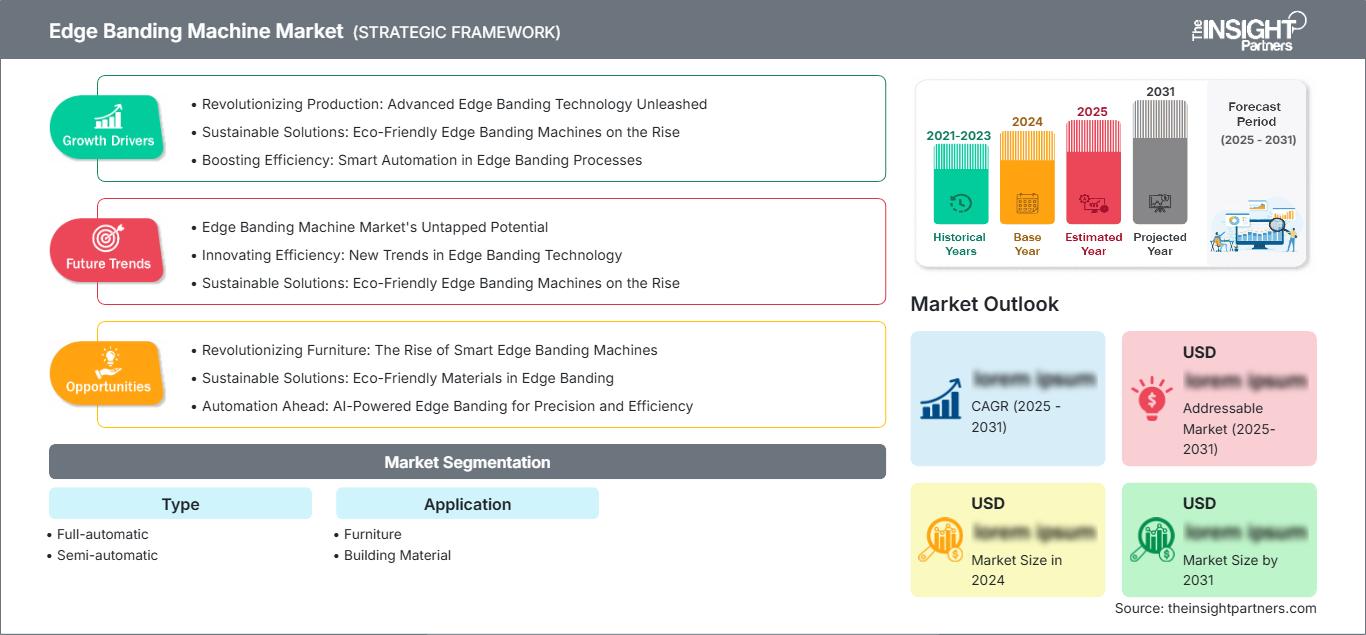
Edge Banding Machine Market: Strategic Insights
Regional Insights
North America Edge Banding Machine Market
North America represents ~25% of global revenue in 2025 and is modeled to grow at a ~6% CAGR through 2034. Share of Edge Banding Machine is based on US cabinet manufacturing, home remodeling, office & hotel interiors, and Canadian millwork. The high labor rate necessitates automation through automatic feeding, return of panels, and handling.
Local commissioning, availability of spare parts, adhesives, and technicians is highly valued by users as any failure may shut down the whole line. Compact full-automatic equipment finds applications in medium size shops, while large manufacturers integrate double or single-sided machines with saws, CNC routers, and inventories. Mexico supplies export-oriented furniture manufacturing capability along with components production, offering a way in to cost-conscious but increasingly automated operations.
U.S. Edge Banding Machine Market
The US accounts for ~81% of North American revenue in 2025 and is forecast to advance at a ~6% CAGR. The dominant nation in North America due to manufacturers of cabinets, closets, store fixtures, office furniture, and architectural millwork who cater to a large construction and renovation market. Preference goes to machinery which integrates premilling, PUR or EVA gluing, corner rounding, scraping, and buffing.
Product and service availability by Biesse S.p.A. and SCM Group S.p.A., while machinery availability by Akhurst Machinery Limited and Cantek America Inc. Application trends include texture panels, thin edges, high gloss, and short production runs demanding recipe changes. The cost of financing will hinder capital investments, yet labor savings, rework reduction, and quick changeover will fuel the need for replacement.
Europe Edge Banding Machine Market
Europe holds ~30% of global revenue in 2025 and is projected to register a ~6% CAGR through 2034. Strong equipment engineering and mature furniture clusters make the region both a production base and a demanding user market. Germany is the leading country in Europe, supported by automated furniture, kitchen, door, and component plants, exacting finish standards, and close integration between machinery, tooling, adhesives, and controls.
Italy represents a combination of large-scale machine producers and furniture and design manufacturers and promotes fast commercialization of flexible cells and one-batch technology. France and Spain represent kitchen and contract-furniture and building component demand, while the UK focuses on cabinets, joinery, fit-out, and replacement equipment. In all these markets, manufacturers are looking for invisible joints, reliable PUR application technology, minimal start-up losses, and software translating production orders into machine instructions.
European growth does not depend on greenfield plant investments as much as on the upgrade of existing facilities. Plants upgrade manually adjusted lines with servo-controlled systems, install return conveyor or robotics systems and diagnostics to ensure uninterrupted operation with less manpower. Energy conservation and material utilization affect purchase decisions; however, buyers still evaluate new bonding techniques in comparison with edge strength, color-fastness and operation costs.
APAC Edge Banding Machine Market
Asia Pacific commands ~38% of global revenue in 2025 and is the fastest-growing region at a modeled ~9% CAGR. China emerges as the top-performing country in Asia Pacific in terms of size for panel furniture, cabinets, machinery manufacturing, and export manufacture. High specification automation, traceability, and small cells prevail in Japan and South Korea whereas India takes to structured furniture expansion and rising machinery assembly domestically.
Cabinets and building products demand come from Australia whereas capacity in global markets comes from the exporters in Southeast Asia. There are drivers towards automation which include industrial policies, localization, urban housing needs, modular interiors, and wage pressure. The market results continue to be fragmented where high production plants go in for full automatic lines and smaller shops use semi-automatic machinery.
Middle East & Africa Edge Banding Machine Market
The Middle East and Africa is expected to expand at a ~7% CAGR through 2034. Saudi Arabia leads the Middle East and Africa region on account of housing, hospitality, commercial fit-out and industrial-localization projects. UAE is characterized by premium interiors, joinery and project-furniture requirements which usually call for versatile machines for various specifications and shorter lead times.
South Africa is behind the support for cabinets, retail fixtures, and construction materials while Rest of MEA continues to be driven by distributors and projects. Availability of energy, cost of machinery imports, technicians availability and financing influence technology adoption. Machinery suppliers with strong semi-automatic machines, coupled with spare parts and training, are capable of tapping into small manufacturers, while big fit-out and furniture factories require automation.
Segmentation Analysis
Type
Type is modeled to grow at a ~8% CAGR during 2026–2034. The Edge Banding Machine Market scope spans full-automatic and semi-automatic systems, differentiated by feeding, adjustment, machining-unit integration, handling, and software control. Investment decisions depend on daily panel volume, product variety, available labor, quality targets, footprint, service access, and the payback achieved through lower setup time, scrap, and rework.
- Full-automatic: Full-automatic equipment leads value contribution because it combines multiple machining and finishing units with recipe control, higher feed speeds, automatic adjustment, and optional handling. It is strategically important for scaled furniture plants and flexible industrial production.
- Semi-automatic: Semi-automatic machines address smaller workshops, custom manufacturers, and capacity additions where capital discipline matters. Their simpler controls and maintenance lower entry barriers, while dependable gluing and trimming improve finish consistency over manual edge application.
Application
Application is projected to expand at a ~7% CAGR during 2026–2034. Furniture remains the principal demand pool, but building-material users broaden requirements toward doors, partitions, wall panels, and modular interior components. Growth depends on panel consumption, renovation cycles, furniture exports, customization, and manufacturers’ willingness to move edge finishing from stand-alone craftsmanship into repeatable production flow.
- Furniture: Furniture production generates the largest installed base through cabinets, kitchens, wardrobes, offices, retail fixtures, and ready-to-assemble products. Shorter product cycles favor rapid recipe changes, edge magazines, and connected quality control.
- Building Material: Building-material applications include doors, partitions, decorative boards, and interior systems. Strategic demand comes from standardization and factory fabrication, where sealed, durable edges improve appearance, moisture resistance, and repeatable site installation.
Opportunity Snapshot
| Application | Revenue Contribution | Trend Tag | Adoption Stage |
| Furniture | High | Batch One | Mature |
| Building Material | Medium | Panel Prefabrication | Scaling |
Edge Banding Machine Market Growth Drivers and Impact Analysis
Furniture Factories Automate Repetitive Finishing
Finishing is a bottleneck for furniture and cabinetry manufacturers where panel saws run faster than edge applicators that need setup or reworking. Edge banders automatically coordinate premilling, glue feeding, pressing, trimming, rounding the corners, scraping, and buffing, delivering a finished part in one cycle. The practical effect is more output per operator and greater consistency in quality. The factories also minimize damage from handling and work-in-progress parts resulting from having multiple machines. This driver works best for full-automatic systems but also improves semi-automatic equipment in smaller operations that make a first move toward automatic edge application. It is highly dependent on utilization, production mix, glue control, and vendor service.
Customized Panels Require Faster Changeovers
The demand for configured kitchens, wardrobes, offices, retail display stands, and interiors adds variety in terms of sizes, edge color, thickness, and finish of panels. Lengthy mechanical setups work against profitability in the case of small quantities. Servo-driven machines, barcode/job list entry, multiple roll magazines, and automated tool positioning reduce changeover times and minimize operator mistakes. The effect in the marketplace is a move from maximizing the speed of the line to the flexibility of output, represented by the number of parts produced per mixed shift. This process enables connected machinery that receives recipes from the design/manufacturing software and verifies settings before processing the panels.
Factory-Built Interiors Expand Panel Processing
Modular furniture, prefabricated interiors, standardized doors, and decorative wall systems move more fabrication from construction sites into controlled factories. Edge finishing becomes essential where exposed board surfaces require appearance, moisture protection, impact resistance, or safe handling. As builders seek repeatable components and faster installation, building-material processors can justify machinery that delivers consistent edges at scale. The effect is broader demand beyond traditional furniture plants, including door, partition, fixture, and panel-system manufacturers. Machine specifications vary by workpiece size, edge material, profile, and adhesive, making application engineering important. Suppliers that demonstrate reliable processing of engineered wood, laminates, and specialty surfaces can convert this structural shift into equipment, tooling, and service revenue.
Edge Banding Machine Market Future Trends
Self-Adjusting Cells and Closed-Loop Quality Control
Edge Banding Machine Market trends increasingly point toward cells that verify incoming panel identity, load the required edge, position machining units, monitor adhesive conditions, and flag finish deviations with less operator intervention. Cameras, temperature sensors, vibration data, and production software can create a closed loop between recipe and result. Through 2034, differentiation will move from isolated mechanical features toward the reliability of the total cell, including feeding, return, inspection, and data exchange. Adoption will be gradual because mixed factory software, legacy machines, and limited technical skills complicate integration. Suppliers that design open interfaces and practical exception handling will have an advantage over systems that automate ideal conditions but stall when materials or labels vary.
Bonding Technologies Compete on Energy and Finish
Zero-joint appearance, lower glue visibility, and reduced energy use will continue to reshape bonding choices. PUR, hot-air, laser-compatible edges, and emerging alternative activation methods each offer different balances of finish quality, bond strength, cleaning effort, consumable cost, and power demand. Future machines will likely support multiple processes or simplify switching so manufacturers can align bonding with product value. Premium kitchens and high-gloss panels may justify advanced systems, while volume furniture will retain proven hot-melt approaches where economics are strongest. Procurement will increasingly use lifecycle trials that measure scrap, maintenance, startup waste, and edge durability, limiting claims based only on visual samples or nominal energy consumption.
Edge Banding Machine Market Opportunities
Localized Automation Packages for Emerging Furniture Hubs
India, Southeast Asia, the Middle East, and selected African markets offer investment opportunities where panel furniture and interior manufacturing are formalizing but technical resources remain uneven. Edge Banding Machine Market Forecasts support packages that combine a right-sized machine, dust extraction guidance, adhesive setup, operator training, spare-parts kits, and remote diagnostics. Local assembly or stocked components can reduce lead times and foreign-exchange exposure. Distributors should segment customers by panel volume and changeover frequency rather than promoting the most automated platform. A staged pathway from semi-automatic machines to full cells can protect customer returns while building supplier relationships. Success requires demonstration centers, financing partnerships, and technicians who understand both machining units and the surrounding production flow.
Retrofit, Service, and Productivity Software
The installed base creates recurring opportunities beyond new-machine sales. Suppliers can offer glue-pot upgrades, tool and scraper optimization, edge magazines, barcode readers, safety improvements, remote support, and productivity dashboards where mechanical platforms remain serviceable. A disciplined audit can identify whether defects originate in panel sizing, adhesive temperature, pressure, tooling, material storage, or operator setup, preventing unnecessary replacement. This service model is attractive in Europe and North America, where mature factories must increase flexibility without rebuilding entire lines. Commercial execution should combine scheduled maintenance, technician training, and measurable output targets. Vendors able to document reduced changeover, scrap, or downtime can defend value even when capital budgets are constrained.
Recent Developments
- September 2026: TingTing Group today announced the official launch of Victory, a new brand dedicated to high-end edge banding machines. Victory's first product line covers the Group's existing mainstream edge banding series, with more models to follow, delivering stable, efficient and easy-to-set-up edge banding solutions to furniture manufacturers worldwide.
- April 2024: EXCITECH, the leading manufacturer of woodworking machinery, has recently launched their latest innovation - the Laser Edge Banding Machine. This machine is designed to revolutionize the woodworking industry, featuring advanced laser technology that ensures precise and flawless edge banding.
- October 2023: OAV launches Intelligent edge banding machine, bringing technological innovation to the woodworking and furniture industry. The design features of the intelligent edge banding machine have practical benefits in several ways. The 10-inch smart touch panel improves previous functions and enables direct switching between different edge thicknesses, increasing efficiency and reducing costs. The design also minimizes material waste and tool damage by accurately determining the size of the processed material. It also supports multiple languages and user-friendly operations, resulting in a perfect edge with just a simple touch.
Frequently Asked Questions

- Comprehensive Market Sizing and Forecast Analysis
- Detailed Segmentation Analysis
- In-Depth Market Dynamics Assessment
- Regional and Country-Level Insights
- Competitive Landscape and Company Benchmarking
- Strategic Business Intelligence
Recent Reports
Testimonials

The Insight Partners provided valuable market intelligence that supported our global go-to-market strategy. Their team was professional, responsive, and attentive to our feedback, providing thoughtful analysis and helpful methodological clarifications throughout the project.
Junmo Kim Chief Financial Officer (CFO), Enertech Co., Ltd.
The Insight Partners' SCADA System Market report is comprehensive, with valuable insights on current trends and future forecasts. The team was highly professional, responsive, and supportive throughout. We are very satisfied and highly recommend their services.
RAN KEDEM Partner, Reali Technologies LTDs
I requested a report on a very specific software market and the team produced the report in a few days. The information was very relevant and well presented. I then requested some changes and additions to the report. The team was again very responsive and I got the final report in less than a week.
JEAN-HERVE JENN Chairman, Future Analytica
We worked with The Insight Partners for an important market study and forecast. They gave us clear insights into opportunities and risks, which helped shape our plans. Their research was easy to use and based on solid data. It helped us make smart, confident decisions. We highly recommend them.
PIYUSH NAGPAL Sr. Vice President, High Beam Global
The Insight Partners delivered insightful, well-structured market research with strong domain expertise. Their team was professional and responsive throughout. The user-friendly website made accessing industry reports seamless. We highly recommend them for reliable, high-quality research services
YUKIHIKO ADACHI CEO, Deep Blue, LLC.
This is the first time I have purchased a market report from The Insight Partners.While I was unsure at first, I visited their web site and felt more comfortable to take the risk and purchase a market report.I am completely satisfied with the quality of the report and customer service. I had several questions and comments with the initial report, but after a couple of dialogs over email with their analyst I believe I have a report that I can use as input to our strategic planning process.Thank you so much for taking the extra time and making this a positive experience.I will definitely recommend your service to others and you will be my first call when we need further market data.
JOHN SUZUKI President and Chief Executive Officer, Board Director, BK Technologies
I wish to appreciate your support and the professionalism you displayed in the course of attending to my request for information regarding to infectious disease IVD market in Nigeria. I appreciate your patience, your guidance, and the fact that you were willing to offer a discount, which eventually made it possible for us to close a deal. I look forward to engaging The Insight Partners in the future, all thanks to the impression you have created in me as a result of this first encounter.
DR CHIJIOKE ONYIA MANAGING DIRECTOR, PineCrest Healthcare Ltd.Reason to Buy
- Informed Decision-Making
- Understanding Market Dynamics
- Competitive Analysis
- Identifying Emerging Markets
- Customer Insights
- Market Forecasts
- Risk Mitigation
- Boosting Operational Efficiency
- Strategic Planning
- Investment Justification
- Tracking Industry Innovations
- Aligning with Regulatory Trends





 Get Free Sample for