
Electrical Steel Market Trends, Size & Forecast by 2034
Coverage: By Type (Non Grain-Oriented Steel, Grain-Oriented Steel); Application (Transformers, Motors, Inductors, Others); End-Use Industry (Energy, Automobiles, Manufacturing, Household Appliances, Others) , and Geography (North America, Europe, Asia Pacific, and South and Central America)
- Status : Data Released
- Report Code : TIPRE00009456
- Category : Chemicals and Materials
- No. of Pages : 150
- Available Report Formats :


- Last update date : August 10, 2026


2025 Market Size
US$ 28.20 Bn
Base year value
2034 Forecast
US$ 40.85 Bn
Projected by 2034
CAGR 2026-2034
4.20 %
Growth rate
Addressable Market
US$ 313.53 Bn
(2026-2034)
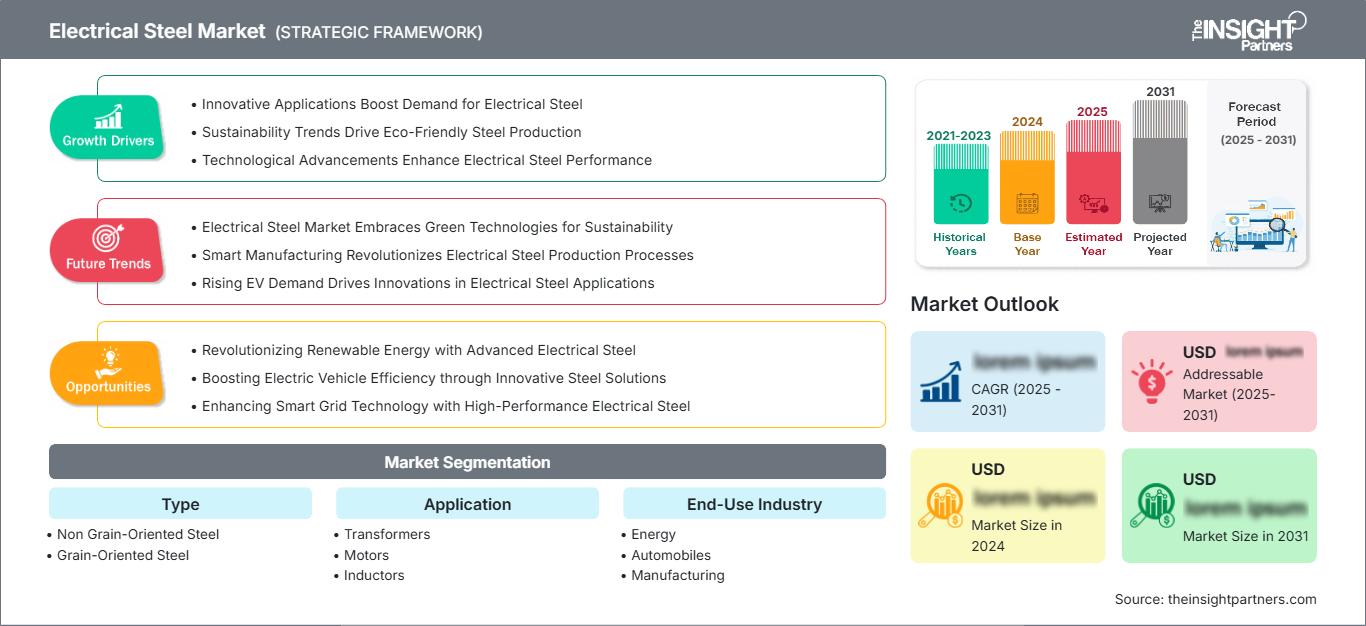
The Electrical Steel Market was valued at US$ 28.20 Billion in 2025 and is projected to reach US$ 40.85 Billion by 2034, registering a CAGR of 4.20% during 2026–2034. The Market is advancing as utilities, automakers, and industrial manufacturers prioritize magnetic materials that reduce core losses in transformers, motors, and inductors while supporting broader electrification and grid reliability requirements.
In North America, demand is expected to expand at a 3.8–4.8% CAGR as grid modernization, transformer replacement, and electric motor efficiency programs support regional procurement. The Electrical Steel Market size outlook is reinforced by domestic supply-chain security efforts, higher renewable interconnection activity, and long-cycle utility investment in distribution equipment.
Electrical Steel Market Assessment and Insights
- North America: Share in 2025 of 12–16% and CAGR between 3.8–4.8%. Grid upgrades, EV manufacturing, and domestic transformer supply programs support steady demand for high-efficiency magnetic steel.
- US: Share in 2025 of 78–82% of North America and CAGR between 4.0–5.0%. Utility transformer procurement and automotive motor laminations remain key demand anchors.
- Europe: Share in 2025 of 10–14% and CAGR between 3.4–4.4%. Germany, France, Italy, Spain, and the UK lead demand through grid efficiency and industrial electrification programs.
- Asia Pacific: Share in 2025 of 68–72% and CAGR between 4.4–5.4%. China, Japan, South Korea, and India dominate through transformer manufacturing, EV output, and appliance production.
- Largest Segment: Non Grain-Oriented Steel with market share of 60–64% in 2025 and CAGR of 4.5–5.5% during 2026–2034, supported by motors and rotating equipment.
- High Growth Segment: Motors with market share of 30–34% in 2025 and CAGR of 5.0–6.0% during 2026–2034, driven by EVs, compressors, and industrial drives.
- Key companies analyzed in detail: Cleveland-Cliffs Inc., ArcelorMittal S.A., China Baowu Steel Group Corporation Limited, Cogent Power Limited, JFE Steel Corporation, Nippon Steel Corporation, Novolipetsk Steel Public Joint Stock Company, POSCO Holdings Inc., thyssenkrupp Steel Europe AG, voestalpine AG.
Source: The Insight Partners' analysis based on proprietary research, government publications, company annual reports, investor presentations, industry databases, and expert interviews.
Electrical steel production is shifting from basic silicon-steel output toward higher permeability, tighter gauge control, and improved coating systems. Demand increasingly reflects transformer efficiency mandates, motor miniaturization, and lower-loss designs for rotating equipment. Producers are balancing capacity utilization with quality upgrades, while customers seek secure sourcing for grain-oriented and non grain-oriented grades used in electricity networks, EV traction motors, compressors, and industrial automation systems.
Future growth will depend on Asia Pacific capacity additions, North American reshoring, and European efficiency standards. Investment is moving toward premium grades, laser-scribed grain-oriented material, and thinner non grain-oriented sheets. Regulatory pressure to reduce transmission losses, rising renewable interconnection queues, and higher electricity consumption from data centers are expected to support stable procurement despite cyclical steel-price volatility.
Electrical Steel Market Report Scope
| Report Attribute | Details |
|---|---|
| Market size in 2025 | US$ 28.20 Billion |
| Market Size by 2034 | US$ 40.85 Billion |
| Global CAGR (2026 - 2034) | 4.20% |
| Historical Data | 2021-2024 |
| Forecast period | 2026-2034 |
Electrical Steel Market Analysis
The Electrical Steel Market growth outlook is tied to electricity demand, power equipment replacement, and electrification of mobility and industrial systems. The IEA reported strong growth in power demand and highlighted grids as a bottleneck, with renewable, storage, and large-load projects waiting for connection. This pressure increases transformer procurement and supports grain-oriented steel use in distribution and transmission assets.
Automotive electrification strengthens demand for non grain-oriented steel because motor stators and rotors require low core losses at high frequencies. Household appliances, HVAC systems, pumps, and factory automation also depend on efficient motors. Supply dynamics remain influenced by coating quality, annealing capacity, raw steel costs, and limited availability of premium electrical grades across several regional markets.
Current Electrical Steel Market analysis shows a competitive environment shaped by technology depth, integrated steelmaking, and proximity to equipment manufacturers. Cleveland-Cliffs Inc. supports North American transformer and motor supply, while China Baowu Steel Group Corporation Limited, JFE Steel Corporation, Nippon Steel Corporation, and POSCO Holdings Inc. remain central to Asian production capacity.
ArcelorMittal S.A., thyssenkrupp Steel Europe AG, voestalpine AG, Cogent Power Limited, and Novolipetsk Steel Public Joint Stock Company compete through steel quality, coating systems, and downstream lamination expertise. Strategic positioning increasingly emphasizes localized supply, premium motor grades, and transformer material availability as utilities and automakers seek lower procurement risk.
Procurement strategies are also becoming more technical as buyers compare core-loss guarantees, coating durability, lamination yield, and supplier qualification cycles before awarding contracts. This favors producers that combine metallurgical capability with application engineering support. For transformer OEMs, predictable magnetic performance helps reduce lifecycle energy losses, while motor manufacturers prioritize thinner gauges that improve efficiency without increasing stack size. As a result, commercial differentiation is moving beyond volume availability toward documented performance, regional responsiveness, and the ability to support customers through design validation, testing, and multi-year sourcing programs.
● REPORT CUSTOMIZATION
Tailor This Report To Align With Your Specific Business Requirements
This report can be customized to align precisely with your business objectives, scope, and target markets. Customization options include tailored segmentation, geography, competitive analysis, and strategic insights to support informed decision-making.
Customize This Report →WHAT YOU CAN ADJUST
- ● Segmentations
- ● Geography
- ● Competitive Analysis
- ● Language Preferences
Electrical Steel Market: Strategic Insights
Regional Insights
North America Electrical Steel Market
North America held 12–16% of revenue in 2025 and is projected to grow at a 3.8–4.8% CAGR. Utilities are replacing aging transformers, while renewable interconnection and data center substations require additional electrical steel cores. Domestic production security remains important because high-grade grain-oriented material has strategic relevance for grid reliability.
The market also benefits from EV battery-belt investments, industrial motor efficiency upgrades, and federal focus on resilient power infrastructure. The Electrical Steel Market share in the region remains smaller than Asia Pacific, but higher-value transformer and motor grades support margin strength. Cleveland-Cliffs Inc. and downstream laminators help anchor local supply.
U.S. Electrical Steel Market
The U.S. represented 78–82% of North American revenue in 2025 and is forecast to grow at a 4.0–5.0% CAGR. Transformer replacement, utility procurement, and electric motor applications sustain demand. Domestic sourcing remains a procurement priority as grid equipment lead times remain elevated and industrial electrification increases load growth.
Cleveland-Cliffs Inc. maintains an important domestic position, while automotive suppliers and motor manufacturers drive use of non grain-oriented steel in traction and auxiliary motors. Demand is also supported by HVAC, appliances, pumps, and factory automation. Federal grid investment and private data center construction strengthen long-term order visibility.
Europe Electrical Steel Market
Europe accounted for 10–14% of revenue in 2025 and is expected to grow at a 3.4–4.4% CAGR. Germany leads regional consumption due to motor manufacturing, automotive electrification, and industrial machinery output. France supports demand through nuclear-grid maintenance and transformer replacement, while Italy and Spain contribute via appliance and renewable infrastructure projects.
The UK market benefits from offshore wind grid connections and distribution upgrades. European producers such as ArcelorMittal S.A., thyssenkrupp Steel Europe AG, and voestalpine AG focus on lower-loss grades and advanced processing. Energy-efficiency standards and high electricity prices encourage equipment makers to specify premium magnetic materials across transformers and motors.
APAC Electrical Steel Market
Asia Pacific represented 68–72% of global revenue in 2025 and is forecast to grow at a 4.4–5.4% CAGR. China is the leading country due to its transformer, EV, appliance, and industrial motor base. Japan and South Korea support premium grades, while India expands grid and manufacturing demand.
China Baowu Steel Group Corporation Limited, JFE Steel Corporation, Nippon Steel Corporation, and POSCO Holdings Inc. reinforce regional leadership. Policy support for renewable power, EVs, and industrial energy efficiency drives consumption across both grain-oriented and non grain-oriented steels. Australia contributes through grid investment and renewable integration requirements.
Middle East & Africa Electrical Steel Market
The Middle East & Africa is estimated to exhibit a CAGR of 3.6-4.6%. Demand in the region is driven by Saudi Arabia through grid investments, industrial diversification, and major infrastructure projects. In the UAE, the drivers include data centers, utilities, and smart buildings, while South Africa faces a need for transformer replacements.
Rest of MEA demand is driven by electrification, mining, renewable energy, and infrastructure. MEA will remain an import-oriented region for most of its electrical steel needs, offering opportunities for distributors and international manufacturers. Future procurement trends will depend on suppliers' ability to meet transformer requirements.
Segmentation Analysis
Type
Type Segment will grow at a CAGR of 4.2%-5.2% between 2026 and 2034. The scope of the Electrical Steel market encompasses grain structure, magnetic properties, and end-use equipment requirements. Non grain-oriented steel is used in rotating equipment, whereas grain-oriented steel is still indispensable for transformers.
- Non Grain-Oriented Steel: This sub-segment holds the largest position because EV motors, industrial drives, appliances, and generators require magnetic properties in multiple directions, supporting broad use across rotating equipment.
- Grain-Oriented Steel: This sub-segment is strategically important for transformers and high-efficiency grid equipment, where directional magnetic performance reduces core losses and improves energy transmission efficiency.
Application
The Application segment will witness a CAGR of 4.3–5.3% till 2034. The use cases include equipment used for the conversion, distribution, and control of electricity. Transformers continue to form the backbone of grid infrastructure, while motors offer greater growth in EVs, household appliances, HVAC, and industrial automation.
- Transformers: Transformer applications retain strong strategic relevance because utilities, renewable developers, and data centers require efficient core materials for transmission, distribution, and step-up power equipment.
- Motors: Motor demand is rising as EV platforms, compressors, fans, pumps, and industrial drives increasingly require premium low-loss materials to improve operating efficiency and thermal performance.
- Inductors: Inductors represent a specialized demand base linked to power electronics, charging systems, converters, and industrial electrical assemblies requiring stable magnetic properties under changing loads.
End-Use Industry
The End-Use Industries segment is projected to grow at a 4.0%-5.0% CAGR. Energy will remain a core industry due to the energy grid's reliance on transformer cores. The automobile industry will see rapid growth through EV motors, and manufacturing and household appliances will maintain steady use of motors and electromagnets.
- Energy: Energy applications drive demand for grain-oriented grades in transformers, renewable interconnections, substations, and grid modernization projects requiring lower transmission and distribution losses.
- Automobiles: Automotive demand is increasing as EV traction motors, hybrid powertrains, and auxiliary systems use non grain-oriented grades to improve magnetic efficiency and vehicle energy performance.
- Manufacturing: Manufacturing relies on electrical steel in motors, drives, generators, and automation equipment, making energy-efficient machinery procurement an important source of stable industrial demand.
- Household Appliances: Appliance makers use electrical steel in compressors, washing machines, fans, and small motors, where efficiency labels and operating-cost reduction influence material selection.
Opportunity Snapshot
| Segment Name | Revenue Contribution | Trend Tag | Adoption Stage |
| Transformers | High | Grid Upgrade | Mature |
| Motors | High | EV Drives | Scaling |
| Inductors | Medium | Power Electronics | Emerging |
Electrical Steel Market Growth Drivers and Impact Analysis
Grid Modernization and Transformer Replacement
The aging electrical network infrastructure results in an ongoing demand for transformers, especially where the rise of renewables, data centers, electric vehicle charging stations, and industry electrification increases load. According to the IEA, grid constraints affect more than 2,500 GW of renewables, storage capacity, and large-load projects, underscoring the need for greater grid investment. This will affect demand for electrical steel, as grain-oriented electrical steel with minimum core loss is required in transformers. The utility companies have also insisted on using efficient equipment to minimize technical losses and increase reliability. Because transformers have long lead times, equipment manufacturers secure long-term contracts for high-quality materials.
Electric Vehicle Motor Efficiency Requirements
The manufacturing of EVs is increasing the significance of non-GO grades, as these materials must be thin and exhibit low loss to operate effectively at high RPMs. Motor designs are being fine-tuned by automakers to improve efficiency, reduce heat dissipation, and increase power density. These needs are raising the requirement for high-quality electrical steel rather than commoditized steel grades. Manufacturers with state-of-the-art annealing, gauging, and coating facilities are well-positioned to meet the demands of automotive platforms subject to stringent qualification programs. It should also be kept in mind that the market effect extends beyond passenger EVs, as there is a need for efficient motor cores in hybrid EVs, electric buses, and two-wheelers, and deeper integration with motor manufacturers.
Energy-Efficient Appliances and Industrial Motors
Appliances, HVAC, pumping and ventilating fans, compressors, and drives represent an ongoing market for non grain-oriented steel in electrical applications. Efficiency requirements force equipment makers to minimize motor losses, enhance thermal performance, and account for energy costs over the equipment's lifetime. It encourages the use of higher-grade magnetic steel even in lower-priced categories. Automation technologies increase the use of electric drives and motors on the factory floor, in warehouses, and in process industries. The result for producers will be a more diversified customer list compared to transformers and EV applications, de-risking end-market concentration. The demand for non grain-oriented steel in appliance applications is quantity-driven, whereas the industrial sector is usually higher quality-demanding. The combination provides stability in consumption over economic cycles.
Electrical Steel Market Future Trends
Premium Thin-Gauge and Low-Loss Grades
The Electrical Steel market trends indicate that the commercial use of thinner, low-loss electrical steels for high-frequency motors, transformers, and power electronics will become more common. Equipment makers are forced to minimize losses while maintaining the same size, making the use of steel with high magnetic permeability and low hysteresis loss attractive. Steelmakers are expected to invest in annealing, coatings, finishing processes, and domain refinement techniques. These trends will gradually differentiate high-value-added from commodity producers as customers place greater emphasis on certified magnetic performance, technical support, and repeatable production quality.
Localized Supply Chains for Strategic Electrical Equipment
Governments and utilities are expected to give greater attention to domestic or allied sourcing of electrical steel because transformers and motors are critical to energy security. Supply disruptions, long lead times, and concentrated premium-grade manufacturing have exposed vulnerabilities in grid equipment procurement. Future sourcing strategies will likely include regional qualification programs, multi-year supply contracts, and investment incentives for steel and transformer capacity. This trend may support North American and European production upgrades, while Asian producers continue to expand advanced-grade output to meet demand for EV and renewable equipment.
Electrical Steel Market Opportunities
Transformer Supply Agreements with Utilities and OEMs
Procurement by utilities on long cycles provides an opportunity for steel manufacturers to generate guaranteed demand by collaborating with transformer OEMs. The focus of Electrical Steel Market Forecasts has now shifted towards investment in grids, as renewable energy interconnections, data centers, and aging infrastructure require more transformers. Manufacturers who can ensure consistent grain-oriented steel, consistent coatings, and dependable deliveries may be considered preferred suppliers. Such investments can include debottlenecking of annealing lines, domain refinement capacity, and meeting the requirements of efficient transformers.
Automotive-Grade Non Grain-Oriented Steel Expansion
Automotive electrification provides a value-added opportunity for those producers capable of meeting stringent motor lamination specifications. EV traction motors require non grain-oriented alloys with consistent magnetic characteristics, thin gauges, and coatings that are suitable for high-speed production. There are opportunities for steel producers to invest in automotive qualification initiatives, collaborate with motor makers on design, and provide service facilities in proximity to the market to increase efficiency. The biggest opportunity lies in locations where OEMs are sourcing EV platforms locally and shortening their supply chains.
Recent Developments
- June 2026: Fives Group has entered a significant contract with JSW Steel to enhance its presence in India's electrical steel sector. JSW Steel, the country's largest private-sector steel producer, aims to grow its electrical steel production to support national industrial goals of doubling steel capacity by 2030. Fives, in collaboration with John Cockerill, will design and supply annealing furnaces for three production lines, utilizing its expertise in thermal processing to ensure superior temperature control and metallurgical quality for high-performance NGO grades.
- April 2026: JSW Steel and JFE Steel Corporation announced their 50:50 joint venture, JSW JFE Steel Limited, at a ceremony in Sambalpur, Odisha. The event was attended by key figures including the Odisha Chief Minister and the Japanese Ambassador, symbolizing a new phase in Indo-Japanese industrial collaboration.
Frequently Asked Questions

- Comprehensive Market Sizing and Forecast Analysis
- Detailed Segmentation Analysis
- In-Depth Market Dynamics Assessment
- Regional and Country-Level Insights
- Competitive Landscape and Company Benchmarking
- Strategic Business Intelligence
Recent Reports
Testimonials

The Insight Partners' SCADA System Market report is comprehensive, with valuable insights on current trends and future forecasts. The team was highly professional, responsive, and supportive throughout. We are very satisfied and highly recommend their services.
RAN KEDEM Partner, Reali Technologies LTDs
I requested a report on a very specific software market and the team produced the report in a few days. The information was very relevant and well presented. I then requested some changes and additions to the report. The team was again very responsive and I got the final report in less than a week.
JEAN-HERVE JENN Chairman, Future Analytica
We worked with The Insight Partners for an important market study and forecast. They gave us clear insights into opportunities and risks, which helped shape our plans. Their research was easy to use and based on solid data. It helped us make smart, confident decisions. We highly recommend them.
PIYUSH NAGPAL Sr. Vice President, High Beam Global
The Insight Partners delivered insightful, well-structured market research with strong domain expertise. Their team was professional and responsive throughout. The user-friendly website made accessing industry reports seamless. We highly recommend them for reliable, high-quality research services
YUKIHIKO ADACHI CEO, Deep Blue, LLC.
This is the first time I have purchased a market report from The Insight Partners.While I was unsure at first, I visited their web site and felt more comfortable to take the risk and purchase a market report.I am completely satisfied with the quality of the report and customer service. I had several questions and comments with the initial report, but after a couple of dialogs over email with their analyst I believe I have a report that I can use as input to our strategic planning process.Thank you so much for taking the extra time and making this a positive experience.I will definitely recommend your service to others and you will be my first call when we need further market data.
JOHN SUZUKI President and Chief Executive Officer, Board Director, BK Technologies
I wish to appreciate your support and the professionalism you displayed in the course of attending to my request for information regarding to infectious disease IVD market in Nigeria. I appreciate your patience, your guidance, and the fact that you were willing to offer a discount, which eventually made it possible for us to close a deal. I look forward to engaging The Insight Partners in the future, all thanks to the impression you have created in me as a result of this first encounter.
DR CHIJIOKE ONYIA MANAGING DIRECTOR, PineCrest Healthcare Ltd.Reason to Buy
- Informed Decision-Making
- Understanding Market Dynamics
- Competitive Analysis
- Identifying Emerging Markets
- Customer Insights
- Market Forecasts
- Risk Mitigation
- Boosting Operational Efficiency
- Strategic Planning
- Investment Justification
- Tracking Industry Innovations
- Aligning with Regulatory Trends





 Get Free Sample for