
Electronic Smart Mask Market Size, Share & Demand by 2034
Coverage: By Product (Hang Ear Type, Hang Neck Type); Application (Health Care, Air Filter, Haze Isolation) , and Geography (North America, Europe, Asia Pacific, and South and Central America)
- Status : Data Released
- Report Code : TIPRE00020028
- Category : Life Sciences
- No. of Pages : 150
- Available Report Formats :


- Last update date : July 03, 2026


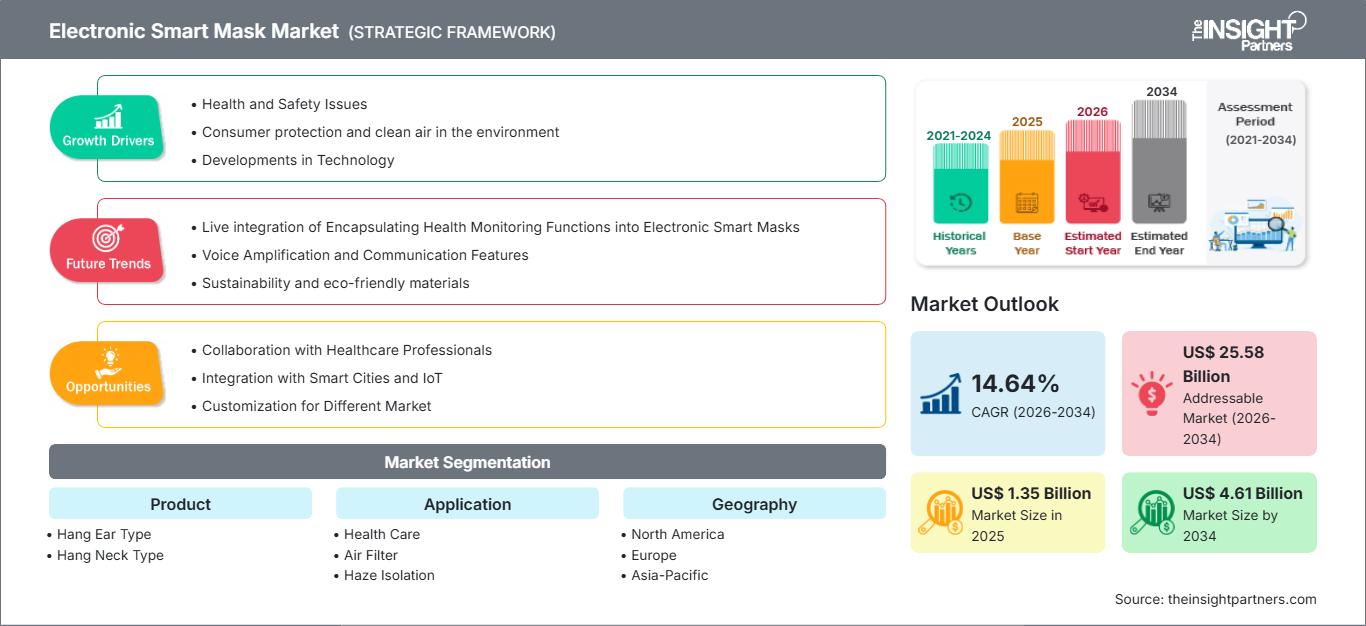
2025 Market Size
US$ 1.35 Bn
Base year value
2034 Forecast
US$ 4.61 Bn
Projected by 2034
CAGR 2026-2034
14.64 %
Growth rate
Addressable Market
US$ 25.58 Bn
(2026-2034)
Electronic Smart Mask Market was valued at US$ 1.35 Billion in 2025 and is projected to reach US$ 4.61 Billion by 2034, expanding at a CAGR of 14.64% during 2026–2034. The market is advancing through the convergence of wearable electronics, environmental sensing, connected healthcare, and intelligent air-filtration technologies. Manufacturers are integrating biometric monitoring, real-time air quality detection, rechargeable filtration systems, and mobile connectivity to improve respiratory protection while supporting digital health applications across consumer and professional environments.
North America is expected to maintain a strong position throughout the forecast period, supported by increasing adoption of connected healthcare devices, higher consumer awareness regarding airborne health risks, and continuous investments in wearable medical technologies. The regional market is anticipated to register a CAGR in the range of 13.8–14.4% during 2026–2034, with demand reinforced by stricter workplace safety practices, expanding telehealth ecosystems, and rising deployment of smart respiratory protection in healthcare and industrial settings.
Electronic Smart Mask Market Assessment and Insights
- North America: Accounted for 34–36% share in 2025 and is anticipated to grow at a CAGR of 13.8–14.4% during 2026–2034. Market expansion is supported by advanced healthcare infrastructure, widespread wearable technology adoption, and increasing occupational safety regulations across healthcare, manufacturing, and public service sectors.
- U.S.: Represented 74–77% of the North American market in 2025 and is forecast to expand at a CAGR of 13.9–14.5% during 2026–2034, driven by connected health investments, strong consumer electronics penetration, and growing demand for intelligent respiratory monitoring solutions.
- Europe: Held 26–29% share in 2025 and is expected to register a CAGR of 13.2–13.8% during 2026–2034. Germany, the UK, and France remain leading contributors due to industrial safety compliance, environmental awareness, and investments in digital healthcare technologies.
- Asia Pacific: Captured 28–31% share in 2025 and is projected to witness the fastest expansion at a CAGR of 15.8–16.4% during 2026–2034. China, Japan, South Korea, and India continue to strengthen regional manufacturing capabilities while increasing adoption of wearable consumer electronics.
- Largest Segment – Application (Health Care): The healthcare application accounted for 46–49% market share in 2025 and is forecast to grow at a CAGR of 15.0–15.6% during 2026–2034, supported by continuous respiratory monitoring, infection prevention initiatives, and connected patient care.
- High Growth Segment – Product (Hang Neck Type): Hang Neck Type represented 37–40% market share in 2025 and is anticipated to expand at a CAGR of 16.2–16.8% during 2026–2034, benefiting from improved battery integration, ergonomic designs, and demand for extended daily usage.
- Key companies analyzed in detail: Mondial Medical Technologies, LG Electronics Inc., Xiaomi Corporation, Mitsubishi Electric Corporation, Dyson Limited, HimaMonkey, TCL Technology Group Corporation, Honeywell International Inc., 3M Company, and Samsung Electronics Co., Ltd.
Source: The Insight Partners' analysis based on proprietary research, government publications, company annual reports, investor presentations, industry databases, and expert interviews.
Technological advancements have revolutionized the Electronic Smart Mask Market by transforming it from traditional respirators into smart wearable health products that incorporate filtration technology and environmental/physiological sensing capabilities. Advancements in technology such as portable electronics, battery technology, sensing technology and Bluetooth application in mobile devices have improved user experience and reduced maintenance needs. Product differentiation is being sought through software ecosystems, data analytics and personal respiratory health care via reusable masks with replaceable filters.
The industry outlook looks promising due to governmental efforts in promoting adoption of digital health technology, air-quality management in urban environments and investments in wearable technologies. New opportunities will arise in Southeast Asia, the Middle East and select Latin American economies which have experienced urbanization, technological improvements in health care delivery and increased disposable income levels. Growth in regulatory environment for medical wearables and environmental sensing will further spur market expansion.
Electronic Smart Mask Market Report Scope
| Report Attribute | Details |
|---|---|
| Market size in 2025 | US$ 1.35 Billion |
| Market Size by 2034 | US$ 4.61 Billion |
| Global CAGR (2026 - 2034) | 14.64% |
| Historical Data | 2021-2024 |
| Forecast period | 2026-2034 |
Electronic Smart Mask Market Analysis
The rising awareness of airborne pollution hazards, disease control needs, and workplace respiratory safety has driven up the demand from healthcare facilities, industries, and consumer market sectors. Electronic smart masks with sensors measuring particulates, breathing, temperature, and apps are being marketed as multi-use wearable technology instead of the traditional type of protection. The development of the wearable health market has increased interoperability of respiratory equipment and digital healthcare services, thus promoting the use of connected respiratory monitoring devices in hospitals and occupational health centers.
The supply chain has become more robust due to the diverse sourcing of sensor, battery, microcontroller, and advanced filtering components. Strategic partnerships between electronic hardware vendors, healthcare software makers, and material science companies have been facilitating the release of innovative products onto the market. Thus, the Electronic Smart Mask size, Electronic Smart Mask growth, and Electronic Smart Mask scope are growing in parallel with the investments into connected healthcare and wearable electronic solutions.
Competition in the Electronic Smart Mask Market consists of technology differentiations, ecosystem integrations, and ongoing innovations in products. LG Electronics Inc., Xiaomi Corporation, Dyson Limited, Samsung Electronics Co., Ltd., and Honeywell International Inc. continue to develop their innovative filtration systems and wearables using advanced AI technologies for monitoring and energy efficiency. Moreover, Mondial Medical Technologies, Mitsubishi Electric Corporation, 3M Company, HimaMonkey, and TCL Technology Group Corporation build their competitive advantage through respiratory technologies, industrial applications, and consumer oriented smart wearables.
Investments are concentrated on artificial intelligence, sensor miniaturization, antimicrobial materials, and cloud connectivity of health analytics. Healthcare organizations, research organizations, and semiconductor manufacturing are cooperating to promote commercialization and expand international distribution networks. These processes positively contribute to Electronic Smart Mask market share growth, promote favorable Electronic Smart Mask trends, and conduct a thorough Electronic Smart Mask market analysis.
● REPORT CUSTOMIZATION
Tailor This Report To Align With Your Specific Business Requirements
This report can be customized to align precisely with your business objectives, scope, and target markets. Customization options include tailored segmentation, geography, competitive analysis, and strategic insights to support informed decision-making.
Customize This Report →WHAT YOU CAN ADJUST
- ● Segmentations
- ● Geography
- ● Competitive Analysis
- ● Language Preferences
Electronic Smart Mask Market: Strategic Insights
Regional Insights
North America Electronic Smart Mask Market
North America had the market share of 34–36% in 2025, and the region is expected to exhibit CAGR of 13.8-14.4% from 2026 to 2034. The growth in the region will be attributed to the growing adoption of wearable health technology, increasing investments in the connected medical devices, and strict standards for occupational respiratory protection. Growing awareness about air pollution, wildfire smoke, and occupational safety is also anticipated to fuel the demand.
The region is known for its strong research capabilities, semiconductor production facilities, and digital healthcare ecosystem. There is a consistent promotion of preventive healthcare programs by government authorities and healthcare institutions in the region, along with investments by tech giants in the development of AI-driven wearable devices.
U.S. Electronic Smart Mask Market
The U.S. represented 74–77% of the North American market in 2025 and is expected to expand at a CAGR of 13.9–14.5% during 2026–2034. Demand is supported by advanced healthcare infrastructure, high consumer spending on wearable electronics, and strong adoption of connected medical technologies. Hospitals, industrial employers, and technology-conscious consumers increasingly utilize intelligent respiratory devices for preventive healthcare and environmental protection.
The presence of leading electronics manufacturers, healthcare technology developers, and research institutions accelerates product commercialization across the country. Increasing integration of respiratory monitoring with mobile health applications, telehealth platforms, and workplace wellness programs further strengthens domestic demand. Growing emphasis on reusable protective equipment also supports innovation in battery efficiency, lightweight materials, and intelligent filtration technologies.
Europe Electronic Smart Mask Market
Europe held 26–29% of the global market share in 2025 and is projected to grow at a CAGR of 13.2–13.8% during 2026–2034. Germany remains the regional leader owing to its advanced manufacturing ecosystem, strong industrial safety regulations, and continuous investments in medical technology innovation. The region also benefits from rising environmental awareness and increasing adoption of wearable healthcare devices.
The United Kingdom continues expanding deployment of digital healthcare solutions across hospitals and home healthcare environments. Growing public awareness of respiratory health, together with increasing investments in connected healthcare infrastructure, encourages adoption of intelligent respiratory protection. Research collaborations between universities, healthcare providers, and technology companies further accelerate innovation within wearable medical electronics.
France, Italy, and Spain collectively contribute to regional growth through healthcare modernization, industrial digitalization, and improved workplace safety compliance. Demand continues to rise across transportation, manufacturing, healthcare, and consumer markets as governments promote preventive healthcare initiatives and sustainable wearable technologies. These developments support broader commercialization of connected respiratory monitoring devices throughout Southern and Western Europe.
APAC Electronic Smart Mask Market
Asia Pacific captured 28–31% of the global market share in 2025 and is forecast to record the fastest CAGR of 15.8–16.4% during 2026–2034. China leads regional production through extensive consumer electronics manufacturing capabilities and large-scale component supply chains.
Japan and South Korea continue advancing sensor technologies, miniaturized electronics, and premium wearable healthcare products. Their innovation capabilities strengthen commercialization of intelligent respiratory devices with advanced monitoring functions.
India and Australia increasingly benefit from expanding healthcare infrastructure, urban air-quality initiatives, and growing wearable technology adoption. Government support for domestic electronics manufacturing and digital health programs further accelerates regional market development.
Middle East & Africa Electronic Smart Mask Market
The Middle East & Africa market is projected to register a CAGR of 12.6–13.2% during 2026–2034. Saudi Arabia leads regional adoption through healthcare modernization programs, industrial diversification, and investments in smart medical technologies supporting occupational respiratory protection.
The United Arab Emirates continues promoting digital healthcare transformation while expanding deployment of connected wearable technologies across healthcare facilities and public infrastructure projects.
South Africa and the Rest of MEA are witnessing gradual adoption supported by infrastructure investments, industrial safety improvements, and increasing awareness regarding respiratory health. Energy sector expansion, urbanization, and modernization of healthcare systems are expected to sustain future demand.
Segmentation Analysis
Product
The Product segment is expected to register a CAGR of 15.1–15.7% during 2026–2034. Product innovation focuses on ergonomic comfort, battery efficiency, lightweight construction, and intelligent sensor integration. Manufacturers continue introducing reusable smart masks with improved connectivity, filtration efficiency, and mobile application compatibility, supporting adoption across healthcare professionals, industrial workers, and consumers seeking long-duration respiratory protection.
- Hang Ear Type: This design remains widely preferred for everyday consumer use because of its lightweight structure, convenient wearing experience, and compatibility with compact filtration and monitoring technologies. Demand remains stable across urban commuters and healthcare users.
- Hang Neck Type: Growing preference for extended operational time, larger battery capacity, and enhanced airflow systems supports increasing adoption. The design accommodates advanced electronic components while improving comfort during prolonged industrial, healthcare, and outdoor applications.
Application
The Application segment is anticipated to record a CAGR of 15.3–15.9% during 2026–2034. Expanding healthcare digitization, increasing awareness of airborne pollutants, and rising occupational safety requirements continue broadening application opportunities. Intelligent respiratory devices increasingly combine environmental sensing, biometric monitoring, and real-time data connectivity to address multiple end-user requirements across healthcare and industrial environments.
- Health Care: The dominant application benefits from increasing adoption of connected patient monitoring, infection prevention protocols, and respiratory health management. Hospitals and healthcare providers increasingly integrate intelligent wearable respiratory devices into preventive healthcare strategies.
- Air Filter: Demand is expanding as urban populations seek advanced protection against particulate pollution, allergens, and airborne contaminants. Consumer interest in reusable filtration solutions supports continuous product innovation and wider commercial availability.
- Haze Isolation: Increasing frequency of wildfire smoke, industrial emissions, and seasonal air-quality deterioration strengthens adoption. Intelligent monitoring capabilities provide users with real-time environmental information, improving protection during outdoor activities and occupational exposure.
Opportunity Snapshot
| Segment Name | Revenue Contribution | Trend Tag | Adoption Stage |
| Health Care | High | Remote Monitoring | Mature |
| Air Filter | Medium | Urban Pollution | Scaling |
| Haze Isolation | Medium | Wildfire Safety | Emerging |
Electronic Smart Mask Market Growth Drivers and Impact Analysis
Expansion of Connected Healthcare and Remote Patient Monitoring
Wearable technologies have been adopted in healthcare systems with the aim of promoting preventive medicine, disease management, and patient monitoring. Electronic smart masks with the capabilities of measuring respiratory rate, analyzing breathing patterns, and measuring body temperature and wirelessly connect to other devices form part of a wider ecosystem that enables continuous observation of patients' physiological functions beyond clinical environments. Both hospitals, outpatients, and home care providers are testing this technology for minimizing unnecessary trips to hospitals and enhancing patient involvement. With greater ability to integrate with electronic medical records and telemedicine tools, wearable mask makers are now incorporating cloud computing and artificial intelligence capabilities to provide actionable health data. The transition of protective gear into wearable medical devices is paving way for more business opportunities.
Increasing Urban Air Pollution and Occupational Safety Requirements
Urban sprawl, increased industrialization, and increased levels of airborne particles keep pushing up the need for better respiratory protection products. Health laws at the workplace are being tightened, and at the same time, there is increasing emphasis on the development of intelligent personal protective devices that can monitor both environment and health of the wearer. Smart masks give data on environmental conditions like the quality of air, level of particulates, condition of filters, and the breathing process of the user. Various industries such as manufacturing, mining, construction, transport, and healthcare industries increasingly look forward to respiratory protection products with smart features.
Advancements in Miniaturized Sensors and Energy-Efficient Electronics
Progressive developments in semiconductors, batteries, low-energy wireless connectivity, and small environmental sensors have greatly improved the feasibility of electronic smart masks. Current designs offer multi-sensing capabilities without adding any significant mass or compromising user comfort, thus making them ideal for extended daily usage. The advancements in artificial intelligence contribute to the enhanced performance of the breathing analysis, maintenance, and personalized health advice provided by the application on the user's mobile phone. The declining costs of manufacture in microelectronics combined with scaling up production enable manufacturers to launch their products in both high-end and mid-priced markets.
Electronic Smart Mask Market Future Trends
Artificial Intelligence Will Enhance Personalized Respiratory Protection
Artificial Intelligence is anticipated to be a defining feature of the electronic smart masks in the future. The future electronic smart masks will take into account the analysis of breathing habits, environmental factors, and activities of the users to optimize the air flow, filter efficiency, and battery efficiency on their own. Machine learning will help in improving the personalization of advice by detecting any irregularities in the breathing pattern and the environment. Smartphones and other wearable technology, as well as cloud-based health management systems, will facilitate health monitoring and preventative health care programs.
Smart Wearables Will Become Part of Broader Environmental Monitoring Networks
Electronic smart masks are expected to evolve beyond individual protection devices into connected environmental sensing platforms capable of supporting smart city initiatives and public health surveillance. Future devices will securely exchange anonymized environmental information with cloud infrastructure, enabling real-time mapping of pollution levels, airborne hazards, and localized air quality conditions. Improvements in wireless connectivity, edge computing, and Internet of Things architectures will facilitate seamless integration with municipal environmental monitoring systems. Organizations responsible for workplace safety, transportation infrastructure, and emergency response will increasingly utilize aggregated respiratory and environmental data to improve decision-making, resource allocation, and community resilience against emerging environmental challenges.
Electronic Smart Mask Market Opportunities
Commercial Expansion Across Emerging Healthcare Systems
Emerging economies present significant long-term opportunities as governments expand healthcare infrastructure, promote digital health adoption, and increase investment in preventive medicine. Rising disposable income, urbanization, and greater awareness of respiratory wellness are encouraging consumers to adopt connected wearable health technologies. Manufacturers that establish localized production, regional partnerships, and affordable product portfolios can strengthen market penetration while reducing supply chain risks. Collaboration with hospitals, insurance providers, and public healthcare agencies will further improve commercialization opportunities. Vendors capable of adapting products to local regulatory requirements, environmental conditions, and pricing expectations are expected to secure sustainable competitive advantages while expanding their global customer base.
Development of Enterprise Solutions for Industrial Workforce Protection
Industrial organizations increasingly seek intelligent personal protective equipment capable of improving worker safety while supporting operational efficiency. Electronic smart masks integrated with workforce management software, environmental monitoring platforms, and predictive safety analytics create opportunities beyond conventional hardware sales. Subscription-based software services, cloud analytics, and fleet management capabilities enable manufacturers to establish recurring revenue models while delivering measurable value to employers. Mining, construction, chemical processing, logistics, energy, and advanced manufacturing industries are expected to become important enterprise customers as regulatory expectations surrounding occupational health continue to strengthen. These business-to-business opportunities support long-term investment, strategic partnerships, and differentiation through integrated digital safety ecosystems.
Recent Developments
- April 2024: Razer reached a settlement with the U.S. Federal Trade Commission (FTC) regarding marketing claims for its Razer Zephyr electronic air-purifying mask. The agreement required refunds to consumers and prohibited unsubstantiated health claims for future protective equipment. While not a product launch, it represents a significant regulatory event affecting the smart mask industry
- January 2025: The FTC announced that it had begun distributing more than US$1 million in refunds to purchasers of the Razer Zephyr mask following the settlement, marking the conclusion of one of the industry's most notable regulatory actions involving an electronic smart mask.
- October 2024: LG continued global commercialization and accessory support for the LG PuriCare Wearable Air Purifier, maintaining replacement filters, UVnano charging case, and ThinQ app support through its official product channels rather than launching a new generation.
Frequently Asked Questions

- Comprehensive Market Sizing and Forecast Analysis
- Detailed Segmentation Analysis
- In-Depth Market Dynamics Assessment
- Regional and Country-Level Insights
- Competitive Landscape and Company Benchmarking
- Strategic Business Intelligence
Recent Reports
Testimonials

The Insight Partners' SCADA System Market report is comprehensive, with valuable insights on current trends and future forecasts. The team was highly professional, responsive, and supportive throughout. We are very satisfied and highly recommend their services.
RAN KEDEM Partner, Reali Technologies LTDs
I requested a report on a very specific software market and the team produced the report in a few days. The information was very relevant and well presented. I then requested some changes and additions to the report. The team was again very responsive and I got the final report in less than a week.
JEAN-HERVE JENN Chairman, Future Analytica
We worked with The Insight Partners for an important market study and forecast. They gave us clear insights into opportunities and risks, which helped shape our plans. Their research was easy to use and based on solid data. It helped us make smart, confident decisions. We highly recommend them.
PIYUSH NAGPAL Sr. Vice President, High Beam Global
The Insight Partners delivered insightful, well-structured market research with strong domain expertise. Their team was professional and responsive throughout. The user-friendly website made accessing industry reports seamless. We highly recommend them for reliable, high-quality research services
YUKIHIKO ADACHI CEO, Deep Blue, LLC.
This is the first time I have purchased a market report from The Insight Partners.While I was unsure at first, I visited their web site and felt more comfortable to take the risk and purchase a market report.I am completely satisfied with the quality of the report and customer service. I had several questions and comments with the initial report, but after a couple of dialogs over email with their analyst I believe I have a report that I can use as input to our strategic planning process.Thank you so much for taking the extra time and making this a positive experience.I will definitely recommend your service to others and you will be my first call when we need further market data.
JOHN SUZUKI President and Chief Executive Officer, Board Director, BK Technologies
I wish to appreciate your support and the professionalism you displayed in the course of attending to my request for information regarding to infectious disease IVD market in Nigeria. I appreciate your patience, your guidance, and the fact that you were willing to offer a discount, which eventually made it possible for us to close a deal. I look forward to engaging The Insight Partners in the future, all thanks to the impression you have created in me as a result of this first encounter.
DR CHIJIOKE ONYIA MANAGING DIRECTOR, PineCrest Healthcare Ltd.Reason to Buy
- Informed Decision-Making
- Understanding Market Dynamics
- Competitive Analysis
- Identifying Emerging Markets
- Customer Insights
- Market Forecasts
- Risk Mitigation
- Boosting Operational Efficiency
- Strategic Planning
- Investment Justification
- Tracking Industry Innovations
- Aligning with Regulatory Trends





 Get Free Sample for