
Electroosmotic Pump Market Size, Trends & Growth by 2034
Coverage: By Type (Cascaded Electroosmotic Pumps, Porous Electroosmotic Pumps, Planar Shallow Electroosmotic Pumps, Micro pumps); Application (Healthcare, Laboratory, Others) , and Geography (North America, Europe, Asia Pacific, and South and Central America)
- Status : Data Released
- Report Code : TIPRE00020029
- Category : Life Sciences
- No. of Pages : 150
- Available Report Formats :


- Last update date : July 08, 2026


2025 Market Size
US$ 517.98 Mn
Base year value
2034 Forecast
US$ 1,363.77 Mn
Projected by 2034
CAGR 2026-2034
11.36 %
Growth rate
Addressable Market
US$ 8,295.28 Mn
(2026-2034)
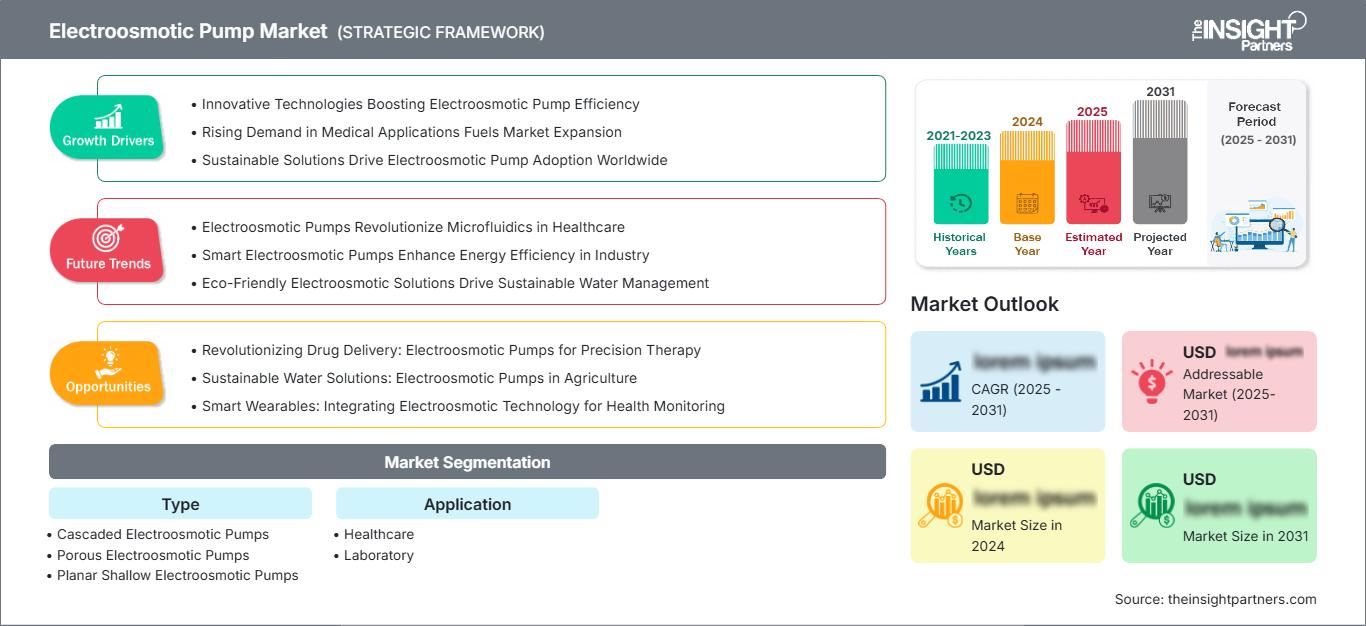
The electroosmotic pump market size was valued at US$ 517.98 Million in 2025 and is projected to reach US$ 1,363.77 Million by 2034, expanding at a CAGR of 11.36% during 2026–2034. Increasing adoption of precision fluid handling technologies across healthcare diagnostics, analytical laboratories, and microfluidic systems is strengthening commercial demand. Continuous advances in miniaturized pumping technologies, coupled with growing investments in lab-on-chip devices and biomedical instrumentation, are supporting sustained market expansion across developed and emerging economies.
North America continues to represent a strategically important regional market, supported by extensive biomedical research infrastructure, advanced semiconductor fabrication capabilities, and strong commercialization of microfluidic technologies. The regional market is expected to expand at an estimated 10.5–11.5% CAGR during 2026–2034, supported by increasing investment in precision diagnostics, pharmaceutical R&D, and point-of-care testing platforms, while expanding collaboration between academic research institutions and technology developers further accelerates product innovation.
Electroosmotic Pump Market Assessment and Insights
- North America: Accounted for an estimated 34–38% electroosmotic pump market share in 2025 and is projected to expand at a 10.5–11.5% CAGR during 2026–2034. Strong medical device innovation, extensive research funding, and commercialization of microfluidic technologies continue supporting regional demand across healthcare and laboratory applications.
- U.S.: Represented approximately 79–83% of the North American market in 2025 and is anticipated to register a 10.8–11.8% CAGR during 2026–2034, supported by advanced life sciences research, biotechnology investments, and widespread laboratory automation.
- Europe: Held an estimated 27–31% market share in 2025 and is forecast to grow at a 10.3–11.3% CAGR during 2026–2034. Germany, the United Kingdom, and France remain leading contributors owing to strong analytical instrumentation manufacturing and biomedical innovation.
- Asia Pacific: Accounted for approximately 24–28% of the market in 2025 and is projected to expand at a 12.2–13.2% CAGR during 2026–2034. China, Japan, South Korea, and India are benefiting from increasing healthcare investments, semiconductor manufacturing expansion, and laboratory modernization initiatives.
- Largest Segment: Healthcare represented an estimated 58–62% market share in 2025 and is expected to grow at a 11.0–12.0% CAGR during 2026–2034, driven by expanding adoption of microfluidic diagnostic platforms and precision drug delivery technologies.
- High Growth Segment: Micro pumps accounted for an estimated 20–24% market share in 2025 and are projected to register a 12.8–13.8% CAGR during 2026–2034, supported by increasing deployment in portable analytical instruments and integrated lab-on-chip systems.
- Key companies analyzed in detail: Takasago Fluidic Systems, Dolomite Microfluidics, Fluigent SAS, Bürkert Fluid Control Systems, ALA Scientific Instruments Inc., Bartels Mikrotechnik GmbH, Micropump Inc., Darwin Microfluidics, Elveflow, and Servoflo Corporation.
Source: The Insight Partners' analysis based on proprietary research, government publications, company annual reports, investor presentations, industry databases, and expert interviews.
Electroosmotic pumping technology has advanced from experimental lab devices used for research purposes to become a marketable tool for fluid handling in highly sophisticated analytical tools. The progress achieved through porous material improvement, electrode durability, micro-fabrication process development, and electronic control systems integration has led to better operational efficiency, higher flow stability, and reduced power consumption. With increasing popularity of miniature analytical equipment for use in drug development, clinical diagnostics, and life sciences research, there is a trend towards the manufacturing process scaling that can fulfill quality and reliability criteria at lower production costs and reduced device size.
The electroosmotic pump market forecast is driven by growing biomedical innovations in Asia Pacific and selected Middle Eastern countries as well as further commercialization of portable diagnostic devices. Growing attention to the speed of disease detection, precision medicine, and laboratory automation promotes further usage of electroosmotic pumping technology. The alliances between medical device manufacturers, semiconductor companies, and suppliers of microfluidics components will promote adoption of the technology and provide new possibilities for customized product development.
Electroosmotic Pump Market Report Scope
| Report Attribute | Details |
|---|---|
| Market size in 2025 | US$ 517.98 Million |
| Market Size by 2034 | US$ 1,363.77 Million |
| Global CAGR (2026 - 2034) | 11.36% |
| Historical Data | 2021-2024 |
| Forecast period | 2026-2034 |
Electroosmotic Pump Market Analysis
Rising requirements for small-size, precise fluid handling systems are promoting the use of electroosmotic pumps within biomedical engineering, pharmaceutical sciences, environment analysis, and analytical chemistry. Compared to the existing mechanical pumping systems, electroosmotic technology provides pulseless flow, minimum wear, and high accuracy for working with very small amounts of liquids. This is becoming an important advantage for DNA sequencing, protein analysis, point of care diagnostics, and organ-on-a-chip technologies. The increasing focus on small-size healthcare equipment and automation in the laboratory processes is contributing to the Electroosmotic Pump size improvement and providing additional opportunities for commercialization around the world.
Further development of the industry value chain is facilitated by the advancement in the fields of advanced ceramics, porous glass technology, precision polymers production, semiconductor manufacturing, and MEMS technology. Component manufacturers and system integrators are working together more actively for improving fluidic properties, minimizing manufacturing complications, and enhancing product uniformity. Rising demand from pharmaceutical companies, academic labs, and biotech organizations is stimulating suppliers to develop comprehensive solutions integrating electroosmotic pumps with various sensors, controllers, and analytical systems. These electroosmotic pump market trends contribute to analysis as well as expanding its scope.
Competition in the electroosmotic pump market continues to be defined by technology specialization rather than mass production capacity. Such firms as Takasago Fluidic Systems, Dolomite Microfluidics, Fluigent SAS, Bürkert Fluid Control Systems, and Bartels Mikrotechnik GmbH have been developing their products in order to increase flow accuracy, device resistance, and integration potential for laboratory automation systems. At the same time, Elveflow, Darwin Microfluidics, ALA Scientific Instruments Inc., Micropump Inc., and Servoflo Corporation have been augmenting their product lines by offering customized fluid management solutions for research centers and medical device manufacturers.
R&D activities are becoming more and more focused on scalable microfluidic manufacturing processes, MEMS technologies, and biomedical instruments. The progress of government-sponsored research projects, university-industry partnerships, and biotech investments accelerates commercialization of next-generation fluidic devices around the world. As the need for precision diagnostics keeps growing, the development of modular Electroosmotic Pump products that can be applied for different purposes without customization has become a priority for manufacturers. This strategy is supposed to positively affect Electroosmotic Pump share, Electroosmotic Pump growth prospects, and Electroosmotic Pump trends in the healthcare, analytics, and laboratory automation sectors.
● REPORT CUSTOMIZATION
Tailor This Report To Align With Your Specific Business Requirements
This report can be customized to align precisely with your business objectives, scope, and target markets. Customization options include tailored segmentation, geography, competitive analysis, and strategic insights to support informed decision-making.
Customize This Report →WHAT YOU CAN ADJUST
- ● Segmentations
- ● Geography
- ● Competitive Analysis
- ● Language Preferences
Electroosmotic Pump Market: Strategic Insights
Regional Insights
North America Electroosmotic Pump Market
North America was projected to contribute around 34-38% share to the total worldwide Electroosmotic Pump Market in 2025 and is likely to grow at a CAGR of 10.5-11.5% during 2026-2034. North America enjoys a well-developed infrastructure in its healthcare sector along with heavy investment in biotechnology and use of microfluidics technology in diagnostics and pharmaceutical R&D.
Availability of leading research institutions, contract research organizations and companies manufacturing medical devices has been instrumental in boosting the commercialization of the electroosmotic pump technology. Higher usage of lab-on-a-chip technology, molecular diagnostic tools and initiatives towards precision medicine have been creating demands for high precision and pulseless fluid flow technology in the region.
U.S. Electroosmotic Pump Market
The U.S. represented approximately 79–83% of the Electroosmotic Pump market in North America in 2025 and is projected to register a 10.8–11.8% CAGR during 2026–2034. Strong investment in pharmaceutical research, biotechnology innovation, and analytical instrumentation supports continued adoption of electroosmotic pumps. Expanding clinical diagnostics, genomics research, and laboratory automation initiatives are reinforcing demand for precision microfluidic components across both research and commercial environments.
Major industry participants, research institutions, and medical technology developers in the electroosmotic pump market continue to collaborate on advanced microfluidic platforms designed for next-generation healthcare applications. The country's mature semiconductor manufacturing ecosystem also supports fabrication of high-performance MEMS-based fluidic components. Increasing commercialization of portable diagnostic devices and personalized medicine solutions is expected to further strengthen long-term market expansion.
Europe Electroosmotic Pump Market
Europe held an estimated 27–31% share of the global electroosmotic pump market in 2025 and is anticipated to grow at a 10.3–11.3% CAGR during 2026–2034. Germany remains the leading regional market owing to its strong precision engineering capabilities, established analytical instrumentation sector, and extensive investments in biomedical research. Continued collaboration between universities, healthcare organizations, and technology developers supports steady innovation.
The UK electroosmotic pump market continues to experience healthy adoption of electroosmotic pumping technologies through expanding biotechnology research, pharmaceutical innovation, and increasing investment in laboratory automation. Government-supported life sciences programs and commercialization of advanced diagnostic platforms contribute to sustained market development while encouraging adoption across clinical laboratories and research institutions.
France, Italy, and Spain collectively contribute to regional expansion through increasing healthcare modernization, research funding, and analytical laboratory upgrades. France benefits from strong pharmaceutical research capabilities, while Italy supports advanced medical device manufacturing. Spain continues strengthening biotechnology innovation through public-private partnerships, creating favorable conditions for broader deployment of precision fluid handling technologies across laboratory and healthcare applications.
APAC Electroosmotic Pump Market
Asia Pacific accounted for approximately 24–28% of the global electroosmotic pump market in 2025 and is forecast to register the fastest regional expansion at a 12.2–13.2% CAGR during 2026–2034. China remains the largest regional contributor due to expanding medical device manufacturing and growing biotechnology investments.
Japan and South Korea continue advancing precision engineering, semiconductor manufacturing, and laboratory automation technologies, supporting increased integration of electroosmotic pumps into analytical instruments and biomedical devices.
India and Australia are experiencing growing demand through healthcare infrastructure modernization, expanding research capabilities, and government initiatives supporting biotechnology innovation, creating favorable conditions for long-term regional development.
Middle East & Africa Electroosmotic Pump Market
The Middle East & Africa electroosmotic pump market is projected to expand at a 9.4–10.4% CAGR during 2026–2034, supported by increasing investments in healthcare infrastructure and laboratory modernization. Saudi Arabia continues leading regional adoption through strategic life sciences investments and research development initiatives.
The United Arab Emirates is strengthening biotechnology capabilities through innovation-focused healthcare projects and expansion of advanced diagnostic facilities, encouraging greater deployment of precision microfluidic technologies.
South Africa and the Rest of the Middle East & Africa are gradually increasing adoption as universities, research laboratories, and healthcare providers invest in analytical instrumentation, supporting steady demand for electroosmotic pumping systems across emerging scientific and clinical applications.
Segmentation Analysis
Type
The Type segment in the electroosmotic pump market is expected to expand at a 11.4–12.4% CAGR during 2026–2034. Continuous advances in microfabrication, porous materials, and integrated electronics are enabling manufacturers to improve flow precision, reliability, and energy efficiency across electroosmotic pumping technologies. Growing deployment in analytical instruments, biomedical devices, and portable diagnostic platforms continues to support product innovation while addressing application-specific fluid management requirements.
- Cascaded Electroosmotic Pumps: These systems provide enhanced pressure generation through multiple electroosmotic stages, making them suitable for high-performance analytical equipment, pharmaceutical research instruments, and advanced laboratory automation where stable, high-pressure fluid delivery is essential.
- Porous Electroosmotic Pumps: Widely adopted because of their simple construction and efficient fluid transport, porous electroosmotic pumps are increasingly utilized in microfluidic research, biosensing applications, and compact diagnostic devices requiring reliable low-flow operation.
- Planar Shallow Electroosmotic Pumps: Their compact geometry and compatibility with MEMS fabrication processes make them attractive for integrated lab-on-chip systems, portable analytical platforms, and miniaturized biomedical devices requiring highly controlled fluid movement.
- Micro pumps: Rising demand for portable healthcare equipment, wearable diagnostic systems, and point-of-care testing devices continues to strengthen adoption of micro pumps, positioning them as the fastest-expanding technology category within advanced electroosmotic pumping solutions.
Application
The Application segment is projected to register a 11.2–12.2% CAGR during 2026–2034. Growing demand for accurate fluid handling across life science research, molecular diagnostics, and laboratory automation continues driving adoption. Increasing integration of electroosmotic pumping technology into compact analytical instruments is supporting broader commercialization across healthcare institutions and research laboratories worldwide.
- Healthcare: Healthcare remains the leading application due to increasing utilization of electroosmotic pumps in molecular diagnostics, drug discovery, organ-on-chip research, precision medicine, and portable diagnostic devices requiring pulse-free microfluidic control.
- Laboratory: Laboratory applications continue expanding through increasing automation of analytical workflows, academic research activities, environmental testing, and pharmaceutical quality control, where accurate low-volume fluid transport significantly improves experimental reproducibility and operational efficiency.
Opportunity Snapshot
| Segment Name | Revenue Contribution | Trend Tag | Adoption Stage |
| Healthcare | High | Point-of-Care | Mature |
| Laboratory | Medium | Lab Automation | Scaling |
Electroosmotic Pump Market Growth Drivers and Impact Analysis
Rising Adoption of Microfluidics in Healthcare Diagnostics
The fast adoption of microfluidics technology in clinical diagnostics has resulted in growing needs for electro-osmotic pumps that are capable of providing stable and accurate fluid delivery without pulses. The adoption of compact analytical devices in hospitals, diagnostic labs, and biotech firms is resulting in the need for such pumping devices because of their capability to provide exact delivery of tiny amounts of liquids used in molecular diagnostics, immunodiagnostics, and genomics. Electro-osmotic pumps offer increased accuracy of analysis, decrease in the amount of sample required for testing and overall simplification of the analytical process, which makes them well-suited for next generation diagnostics equipment. Increased investment in point-of-care diagnostics, precision medicine, and portable health care devices drives market growth even more.
Growing Laboratory Automation and Research Investments
The growing use of laboratory automation by pharmaceutical companies, research centers, and academic institutions is providing persistent growth prospects for electroosmotic pump suppliers. Automated analytical processes require accurate and consistent systems of fluid transfer capable of carrying out such operations as chromatography, sample preparation, cellular analysis, and chemical synthesis. In addition, electroosmotic pumps help to reduce mechanical pulsations and provide high flow stability. Growing government investment in the biotechnology, life sciences, and biomedical engineering sectors is spurring the need to upgrade the analytical capabilities of laboratories. On the other hand, pharmaceutical companies keep raising their expenditures on drug discovery and biologics development, which drives the need for dependable microfluidic systems.
Advancements in MEMS and Precision Manufacturing Technologies
Constant innovations in MEMS technology, semiconductor technology, and precise manufacturing methods will lead to the creation of miniaturized, efficient, and well-integrated electro-osmotic pumps. Innovations in terms of porous material, microchannel design, electrodes, and electronics have led to increased stability, longevity, energy efficiency, and cost-effectiveness of such devices. The technological advances have made it possible to integrate electro-osmotic pumps into wearable medical devices, portable analyzers, environmental monitoring devices, and laboratory equipment. Closer cooperation of semiconductor manufacturers, biomedical engineers, and medical device makers will facilitate the commercial success of the next generation of liquid handling systems.
Electroosmotic Pump Market Future Trends
Integration with Next-Generation Lab-on-Chip Platforms
Electroosmotic pumps have been becoming more and more an indispensable part of the next generation laboratory on chip platforms for diagnostics, drug discovery, and environmental analysis. Modern producers are working on creation of miniaturized pump devices for combination with sensors, microchannels, and electronics for making automated analysis systems. Miniaturization will provide reduction in the size of instruments with improved analysis accuracy and efficiency. R&D institutions give much attention to production of disposable microfluidic cartridges allowing high throughput analysis with low volumes of the samples. Further development of integrated microfluidic systems will widen areas of commercial use including healthcare, food analysis, environment protection, and forensics.
Increasing Development of Portable and Wearable Analytical Devices
Portable analytical instruments and wearable medical technologies are expected to become important application areas for electroosmotic pumping systems during the forecast period. Growing demand for decentralized diagnostics, continuous patient monitoring, and field-based analytical testing is encouraging manufacturers to design lightweight, energy-efficient, and highly reliable fluid management solutions. Electroosmotic pumps provide precise liquid movement without moving mechanical parts, improving operational stability while reducing maintenance requirements. Advancements in battery technology, wireless connectivity, and miniaturized electronics are enabling the commercialization of compact diagnostic systems for clinical, industrial, and environmental applications. This trend is expected to encourage wider adoption across emerging healthcare delivery models and mobile analytical platforms.
Electroosmotic Pump Market Opportunities
Expansion Across Emerging Healthcare Infrastructure Markets
Developing economies are investing substantially in healthcare modernization, biotechnology research, and advanced laboratory infrastructure, creating favorable conditions for electroosmotic pump suppliers. Governments are supporting domestic production of medical devices while expanding access to precision diagnostics and laboratory testing services. These investments are increasing demand for compact fluid management technologies capable of supporting modern analytical equipment. Manufacturers that establish regional partnerships, localized production capabilities, and technical support networks are well positioned to capitalize on expanding procurement opportunities. Customized products designed for cost-sensitive healthcare systems and research laboratories can further strengthen market penetration. As healthcare infrastructure continues improving across Asia, the Middle East, and selected Latin American countries, long-term commercial opportunities are expected to increase significantly.
Strategic Collaborations for Customized Microfluidic Solutions
Collaborative product development between electroosmotic pump manufacturers, medical device companies, biotechnology firms, and analytical instrument producers is creating substantial opportunities for differentiated market offerings. Customers increasingly require application-specific fluid management systems optimized for diagnostics, pharmaceutical research, environmental monitoring, and industrial testing. Joint development programs allow manufacturers to integrate electroosmotic pumping technologies into complete analytical platforms while shortening product development cycles. Strategic alliances also support technology transfer, manufacturing optimization, and global market expansion. Companies investing in modular product architectures, digital control systems, and customized engineering services are expected to strengthen customer relationships while capturing higher-value commercial contracts across rapidly evolving microfluidic and biomedical technology markets.
Recent Developments
- March 2025: Dolomite Microfluidics expanded its microfluidics platform portfolio supporting integration of electroosmotic flow technologies in advanced lab-on-chip research applications through updated modular fluidic systems. Is it accurate and related to the Electroosmotic Pump Market?
- January 2024: Researchers at Advanced Functional Materials published a new electroosmotic pump-based chemical delivery platform utilizing anionic and cationic hydrogels for precise spatiotemporal drug delivery, demonstrating advances in electroosmotic pump technology for biomedical microfluidics.
- February 2025: Sandur Fluid Controls Pvt. Ltd. expanded the commercialization of its Electro-Osmotic Pump (EOP) portfolio, highlighting applications in microfluidics, capillary electrophoresis, membrane separation, and biomedical systems while promoting advanced electroosmotic pump solutions for research and industrial users through its official product platform.
Frequently Asked Questions

- Comprehensive Market Sizing and Forecast Analysis
- Detailed Segmentation Analysis
- In-Depth Market Dynamics Assessment
- Regional and Country-Level Insights
- Competitive Landscape and Company Benchmarking
- Strategic Business Intelligence
Recent Reports
Testimonials

The Insight Partners' SCADA System Market report is comprehensive, with valuable insights on current trends and future forecasts. The team was highly professional, responsive, and supportive throughout. We are very satisfied and highly recommend their services.
RAN KEDEM Partner, Reali Technologies LTDs
I requested a report on a very specific software market and the team produced the report in a few days. The information was very relevant and well presented. I then requested some changes and additions to the report. The team was again very responsive and I got the final report in less than a week.
JEAN-HERVE JENN Chairman, Future Analytica
We worked with The Insight Partners for an important market study and forecast. They gave us clear insights into opportunities and risks, which helped shape our plans. Their research was easy to use and based on solid data. It helped us make smart, confident decisions. We highly recommend them.
PIYUSH NAGPAL Sr. Vice President, High Beam Global
The Insight Partners delivered insightful, well-structured market research with strong domain expertise. Their team was professional and responsive throughout. The user-friendly website made accessing industry reports seamless. We highly recommend them for reliable, high-quality research services
YUKIHIKO ADACHI CEO, Deep Blue, LLC.
This is the first time I have purchased a market report from The Insight Partners.While I was unsure at first, I visited their web site and felt more comfortable to take the risk and purchase a market report.I am completely satisfied with the quality of the report and customer service. I had several questions and comments with the initial report, but after a couple of dialogs over email with their analyst I believe I have a report that I can use as input to our strategic planning process.Thank you so much for taking the extra time and making this a positive experience.I will definitely recommend your service to others and you will be my first call when we need further market data.
JOHN SUZUKI President and Chief Executive Officer, Board Director, BK Technologies
I wish to appreciate your support and the professionalism you displayed in the course of attending to my request for information regarding to infectious disease IVD market in Nigeria. I appreciate your patience, your guidance, and the fact that you were willing to offer a discount, which eventually made it possible for us to close a deal. I look forward to engaging The Insight Partners in the future, all thanks to the impression you have created in me as a result of this first encounter.
DR CHIJIOKE ONYIA MANAGING DIRECTOR, PineCrest Healthcare Ltd.Reason to Buy
- Informed Decision-Making
- Understanding Market Dynamics
- Competitive Analysis
- Identifying Emerging Markets
- Customer Insights
- Market Forecasts
- Risk Mitigation
- Boosting Operational Efficiency
- Strategic Planning
- Investment Justification
- Tracking Industry Innovations
- Aligning with Regulatory Trends





 Get Free Sample for