
Endoscope Cleaning Swab Market Size, Demand & Growth by 2034
Coverage: By Type (Single Ended Brush, Double Ended Brush); End User (Hospitals and Clinics, Diagnostic Labs, Ambulatory Surgery Centers), and Geography (North America, Europe, Asia Pacific, and South and Central America)
- Status : Data Released
- Report Code : TIPRE00019713
- Category : Life Sciences
- No. of Pages : 150
- Available Report Formats :


- Last update date : July 08, 2026


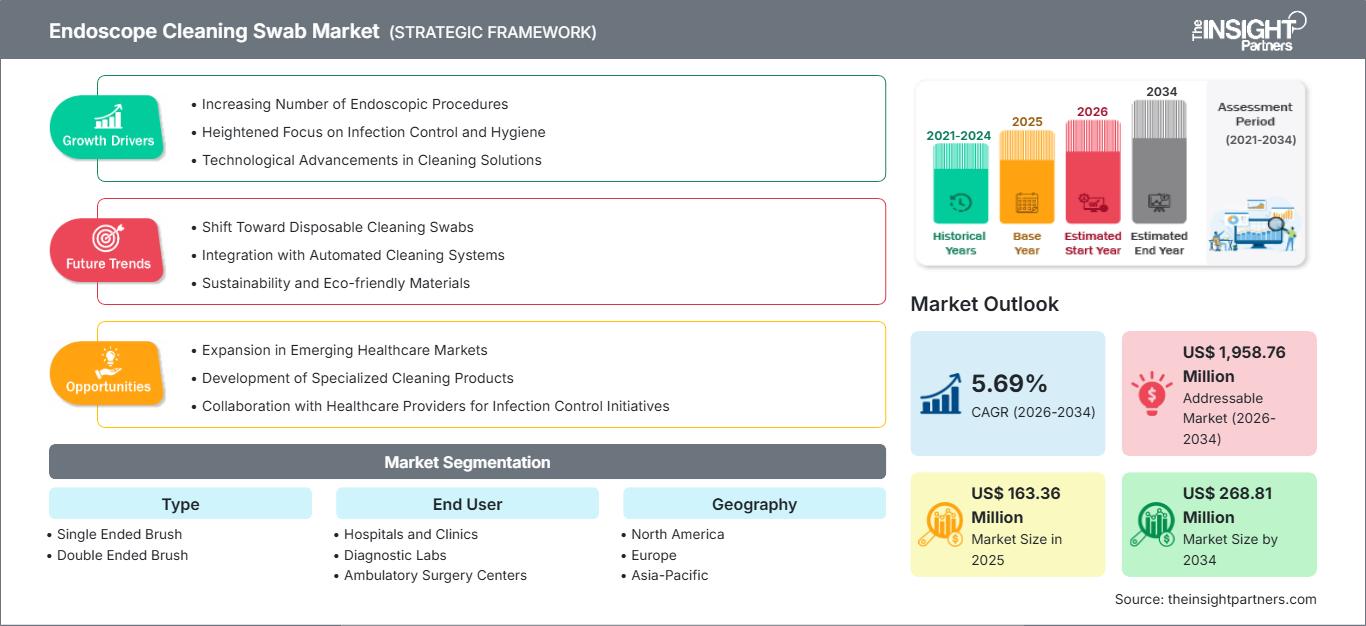
2025 Market Size
US$ 163.36 Mn
Base year value
2034 Forecast
US$ 268.81 Mn
Projected by 2034
CAGR 2026-2034
5.69 %
Growth rate
Addressable Market
US$ 1,958.76 Mn
(2026-2034)
The endoscope cleaning swab market size was valued at US$ 163.36 million in 2025 and is projected to reach US$ 268.81 million by 2034, expanding at a CAGR of 5.69% during 2026–2034. Market expansion is supported by increasing endoscopic procedures, heightened infection prevention standards, and the adoption of validated cleaning accessories across healthcare facilities. Continuous improvements in sterile processing workflows and regulatory emphasis on reprocessing quality further strengthen long-term demand for specialized cleaning swabs.
According to the endoscope cleaning swab market report, North America is expected to maintain its leadership throughout the forecast period, supported by a mature healthcare infrastructure and stringent medical device reprocessing regulations. The regional market is anticipated to expand at a CAGR of 5.3–5.8% between 2026 and 2034. Rising procedural volumes, broader implementation of infection prevention protocols, and sustained investments in hospital sterilization departments continue to reinforce regional demand for high-performance endoscope cleaning accessories.
Endoscope Cleaning Swab Market Assessment and Insights
- North America: Accounted for 37–41% endoscope cleaning swab market share in 2025 and is projected to expand at a CAGR of 5.3–5.8% during 2026–2034. High procedural volumes, strict endoscope reprocessing guidelines, and increasing investments in infection prevention technologies support sustained market expansion across hospitals and ambulatory care settings.
- U.S.: Represented 82–86% of the North American market in 2025 and is anticipated to grow at a CAGR of 5.4–5.9% through 2034. Growth is driven by extensive endoscopy utilization, replacement demand for single-use cleaning products, and regulatory compliance requirements.
- Europe: Held 27–31% share in 2025 and is forecast to register a CAGR of 5.1–5.6% between 2026 and 2034. Germany, the UK, and France remain the largest contributors due to established healthcare systems and stringent sterilization practices.
- Asia Pacific: Captured 22–26% share in 2025 and is expected to record the fastest regional CAGR of 6.2–6.8% during the forecast period. China, Japan, India, and South Korea continue to benefit from expanding healthcare infrastructure and increasing gastrointestinal screening programs.
- Largest Segment: Hospitals and Clinics accounted for 61–65% endoscope cleaning swab market share in 2025 and are projected to grow at a CAGR of 5.6–6.0% through 2034, supported by high endoscopy procedure volumes and stringent infection control requirements.
- High Growth Segment: Double Ended Brush is projected to grow at a CAGR of 6.3–6.8% while accounting for 44–48% market share in 2025, reflecting increasing preference for efficient multi-surface cleaning during endoscope reprocessing.
- Key companies analyzed in detail: Cook Medical LLC, Becton, Dickinson and Company, STERIS plc, Olympus Corporation, 3M Company, Hygiena LLC, Jiangsu Kangjin Medical Instrument Co., Ltd., Smartdata Medical, GA Health Company Limited, and Advanced Sterilization Products, Inc.
Source: The Insight Partners' analysis based on proprietary research, government publications, company annual reports, investor presentations, industry databases, and expert interviews.
Greater procedural complexity and the increasing significance attached to infection prevention issues have resulted in a shift in the priorities of manufacturers of endoscope cleaning accessories. Manufacturers have been placing greater focus on improving the durability of fibers, compatibility of cleaning accessories with flexible endoscope channels, and sterilized one-use designs that reduce contamination possibilities. Increasing automation in sterile processing departments, combined with changing international guidelines on reprocessing from healthcare organizations, is contributing towards the demand for standardized cleaning consumables. These factors are having a positive impact on the endoscope cleaning swab market, as manufacturers are optimizing their production processes, quality management system, and distribution networks in order to meet expanding healthcare needs.
The endoscope cleaning swab market forecast indicates that manufacturers are projected to make investment in emerging healthcare markets where there is an increase in the number of diagnostics endoscopy capabilities. Increased healthcare modernization programs, higher reimbursement, and infection prevention accreditation requirements are likely to drive product adoption. Development of digital tracking systems, sustainable manufacturing practices, and product innovation aimed at compatibility with advanced endoscope platforms is going to enhance the scope of the endoscope cleaning swab market.
Endoscope Cleaning Swab Market Report Scope
| Report Attribute | Details |
|---|---|
| Market size in 2025 | US$ 163.36 Million |
| Market Size by 2034 | US$ 268.81 Million |
| Global CAGR (2026 - 2034) | 5.69% |
| Historical Data | 2021-2024 |
| Forecast period | 2026-2034 |
Endoscope Cleaning Swab Market Analysis
With increasing global demand for minimally invasive diagnostics and treatment, the consumption of endoscope cleaning swabs has been boosted. With increasing numbers of elderly, chronically ill patients, and preventive screening campaigns, gastrointestinal, pulmonary, and urological procedures have been rising. Invalidation of manual endoscope cleaning is considered one of the main reasons of their contamination, therefore, healthcare specialists pay attention to the validation of cleaning procedures, which stimulates purchasing of special accessories providing reliable performance. Moreover, healthcare providers tend to use standard products and this is another reason why endoscope cleaning swabs will be growing in size among hospitals' procurements.
Market ecosystem comprises of material providers, medical components manufacturers, sterilization solutions producers, distributors, healthcare organizations, and regulators. Supply chain resilience is an increasingly relevant factor in regard to uninterrupted delivery of sterile products. Therefore, manufacturers have been improving their production capacities and inventories of products.
Competition in the endoscope cleaning swab market is becoming more oriented toward innovation, regulatory compliance, manufacturing quality, and global distribution than prices. Companies like Cook Medical LLC, Becton, Dickinson and Company, STERIS plc, Olympus Corporation, and 3M Company remain committed to improving their products, gaining regulatory approval and expanding their commercial reach. On the other hand, Hygiena LLC, Jiangsu Kangjin Medical Instrument Co., Ltd., Smartdata Medical, GA Health Company Limited, and Advanced Sterilization Products, Inc. enhance competition through meeting unique customer needs in regional healthcare markets. Product development efforts of the companies mentioned above contribute to the growing endoscope cleaning swab market share in institutional purchasing.
The investment trend in the industry becomes more oriented towards infection control technologies, sustainable manufacturing, automation of the sterile processing workflow, and healthcare digitalization. Comprehensive reprocessing management solutions are being adopted by hospitals that facilitate better documentation and compliance with international quality standards. Cooperation between manufacturers of medical devices and healthcare institutions is expected to facilitate faster commercialization of next generation of cleaning accessories. Such trends contribute to positive developments in the endoscope cleaning swab market while supporting the endoscope cleaning swab market analysis provided in the report.
● REPORT CUSTOMIZATION
Tailor This Report To Align With Your Specific Business Requirements
This report can be customized to align precisely with your business objectives, scope, and target markets. Customization options include tailored segmentation, geography, competitive analysis, and strategic insights to support informed decision-making.
Customize This Report →WHAT YOU CAN ADJUST
- ● Segmentations
- ● Geography
- ● Competitive Analysis
- ● Language Preferences
Endoscope Cleaning Swab Market: Strategic Insights
Regional Insights
North America Endoscope Cleaning Swab Market
North America accounted for 37–41% of the global market share in 2025 and is projected to expand at a CAGR of 5.3–5.8% during 2026–2034. The region benefits from a mature healthcare infrastructure, high endoscopy procedure volumes, and stringent reprocessing standards established by regulatory agencies and professional organizations. Continuous investments in hospital sterilization departments and growing adoption of single-use cleaning accessories further support market expansion.
Healthcare providers across the U.S. and Canada continue to prioritize validated cleaning protocols to reduce healthcare-associated infections and improve patient safety. Rising use of disposable accessories, along with upgrades in central sterile services departments, would help maintain demand for high-end endoscope-cleaning swabs during the forecast period.
U.S. Endoscope Cleaning Swab Market
The U.S. represented 82–86% of the North American market in 2025 and is anticipated to register a CAGR of 5.4–5.9% between 2026 and 2034. The country's leadership is supported by one of the world's largest installed bases of flexible endoscopes, increasing gastrointestinal screening programs, and strong compliance with infection prevention regulations. Hospitals and outpatient facilities continue expanding investments in sterile processing technologies to improve operational efficiency.
The presence of major manufacturers, well-developed distribution networks, and frequent product innovation further strengthens the national market. Rising awareness regarding endoscope contamination, combined with increasing accreditation requirements and quality audits, encourages healthcare providers to adopt validated cleaning accessories. Growing procedure volumes across gastroenterology, pulmonology, and urology specialties are expected to sustain stable procurement demand throughout the forecast period.
Europe Endoscope Cleaning Swab Market
Europe held 27–31% of the global endoscope cleaning swab market share in 2025 and is forecast to grow at a CAGR of 5.1–5.6% during 2026–2034. Germany remains the leading national market owing to its advanced hospital infrastructure, extensive endoscopy services, and widespread implementation of standardized medical device reprocessing protocols. Continuous investments in infection prevention technologies further reinforce regional demand.
The United Kingdom continues to experience stable market expansion as national healthcare providers increase diagnostic endoscopy capacity to address growing demand for colorectal cancer screening and gastrointestinal disease management. Modernization of sterilization departments and stricter quality assurance measures encourage broader adoption of disposable endoscope cleaning accessories, supporting consistent procurement across public and private healthcare facilities.
France, Italy, and Spain collectively contribute a significant share of regional demand through ongoing healthcare modernization and increasing adoption of minimally invasive diagnostic procedures. Investments in hospital infrastructure, rising awareness regarding cross-contamination prevention, and harmonized European medical device regulations continue supporting demand for high-quality endoscope cleaning swabs across these countries, although Germany remains the largest contributor to regional revenue.
APAC Endoscope Cleaning Swab Market
Asia Pacific accounted for 22–26% of the global market share in 2025 and is projected to record the fastest regional CAGR of 6.2–6.8% through 2034. China leads regional revenue generation, supported by rapid expansion of hospital infrastructure and increasing procedural volumes.
Japan and South Korea continue strengthening market demand through advanced healthcare systems, aging populations, and widespread adoption of minimally invasive diagnostics. High-quality sterilization practices further encourage use of specialized cleaning accessories.
India and Australia are witnessing increasing investments in healthcare infrastructure, diagnostic capacity expansion, and infection prevention initiatives. Government healthcare modernization programs and growing awareness of standardized endoscope reprocessing are expected to accelerate regional market development during the forecast period.
Middle East & Africa Endoscope Cleaning Swab Market
The Middle East & Africa endoscope cleaning swab market is projected to register a CAGR of 5.0–5.5% during 2026–2034. Saudi Arabia remains the leading regional market owing to continued investments in healthcare infrastructure, hospital expansion, and modernization of medical device sterilization practices.
The United Arab Emirates continues to strengthen demand through increasing private healthcare investments and adoption of internationally recognized infection prevention standards. Advanced specialty hospitals are expanding endoscopy capabilities across multiple clinical disciplines.
South Africa and the Rest of the Middle East & Africa are gradually increasing adoption of standardized endoscope reprocessing products as healthcare access improves. Continued investment in healthcare infrastructure, medical training, and infection prevention programs is expected to support steady market expansion across the region.
Segmentation Analysis
Type
By Type, the CAGR growth is expected to range between 5.8 and 6.2% during 2026 and 2034. The trend for innovations in the products includes increasing efforts toward efficient cleaning, access to channels, and compatibility with flexible endoscopes that are used in various fields of healthcare. Infection prevention regulations require standardizing cleaning of the endoscope manually; therefore, the use of special cleaning brushes is encouraged by medical facilities.
- Single Ended Brush: Widely adopted for routine manual cleaning of endoscope channels where precise access is required. The product remains important in healthcare facilities seeking cost-effective, validated cleaning solutions that support standardized reprocessing workflows and regulatory compliance.
- Double Ended Brush: Demand continues to increase because dual-ended configurations improve cleaning efficiency across different channel sizes during a single reprocessing cycle. Hospitals increasingly prefer these brushes to optimize workflow, reduce cleaning time, and improve consistency in manual endoscope reprocessing.
End User
The End User segment is projected to expand at a CAGR of 5.6–6.0% during 2026–2034. Rising procedural volumes, increasing investments in infection prevention, and growing regulatory scrutiny surrounding endoscope reprocessing continue to drive procurement across healthcare facilities. Hospitals remain the primary consumers due to their extensive diagnostic and therapeutic endoscopy services, while outpatient settings continue expanding demand as minimally invasive procedures become more accessible.
- Hospitals and Clinics: This segment represents the largest demand base owing to high procedure volumes, established sterile processing departments, and continuous procurement of validated cleaning accessories to maintain regulatory compliance and patient safety.
- Diagnostic Labs: Diagnostic laboratories increasingly utilize specialized cleaning accessories for reusable endoscopic instruments supporting advanced diagnostic workflows. Growing emphasis on contamination prevention and standardized laboratory quality systems continues to strengthen procurement activity.
- Ambulatory Surgery Centers: Rising adoption of minimally invasive procedures in outpatient environments supports increasing demand for efficient and easy-to-use cleaning products. Expansion of ambulatory surgical services and shorter patient turnaround times encourage consistent use of disposable endoscope cleaning swabs.
Opportunity Snapshot
| Segment Name | Revenue Contribution | Trend Tag | Adoption Stage |
| Hospitals and Clinics | High | Infection Control | Mature |
| Diagnostic Labs | Medium | Quality Validation | Scaling |
| Ambulatory Surgery Centers | Medium | Outpatient Expansion | Scaling |
Endoscope Cleaning Swab Market Growth Drivers and Impact Analysis
Increasing Endoscopic Procedure Volumes Worldwide
Growth in the number of gastrointestinal, respiratory, urological, and otolaryngological procedures will lead to continued growth in demand for endoscope cleaning products. Aging of population, rising prevalence of chronic gastrointestinal conditions, and adoption of more preventive screening programs contribute to increasing use of flexible endoscopes in healthcare organizations. Each and every used endoscope should be manually cleaned prior to disinfection or sterilization, which makes cleaning swabs essential part of the reprocessing process. The development of new endoscopy departments in hospitals alongside the rise in number of minimally invasive procedures performed in ambulatory surgery centers can be observed. With growing number of procedures in both developed and developing countries, purchases of specific cleaning swabs are anticipated to grow steadily.
Stricter Infection Prevention and Reprocessing Regulations
Regulatory requirements pertaining to the reprocessing of medical devices have been continuously enhanced owing to increased awareness regarding infections associated with endoscopes. Standard procedures for endoscope cleaning are being developed and adopted along with documented quality assurance processes and training for employees. Such trends make healthcare facilities more motivated to switch from conventional cleaning devices to those designed specifically for endoscopes and adhering to certain criteria for performance. Emphasis on patient safety and audit preparation as well as documentable reprocessing processes has also contributed to the increased adoption of disposable cleaning accessories. Thus, companies able to provide regulation-compliant products of good quality and compatible with various types of endoscopes are likely to receive ongoing orders in the forecast period.
Expansion of Healthcare Infrastructure in Emerging Economies
Investments in health infrastructure in Asia Pacific, Latin America, and even the Middle East have been contributing to improved access to more advanced diagnostic and therapeutic services, such as endoscopy procedures. There have been continued investments by governments in the construction of more hospitals and specialist centers, and in the purchase of medical devices, due to the increasing disease burden and the need to make healthcare accessible. All of these create more installations of reusable endoscope units that require cleaning accessory kits. Moreover, there is an improvement in the infection prevention capabilities of hospitals through the modernization of their sterile processing units and reprocessing activities.
Endoscope Cleaning Swab Market Future Trends
Integration of Smart Reprocessing and Digital Traceability
Healthcare professionals are now using digital traceability in endoscope reprocessing to improve compliance and documentation and eliminate human error. Barcode traceability, electronic endoscope reprocessing records, and workflow management systems are fast becoming integral parts of the central sterile services departments. With the evolution of such technologies, manufacturers are producing cleaning tools that perfectly fit into reprocessing and quality management systems. Moreover, the increased focus on traceability helps meet the accreditation standards and increases transparency during inspections. In the coming years, the need for cleaning products that work within digital reprocessing ecosystems will increase.
Growing Preference for High-Performance Disposable Cleaning Accessories
Healthcare institutions are increasingly adopting sterile single-use cleaning accessories to ensure a reduction in cross-contamination hazards as well as make it easier to implement measures to prevent infections. Disposability of endoscope cleaning swabs will address reusability issues, reduce the number of validations, and create uniformity in the reprocessing process. The market is reacting to this change by introducing innovations in bristle materials and design, as well as by increasing compatibility with more complex flexible endoscopes. Sustainable practices have become another driving force of innovation and the use of eco-friendly materials that preserve performance.
Endoscope Cleaning Swab Market Opportunities
Expansion of Outpatient Endoscopy Services Across Emerging Healthcare Systems
The rapid development of ambulatory surgery centers and outpatient diagnostic facilities presents a significant opportunity for manufacturers of endoscope cleaning swabs. Many healthcare systems are shifting suitable procedures away from tertiary hospitals to improve patient access and reduce healthcare costs. This transition increases the number of facilities performing endoscopic procedures while simultaneously creating demand for standardized, easy-to-use reprocessing accessories. Manufacturers can strengthen market penetration by expanding regional distribution networks, providing clinical education, and introducing products tailored to outpatient workflow requirements. Strategic partnerships with healthcare providers, distributors, and procurement organizations will further support commercial expansion. Companies capable of delivering reliable products with competitive pricing and regulatory compliance are well positioned to benefit from the growing decentralization of endoscopic care worldwide.
Product Innovation Focused on Advanced Endoscope Compatibility
The introduction of increasingly sophisticated flexible endoscopes with narrower and intricate internal channels creates opportunities for manufacturers to develop next-generation cleaning accessories. The incorporation of improved fiber technology, enhanced flexibility, optimized brush geometries, and materials designed to maximize cleaning efficiency without compromising instrument integrity is expected to be a key endoscope cleaning swab market trend. Innovation can also address compatibility across multiple endoscope brands, simplifying procurement for healthcare providers managing diverse equipment inventories. Investments in research and development, supported by close collaboration with medical device manufacturers and healthcare institutions, are likely to accelerate commercialization of differentiated cleaning solutions. Companies that successfully combine performance, regulatory compliance, and workflow efficiency will strengthen competitive positioning and capture expanding demand across global healthcare markets.
Recent Developments
- In February 2026: Advin Healthcare scaled the international distribution of its specialized Endoscope Channel Cleaning Brushes. Engineered for gastroscope and colonoscope workflows, these devices utilize custom medical-grade nylon fibers on a highly flexible shaft to seamlessly navigate narrow lumens and internal valves. The expansion targets growing compliance demands in hospital sterilization centers that require precise manual scrubbing before high-level disinfection.
- In October 2024: STERIS updated its end-to-end endoscope reprocessing framework, specifically refining how its manual point-of-use cleaning accessories mesh with mechanical washers. This alignment addresses stricter multi-society regulatory parameters, providing sterile-processing technicians with specialized single-use brush and swab accessories designed to reduce cross-contamination risks across intricate flexible scope channels.
- In Mid-2024, CONMED Corporation optimized its infection-prevention lineup by deploying the Channel Master™ series, featuring flexible single-ended, double-ended, and combination cleaning configurations. To maximize soil extraction at the distal tip—particularly across complex duodenoscope elevator regions—the firm rolled out the Whistle® Cleaning Brush, which company clinical testing confirms removes up to 47% more structural debris than traditional dual-ended standard brushes.
Frequently Asked Questions

- Comprehensive Market Sizing and Forecast Analysis
- Detailed Segmentation Analysis
- In-Depth Market Dynamics Assessment
- Regional and Country-Level Insights
- Competitive Landscape and Company Benchmarking
- Strategic Business Intelligence
Recent Reports
Testimonials

The Insight Partners provided valuable market intelligence that supported our global go-to-market strategy. Their team was professional, responsive, and attentive to our feedback, providing thoughtful analysis and helpful methodological clarifications throughout the project.
Junmo Kim Chief Financial Officer (CFO), Enertech Co., Ltd.
The Insight Partners' SCADA System Market report is comprehensive, with valuable insights on current trends and future forecasts. The team was highly professional, responsive, and supportive throughout. We are very satisfied and highly recommend their services.
RAN KEDEM Partner, Reali Technologies LTDs
I requested a report on a very specific software market and the team produced the report in a few days. The information was very relevant and well presented. I then requested some changes and additions to the report. The team was again very responsive and I got the final report in less than a week.
JEAN-HERVE JENN Chairman, Future Analytica
We worked with The Insight Partners for an important market study and forecast. They gave us clear insights into opportunities and risks, which helped shape our plans. Their research was easy to use and based on solid data. It helped us make smart, confident decisions. We highly recommend them.
PIYUSH NAGPAL Sr. Vice President, High Beam Global
The Insight Partners delivered insightful, well-structured market research with strong domain expertise. Their team was professional and responsive throughout. The user-friendly website made accessing industry reports seamless. We highly recommend them for reliable, high-quality research services
YUKIHIKO ADACHI CEO, Deep Blue, LLC.
This is the first time I have purchased a market report from The Insight Partners.While I was unsure at first, I visited their web site and felt more comfortable to take the risk and purchase a market report.I am completely satisfied with the quality of the report and customer service. I had several questions and comments with the initial report, but after a couple of dialogs over email with their analyst I believe I have a report that I can use as input to our strategic planning process.Thank you so much for taking the extra time and making this a positive experience.I will definitely recommend your service to others and you will be my first call when we need further market data.
JOHN SUZUKI President and Chief Executive Officer, Board Director, BK Technologies
I wish to appreciate your support and the professionalism you displayed in the course of attending to my request for information regarding to infectious disease IVD market in Nigeria. I appreciate your patience, your guidance, and the fact that you were willing to offer a discount, which eventually made it possible for us to close a deal. I look forward to engaging The Insight Partners in the future, all thanks to the impression you have created in me as a result of this first encounter.
DR CHIJIOKE ONYIA MANAGING DIRECTOR, PineCrest Healthcare Ltd.Reason to Buy
- Informed Decision-Making
- Understanding Market Dynamics
- Competitive Analysis
- Identifying Emerging Markets
- Customer Insights
- Market Forecasts
- Risk Mitigation
- Boosting Operational Efficiency
- Strategic Planning
- Investment Justification
- Tracking Industry Innovations
- Aligning with Regulatory Trends





 Get Free Sample for