
Engineered Fluids Market Growth, Trends & Forecast by 2034
Coverage: by Type (Lubricants, Solvents, Heat Transfer Fluids); End-Use Industry (Electronics and Semiconductor, Automotive, Chemical Processing, Oil and Gas, Power Generation, Aerospace) , and Geography (North America, Europe, Asia Pacific, and South and Central America)
- Status : Data Released
- Report Code : TIPRE00005845
- Category : Chemicals and Materials
- No. of Pages : 150
- Available Report Formats :


- Last update date : August 19, 2026


2025 Market Size
US$ 1.17 Bn
Base year value
2034 Forecast
US$ 2.05 Bn
Projected by 2034
CAGR 2026-2034
6.43 %
Growth rate
Addressable Market
US$ 14.57 Bn
(2026-2034)
The Engineered Fluids Market size was valued at US$ 1.17 Billion in 2025 and is expected to reach US$ 2.05 Billion by 2034, growing at a CAGR of 6.43% from 2026 to 2034. Growth drivers for the market include rising demand for precise temperature management, dielectric cooling, customized lubricants, and clean fluids due to growing requirements within sophisticated industrial operations.
North America continues to be an important market for engineered fluids, driven by semiconductor production, aerospace production, advancements in the automotive industry, and the adoption of new industrial processes. This market is forecasted to grow at a CAGR of 5.7–6.3% from 2026 to 2034, aided by investments in local electronics and sophisticated cooling systems in computer systems generating more heat.
Engineered Fluids Market Assessment and Insights
- North America: North America accounted for a 29–33% Engineered Fluids Market share in 2025 and is projected to grow at a CAGR of 5.7–6.3% between 2026–2034, supported by semiconductor, aerospace, automotive, and advanced cooling applications.
- US: The US represented 80–84% of North America's 2025 demand and is projected to grow at a CAGR of 5.6–6.2% between 2026–2034, supported by electronics manufacturing and data-center investment.
- Europe: Europe held a 24–28% share in 2025 and is expected to expand at a CAGR of 5.5–6.1% between 2026–2034, led by Germany, France, the UK, Italy, and Spain across automotive and aerospace applications.
- Asia Pacific: Asia Pacific represented a 31–35% share in 2025 and is projected to grow at a CAGR of 7.0–7.7% between 2026–2034, led by China, Japan, South Korea, India, and Australia.
- Largest Segment: Lubricants held a 43–47% market share in 2025 and are projected to grow at a CAGR of 5.9–6.5% between 2026–2034, supported by demanding industrial and mobility applications.
- High Growth Segment: Heat Transfer Fluids held a 24–28% market share in 2025 and are projected to grow at a CAGR of 7.2–7.9% between 2026–2034, driven by advanced thermal-management requirements.
- Key companies analyzed in detail: AGC Inc.; Daikin Industries, Ltd.; Engineered Custom Lubricants; F2 Chemicals Limited; Halocarbon Products Corporation; HaloPolymer Kirovo-Chepetsk JSC; IKV Tribology Ltd.; Solvay S.A.; 3M Company; The Chemours Company.
Source: The Insight Partners' analysis based on proprietary research, government publications, company annual reports, investor presentations, industry databases, and expert interviews.
Engineered Fluids Market trends include increasing purity, thermal stability, electric insulating capacity, and application specific products. Fluorinated fluids continue to be relevant due to their chemical stability, low viscosity, dielectric, and thermal characteristics allowing for specific applications. On the other hand, the companies are adjusting their product ranges to meet the environmental standards, including lower GWP fluids and decreasing dependency on certain PFAS chemistries. Increasing technical demands are being applied by customers for use in semiconductor processing, electronics testing, precision cleaning, and cooling applications.
As far as the future development is concerned, the market is expected to benefit from the development of Asia Pacific electronics manufacturing industry, semiconductor investments in North America, aerospace upgrading, and high-performance computing infrastructure. The suppliers continue to develop lower GWP fluorinated fluids, dielectric cooling, and regional manufacturing partnerships. The regulatory environment will have its influence on the choice of the products, and at the same time, the performance of the product will be taken into account.
Engineered Fluids Market Report Scope
| Report Attribute | Details |
|---|---|
| Market size in 2025 | US$ 1.17 Billion |
| Market Size by 2034 | US$ 2.05 Billion |
| Global CAGR (2026 - 2034) | 6.43% |
| Historical Data | 2021-2024 |
| Forecast period | 2026-2034 |
Engineered Fluids Market Analysis
Demand for the product comes from applications in which traditional mineral, water-based, or synthetic fluids do not provide the necessary thermal, electrical, chemical, or lubricating performance on a consistent basis. The applications include semiconductor processing, electronic testing, aerospace products, automotive products, and specialty machinery equipment. With increasing miniaturization and faster operations, fluid performance becomes more and more important in these applications.
The supply chain includes producers of fluorochemicals, synthetic-base fluids, additives, and specialty chemicals; formulation; purification; packaging; distribution; and application engineering. Feedstock supply, economies of scale, regulation, purification processes, and customer qualification time affect supply. High-purity electronics applications typically have more stringent purification processes than traditional industrial applications, providing technical barriers to entry for new suppliers.
According to the Engineered Fluids Market report, the competitive environment is limited to large chemical companies worldwide and specialists in fluid development. AGC Inc. and Daikin Industries, Ltd. offer fluorinated liquids, while Solvay S.A. has introduced Galden fluids for use in electronics testing, vapor phase soldering and heat transfer. Chemours Company is building up their capabilities in the two-phase immersion cooling segment, while 3M Company discontinued PFAS production – representing another significant shift in the supply chain of the existing users of fluorinated fluids.
Capital investments in the Engineered Fluids Market tend to flow to low-GWP fluids, semiconductor grade materials and cooling liquids. F2 Chemicals Limited and Halocarbon Products Corporation remain specialists in fluorinated chemistries, while HaloPolymer Kirovo-Chepetsk JSC brings in capabilities of fluorochemical production. Engineered Custom Lubricants and IKV Tribology Ltd. provide special lubricant solutions. Strategic positioning in such conditions thus involves technical qualification, application engineering and regulatory preparedness together with high purity fluid supply capability.
● REPORT CUSTOMIZATION
Tailor This Report To Align With Your Specific Business Requirements
This report can be customized to align precisely with your business objectives, scope, and target markets. Customization options include tailored segmentation, geography, competitive analysis, and strategic insights to support informed decision-making.
Customize This Report →WHAT YOU CAN ADJUST
- ● Segmentations
- ● Geography
- ● Competitive Analysis
- ● Language Preferences
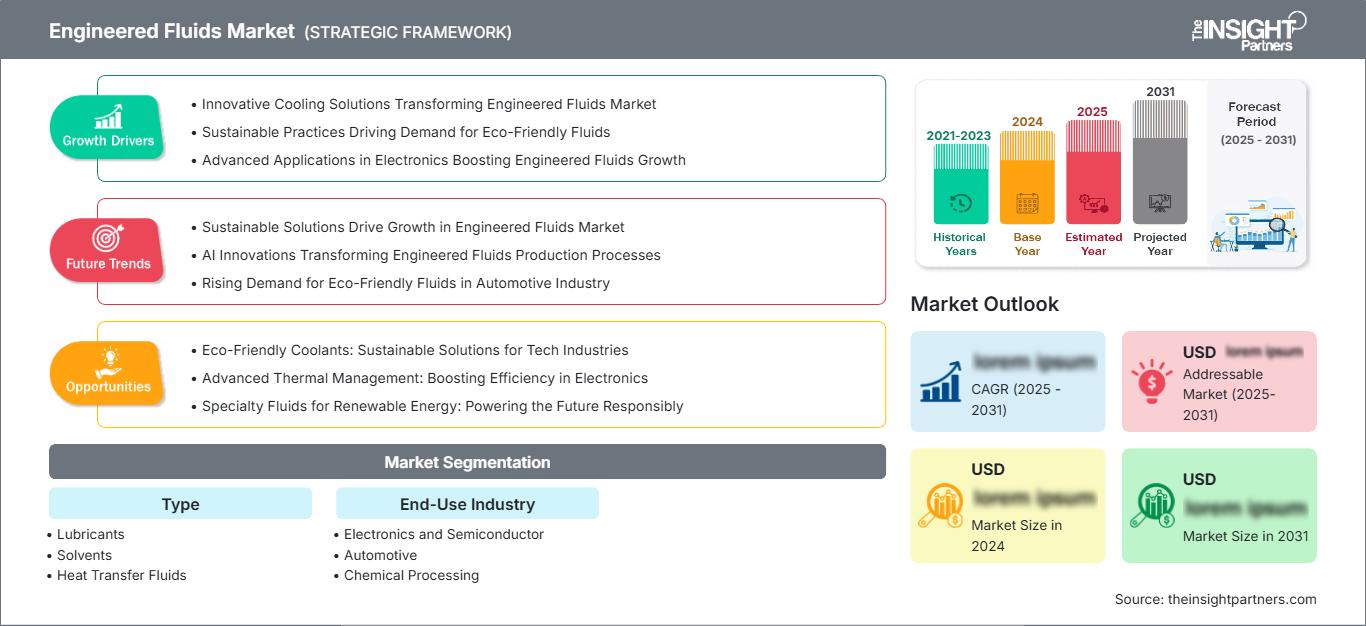
Engineered Fluids Market: Strategic Insights
Regional Insights
North America Engineered Fluids Market
North America represented 29–33% of global demand in 2025 and is projected to expand at a CAGR of 5.7–6.3% through 2034. The US dominates regional consumption because of its semiconductor, aerospace, automotive, chemical, and advanced computing industries. Semiconductor investment is increasing requirements for precision cleaning and temperature-control fluids, while aerospace applications require highly stable specialty lubricants and thermal-management products.
The contributions Canada makes include those made in aerospace, automotive, energy, and industrial process applications. Regional demands for refrigerants are additionally being shaped by the growth of the data center industry and high performance computing, where dielectric and two-phase fluids are capable of providing an alternative to traditional cooling solutions. At the same time, environmental regulations are driving suppliers to develop low GWP products, and consumers to consider fluid reuse and recycling opportunities.
U.S. Engineered Fluids Market
North America had an 80–84% share of the 2025 demand, and the region will continue to grow at a CAGR of 5.6–6.2% until 2034. Semiconductor fabrication, aerospace, automotive, chemical processing, and data center infrastructure comprise the main applications for this industry. Suppliers develop technologies and client relations specific to each type of fluid, contributing to their formulation and qualification.
Increasing demand in the Engineered Fluids Market is observed for high purity semiconductor fluids, advanced dielectric cooling fluids, and special lubricants. Chemours expands its activities related to liquid cooling. On the other hand, AGC Inc., Daikin Industries, Ltd., Solvay S.A., and other fluorochemical suppliers respond to specific industrial needs. US demand is forecasted to be stable because semiconductor capacity expansion and advanced computing need such fluids that can regulate temperature without disrupting electrical or material properties.
Europe Engineered Fluids Market
Europe represented 24–28% of worldwide demand in 2025 and is anticipated to experience growth at CAGR 5.5–6.1% through 2034. Germany holds the highest share of regional consumption with support from automotive engineering, industrial machinery, chemicals, and electronics. Other major customers include the United Kingdom, France, Italy, and Spain through aerospace, automotive production, energy, and specialty industrial applications. Increased regulatory focus on fluorinated materials is affecting the choice of technology.
Germany is a large industrial base where engineered fluids are employed for precision lubrication, thermal management, electronics production, and automotive engineering. France and the United Kingdom offer growth potential in aerospace and advanced industrial equipment applications, whereas Italy and Spain offer opportunities in automotive, machinery, electronics, and chemical processing applications. Customers in Europe place an increasing emphasis on environmental friendliness, recoverability, and regulations along with performance, thereby driving suppliers to offer environmentally sustainable specialty fluids.
APAC Engineered Fluids Market
In 2025, APAC was forecast to account for a 31-35% share and will register a CAGR of 7.0-7.7% up to 2034. China will be the most demanding region followed by Japan, South Korea, India, and Australia. There is an increasing demand for high-performance thermal and lubrication fluids due to semiconductor manufacturing, electronics production, automotive manufacturing, and industrial development.
There are positive factors for China and South Korea because of semiconductor and electronics production capabilities, while Japan will take advantage of advanced manufacturing and chemical expertise. India will increase electronics and automotive production, while Australia will make contributions to the market due to its resource-based and industrial use of thermal management fluids.
Middle East & Africa Engineered Fluids Market
Middle East and Africa is projected to grow at a CAGR of 4.9–5.6% through 2034. Saudi Arabia and the UAE lead regional demand through energy, infrastructure, industrial diversification, and data-center development. South Africa contributes through automotive, chemicals, mining, and industrial processing, while the rest of MEA remains project-driven.
High temperature conditions necessitate increased demand for reliable lubrication and cooling technologies. In relation to the data centers, there is an emergence of an opportunity for developing dielectric coolant fluids. The petrochemical and chemicals industries also offer opportunities for developing special lubricants and solvents. The local adoption of these solutions will be contingent on financing and regulations.
Segmentation Analysis
Type
The Type segment is projected to grow at a CAGR of 6.0–6.6% during 2026–2034. Lubricants currently represent the largest application category because they serve aerospace, automotive, industrial machinery, and specialty equipment. Solvents remain important for precision cleaning and processing, while heat transfer fluids are gaining strategic importance as electronics, semiconductor equipment, and high-performance computing generate higher thermal-management requirements.
- Lubricants: Specialized lubricants serve equipment operating under extreme temperatures, loads, vacuum conditions, or chemical exposure. Demand is supported by aerospace, automotive, industrial machinery, and precision-engineering applications requiring long service life.
- Solvents: Engineered solvents are used for precision cleaning, degreasing, electronic processing, and specialty manufacturing where low residue, controlled evaporation, and chemical compatibility are essential to process quality.
- Heat Transfer Fluids: Heat transfer fluids support controlled thermal management across semiconductor equipment, electronics, industrial systems, and emerging immersion-cooling applications where conventional cooling approaches cannot meet heat-load requirements.
End-Use Industry
The End-Use Industry segment is projected to grow at a CAGR of 6.4–7.0% during 2026–2034. Electronics and semiconductor applications are becoming increasingly influential because advanced fabrication and computing equipment require high-purity fluids with predictable dielectric and thermal behavior. Automotive, aerospace, chemical, oil and gas, and power-generation applications provide diversified demand.
- Electronics and Semiconductor: Semiconductor and electronics manufacturing requires high-purity fluids for cleaning, temperature control, testing, and cooling, with stringent requirements for dielectric performance, contamination control, and material compatibility.
- Automotive: Automotive applications use engineered fluids for precision lubrication, thermal management, electric-drive components, manufacturing processes, and specialized systems operating under demanding temperature and load conditions.
- Chemical Processing: Chemical-processing facilities require chemically stable fluids for heat transfer, lubrication, cleaning, and equipment protection where aggressive environments can rapidly degrade conventional fluid technologies.
- Oil and Gas: Oil and gas applications use engineered fluids for specialized lubrication, thermal control, processing, and equipment operation under high-pressure, high-temperature, and chemically challenging field conditions.
- Power Generation: Power-generation facilities require stable thermal and lubrication fluids for turbines, electrical systems, process equipment, and specialized cooling applications where reliability and controlled operating temperatures are critical.
- Aerospace: Aerospace systems require lightweight, thermally stable, chemically resistant fluids for aircraft components, precision mechanisms, hydraulic-related systems, and manufacturing processes operating under stringent reliability requirements.
Opportunity Snapshot
| Segment Name | Revenue Contribution | Trend Tag | Adoption Stage |
| Electronics and Semiconductor | High | Chip Cooling | Scaling |
| Automotive | High | EV Thermal | Scaling |
| Chemical Processing | Medium | Process Stability | Mature |
| Oil and Gas | Medium | Extreme Lubrication | Mature |
| Power Generation | Medium | Thermal Control | Mature |
| Aerospace | Medium | Flight Reliability | Mature |
Engineered Fluids Market Growth Drivers and Impact Analysis
Rising thermal loads in electronics and advanced computing
Increasing computing density is creating a stronger requirement for fluids capable of removing heat while maintaining electrical isolation and material compatibility. Semiconductor equipment, advanced electronics, and data-center systems are moving toward higher heat fluxes that can challenge conventional air and water cooling. Engineered dielectric fluids can enable direct-contact cooling while avoiding electrical short circuits. The commercial impact extends beyond fluid volumes because successful qualification can create recurring demand across equipment generations. Suppliers with high-purity manufacturing and proven dielectric performance can establish long customer relationships through lengthy validation processes. The trend also encourages development of two-phase cooling fluids, which can exploit phase change to transfer substantial heat efficiently. Consequently, thermal-management applications are becoming an important incremental demand source alongside established lubrication and solvent markets.
Expansion of semiconductor manufacturing and precision processing
Global semiconductor capacity expansion is increasing demand for specialty fluids used in cleaning, testing, thermal control, and equipment operation. Advanced fabrication requires extremely controlled processing environments, making fluid purity, chemical stability, evaporation characteristics, and residue control important purchasing criteria. Engineered fluids can provide performance advantages where conventional solvents or coolants introduce contamination, corrosion, or dielectric risks. The market impact is amplified by the value of semiconductor equipment and wafers, because fluid-related process failures can generate significant production losses. Suppliers therefore compete on consistency, analytical testing, supply security, and qualification support rather than price alone. As new fabrication capacity develops in North America and Asia Pacific, local supply capabilities become increasingly important. This dynamic supports investment in purification, packaging, technical laboratories, and regional customer-support infrastructure.
Demand for longer equipment life and specialized lubrication
Industrial and aerospace equipment increasingly operates under demanding temperature, pressure, speed, and load conditions, increasing the need for lubricants that maintain stable performance beyond the capabilities of conventional oils. Engineered lubricants can provide low volatility, strong thermal stability, chemical resistance, and predictable viscosity across specialized operating environments. Longer component life can reduce maintenance frequency and unplanned downtime, making fluid selection relevant to total operating cost rather than consumable price alone. Aerospace applications are particularly sensitive because reliability requirements limit tolerance for lubricant degradation or material incompatibility. Automotive and industrial equipment manufacturers are also evaluating specialty fluids for electric-drive systems and compact mechanisms. This driver supports premium formulations and application-specific products, allowing suppliers with formulation expertise to compete through performance validation, technical service, and equipment compatibility.
Engineered Fluids Market Future Trends
Transition toward lower-impact fluorinated fluid technologies
Environmental considerations are expected to reshape the engineered-fluid product portfolio over the coming decade. Suppliers are developing lower-GWP fluorinated liquids while customers increasingly evaluate atmospheric lifetime, recovery potential, and regulatory status alongside thermal and chemical performance. Daikin's DAISAVE portfolio illustrates this direction through fluorinated liquids positioned around low GWP, zero ozone depletion potential, thermal stability, and recycling potential. Regulatory scrutiny will nevertheless remain a major consideration because some high-performance fluids belong to broader PFAS categories. Future products are therefore likely to emphasize narrower environmental footprints, controlled emissions, closed-loop recovery, and improved recyclability. Qualification requirements will remain demanding, particularly for semiconductor and aerospace applications, limiting rapid substitution. Suppliers that combine technical equivalence with documented environmental advantages should be better positioned as customers update procurement specifications.
Growth of direct liquid and immersion cooling systems
Engineered Fluids Market trends increasingly point toward direct liquid cooling as computing power rises and conventional cooling approaches encounter thermal and energy constraints. Two-phase immersion systems can directly contact electronic components with dielectric fluids, allowing heat removal without electrical conduction. Chemours has been developing Opteon two-phase immersion fluids for data-center applications, while Daikin is expanding its fluorinated-liquid portfolio toward immersion cooling. These technologies could become more relevant as artificial intelligence accelerates demand for high-density computing. Adoption will depend on fluid availability, equipment compatibility, environmental requirements, recovery systems, and total cooling economics. Over time, cooling architectures may become increasingly integrated with fluid-management systems, creating demand for fluids engineered around specific hardware platforms rather than generic thermal specifications.
Engineered Fluids Market Opportunities
Localized production for semiconductor and electronics customers
Engineered Fluids Market Forecasts indicate a strategic opportunity for suppliers to establish regional production and purification capacity near semiconductor clusters. High-value electronics customers require reliable delivery, controlled contamination levels, and rapid technical support, making long-distance supply chains less attractive for critical process fluids. Local facilities can shorten logistics cycles while allowing suppliers to customize packaging, purification, and analytical testing around customer specifications. Asia Pacific offers particularly strong potential because China, Japan, South Korea, Taiwan, India, and Southeast Asia are expanding electronics ecosystems. North America also presents opportunities as semiconductor manufacturing capacity is being localized. Investment in regional laboratories, clean packaging, recovery infrastructure, and application engineering can strengthen customer retention. Suppliers that combine manufacturing proximity with technical qualification support may capture higher-value applications and reduce exposure to transportation or geopolitical disruptions.
Specialty cooling fluids for high-density computing infrastructure
High-density computing presents an investment opportunity beyond traditional industrial cooling because increasing chip power creates requirements for compact, reliable, and energy-efficient thermal-management systems. Specialty dielectric and two-phase fluids can support direct cooling where air-based architectures become less effective. The opportunity extends across data centers, edge computing, high-performance computing, and advanced semiconductor test environments. Suppliers can develop application-specific fluids optimized for boiling behavior, dielectric strength, material compatibility, environmental performance, and recovery. Strategic partnerships with server manufacturers, semiconductor companies, cooling-system developers, and data-center operators can accelerate qualification. The Chemours qualification of its Opteon two-phase immersion cooling fluid by Samsung Electronics demonstrates how component-level validation can support broader adoption. Future investment is likely to favor suppliers capable of providing both fluid technology and technical integration expertise.
Recent Developments
- June 2025: Engineered Fluids is partnering with Dovetail Electric Aviation to create a next-generation immersion-cooled battery system, utilizing Engineered Fluids' AmpCool for Dovetail's DovePack, a modular battery pack for regional aircraft. This collaboration aims to enhance electric propulsion systems, converting conventional aircraft into zero-emission ones and providing energy solutions for other electric aviation firms. The focus is on validating immersion cooling as a key thermal management solution in aviation, where safety and performance are critical.
- February 2025: MicroCare, a leader in critical cleaning solutions, introduces its MicroCare Engineered Fluids as replacements for 3M Novec 7100, 7200, and 7300 fluids. These products support manufacturers in maintaining high-quality cleaning and coating processes. Attendees are invited to explore these innovations at Booth #7070 during the Precision Machining Technology Show (PMTS) 2025, held April 1–3 in Cleveland, OH.
Frequently Asked Questions

- Comprehensive Market Sizing and Forecast Analysis
- Detailed Segmentation Analysis
- In-Depth Market Dynamics Assessment
- Regional and Country-Level Insights
- Competitive Landscape and Company Benchmarking
- Strategic Business Intelligence
Recent Reports
Testimonials

The Insight Partners' SCADA System Market report is comprehensive, with valuable insights on current trends and future forecasts. The team was highly professional, responsive, and supportive throughout. We are very satisfied and highly recommend their services.
RAN KEDEM Partner, Reali Technologies LTDs
I requested a report on a very specific software market and the team produced the report in a few days. The information was very relevant and well presented. I then requested some changes and additions to the report. The team was again very responsive and I got the final report in less than a week.
JEAN-HERVE JENN Chairman, Future Analytica
We worked with The Insight Partners for an important market study and forecast. They gave us clear insights into opportunities and risks, which helped shape our plans. Their research was easy to use and based on solid data. It helped us make smart, confident decisions. We highly recommend them.
PIYUSH NAGPAL Sr. Vice President, High Beam Global
The Insight Partners delivered insightful, well-structured market research with strong domain expertise. Their team was professional and responsive throughout. The user-friendly website made accessing industry reports seamless. We highly recommend them for reliable, high-quality research services
YUKIHIKO ADACHI CEO, Deep Blue, LLC.
This is the first time I have purchased a market report from The Insight Partners.While I was unsure at first, I visited their web site and felt more comfortable to take the risk and purchase a market report.I am completely satisfied with the quality of the report and customer service. I had several questions and comments with the initial report, but after a couple of dialogs over email with their analyst I believe I have a report that I can use as input to our strategic planning process.Thank you so much for taking the extra time and making this a positive experience.I will definitely recommend your service to others and you will be my first call when we need further market data.
JOHN SUZUKI President and Chief Executive Officer, Board Director, BK Technologies
I wish to appreciate your support and the professionalism you displayed in the course of attending to my request for information regarding to infectious disease IVD market in Nigeria. I appreciate your patience, your guidance, and the fact that you were willing to offer a discount, which eventually made it possible for us to close a deal. I look forward to engaging The Insight Partners in the future, all thanks to the impression you have created in me as a result of this first encounter.
DR CHIJIOKE ONYIA MANAGING DIRECTOR, PineCrest Healthcare Ltd.Reason to Buy
- Informed Decision-Making
- Understanding Market Dynamics
- Competitive Analysis
- Identifying Emerging Markets
- Customer Insights
- Market Forecasts
- Risk Mitigation
- Boosting Operational Efficiency
- Strategic Planning
- Investment Justification
- Tracking Industry Innovations
- Aligning with Regulatory Trends





 Get Free Sample for