
Error Monitoring Tool Market Trends, Demand & Growth by 2034
Coverage: By Deployment Type (On-Premises, Cloud); Organization Size (Small Enterprises, Medium-sized Enterprises, Large Enterprises) , and Geography (North America, Europe, Asia Pacific, and South and Central America)
- Status : Data Released
- Report Code : TIPRE00021749
- Category : Technology, Media and Telecommunications
- No. of Pages : 150
- Available Report Formats :


- Last update date : August 04, 2026


2025 Market Size
US$ 1.33 Bn
Base year value
2034 Forecast
US$ 4.04 Bn
Projected by 2034
CAGR 2026-2034
13.13 %
Growth rate
Addressable Market
US$ 23.32 Bn
(2026-2034)
The global error monitoring tool market was valued at US$ 1.33 Billion in 2025 and is projected to reach US$ 4.04 Billion by 2034, expanding at a CAGR of 13.13% between 2026 and 2034, driven by rising application complexity and continuous software delivery cycles. Enterprises across every industry are emphasizing protecting their digital experiences from silent failures, and this urgency is reshaping the error monitoring tool market at a rapid pace.
Within this broader trajectory, the error monitoring tool market size in North America is estimated to expand at a CAGR of 12.4% to 13.6% between 2026 and 2034, supported by a dense concentration of DevOps-mature enterprises and early adoption of AI-assisted debugging. Cloud-native application sprawl, stringent uptime expectations from digital-first consumers, and heavy investment in observability platforms across finance, retail, and technology sectors continue to reinforce regional momentum through the forecast period.
Error Monitoring Tool Market Assessment and Insights
- North America: The region maintains a leading position, holding an estimated 36–40% share in 2025 and growing at a CAGR of 12.4–13.6% between 2026–2034, underpinned by mature cloud adoption, dense SaaS vendor concentration, and enterprise DevOps maturity.
- US: The United States anchors regional demand with an estimated 84–88% share within North America in 2025, growing at a CAGR of 12.2–13.4% between 2026–2034, led by hyperscale cloud usage and continuous delivery practices.
- Europe: Europe holds an estimated 24–28% share in 2025, growing at a CAGR of 12.8–14.0% between 2026–2034, with the UK, Germany, and France leading adoption through regulated digital infrastructure and fintech expansion.
- Asia Pacific: Asia Pacific accounts for an estimated 20–24% share in 2025, growing at a CAGR of 14.5–15.8% between 2026–2034, led by China, India, and Japan amid rapid cloud migration and mobile-first application development.
- Largest Segment: Cloud deployment leads with an estimated 61–65% market share in 2025, growing at a CAGR of 13.8–14.6% between 2026–2034, favored for scalability and reduced infrastructure overhead.
- High Growth Segment: Large Enterprises represent the fastest-expanding organization-size cohort, holding an estimated 46–50% share in 2025 and growing at a CAGR of 13.6–14.4% between 2026–2034, reflecting deepening observability budgets.
- Key companies analyzed in detail: Airbrake Technologies, Inc, Atlassian, Axosoft, Bugsnag Inc, IBM, Inflectra Corporation, JetBrains, Nulab, Inc, Raygun, Zoho Corporation
Source: The Insight Partners' analysis based on proprietary research, government publications, company annual reports, investor presentations, industry databases, and expert interviews.
The software development industry has shifted firmly in the direction of continuous integration and continuous delivery, shrinking the time between releases and increasing the number of opportunities for any hidden bugs to slip into production. This trend has forced engineering teams to abandon traditional logging analysis methods and instead rely on instrumentation that can track exceptions, stack traces, and breadcrumbs in real time. Vendors have increasingly embedded artificial intelligence into the troubleshooting process, analyzing errors against deployment history in order to reduce resolution times and engineering overhead.
Looking ahead, adoption in the Error Monitoring Tool Market is expected to broaden beyond established technology hubs as mid-sized enterprises in emerging economies digitize customer-facing applications. Growing regulatory emphasis on service reliability, combined with rising venture investment in developer tooling, is likely to sustain vendor innovation. Consolidation between error monitoring and broader observability suites is anticipated to continue, as buyers increasingly favor unified platforms over fragmented point solutions for managing application stability at scale.
Error Monitoring Tool Market Report Scope
| Report Attribute | Details |
|---|---|
| Market size in 2025 | US$ 1.33 Billion |
| Market Size by 2034 | US$ 4.04 Billion |
| Global CAGR (2026 - 2034) | 13.13% |
| Historical Data | 2021-2024 |
| Forecast period | 2026-2034 |
Error Monitoring Tool Market Analysis
Market growth in error monitoring solutions is driven by the abundance of microservice architecture, mobile apps, and APIs that result in fragmented and voluminous error reports. It is essential for engineering teams to have visibility on defect prioritization based on user experience impact as opposed to the frequency of occurrence, which has become table stakes and no longer a competitive advantage. Companies need to reduce their loss due to downtime, thereby increasing investments in proactive rather than reactive measures.
This industry encompasses software development kits, cloud platform hosting services, integration with issue trackers and communication services, and increasingly AI models providing automatic root-cause analysis. In terms of supply-side dynamics, there is an advantage for vendors who can cover a wide range of languages and frameworks, since fragmented technology stacks in enterprises need uniform instrumentation of web, mobile, and backend services without performance costs.
Competitive intensity in the error monitoring tool market analysis features both incumbent vendors and niche ones. IBM relies on its Instana platform for enabling observability based on error monitoring powered by artificial intelligence. Meanwhile, Atlassian and JetBrains incorporate defect monitoring into their respective developer collaboration platforms. The competition between Bugsnag Inc, Raygun, and Airbrake Technologies, Inc focuses on real-time crash analysis and developers' experience, while Zoho Corporation, Nulab, Inc, Axosoft, and Inflectra Corporation cater to companies looking for integrated solutions for managing projects and ensuring quality control.
The trend in investment into the industry favors artificial intelligence-powered debugging tools, extended OpenTelemetry support, and tighter integration into incident management processes. Vendors position themselves in terms of consolidation of platforms with bundled crash reporting, performance monitoring, and real user monitoring into a single subscription package. Such a strategy helps reduce tool sprawl for buyers and increases vendor lock-in differentiating vendors from each other in terms of application health management.
● REPORT CUSTOMIZATION
Tailor This Report To Align With Your Specific Business Requirements
This report can be customized to align precisely with your business objectives, scope, and target markets. Customization options include tailored segmentation, geography, competitive analysis, and strategic insights to support informed decision-making.
Customize This Report →WHAT YOU CAN ADJUST
- ● Segmentations
- ● Geography
- ● Competitive Analysis
- ● Language Preferences
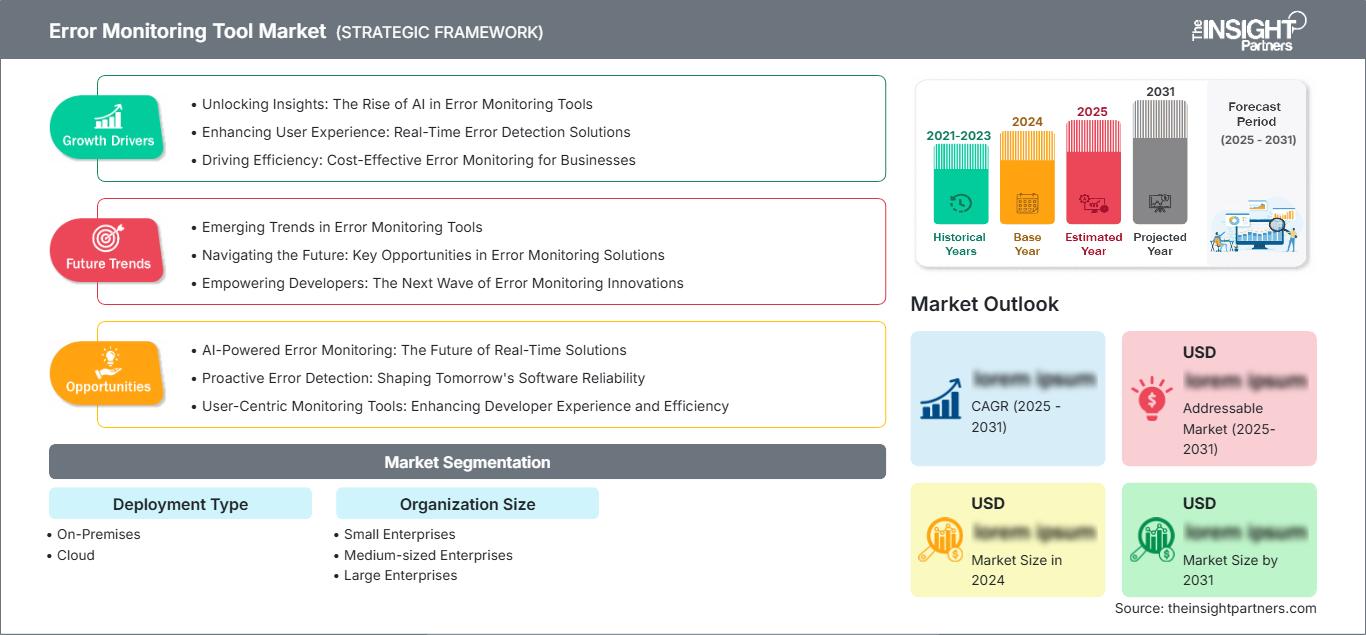
Error Monitoring Tool Market: Strategic Insights
Regional Insights
North America Error Monitoring Tool Market
North America is estimated to hold a 36–40% share of the error monitoring tool market share in 2025 and is projected to expand at a CAGR of 12.4–13.6% between 2026–2034. Regional strength stems from a dense concentration of cloud-native enterprises, mature DevOps practices, and early willingness to adopt AI-assisted diagnostic tooling across finance, retail, media, and technology verticals operating at significant application scale.
In the Error Monitoring Tool Market, structural drivers include high cloud infrastructure penetration, well-established software engineering talent pools, and continuous delivery norms that necessitate real-time defect visibility. Enterprises across the region are increasingly consolidating crash reporting, performance monitoring, and incident response into unified platforms, reflecting a broader shift toward observability-driven engineering culture that favors vendors offering deep integration with existing DevOps toolchains and cloud infrastructure providers.
U.S. Error Monitoring Tool Market
The United States commands an estimated 84–88% share of the North American error monitoring tool market in 2025 and is expected to grow at a CAGR of 12.2–13.4% between 2026–2034. This is because of the high level of concentration of hyperscale technology companies, digital natives, and software companies that are venture-funded in the country for running critical traffic-based applications that need stability monitoring at all times.
The companies have significant representation in providers like IBM, Atlassian, Bugsnag Inc., and Raygun. The application trends are toward cloud-based architecture using APIs, and it cuts across fintech, ecommerce, and SaaS industries. For these industries, any downtime leads to loss of revenue. Companies are adopting artificial intelligence for triaging alerts and root cause analysis due to increased alert volume.
Europe Error Monitoring Tool Market
Europe holds an estimated 24–28% share of the error monitoring tool market in 2025, expanding at a CAGR of 12.8–14.0% between 2026–2034. Adoption is propelled by stringent data protection expectations, growing fintech and e-commerce digitization, and enterprise modernization initiatives across manufacturing and public sector technology deployments throughout the region's largest economies.
The United Kingdom leads regional adoption, supported by a dense fintech and SaaS ecosystem alongside strong enterprise cloud migration momentum. Germany follows closely, driven by industrial digitization and growing DevOps maturity among manufacturing and automotive software teams. France, Italy, and Spain are registering steady uptake as mid-sized enterprises modernize legacy application stacks, with France additionally benefiting from expanding public sector digital service platforms.
APAC Error Monitoring Tool Market
Asia Pacific accounts for an estimated 20–24% share of the error monitoring tool market in 2025 and is projected to grow at a CAGR of 14.5–15.8% between 2026–2034, the fastest among major regions. China and India lead adoption momentum, supported by expansive mobile application ecosystems and accelerating cloud infrastructure investment across technology and financial services sectors.
Japan and South Korea contribute steady enterprise-grade demand rooted in mature software quality practices, while Australia reflects growing SaaS vendor presence supporting regional cloud migration. Government-backed digital economy initiatives across the region, combined with rising smartphone penetration and e-commerce transaction volumes, are reinforcing industrial and policy-driven momentum behind sustained observability tooling investment.
Middle East & Africa Error Monitoring Tool Market
The Middle East and Africa Error Monitoring Tool Market is projected to grow at a CAGR of 13.0–14.2% between 2026 and 2034, led by Saudi Arabia and the United Arab Emirates. Both markets are advancing digital transformation agendas tied to national economic diversification programs, fueling enterprise cloud adoption across banking, telecommunications, and government digital service platforms. Increasing demand for application reliability, real-time performance monitoring, and observability solutions is further supporting market growth as organizations scale cloud-native and customer-facing digital applications across the region.
South Africa contributes steady demand through its comparatively mature technology services sector, while the Rest of MEA reflects early-stage adoption tied to expanding mobile connectivity. Infrastructure investment in regional data centers and energy-sector digitization, particularly across utilities modernizing grid and asset monitoring systems, is gradually extending observability tooling demand beyond traditional financial services adopters.
Segmentation Analysis
Deployment Type
Cloud deployment is projected to grow at a CAGR of 13.8–14.6% between 2026–2034 within the error monitoring tool market scope, reflecting enterprise preference for scalable, subscription-based infrastructure that reduces maintenance overhead. Cloud-hosted solutions enable faster onboarding, automatic updates, and seamless integration with modern CI/CD pipelines, making them the default choice for organizations prioritizing agility, elastic scaling, and reduced total cost of ownership across distributed engineering teams managing high-velocity release schedules.
- On-Premises: On-premises deployment retains relevance among regulated industries such as banking, healthcare, and government agencies requiring strict data residency and internal control over sensitive diagnostic telemetry and application logs.
- Cloud: Cloud deployment dominates new implementations, favored for rapid scalability, lower upfront investment, and simplified integration across distributed, multi-region application environments.
Organization Size
Large Enterprises are projected to grow at a CAGR of 13.6–14.4% between 2026–2034, driven by expansive application portfolios, dedicated site reliability engineering teams, and sustained observability budgets. These organizations increasingly consolidate multiple monitoring point solutions into unified platforms, prioritizing vendors capable of supporting complex, multi-cloud environments alongside enterprise-grade compliance, governance, and integration requirements across globally distributed development organizations.
- Small Enterprises: Small enterprises favor lightweight, cost-effective tools with rapid setup, prioritizing essential crash reporting over advanced customization or extensive integration depth.
- Medium-sized Enterprises: Medium-sized enterprises balance functionality and cost, adopting tools that support growing engineering teams without the complexity associated with large-scale enterprise deployments.
- Large Enterprises: Large enterprises demand comprehensive platforms supporting multi-team governance, advanced analytics, and integration across extensive, globally distributed application portfolios.
Opportunity Snapshot
| Industry Vertical | Revenue Contribution | Trend Tag | Adoption Stage |
| Banking, Financial Services & Insurance | High | Fraud Resilience | Mature |
| Retail & E-commerce | High | Peak Traffic Monitoring | Scaling |
| Healthcare & Life Sciences | Medium | Compliance Logging | Scaling |
| IT & Telecommunications | High | Network Diagnostics | Mature |
| Media & Entertainment | Medium | Streaming Stability | Scaling |
| Government & Public Sector | Low | Citizen Portal Uptime | Emerging |
| Manufacturing | Medium | Industrial IoT Alerts | Emerging |
Error Monitoring Tool Market Growth Drivers and Impact Analysis
Accelerating Cloud-Native Application Development
Companies are swiftly moving monolithic applications to a microservice and container architecture model, increasing the volume of independently deployable units that create diagnostic data. This architectural transition results in a higher rate and complexity of runtime exceptions and makes manual log processing inefficient on a large scale. Thus, companies need automation for instrumentation that will be able to correlate the issues across various services instantly. In practice, the result of this trend can be seen in a lower mean-time-to-resolution because teams will get an instant insight into which service, deployment, or code change caused a regression. The vendors that provide framework-compatible low-cost agents are getting an outsized share of the market with the growth of containerized workloads on Kubernetes and serverless platforms.
Rising Cost of Application Downtime and User Attrition
Digital-first consumer expectations have brought about much less tolerance of application instability, with crashes and other errors causing user churn and revenue loss through their direct connection to abandonment in the cases of e-commerce, finance and media. Application stability has become a competitive advantage, rather than just an IT issue, for businesses, and budgets devoted to error monitoring receive top-level attention. This trend shows itself through faster adoption within consumer-facing industries, where a simple outage is associated with large financial and reputational losses. Businesses are choosing tools that provide user-impact-based prioritization of errors, thus allocating engineering resources for the resolution of issues impacting the majority of customers first.
Integration of Artificial Intelligence in Root-Cause Diagnostics
Vendors are directly embedding large language models within the triage workflow for automatic analysis of the stack trace, historic trends, and deployment context in order to suggest potential solutions. In this way, they reduce the amount of effort needed from the engineering team when dealing with increasing numbers of alerts within increasingly complex application architectures. The direct impact is shorter debugging processes, especially for teams that deal with old software architectures where there is not enough internal knowledge available. The use of AI-supported diagnostics makes the process of incident resolution more accessible from a skills point of view as well because it allows even small teams to deal with problems that otherwise would have required specialized skills.
Error Monitoring Tool Market Future Trends
Convergence of Error Monitoring Tool Market Trends with Full-Stack Observability
Standalone error monitoring is steadily converging with broader observability platforms encompassing logs, metrics, and distributed tracing. Buyers increasingly favor unified vendors over fragmented point solutions, driving providers to expand product portfolios through internal development or acquisition. This convergence reduces integration overhead for engineering teams while creating stronger vendor lock-in dynamics. Providers historically focused on crash reporting are extending into performance monitoring and infrastructure visibility to remain competitive. Over the coming years, differentiation is expected to shift from raw error capture capability toward breadth of correlated telemetry and quality of automated insights delivered across the entire application stack, from front-end user experience through backend infrastructure dependencies.
Expansion of Agentic AI Monitoring for Generative AI Workloads
As enterprises deploy large language model-powered applications and autonomous agents into production, monitoring requirements are extending beyond traditional exception handling toward tracking prompts, token usage, latency, and agent decision paths. This emerging category requires specialized instrumentation capable of correlating generative AI-specific failures with conventional application errors. Vendors are beginning to introduce dedicated observability modules for agentic workflows, reflecting anticipation of substantial future demand. Over the forecast horizon, organizations operating AI-driven customer experiences are expected to require monitoring platforms capable of unifying conventional application diagnostics with generative AI performance and cost tracking within a single operational dashboard.
Error Monitoring Tool Market Opportunities
Expansion into Mid-Market Segments Across Emerging Economies
Substantial untapped opportunity exists among mid-sized enterprises across emerging economies in Southeast Asia, Latin America, and Eastern Europe, where digital transformation is accelerating but observability tooling adoption remains comparatively nascent. Vendors offering simplified onboarding, transparent pricing, and localized support stand to capture early market share as regional software development activity scales. This opportunity aligns with an anticipated future error monitoring tool market forecast environment favoring geographic diversification beyond saturated North American and Western European accounts. Investment in regional data residency options, local currency billing, and language localization could meaningfully accelerate penetration. Partnerships with regional cloud infrastructure providers and system integrators represent a practical entry strategy, enabling vendors to reduce customer acquisition costs while building credibility within developer communities that increasingly influence enterprise technology procurement decisions across these fast-growing digital economies.
Bundled Observability Offerings for Small and Medium Enterprises
Small and medium enterprises frequently forgo dedicated error monitoring due to budget constraints and limited internal expertise, representing a significant underserved opportunity. Vendors capable of packaging simplified, affordably priced bundles combining essential crash reporting, basic performance monitoring, and guided incident response could unlock substantial incremental demand within this segment. Investment in self-service onboarding, templated integrations, and freemium pricing tiers would lower adoption barriers meaningfully. As no-code and low-code development tools proliferate among smaller organizations, demand for accessible, lightweight monitoring solutions tailored to non-specialist engineering teams is expected to grow, creating a durable opportunity for vendors willing to prioritize simplicity and cost efficiency over enterprise-grade feature depth.
Frequently Asked Questions

- Comprehensive Market Sizing and Forecast Analysis
- Detailed Segmentation Analysis
- In-Depth Market Dynamics Assessment
- Regional and Country-Level Insights
- Competitive Landscape and Company Benchmarking
- Strategic Business Intelligence
Recent Reports
Testimonials

The Insight Partners' SCADA System Market report is comprehensive, with valuable insights on current trends and future forecasts. The team was highly professional, responsive, and supportive throughout. We are very satisfied and highly recommend their services.
RAN KEDEM Partner, Reali Technologies LTDs
I requested a report on a very specific software market and the team produced the report in a few days. The information was very relevant and well presented. I then requested some changes and additions to the report. The team was again very responsive and I got the final report in less than a week.
JEAN-HERVE JENN Chairman, Future Analytica
We worked with The Insight Partners for an important market study and forecast. They gave us clear insights into opportunities and risks, which helped shape our plans. Their research was easy to use and based on solid data. It helped us make smart, confident decisions. We highly recommend them.
PIYUSH NAGPAL Sr. Vice President, High Beam Global
The Insight Partners delivered insightful, well-structured market research with strong domain expertise. Their team was professional and responsive throughout. The user-friendly website made accessing industry reports seamless. We highly recommend them for reliable, high-quality research services
YUKIHIKO ADACHI CEO, Deep Blue, LLC.
This is the first time I have purchased a market report from The Insight Partners.While I was unsure at first, I visited their web site and felt more comfortable to take the risk and purchase a market report.I am completely satisfied with the quality of the report and customer service. I had several questions and comments with the initial report, but after a couple of dialogs over email with their analyst I believe I have a report that I can use as input to our strategic planning process.Thank you so much for taking the extra time and making this a positive experience.I will definitely recommend your service to others and you will be my first call when we need further market data.
JOHN SUZUKI President and Chief Executive Officer, Board Director, BK Technologies
I wish to appreciate your support and the professionalism you displayed in the course of attending to my request for information regarding to infectious disease IVD market in Nigeria. I appreciate your patience, your guidance, and the fact that you were willing to offer a discount, which eventually made it possible for us to close a deal. I look forward to engaging The Insight Partners in the future, all thanks to the impression you have created in me as a result of this first encounter.
DR CHIJIOKE ONYIA MANAGING DIRECTOR, PineCrest Healthcare Ltd.Reason to Buy
- Informed Decision-Making
- Understanding Market Dynamics
- Competitive Analysis
- Identifying Emerging Markets
- Customer Insights
- Market Forecasts
- Risk Mitigation
- Boosting Operational Efficiency
- Strategic Planning
- Investment Justification
- Tracking Industry Innovations
- Aligning with Regulatory Trends





 Get Free Sample for