
Ethanol Market Share, Growth & Demand by 2034
Coverage: By Source (Sugar and Molasses Based Ethanol, Grain Based Ethanol, Second Generation Ethanol); Application (Industrial Solvents, Fuel and Fuel Additives, Beverages, Disinfectant, Personal Care, Others); End User Industry (Building and Construction, Consumer Goods, Aerospace, Marine, Others), and Geography (North America, Europe, Asia Pacific, and South and Central America)
- Status : Data Released
- Report Code : TIPRE00021788
- Category : Chemicals and Materials
- No. of Pages : 150
- Available Report Formats :


- Last update date : September 01, 2026


2025 Market Size
US$ 77.17 Bn
Base year value
2034 Forecast
US$ 118.77 Bn
Projected by 2034
CAGR 2026-2034
4.91 %
Growth rate
Addressable Market
US$ 889.40 Bn
(2026-2034)
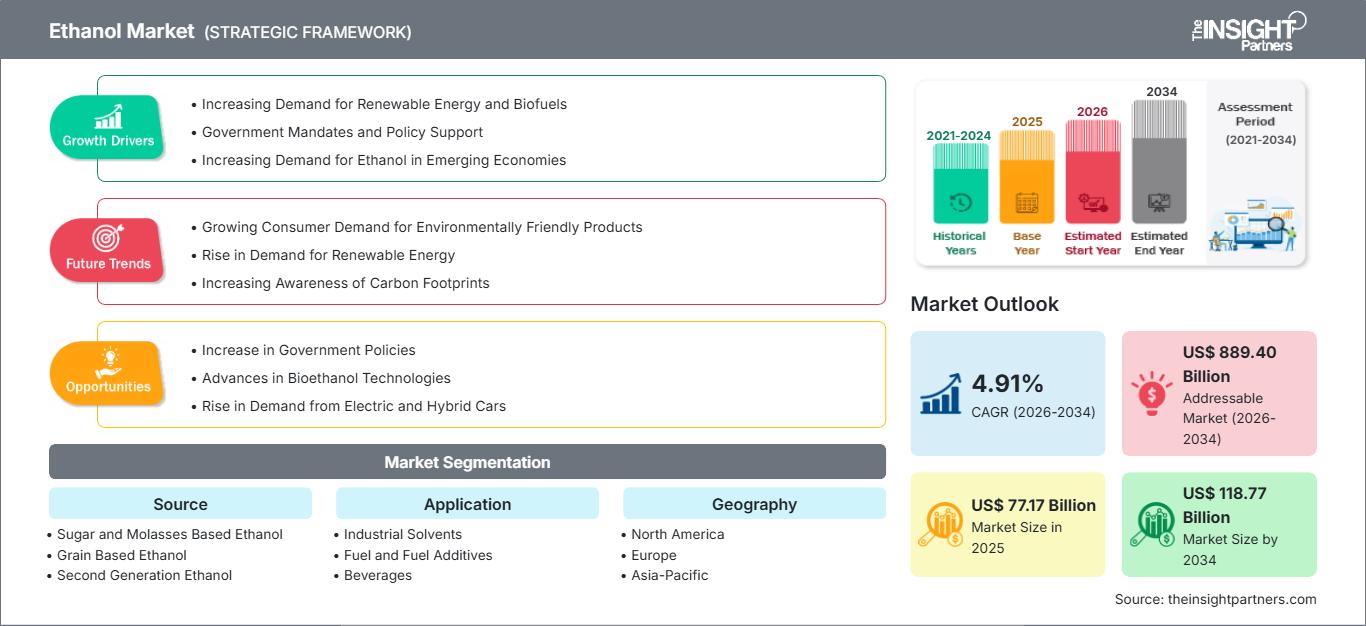
The Ethanol Market is projected to expand from US$ 77.17 billion in 2025 to US$ 118.77 billion by 2034, registering a CAGR of 4.91% during 2026–2034. The growth will be aided by increasing fuel-mixing rules, rising requirement for lower carbon fuels in transportation, and increased usage of ethanol as a solvent, beverage alcohol, disinfectant, and personal care products. Diversification of raw materials is also contributing to enhanced supply resilience in major ethanol-producing countries.
North America will continue to be strategically significant owing to its existing corn-based production facilities, developed fuel ethanol distribution channels, and consistent government support for renewables. The Ethanol Market Size in North America will experience an estimated growth rate of 3.8%-4.6% CAGR till 2034.
Ethanol Market Assessment and Insights
- North America: North America accounted for a modeled 35–40% share in 2025 and is expected to grow at a 3.8–4.6% CAGR between 2026–2034, supported by large-scale U.S. production, established infrastructure, and renewable-fuel policy mechanisms.
- US: The U.S. represented approximately 88–92% of North American value in 2025 and is projected to grow at a 3.7–4.5% CAGR through 2034, led by fuel blending and exports.
- Europe: Europe held a modeled 10–14% share in 2025 and is expected to register a 4.0–4.8% CAGR through 2034. Germany, France, Spain, Italy, and the UK support demand through renewable transport targets and established fuel-distribution systems.
- Asia Pacific: Asia Pacific represented approximately 15–19% share in 2025 and is projected to expand at a 6.0–7.2% CAGR through 2034, with China, India, Japan, South Korea, and Thailand providing diverse demand drivers.
- Largest Segment: Fuel and Fuel Additives represented a modeled 55–60% market share in 2025 and is expected to expand at a 4.5–5.3% CAGR through 2034.
- High Growth Segment: Second Generation Ethanol held an estimated 4–7% share in 2025 and is expected to record a 9.0–11.0% CAGR during 2026–2034 as low-carbon feedstock pathways advance.
- Key companies analyzed in detail: Cargill, Incorporated; Archer-Daniels-Midland Company; Grain Processing Corporation; ACE Ethanol LLC; Advanced BioEnergy, LLC; MGP Ingredients, Inc.; Flint Hills Resources, LLC; Marquis Energy, LLC; United Breweries Limited; Molson Coors Beverage Company.
Source: The Insight Partners' analysis based on proprietary research, government publications, company annual reports, investor presentations, industry databases, and expert interviews.
The Ethanol Market has shifted its focus from being used primarily for beverages and industries to being used in a larger biofuel ecosystem. The feedstocks for production are corn, sugarcane, molasses, and increasingly cellulosics. Big companies are combining ethanol distillation with animal feed production, electricity generation, carbon management systems, and agricultural supplies. Economics of production are now influenced by feedstock availability, energy prices, co-product economics, mandated blending requirements, and logistics rather than ethanol production itself.
In the future, the Ethanol Market may gain advantage due to the emergence of new consumption centers in India, South East Asia, and specific Latin American nations. Efficiency distilleries, diversified feedstocks, low carbon footprint, and ethanol-to-jet facilities have gained importance. Moreover, regulation has gained significance as fuel blending is now linked with energy security, agriculture policy, emission reduction, and value addition locally.
Ethanol Market Report Scope
| Report Attribute | Details |
|---|---|
| Market size in 2025 | US$ 77.17 Billion |
| Market Size by 2034 | US$ 118.77 Billion |
| Global CAGR (2026 - 2034) | 4.91% |
| Historical Data | 2021-2024 |
| Forecast period | 2026-2034 |
Ethanol Market Analysis
Ethanol market growth is propelled by fuel mandates, agriculture, and industry. Its value chain includes feedstocks such as sugar cane, molasses, corn, grains, or cellulosic biomass; fermentation; distillation; dehydration; storage; transportation and blending. In addition to ethanol itself, producers profit from selling various co-products including distillers grains, carbon dioxide, corn oil, electricity and others. Proximity of feedstock sources is still relevant as transportation cost can significantly impact margins of delivered ethanol.
Market demand differs by application. Fuel and fuel additives are the largest segment due to the ability of ethanol to deliver oxygenation and octane improvement without increasing consumption of petroleum. Industrial applications need purity, while beverage companies require food-grade quality. Market supply is more and more influenced by weather, commodity price for agriculture, utilization rate of facilities, availability of exports and blending policies in the consuming countries.
Competitors in market include diversified agricultural processors, specialized ethanol manufacturers and beverage companies having fermentation capabilities. Archer-Daniels-Midland Company and Cargill, Incorporated have advantage of their feedstock sourcing capabilities, whereas Flint Hills Resources, LLC, Marquis Energy, LLC, ACE Ethanol LLC and Grain Processing Corporation hold positions in U.S. production.The Ethanol Market report also indicates greater emphasis on plant efficiency, carbon intensity, coproduct monetization, and geographic flexibility.
The process of strategic positioning is becoming increasingly affected by technological and policy exposure. Archer-Daniels-Midland Company is enhancing its ethanol economics with regard to execution and market positioning of its biofuels, whereas Cargill, Incorporated, has increased its exposure to Brazilian sugar and energy. MGP Ingredients, Inc., continues to stay relevant due to fermentation processes and distillery products. Companies such as United Breweries Limited and Molson Coors Beverage Company offer exposure to ethanol beverages demand.
● REPORT CUSTOMIZATION
Tailor This Report To Align With Your Specific Business Requirements
This report can be customized to align precisely with your business objectives, scope, and target markets. Customization options include tailored segmentation, geography, competitive analysis, and strategic insights to support informed decision-making.
Customize This Report →WHAT YOU CAN ADJUST
- ● Segmentations
- ● Geography
- ● Competitive Analysis
- ● Language Preferences
Ethanol Market: Strategic Insights
Regional Insights
North America Ethanol Market
In the North American region, a Ethanol Market share of around 35-40% was estimated in 2025, which is projected to grow at a CAGR of 3.8-4.6% through 2034. The United States dominates in regional production, whereas Canada contributes additional demand owing to fuel blending rules and export opportunities. Advantages of regional companies include corn logistics systems, distillation capacities, rail transport, storage units, and fuel blending facilities.
Furthermore, the US can boast of its established coproduct economy with distillers grains and corn oil increasing plant diversification. Policy certainty, renewable-volume mandates, demand for exports, and increased ethanol blends are market drivers. Canada adds demand because of clean-fuel policies and blending mandates. Thus, this combination supports growth without dependency on production facilities expansion.
U.S. Ethanol Market
The U.S. was responsible for approximately 88–92% of North American value in 2025 and forecasted to register a 3.7–4.5% CAGR growth. The presence of corn feedstock, well-established processing facilities, pipeline and terminal networks, and high domestic fuel consumption drive the industry. Leading players in the industry are Archer-Daniels-Midland Company, Cargill, Incorporated, Flint Hills Resources, LLC, Marquis Energy, LLC, and ACE Ethanol LLC.
Fuel consumption makes up the main consumption pattern in the U.S., and the others come from industrial consumption and exports. The total output in the U.S. in 2025 was an unprecedented 16.49 billion gallons of fuel. There are strategic considerations such as increased blending volumes, international exports, and low carbon fuel incentives.
Europe Ethanol Market
Europe represented approximately 10–14% of the Ethanol Market in 2025 and is projected to grow at a 4.0–4.8% CAGR through 2034. The UK, Germany, France, Italy, and Spain are leading markets, supported by renewable transport targets, established fuel distribution, and increasing emphasis on sustainable biofuels. Germany remains a leading regional demand center because of its large automotive base and established renewable-fuel infrastructure.
Support for ethanol consumption is still seen through the use of E10 and the renewable transport obligation in the UK. The advantage of Germany and France is that they have big car parks and already have blending facilities in place, whereas Italy and Spain contribute to the demand for transport decarbonization. Sustainability criteria and feedstock tracking are becoming more relevant.
APAC Ethanol Market
The APAC region held a 15–19% market share in 2025 and is expected to expand at a 6.0–7.2% CAGR. Some of the key markets in APAC include China, India, Japan, South Korea, and Australia, wherein India is emerging as a major growing market. The reasons behind growth in the APAC region include industrialization, reducing fuel imports, feedstock for agriculture, and blending facilities.
India has made significant advancements in terms of E20 blending, whereas China and Thailand have significant production capacities. Japan and South Korea are looking at alternative low-carbon fuel options. Distillation facility developments are boosting regional supplies; however, factors such as feedstock, water availability, logistics, and vehicle compatibility cannot be overlooked.
Middle East & Africa Ethanol Market
However, Middle East and Africa constituted a smaller proportion of the world demand in 2025 but provided selective growth opportunities. Saudi Arabia and the UAE focus on energy diversification and use of less carbon fuels, while South Africa possesses strengths in agriculture and industries. The region’s market is forecast to grow at a 4.0%-5.0% CAGR till 2034.
While Saudi Arabia and UAE present growth opportunities in industrial solvents and future low carbon fuels, South Africa holds growth opportunities in agriculture feedstock and beverages. However, the rest of MEA presents a fragmented scenario, where infrastructure building and energy security concerns influence adoption. Lack of production capacity and blending framework could limit its adoption in the near term.
Segmentation Analysis
Source
Source selection directly influences cost, carbon intensity, production flexibility, and policy eligibility. The segment is expected to grow at a 4.7–5.6% CAGR during 2026–2034, with established sugar and grain routes retaining scale while second-generation technologies gain strategic importance.
- Sugar and Molasses Based Ethanol: Sugarcane and molasses provide established fermentation pathways, particularly in Brazil and India. Their integration with sugar mills enables energy recovery, flexible feedstock management, and diversified agricultural revenue streams.
- Grain Based Ethanol: Corn and other grains remain central to large-scale production, particularly in North America. Integrated processing generates ethanol alongside animal feed and corn oil, strengthening overall plant economics.
- Second Generation Ethanol: Cellulosic and waste-based routes target lower carbon intensity by utilizing agricultural residues, municipal biomass, and other non-food feedstocks. Commercial scaling remains dependent on technology cost, feedstock logistics, and policy incentives.
Application
Application diversity reduces dependence on transportation fuels and creates opportunities for higher-purity products. The segment is expected to expand at a 4.4–5.3% CAGR through 2034, with fuel applications remaining dominant while industrial and personal-care uses provide diversification.
- Industrial Solvents: Ethanol functions as a versatile solvent across chemicals, pharmaceuticals, inks, and cleaning formulations. Demand depends on purity specifications, industrial production, substitution economics, and regulatory requirements governing solvent handling.
- Fuel and Fuel Additives: Fuel applications remain the principal outlet because ethanol increases octane and can reduce petroleum consumption. National blending mandates, vehicle compatibility, fuel infrastructure, and energy-security priorities determine regional demand intensity.
- Beverages: Beverage applications require food-grade ethanol produced under stringent quality controls. Demand is linked to spirits production, consumer preferences, premiumization, and regulatory requirements covering alcohol manufacturing, labeling, and taxation.
- Disinfectant: Ethanol remains important in disinfectant and hygiene formulations because of its established antimicrobial performance. Demand varies with healthcare consumption, institutional hygiene requirements, household cleaning practices, and formulation standards.
- Personal Care: Cosmetics and personal-care products use ethanol as a solvent, carrier, and formulation aid. Demand benefits from expanding skincare, fragrance, grooming, and aerosol categories requiring consistent purity and sensory performance.
End User Industry
End-user diversity strengthens the Ethanol Market scope by connecting fuel, industrial, beverage, and consumer applications. This segment is expected to expand at a 4.6–5.5% CAGR through 2034, with construction-related industrial consumption and transportation remaining important volume centers.
- Building and Construction: Ethanol-based solvents and formulations support coatings, cleaning products, adhesives, and construction chemicals. Demand is linked to infrastructure activity, renovation, industrial maintenance, and the broader use of solvent-based formulations.
- Consumer Goods: Consumer goods applications include beverages, personal care, cleaning products, and household formulations. Consistent product quality and regulatory compliance are central purchasing criteria for manufacturers.
- Aerospace: Aerospace applications increasingly evaluate ethanol-derived pathways through sustainable aviation fuel and specialty chemical opportunities. Technical qualification, lifecycle emissions, certification, and feedstock traceability determine commercial adoption.
- Marine: Marine applications offer longer-term potential through low-carbon fuel strategies and ethanol-derived pathways. Adoption depends on engine compatibility, fuel standards, port infrastructure, vessel economics, and maritime emissions regulations.
Opportunity Snapshot
| Application | Revenue Contribution | Trend Tag | Adoption Stage |
| Industrial Solvents | Medium | Chemical Solvents | Mature |
| Fuel and Fuel Additives | High | E20 Blending | Mature |
| Beverages | Medium | Premium Spirits | Mature |
| Disinfectant | Medium | Hygiene Formulations | Mature |
| Personal Care | Low | Clean Formulation | Scaling |
Ethanol Market Growth Drivers and Impact Analysis
Expansion of Mandatory Ethanol Blending Programs
Mandatory blending is one of the most potent structural factors as it ensures demand that is independent of consumers' willingness to buy fuels. In August 2025, Brazil raised its mandatory anhydrous ethanol blend from 27% to 30%, and India progressed toward E20 usage across the country. These kinds of policies lead to an increase in the amount of ethanol required to be purchased, expansion in capacity, and enhanced predictability for producers buying raw materials. Renewable-fuel obligations and blend opportunities in the US are additional examples of how such policies affect the demand of refineries and distributors. The commercial effect is not limited to the purchase of ethanol as greater mandatory blending encourages investments in storing, transportation, dehydration, quality control, and terminals.
Energy Security and Petroleum Import Reduction
Energy security goals have resulted in increased demand for ethanol in countries which depend heavily on imports of petroleum. Through ethanol, governments are able to replace a share of gasoline use with fuel made using crops grown domestically. This provides the link between energy security policies and rural development. India, through increased blending goals, is associated with reduced reliance on oil imports. Similarly, Brazil relies on ethanol in its quest for domestic energy self-sufficiency. The same rationale is behind the rising importance of ethanol in the developing countries of Southeast Asia. It has significant implications for ethanol producers, since energy security policies often favor long-term purchase agreements over demand stimulation programs.
Feedstock Diversification and Agricultural Integration
Diversification of feedstocks increases the resilience of ethanol manufacturing as well as enlarges the number of areas which can be engaged into the value chain. Ethanol can be manufactured using different raw materials: sugarcane, molasses, corn, grains, spoiled food grains, agricultural residues, cellulosic feedstocks, etc. India has diversified its sources of feedstock, whereas in North America there are many opportunities related to processing corn. It is possible to monetize the additional products such as distillers grains, corn oil, electricity, and carbon dioxide. In addition, a new production paradigm appears to be more flexible in case of changes in commodity prices and regulations.
Ethanol Market Future Trends
Integration of Ethanol With Sustainable Aviation Fuel
The Ethanol Market trends are increasingly moving beyond conventional road transportation toward ethanol-to-jet pathways. Producers and technology companies are evaluating ethanol as an intermediate feedstock for sustainable aviation fuel, creating a potential higher-value outlet for existing fermentation capacity. Commercial relevance will depend on lifecycle carbon intensity, conversion efficiency, aviation certification, feedstock traceability, and long-term offtake agreements. Regions with established ethanol production may gain an advantage because existing fermentation, dehydration, storage, and logistics infrastructure can provide a foundation for downstream conversion. As aviation decarbonization policies strengthen, producers may increasingly evaluate whether incremental capital should target conventional fuel markets or specialized aviation pathways. This transition could gradually change investment priorities across the global ethanol value chain.
Lower-Carbon Production Through Process Optimization
Future producers are likely to prioritize carbon-intensity reduction without sacrificing plant economics. Improvements in fermentation efficiency, heat integration, renewable electricity, biomass energy, water recycling, carbon capture, and coproduct utilization can reduce lifecycle emissions. These initiatives may become increasingly important as buyers and regulators differentiate ethanol according to environmental performance rather than volume alone. Plants with access to low-carbon electricity or concentrated carbon dioxide streams could develop stronger positions in premium markets. Digital process control and predictive maintenance may further improve yields and reduce downtime. Consequently, investment decisions will increasingly consider carbon intensity alongside capacity, feedstock cost, and geographic access. Producers that combine operational efficiency with verified emissions performance may obtain broader access to regulated and voluntary low-carbon fuel markets.
Ethanol Market Opportunities
Expansion of Production Capacity in Emerging Blending Markets
Ethanol Market Forecasts indicate attractive opportunities in countries where fuel demand is rising alongside government efforts to reduce petroleum imports. India provides a prominent example, while Southeast Asian economies are also strengthening biofuel frameworks. Investors can target modular distilleries, feedstock aggregation, dehydration systems, storage facilities, and regional logistics rather than relying solely on large integrated plants. Partnerships with sugar mills, grain processors, oil companies, and agricultural cooperatives can reduce feedstock and offtake risks. Local production may also improve economic resilience by retaining agricultural value within domestic supply chains. The strongest opportunities are likely to occur where policymakers provide clear blending targets, standardized procurement mechanisms, and infrastructure support while allowing producers to use multiple eligible feedstocks.
Development of Higher-Value Ethanol Derivatives
Diversification into higher-value applications can reduce exposure to fuel-price cycles and commodity volatility. Producers can develop industrial-grade, pharmaceutical-grade, cosmetic-grade, and specialty ethanol products where purity and reliability command differentiated pricing. Additional opportunities exist in ethanol-derived chemicals, sustainable aviation fuel, and other bio-based intermediates. Companies with existing distillation and purification capabilities can potentially add downstream units without recreating the entire production chain. Strategic investment should prioritize markets with stringent quality requirements, stable industrial demand, and limited local supply. Certification, traceability, storage quality, and regulatory compliance will be essential to commercial positioning. A broader product portfolio can therefore improve plant utilization while providing alternative revenue streams when transportation-fuel margins weaken.
Recent Developments
- July 2026: Duc Giang Chemicals is seeking a buyer for its ethanol plant in Vietnam, two years after acquiring the facility. Management indicated that ethanol is not a core business and that continued cassava-based production would require additional investment. The plant was selling about 1,000 tons of ethanol monthly, with earlier plans targeting higher utilization and potential capacity expansion.
- June 2026: India launched an E85 fuel blend containing 85% ethanol as part of its flex-fuel mobility program, supporting efforts to reduce dependence on imported crude oil. The initiative allows compatible flex-fuel vehicles to operate across ethanol-petrol blends ranging from E20 to E100, strengthening the role of ethanol in India's transportation fuel strategy.
Frequently Asked Questions

- Comprehensive Market Sizing and Forecast Analysis
- Detailed Segmentation Analysis
- In-Depth Market Dynamics Assessment
- Regional and Country-Level Insights
- Competitive Landscape and Company Benchmarking
- Strategic Business Intelligence
Recent Reports
Testimonials

The Insight Partners' SCADA System Market report is comprehensive, with valuable insights on current trends and future forecasts. The team was highly professional, responsive, and supportive throughout. We are very satisfied and highly recommend their services.
RAN KEDEM Partner, Reali Technologies LTDs
I requested a report on a very specific software market and the team produced the report in a few days. The information was very relevant and well presented. I then requested some changes and additions to the report. The team was again very responsive and I got the final report in less than a week.
JEAN-HERVE JENN Chairman, Future Analytica
We worked with The Insight Partners for an important market study and forecast. They gave us clear insights into opportunities and risks, which helped shape our plans. Their research was easy to use and based on solid data. It helped us make smart, confident decisions. We highly recommend them.
PIYUSH NAGPAL Sr. Vice President, High Beam Global
The Insight Partners delivered insightful, well-structured market research with strong domain expertise. Their team was professional and responsive throughout. The user-friendly website made accessing industry reports seamless. We highly recommend them for reliable, high-quality research services
YUKIHIKO ADACHI CEO, Deep Blue, LLC.
This is the first time I have purchased a market report from The Insight Partners.While I was unsure at first, I visited their web site and felt more comfortable to take the risk and purchase a market report.I am completely satisfied with the quality of the report and customer service. I had several questions and comments with the initial report, but after a couple of dialogs over email with their analyst I believe I have a report that I can use as input to our strategic planning process.Thank you so much for taking the extra time and making this a positive experience.I will definitely recommend your service to others and you will be my first call when we need further market data.
JOHN SUZUKI President and Chief Executive Officer, Board Director, BK Technologies
I wish to appreciate your support and the professionalism you displayed in the course of attending to my request for information regarding to infectious disease IVD market in Nigeria. I appreciate your patience, your guidance, and the fact that you were willing to offer a discount, which eventually made it possible for us to close a deal. I look forward to engaging The Insight Partners in the future, all thanks to the impression you have created in me as a result of this first encounter.
DR CHIJIOKE ONYIA MANAGING DIRECTOR, PineCrest Healthcare Ltd.Reason to Buy
- Informed Decision-Making
- Understanding Market Dynamics
- Competitive Analysis
- Identifying Emerging Markets
- Customer Insights
- Market Forecasts
- Risk Mitigation
- Boosting Operational Efficiency
- Strategic Planning
- Investment Justification
- Tracking Industry Innovations
- Aligning with Regulatory Trends





 Get Free Sample for