
Ethoxylates Market Size, Share & Demand by 2034
Coverage: By Product (Alcohol, Fatty amine, Fatty acid, Ethyl ester, Glyceride, Others); Application (Household and personal care, Institutional and industrial cleaning, Pharmaceutical, Agrochemicals, Oilfield chemicals, Others); End Use (Detergents, Personal care, Oinments and emulsions, Herbicides, Insecticides, Others), and Geography (North America, Europe, Asia Pacific, and South and Central America)
- Status : Data Released
- Report Code : TIPRE00015893
- Category : Chemicals and Materials
- No. of Pages : 150
- Available Report Formats :


- Last update date : September 01, 2026


2025 Market Size
US$ 8.92 Bn
Base year value
2034 Forecast
US$ 12.35 Bn
Projected by 2034
CAGR 2026-2034
3.68 %
Growth rate
Addressable Market
US$ 96.60 Bn
(2026-2034)
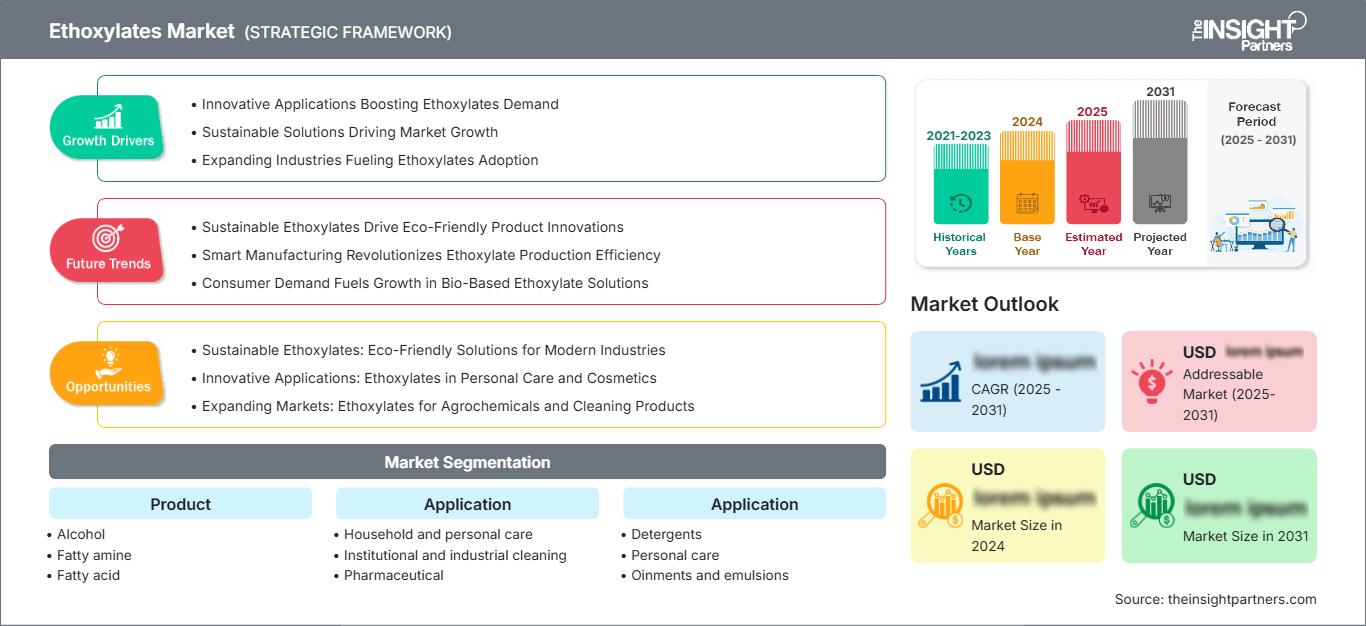
The Ethoxylates Market is valued at US$ 8.92 Billion in 2025 and is projected to reach US$ 12.35 Billion by 2034, expanding at a CAGR of 3.68% from 2026 to 2034. These products include nonionic surfactants and comparable ethoxylated surfactants used in applications such as homecare and personal care, industrial cleaning products, pharmaceuticals, agrochemicals, and oil field activities. Key drivers include the versatility of formulations as well as properties like wetting and emulsification, and the substitution of outdated surfactants with new and improved surfactant systems.
The growth prospects in North America Ethoxylates Market Size are expected to be moderate, with a focus on formulators' preference for high performance surfactants for institutional cleaners, personal care products, agrochemicals, and oil fields applications. The key growth drivers are the existing manufacturing base for chemicals, supply of ethylene oxide and alcohol, and the increased preference for environmentally friendly surfactants.
Ethoxylates Market Assessment and Insights
- North America: The region is estimated to account for 24–28% share in 2025 and grow at a CAGR of 3.1–3.7% during 2026–2034, supported by advanced formulation industries and established alkoxylation capacity.
- US: The US represents approximately 20–23% of the global market in 2025 and is expected to expand at a CAGR of 3.0–3.6%, driven by cleaning, agriculture, and oilfield demand.
- Europe: Europe is estimated at 22–26% share in 2025, with Germany, France, Italy, the UK, and Spain supporting demand. The region is projected to grow at 2.8–3.5% CAGR through 2034 amid sustainability-led formulation changes.
- Asia Pacific: Asia Pacific is estimated to hold 37–41% share in 2025 and record 4.2–4.9% CAGR through 2034, led by China, India, Japan, and South Korea and supported by expanding downstream manufacturing.
- Largest Segment: Alcohol ethoxylates are estimated to hold a 34–38% market share in 2025 and grow at a 3.7–4.3% CAGR through 2034, supported by broad detergent and cleaning applications.
- High Growth Segment: Agrochemicals are estimated to represent 13–16% share in 2025 and grow at a 4.5–5.2% CAGR as ethoxylated surfactants improve wetting, spreading, and formulation stability.
- Key companies analyzed in detail: BASF SE, Clariant AG, India Glycols Limited, INEOS Group Limited, Dow Inc., Huntsman International LLC, Shell plc, Sasol Limited, Solvay SA, and Stepan Company.
Source: The Insight Partners' analysis based on proprietary research, government publications, company annual reports, investor presentations, industry databases, and expert interviews.
The future of Ethoxylates Market development is expected to be influenced by feedstock integration, alkoxylation capacity and formulation specialization. There will be a shift away from commodity products towards customized ethoxylate products for cleaning applications, crop protection, personal care and industrial applications. Resilient supply chains are also set to play an increasingly strategic role, driving regionalization and diversification.
Growth opportunities are forecasted to arise in Asia Pacific countries such as China and India, where there is growth in detergent production, personal care consumption, agriculture and industry. Capacity addition in alkoxylation capacity in North America will add to supply flexibility, while European producers will focus on renewable carbon solutions and compliance. Companies with integrated feedstocks, flexibly located ethoxylation capacity and formulation expertise will see better growth opportunities.
Ethoxylates Market Report Scope
| Report Attribute | Details |
|---|---|
| Market size in 2025 | US$ 8.92 Billion |
| Market Size by 2034 | US$ 12.35 Billion |
| Global CAGR (2026 - 2034) | 3.68% |
| Historical Data | 2021-2024 |
| Forecast period | 2026-2034 |
Ethoxylates Market Analysis
The Ethoxylates Market can be fueled by the versatility of ethoxylates, that offer wetting, emulsifying, surfactancy, solubilizing, and dispersing functions in many formulations. The value chain starts from ethylene oxide and appropriate hydrophobic raw materials and ends with the finishing, testing, packaging, and distribution after controlled alkoxylation process. The large integrated manufacturers have advantages due to their sources of raw materials and manufacturing scale, while the specialities suppliers compete on molecular structure and technical services. The fluctuations of ethylene oxide, fatty alcohols, oleochemical raw materials, energy, and logistics costs should be considered as supply factors.
Positioning mentioned in the Ethoxylates Market Report is becoming more dependent on the availability of the capacity, manufacturing footprint in regions, sustainability and formulation skills. BASF SE, Clariant AG, Dow Inc., INEOS Group Limited, Huntsman International LLC, Shell plc, Sasol Limited, Solvay SA, and Stepan Company compete by means of their broad surfactants portfolio and technical capabilities, while India Glycols Limited has advantage due to its integrated renewable raw material exposure. The latest capacities addition show the importance of the manufacturing in regions. For example, new Stepan’s Pasadena alkoxylation plant adds 75,000 metric tons of annual alkoxylation capacity.
● REPORT CUSTOMIZATION
Tailor This Report To Align With Your Specific Business Requirements
This report can be customized to align precisely with your business objectives, scope, and target markets. Customization options include tailored segmentation, geography, competitive analysis, and strategic insights to support informed decision-making.
Customize This Report →WHAT YOU CAN ADJUST
- ● Segmentations
- ● Geography
- ● Competitive Analysis
- ● Language Preferences
Ethoxylates Market: Strategic Insights
Regional Insights
North America Ethoxylates Market
North America holds about 24-28% of the world Ethoxylates Market share in 2025 and is forecast to experience 3.1-3.7% CAGR growth till 2034. North America enjoys the advantage of mature chemical infrastructure, advanced detergent and institutional cleaning sectors, well-established personal care formulation skills and high consumption of agricultural and oilfield chemicals. Domestic alkoxylation capacity additions will increase the availability of supply and minimize dependence on remote sources of production.
United States accounts for the majority of the demand in this region, backed up by integrated chemical suppliers, large-scale downstream formulators and multiple end-use sectors. Canada supports the region with industrial chemical usage, formulations used in mining industry, cleaning chemicals and demands from the resources sector. The growing focus on renewable carbon-based raw materials, reliable supply chain and specialty surfactants will drive the development of premium offerings.
U.S. Ethoxylates Market
The US is projected to account for 82–86% of North American demand in 2025 and is anticipated to grow at a CAGR of 3.0-3.6%. It will benefit from abundant chemical production capacity and robust consumption in detergents, personal care, agriculture, and oilfield chemicals. Leading manufacturers have manufacturing and technical service facilities in all these segments.
Increasing demand is towards high-end and specialized products, where greater emphasis is on cleaning performance, foaming control, emulsification, and compatibility. Growth of alkoxylation capacity is of strategic importance, as it will increase availability in the region and reduce supply chain logistics. This trend is supported by the Pasadena investment of Stepan that will add 75,000 metric tons of capacity for ethoxylation and propoxylation annually.
Europe Ethoxylates Market
Europe represents 22-26% of the world market in 2025, and the region will witness growth at a CAGR of 2.8-3.5%. Germany continues to be a key country with the support of chemical industry, detergents, industrial cleaners, and specialty formulations. The growth in European demand will be driven by environmental considerations and the need for sustainable carbon sources.
The UK and France have a mature household, personal care, and industrial formulations industry, while Italy and Spain contribute through detergents, agricultural products, coatings, and consumer products. More producers are developing sustainable formulations like biobased and mass balance ethoxylates. For instance, Clariant's biobased castor oil ethoxylate is based on a segregated chain and serves as a substitute for fossil-based alternatives.
APAC Ethoxylates Market
The APAC region is estimated to have a 37-41% market share in 2025 and will register a CAGR of 4.2-4.9%. China is the leading country in terms of regional consumption, followed by Japan, South Korea, India, and Australia. Rising demands for detergent, personal care, pharmaceutical, agricultural, and industrial manufacturing industries boost consumption, while local chemical manufacturing reduces the dependency on imports.
Further, growing investments in chemical manufacturing, specialty chemicals, and downstream manufacturing are boosting regional consumption even more. China and India are increasing production capacities, whereas Japan and South Korea are still focused on high-end applications of chemical products. Moreover, rising urbanization, consumer expenditures, and industrial output in Southeast Asian countries are opening up opportunities for companies. Government policies that encourage local production of chemicals will boost regional growth over the forecast period.
Middle East & Africa Ethoxylates Market
MEA is a developing market, with its growth potential pegged at a 3.5% to 4.2% CAGR. Saudi Arabia has the highest potential in this region due to petrochemicals integration, while UAE and South Africa contribute to the downstream and formulation markets.
The sectors of energy chemicals, infrastructure construction, household cleaning, agriculture, and industrial processing drive the demand in the region. Saudi Arabia leverages feedstock integration, while UAE acts as a trading and logistics center for the region. The contribution from South Africa comes in the form of detergents, personal care, mining chemicals, and industrial cleaning products.
Segmentation Analysis
Product
Alcohol ethoxylates remain the leading product category, supported by extensive detergent, personal-care, and industrial-cleaning applications. Fatty amine and fatty acid ethoxylates serve more specialized formulation requirements. The product segment is projected to grow at a 3.5–4.1% CAGR from 2026–2034 as producers emphasize performance, biodegradability, and formulation flexibility.
- Alcohol: Widely used in detergents and cleaners because of strong wetting, emulsification, and detergency characteristics, making alcohol-based grades important for both household and industrial formulations.
- Fatty amine: Supports emulsification, corrosion-related formulations, agrochemicals, and specialty industrial applications where molecular functionality provides performance advantages.
- Fatty acid: Provides emulsifying and wetting functionality across personal care, cleaning, agriculture, and industrial formulations, with growing interest in oleochemical-derived feedstocks.
- Ethyl ester: Serves specialized formulation requirements where ester functionality contributes solvency, emulsification, and compatibility within industrial and specialty chemical systems.
- Glyceride: Used in selected personal-care, pharmaceutical, and specialty applications where mildness, emulsification, and compatibility with formulation ingredients are important.
Application
Application demand is diversified across consumer, industrial, agricultural, and pharmaceutical formulations. Household and personal care remains a major demand base, while agrochemicals and oilfield chemicals provide higher-value specialty applications. The application segment is projected to grow at a 3.8–4.4% CAGR during 2026–2034.
- Household and personal care: Requires consistent detergency, emulsification, wetting, and mildness characteristics, supporting extensive use in laundry, surface cleaning, cosmetics, and hygiene formulations.
- Institutional and industrial cleaning: Benefits from high-performance surfactants that provide soil removal, wetting, and formulation stability across commercial and heavy-duty cleaning systems.
- Pharmaceutical: Uses selected ethoxylated materials as emulsifiers, solubilizers, and formulation aids where consistency, purity, and compatibility are critical.
- Agrochemicals: Ethoxylates improve spreading, wetting, emulsification, and active-ingredient distribution, supporting formulation efficiency across herbicide and insecticide systems.
- Oilfield chemicals: Specialty ethoxylates support emulsification, wetting, demulsification, and formulation performance in demanding oilfield environments.
End Use
End-use demand is concentrated in detergents and personal care, while ointments and emulsions, herbicides, and insecticides provide specialized growth opportunities. The segment is projected to expand at a 3.9–4.5% CAGR through 2034 as downstream formulation volumes increase.
- Detergents: Represent a core end use because ethoxylates provide detergency, wetting, emulsification, and soil removal across liquid and powder cleaning systems.
- Personal care: Uses ethoxylates in cleansing, emulsification, solubilization, and formulation stabilization, particularly where texture and ingredient compatibility influence consumer acceptance.
- Oinments and emulsions: Ethoxylated ingredients support stable dispersions and emulsification in selected topical and pharmaceutical formulations requiring consistent product characteristics.
- Herbicides: Surfactants improve spray coverage, wetting, spreading, and active-ingredient delivery, increasing formulation efficiency under varied crop and application conditions.
- Insecticides: Ethoxylates support active-ingredient dispersion and surface coverage, helping formulators improve application consistency and performance.
Opportunity Snapshot
| End Use | Revenue Contribution | Trend Tag | Adoption Stage |
|---|---|---|---|
| Detergents | High | Low-Residue Cleaning | Mature |
| Personal care | High | Mild Formulation | Mature |
| Oinments and emulsions | Medium | Stable Emulsions | Scaling |
| Herbicides | Medium | Spray Efficiency | Scaling |
| Insecticides | Medium | Surface Coverage | Scaling |
Ethoxylates Market Growth Drivers and Impact Analysis
Expansion of Household and Institutional Cleaning Formulations
The need for efficient cleaning formulations drives the demand for ethoxylates as these are capable of wetting, emulsifying, acting as detergents, and removing soils across different water environments. Household laundry, dish washing, hard surface cleaning, and institutional cleaning need surfactants that can provide stable performance at controlled concentrations. In developing countries, increasing urbanization and use of packaged detergents expand the potential market. In mature markets, there is an emphasis on optimizing formulations, which drives manufacturers to produce concentrated and application-specific formulations. This works to the advantage of those manufacturers who have ethoxylation flexibility and extensive hydrophobe availability.
Growth of Agrochemical and Specialty Industrial Formulations
Formulation of agricultural agents is seen as a key area for growth owing to the properties of ethoxylated surfactants which offer wetting, spreading, emulsifying, and distributing of active ingredients. The formulation of crop protection agents today requires formulation technology that will ensure uniform distribution even with increased concentrations of active ingredients and varied methods of application. Industrial demand also arises due to the role played by surfactants in processing and dispersion. This ensures diverse demand, thus reducing dependency on household cleaning agents. Suppliers able to formulate hydrophilicity-lipophilicity ratio, molecular weight distribution, and compatibility with active ingredients are poised to capture high-value areas of demand. Growth of mechanized farming and crop growing in APAC and Latin America also helps drive consumption, while industrial formulations are another area for manufacturers with formulation services.
Shift Toward Renewable and Lower-Impact Surfactant Systems
Sustainability requirements are increasingly influencing surfactant purchasing decisions, particularly in Europe and among multinational consumer-product manufacturers. Customers are seeking renewable-carbon feedstocks, improved biodegradability, transparent sourcing, and lower product carbon footprints while maintaining formulation performance. This shift encourages producers to introduce bio-based or mass-balance ethoxylates rather than relying solely on conventional fossil-derived products. Clariant’s 2026 introduction of a fully bio-based castor oil ethoxylate illustrates how renewable-carbon solutions are being developed for industrial formulations. Such products can command strategic value where customers have carbon-reduction targets or sustainability specifications. The trend also encourages suppliers to invest in certification, traceability, feedstock partnerships, and production processes capable of supporting differentiated environmental claims.
Ethoxylates Market Future Trends
Increasing Adoption of Bio-Based Ethoxylates
Bio-based ethoxylates are expected to gain greater commercial relevance as brand owners and industrial customers seek measurable reductions in fossil-carbon dependence in the Ethoxylates Market Trends. Development will increasingly focus on renewable feedstocks that can deliver equivalent performance to conventional materials without requiring major reformulation. Mass-balance certification, segregated supply chains, and renewable-carbon accounting will become important purchasing criteria, especially for multinational customers with public sustainability commitments. Producers are likely to expand bio-based portfolios across detergents, personal care, agriculture, and industrial formulations. The competitive advantage will depend not only on feedstock origin but also on consistent quality, scalability, certification, cost competitiveness, and compatibility with existing manufacturing processes. As procurement teams increasingly evaluate product carbon footprints, suppliers able to provide traceable environmental attributes alongside reliable technical performance should strengthen their positions.
Regionalization of Alkoxylation Capacity
Supply-chain resilience is likely to remain a major strategic priority, encouraging investment in regional alkoxylation capacity closer to important feedstock sources and downstream customers. Producers are expected to diversify manufacturing networks to reduce exposure to logistics disruption, raw-material shortages, and regional price volatility. New capacity will increasingly emphasize flexible production capable of manufacturing multiple ethoxylate and propoxylate grades rather than single-product commodity output. Stepan’s Pasadena investment illustrates this direction by combining proximity to Gulf Coast raw materials with flexible alkoxylation capabilities. Similar investments could emerge in Asia Pacific and other high-growth regions. Regional production should improve lead times, support customized formulations, and allow producers to respond more rapidly to changes in customer demand.
Ethoxylates Market Opportunities
Expansion of High-Performance Specialty Grades
Specialty ethoxylates offer an attractive opportunity because customers increasingly prioritize formulation performance rather than purchasing purely on volume and price. Producers can develop differentiated grades for difficult cleaning environments, crop-protection formulations, pharmaceutical systems, personal-care products, and oilfield chemicals. Opportunities exist in controlling cloud point, foam profile, wetting characteristics, emulsification behavior, and compatibility with active ingredients. Customization can increase customer retention because formulation changes often require extensive testing and regulatory qualification. Companies with integrated research capabilities can therefore establish stronger positions than suppliers competing only on commodity production. The opportunity is particularly relevant in developed markets where formulation sophistication is high and in emerging markets where manufacturers are upgrading products to meet international performance requirements.
Localized Manufacturing in High-Growth Economies
Expansion of local production in Asia Pacific and other developing regions represents an important investment opportunity because downstream detergent, personal-care, agriculture, and industrial sectors are growing faster than mature markets. Local alkoxylation assets in the Ethoxylates Market Forecast can reduce freight exposure, shorten delivery times, and improve responsiveness to regional formulation requirements. India and Southeast Asia offer particularly attractive conditions because they combine expanding consumer markets with developing chemical manufacturing ecosystems. Producers can also establish local technical centers to adapt ethoxylate grades to water quality, climate, agricultural practices, and customer formulation preferences. Strategic partnerships with regional distributors and downstream formulators could accelerate market penetration. Investments that combine manufacturing, storage, technical service, and feedstock security should provide stronger long-term competitiveness.
Recent Developments
- June 2025: Econic Technologies Ltd launched Recreaire® carbonate ethoxylates, a new family of CO₂-based surfactants designed to replace conventional fossil- and oleochemical feedstocks. The technology can incorporate up to 45% CO₂ by weight and provides fatty alcohol ethoxylate alternatives for cleaning, personal care, coatings, agrochemicals, and metalworking applications. Econic reported up to a 65% reduction in global warming potential compared with conventional fatty alcohol ethoxylates.
- October 2025: Bhageria Industries Limited commenced commercial production of its new Plasticizers & Ethoxylates product line at its Tarapur facility following Maharashtra Pollution Control Board approval. The company intends to serve domestic and international markets, with its ethoxylates portfolio supporting diversification into specialty chemicals. Management subsequently indicated that ethoxylate products were being evaluated for selection, with production expected to ramp up after product finalization.
Frequently Asked Questions

- Comprehensive Market Sizing and Forecast Analysis
- Detailed Segmentation Analysis
- In-Depth Market Dynamics Assessment
- Regional and Country-Level Insights
- Competitive Landscape and Company Benchmarking
- Strategic Business Intelligence
Recent Reports
Testimonials

The Insight Partners' SCADA System Market report is comprehensive, with valuable insights on current trends and future forecasts. The team was highly professional, responsive, and supportive throughout. We are very satisfied and highly recommend their services.
RAN KEDEM Partner, Reali Technologies LTDs
I requested a report on a very specific software market and the team produced the report in a few days. The information was very relevant and well presented. I then requested some changes and additions to the report. The team was again very responsive and I got the final report in less than a week.
JEAN-HERVE JENN Chairman, Future Analytica
We worked with The Insight Partners for an important market study and forecast. They gave us clear insights into opportunities and risks, which helped shape our plans. Their research was easy to use and based on solid data. It helped us make smart, confident decisions. We highly recommend them.
PIYUSH NAGPAL Sr. Vice President, High Beam Global
The Insight Partners delivered insightful, well-structured market research with strong domain expertise. Their team was professional and responsive throughout. The user-friendly website made accessing industry reports seamless. We highly recommend them for reliable, high-quality research services
YUKIHIKO ADACHI CEO, Deep Blue, LLC.
This is the first time I have purchased a market report from The Insight Partners.While I was unsure at first, I visited their web site and felt more comfortable to take the risk and purchase a market report.I am completely satisfied with the quality of the report and customer service. I had several questions and comments with the initial report, but after a couple of dialogs over email with their analyst I believe I have a report that I can use as input to our strategic planning process.Thank you so much for taking the extra time and making this a positive experience.I will definitely recommend your service to others and you will be my first call when we need further market data.
JOHN SUZUKI President and Chief Executive Officer, Board Director, BK Technologies
I wish to appreciate your support and the professionalism you displayed in the course of attending to my request for information regarding to infectious disease IVD market in Nigeria. I appreciate your patience, your guidance, and the fact that you were willing to offer a discount, which eventually made it possible for us to close a deal. I look forward to engaging The Insight Partners in the future, all thanks to the impression you have created in me as a result of this first encounter.
DR CHIJIOKE ONYIA MANAGING DIRECTOR, PineCrest Healthcare Ltd.Reason to Buy
- Informed Decision-Making
- Understanding Market Dynamics
- Competitive Analysis
- Identifying Emerging Markets
- Customer Insights
- Market Forecasts
- Risk Mitigation
- Boosting Operational Efficiency
- Strategic Planning
- Investment Justification
- Tracking Industry Innovations
- Aligning with Regulatory Trends





 Get Free Sample for