
Europe Forging Market Size, Share & Forecast to 2034
Coverage: By Material Type (Nickel-based Alloys, Titanium Alloys, Steel Alloys, Aluminum Alloys, and Others), Type (Closed Die Forging and Open Die Forging), and End Use Industry (Automotive, Aerospace, Heavy Equipment, Manufacturing, Oil and Gas, Construction Equipment, Agricultural Equipment, Energy and Power, and Others), and Geography
- Status : Published
- Report Code : TIPRE00044086
- Category : Manufacturing and Construction
- No. of Pages : 160
- Available Report Formats :


- Last update date : November 05, 2026


2025 Market Size
US$ 20.09 Bn
Base year value
2034 Forecast
US$ 29.95 Bn
Projected by 2034
CAGR 2026-2034
4.53 %
Growth rate
Addressable Market
US$ 227.12 Bn
(2026-2034)
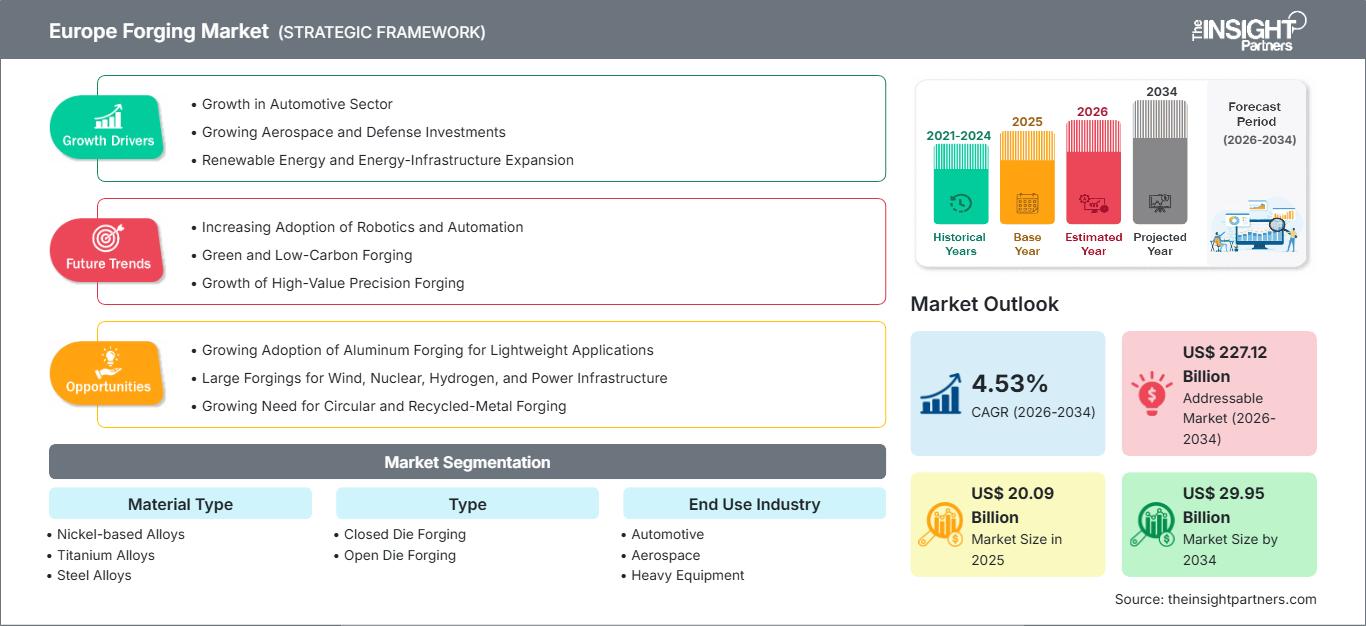
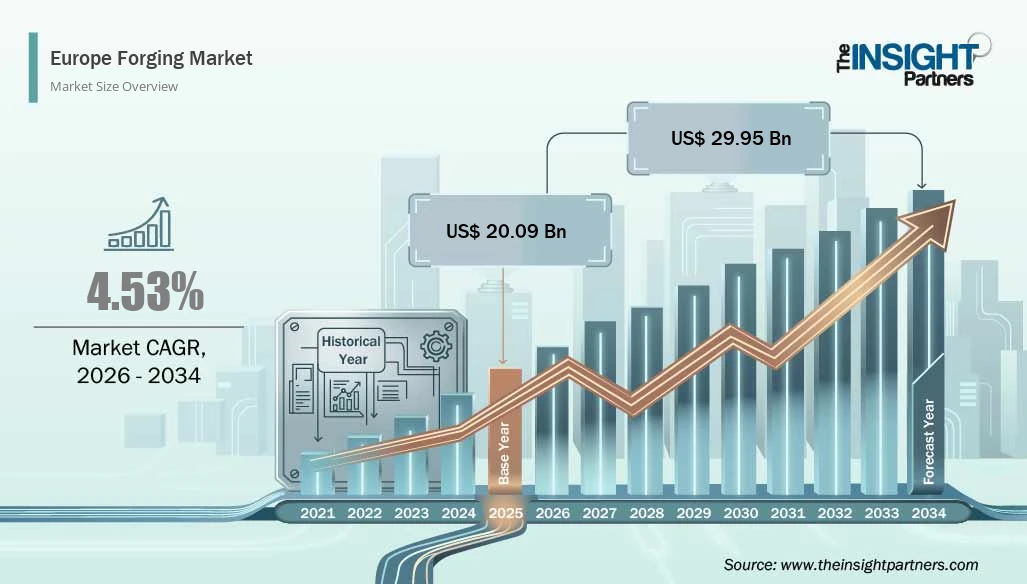
The Europe Forging Market is valued at US$ 20.09 billion in 2025 and is projected to reach US$ 29.95 billion by 2034, registering a CAGR of 4.53% during 2026–2034. Market expansion is supported by sustained demand for high-strength metal components across automotive, aerospace, heavy equipment, energy, and industrial manufacturing applications. Increasing requirements for structural integrity, fatigue resistance, dimensional reliability, and material efficiency are reinforcing the importance of forging in critical component production. Advancements in forming technologies, process automation, and metallurgical engineering are further influencing manufacturing capabilities and purchasing decisions..
Europe Forging Market Assessment and Insights
Regional Outlook
- Germany: 39.44% of the European market in 2025 | 4.63% CAGR through 2034. Market position: Germany is the largest country market in Europe, supported by its automotive OEM ecosystem, industrial machinery production, and advanced metal-forming capabilities. Strong engineering infrastructure and established supplier relationships reinforce its manufacturing position.
- France: 9.77% of the European market in 2025 | 4.98% CAGR through 2034. Market position: France maintains an important position through aerospace, defense, energy, and transportation manufacturing. Aircraft engine production and specialized metallurgical capabilities support demand for high-integrity forged components and encourage investment in advanced forging equipment.
- Italy: 20.73% of the European market in 2025 | 3.78% CAGR through 2034. Market position: Italy is the second-largest country market in Europe, supported by automotive component manufacturing, mechanical engineering, industrial equipment, and specialized forging suppliers. Its manufacturing network serves domestic OEMs and international industrial customers.
- UK: 6.20% of the European market in 2025 | 4.18% CAGR through 2034. Market position: The UK benefits from aerospace engineering, defense procurement, energy infrastructure, and specialized industrial manufacturing. Its established aerospace supply chain supports demand for technically qualified components and advanced metallurgical processing.
- Spain: 5.0% of the European market in 2025 | 4.46% CAGR through 2034. Market position: Spain benefits from automotive manufacturing, transportation equipment, industrial machinery, and renewable energy infrastructure. Its forging industry is connected to international automotive supply chains and is increasingly focused on automation and production efficiency.
Segment Outlook
- Closed Die Forging: 78.14% Share in 2025 | 4.28% CAGR through 2034. Market position: Closed die forging leads the process category because of its suitability for repeatable, high-volume manufacturing. Automotive production, standardized industrial components, dimensional consistency, and material utilization support its substantial revenue contribution.
- Aerospace: 10.09% Share in 2025 | 5.87% CAGR through 2034. Market position: Aerospace represents a high-growth end-use opportunity because aircraft engine programs, landing gear production, defense requirements, and stringent component qualification standards increase demand for high-integrity forged products.
Competitive Coverage
SIFCO Industries, Inc., Ficep S.p.A., Bharat Forge Limited, Doosan Enerbility Co., Ltd., Bruck GmbH, thyssenkrupp AG, Stalchem Sp. z o.o., Elcee Group B.V., voestalpine AG, Kühr GmbH, Lucchini RS S.p.A., RIGANTI S.p.A.
Methodology
The Insight Partners follows Data Collection & Secondary Research, Primary Research, Data Analysis, and Data Triangulation & Final Review to validate market estimates and insights.
Source: The Insight Partners' analysis based on proprietary research, government publications, company annual reports, investor presentations, industry databases, and expert interviews.
The European forging industry has developed around established automotive, aerospace, machinery, and heavy industrial manufacturing clusters. Germany provides substantial production infrastructure, while Italy maintains a strong network of specialist forging companies serving transportation and industrial equipment customers. France has developed specialized capabilities in aerospace and defense-related components, supported by its integrated aircraft manufacturing ecosystem. On the technology side, improvements in hydraulic presses, automated material handling, process simulation and heat treatment have shaped manufacturing productivity across the region. More and more manufacturers are combining forging with machining, inspection and finishing to meet tough customer specs and cut down on production variability.
Looking ahead, the picture comes down to investment in aerospace production, industrial modernization, energy infrastructure and localized manufacturing. France and Germany matter most for advanced aerospace components, while Italy and Spain lean on automotive and industrial equipment supply chains. Central and Eastern European economies offer a way to diversify suppliers and localize production.
Europe Forging Market Report Scope
| Report Attribute | Details |
|---|---|
| Market size in 2025 | US$ 20.09 Billion |
| Market Size by 2034 | US$ 29.95 Billion |
| CAGR (2026 - 2034) | 4.53% |
| Historical Data | 2021-2024 |
| Forecast period | 2026-2034 |
Europe Forging Market Analysis
The Europe Forging Market growth is supported by industrial demand for components that require high mechanical strength, fatigue resistance, and structural reliability. Automotive manufacturers use forged components in drivetrains, chassis systems, axles, and steering assemblies. Aerospace manufacturers need specialty products for engines, landing gear and structural parts, where the material must hold up and be traceable. Heavy equipment, farm machinery, construction gear, energy infrastructure and industrial manufacturing add more demand on top. That spread of uses keeps the customer base broad, though demand still rises and falls with vehicle production, aerospace delivery schedules, capital spending and infrastructure investment.
The competitive field is a mix of diversified industrial groups, automotive component suppliers, and forging specialists. thyssenkrupp AG has a big footprint in forged technologies for the auto industry, and voestalpine AG pairs metallurgy with engineered industrial products. Lucchini RS S.p.A. serves tough industrial and transportation applications, while Bruck GmbH brings specialized manufacturing know-how. SIFCO Industries, Inc. and Bharat Forge Limited work within international supply chains, serving customers with demanding technical needs. Then there are the European specialists, like Khr GmbH, Stalchem Sp. z o.o., Elcee Group B.V., and RIGANTI S.p.A., who round out the wider competitive ecosystem.
The Europe forging market analysis indicates that investment priorities increasingly include press modernization, automated production, machining integration, and specialized alloy processing. Manufacturers are also assessing the economics of replacing older equipment with energy-efficient production systems. Aerospace suppliers require additional investments in qualification, testing, and traceability, while automotive suppliers are adapting production to changing vehicle architectures.
● REPORT CUSTOMIZATION
Tailor This Report To Align With Your Specific Business Requirements
This report can be customized to align precisely with your business objectives, scope, and target markets. Customization options include tailored segmentation, geography, competitive analysis, and strategic insights to support informed decision-making.
Customize This Report →WHAT YOU CAN ADJUST
- ● Segmentations
- ● Geography
- ● Competitive Analysis
- ● Language Preferences
Europe Forging Market: Strategic Insights
Regional Insights
Germany Forging Market
Germany accounts for 39.44% of the Europe Forging Market share in 2025 and is projected to register a CAGR of 4.63% through 2034. Its leading position is supported by an extensive automotive manufacturing ecosystem, industrial machinery production, engineering expertise, and a well-developed metalworking supply chain. German manufacturers supply forged components for passenger vehicles, commercial vehicles, construction machinery, power-generation equipment, and specialized industrial systems. The country also benefits from established relationships between component suppliers, equipment manufacturers, and major industrial OEMs.
France Forging Market
France represents 9.77% of the Europe Forging Market share in 2025 and is expected to record a CAGR of 4.98% through 2034. The country has an important forging industry supported by aerospace, defense, energy, and industrial equipment manufacturing. Its aerospace ecosystem is particularly significant because aircraft engine manufacturers, aircraft producers, and their suppliers require high-integrity forged components. France's forging industry recorded approximately 436,000 metric tons of production and 73 production sites in 2025, demonstrating the presence of an established manufacturing base. The country's industrial capabilities extend across conventional steel processing and specialized material applications.
Italy Forging Market
Italy accounts for 20.73% of the Europe Forging Market share in 2025 and is projected to register a CAGR of 3.78% through 2034. It is the second-largest country market in Europe, supported by automotive component manufacturing, mechanical engineering, industrial machinery, and a broad network of specialized manufacturing companies. Italian suppliers participate in domestic and international supply chains, manufacturing components for passenger vehicles, commercial vehicles, industrial equipment, and transportation systems. The country's industrial structure also supports customized production and specialized metal-forming capabilities.
UK Forging Market
The UK represents 6.20% of the Europe Forging Market share in 2025 and is expected to record a CAGR of 4.18% through 2034. Aerospace manufacturing, defense procurement, power generation, transportation equipment, and specialized industrial engineering all keep the country's forging industry going. The aerospace sector is what drives demand for precision-forged engine components, structural parts, and other high-performance metal pieces.
Spain Forging Market
Spain accounts for 5.0% of the Europe Forging Market share in 2025 and is projected to register a CAGR of 4.46% through 2034. Spain's forging industry leans on automotive manufacturing, transportation equipment, industrial machinery, and a renewable energy build-out that keeps growing. Those industrial clusters keep demand steady for forged steel and aluminum parts, the kind that go into vehicles, machinery, and industrial equipment..
Rest of Europe Forging Market
The Rest of Europe accounts for 18.86% of the Europe Forging Market share in 2025 and is projected to register a CAGR of 5.02% through 2034. This category includes Poland, the Czech Republic, Austria, Sweden, Finland, Slovenia, and other European manufacturing economies. Poland and the Czech Republic benefit from automotive supplier networks and industrial machinery manufacturing, while Austria and Sweden contribute through specialized steel processing, engineering, transportation, and energy equipment production. These countries provide an increasingly important manufacturing base for regional supply-chain diversification.
Segmentation Analysis
The market is segmented by Material Type, Type, and End Use Industry. Each category reflects different metallurgical requirements, production methods, component specifications, and purchasing priorities.
Material Type
Material Type is a fundamental purchasing and manufacturing consideration because alloy composition determines component strength, temperature resistance, corrosion performance, weight, and processing requirements. Material choice comes down to operating environment, engineering specs, product lifecycle and total manufacturing cost. Steel continues to be the primary heavy industry material for general uses, thanks to mature processing infrastructure and superior mechanical flexibility. New aerospace, power, and industrial applications are driving demand for higher metallurgical performance, with nickel alloys growth is projected to grow at a CAGR of 4.03% from 2026-2034.. The Europe forging market scope continues to expand across diverse material types serving multiple industrial applications
- Nickel-based Alloys: Nickel alloys are suitable for critical environments where components are exposed to high temperatures, oxidation, and corrosion as well as mechanical stress. Their application is more evident in aircraft engines and gas turbines, industrial chemical equipment and energy-specific applications where reliable functioning within their operating conditions is required.
- Titanium Alloys: Titanium alloys For structural parts with a strong strength-to-weight ratio and corrosion resistance titanium alloy is a key material of aerospace structures, aircraft engines, and some industrial processes. Its higher processing requirements also stimulate manufacturers to adopt forging technology and more demanding quality control.
- Steel Alloys: Steel alloys continue to be fundamental to industrial forging due to their mechanical versatility, well-established supply chains, and suitability for a wide variety of manufacturing methods. They are used in transportation construction agricultural machinery, energy, and heavy equipment sectors where durability and structural strength are essential.
- Aluminum Alloys: Aluminum alloys are relevant where component weight reduction and corrosion resistance are important purchasing considerations. Their application in automotive structures, aerospace components, and transportation equipment supports demand for controlled forming processes and improved dimensional accuracy.
- Others: Other materials include specialized metal compositions selected for particular mechanical, thermal, or environmental requirements. Their use depends on customer engineering specifications and the availability of suitable processing capabilities, particularly in customized industrial and specialized manufacturing applications.
Type
The Type category determines how metal deformation is performed and influences component geometry, production flexibility, tooling requirements, and manufacturing economics. Demand is shaped by production volumes, component complexity, dimensional tolerances, and the scale of customer orders. Manufacturers select processes according to intended component designs and operational requirements. Closed die forging is expected to maintain its dominant position, while open die forging remains strategically important for customized and large-scale industrial components. Closed die forging is projected to register a CAGR of 4.28% during 2026–2034.
- Closed Die Forging: Closed die forging uses shaped dies to form metal into components with defined geometries. The process is suited to repeat production, complex shapes, and consistent component dimensions. Its manufacturing economics are particularly relevant to automotive and other volume-oriented industrial customers.
- Open Die Forging: Open die forging is used to manufacture large, customized, and relatively simple geometries through controlled deformation between dies. Its flexibility supports heavy industrial, energy, aerospace, and infrastructure applications where component dimensions and metallurgical requirements can vary considerably.
End Use Industry
End Use Industry determines the technical requirements, procurement cycles, production volumes, and performance specifications influencing component demand. The category benefits from diversified industrial consumption, reducing dependence on any single customer sector. Automotive applications provide a substantial established demand base, while aerospace offers a higher-growth opportunity because of aircraft production requirements, specialized material specifications, and increasing component complexity. Aerospace-related forging demand is projected to register a CAGR of 5.87% during 2026–2034, reflecting the importance of qualified supply chains and high-integrity manufacturing.
- Automotive: Automotive manufacturers use forged components in drivetrains, axles, crankshafts, steering systems, suspension assemblies, and other structural applications. Procurement is influenced by vehicle production, platform standardization, component durability, lightweighting strategies, and changing electric vehicle architectures.
- Aerospace: Aerospace applications require forged components with controlled metallurgical characteristics, structural integrity, and documented production histories. Aircraft engines, landing gear, and critical structural assemblies create demand for specialized processing, testing, and long-term supplier qualification.
- Heavy Equipment: Heavy equipment manufacturers require robust forged components for machinery operating under repetitive mechanical loads and demanding working conditions. Applications include drivetrain assemblies, shafts, connecting components, and other parts used in industrial and material-handling equipment.
- Manufacturing: General manufacturing uses forged components in machinery, mechanical systems, industrial tools, and production equipment. Demand reflects industrial capital expenditure, equipment replacement, factory modernization, and the requirement for dependable components in continuous-operation environments.
- Oil and Gas: Oil and gas applications require forged products for pumps, valves, pressure equipment, drilling systems, and other high-stress operating environments. Corrosion resistance, pressure integrity, material traceability, and reliability are important supplier-selection considerations.
- Construction Equipment: Construction equipment manufacturers use forged parts in hydraulic systems, structural assemblies, axles, and load-bearing machinery components. Infrastructure development, equipment utilization, replacement demand, and mechanization influence procurement requirements.
- Agricultural Equipment: Agricultural machinery requires forged components capable of withstanding repetitive loading, vibration, and challenging operating environments. Tractors, harvesting equipment, transmission systems, and agricultural implements provide applications for durable metal components.
- Energy and Power: Energy and power applications include turbines, generators, power-generation equipment, and associated industrial systems. Large components and demanding operational conditions create requirements for specialized forging, metallurgical control, and comprehensive inspection.
- Others: Other end-use applications include railways, marine equipment, defense-related manufacturing, and specialized industrial systems. Their contribution depends on infrastructure procurement, industrial investment, and the availability of qualified suppliers capable of meeting application-specific engineering standards.
Opportunity Snapshot
The following table evaluates the commercial relevance of the End Use Industry category. Revenue contribution represents qualitative relative importance rather than measured market shares.
| End Use Industry | Revenue Contribution | Trend Tag | Adoption Stage |
| Automotive | High | Vehicle Lightweighting | Mature |
| Aerospace | Medium | Engine Components | Scaling |
| Heavy Equipment | High | Machinery Modernization | Mature |
| Manufacturing | High | Industrial Automation | Mature |
| Oil and Gas | Medium | Pressure Integrity | Mature |
| Construction Equipment | Medium | Infrastructure Machinery | Scaling |
| Agricultural Equipment | Medium | Farm Mechanization | Mature |
| Energy and Power | Medium | Turbine Components | Scaling |
| Others | Low | Specialized Components | Emerging |
Europe Forging Market Growth Drivers and Impact Analysis
Increasing Demand for High-Performance Automotive Components
Automotive manufacturing generates steady, recurring demand across Europe, since vehicle platforms need components that hold up under mechanical stress, vibration, and long operating cycles. Axles, crankshafts, connecting rods, steering systems, and suspension assemblies all depend on forged parts. Germany and Italy offer deep automotive engineering and component manufacturing ecosystems; Spain and the rest of Europe add integrated vehicle supply chains. Electric vehicle development is reshaping powertrain configurations, yet forged structural and mechanical components remain essential. What changes is the focus: manufacturers are reassessing weight, geometry, and material selection. Suppliers that serve multiple vehicle architectures while keeping manufacturing consistent can hold on to OEM relationships and win places in new platform programs.
Expansion of Aerospace and Defense Manufacturing
Forged products for aerospace and defense must meet strict mechanical, metallurgical, and traceability requirements, and France, Germany, and the UK all sustain major aerospace manufacturing sectors that generate demand for engine components, landing gear, and structural assemblies. Because component performance bears directly on operational safety, these parts go through demanding qualification procedures, and aircraft production programs require suppliers to hold consistent quality across long manufacturing cycles. Defense procurement adds further demand for specialized components in aircraft, military vehicles, and other equipment. Investment in European aerospace production and international supplier partnerships is prompting forging manufacturers to expand specialized processing and inspection capabilities. Suppliers with established certifications, engineering resources, and dependable delivery performance are better positioned to secure long-term aerospace procurement programs.
Rising Infrastructure and Energy Investment Driving Heavy Forging Demand
Lately, demand for large, mechanically heavy-duty forged components has grown as infrastructure modernization and investment in the energy sector have spurred investments in new equipment. Power-generation equipment, industrial turbines, pressure equipment, equipment for the mining sector and large construction machinery all demand high-performance, long-life forged components that can absorb mechanical and thermal load for extended periods. Oil and gas production equipment also needs high-quality forged products used in valves pumps drilling equipment and pressure loads. Germany Italy France and other European nations have developed industrial engineering capability in this market, and infrastructure investments have driven demand for replacement of existing equipment and for new capacity. Energy investments also demand high-quality specialized forged components and dimensions customized to the application. For forgings, the commercial opportunity is linked to engineering complexity, project execution capability and capacity to produce very large components with correct mechanical properties and tolerances.
Europe Forging Market Future Trends
Integration of Digital Manufacturing and Intelligent Process Control
The Europe Forging Market trends increasingly point toward the integration of digital manufacturing technologies throughout the production process. Advanced sensors, temperature monitoring, automated material handling, and process simulation can improve control over deformation, heating, and cooling conditions. Digital production records also support traceability and quality documentation, particularly in aerospace, defense, and energy applications. Predictive maintenance systems can help manufacturers identify equipment deterioration before unplanned downtime affects production schedules. German and Italian industrial equipment suppliers and forging manufacturers are particularly relevant to this technological transition because of their established engineering capabilities.
Growing Emphasis on Low-Emission and Circular Forging Manufacturing
Environmental considerations are increasingly factoring into European metal manufacturing investment decisions. Forging is energy-intensive due to the need to heat, deform, and cool parts, with the finishing processes. Industry is exploring energy-saving furnaces, better heat recovery, green electricity sourcing, flexible production planning, and a higher share of recycled metal input. Shifts in the decarbonization pathways of steelmaking can also impact the life cycle emissions of forgings. Decarbonization policies and customer buying standards for industrial sector decarbonization in Europe may factor in material source and manufacturing emissions, and life cycle performance alongside quality and cost.
Europe Forging Market Opportunities
Expansion of Specialized Aerospace Forging and Advanced Alloy Processing
Aerospace supply-chain localization is a potential investment for European forging producers looking to move into higher-quality, industrial markets. Supply chains for aircraft engine programs, landing gears and defense aerospace programs need suppliers with the capacity to work with appropriate materials within sophisticated manufacturing environments. Investment in ring rolling, precision forging, heat treatment, NDT and complex machining can meet these requirements. France brings opportunities for aircraft engine and aerospace component clusters, while Germany and the UK bring additional engineering and qualification capabilities. The Europe Forging Market Forecasts therefore present a strategic case for investment in specialized production rather than capacity expansion alone. Manufacturers should prioritize customer-specific qualifications, engineering collaboration, and integrated quality systems to establish durable positions in aerospace supply chains.
Investment in Heavy Forging Capacity for Energy and Industrial Infrastructure
Power-generation plants, industrial facilities, mine equipment, and large-scale energy projects drive demand for suppliers of heavyweight forgings. Many such applications need customized presses, specialized material handling, large heat-treating facilities, and machining capabilities, which are limited in some regions. Building dedicated heavy forging facilities will enable firms to meet customer requirements for assured supplies of essential parts. Germany and Italy have mature industrial engineering environments, while France has opportunities related to nuclear and energy equipment manufacturing.
Recent Developments
- February 2026: Märkisches Werk GmbH — The German manufacturer announced the commissioning of a fully automated forging press center at its Halver facility. The investment includes electrically driven upsetting machines operated by industrial robots and a new 1,000-ton spindle forging press. The expansion is intended to increase large-bore valve spindle production capacity by 30%, improve manufacturing reliability, and strengthen the company's ability to meet demand for high-strength alloy components.
- July 2026: Bharat Forge Limited – The company’s Aerospace Division, has signed a Memorandum of Understanding (MoU) with FLYING WHALES, a French-Canadian global pioneer in heavy-lift airship technology, to jointly develop, manufacture, and field advanced airships for India’s defense and strategic operational requirements. The MoU was signed by Mr. Guru Biswal, CEO Aerospace, Bharat Forge Limited, and Mr. Sébastien Bougon, President, FLYING WHALES, at the Farnborough International Airshow 2026.
- August 2026: Jupiter Wagons Ltd. – The company entered into a strategic partnership with Italy-based Lucchini RS Holding S.p.A. to establish an integrated railwheel manufacturing platform in India. Under the agreement, Lucchini RS will acquire a 15% stake in Jupiter Tatravagonka Railwheel Factory Pvt. Ltd. (JTRWF), while Italian government-backed financial institution SIMEST will acquire an additional 10% stake. The combined investment is valued at approximately €28 million.
Frequently Asked Questions

- Comprehensive Market Sizing and Forecast Analysis
- Detailed Segmentation Analysis
- In-Depth Market Dynamics Assessment
- Regional and Country-Level Insights
- Competitive Landscape and Company Benchmarking
- Strategic Business Intelligence
Recent Reports
Testimonials

The Insight Partners provided valuable market intelligence that supported our global go-to-market strategy. Their team was professional, responsive, and attentive to our feedback, providing thoughtful analysis and helpful methodological clarifications throughout the project.
Junmo Kim Chief Financial Officer (CFO), Enertech Co., Ltd.
The Insight Partners' SCADA System Market report is comprehensive, with valuable insights on current trends and future forecasts. The team was highly professional, responsive, and supportive throughout. We are very satisfied and highly recommend their services.
RAN KEDEM Partner, Reali Technologies LTDs
I requested a report on a very specific software market and the team produced the report in a few days. The information was very relevant and well presented. I then requested some changes and additions to the report. The team was again very responsive and I got the final report in less than a week.
JEAN-HERVE JENN Chairman, Future Analytica
We worked with The Insight Partners for an important market study and forecast. They gave us clear insights into opportunities and risks, which helped shape our plans. Their research was easy to use and based on solid data. It helped us make smart, confident decisions. We highly recommend them.
PIYUSH NAGPAL Sr. Vice President, High Beam Global
The Insight Partners delivered insightful, well-structured market research with strong domain expertise. Their team was professional and responsive throughout. The user-friendly website made accessing industry reports seamless. We highly recommend them for reliable, high-quality research services
YUKIHIKO ADACHI CEO, Deep Blue, LLC.
This is the first time I have purchased a market report from The Insight Partners.While I was unsure at first, I visited their web site and felt more comfortable to take the risk and purchase a market report.I am completely satisfied with the quality of the report and customer service. I had several questions and comments with the initial report, but after a couple of dialogs over email with their analyst I believe I have a report that I can use as input to our strategic planning process.Thank you so much for taking the extra time and making this a positive experience.I will definitely recommend your service to others and you will be my first call when we need further market data.
JOHN SUZUKI President and Chief Executive Officer, Board Director, BK Technologies
I wish to appreciate your support and the professionalism you displayed in the course of attending to my request for information regarding to infectious disease IVD market in Nigeria. I appreciate your patience, your guidance, and the fact that you were willing to offer a discount, which eventually made it possible for us to close a deal. I look forward to engaging The Insight Partners in the future, all thanks to the impression you have created in me as a result of this first encounter.
DR CHIJIOKE ONYIA MANAGING DIRECTOR, PineCrest Healthcare Ltd.Reason to Buy
- Informed Decision-Making
- Understanding Market Dynamics
- Competitive Analysis
- Identifying Emerging Markets
- Customer Insights
- Market Forecasts
- Risk Mitigation
- Boosting Operational Efficiency
- Strategic Planning
- Investment Justification
- Tracking Industry Innovations
- Aligning with Regulatory Trends





 Get Free Sample for