
Exterior Doors Market Growth, Demand & Size by 2034
Coverage: By Door Type (Panel Doors, Bypass Doors, Bifold Doors, Pocket Doors, Others); Material (Wood, Metal, Glass, Fiberglass, Fiberboard, Others); Mechanism (Swinging, Sliding, Folding, Revolving, Others); End-user (Residential, Non-residential), and Geography (North America, Europe, Asia Pacific, and South and Central America)
- Status : Data Released
- Report Code : TIPRE00016449
- Category : Manufacturing and Construction
- No. of Pages : 150
- Available Report Formats :


- Last update date : September 28, 2026


2025 Market Size
US$ 133.08 Bn
Base year value
2034 Forecast
US$ 231.59 Bn
Projected by 2034
CAGR 2026-2034
6.35 %
Growth rate
Addressable Market
US$ 1,650.12 Bn
(2026-2034)
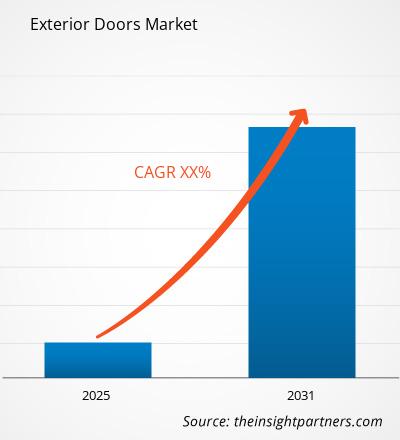
The exterior doors market was valued at US$ 133.08 Billion in 2025 and is projected to reach US$ 231.59 Billion by 2034, expanding at a CAGR of 6.35% during 2026–2034. The market encompasses panel, bypass, bifold, and pocket doors produced from wood, metal, glass, fiberglass, and fiberboard, with swinging, sliding, folding, and revolving mechanisms serving residential and non-residential buildings worldwide.
Across North America, the exterior doors market size is supported by a modelled 5.8–6.4% CAGR through 2034, reflecting replacement-led demand and stronger building-envelope requirements. Renovation of ageing housing stock and adoption of insulated, impact-rated entry systems anchor volume, while smart locks and connected access raise average selling values. The outlook aligns with IEA evidence that poorly insulated buildings remain a priority for efficiency upgrades in advanced economies.
Exterior Doors Market Assessment and Insights
- North America held 28–31% Share in 2025 and is projected to register a CAGR between 5.8–6.4% during 2026–2034, supported by replacement activity, hurricane resilience codes, energy retrofits, and established dealer-installer networks.
- US represented 83–86% of North American demand in 2025, with a 5.9–6.5% CAGR between 2026–2034 as residential renovation and code-compliant commercial replacement sustain orders.
- Europe captured 24–27% Share in 2025 and should grow at 5.2–5.8% during 2026–2034. Germany leads, while the UK, France, Italy, and Spain contribute through renovation, decarbonization, and hospitality construction.
- Asia Pacific accounted for 32–35% Share in 2025 and is expected to record a 7.1–7.8% CAGR between 2026–2034. China leads, with India, Japan, South Korea, and Australia supporting urban housing and infrastructure demand.
- Largest Segment Residential held 60–64% market share in 2025 and is forecast to expand at a 6.1–6.7% CAGR during 2026–2034, driven by new homes and replacement cycles.
- High Growth Segment Fiberglass represented 18–22% market share in 2025 and is projected to post a 7.4–8.2% CAGR during 2026–2034, reflecting durability and insulation advantages.
- Key companies analyzed in detail: ASSA ABLOY AB, Owens Corning, JELD-WEN Holding, Inc., YKK AP Inc., Sanwa Holdings Corporation, LIXIL Corporation, Andersen Corporation, Pella Corporation, Hörmann KG Verkaufsgesellschaft, and Marvin Lumber and Cedar Company.
Source: The Insight Partners' analysis based on proprietary research, government publications, company annual reports, investor presentations, industry databases, and expert interviews.
Product architecture is no longer limited to timber slabs but includes engineered systems, including an insulated core, weather seal, reinforced frame, multipoint locking, and factory finishes. Fiberglass panels mimic wood appearance while minimizing warping and maintenance needs, while aluminum and steel facilitate greater glazing areas and security requirements. Firms consolidate supplier networks, employing computerized machining and configurations to speed up manufacturing time. Installation expertise of the dealers is important since the precision of installation affects air infiltration, waterproofing, hardware efficiency, and warranty fulfillment.
Until 2034, the opportunities for expansion can be found in Indian urban areas, Gulf megaprojects, and housing corridors in Southeast Asia, whereas developed markets will concentrate on replacement and efficiency upgrades. The criteria for energy performance, resilience, and sustainability in buildings can encourage certification of heat insulation, fire resistance, noise control, and recycling. The areas of investment will include local manufacturing, composites molding, smart locking systems, and installer certification program. The UNEP finding of more than doubling green building certifications over the past decade justifies the economic efficiency of certification.
Exterior Doors Market Report Scope
| Report Attribute | Details |
|---|---|
| Market size in 2025 | US$ 133.08 Billion |
| Market Size by 2034 | US$ 231.59 Billion |
| Global CAGR (2026 - 2034) | 6.35% |
| Historical Data | 2021-2024 |
| Forecast period | 2026-2034 |
Exterior Doors Market Analysis
Growth of the exterior doors market stems from building construction, renovation, commercial building, and replacement due to weathering and safety concerns. Value chain involves raw materials, processors, producers of skin and core for the door, companies dealing with glass and hardware, system manufacturers, distributors, dealers, installation companies, and building owners. The specification process starts with the performance of the door itself instead of the cost of the slab.
Supply costs will depend on the materials that are utilized in the production of doors. Wooden doors will continue to be influenced by supply cost of wood and its processing and finishing stages. The metal doors will be dependent on the cycles in aluminum and steel industries, while the fiberglass will rely on the resin, reinforcing fibers, molds, and bonding process. In the local manufacture case, the costs of shipping bulky products will be reduced, while in standard size, it is easier to achieve scale.
The exterior doors market report is characterized by a fragmented market with global players and regional leaders. ASSA ABLOY AB and Sanwa Holdings Corporation have access and opening commercialization skills, whereas Owens Corning and JELD-WEN Holding, Inc. are characterized by broad residential marketing and engineering doors products. The companies such as YKK AP Inc. and LIXIL Corporation use facade systems, whereas the company Hörmann KG Verkaufsgesellschaft serves the luxury and industrial segments.
Investment areas are fiberglass molding, automated finishing, certification testing, regional logistics, and technology for dealers. Versatility of design, quality of raw materials, and contractors’ relations are distinctive aspects of Andersen Corporation, Pella Corporation, and Marvin Lumber and Cedar Company. Today, the competitive position is determined by a whole system including frames, sealing, glazing, hardware, and related services. Mergers may be related to new elements and geography; however, well-managed integration should be performed due to the negative impact of poor installation and delays in customization orders on brand image.
● REPORT CUSTOMIZATION
Tailor This Report To Align With Your Specific Business Requirements
This report can be customized to align precisely with your business objectives, scope, and target markets. Customization options include tailored segmentation, geography, competitive analysis, and strategic insights to support informed decision-making.
Customize This Report →WHAT YOU CAN ADJUST
- ● Segmentations
- ● Geography
- ● Competitive Analysis
- ● Language Preferences
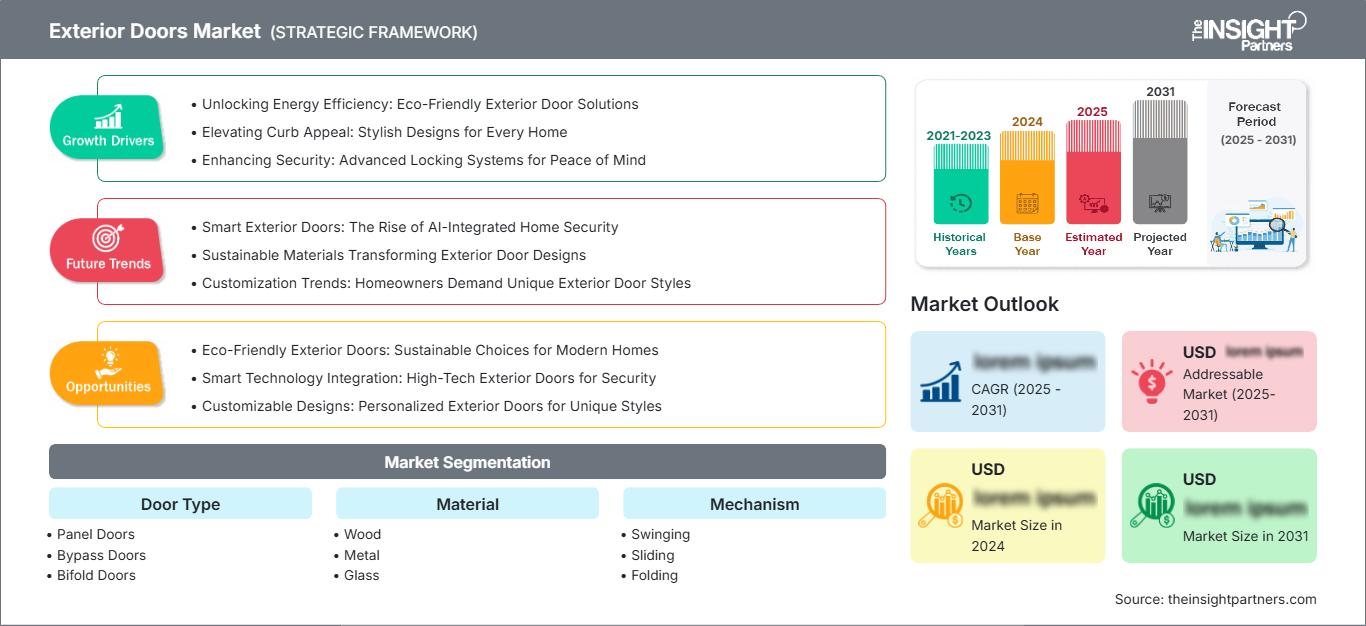
Exterior Doors Market: Strategic Insights
Regional Insights
North America exterior doors market
North America was expected to have 28-31% exterior doors market share of exterior doors by 2025 and to exhibit 5.8-6.4% CAGR from 2026 to 2034. The replacement segment is crucial for demand due to the maturity of existing housing stock and subsequent demand arising out of need for improved weather proofing, hardware safety, aesthetics, and reduced maintenance needs. While coastal regions require products with impact rating, cold climates prefer insulated fiberglass, steel, and wood-based constructions.
Dealers and contractors continue to be dominant in terms of distribution channel, despite increased role of digital visualization in influencing selection before visiting showrooms. North American renovation, Canadian energy efficiency renovations, and urban construction activities in Mexico drive the demand. Energy demand of building stocks, as per IEA data, amounting to almost 30% of total global energy consumption makes an efficient construction of building openings more critical than ever before. Manufacturers of certified products with dedicated installation network can justify pricing even considering cost of transportation, labor, and customization issues. Retailers cater to standard replacement activities, whereas specialty dealers provide for premium, oversized, and specified requirements.
U.S. Exterior Doors Market
In 2025, the US will account for 83% to 86% of sales in North America and will grow by 5.9% to 6.5% through 2034. The construction of new houses replacing the old ones will lead to demand for panel and swing doors with multifamily and commercial projects opting for glazed, sliding, automatic and fire rated types. Census construction information and remodeling will provide an extensive demand base, although the impact of affordability and interest rates may influence the quarterly ordering trends.
Owens Corning, JELD-WEN Holding, Inc., Andersen Corporation, Pella Corporation, and Marvin Lumber and Cedar Company have well-known residential product ranges and marketing programs. ASSA ABLOY AB will have commercial hardware products and expertise. Trends in design applications include fiberglass front doors, bigger patio door sizes, roll-up screens, multi-point locking mechanisms, impact resistance certification, and access technology. Regional production reduces the cost of shipping of bulky materials, while prefinished and prehung doors systems reduce labor costs at construction sites. Dealers are key players due to proper measurement and installation required for leaking, forces of operation, security, and warranties. Contractors value shorter lead times, standardization and assemblies.
Europe Exterior Doors Market
Europe contributed between 24% and 27% of overall revenue in 2025 and is forecast to grow at 5.2% and 5.8% CAGR between 2026 and 2034, with Germany having the highest share. Renovation projects, insulation performance requirement, safety regulations, and circular product documentation affect buying decisions. While the focus of the UK is on replacement, social housing, and security composite entrance doors, that of Germany lies in technical documentation and insulated profile doors.
In France, the focus is on renovations in multifamily buildings and public buildings. Hospitality renovations in Italy and Spain provide the advantage, along with urban residential construction. Wood continues to be culturally significant, however, fiberglass, insulated metal, and glazed aluminum have an edge when considerations of maintenance, security, and larger openings prevail. Companies such as JELD-WEN Holding, Inc., Hörmann KG Verkaufsgesellschaft, ASSA ABLOY AB, and LIXIL Corporation compete by differentiating their channels and specifications. Declaration of attributes, certified performance, traceability of input materials, and repairability of components is rewarded due to procurement being aligned to carbon and circularity criteria. Shortage of labor ensures factory fabrication and installer training, whereas fragmented construction drives local product sizes and finishes.
APAC Exterior Doors Market
The Asia Pacific region was 32% to 35% of global revenue in 2025 and is projected to exhibit a 7.1% to 7.8% CAGR during 2026 to 2034, with China being the largest country in the market. The demand drivers include urban housing, transportation, health care, hospitality, and commercial construction.
Indo offers the most promising growth trajectory in the industry, while Japan and South Korea focus on quality and efficient design, automation, and disaster-resistance. Australia favors energy-efficiency and bushfire-resistance. With such an extensive geographical area, China provides hardware for metal, glass, panels, and sliding doors, with policies favoring urban redevelopment leading to substitution. Leading companies include YKK AP Inc., LIXIL Corporation, Sanwa Holdings Corporation, and access suppliers.
Middle East & Africa Exterior Doors Market
Middle East and Africa demand forecasted for a CAGR of 6.3-7.0% up to 2034. Saudi Arabia is driving through tourism, residential, logistics and big cities projects, UAE is focusing on premium hotels, mixed use buildings and performance glazed entries.
The South Africa will be the renovation and commercial driver, the rest of MEA is a project driven region which is highly finance sensitive. Hot climate increases the importance of thermal insulation, solar control glazing, corrosion protection and dust sealing.
Segmentation Analysis
Door Type
Door Type is projected to advance at a 6.0–6.6% CAGR during 2026–2034. Within the exterior doors market scope, selection depends on opening width, adjacent wall space, weather exposure, security, accessibility, and architectural intent. Panel doors remain the conventional entry solution, while bypass, bifold, and pocket formats respond to premium indoor-outdoor living, compact layouts, and wider commercial openings.
- Panel Doors hold the broadest position across single-family entrances and institutional openings, supported by familiar installation, extensive material choices, security hardware compatibility, and efficient standard-size manufacturing.
- Bypass Doors serve patios, balconies, and commercial façades where overlapping panels conserve swing space, enabling broad glazed openings while placing higher strategic importance on rollers, seals, and frame alignment.
- Bifold Doors address premium residential and hospitality projects seeking expansive indoor-outdoor connections. Demand centers on engineered frames, weather performance, smooth hardware, and installer capability for complex multi-panel configurations.
- Pocket Doors occupy a specialized position where panels must disappear into wall cavities, offering space efficiency and visual continuity but requiring precise structural coordination, drainage, sealing, and service access.
Material
Material is expected to grow at a 6.2–6.8% CAGR during 2026–2034. Decisions balance thermal performance, structural strength, appearance, maintenance, fire behavior, moisture resistance, embodied impact, and price. Wood retains premium aesthetic relevance; metal supports security and large spans; glass enables daylight; fiberglass gains fastest; and fiberboard offers engineered consistency where protected construction and surface finishing are appropriate.
- Wood remains strategically important in premium, heritage, and customized entrances, where natural grain and repairability justify careful finishing, moisture control, responsible sourcing, and periodic maintenance.
- Metal serves security, fire-rated, commercial, and high-traffic applications through steel strength or aluminum corrosion resistance, with insulated breaks, durable coatings, and precise fabrication improving envelope performance.
- Glass supports daylight, visibility, merchandising, and indoor-outdoor connection. Safety laminates, insulating units, coatings, framing quality, and bird-friendly or privacy treatments determine performance and specification acceptance.
- Fiberglass combines wood-like appearance, dimensional stability, corrosion resistance, insulation, and limited maintenance, making it strategically attractive for replacement, coastal climates, and broad residential customization.
- Fiberboard provides smooth surfaces, repeatable profiles, and material efficiency in engineered assemblies, but exterior suitability depends on protective skins, edge sealing, moisture-resistant binders, and controlled exposure.
Mechanism
Mechanism segment in the exterior doors market is forecast to register a 6.1–6.7% CAGR during 2026–2034. Swinging systems dominate conventional entries because they seal effectively and integrate familiar locks. Sliding and folding systems gain with larger glazed openings, while revolving doors remain strategically important for high-traffic commercial buildings where controlled pedestrian flow and reduced air exchange justify higher capital and maintenance requirements.
- Swinging remains the standard mechanism for residential entrances and many institutional openings, supported by dependable perimeter sealing, accessible hardware choices, straightforward servicing, and broad compatibility with fire-rated assemblies.
- Sliding gains in patios, balconies, hospitality, retail, and offices by conserving floor area and supporting broad glazing, although track cleanliness, roller quality, water management, and locking remain critical.
- Folding enables near-total opening widths for premium homes, restaurants, and resorts, making precision hinges, panel alignment, weather seals, threshold design, and trained installation central to lifecycle performance.
- Revolving occupies a focused commercial niche in airports, hotels, offices, and hospitals, controlling pedestrian flow and infiltration while requiring safety sensors, preventive maintenance, and accessible alternative entrances.
End-user
End-user demand is modelled at a 6.0–6.6% CAGR during 2026–2034. Residential applications provide the largest installed base through new housing, renovation, and damage replacement. Non-residential specifications command higher system complexity, incorporating fire, accessibility, security, acoustic, hygiene, traffic, and automation requirements. Channel strategy differs accordingly, with homeowners relying on dealers and retailers while institutions use architects, contractors, and facility managers.
- Residential combines recurring replacement with new construction, emphasizing curb appeal, insulation, security, daylight, low maintenance, and dependable installation across entry, patio, balcony, and storm-door applications.
- Non-residential spans offices, retail, hospitality, healthcare, education, transport, industrial, and public buildings, where compliance documentation, durability, automatic access, service response, and lifecycle cost drive specifications.
Opportunity Snapshot
| End Users | Revenue Contribution | Trend Tag | Adoption Stage |
| Residential | High | Energy Retrofit | Mature |
| Non-residential | Medium | Smart Access | Scaling |
Exterior Doors Market Growth Drivers and Impact Analysis
Building-envelope efficiency and lifecycle economics
About 30% of total global energy consumption is by buildings, according to the IEA, while residential applications consume about 70% of energy used by buildings. Exterior apertures become more important for the purposes of retrofits and code revisions since factors such as infiltration, heat loss via conduction, installation gaps, and solar penetration influence the heating and cooling loads. High-performance doors include insulated core construction, thermal barrier systems, low-e glass, multiple point compression, and certified weather seals. The commercial significance is more than just the volume of products sold, as evidenced by the need for certified U-values, air water tests, environmental product declarations, and warranties of system integrity. Those companies that have the capability of quantifying door performance can join in incentive-driven refurbishment initiatives, LEED certification projects, and institutional sourcing.
Urban construction and formal housing expansion
Higher levels of urbanization mean higher customer bases for apartments, residential houses, schools, hospitals, malls, and logistics and transportation centers. These facilities will have different door opening requirements from regular panel doors in mass housing to automatic or revolving doors in high-use property. Infrastructure plans of Asia Pacific region and selected Gulf states become projects, and developed countries provide renovation and adaptive reuse services. Impacts are felt throughout the entire value chain: the fabricators need local fabrication capabilities, the distributors need varied product portfolios, and installers need certifications for installation of difficult door openings. However, standard door offerings with adjustable sizes, finishes, glass, and hardware could manage volume while retaining the specification abilities. Cost becomes an issue in affordable housing, providing scope for engineering material use and frame and finishing at factory level.
Security, resilience, and access-control convergence
Today, more and more, exterior doors are not barriers, but security and resilience systems in their entirety. Frames, anchors, glazing, locks, closers, thresholds, sensors, as well as credentials and remote monitoring features, are all defined by coastal winds, exposure to fire and smoke, precipitation, forced entry, access requirements, and security policies of an institution. Market opportunity for this industry is in embracing the proven assembly of components, whereas the strategic advantage of the firms in this industry is the collaboration among door manufacturers, hardware, glazing, and access control suppliers. It is clear from the acquisitions of ASSA ABLOY AB. For firms in the industry, the market opportunity is the ongoing revenue from maintenance and upgrading, and the execution challenge is cybersecurity and interoperability, as well as installation.
Exterior Doors Market Future Trends
Material-light, circular, and digitally documented door systems
The exterior doors market trends will increasingly reflect material passports, environmental product declarations, repairable hardware, recycled content, and traceable wood or metals. UNEP reports that green building certifications nearly tripled over the past decade, raising the commercial relevance of auditable product data. Manufacturers will redesign assemblies for replaceable seals, glazing, locks, and skins rather than full-unit disposal. Digital twins linked to product serial numbers can store test reports, maintenance guidance, and component histories for owners. The transition favors suppliers that coordinate design, procurement, manufacturing, and after-sales records. It also creates cost pressure, because circularity claims require evidence, supplier controls, and consistent reporting rather than marketing language alone.
Adaptive entrances combining sensing, automation, and climate response
Exterior openings of tomorrow will operate according to occupancy, climate, air quality, and security considerations. Sensors will orchestrate closers, automatic actuators, vent positions, shade glass, and building control systems, minimizing unwanted air changes while enhancing mobility. Hotels and apartment buildings will be able to link IDs to temporary access rights, service procedures, and visitor management systems. Edge computing and open communication standards will become critical in the face of owner resistance to lock-in by proprietary products. Implementation must start first at higher-end commercial and residential applications before becoming standard through modular hardware offerings. Door manufacturers must have software partnerships, installation skills, and long-term support.
Exterior Doors Market Opportunities
Scaled retrofit packages for ageing residential stock
Investors and manufacturers in the exterior doors market forecast can build standardized replacement packages that combine measured openings, prefinished doors, insulated frames, upgraded thresholds, smart-ready locks, and certified installation. The addressable opportunity is largest where ageing homes, high heating or cooling costs, storm exposure, and limited contractor capacity intersect. A digital survey-to-order workflow can reduce measurement errors and compress lead times, while regional assembly limits freight. Partnerships with utilities, insurers, lenders, and renovation platforms may lower customer acquisition costs and bundle financing. Success requires transparent performance claims, installer quality control, and dependable warranty service. Providers should pilot by climate zone, track energy and callback outcomes, then expand through certified dealer territories.
Localized high-performance systems for fast-growing cities
Fast-growing urban areas present an opportunity for manufacturing on-site metal, fiberglass, and glazed exteriors that suit the climate, code compliance, and methods of construction. India, Saudi Arabia, the UAE, and selected Southeast Asian economies represent combinations of housing, hospitality, healthcare, logistics, and infrastructure projects. The new players should not be tempted by trying to sell one global catalog only. They can develop modular platforms, testing facilities locally, regional finishes, and installer academies, while obtaining hardware or specialty glazing from global suppliers. Joint ventures with developers and façade constructors will help gain references and visibility. Effective working capital management is important as custom-designed projects have long approvals, retention payments, and risks of construction delays.
Recent Developments
- June 2026: JELD-WEN Holding, Inc. – launched the Curator Collection Fiberglass Door Systems, using a one-step FortiTec assembly intended to reduce delamination and separation. The range combines authentic wood-grain aesthetics with climate-resilient construction, while solid-panel designs include impact-rated and fire-rated capabilities, strengthening the company’s position in premium, low-maintenance residential entrances.
- November 2025: ASSA ABLOY AB – introduced DC850 and DC870 concealed cam-motion door closers. The smaller DC850 fits more door profiles with reduced morticing, while the DC870 provides closing force up to EN 6 for heavier, taller, and wider doors. Both models support fire-approved timber and uninsulated steel applications, improving specification flexibility.
- May 2025: Andersen Corporation – expanded its LuminAire retractable screen offering with a patio-door option designed for most patio doors, including the Andersen 100 Series Gliding Patio Door. The SlideAway system retracts when unused, supports ventilation and clear views, and targets relatively simple installation, broadening the company’s indoor-outdoor living proposition.
Frequently Asked Questions

- Comprehensive Market Sizing and Forecast Analysis
- Detailed Segmentation Analysis
- In-Depth Market Dynamics Assessment
- Regional and Country-Level Insights
- Competitive Landscape and Company Benchmarking
- Strategic Business Intelligence
Recent Reports
Testimonials

The Insight Partners provided valuable market intelligence that supported our global go-to-market strategy. Their team was professional, responsive, and attentive to our feedback, providing thoughtful analysis and helpful methodological clarifications throughout the project.
Junmo Kim Chief Financial Officer (CFO), Enertech Co., Ltd.
The Insight Partners' SCADA System Market report is comprehensive, with valuable insights on current trends and future forecasts. The team was highly professional, responsive, and supportive throughout. We are very satisfied and highly recommend their services.
RAN KEDEM Partner, Reali Technologies LTDs
I requested a report on a very specific software market and the team produced the report in a few days. The information was very relevant and well presented. I then requested some changes and additions to the report. The team was again very responsive and I got the final report in less than a week.
JEAN-HERVE JENN Chairman, Future Analytica
We worked with The Insight Partners for an important market study and forecast. They gave us clear insights into opportunities and risks, which helped shape our plans. Their research was easy to use and based on solid data. It helped us make smart, confident decisions. We highly recommend them.
PIYUSH NAGPAL Sr. Vice President, High Beam Global
The Insight Partners delivered insightful, well-structured market research with strong domain expertise. Their team was professional and responsive throughout. The user-friendly website made accessing industry reports seamless. We highly recommend them for reliable, high-quality research services
YUKIHIKO ADACHI CEO, Deep Blue, LLC.
This is the first time I have purchased a market report from The Insight Partners.While I was unsure at first, I visited their web site and felt more comfortable to take the risk and purchase a market report.I am completely satisfied with the quality of the report and customer service. I had several questions and comments with the initial report, but after a couple of dialogs over email with their analyst I believe I have a report that I can use as input to our strategic planning process.Thank you so much for taking the extra time and making this a positive experience.I will definitely recommend your service to others and you will be my first call when we need further market data.
JOHN SUZUKI President and Chief Executive Officer, Board Director, BK Technologies
I wish to appreciate your support and the professionalism you displayed in the course of attending to my request for information regarding to infectious disease IVD market in Nigeria. I appreciate your patience, your guidance, and the fact that you were willing to offer a discount, which eventually made it possible for us to close a deal. I look forward to engaging The Insight Partners in the future, all thanks to the impression you have created in me as a result of this first encounter.
DR CHIJIOKE ONYIA MANAGING DIRECTOR, PineCrest Healthcare Ltd.Reason to Buy
- Informed Decision-Making
- Understanding Market Dynamics
- Competitive Analysis
- Identifying Emerging Markets
- Customer Insights
- Market Forecasts
- Risk Mitigation
- Boosting Operational Efficiency
- Strategic Planning
- Investment Justification
- Tracking Industry Innovations
- Aligning with Regulatory Trends





 Get Free Sample for