
Fabricated Foams Market Growth, Trends & Forecast by 2034
Coverage: By Material (Plastic, Rubber, Low-Density Elastomer, Others); Application (Construction Industry, Automobile Industry, FMCG Industry, Logistics Industry, Others) , and Geography (North America, Europe, Asia Pacific, and South and Central America)
- Status : Data Released
- Report Code : TIPRE00027412
- Category : Chemicals and Materials
- No. of Pages : 150
- Available Report Formats :


- Last update date : September 17, 2026


2025 Market Size
US$ 79.27 Bn
Base year value
2034 Forecast
US$ 129.29 Bn
Projected by 2034
CAGR 2026-2034
5.59 %
Growth rate
Addressable Market
US$ 945.67 Bn
(2026-2034)
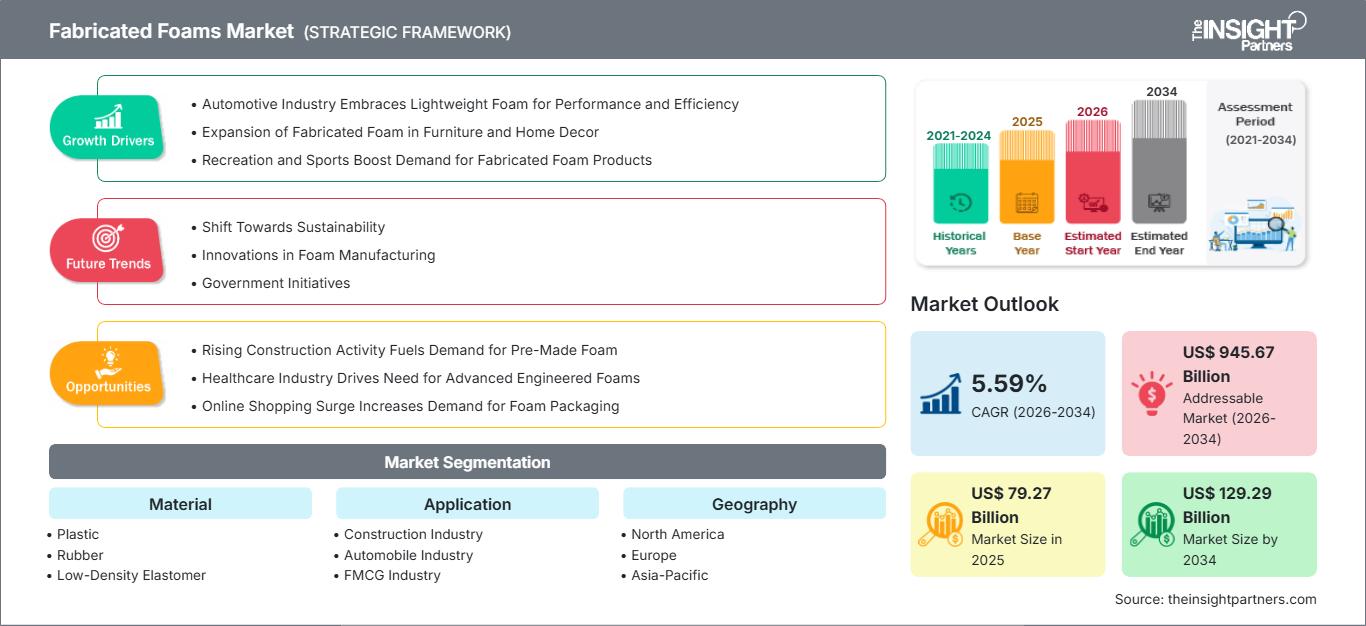
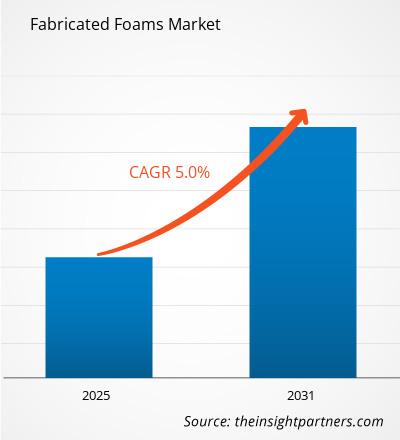
The Fabricated Foams Market is valued at US$ 79.27 Billion in 2025 and is projected to reach US$ 129.29 Billion by 2034, expanding at a CAGR of 5.59% during 2026–2034. The market encompasses fabricated foams, including those that have been processed using cutting, molding, laminating, thermoforming, and other forms of fabrication. The market’s growth is driven by needs for lightweighting, cushioning, insulation, vibration control, protection, packaging, and engineered components.
The North American fabricated foams market size is driven by existing foam converting capabilities, OEM penetration, and needs for components with tight tolerances. Growth in this region is further driven by substitution of heavy protection products, automation in fabrication, and growing needs for thermal and acoustical management in buildings and vehicles. Increasingly, North American converters are focusing on material selection, prototyping, CNC cutting, die cutting, and assembly in their operations.
Fabricated Foams Market Assessment and Insights
- North America: North America represented a modeled 28–32% share in 2025 and is expected to expand at a 5.8–6.2% CAGR between 2026–2034. Automotive production, construction renovation, protective packaging, and advanced fabrication capacity support demand.
- US: The US accounted for approximately 78–82% of North American demand in 2025 and is projected to grow at a 5.4–5.9% CAGR during 2026–2034, supported by OEM manufacturing and packaging applications.
- Europe: Europe held a modeled 22–26% share in 2025 and is expected to register a 5.0–5.5% CAGR during 2026–2034. Germany, France, Italy, the UK, and Spain support demand through automotive manufacturing, construction refurbishment, and industrial insulation.
- Asia Pacific: Asia Pacific represented an estimated 31–35% share in 2025 and is projected to grow at a 6.1–6.7% CAGR between 2026–2034. China, Japan, South Korea, and India lead regional demand through manufacturing and infrastructure activity.
- Largest Segment: Construction Industry represented an estimated 31–35% share in 2025 and is expected to grow at a 5.4–5.8% CAGR during 2026–2034, supported by insulation, sealing, cushioning, and building-envelope applications.
- High Growth Segment: Automobile Industry accounted for an estimated 22–26% share in 2025 and is projected to expand at a 6.3–6.8% CAGR during 2026–2034, driven by lightweighting and acoustic applications.
- Key companies analyzed in detail: American Excelsior Company, American Foam Products, Inc., Heubach Corporation, Flextech, Inc., Luxaire Cushion Company, Wisconsin Foam Products, Inc., Thrust Industries, Design Converting, Inc., Geneva Enterprises, LLC, and Able Industrial Products, Inc.
Source: The Insight Partners' analysis based on proprietary research, government publications, company annual reports, investor presentations, industry databases, and expert interviews.
The market for Fabricated Foams has seen a change in the form of evolution from uniform cushioning material to fabrication of products through engineered foams based on geometrical parameters, density, elasticity, thermal properties, and surfaces. The process technologies employed by manufacturers of fabricated foams include die cutting, CNC routing, water-jet cutting, thermoforming, compression molding, laminating, and bonding. In addition, production economics for fabricated foams market is also witnessing the transition to flexible manufacturing processes in which automated machinery will reduce setup time for customized parts.
Going forward, the Fabricated Foams market is expected to benefit from investments made in emerging manufacturing clusters in Asia Pacific along with capacity additions in North America. Lightweighting of automobiles, energy-efficient buildings, protective packaging, and electronics packaging are driving the need for materials that provide combination of lightness and dimensional stability. Energy performance and material efficiency being the focus areas of regulations, insulation and engineered components with high value will be in demand. Manufacturers capable of offering design services, rapid prototyping, automated cutting, and optimized materials are expected to have edge in specification-led sourcing.
Fabricated Foams Market Report Scope
| Report Attribute | Details |
|---|---|
| Market size in 2025 | US$ 79.27 Billion |
| Market Size by 2034 | US$ 129.29 Billion |
| Global CAGR (2026 - 2034) | 5.59% |
| Historical Data | 2021-2024 |
| Forecast period | 2026-2034 |
Fabricated Foams Market Analysis
The demand arises from the requirement for lightweight, durable, insulating, and protective parts that could be manufactured in application-specific geometries. The customers in construction industry require seals, insulation, filler for expansion joint, vibration control, and protective parts, whereas in the automobile industry the requirement for lightweight cushions and acoustic parts is growing. FMCG companies require the fabricated foam products for product protection and presentation, whereas the logistic operators require reusable dunnage, inserts, liners, and protective packages. Therefore, the value chain includes polymer producers, foam producers, converters, fabricators, OEMs, packaging designers, distributors, and logistics providers.
Supply will continue to be affected by the costs of polymer feedstocks, foam density, yield, labor costs, tooling, and equipment utilization. Fabricators having different kinds of technologies for cutting and forming could move between different kinds of materials and part geometries and therefore reduce their reliance on one specific technology. Shorter lead-times become more and more important because of customers' desire to have the part fabrication close to them and minimize the exposure to inventory.
The competitive landscape in the Fabricated Foams Market Report is fragmented, as specialists compete with each other through their expertise in applications, rapid response times, breadth of materials, accuracy, and customer service. The American Excelsior Company integrates flexible foam forming with additional engineered products, whereas the American Foam Products, Inc. concentrates on protective packaging and custom inserts. Heubach Corporation provides a variety of capabilities in fabrication and conversion, and the Flextech, Inc. specializes in engineered parts, molding, thermoforming, skiving, and die cutting. The Wisconsin Foam Products, Inc. distinguishes itself through its broad inventories and OEM customizing capabilities.
Strategic positioning is becoming more connected to automation and process capability. The Thrust Industries concentrate on precision die cutting and cutting technology, and the Design Converting, Inc. combines die cutting with lamination and assembly processes. Future investments will be directed towards automation of cutting operations, tighter tolerances, digital designing, and production flexibility. Specialists can compete through serving complicated and small volume markets which big companies may ignore. Hence, the Fabricated Foams Market creates an opportunity for the suppliers to create relationships with the customers through their engineering capabilities and strict conversion expenses.
● REPORT CUSTOMIZATION
Tailor This Report To Align With Your Specific Business Requirements
This report can be customized to align precisely with your business objectives, scope, and target markets. Customization options include tailored segmentation, geography, competitive analysis, and strategic insights to support informed decision-making.
Customize This Report →WHAT YOU CAN ADJUST
- ● Segmentations
- ● Geography
- ● Competitive Analysis
- ● Language Preferences
Fabricated Foams Market: Strategic Insights
Regional Insights
North America Fabricated Foams Market
The Fabricated Foams Market share for North America was estimated to be modeled at 28-32% in 2025 and is predicted to grow at a CAGR of 5.8-6.2% for the period 2026-2034. The major demand driver is the US, which is aided by existing fabricating centers, production of vehicles, renovation projects in construction, manufacture of equipment and protective packaging needs. Canada adds its share of demand via construction, transport and industrial sectors, whereas Mexico is growing in importance as a production base for vehicles and industries.
The suppliers in the region are increasingly focusing on automation for cutting and prototyping, small batch production and design engineering. There is also demand driven by substitution of heavier cushioning and insulation materials with fabricated light weight material. The region has an advanced ecosystem of Original Equipment Manufacturers who require precise density and other specifications in their requirements.
U.S. Fabricated Foams Market
The US accounted for around 78%-82% of the North American Fabricated Foams Market demand in 2025 and is expected to exhibit a 5.4%-5.9% CAGR during 2026-2034. The primary applications include construction, automotive, logistics, industrial machinery, and packaging of consumer products. Some of the key fabricators in the domestic market serve OEM customers by offering rapid prototyping, customized cutting, material sourcing, and assembly. Moreover, the availability of foam converters limits reliance on foreign suppliers of fabricated products.
On the other hand, the increasing use of the automotive industry in acoustics, cushioning, sealing, and weight reduction and the requirement for construction in insulation and expansion joints are some of the major uses in the region. On the other hand, logistics and FMCG companies focus on protective packaging, reuseable inserts, and efficient material handling. The US companies are also automating their production process. Given that customers look for faster deliveries and limited inventory risks, the regional manufacturing capacity gives an edge to US manufacturers.
Europe Fabricated Foams Market
The European share in 2025 was estimated to be 22-26%, which will increase at 5.0-5.5% CAGR during 2026-2034. The leading countries include Germany, the United Kingdom, France, Italy, and Spain. Applications in this region are driven by engineering in cars, industrial machinery, construction refurbishing, insulation, packaging, and precision parts. Environmental regulations and energy-efficiency goals necessitate lightweight materials with better thermal and sound insulating properties.
The automotive and industrial engineering industry of Germany requires high density specifications. The United Kingdom has its advantages in packaging, construction, aerospace, and industrial markets, France is advantaged by the automotive, infrastructure, and consumer product industries, and Italy's machinery, furniture, automotive, and packaging applications make the demand broader. The automobile, construction, and logistics industries drive Spain's demand. The technical customization and process efficiency become more important for competing than the volume.
APAC Fabricated Foams Market
The APAC region accounted for around 31-35% in 2025 and is forecasted to witness a CAGR of 6.1-6.7% during 2034. China holds dominance in the region on account of the huge amount of manufacturing output, automotive manufacturing, electronics, construction, and logistics activities. Japan and South Korea play roles via premium quality applications in the field of automotive and electronics. The country that is growing through infrastructure and manufacturing is India.
Australia is contributing in the form of construction, mining equipment, packaging, and industrial applications. Factors supporting growth in the region include localization of manufacturing activities, increased vehicle manufacturing activities, warehousing operations, and infrastructure projects. Automated cutting systems and digitalized production systems are being used by fabricators owing to shorter product cycles. Support from policies for domestic manufacturing and efficient construction helps in creating opportunities in insulation, protective packaging, and engineered parts.
Middle East & Africa Fabricated Foams Market
The Middle East & Africa region is projected to grow at a 4.7–5.3% CAGR during 2026–2034. Saudi Arabia and the UAE lead regional demand through construction, industrial diversification, logistics infrastructure, and large-scale development programs. South Africa provides an established manufacturing base for automotive, construction, packaging, and industrial applications.
The rest of the demand for MEA is relatively fragmented but gains advantage from urbanization, warehouse construction, transportation infrastructure, and investments in industry. Energy savings is a crucial factor of consideration when using MEA in tropical conditions, stimulating interest in insulation and sealing compounds. Construction continues to be the primary driver of demand for MEA, with car assembly and logistics being other potential uses of the material.
Segmentation Analysis
Material
Material selection determines density, resilience, flexibility, thermal performance, chemical resistance, and processing suitability. The Fabricated Foams Market increasingly favors materials that can satisfy application-specific performance requirements while supporting efficient conversion. The segment is expected to grow at a 5.3–5.9% CAGR during 2026–2034 as converters expand material portfolios and customers demand more customized component specifications.
- Plastic: Plastic-based foams remain important for lightweight packaging, insulation, cushioning, and engineered components because polyethylene and related materials provide dimensional stability, moisture resistance, and versatile fabrication characteristics.
- Rubber: Rubber foams are strategically important where flexibility, sealing, vibration control, and resistance to environmental exposure are required. Demand is concentrated in construction, automotive, industrial equipment, and insulation applications.
- Low-Density Elastomer: Low-density elastomers address applications requiring flexibility, low weight, cushioning, and thermal performance. Their importance is increasing in specialized insulation, sealing, acoustic management, and lightweight component designs.
Application
Application requirements determine foam geometry, density, conversion method, and performance specifications. Construction remains the largest application category, while automotive is positioned for comparatively faster expansion as lightweighting and acoustic requirements intensify. The application segment is projected to grow at a 5.5–6.1% CAGR during 2026–2034.
- Construction Industry: Construction represents the largest application base, supported by insulation, sealing, expansion joints, vibration control, protective components, and renovation activity. Energy-efficiency requirements strengthen demand for engineered foam solutions.
- Automobile Industry: Automotive demand is supported by lightweighting, acoustic insulation, cushioning, sealing, and interior components. Increasing vehicle electronics and design complexity create additional opportunities for precision-fabricated foam parts.
- FMCG Industry: FMCG applications primarily use fabricated foam for product protection, displays, cushioning, presentation, and specialty packaging. Demand follows consumer-product launches, premium packaging requirements, and damage-reduction objectives.
- Logistics Industry: Logistics applications emphasize protective packaging, reusable dunnage, inserts, liners, and material-handling components. Expansion of warehouses and higher-value shipments supports demand for customized protective solutions.
Opportunity Snapshot
| Application | Revenue Contribution | Trend Tag | Adoption Stage |
| Construction Industry | High | Energy Insulation | Mature |
| Automobile Industry | High | Vehicle Lightweighting | Scaling |
| FMCG Industry | Medium | Premium Protection | Scaling |
| Logistics Industry | Medium | Reusable Dunnage | Scaling |
Fabricated Foams Market Growth Drivers and Impact Analysis
Automotive Lightweighting and Acoustic Performance Requirements
Vehicle manufacturers are seeking weight-efficient materials that can provide cushioning, sealing, acoustic absorption, and vibration management without adding substantial mass. Fabricated foam components can be converted into precise geometries suited to doors, interiors, compartments, seals, and protective assemblies. The transition toward electric and electronically integrated vehicles further increases the importance of thermal and acoustic management around compact components. For converters, this shift creates opportunities to move from standardized sheets toward engineered parts designed jointly with OEMs and Tier suppliers. It also raises technical barriers because customers increasingly require repeatable density, dimensional accuracy, flame performance, and bonding characteristics. Suppliers with CNC cutting, thermoforming, lamination, and molding capabilities can capture higher-value applications and deepen relationships with automotive customers.
Energy-Efficient Buildings and Advanced Insulation Requirements
Building-efficiency initiatives are increasing the importance of insulation, sealing, thermal breaks, vibration control, and moisture-management components. Fabricated foam materials can be converted into application-specific profiles and shapes that support installation efficiency while reducing material waste. In renovation-heavy markets, flexible components are particularly useful because they can accommodate irregular geometries and retrofit constraints. Hot and cold climate conditions also increase demand for materials that help control heat transfer and condensation. Manufacturers can benefit by developing products with improved thermal performance, durability, flame resistance, and installation convenience. Specification activity is shifting toward performance-based procurement, which favors suppliers capable of providing technical documentation and consistent manufacturing. The resulting demand extends beyond new construction into commercial refurbishment, industrial facilities, HVAC systems, and infrastructure upgrades.
Expansion of Protective Packaging and Automated Fulfillment
Growth in warehouse automation, direct-to-consumer distribution, and high-value product shipments is increasing the need for protective materials that reduce damage while optimizing package dimensions. Fabricated foams can provide custom inserts, end caps, liners, trays, and reusable dunnage tailored to product geometry. Automated fulfillment also creates demand for components that can withstand repeated handling without excessive deformation or shedding. Packaging engineers increasingly evaluate total delivered cost rather than material price alone, including damage rates, storage requirements, assembly labor, and return costs. This favors suppliers able to combine design assistance with efficient conversion. Opportunities are particularly strong in electronics, medical devices, industrial equipment, premium consumer products, and sensitive machinery, where customized cushioning can protect products throughout transportation and reduce costly claims.
Fabricated Foams Market Future Trends
Digital Design and Automated Foam Fabrication
Digital engineering is expected to become more deeply integrated into foam component development, allowing customers to move from three-dimensional drawings to prototypes and production with fewer manual iterations. CNC routing, automated die cutting, water-jet systems, and digitally controlled forming equipment will improve repeatability while supporting economically viable short runs. The trend should reduce tooling barriers for customized components and enable faster design changes. Artificial intelligence can also support nesting, material utilization, production scheduling, and quality inspection. As these technologies mature, suppliers will increasingly compete on engineering responsiveness rather than basic cutting capacity. Digital workflows should be particularly valuable for automotive, medical, electronics, and industrial customers that frequently revise component geometry. Over time, connected production systems may also provide stronger traceability and more consistent process control.
Higher-Performance and Application-Specific Foam Formulations
Material development is expected to shift toward foams engineered for specific combinations of thermal, acoustic, mechanical, chemical, and environmental performance. Customers increasingly require materials that remain lightweight while meeting demanding operating conditions. This Fabricated Foams Market Trend will encourage broader use of cross-linked polyolefins, specialty elastomers, high-temperature materials, conductive structures, and flame-retardant formulations. Recycled-content and lower-impact material options are also likely to receive greater attention where performance requirements permit. Fabricators will need deeper knowledge of material behavior because conversion methods can influence final component properties. Partnerships between foam producers and converters may therefore become more important, especially when new materials require modified cutting, bonding, molding, or thermoforming conditions. Application-specific formulations should support higher-value opportunities and reduce direct price competition among fabricators.
Fabricated Foams Market Opportunities
Localized Fabrication for Resilient Supply Chains
Manufacturers can capture opportunity by establishing or expanding regional fabrication capacity close to automotive plants, construction clusters, distribution hubs, and industrial OEMs. Localized conversion reduces transportation distances, shortens replenishment cycles, and allows customers to hold less finished inventory. This model is particularly attractive for bulky foam products where shipping unconverted or semi-finished material can be more economical than transporting finished components. Suppliers can strengthen the proposition by offering rapid prototyping, digital quoting, small production runs, and vendor-managed inventory. Expansion can also involve partnerships with distributors or contract manufacturers rather than wholly owned facilities. The strongest opportunities in the Fabricated Foams Market Forecast are likely to emerge in fast-growing manufacturing corridors across Asia Pacific and Mexico, alongside established North American and European industrial clusters where customers increasingly prioritize supply continuity and responsive engineering support.
Integrated Engineering and Multi-Process Component Manufacturing
Another opportunity lies in combining material selection, design engineering, prototyping, cutting, molding, laminating, bonding, and assembly under one supplier relationship. Customers can reduce qualification complexity when a single converter manages multiple manufacturing stages and provides consistent quality documentation. Integrated capability is especially valuable for automotive, industrial machinery, medical, and electronics applications where foam components interact with other materials or assemblies. Suppliers can differentiate by developing application-specific design libraries, rapid prototyping services, automated inspection, and repeatable production cells. Investment in these capabilities can also improve customer retention because qualification and tooling become embedded within the supplier relationship. Over time, integrated fabricators may capture a greater portion of component value while reducing exposure to commodity foam-sheet pricing and increasing their relevance in early-stage product development.
Recent Developments
- July 2026: Flextech, Inc. — Flextech announced its appointment as an approved fabricator under Zotefoams’ Global Approved Partner Program, strengthening its role in medical, defense, and industrial applications. The partnership combines specialized foam fabrication capabilities with Zotefoams materials and expands access to engineered components requiring controlled performance, repeatability, and application-specific processing.
- January 2026: American Excelsior Company — American Excelsior completed a US$2.0 million expansion of its molded urethane production line at the Sheboygan, Wisconsin facility. The automated production line became operational in January 2025 and was designed to triple molded-division capacity while improving production efficiency, responsiveness, and the ability to address increasing customer demand.
Frequently Asked Questions

- Comprehensive Market Sizing and Forecast Analysis
- Detailed Segmentation Analysis
- In-Depth Market Dynamics Assessment
- Regional and Country-Level Insights
- Competitive Landscape and Company Benchmarking
- Strategic Business Intelligence
Recent Reports
Testimonials

The Insight Partners' SCADA System Market report is comprehensive, with valuable insights on current trends and future forecasts. The team was highly professional, responsive, and supportive throughout. We are very satisfied and highly recommend their services.
RAN KEDEM Partner, Reali Technologies LTDs
I requested a report on a very specific software market and the team produced the report in a few days. The information was very relevant and well presented. I then requested some changes and additions to the report. The team was again very responsive and I got the final report in less than a week.
JEAN-HERVE JENN Chairman, Future Analytica
We worked with The Insight Partners for an important market study and forecast. They gave us clear insights into opportunities and risks, which helped shape our plans. Their research was easy to use and based on solid data. It helped us make smart, confident decisions. We highly recommend them.
PIYUSH NAGPAL Sr. Vice President, High Beam Global
The Insight Partners delivered insightful, well-structured market research with strong domain expertise. Their team was professional and responsive throughout. The user-friendly website made accessing industry reports seamless. We highly recommend them for reliable, high-quality research services
YUKIHIKO ADACHI CEO, Deep Blue, LLC.
This is the first time I have purchased a market report from The Insight Partners.While I was unsure at first, I visited their web site and felt more comfortable to take the risk and purchase a market report.I am completely satisfied with the quality of the report and customer service. I had several questions and comments with the initial report, but after a couple of dialogs over email with their analyst I believe I have a report that I can use as input to our strategic planning process.Thank you so much for taking the extra time and making this a positive experience.I will definitely recommend your service to others and you will be my first call when we need further market data.
JOHN SUZUKI President and Chief Executive Officer, Board Director, BK Technologies
I wish to appreciate your support and the professionalism you displayed in the course of attending to my request for information regarding to infectious disease IVD market in Nigeria. I appreciate your patience, your guidance, and the fact that you were willing to offer a discount, which eventually made it possible for us to close a deal. I look forward to engaging The Insight Partners in the future, all thanks to the impression you have created in me as a result of this first encounter.
DR CHIJIOKE ONYIA MANAGING DIRECTOR, PineCrest Healthcare Ltd.Reason to Buy
- Informed Decision-Making
- Understanding Market Dynamics
- Competitive Analysis
- Identifying Emerging Markets
- Customer Insights
- Market Forecasts
- Risk Mitigation
- Boosting Operational Efficiency
- Strategic Planning
- Investment Justification
- Tracking Industry Innovations
- Aligning with Regulatory Trends





 Get Free Sample for