
FBAR Devices Market Demand, Share & Growth by 2034
Coverage: By Type (Duplexers, Multiplexers, Filters), by application, (Telecommunication, Military, Automotive, Consumer Electronics), and Geography (North America, Europe, Asia Pacific, and South and Central America)
- Status : Data Released
- Report Code : TIPRE00015596
- Category : Life Sciences
- No. of Pages : 150
- Available Report Formats :


- Last update date : June 22, 2026


2025 Market Size
US$ 122.40 Mn
Base year value
2034 Forecast
US$ 205.80 Mn
Projected by 2034
CAGR 2026-2034
5.94 %
Growth rate
Addressable Market
US$ 1,486.39 Mn
(2026-2034)
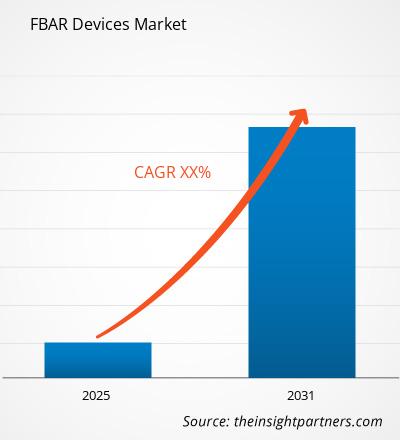
The global FBAR devices market size is projected to reach US$ 205.80 million by 2034 from US$ 122.40 million in 2025. The market is anticipated to register a CAGR of 5.94% during the forecast period 2026–2034.
Key market dynamics include the rapid global expansion of 5G and nascent 6G networks, the increasing complexity of RF front-end modules in smartphones, and the rising demand for high-selectivity filters that can operate at gigahertz frequencies. Additionally, the market is expected to benefit from the massive proliferation of IoT devices, advancements in automotive telematics for autonomous driving, and the continuous push for miniaturization in consumer electronics.
FBAR Devices Market Analysis
The FBAR devices market analysis reveals a critical shift toward high-frequency, wide-bandwidth solutions as telecommunications transition to Sub-6GHz and millimeter-wave spectrums. The market trends indicate a move away from traditional surface acoustic wave filters toward FBAR and other bulk acoustic wave technologies due to FBAR superior power handling and lower insertion loss at high frequencies. Strategic opportunities are emerging in the automotive and aerospace sectors, where thermal stability and reliability under extreme conditions are paramount. The analysis also notes that market expansion is closely tied to the integration of piezoelectric MEMS with CMOS technology, allowing for smaller, more efficient chip designs. Competitive differentiation is increasingly defined by the ability to utilize advanced materials like Scandium-doped Aluminum Nitride to enhance electromechanical coupling and bandwidth performance.
FBAR Devices Market Overview
FBAR devices have evolved from specialized components for high-end military radar to essential building blocks of modern mobile connectivity. FBAR devices encompass duplexers, multiplexers, and specialized filters integrated into RF front-end modules. Both established semiconductor giants and specialized MEMS foundries compete in this market, focusing on enhancing the Quality factor and reducing the footprint of resonators. Growing demand for always-connected devices, including wearables and smart home infrastructure, has solidified FBAR as a preferred technology for interference mitigation in dense spectral environments. North America and Asia-Pacific lead in revenue due to their advanced semiconductor ecosystems and high smartphone penetration. The US market remains a hub for R&D and intellectual property, while China and South Korea drive volume through aggressive 5G infrastructure rollouts and large-scale consumer electronics manufacturing.
Market Research Highlights
- Global market for FBAR Devices was valued at US$ 122.40 Million in 2025
- Annual market size is expected to reach US$ 205.80 Million by 2034
- Total addressable market (TAM) during 2026-2034 is projected to reach approximately US$ 1,486.39 Million
- Market is anticipated to register a CAGR of 5.94% during the forecast period
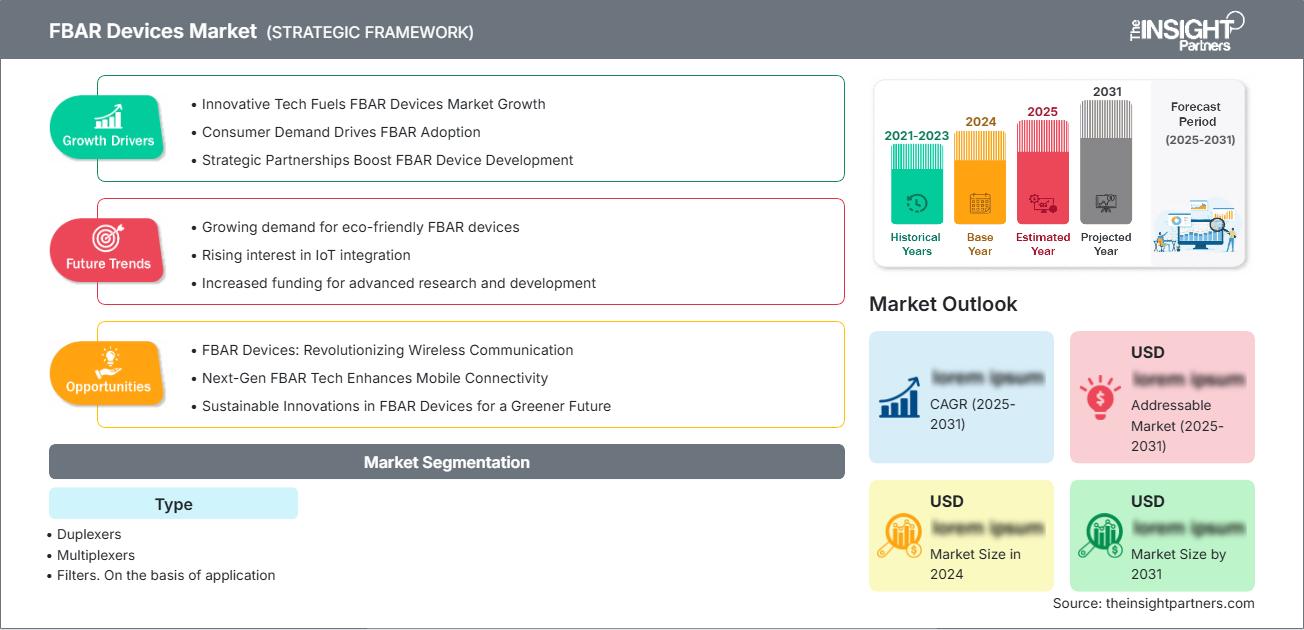
- The United States represents a key market, supported by Innovative Tech Fuels FBAR Devices Market Growth, Consumer Demand Drives FBAR Adoption, Strategic Partnerships Boost FBAR Device Development, as well as evolving industry dynamics
- Market analysis covers North America, Europe, Asia-Pacific, South and Central America, Middle East and Africa, with growth evaluated across the forecast period
- Market opportunities such as FBAR Devices: Revolutionizing Wireless Communication, Next-Gen FBAR Tech Enhances Mobile Connectivity, Sustainable Innovations in FBAR Devices for a Greener Future are expected to influence market dynamics and addressable market
- Report profiles industry participants, including Qualcomm, Broadcom, Taiyo Yuden, Skyworks Solutions, Inc., Qorvo Inc., TDK Corporation, Integrated Technology Future, Akoustis Technologies, while analyzing competitive strategies and innovation developments
-
Source: The Insight Partners' analysis based on proprietary research, government publications, company annual reports, investor presentations, industry databases, and expert interviews.
● REPORT CUSTOMIZATION
Tailor This Report To Align With Your Specific Business Requirements
This report can be customized to align precisely with your business objectives, scope, and target markets. Customization options include tailored segmentation, geography, competitive analysis, and strategic insights to support informed decision-making.
Customize This Report →WHAT YOU CAN ADJUST
- ● Segmentations
- ● Geography
- ● Competitive Analysis
- ● Language Preferences
FBAR Devices Market: Strategic Insights
-
Get Top Key Market Trends of this report.This FREE sample will include data analysis, ranging from market trends to estimates and forecasts.
FBAR Devices Market Drivers and Opportunities
Market Drivers:
- Expansion of 5G and 6G Networks: The transition to higher frequency bands requires filters with steep out-of-band rejection. FBAR technology is uniquely suited for these demanding specifications, driving its adoption in 5G smartphones and base stations.
- Miniaturization of Consumer Electronics: As mobile devices pack more antennas and sensors into slimmer frames, the compact, wafer-level packaging of FBAR devices provides a significant space-saving advantage over bulkier alternatives.
- Rising IoT and Wearable Integration: The surge in connected devices requires efficient frequency management to prevent signal cross-talk. FBAR high selectivity ensures reliable performance in the increasingly crowded 2.4 GHz and 5 GHz unlicensed bands.
Market Opportunities:
- Automotive Telematics and V2X Communication: The rise of autonomous vehicles increases the need for high-speed, low-latency data links, creating a massive opening for ruggedized FBAR devices in vehicle-to-everything systems.
- Advancements in Material Science: Developing resonators using Scandium-doped AlN offers the opportunity to achieve wider bandwidths, meeting the requirements of next-generation Wi-Fi 7 and 6G standards.
- Growth in Medical and Industrial Sensors: Beyond RF filtering, FBAR technology is being explored for high-sensitivity mass sensors in biosensing and chemical detection, opening non-telecom revenue streams.
FBAR Devices Market Report Segmentation Analysis
The FBAR Devices Market share is analyzed across various segments to provide a clearer understanding of its structure, growth potential, and emerging trends. Below is the standard segmentation approach used in most industry reports:
By Product Type:
- Filters: The dominant volume driver, particularly within the 5G smartphone, where high-frequency selectivity is essential.
- Duplexers: Critical components that allow bi-directional communication on a single antenna, seeing steady growth in mobile terminal applications.
- Multiplexers: A fast-growing niche that enables devices to manage multiple frequency bands simultaneously, essential for carrier aggregation.
- Others: Includes FBAR-based resonators and oscillators used in specialized timing and sensing applications.
By Application:
- Smartphones: Remain the primary channel for FBAR devices, benefiting from the global transition to 5G-enabled handsets.
- Tablets: A significant consumer of high-performance RF filters to support data-intensive streaming and productivity tasks.
- Wearables: The fastest-rising application, where the extreme miniaturization of FBAR technology enables connectivity in smartwatches and health trackers.
- Automotive: Offers a select but growing range of AEC-qualified FBAR devices for in-vehicle infotainment and safety systems.
- Others: Includes aerospace, defense, and industrial IoT devices.
By End-User:
- Telecommunications: The primary driver of high-power FBAR solutions for base stations and network infrastructure.
- Consumer Electronics: Represents the largest market share, fueled by the demand for mobile devices, laptops, and connected home gadgets.
- Automotive: Emerging as a high-margin segment with the integration of 5G modules in modern passenger vehicles.
- Others: Comprises industrial, medical, and aerospace applications requiring high-precision frequency control.
By Geography:
- North America
- Europe
- Asia Pacific
- South & Central America
- Middle East & Africa
FBAR Devices Market Report Scope
| Report Attribute | Details |
|---|---|
| Market size in 2025 | US$ 122.40 Million |
| Market Size by 2034 | US$ 205.80 Million |
| Global CAGR (2026 - 2034) | 5.94% |
| Historical Data | 2021-2024 |
| Forecast period | 2026-2034 |
| Segments Covered |
By Type
|
| Regions and Countries Covered |
North America
|
| Market leaders and key company profiles |
|
FBAR Devices Market Players Density: Understanding Its Impact on Business Dynamics
The FBAR Devices Market is growing rapidly, driven by increasing end-user demand due to factors such as evolving consumer preferences, technological advancements, and greater awareness of the product's benefits. As demand rises, businesses are expanding their offerings, innovating to meet consumer needs, and capitalizing on emerging trends, which further fuels market growth.
FBAR Devices Market Share Analysis by Geography
Asia-Pacific is expected to grow fastest in the coming years. Emerging markets in South & Central America, the Middle East, and Africa also have many untapped opportunities for premium RF component manufacturers to expand.
The FBAR devices market is undergoing a significant transformation, moving from specialized high-end components to a global mainstream technology for 5G and Wi-Fi 7 connectivity. Below is a summary of market share and trends by region:
North America
- Market Share: Holds a significant position, driven by major R&D hubs and the presence of market leaders in the US.
- Key Drivers:
- Rapid deployment of 5G standalone networks across the United States
- High consumer demand for flagship smartphones with advanced multi-band capabilities
- Strong aerospace and defense sector requiring high-frequency, ruggedized filters
- Trends: Focus on developing integrated RFFE modules and the adoption of Wi-Fi 6E/7 standards in high-end consumer products.
Europe
- Market Share: Anchored by a robust automotive industry and industrial automation sectors in Germany and France.
- Key Drivers:
Increasing integration of V2X communication in European automotive manufacturing
-
- Strict regulatory standards for spectral efficiency and interference mitigation
- Government support for 6G research and development initiatives
- Trends: A strategic shift toward using FBAR in industrial IoT applications and smart city infrastructure to support low-latency data transmission.
Asia-Pacific
- Market Share: The fastest-growing region, with China and South Korea acting as the primary markets for both manufacturing and consumption.
- Key Drivers:
- Massive smartphone production ecosystem in China, Vietnam, and India
- Government-supported initiatives for 5G and 6G infrastructure expansion
- Rapid urbanization and rising disposable incomes are leading to a preference for premium connected electronics
- Trends: Growth of localized semiconductor foundries and a heavy focus on B2B contracts for high-volume consumer electronics components.
South and Central America
- Market Share: Emerging market with a growing telecommunications sector in countries like Brazil and Chile.
- Key Drivers:
- Gradual modernization of mobile networks from 4G to 5G
- Rising awareness of high-performance connectivity for remote work and education
- Increasing imports of 5G-enabled consumer electronics
- Trends: Growth of regional distribution networks for affordable 5G handsets and the introduction of FBAR-based filters in local telecommunications projects.
Middle East and Africa
- Market Share: Developing market transitioning toward formalized digital economies and smart infrastructure.
- Key Drivers:
- Strategic investments in smart city projects in the GCC region
- High demand for reliable mobile connectivity in urban centers
- Trends: Implementation of modern telecommunications infrastructure to reduce import reliance, coupled with a focus on high-reliability components for industrial monitoring.
High Market Density and Competition
Competition is intensifying due to the presence of established leaders such as Broadcom, Qorvo, and Qualcomm. Regional players and innovators like Taiyo Yuden and Akoustis Technologies also contribute to a diverse and rapidly expanding market landscape.
This competitive environment pushes vendors to differentiate through:
- Premiumization and Performance: Positioning FBAR as a superior alternative to SAW and BAW-SMR by emphasizing higher Q factors and better power handling for 5G bands.
- Product Diversification: Expanding beyond simple filters to offer complex multiplexers and integrated modules that support a wider range of communication protocols.
- Supply Chain Control: Leading firms manage the entire lifecycle from MEMS design to wafer fabrication to ensure quality and meet strict delivery timelines for smartphone OEMs.
- Advanced Material Integration: Utilizing spray-drying and membrane filtration techniques in material prep or adopting ScAlN to push the boundaries of bandwidth and frequency.
Opportunities and Strategic Moves
- Partner with high-end smartphone OEMs and automotive telematics providers to tap into the surging demand for high-frequency filtering in Asia-Pacific and North American markets.
- Incorporate sustainable manufacturing processes and focus on miniaturization to appeal to environmentally conscious tech companies seeking efficient, low-power components.
Major Companies operating in the FBAR Devices Market are:
- Qualcomm
- Broadcom
- Taiyo Yuden
- Skyworks Solutions, Inc.
- Qorvo Inc.
- TDK Corporation
- Integrated Technology Future
- Akoustis Technologies
Disclaimer: The companies listed above are not ranked in any particular order.
FBAR Devices Market News and Recent Developments
- In March 2026, TDK Corporation announced that TDK will start manufacturing advanced sensors for various Apple products in the US. Built on a partnership spanning more than 30 years with Apple, this initiative will allow both companies to reinforce their advanced sensors manufacturing capabilities via Japan–U.S. collaboration and, by producing at U.S. facilities, contribute to a more reliable sensor supply chain. In the context of Apple’s current American Manufacturing Program initiative, this is the first time a Japanese company will produce components for Apple in the US.
- In January 2026, TDK Corporation announced a suite of InvenSense SmartMotion® custom sensing solutions for more intuitive user experiences with TWS ear buds, AI glasses, augmented reality eyewear, smart watches, fitness bands, and other IoT devices. Combining leading MEMS sensor innovation with sensor fusion software, the three newest IMUs are based on TDK’s latest ultra-low power, high-performance ICM-456xx family that offers edge intelligence for the next generation of consumer technology at the highest motion tracking accuracy.
FBAR Devices Market Report Coverage and Deliverables
The FBAR Devices Market Size and Forecast (2021–2034) report provides a detailed analysis of the market covering below areas:
- FBAR Devices Market size and forecast at global, regional, and country levels for all the key market segments covered under the scope
- FBAR Devices Market trends, as well as market dynamics such as drivers, restraints, and key opportunities
- Detailed PEST and SWOT analysis
- FBAR Devices Market analysis covering key market trends, global and regional framework, major players, regulations, and recent market developments
- Industry landscape and competition analysis covering market concentration, heat map analysis, prominent players, and recent developments in the FBAR Devices Market
- Detailed company profiles
Frequently Asked Questions

- Comprehensive Market Sizing and Forecast Analysis
- Detailed Segmentation Analysis
- In-Depth Market Dynamics Assessment
- Regional and Country-Level Insights
- Competitive Landscape and Company Benchmarking
- Strategic Business Intelligence
Recent Reports
Testimonials

The Insight Partners' SCADA System Market report is comprehensive, with valuable insights on current trends and future forecasts. The team was highly professional, responsive, and supportive throughout. We are very satisfied and highly recommend their services.
RAN KEDEM Partner, Reali Technologies LTDs
I requested a report on a very specific software market and the team produced the report in a few days. The information was very relevant and well presented. I then requested some changes and additions to the report. The team was again very responsive and I got the final report in less than a week.
JEAN-HERVE JENN Chairman, Future Analytica
We worked with The Insight Partners for an important market study and forecast. They gave us clear insights into opportunities and risks, which helped shape our plans. Their research was easy to use and based on solid data. It helped us make smart, confident decisions. We highly recommend them.
PIYUSH NAGPAL Sr. Vice President, High Beam Global
The Insight Partners delivered insightful, well-structured market research with strong domain expertise. Their team was professional and responsive throughout. The user-friendly website made accessing industry reports seamless. We highly recommend them for reliable, high-quality research services
YUKIHIKO ADACHI CEO, Deep Blue, LLC.
This is the first time I have purchased a market report from The Insight Partners.While I was unsure at first, I visited their web site and felt more comfortable to take the risk and purchase a market report.I am completely satisfied with the quality of the report and customer service. I had several questions and comments with the initial report, but after a couple of dialogs over email with their analyst I believe I have a report that I can use as input to our strategic planning process.Thank you so much for taking the extra time and making this a positive experience.I will definitely recommend your service to others and you will be my first call when we need further market data.
JOHN SUZUKI President and Chief Executive Officer, Board Director, BK Technologies
I wish to appreciate your support and the professionalism you displayed in the course of attending to my request for information regarding to infectious disease IVD market in Nigeria. I appreciate your patience, your guidance, and the fact that you were willing to offer a discount, which eventually made it possible for us to close a deal. I look forward to engaging The Insight Partners in the future, all thanks to the impression you have created in me as a result of this first encounter.
DR CHIJIOKE ONYIA MANAGING DIRECTOR, PineCrest Healthcare Ltd.Reason to Buy
- Informed Decision-Making
- Understanding Market Dynamics
- Competitive Analysis
- Identifying Emerging Markets
- Customer Insights
- Market Forecasts
- Risk Mitigation
- Boosting Operational Efficiency
- Strategic Planning
- Investment Justification
- Tracking Industry Innovations
- Aligning with Regulatory Trends





 Get Free Sample for