
Feed Processing Machinery Market Share, Demand & Growth by 2034
Coverage: By Function (Pelleting, Mixing, Grinding, Extrusion); Feed Type (Ruminant Feed, Poultry Feed, Swine Feed, Aquaculture Feed, Others) , and Geography (North America, Europe, Asia Pacific, and South and Central America)
- Status : Data Released
- Report Code : TIPRE00026910
- Category : Manufacturing and Construction
- No. of Pages : 150
- Available Report Formats :


- Last update date : November 09, 2026


2025 Market Size
US$ 4.8 Bn
Base year value
2034 Forecast
US$ 6.74 Bn
Projected by 2034
CAGR 2026-2034
3.84 %
Growth rate
Addressable Market
US$ 52.40 Bn
(2026-2034)
The Feed Processing Machinery Market was valued at US$ 4.8 Billion in 2025 and is projected to reach US$ 6.74 Billion by 2034, registering a CAGR of 3.84% during 2026–2034. Demand is advancing as commercial feed producers modernize grinding, mixing, pelleting, and extrusion lines to improve formulation consistency, feed safety, energy performance, and throughput across poultry, ruminant, swine, and aquaculture applications.
North America remains an established technology and replacement market, with regional revenue projected to expand at a ~3% CAGR through 2034. The Feed Processing Machinery Market size in the region is supported by large integrated livestock operations, strict quality-control requirements, automation upgrades, and recurring investment in wear parts, digital controls, and energy-efficient pellet mills.
Feed Processing Machinery Market Assessment and Insights
Regional Outlook
- North America: ~25% of the global Feed Processing Machinery Market share in 2025 | ~3% CAGR through 2034. Market position: A mature regional market supported by integrated feed production, high automation intensity, durable replacement demand, and strong supplier service networks.
- US: ~78% of North American market revenue in 2025 | ~3% CAGR through 2034. Market position: The leading country in North America, reflecting concentrated livestock production, large commercial mills, equipment retrofits, and demand for traceable, recipe-controlled feed manufacturing.
- Europe: ~24% of the global market in 2025 | ~3% CAGR through 2034. Market position: A mature market shaped by feed hygiene, energy efficiency, emissions management, retrofit activity, and strong engineering capabilities in Germany, France, the UK, Italy, and Spain.
- Asia Pacific: ~37% of the global market in 2025 | ~5% CAGR through 2034. Market position: The largest and fastest-growing region, driven by feed capacity additions, aquaculture expansion, poultry integration, urban protein demand, and machinery localization in China, India, and Southeast Asia.
Segment Outlook
- Function: ~55% Share in 2025 | ~4% CAGR through 2034. Market position: Function leads because grinding, mixing, pelleting, and extrusion form the essential processing core of every industrial feed line and carry substantial equipment value.
- Feed Type: ~45% Share in 2025 | ~4% CAGR through 2034. Market position: Feed Type is the high-growth main segment as application-specific formulations require differentiated conditioning, die configuration, particle size control, and extrusion performance.
Competitive Coverage
ANDRITZ AG, B.K. Allied Industries, Bratney Companies, Bühler AG, Clextral SAS, Dinnissen Process Technology, HET Feed Machinery, FAMSUN Co., Ltd., Pavan Group, CPM Holdings, Inc.
Methodology
The Insight Partners follows Data Collection & Secondary Research, Primary Research, Data Analysis, and Data Triangulation & Final Review to validate market estimates and insights.
Source: The Insight Partners' analysis based on proprietary research, government publications, company annual reports, investor presentations, industry databases, and expert interviews.
The development of feed processing machines has advanced from mechanically discrete milling machines into fully integrated production lines for feeding, dosing, grinding, conditioning, pelletizing, cooling, coating, and packaging. Increasingly, features such as variable speed drives, near infrared measurements, recipe management and remote diagnostics are important considerations for purchasers of feed-processing equipment. The economics of producing feed now reward equipment that minimizes fines, maintains moisture control, reduces cleaning time, and processes substitute ingredients without impacting production levels. Meanwhile, high fabrication steel prices, available maintenance, and long qualification periods affect supplier decisions.
By 2034, investment spending will trend toward modular plants in new feed producing countries and plant automation in mature markets. The Asia Pacific region will see an increasing share of investment spent on new-line equipment, while North America and Europe will focus on efficiency upgrades, traceability, and service life improvements. Controls, process engineering, commissioning, and training related to feed safety, dust control, locally produced materials, and alternative agricultural products will motivate suppliers to provide machinery bundled with those services.
Feed Processing Machinery Market Report Scope
| Report Attribute | Details |
|---|---|
| Market size in 2025 | US$ 4.8 Billion |
| Market Size by 2034 | US$ 6.74 Billion |
| Global CAGR (2026 - 2034) | 3.84% |
| Historical Data | 2021-2024 |
| Forecast period | 2026-2034 |
Feed Processing Machinery Market Analysis
Feed Processing Machinery growth depends on increased compound-feed intricacy, not animal population levels. Producers have a need for consistent particle size, homogeneous distribution of micro ingredients, thermal treatment, and reliable pellets to optimize feed conversion. As such, commercial mills, integrated farms, and aquafeed producers consider machinery as a process system, not separate machines.
Supply chain factors include steel making, electric motors, bearing, pellet dies, screens, and automation equipment. The value chain includes engineering, installation, wear parts, monitoring, and maintenance. The supply chain favors manufacturers who keep service inventory within the region since pellet dies, hammers, rollers, and seals need to be replaced regularly. Energy costs determine buyer priorities between new machinery, debottlenecking lines, and control systems.
Positioning factors in the Feed Processing Machinery Market analysis include throughput, hygiene, energy efficiency, flexibility in recipes, reliability, and installed-base capability. Competitors like ANDRITZ AG and Bühler AG compete in terms of their capability to engineer and automate complete plants, and CPM Holdings, Inc. is highly exposed in pelleting and size reduction applications. Clextral SAS competes in twin-screw extrusion; Dinnissen Process Technology competes in mixing and handling, and FAMSUN Co., Ltd. in turnkey high-capacity feed facilities.
There is heavy investment in smart control systems, modular plant design, precise metering systems, and localized production. Examples of specialized equipment, regional engineering, and complete line capabilities are offered by B.K. Allied Industries, Bratney Companies, HET Feed Machinery, and Pavan Group. The strategic advantage comes from decreasing the cost per tonne, reducing commissioning times, and allowing for reformulations due to alternative proteins and by-products.
● REPORT CUSTOMIZATION
Tailor This Report To Align With Your Specific Business Requirements
This report can be customized to align precisely with your business objectives, scope, and target markets. Customization options include tailored segmentation, geography, competitive analysis, and strategic insights to support informed decision-making.
Customize This Report →WHAT YOU CAN ADJUST
- ● Segmentations
- ● Geography
- ● Competitive Analysis
- ● Language Preferences
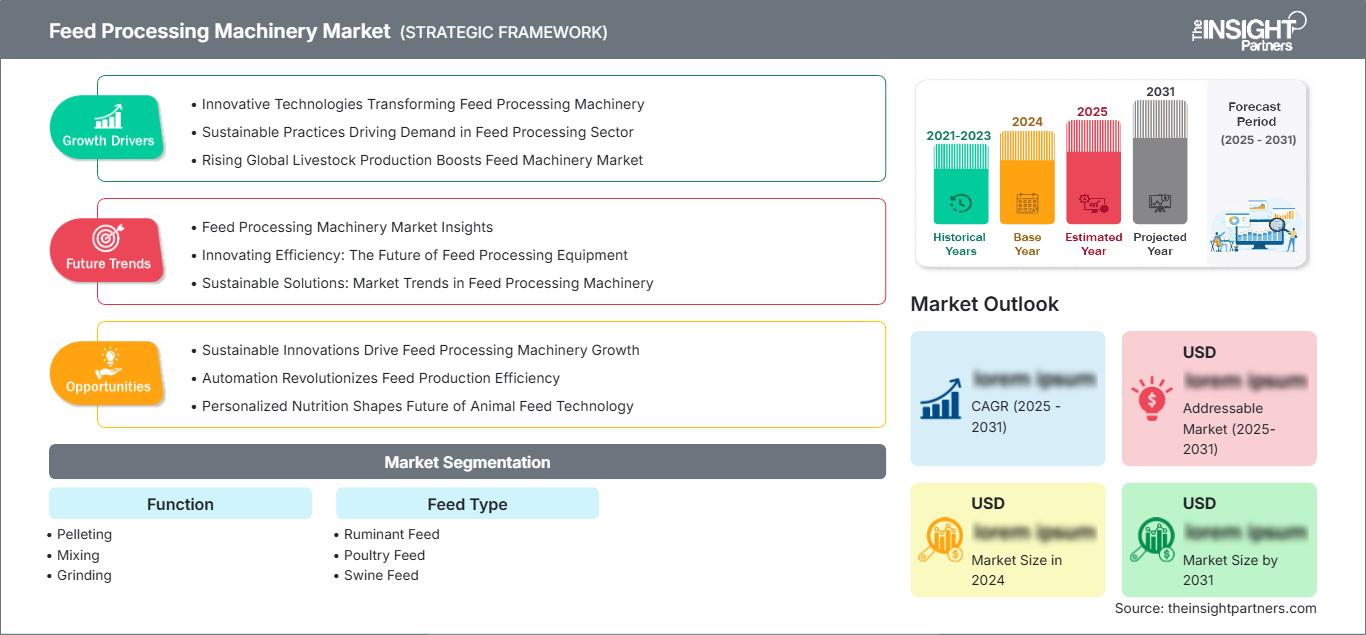
Feed Processing Machinery Market: Strategic Insights
Regional Insights
North America Feed Processing Machinery Market
North America accounted for ~25% of global revenue in 2025 and is projected to register a ~3% CAGR through 2034. Feed processing machinery market share includes existing mature infrastructure, larger commercial feed mills, integrations in poultry and swine, and strong aftermarket opportunities. In terms of buyer needs, they are more inclined towards uptime, robustness of pellets, hygiene, and automated documentation compared to simple capacity augmentation.
Growth will be driven by replacement of aging pellet mills and grinders, micro-dosing systems, and liquid application systems along with automation in the integration of machinery to the entire plant control system. High labor costs further favor automated bag handling and predictive maintenance. In Canada, dairy-based, poultry-based, aquaculture and grain-based feeds, whereas in Mexico, there is growth in poultry and livestock feed along with export protein chains.
U.S. Feed Processing Machinery Market
The U.S. represented ~78% of North American revenue in 2025 and is projected to expand at a ~3% CAGR through 2034, making it the leading country in North America. Its position rests on major poultry, swine, dairy, beef, and aquaculture value chains, as well as extensive compound-feed infrastructure and a dense base of equipment service specialists.
Relevant commercial/service exposure is held by CPM Holdings, Inc., Bratney Companies, ANDRITZ AG, and Bühler AG. Current applications focus on recipe management, dust reduction, energy metering, pathogen reduction processes, and fast changeovers. The big integrated players prefer high-throughput systems, while standalone mill owners like to incrementally upgrade their grinder, mixer, cooling systems, controls, and wear parts for extended life but not an overall facility upgrade.
Europe Feed Processing Machinery Market
Europe held ~24% of the global market in 2025 and is projected to record a ~3% CAGR through 2034. Retrofits will drive demand from mature feed production, hygiene requirements, high energy costs, and the need for reduced-impact ingredients. Germany is the leading country within Europe due to its engineering sector, livestock and feed presence, automation, and machinery provision in the region.
France integrates its demand from poultry, dairy, swine and aquaculture along with expertise in extrusion through Clextral SAS. The United Kingdom’s market demands assurance, mill refurbishment, and resilience. Engineering skills and feed demand related to poultry, dairy and specialty livestock are brought by Italy. The big pig and poultry production in Spain fuels replacement and optimization projects. Companies involved in the segment include Dinnissen Process Technology, Bühler AG, ANDRITZ AG, and Pavan Group.
Investment in Europe becomes oriented towards energy-saving motors, heat recovery, dust management, hygienic access and traceability. Requirements from end-users relate to machinery capable of processing pulses, oilseeds meals, by-products and alternative protein sources with different flow and moisture properties.
APAC Feed Processing Machinery Market
Asia Pacific represented ~37% of global revenue in 2025 and is projected to register a ~5% CAGR through 2034, making it the largest and fastest-growing region. China is the leading country in Asia Pacific, supported by large compound-feed output, domestic machinery production, livestock integration, and aquaculture processing demand.
In Japan and South Korea, machinery which is automatic, compact and reliable is emphasized. In India, there is a development in systematic capabilities for making feed for dairying, poultry and aquaculture production, while in Australia, help is being provided to livestock, dairy and aquaculture industries. This is advantageous for FAMSUN Co., Ltd., HET Feed Machinery and B.K. Allied Industries among other international companies because of policies related to localization and food security.
Middle East & Africa Feed Processing Machinery Market
The Middle East & Africa market is projected to expand at a ~5% CAGR through 2034. Saudi Arabia is positioned as a leading country in the Middle East & Africa, supported by poultry integration, food-security investment, and new feed capacity. The UAE provides demand through poultry, dairy, aquaculture, and regional logistics.
South Africa anchors more established milling and livestock infrastructure, while Rest of MEA presents selective greenfield opportunities where imported feed is costly and domestic protein production is expanding. Machinery demand remains sensitive to financing, power reliability, spare-parts access, and operator training. Modular lines, robust controls, and energy-efficient grinding and pelleting are therefore commercially important.
Segmentation Analysis
Function
Function is projected to register a ~4% CAGR during 2026–2034. The Feed Processing Machinery Market scope covers the core conversion stages that determine particle size, uniformity, pellet integrity, digestibility, and line throughput. Investment choices depend on formulation, capacity, hygiene, energy use, and whether producers require conventional compound feed or higher-value extruded products.
- Pelleting: Pellet mills hold strategic importance across poultry, ruminant, and swine feed because densification improves handling, reduces ingredient segregation, and supports consistent intake. Demand centers on durable dies, conditioning control, lower fines, and dependable cooling.
- Mixing: Mixers are essential for uniform distribution of macro ingredients, micro-additives, liquids, and medication. Fast discharge, cleanability, low residue, and short batch cycles are decisive where producers run numerous species- and life-stage-specific recipes.
- Grinding: Hammer and roller mills establish particle size before mixing and conditioning. Buyers balance throughput, electricity consumption, screen or roll wear, dust generation, and the need to process grains, meals, fibrous materials, and agricultural by-products.
- Extrusion: Extrusion is strategically important in aquafeed and specialized nutrition because temperature, pressure, shear, and die design can control density, digestibility, texture, and water stability. Twin-screw platforms offer flexibility for complex formulations.
Feed Type
Feed Type is projected to expand at a ~4% CAGR during 2026–2034. Machinery configuration varies by animal physiology, ingredient mix, pellet dimensions, thermal requirements, and target density. Poultry and swine favor high-throughput repeatability, ruminant feed requires tolerance for fibrous ingredients, and aquaculture applications place greater emphasis on extrusion precision and water stability.
- Ruminant Feed: Ruminant lines process grains, oilseed meals, minerals, molasses, and fibrous co-products. Robust grinding, mixing, liquid addition, and pelleting help manufacturers handle variable bulk density while maintaining formulation consistency for dairy and beef applications.
- Poultry Feed: Poultry feed represents a major demand pool because integrated producers require large volumes of starter, grower, and finisher formulations. Crumbling, conditioning, pellet durability, sanitation, and rapid recipe transitions directly influence mill economics.
- Swine Feed: Swine programs require controlled particle size and uniform nutrient distribution across multiple production stages. Equipment demand favors precise grinding, micro-dosing, mixing, and pelleting systems that support feed efficiency while limiting segregation and cross-contamination.
- Aquaculture Feed: Aquafeed production relies on extrusion, drying, coating, and cooling to achieve species-specific density, oil loading, durability, and water stability. Capacity additions in Asia and specialized formulation requirements make this an important technology-led application.
Opportunity Snapshot
| Application | Revenue Contribution | Trend Tag | Adoption Stage |
| Ruminant Feed | Medium | Fiber Handling | Mature |
| Poultry Feed | High | Integrated Pelleting | Mature |
| Swine Feed | Medium | Precision Grinding | Mature |
| Aquaculture Feed | Medium | Density Control | Scaling |
Feed Processing Machinery Market Growth Drivers and Impact Analysis
Industrialization of Compound Feed Production
Livestock and aquaculture supply chains increasingly require feed with repeatable nutrient distribution, physical form, and documented processing conditions. This shifts production from simple on-farm milling toward commercial plants that integrate dosing, grinding, mixing, thermal conditioning, pelleting, and quality control. The impact is strongest where poultry and swine integrators manage feed as a major cost and performance variable. Machinery suppliers benefit from complete-line projects, debottlenecking, and aftermarket demand. Customers, however, scrutinize energy per tonne, wear-component life, uptime, and operator requirements. Vendors that demonstrate stable output across changing grains and co-products can address both new capacity and modernization budgets.
Feed Safety, Traceability, and Formulation Precision
Feed manufacturers must manage cross-contamination, ingredient variability, pathogen risk, and increasingly complex additive packages. These requirements increase the value of enclosed conveying, accurate micro-dosing, hygienic mixer access, controlled conditioning, automated sampling, and electronic recipe records. The commercial effect extends beyond compliance because consistent processing can reduce giveaway, rework, and formulation safety margins. Mills producing medicated, specialty, or multiple-species feed particularly value sequencing controls and cleanout performance. Machinery companies that integrate sensors, controls, and validation services can capture a larger share of project value than equipment-only vendors, while customers gain better auditability and faster root-cause analysis.
Expansion of Aquaculture and Specialized Extruded Feed
Aquaculture growth creates machinery demand that differs from conventional livestock feed. Floating, slow-sinking, and sinking diets require accurate control of particle size, extrusion energy, moisture, drying, coating, and bulk density. FAO evidence showing aquaculture’s expanding role in aquatic animal production supports continued investment in specialized feed capacity, particularly in Asia. The impact reaches extruders, preconditioners, dryers, vacuum coaters, and automated control systems. Suppliers with pilot-testing capability and application knowledge are better positioned because customers must validate recipes against species, water conditions, and local raw materials before scaling production.
Feed Processing Machinery Market Future Trends
Closed-Loop Process Control and Predictive Service
Feed Processing Machinery Market trends increasingly point toward connected lines that adjust operating parameters using moisture, motor load, temperature, vibration, throughput, and pellet-quality data. Through 2034, controls are likely to move from alarm-based monitoring toward closed-loop optimization of grinding, conditioning, die compression, cooling, and liquid addition. Predictive service models can help mills schedule screen, hammer, bearing, and die changes before failure. Adoption will be fastest in high-utilization plants where small uptime gains materially affect annual output. Data ownership, cybersecurity, sensor calibration, and integration with legacy controls will remain important implementation constraints.
Flexible Processing of Alternative Ingredients
Future feed lines will need to handle a broader mix of oilseed meals, pulses, insect-derived inputs, fermentation products, food-industry co-products, and regionally available crop residues. These materials introduce different flow, moisture, fiber, fat, and thermal characteristics, making fixed process settings less effective. Equipment development will therefore emphasize adaptable grinding, preconditioning, dosing, mixing, and extrusion. Pilot-scale validation and modular retrofits will become more valuable because feed producers must reformulate without sacrificing throughput or pellet quality. The trend also raises demand for wear-resistant components and cleaning systems suited to more variable raw-material streams.
Feed Processing Machinery Market Opportunities
Brownfield Automation and Energy Retrofits
A major Feed Processing Machinery Market Forecasts opportunity lies in upgrading installed mills rather than replacing complete plants. Suppliers can package variable-speed drives, modern controllers, sensor kits, automated dosing, high-efficiency motors, improved conditioners, and digital maintenance tools around existing mechanical assets. This lowers project risk for customers while targeting measurable savings in power, labor, downtime, and formulation variance. Commercial success depends on site audits, interoperable controls, rapid installation, and credible before-and-after performance measurement. Service contracts and spare-parts planning can convert one-time retrofit projects into recurring lifecycle revenue.
Modular Feed Plants in Emerging Production Hubs
Emerging livestock and aquaculture clusters need scalable capacity but often face financing, construction, power-quality, and skills constraints. Modular plants create an investment pathway by standardizing intake, grinding, mixing, pelleting or extrusion, cooling, and packing into expandable blocks. Vendors can differentiate through local fabrication, operator training, remote support, and spare-parts hubs. India, Southeast Asia, parts of Africa, and the Middle East offer opportunities where domestic protein production and food-security policies support new capacity. Systems must be robust enough for variable ingredients and infrastructure while preserving the controls needed for consistent feed quality.
Recent Developments
- November 2025: K2 Ethanol awarded ANDRITZ an EPC contract for integrated ethanol and animal-feed plants in India. The project includes a multi-grain facility and an animal-feed pellet plant designed for 400 tons per day, linking agricultural-residue utilization with local feed supply and demonstrating demand for complete engineering and commissioning capability.
- May 2025: Bühler AG broke ground on a manufacturing facility in Torreón, Mexico, scheduled to support its Grains & Food business and strengthen production proximity across the Americas. Planned capabilities include sheet-metal work, equipment assembly, and painting, improving regional supply-chain responsiveness for food and feed processing customers.
- October 2024: Dinnissen Process Technology expanded ATEX certification for its automated Sampling Unit to cover multiple internal and external dust-risk zones. The development strengthens safe, consistent sampling for quality control in food and animal-feed plants and supports retrofit integration in hazardous powder-processing environments.
Frequently Asked Questions

- Comprehensive Market Sizing and Forecast Analysis
- Detailed Segmentation Analysis
- In-Depth Market Dynamics Assessment
- Regional and Country-Level Insights
- Competitive Landscape and Company Benchmarking
- Strategic Business Intelligence
Recent Reports
Testimonials

The Insight Partners provided valuable market intelligence that supported our global go-to-market strategy. Their team was professional, responsive, and attentive to our feedback, providing thoughtful analysis and helpful methodological clarifications throughout the project.
Junmo Kim Chief Financial Officer (CFO), Enertech Co., Ltd.
The Insight Partners' SCADA System Market report is comprehensive, with valuable insights on current trends and future forecasts. The team was highly professional, responsive, and supportive throughout. We are very satisfied and highly recommend their services.
RAN KEDEM Partner, Reali Technologies LTDs
I requested a report on a very specific software market and the team produced the report in a few days. The information was very relevant and well presented. I then requested some changes and additions to the report. The team was again very responsive and I got the final report in less than a week.
JEAN-HERVE JENN Chairman, Future Analytica
We worked with The Insight Partners for an important market study and forecast. They gave us clear insights into opportunities and risks, which helped shape our plans. Their research was easy to use and based on solid data. It helped us make smart, confident decisions. We highly recommend them.
PIYUSH NAGPAL Sr. Vice President, High Beam Global
The Insight Partners delivered insightful, well-structured market research with strong domain expertise. Their team was professional and responsive throughout. The user-friendly website made accessing industry reports seamless. We highly recommend them for reliable, high-quality research services
YUKIHIKO ADACHI CEO, Deep Blue, LLC.
This is the first time I have purchased a market report from The Insight Partners.While I was unsure at first, I visited their web site and felt more comfortable to take the risk and purchase a market report.I am completely satisfied with the quality of the report and customer service. I had several questions and comments with the initial report, but after a couple of dialogs over email with their analyst I believe I have a report that I can use as input to our strategic planning process.Thank you so much for taking the extra time and making this a positive experience.I will definitely recommend your service to others and you will be my first call when we need further market data.
JOHN SUZUKI President and Chief Executive Officer, Board Director, BK Technologies
I wish to appreciate your support and the professionalism you displayed in the course of attending to my request for information regarding to infectious disease IVD market in Nigeria. I appreciate your patience, your guidance, and the fact that you were willing to offer a discount, which eventually made it possible for us to close a deal. I look forward to engaging The Insight Partners in the future, all thanks to the impression you have created in me as a result of this first encounter.
DR CHIJIOKE ONYIA MANAGING DIRECTOR, PineCrest Healthcare Ltd.Reason to Buy
- Informed Decision-Making
- Understanding Market Dynamics
- Competitive Analysis
- Identifying Emerging Markets
- Customer Insights
- Market Forecasts
- Risk Mitigation
- Boosting Operational Efficiency
- Strategic Planning
- Investment Justification
- Tracking Industry Innovations
- Aligning with Regulatory Trends





 Get Free Sample for