
Fiber Glass Yarn Market Growth, Demand & Size by 2034
Coverage: By Type (E-Glass Fabric, S-Glass, C-Glass, Others); Application (Transportation, Marine, Wind Energy, Aerospace, Construction, Electrical and Electronics, Others) , and Geography (North America, Europe, Asia Pacific, and South and Central America)
- Status : Data Released
- Report Code : TIPRE00019203
- Category : Chemicals and Materials
- No. of Pages : 150
- Available Report Formats :


- Last update date : November 02, 2026


2025 Market Size
US$ 4.39 Bn
Base year value
2034 Forecast
US$ 5.67 Bn
Projected by 2034
CAGR 2026-2034
2.88 %
Growth rate
Addressable Market
US$ 45.66 Bn
(2026-2034)
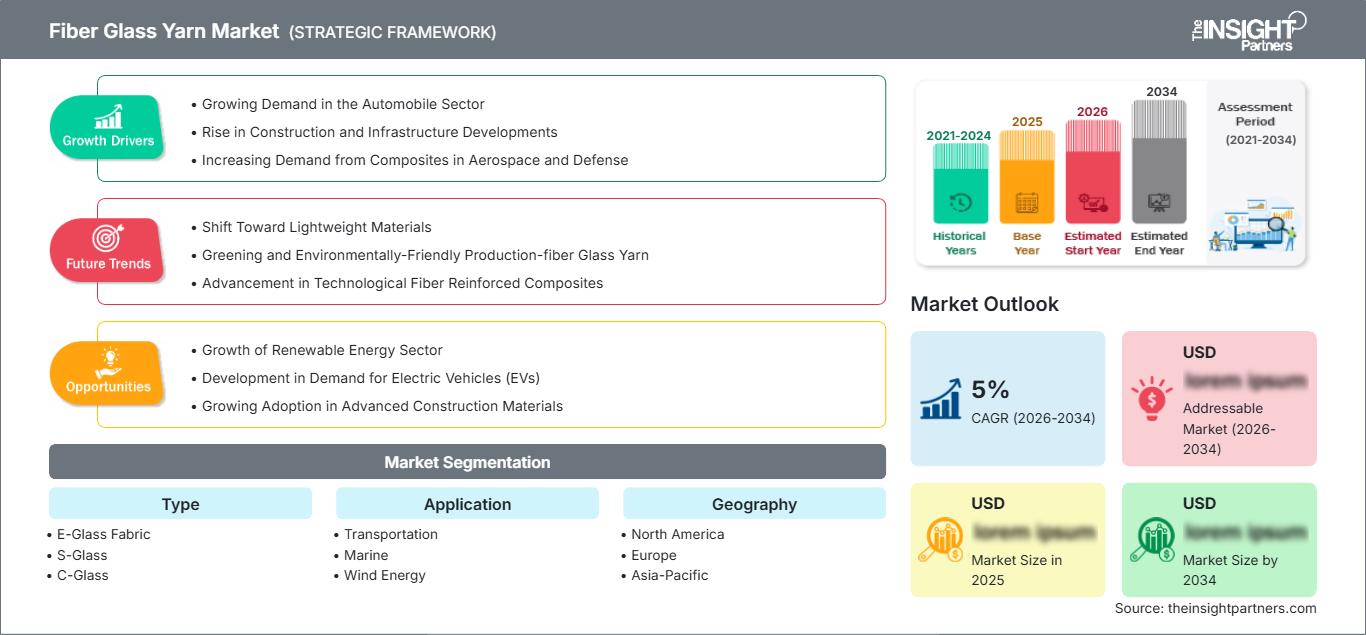
The Fiber Glass Yarn Market was valued at US$ 4.39 Billion in 2025 and is projected to reach US$ 5.67 Billion by 2034, registering a 2.88% CAGR during 2026–2034. The market covers glass fiber yarn produced from E-Glass Fabric, S-Glass, and C-Glass and used across transportation, marine, wind energy, aerospace, construction, and electrical and electronics applications. Demand is shaped by lightweight reinforcement requirements, electrical insulation performance, dimensional stability, and increasing use of glass fiber-based composite structures.
North America represents a mature demand center supported by aerospace manufacturing, transportation composites, electrical insulation, and construction applications. The regional Fiber Glass Yarn Market Size is expected to register a ~2% CAGR through 2034, with growth supported by replacement demand for composite components, continued aerospace production, and requirements for lightweight materials with stable mechanical and electrical performance. Regional manufacturers are increasingly differentiating products through filament engineering, sizing chemistry, and application-specific yarn configurations.
Fiber Glass Yarn Market Assessment and Insights
Regional Outlook
- North America: ~25% of the global market in 2025 | ~2% CAGR through 2034. Market position: North America holds a major mature-market position supported by aerospace, transportation, electrical insulation, and construction demand. Established composite manufacturing capabilities and specialized glass fiber producers support recurring industrial consumption and higher-value yarn applications.
- U.S.: ~78% of North American market revenue in 2025 | ~2% CAGR through 2034. Market position: The U.S. represents the principal country market within North America, supported by aerospace structures, automotive composites, electrical systems, telecommunications infrastructure, and domestic specialty glass fiber manufacturing capabilities serving application-specific performance requirements.
- Europe: ~23% of the global market in 2025 | ~2% CAGR through 2034. Market position: Europe remains a mature market, with Germany representing the leading country in Europe based on industrial manufacturing depth and composite applications. France, the UK, Italy, and Spain support demand through transportation, construction, renewable energy, and industrial applications.
- Asia Pacific: ~44% of the global market in 2025 | ~4% CAGR through 2034. Market position: Asia Pacific is the largest regional market and the fastest-growing region, supported by electronics manufacturing, infrastructure investment, wind energy, transportation production, and expanding domestic composite supply chains across China, Japan, South Korea, India, and Australia.
Segment Outlook
- E-Glass Fabric: ~77% Share in 2025 | ~3% CAGR through 2034. Market position: E-Glass Fabric leads because it combines electrical insulation, mechanical strength, chemical resistance, processability, and cost suitability. Its broad qualification across construction, transportation, electrical systems, industrial composites, and general reinforcement supports high-volume demand.
- S-Glass: ~12% Share in 2025 | ~5% CAGR through 2034. Market position: S-Glass records the highest growth outlook because higher strength, stiffness, impact resistance, and thermal performance support specialized applications. Aerospace, defense-related structures, high-performance composites, and demanding transportation components increasingly require these enhanced properties.
Competitive Coverage
AGY Holding Corp, Chongqing Polycomp International Corporation (CPIC), China Jushi Co., Ltd., Mid-Mountain Materials, Inc., Nippon Electric Glass Co., Ltd., Nitto Boseki Co., Ltd., Original Composites & Fiberglass, PFG Fiber Glass Corporation, Saint-Gobain Performance Plastics, Sichuan Weibo New Material Group Co., Ltd.
Methodology
The Insight Partners follows Data Collection & Secondary Research, Primary Research, Data Analysis, and Data Triangulation & Final Review to validate market estimates and insights.
Source: The Insight Partners' analysis based on proprietary research, government publications, company annual reports, investor presentations, industry databases, and expert interviews.
Production has moved away from generic glass yarn formulations to specific yarn formulations based on filament size, twist, sizing formulation, dielectric properties, and compatibility with resin systems. E-Glass continues to be the main raw material as it meets wide-ranging reinforcing and electrical insulation needs, whereas S-Glass is used in applications where increased strength and rigidity make high-performance material requirements economical. Yarn formulation has become increasingly aligned with the subsequent weaving, braiding, printed circuit board, composite, and insulation manufacturing processes.
Future demand growth is anticipated through the development of electronics manufacturing facilities, renewable energy projects, vehicle lightweighting, and infrastructure development. Future investments will focus on high-performance glass formulations, low-dielectric yarns, energy efficient glass melting technologies, and reduced material variability production technologies. Manufacturing emissions and energy consumption have come under regulatory scrutiny, thus adding value to process efficiency. These trends present an opportunity for glass manufacturers with consistent yarn quality and the capability of customizing glass formulation and surface treatments based on specific application requirements.
Fiber Glass Yarn Market Report Scope
| Report Attribute | Details |
|---|---|
| Market size in 2025 | US$ 4.39 Billion |
| Market Size by 2034 | US$ 5.67 Billion |
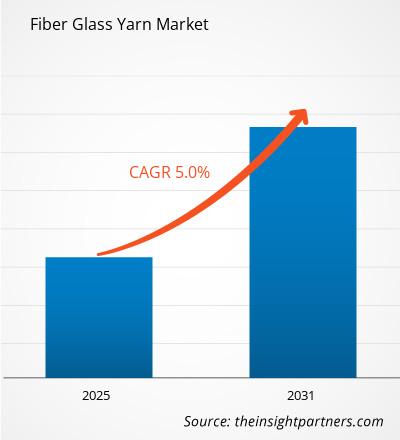
| Global CAGR (2026 - 2034) | 2.88% |
| Historical Data | 2021-2024 |
| Forecast period | 2026-2034 |
Fiber Glass Yarn Market Analysis
Growth of the Fiber Glass Yarn Market is directly dependent on the requirements for lightweight reinforcement and insulation of electrical materials. The value chain consists of silica sand, limestone, alumina, boron compounds, and other materials used in glass-making, which are then followed by processes of melting, fiberizing, sizing, drying, twisting, winding, and yarn conversion. Yarn companies will then supply textiles producers, composites producers, electronics materials producers, and components producers. The supply will be based on the furnace capacity, energy cost, availability of raw materials, production efficiency, and capability to ensure that filaments have consistent size. Demand from wind power, transportation, electronics, and construction will have different procurement requirements.
The competitive dynamics in the Fiber Glass Yarn Market Report are driven by production scale, product qualification, technical expertise, regional production presence, and capability to produce specialty yarn structure. China Jushi and CPIC have comprehensive offerings of glass fibers, while AGY has a considerable focus on specialty fibers. Nippon Electric Glass and Nitto Boseki have established positions in specialty glass materials and electronic application areas. Mid-Mountain Materials, PFG Fiber Glass Corporation, Original Composites & Fiberglass, and Sichuan Weibo New Material Group address niche or regional needs. Saint-Gobain Performance Plastics operates in the industry through technology development in glass-based material systems and end-use applications.
Investment has been increasingly shifting towards high-end materials for electronics, low dielectric glass fiber, process improvements, and production capacity that fits advanced composites. Product differentiation is becoming a more important issue because the battle over standard E-Glass is being fought on scale and cost bases while the fight over specialty yarn is based on performance specifications.
● REPORT CUSTOMIZATION
Tailor This Report To Align With Your Specific Business Requirements
This report can be customized to align precisely with your business objectives, scope, and target markets. Customization options include tailored segmentation, geography, competitive analysis, and strategic insights to support informed decision-making.
Customize This Report →WHAT YOU CAN ADJUST
- ● Segmentations
- ● Geography
- ● Competitive Analysis
- ● Language Preferences
Fiber Glass Yarn Market: Strategic Insights
Regional Insights
North America Fiber Glass Yarn Market
North America accounts for approximately ~25% of the global Fiber Glass Yarn Market Share in 2025 and is projected to expand at a ~2% CAGR through 2034. The region benefits from established aerospace, automotive, marine, electrical, and construction industries that use glass fiber yarn in reinforcement, insulation, textile structures, and composite components. The U.S. accounts for most regional demand because of its broader manufacturing base and concentration of aerospace and advanced composite activity.
Demand is fueled by weight saving applications in the transportation and aviation sectors, where reinforcement of glass fibers lends strength to the product without any weight burden of many traditional materials. The electrical and electronics industry forms a source of repeated demand due to insulation and circuitry related products. Domestic suppliers, like AGY, are there, and some international suppliers are operating from their distribution network and customer approval base. Consumption by Canada and Mexico is from transportation, construction, manufacturing industries, and electrical equipment.
U.S. Fiber Glass Yarn Market
The U.S. market is ~78% of the North American market revenue share in 2025 and will witness ~2% CAGR during 2034. The reason for its dominance is the presence of aerospace production, transportation manufacturing, infrastructure operations, electrical equipment production, and specialty composite production in the region. Glass fiber yarn application in cases where consistent reinforcement, insulation, heat resistance, and dimension stability are required becomes very relevant.
There is a specialty glass fiber manufacturer like AGY in the U.S. market, while international suppliers offer their products to satisfy electronic, constructional, marine, transportation, and industrial needs. Yarns are becoming more and more suitable for processing into woven or braided structures and incorporation into composite materials. Aerospace and high-performance applications drive the need for specialty S-Glass fibers, while E-Glass finds applications in broader sectors.
Europe Fiber Glass Yarn Market
Europe holds ~23% share of the global market in 2025 and is projected to grow at a ~2% CAGR until 2034. The top performing countries in Europe include Germany, due to its vast industrial manufacturing, automotive manufacture, machinery, electrical equipment, and processing of composites. France contributes via the aerospace industry, transportation, construction, and industrial applications, while the UK ensures high demand from the aerospace industry, maritime industry, renewable energy, and advanced manufacturing.
Italy and Spain contribute from the construction industry, transport industry, maritime equipment, industrial parts, and renewable energy. European customers pay increasing attention to material properties, production efficiency, traceability, and environmental features of reinforcement materials.
The wind energy and transport sectors within the region act as crucial outlets for reinforced fiberglass, with electrical and electronic manufacturing serving as an outlet for insulation and high-performance substrate yarns. European companies and foreign companies engage in competition using special product development and technical support. Growing investment is now being made in manufacturing processes that promote efficiency, low emissions, recyclability, and advanced composite applications.
APAC Fiber Glass Yarn Market
Asia Pacific represents ~44% of the global market in 2025 and is expected to register a ~4% CAGR through 2034, making it the fastest-growing region. China is the leading country in the Asia Pacific because of its extensive glass fiber production base, electronics manufacturing ecosystem, transportation industry, construction activity, and wind energy deployment. Japan and South Korea contribute through advanced electronics, automotive, industrial, and specialty materials applications.
India is developing their consumption base by means of infrastructure, transportation, renewable energy, and electricity production, whereas Australia helps to develop demand through construction, infrastructure, marine, and industrial applications. Producers in the region are becoming more specialized in manufacturing of electronic-grade and high-performance glass fibers. There are also policy initiatives that help develop demand.
Middle East & Africa Fiber Glass Yarn Market
Middle East & Africa demand is expected to expand at a ~3% CAGR through 2034. Saudi Arabia represents the leading country in the Middle East & Africa market, where industrial diversification, construction investment, infrastructure development, and transportation projects support composite-material consumption. The UAE contributes through construction, marine, infrastructure, and industrial manufacturing.
South Africa generates demand via construction, electrical, transport, mining infrastructure, and industrial applications. The remainder of the Middle East & Africa region is less cohesive, with demand being driven by infrastructure projects and localized industry. Availability of energy sources and investments in manufacturing capacity affect production economics, while the construction of infrastructure presents the possibility to utilize corrosion-resistant and lightweight composite materials. Demand is thus becoming linked to construction, industrial, marine, and electrical applications.
Segmentation Analysis
Type
Type segment in the Fiber Glass Yarn Market remains the principal basis for differentiating performance, cost, and application suitability. E-Glass Fabric has the largest market position, while S-Glass records the strongest growth outlook. C-Glass maintains relevance in applications where chemical resistance and specialized material characteristics are required.
- E-Glass Fabric: E-Glass Fabric remains the primary volume material because of its balanced mechanical strength, electrical insulation, processability, and cost profile. It is widely incorporated into composite structures, electrical materials, construction products, transportation components, and industrial textiles.
- S-Glass: S-Glass is positioned toward demanding applications requiring higher strength, stiffness, impact resistance, and thermal stability. Aerospace, high-performance transportation, specialized composites, and other applications with stringent mechanical requirements support its strategic importance.
- C-Glass: C-Glass serves applications requiring enhanced chemical resistance and compatibility with selected industrial environments. Its use is more specialized than E-Glass and is linked to applications where resistance characteristics justify material selection.
Application
The application segment in the Fiber Glass Yarn Market determines yarn specifications according to mechanical, electrical, environmental, and processing requirements. Electrical and electronics applications represent a major demand center, while wind energy and aerospace provide technically demanding growth channels. Transportation and construction sustain broader-volume consumption across composite components and reinforced materials.
- Transportation: Transportation manufacturers use glass fiber yarn in lightweight composite components, structural reinforcement, insulation, and related textile structures. Demand is influenced by vehicle lightweighting, durability requirements, and the increasing use of composite materials in commercial and specialty transportation.
- Marine: Marine applications use glass fiber yarn in reinforced composite structures requiring corrosion resistance, durability, and relatively low weight. Boatbuilding, marine infrastructure, and equipment applications create demand for yarn compatible with resin-based composite manufacturing.
- Wind Energy: Wind energy uses glass fiber reinforcement extensively in composite structures where strength, fatigue resistance, and weight management affect component design. Continued turbine deployment and efforts to improve blade performance support demand for suitable yarn configurations.
- Aerospace: Aerospace applications require controlled material properties, consistent quality, and high strength-to-weight performance. Glass fiber yarn is used in selected structural, insulation, radome, interior, and specialty composite applications where material performance and qualification requirements are stringent.
- Construction: Construction applications use glass fiber yarn in reinforced textiles, architectural materials, insulation-related products, roofing, and composite structures. Durability, dimensional stability, corrosion resistance, and compatibility with cementitious or polymer systems influence purchasing decisions.
- Electrical and Electronics: Electrical and electronics applications require electrical insulation, dimensional stability, thermal resistance, and controlled dielectric performance. Glass fiber yarn is incorporated into woven materials and substrates used in circuit boards, insulation systems, and high-frequency electronic applications.
Opportunity Snapshot
| Application | Revenue Contribution | Trend Tag | Adoption Stage |
|---|---|---|---|
| Transportation | High | Lightweighting | Scaling |
| Marine | Medium | Composite Hulls | Mature |
| Wind Energy | High | Blade Reinforcement | Scaling |
| Aerospace | Medium | High Strength | Mature |
| Construction | High | Structural Reinforcement | Mature |
| Electrical and Electronics | High | Low Dielectric | Scaling |
Fiber Glass Yarn Market Growth Drivers and Impact Analysis
Electronics Miniaturization and High-Frequency Communication
The expansion of high-speed computing, AI servers, data centers, and advanced communication equipment is increasing demand for glass fiber materials with controlled dielectric behavior. Conventional electrical insulation remains important, but high-frequency applications require lower signal loss and tighter dimensional control. Glass fiber yarn is incorporated into woven reinforcement used in electronic substrates, making filament characteristics relevant to circuit performance. Product development is consequently moving beyond conventional E-Glass specifications toward specialized low-dielectric compositions and yarn structures. Nippon Electric Glass has introduced D2 Fiber for advanced communication boards, illustrating the shift toward application-specific glass fiber engineering. This driver can increase the value contribution of technically differentiated yarn even where overall volume growth remains moderate.
Lightweight Composite Adoption in Transportation and Aerospace
Transportation and aerospace manufacturers continue to use composite materials to reduce component weight while maintaining mechanical performance and durability. Glass fiber yarn supports woven and braided reinforcement formats that can be integrated into thermoset and thermoplastic composite systems. In transportation, demand extends across structural components, electrical systems, underbody parts, and specialty components. Aerospace applications place greater emphasis on strength-to-weight characteristics, thermal stability, fatigue resistance, and qualification consistency. This differentiation supports S-Glass and other higher-performance yarn products alongside conventional E-Glass. Suppliers that can maintain tight filament tolerances and provide application-specific sizing can participate in higher-value applications where technical qualification creates longer customer relationships and higher switching requirements.
Expansion of Renewable Energy and Corrosion-Resistant Infrastructure
Wind energy and infrastructure development are increasing the requirement for durable reinforcement materials that withstand moisture, fatigue, temperature changes, and corrosive environments. Glass fiber yarn is well-suited to composite reinforcement because it combines mechanical performance with relatively low density and resistance to many environmental conditions. Wind blade manufacturing creates sustained demand for glass fiber reinforcement, while construction applications use glass fiber textiles in reinforced cementitious products, roofing, facades, and other structures. Infrastructure modernization further broadens applications in areas where reduced maintenance and corrosion resistance matter. These end uses support demand diversification beyond traditional electronics and industrial insulation and provide manufacturers with opportunities to adapt yarn specifications to larger composite structures.
Fiber Glass Yarn Market Future Trends
Transition Toward Low-Dielectric and Application-Specific Yarn
Future product development is expected to place greater emphasis on glass fiber yarn engineered for high-frequency electronics, advanced semiconductor packaging, and data-intensive communication equipment. Conventional E-Glass will remain important for mainstream applications, but higher-performance substrates require lower dielectric loss, controlled thermal expansion, and stable mechanical properties. Manufacturers are responding through new glass compositions and specialized yarn architectures rather than relying solely on conventional formulations. Nippon Electric Glass has already introduced low-dielectric D2 Fiber as a yarn supplied to glass-cloth manufacturers for AI server and high-frequency communication applications. This Fiber Glass Yarn Market trend can increase the technical value of yarn and shift competitive differentiation toward material science, qualification performance, and application engineering.
Lower-Carbon Glass Fiber Manufacturing and Circularity
Environmental performance is expected to become a stronger consideration in glass fiber procurement as manufacturers address energy-intensive melting processes and downstream sustainability requirements. Future production strategies are likely to emphasize electric melting, renewable electricity, energy recovery, recycled glass inputs, and process optimization. These measures can reduce the environmental burden associated with high-temperature glass production while improving operating efficiency. Recycling initiatives may become increasingly relevant for production scrap and selected post-industrial glass materials, although maintaining fiber quality and consistent composition remains technically important. Suppliers that combine stable yarn specifications with measurable improvements in energy and material efficiency can respond to procurement requirements increasingly influenced by environmental reporting and lifecycle considerations.
Fiber Glass Yarn Market Opportunities
Specialty Yarn Supply for Advanced Electronics
Advanced electronics represents an opportunity for manufacturers capable of producing tightly controlled yarn with low dielectric loss, low thermal expansion, and consistent filament characteristics. AI servers, high-speed communication equipment, advanced semiconductor packaging, and high-density circuit boards require materials that support higher transmission speeds while managing signal integrity and thermal behavior. This creates a pathway for specialty yarn suppliers to move beyond commodity E-Glass and participate in technically demanding applications. Investment can focus on glass composition development, precision filamentization, yarn twisting, surface treatment, and qualification capabilities. Partnerships with glass-cloth producers and electronic-material manufacturers can shorten commercialization cycles by aligning yarn development with downstream substrate requirements and production processes.
Regionalized Production for Composite and Renewable Energy Supply Chains
Regional manufacturing in the Fiber Glass Yarn Market Forecast can create opportunities as transportation, wind energy, construction, and industrial composite producers seek dependable local supply and shorter logistics routes. Glass fiber yarn production requires specialized furnaces, forming equipment, sizing systems, and quality-control infrastructure, making supply continuity important for customers operating continuous composite-processing lines. Producers can target regional capacity around established wind, transportation, construction, and industrial clusters while maintaining differentiated product portfolios. Strategic investment can focus on flexible production lines capable of serving standard E-Glass and specialty yarn specifications. Local technical support, qualification assistance, and application engineering can further strengthen supplier relationships where customers require consistent yarn performance across multiple production locations.
Recent Developments
- May 2026: Owens Corning - completed the sale of its glass reinforcements business to Praana Group, marking a major ownership transition in the global glass reinforcement industry. The transaction supports Owens Corning's portfolio focus on building products while placing the former reinforcement operations under a new advanced-materials ownership structure. The change is relevant to customer relationships, production continuity, geographic coverage, and competitive positioning. -
- March 2026: China Jushi Co., Ltd. - participated in JEC World 2026, highlighting glass fiber solutions for wind, solar, hydrogen, energy storage, new energy vehicles, AI, and other emerging applications. The company emphasized sustainable manufacturing, product performance, technical cooperation, and stable supply, reinforcing the industry's movement toward higher-value applications and broader composite-material integration. -
Frequently Asked Questions

- Comprehensive Market Sizing and Forecast Analysis
- Detailed Segmentation Analysis
- In-Depth Market Dynamics Assessment
- Regional and Country-Level Insights
- Competitive Landscape and Company Benchmarking
- Strategic Business Intelligence
Recent Reports
Testimonials

The Insight Partners provided valuable market intelligence that supported our global go-to-market strategy. Their team was professional, responsive, and attentive to our feedback, providing thoughtful analysis and helpful methodological clarifications throughout the project.
Junmo Kim Chief Financial Officer (CFO), Enertech Co., Ltd.
The Insight Partners' SCADA System Market report is comprehensive, with valuable insights on current trends and future forecasts. The team was highly professional, responsive, and supportive throughout. We are very satisfied and highly recommend their services.
RAN KEDEM Partner, Reali Technologies LTDs
I requested a report on a very specific software market and the team produced the report in a few days. The information was very relevant and well presented. I then requested some changes and additions to the report. The team was again very responsive and I got the final report in less than a week.
JEAN-HERVE JENN Chairman, Future Analytica
We worked with The Insight Partners for an important market study and forecast. They gave us clear insights into opportunities and risks, which helped shape our plans. Their research was easy to use and based on solid data. It helped us make smart, confident decisions. We highly recommend them.
PIYUSH NAGPAL Sr. Vice President, High Beam Global
The Insight Partners delivered insightful, well-structured market research with strong domain expertise. Their team was professional and responsive throughout. The user-friendly website made accessing industry reports seamless. We highly recommend them for reliable, high-quality research services
YUKIHIKO ADACHI CEO, Deep Blue, LLC.
This is the first time I have purchased a market report from The Insight Partners.While I was unsure at first, I visited their web site and felt more comfortable to take the risk and purchase a market report.I am completely satisfied with the quality of the report and customer service. I had several questions and comments with the initial report, but after a couple of dialogs over email with their analyst I believe I have a report that I can use as input to our strategic planning process.Thank you so much for taking the extra time and making this a positive experience.I will definitely recommend your service to others and you will be my first call when we need further market data.
JOHN SUZUKI President and Chief Executive Officer, Board Director, BK Technologies
I wish to appreciate your support and the professionalism you displayed in the course of attending to my request for information regarding to infectious disease IVD market in Nigeria. I appreciate your patience, your guidance, and the fact that you were willing to offer a discount, which eventually made it possible for us to close a deal. I look forward to engaging The Insight Partners in the future, all thanks to the impression you have created in me as a result of this first encounter.
DR CHIJIOKE ONYIA MANAGING DIRECTOR, PineCrest Healthcare Ltd.Reason to Buy
- Informed Decision-Making
- Understanding Market Dynamics
- Competitive Analysis
- Identifying Emerging Markets
- Customer Insights
- Market Forecasts
- Risk Mitigation
- Boosting Operational Efficiency
- Strategic Planning
- Investment Justification
- Tracking Industry Innovations
- Aligning with Regulatory Trends





 Get Free Sample for