
Fiber to The Home Market Share, Size & Demand by 2034
Coverage: by Network Speed (Less than 50 Mbps, 50 to 100 Mbps, 100 Mbps to 1 Gbps, Gbps to 10 Gbps); Application (Internet TV, VoIP, Interactive Gaming, VPN on Broadband, Virtual Private LAN Service, Smart Home Application, Others), and Geography (North America, Europe, Asia Pacific, and South and Central America)
- Status : Data Released
- Report Code : TIPRE00003626
- Category : Electronics and Semiconductor
- No. of Pages : 150
- Available Report Formats :


- Last update date : August 06, 2026


2025 Market Size
US$ 62.43 Bn
Base year value
2034 Forecast
US$ 109.89 Bn
Projected by 2034
CAGR 2026-2034
7.32 %
Growth rate
Addressable Market
US$ 813.28 Bn
(2026-2034)
The Fiber To The Home Market value is estimated at US$ 62.43 billion in 2025 and will reach US$ 109.89 billion by 2034, with a CAGR of 7.32%. The growth is driven by the rapid adoption of broadband upgrades among residential homes, higher bandwidth symmetries, increasing fiber deepening among telecommunication providers, and the need for dependable access to video, gaming, smart home, remote education, and secure enterprise connectivity.
North American Fiber To The Home Market size will experience a CAGR of 6.4%–7.1% from 2026 to 2034, driven by the record number of US FTTH passings, the proximity of fiber to three-quarters of Canadian homes, and government investments in unserved areas. Demand is boosted by the transition from cable to fiber technology, multiple gigabit broadband packages, and competition-driven overbuilds.
Fiber to The Home Market Assessment and Insights
- North America held 30–33% share in 2025 and is growing at a CAGR of 6.4–7.1% during 2026–2034, supported by BEAD-linked rural builds, cable substitution, and multi-gigabit household demand.
- US represented 80–84% of North American revenue in 2025 and is growing at a CAGR of 6.5–7.2% during 2026–2034, led by AT&T, Verizon, and regional overbuilders.
- Europe accounted for 22–25% share in 2025 and is growing at a CAGR of 5.8–6.6% during 2026–2034, with the UK, Germany, France, Italy, and Spain leading deployment conversion.
- Asia Pacific captured 35–38% share in 2025 and is growing at a CAGR of 7.8–8.6% during 2026–2034, led by China, Japan, South Korea, India, and Australia.
- Largest Segment 100 Mbps to 1 Gbps held 43–47% market share in 2025 and is growing at a CAGR of 6.8–7.5% during 2026–2034 because it fits mainstream household pricing.
- High Growth Segment More than 1 Gbps represented 18–22% market share in 2025 and is growing at a CAGR of 9.1–10.2% during 2026–2034, supported by XGS-PON and premium broadband demand.
- Key companies analyzed in detail: AFL Telecommunications LLC; Altion Tech Communication Co., Ltd.; AT&T Inc.; China Mobile Limited; China Telecom Corporation Limited; Huawei Technologies Co., Ltd.; OFS Fitel, LLC; Verizon Communications Inc.; Vodafone Group Plc; ZTE Corporation.
Source: The Insight Partners' analysis based on proprietary research, government publications, company annual reports, investor presentations, industry databases, and expert interviews.
Access via fiber optics has changed from being premium access in metropolitan cities to becoming a popular access network structure as service providers transition from copper to GPON, XGS-PON, and the initial stages of 50G-PON roadmaps. The production process is moving towards preconnectorized drop cables, high-density optical distribution frames, automated splicing, and common ONT platforms. The Market is driven by operators' tradeoffs among construction cost, uptake timing, and long asset lives.
Future demand will increase because the new geographies will rely on fiber optic networks to bridge the digital divide, while developed geographies will capitalize on multi-gigabit services, smart home packages, and small business services. Favorable policies will continue to be crucial since government funding reduces deployment risks in rural geographies. Open access networks, infrastructure funds, and city collaborations will attract investments in geographies where subscriber take-up, ducting access, and permitting become more economical.
Fiber to The Home Market Report Scope
| Report Attribute | Details |
|---|---|
| Market size in 2025 | US$ 62.43 Billion |
| Market Size by 2034 | US$ 109.89 Billion |
| Global CAGR (2026 - 2034) | 7.32% |
| Historical Data | 2021-2024 |
| Forecast period | 2026-2034 |
Fiber to The Home Market Analysis
Fiber To The Home Market growth is fueled by consumer traffic upload, 4K & 8K video streaming, cloud-based gaming, working and learning from home, and smart homes devices that need reduced latencies compared to traditional access network technologies. Fiber Broadband Association reported 2025 U.S. passing rates over 60% of households, whereas FTTH/B penetration in Europe achieved 74.6% in EU39 in 2024.
Ecosystem participants include fiber cable suppliers, passive components suppliers, suppliers of OLT/ONT equipment, civil contractors, telecom companies, ISPs, cable operators, and broadband wholesalers. Supply chain dynamics are affected by optical fiber availability, quality of fiber connectors, labor productivity, permits, pole access, efficiency of consumer installations, and electronic components for PON upgrades from broadband services to multi-gigabit speeds.
Competition in the Fiber To The Home Market Report is evident in competition amongst telecom operators, equipment manufacturers, and specialized fiber infrastructures providers. AT&T Inc., Verizon Communications Inc., Vodafone Group Plc, China Mobile Limited, and China Telecom Corporation Limited compete in terms of the number of subscribers and geographic coverage, and Huawei Technologies Co., Ltd., ZTE Corporation, AFL Telecommunications LLC, and OFS Fitel, LLC provide equipment and fiber infrastructures.
Capital is being invested into XGS-PON overlays, 10G-capable home gateways, rural deployments, wholesale optical networks, and bundles that consist of broadband connectivity, security features, live streaming, WiFi management, and smart homes. Strategic positioning is based on build cost per pass, provisioning, and churn reduction. Altion Tech Communication Co., Ltd. specializes in access solutions for operators that need optical distribution solutions.
● REPORT CUSTOMIZATION
Tailor This Report To Align With Your Specific Business Requirements
This report can be customized to align precisely with your business objectives, scope, and target markets. Customization options include tailored segmentation, geography, competitive analysis, and strategic insights to support informed decision-making.
Customize This Report →WHAT YOU CAN ADJUST
- ● Segmentations
- ● Geography
- ● Competitive Analysis
- ● Language Preferences
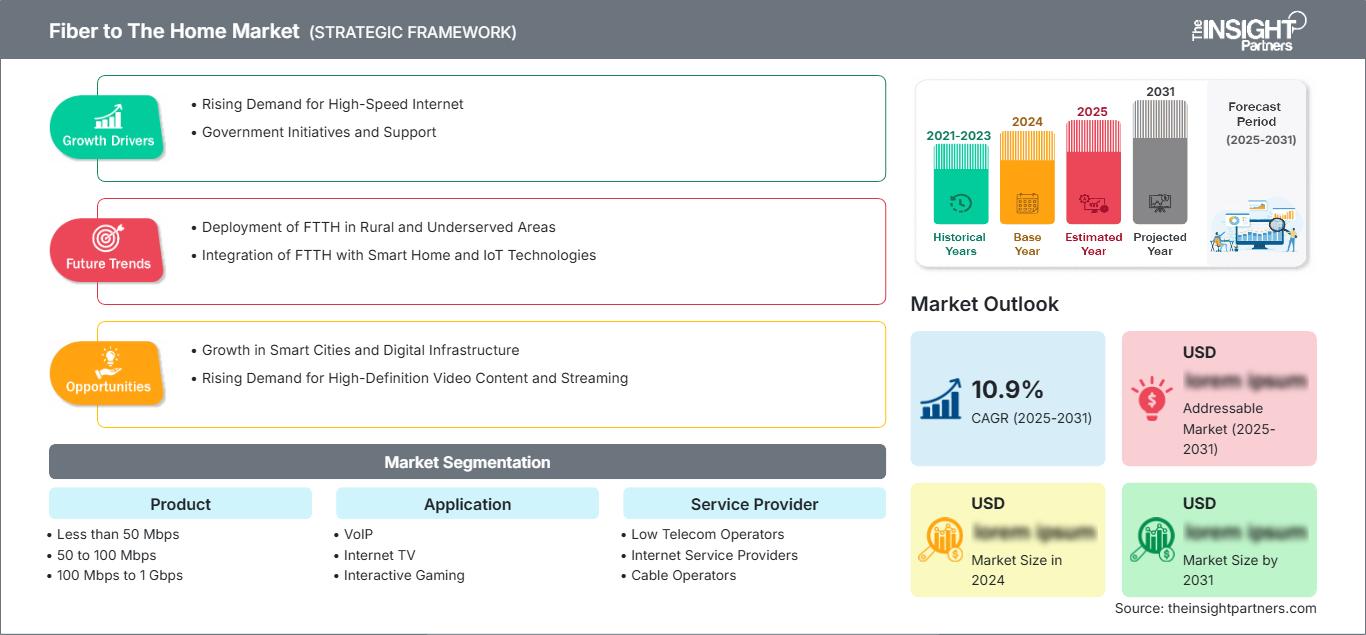
Fiber to The Home Market: Strategic Insights
Regional Insights
North America Fiber To The Home Market
North America accounted for 30-33% Fiber To The Home Market share in 2025 and is expected to grow at a CAGR of 6.4-7.1% from 2026-2034. North American adoption includes U.S. fiber passings at around 100 million taking into account redundant build-outs, fiber availability in Canada at around 75% of homes, and continued demand for symmetrical broadband services.
The structural elements are those like funding by BEAD in rural areas, competitive deployments, cutting of cable, and business-class services in households. The adoption rate of FTTH in the year 2025 in the United States was at 46.5%, and fiber to fiber competition is responsible for the take-up rate of 61%. Hence, the focus is on fast deployment and bundled applications.
U.S. Fiber To The Home Market
The U.S. represented 80–84% of North American revenue in 2025 and is expected to grow at a CAGR of 6.5–7.2% during 2026–2034. Demand is supported by 11.8 million new homes passed in 2025, federal broadband funding, and dense competition among national carriers, municipal networks, and regional providers.
Corporate players are dominated by AT&T Inc. and Verizon Communications Inc. The ecosystem players include AFL Telecommunications LLC and OFS Fitel, LLC who provide fiber cable, connectivity, and installation services. Application trends involve high-end Internet television, interactive games, broadband VPN, and distant learning. This has been made possible by lower latency and improved upload capability.
Europe Fiber To The Home Market
Share in Europe is estimated to be 22-25% in 2025, while it is expected to increase with a CAGR of 5.8-6.6% between 2026 and 2034. FTTH Council Europe stated 269 million EU39 homes passed in September 2024 with coverage of 74.6% and take-up rate of 53.1%.
The UK, Germany, and Italy were some of the biggest annual growers in terms of homes passed, and the countries that show mature adoption trends include France, Spain, and Portugal. Vodafone Group Plc is one of the major regional operators. Policy focuses on copper shut-down, rural penetration, and wholesale access, all encouraging operators to make homes passed into paying customers.
APAC Fiber To The Home Market
The Asia Pacific segment had the market share of 35–38% in 2025 and expected to record the growth rate of 7.8–8.6% CAGR during the forecast period from 2026 to 2034. China is dominated by having 691 million fixed broadband subscribers and 1.21 billion FTTH/O ports in 2025.
Japan and South Korea have highly penetrated with fiber broadband services. India and Australia have rural broadband and gigabit broadband due to government policies. China Mobile Limited, China Telecom Corporation Limited, Huawei Technologies Co., Ltd., and ZTE Corporation support the regional growth in terms of access network, PON and subscribers.
Middle East & Africa Fiber To The Home Market
The Middle East and Africa segment is estimated to achieve a compound annual growth rate (CAGR) of 7.0-7.9% for 2026-2034. The main drivers include the development of smart cities and giga projects by Saudi Arabia and high fiber penetration in the UAE. In addition, there will be demand from South Africa and Rest of MEA driven by urban broadband and enterprise parks.
The provision of utilities, energy systems, and public services assists fiber networks by the need for reliability of connectivity. Deployment will differ owing to cost, the cost of civil engineering work, and absence of regulatory control. Service providers will concentrate on dense urban locations and deploy in further stages through public-private partnerships, tower fiberization, and national digitization initiatives.
Segmentation Analysis
Product
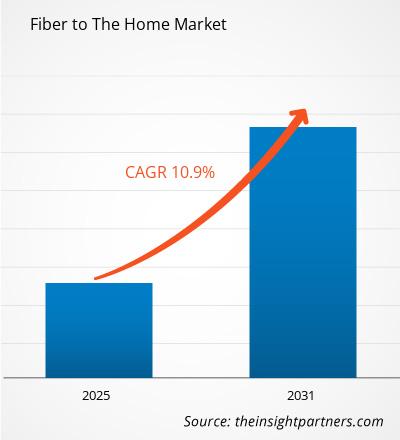
Product is projected to grow at a CAGR of 7.1–7.9% during 2026–2034. The Fiber To The Home Market scope spans entry broadband, mainstream high-speed packages, gigabit tiers, and premium multi-gigabit service. Operators use speed segmentation to align pricing with household usage, network capacity, and competitive positioning while encouraging customers to migrate from basic connectivity toward higher-value plans.
- Less than 50 Mbps remains relevant in price-sensitive or newly connected areas where basic browsing, messaging, and low-resolution video define demand, but migration pressure is rising.
- 50 to 100 Mbps serves budget households and smaller dwellings needing reliable video, remote work, and school access without paying for premium gigabit performance.
- 100 Mbps to 1 Gbps dominates mainstream adoption because it balances affordability, streaming quality, multi-device use, and operator upsell potential across urban and suburban markets.
- More than 1 Gbps is strategically important for premium households, gamers, creators, and smart homes using high upload capacity, low latency, and Wi-Fi 7 gateways.
Application
Application is forecast to grow at a CAGR of 7.4–8.2% during 2026–2034. Application demand is widening as households use fiber for entertainment, secure work access, learning, gaming, and connected devices. Operators increasingly sell broadband as a platform, bundling Wi-Fi management, cybersecurity, streaming, and smart-home services to raise revenue per subscriber.
- VoIP benefits from low latency and stable upload performance, supporting residential voice bundles, small-office calling, and migration away from legacy copper voice services.
- Internet TV remains a major bandwidth driver because households demand high-definition streaming, multiple concurrent screens, and reliable video delivery during peak evening usage.
- Interactive Gaming values fiber for low latency, consistent throughput, and reduced jitter, making it important for premium broadband tiers and household retention strategies.
- Smart Home Application demand rises as cameras, appliances, sensors, and voice assistants require always-on connectivity and stronger in-home Wi-Fi backed by fiber access.
- Virtual Private LAN Service supports distributed small businesses and branch-like home setups where secure connectivity and predictable performance are more important than basic internet access.
- Remote Education depends on stable video conferencing, cloud learning platforms, assessments, and multi-user household access, making fiber valuable for digital inclusion programs.
- VPN on Broadband supports hybrid work, secure enterprise access, and home-office continuity, especially where upload capacity and latency affect productivity and application responsiveness.
Service Provider
Service Provider is expected to grow at a CAGR of 6.9–7.7% during 2026–2034. Provider economics vary by footprint, capital access, customer acquisition cost, and ability to bundle services. Telecom operators lead large-scale builds, while ISPs and cable operators accelerate competitive fiber projects where churn reduction and premium broadband pricing justify investment.
- Low Telecom Operators target localized fiber builds, underserved districts, and cooperative models where community presence helps reduce acquisition cost and improves trust.
- Internet Service Providers use fiber to differentiate speed, reliability, and service quality, often competing through local support, transparent pricing, and faster installation.
- Cable Operators adopt fiber edge-outs and selective FTTH overlays to defend broadband share as symmetrical performance becomes a competitive requirement.
Opportunity Snapshot
| Application | Revenue Contribution | Trend Tag | Adoption Stage |
| VoIP | Medium | Voice Migration | Mature |
| Internet TV | High | Streaming Bundles | Mature |
| Interactive Gaming | Medium | Low Latency | Scaling |
| Smart Home Application | High | Connected Devices | Scaling |
| Virtual Private LAN Service | Medium | Secure LAN | Emerging |
| Remote Education | Medium | Digital Learning | Scaling |
| VPN on Broadband | High | Hybrid Work | Mature |
Fiber to The Home Market Growth Drivers and Impact Analysis
Gigabit Broadband Demand Reshapes Household Connectivity
Households increasingly use broadband for simultaneous streaming, gaming, video meetings, cloud storage, and smart-home monitoring, making upload performance and latency more visible to subscribers. The market impact is a shift from speed as a marketing claim toward service reliability as a retention tool. Fiber gives operators a stronger foundation for symmetrical tiers, managed Wi-Fi, and premium bundles that defend average revenue per user. As fixed wireless and cable compete aggressively, FTTH providers can differentiate through lower jitter, higher upstream capacity, and upgradeable PON electronics. This driver raises demand for 100 Mbps to 1 Gbps packages today and More than 1 Gbps plans as devices, content formats, and home-office needs intensify.
Public Funding and Copper Retirement Improve Build Economics
Government broadband programs reduce commercial risk in rural and underserved areas by supporting middle-mile, last-mile, and affordability initiatives. At the same time, copper retirement lowers maintenance burden and pushes operators toward future-proof networks rather than incremental DSL upgrades. The market impact is strongest where subsidy awards, pole access, and permitting reform align with private capital. The Market participants benefit because public programs create predictable construction pipelines for cable, connectors, electronics, and installation services. Operators also gain a clearer migration path, replacing aging copper with fiber while introducing VoIP, remote education support, and digital public-service access for communities that historically lacked high-quality fixed broadband.
Service Bundling Turns Access Networks into Platforms
Fiber networks increasingly support more than internet access. Operators package broadband with Internet TV, cybersecurity, parental controls, cloud storage, smart-home monitoring, and business-grade VPN on broadband. The market impact is a stronger revenue case for FTTH because the network becomes a platform for recurring digital services. This approach also reduces churn, since households value integrated Wi-Fi support and application reliability more than standalone speed. Equipment suppliers benefit from demand for better ONTs, gateways, and orchestration tools. Providers that can link access performance with service bundles are better positioned to recover construction spending and compete against cable, fixed wireless, and low-cost broadband offers.
Fiber to The Home Market Future Trends
XGS-PON and 50G-PON Roadmaps Raise Access Capacity
Fiber To The Home Market trends point toward faster migration from GPON to XGS-PON, with 50G-PON trials shaping long-term access planning. Operators want higher capacity without rebuilding outside plant, so electronics upgrades become central to network monetization. The trend will support more symmetrical multi-gigabit packages, better enterprise-grade home services, and stronger wholesale access propositions. Vendors that deliver interoperable OLTs, efficient ONTs, and software-managed provisioning will gain relevance as operators pursue capacity growth while controlling power consumption, cabinet space, and field maintenance complexity.
Open-Access Fiber Models Expand Wholesale Monetization
Open-access networks will expand as infrastructure investors seek stable wholesale returns and retail providers avoid duplicative civil works. This model separates network ownership from service competition, allowing multiple ISPs to use the same fiber footprint. The trend is especially relevant in dense urban areas, smaller European markets, and municipal broadband projects where capital efficiency matters. Success depends on fair pricing, service-level transparency, and smooth provisioning. As the model matures, it can improve utilization of passed homes and reduce the activation gap between network coverage and paying subscribers.
Fiber to The Home Market Opportunities
Premium Multi-Gigabit Packages for Dense Urban Households
Fiber To The Home Market Forecasts support targeted investment in More than 1 Gbps packages for apartments, high-income suburbs, creator households, and gamers. Operators can prioritize buildings already passed by fiber, reducing incremental construction cost while raising ARPU through premium speed, managed Wi-Fi, and security bundles. The opportunity is action-oriented because marketing can focus on low latency, upload performance, and device density rather than abstract bandwidth. Providers should pair multi-gigabit plans with Wi-Fi 7 gateways and clear installation support so customers experience measurable improvements inside the home, not only at the network edge.
Rural and Underserved Fiber Builds Through Partnerships
Rural and underserved builds offer a practical opportunity where public funding, utility partnerships, and local ISPs can share deployment risk. Fiber providers should prioritize areas with clear demand aggregation, anchor institutions, and available rights-of-way to improve payback. Partnership models can combine telecom expertise with municipal permitting, electric cooperative infrastructure, or wholesale retail participation. The opportunity extends beyond households because schools, clinics, small businesses, and public safety agencies benefit from resilient fixed connectivity. Vendors supplying preconnectorized cables, cabinets, and compact OLTs can win by reducing installation time and supporting repeatable rural deployment templates.
Recent Developments
- May 2026: Genexis, the European leader in innovative broadband solutions, announces FiberBox P2110, an entry-level 1G standalone fiber network terminal (NT) designed for fast installation, simple upgrades, and cost-efficient deployment in Point-to-Point (PtP) fiber networks.
- May 2024: R&M, the globally active Swiss developer and provider of high-end infrastructure solutions for data and communications networks, opened a new fiber optic plant in India in mid-May. The entire infrastructure was relocated to Bagaluru, in the north of Bangalore. Investments were also made in new production lines and production capacity was further increased. Bagaluru is R&M’s largest site worldwide for the manufacture of fiber optic cabling components.
- October 2023: Nokia announced that it has entered into an agreement with TATA Play Fiber to launch India’s first WiFi6-ready broadband network. With increasing broadband usage in both residential and enterprise areas, there is significant demand for new, high-capacity broadband connections. To meet this demand, broadband networks need future proof fiber and in-home solutions that can scale in line with evolving end-customer needs.
Frequently Asked Questions

- Comprehensive Market Sizing and Forecast Analysis
- Detailed Segmentation Analysis
- In-Depth Market Dynamics Assessment
- Regional and Country-Level Insights
- Competitive Landscape and Company Benchmarking
- Strategic Business Intelligence
Recent Reports
Testimonials

The Insight Partners' SCADA System Market report is comprehensive, with valuable insights on current trends and future forecasts. The team was highly professional, responsive, and supportive throughout. We are very satisfied and highly recommend their services.
RAN KEDEM Partner, Reali Technologies LTDs
I requested a report on a very specific software market and the team produced the report in a few days. The information was very relevant and well presented. I then requested some changes and additions to the report. The team was again very responsive and I got the final report in less than a week.
JEAN-HERVE JENN Chairman, Future Analytica
We worked with The Insight Partners for an important market study and forecast. They gave us clear insights into opportunities and risks, which helped shape our plans. Their research was easy to use and based on solid data. It helped us make smart, confident decisions. We highly recommend them.
PIYUSH NAGPAL Sr. Vice President, High Beam Global
The Insight Partners delivered insightful, well-structured market research with strong domain expertise. Their team was professional and responsive throughout. The user-friendly website made accessing industry reports seamless. We highly recommend them for reliable, high-quality research services
YUKIHIKO ADACHI CEO, Deep Blue, LLC.
This is the first time I have purchased a market report from The Insight Partners.While I was unsure at first, I visited their web site and felt more comfortable to take the risk and purchase a market report.I am completely satisfied with the quality of the report and customer service. I had several questions and comments with the initial report, but after a couple of dialogs over email with their analyst I believe I have a report that I can use as input to our strategic planning process.Thank you so much for taking the extra time and making this a positive experience.I will definitely recommend your service to others and you will be my first call when we need further market data.
JOHN SUZUKI President and Chief Executive Officer, Board Director, BK Technologies
I wish to appreciate your support and the professionalism you displayed in the course of attending to my request for information regarding to infectious disease IVD market in Nigeria. I appreciate your patience, your guidance, and the fact that you were willing to offer a discount, which eventually made it possible for us to close a deal. I look forward to engaging The Insight Partners in the future, all thanks to the impression you have created in me as a result of this first encounter.
DR CHIJIOKE ONYIA MANAGING DIRECTOR, PineCrest Healthcare Ltd.Reason to Buy
- Informed Decision-Making
- Understanding Market Dynamics
- Competitive Analysis
- Identifying Emerging Markets
- Customer Insights
- Market Forecasts
- Risk Mitigation
- Boosting Operational Efficiency
- Strategic Planning
- Investment Justification
- Tracking Industry Innovations
- Aligning with Regulatory Trends





 Get Free Sample for