
Fire Pumps Market Share, Demand & Growth by 2034
Coverage: By Operating Power (Electric Powered, Diesel Powered); Product (Horizontal Split Case, Vertical Split Case, In-Line Fire Pump, Vertical Turbine, End Suction); Application (Field Emergency, Industrial, Commercial, Others), and Geography (North America, Europe, Asia Pacific, and South and Central America)
- Status : Data Released
- Report Code : TIPRE00014097
- Category : Manufacturing and Construction
- No. of Pages : 150
- Available Report Formats :


- Last update date : July 28, 2026


2025 Market Size
US$ 570.53 Mn
Base year value
2034 Forecast
US$ 941.12 Mn
Projected by 2034
CAGR 2026-2034
5.72 %
Growth rate
Addressable Market
US$ 6,851.35 Mn
(2026-2034)
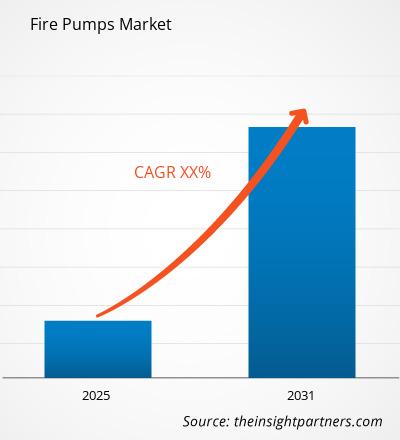
The Fire pumps market size stood at US$ 570.53 Million in 2025, while it will reach US$ 941.12 Million by 2034. The compound annual growth rate of the market will be 5.72% between 2026 and 2034. The drivers are based on code-compliant water-based fire protection in commercial structures, industrial facilities, logistics assets, utilities, and high rise buildings where the availability of reliable pressure delivery is essential for the proper functioning of sprinklers, standpipes, hydrants, and emergency systems.
In North America, the fire pumps market is influenced by old building inventory, insurance-led retrofits, and compliance with the installation methods for pumps as per 2025 NFPA 20 standards. The regional market is forecasted to experience a CAGR of 4.9-5.4% between 2026 and 2034, with data centers, warehouses, healthcare complexes, and petrochemical plants investing more in replacements and retrofits due to risk management and testing requirements.
Fire Pumps Market Assessment and Insights
- North America accounted for 25–28% Fire pumps market share in 2025 and is projected to grow at a CAGR of 4.9–5.4% during 2026–2034, supported by commercial retrofits, data center construction, and stricter pump testing expectations.
- US represented 78–82% of North America in 2025 and is expected to grow at a CAGR of 4.8–5.3% during 2026–2034, driven by warehouses, healthcare, and industrial upgrades.
- Europe held 20–23% share in 2025 and is forecast to expand at a CAGR of 4.6–5.1% during 2026–2034, led by Germany, the UK, France, Italy, and Spain.
- Asia Pacific captured 38–42% share in 2025 and is expected to grow at a CAGR of 6.1–6.7% during 2026–2034, led by China, India, Japan, South Korea, and Australia.
- Largest Segment Diesel Powered held 51–55% market share in 2025 and is projected to grow at a CAGR of 4.9–5.4% during 2026–2034, reflecting backup reliability needs.
- High Growth Segment In-Line Fire Pump held 13–16% market share in 2025 and is expected to grow at a CAGR of 6.3–6.9% during 2026–2034, helped by space-efficient building designs.
- Key companies analyzed in detail: Armstrong Fluid Technology, Ebara Corporation, Flowserve Corporation, Grundfos Holding A/S, KSB SE & Co. KGaA, NAFFCO FZCO, Ruhrpumpen Group, Pentair plc, Xylem Inc., Patterson Pump Company.
Source: The Insight Partners' analysis based on proprietary research, government publications, company annual reports, investor presentations, industry databases, and expert interviews.
System designs in fire pumps have evolved from simple pressure pumping to comprehensive pump packages with controls, variable speed control logic, monitoring features, and validated testing procedures. Manufacturers are gearing their production processes towards assemblies certified for use, reduced lead times, and modular skid packages that mitigate installation risks. Electric-powered fire pumps are growing in buildings with robust power supply systems, while diesel packages are crucial in places where the stability of power utilities, outdoor conditions, and critical continuity of operations guide specifications.
Future growth in the industry will be driven by industrial estates, airport upgrades, fuel depots, logistics complexes, and skyscrapers in emerging markets. Factors contributing to future growth will be new installation regulations, insurers' evaluation, and mandatory periodic testing that will necessitate the replacement of outdated fire pumps. Investments in public infrastructure and in data centers, hospitals, and manufacturing will further increase the Fire Pumps market size.
Fire Pumps Market Report Scope
| Report Attribute | Details |
|---|---|
| Market size in 2025 | US$ 570.53 Million |
| Market Size by 2034 | US$ 941.12 Million |
| Global CAGR (2026 - 2034) | 5.72% |
| Historical Data | 2021-2024 |
| Forecast period | 2026-2034 |
Fire Pumps Market Analysis
The prospects of development of fire pumps are affected by construction safety regulations, insurance companies' requirements and the growth of valuable assets which cannot withstand fires. The demand is most evident in locations where municipal pressure in water pipes is insufficient or where buildings' height, risk category or stocking density makes installation of fire pumps necessary. The trend in commercial campuses, factories, fuel storages and warehouses is now to install pumps at an early stage of the project.
Value Chain of fire pumps consists of manufacturers of pumps, suppliers of engines and motors, controllers, skids, engineering firms, contractors, jurisdictions and service organizations. The supply situation continues to be dependent on castings, engines, electrical panels and certification cycles. Buyers take into account such factors as installed price, technical specifications, service availability and the presence of certified replacement parts.
The fire pumps market analysis suggests that the certification and engineering sector has a moderate degree of consolidation among competitors, with international companies competing with local manufacturers on their ability to offer wider coverage, quick deliveries, and life-cycle services. The companies like Armstrong Fluid Technology, Ebara Corporation, Flowserve Corporation, Grundfos Holding A/S, KSB SE & Co. KGaA, NAFFCO FZCO, Ruhrpumpen Group, Pentair plc, Xylem Inc., and Patterson Pump Company leverage their portfolio and distribution channels in order to protect their specification positions.
The trend of investment is being oriented towards online selection solutions, systems solutions, slim design in line with small dimensions, low emission diesel engines, and remote inspection. Companies that are strategically positioned should be capable of demonstrating the compliance with NFPA 20 and other equivalent regional standards while ensuring simple commissioning process for the contractor.
● REPORT CUSTOMIZATION
Tailor This Report To Align With Your Specific Business Requirements
This report can be customized to align precisely with your business objectives, scope, and target markets. Customization options include tailored segmentation, geography, competitive analysis, and strategic insights to support informed decision-making.
Customize This Report →WHAT YOU CAN ADJUST
- ● Segmentations
- ● Geography
- ● Competitive Analysis
- ● Language Preferences
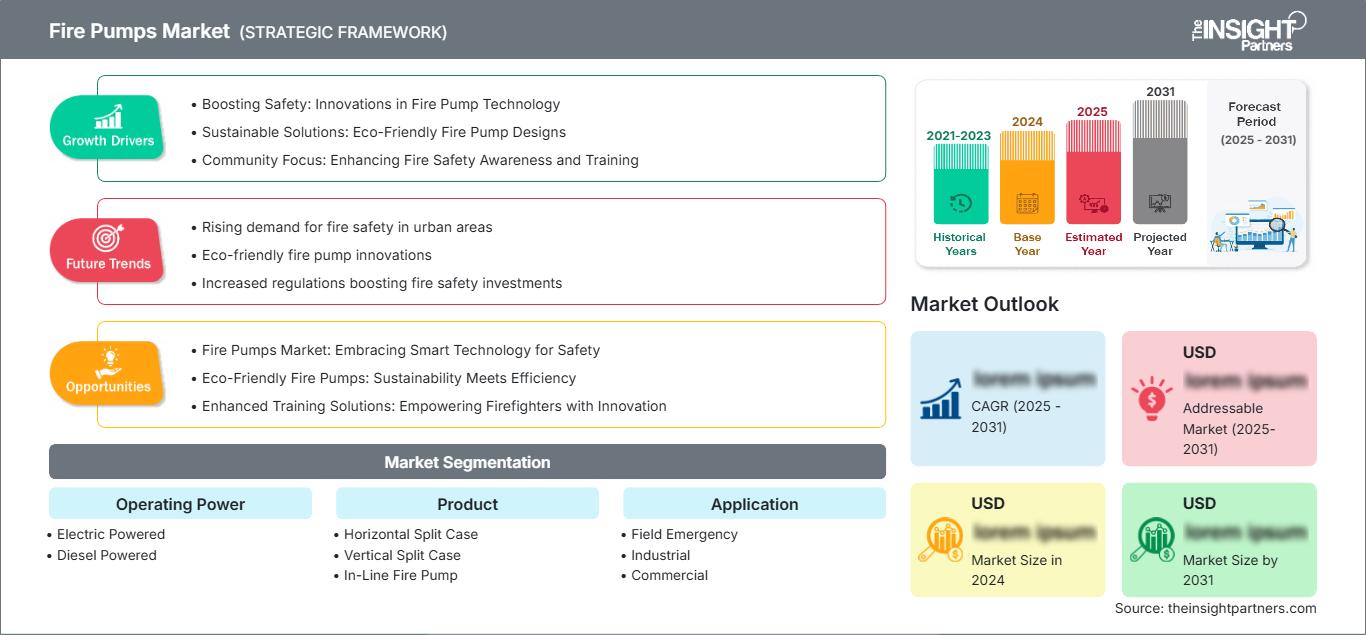
Fire Pumps Market: Strategic Insights
Regional Insights
North America fire pumps market
North America accounted for 25-28% of 2025 revenues in the Fire Pumps market and is projected to record a 4.9-5.4% CAGR between 2026 and 2034. The regional market shares for fire pumps in North America reflect maturity in the installed base, retrofit opportunities, and an active pipeline of projects, including data centers, hospitals, cold storage facilities, and logistics centers that require proper fire pump solutions.
The 2025 edition of NFPA 20 highlights the need for selection, installation, testing, and reliability of fire pumps in a building and will support replacement demand in code-compliant projects. In addition to the US, Canada and Mexico bring additional opportunities through development of industrial parks and manufacturing sector growth.
U.S. Fire Pumps Market
United States holds 78-82% Fire Pumps market share of North America in 2025 and is forecasted to grow with 4.8-5.3% CAGR from 2026 to 2034. Driving factors include tall-building renovations, health care code requirements, warehouse e-commerce fulfillment centers, semiconductor cleanrooms, battery fabrication facilities, and city pressure constraints that require self-contained fire-water pumps.
Armstrong Fluid Technology, Xylem Inc., Pentair plc, Patterson Pump Company, along with other manufacturers have strong channel coverage via fire protection contracting firms and engineering specifications. Commercial sector continues to dominate the market with increased demands for diesel backup generators, approved controller, remote testing ability, and package documentation from industrial sites.
Europe Fire Pumps Market
Europe accounts for 20-23% market share in 2025 and will grow at 4.6-5.1% CAGR during the period of 2026 to 2034, where Germany drives its demand. The UK is highly retrofit-oriented driven by the need for building safety inspection, insurance, and mixed development requiring higher sprinkler and pump capacity.
Germany will be supported by automation of industry and manufacturing of chemicals and logistics facilities, where there is a high demand for engineered pumps from European manufacturers. France, Italy, and Spain will drive demand from construction of transportation networks, hotels, warehouses, and energy plants. European purchasers have high focus on efficiency, certification, noise and serviceability of products.
APAC Fire Pumps Market
APAC held 38%-42% share in 2025 and is estimated to witness 6.1%-6.7% CAGR between 2026 and 2034, emerging as the dominant regional market. China will continue to be the dominant country-level market, whereas India, Japan, South Korea, and Australia contribute to the growth through manufacturing activities, metro systems, airports, and commercial complexes.
Regulations related to construction safety, industrial hazard controls, and resilient infrastructure facilitate the adoption of generator sets. Industrial zones, electronics production, and warehouse management are contributing to the growth of vertical turbine generators and diesel generator sets owing to variations in water availability and power supply.
Middle East & Africa Fire Pumps Market
Middle East & Africa is expected to advance at a 5.5–6.1% CAGR during 2026–2034, led by Saudi Arabia and the UAE. Energy projects, district infrastructure, airports, hotels, and high-rise developments require certified fire water pumping systems suited to harsh ambient conditions and large building footprints.
South Africa and the rest of MEA add demand through mining, utilities, manufacturing estates, and commercial redevelopment. Buyers in the region prioritize diesel redundancy, corrosion-resistant materials, packaged pump houses, and supplier support for commissioning, testing, and maintenance in remote or high-temperature operating environments.
Segmentation Analysis
Operating Power
Operating Power is projected to grow at a 5.3–5.9% CAGR from 2026 to 2034. The fire pumps market scope across operating power is shaped by utility reliability, emissions rules, emergency continuity, and building risk classification. Electric systems are preferred where grid resilience and generator integration are strong, while diesel packages remain central to industrial, remote, and high-hazard locations requiring independent operation.
- Electric Powered pumps are selected for commercial buildings, hospitals, and data centers where reliable electrical infrastructure, lower local emissions, and integration with controllers support predictable testing and maintenance routines.
- Diesel Powered pumps retain strategic importance in industrial plants, fuel terminals, remote facilities, and locations where emergency fire protection must remain available during grid outages or unstable utility conditions.
Product
Product is expected to grow at a 5.5–6.1% CAGR from 2026 to 2034. Product choice depends on flow rate, suction conditions, footprint, maintenance access, and water source. Horizontal split case units remain common for large commercial and industrial duties, while in-line and end suction pumps address compact installations. Vertical turbine units serve below-grade tanks, reservoirs, and special intake conditions.
- Horizontal Split Case pumps hold a strong position in high-flow applications because they provide serviceable construction, proven hydraulic performance, and acceptance among engineers for warehouses, campuses, and industrial facilities.
- Vertical Split Case pumps are used where layout constraints and pipe orientation favor vertical arrangements, offering reliable performance for buildings needing substantial capacity without the same horizontal equipment footprint.
- In-Line Fire Pump units support compact mechanical rooms and retrofit projects, reducing piping complexity while helping contractors meet pressure requirements in commercial buildings with constrained floor area.
- Vertical Turbine pumps are strategically important where water is drawn from wells, reservoirs, or underground tanks, making them suitable for infrastructure, utilities, airports, and industrial facilities.
- End Suction pumps serve smaller commercial and light industrial installations where moderate flow requirements, simpler maintenance, and cost control are important purchasing considerations.
Application
Application is forecast to grow at a 5.6–6.2% CAGR from 2026 to 2034. Demand varies by hazard profile, occupancy, inspection frequency, and project economics. Commercial buildings deliver consistent volume through new construction and retrofits, industrial facilities require robust redundancy and high-capacity systems, and field emergency uses emphasize mobility, rapid deployment, and reliable water delivery under unpredictable conditions.
- Field Emergency applications rely on portable or rapidly deployable pumping solutions for temporary protection, disaster response, municipal support, and sites where fixed infrastructure is unavailable or insufficient.
- Industrial applications require durable pumps for refineries, power plants, chemical facilities, manufacturing lines, and storage terminals where asset density and hazardous processes increase protection requirements.
- Commercial applications dominate procurement through offices, hospitals, hotels, shopping centers, warehouses, and mixed-use towers where compliance, insurance acceptance, and occupant safety drive specification.
Opportunity Snapshot
| Application | Revenue Contribution | Trend Tag | Adoption Stage |
| Field Emergency | Low | Rapid Response | Emerging |
| Industrial | Medium | Risk Control | Scaling |
| Commercial | High | Code Retrofit | Mature |
Fire Pumps Market Growth Drivers and Impact Analysis
Code Enforcement and Insurance-Led Retrofitting
Old pumps are being replaced by building owners because issues with pressure, redundancy, and acceptance may be revealed by inspections, changes in occupancy, and insurance company reviews. The framework of NFPA 20 by 2025 will focus more on installation, testing, controls, and readiness, which means that fire protection contractors will advise on installing new pumps instead of fixing old ones for an indefinite period of time. This influence on the market will be the most evident in the fields of hospitals, schools, hotels, warehouses, and high-rises.
With increased scrutiny from regulatory agencies, facility managers are increasingly focusing on preventive upgrading to ensure their fire protection systems are operational, reliable, and well documented. The difficulty in finding spare parts, high maintenance costs, and the need to prove compliance make aging equipment a major problem that pushes owners to upgrade to a new system with better monitoring abilities. Digital controls, remote diagnostics, and automatic testing systems have become more important since they make inspections easier and provide information about system operations continuously. Insurance companies are also pushing for upgrades through the promotion of reduced risks and better emergency preparations.
Expansion of High-Value Industrial and Logistics Assets
The need for high-capacity pumps arises in cases where large warehouses, industrial plants, fuel depots, and energy centers result in a high fire load. The needs of the industrial market include redundancy in diesel, vertical turbine intake arrangements, and pump room assemblies since assets have to be safeguarded at all times because they work on a 24/7 basis. This type of market is very specific to the value of orders, which include design services and maintenance agreements.
With the expansion of the infrastructure for industrial facilities, e-commerce logistics, and large scale manufacturing units, there is a growing need for sophisticated fire protection solutions which can operate in such complex systems. Such industrial units are equipped with expensive materials and machinery whose malfunction, due to fire hazards, can cause heavy financial losses to the organization. Therefore, there is an increasing need for quality pumping systems which offer a consistent supply of water in emergencies and adhere to safety standards. System integration, performance testing, and lifetime service packages have become significant factors in purchase decisions. Suppliers with expertise in industrial fire pump solutions can take advantage of the current situation, as clients are seeking package deals.
Urban Construction and Pressure Reliability Constraints
Urban density will increase the dependency on pumps as the municipal pressure alone may not be sufficient to support the sprinkler and standpipe system in buildings. Mixed use towers, hospitals, transportation hubs, and retail developments require steady water flow when there is an emergency situation, while renovation projects have limited space available for mechanical rooms. These will lead to preference towards compact in-line pumps, pre-engineered skids and controls that make the testing process simple. For the business effect, this will create more opportunities and also ensure more specification-driven purchases early in the building design phase.
Developers and engineering consultants are incorporating dedicated pumping solutions earlier in the planning process to ensure adequate hydraulic performance and compliance with safety standards. Space limitations in urban buildings are also encouraging demand for compact equipment configurations that provide high performance while reducing installation challenges. Advanced control systems, remote monitoring capabilities, and modular pump packages are gaining attention because they improve operational reliability and simplify maintenance activities. These factors are driving greater collaboration between architects, consultants, contractors, and equipment suppliers during project development. As urban construction expands globally, demand for efficient, reliable, and space-optimized fire pump systems is expected to grow across both new developments and modernization projects.
Fire Pumps Market Future Trends
Remote Testing and Connected Pump Rooms
One of the most important fire pumps market trends is the shift toward connected pump rooms that record test events, controller status, alarms, and maintenance needs. Remote monitoring will not replace physical inspection, but it can improve readiness by showing whether pumps start, transfer power, and maintain pressure during scheduled tests. Facilities with multiple properties can use digital records to prioritize service calls, reduce missed inspections, and support insurer documentation. Suppliers that combine hardware with secure reporting tools will gain stronger aftermarket positions.
Compact Certified Packages for Space-Constrained Buildings
Future designs will increasingly favor compact, certified pump packages that reduce mechanical room complexity without compromising code acceptance. Urban retrofits, hospitals, hotels, and mixed-use towers need equipment that fits tight layouts, minimizes piping changes, and supports faster commissioning. In-line pumps, integrated controllers, and prefabricated assemblies will become more attractive where labor availability and construction schedules are constrained. This trend will reward manufacturers that provide application engineering, approval documentation, and contractor-ready packages for both new builds and modernization projects.
Fire Pumps Market Opportunities
Data Centers and Mission-Critical Campuses
Data centers, semiconductor fabs, and mission-critical campuses offer attractive fire pumps market Forecasts because owners invest in redundant infrastructure, documented testing, and rapid service response to protect uptime. Fire pump suppliers can target these projects with packaged electric and diesel arrangements, remote status visibility, spare parts planning, and service agreements tied to commissioning records. The opportunity is not limited to new construction; existing sites are adding capacity, modifying hazard layouts, and upgrading controllers as power density and cooling infrastructure expand.
Industrial Retrofits in Emerging Manufacturing Corridors
Emerging manufacturing corridors in India, Southeast Asia, the Middle East, and Mexico create investment opportunities for suppliers with local assembly, distributor training, and code advisory capabilities. Many facilities require upgrades as production processes change, storage density rises, or insurers demand documented fire water reliability. Vendors can capture value by offering surveys, pump sizing, certified packages, controller replacement, and maintenance contracts. Partnerships with engineering consultants and fire protection contractors will be critical to convert retrofit needs into specification-led orders.
Recent Developments
- April 2026: Hale Products has unveiled the next generation of its QMAX fire pump platform, introducing the new QMAX-APX Fire Pump designed to support modern fire apparatus engineering, evolving emissions requirements, and connected firefighting technologies. The new pump builds on the established QMAX platform while adding a more modular and future-ready architecture for original equipment manufacturers (OEMs) and fire service operators.
- July 2025: Armstrong Fluid Technology — launched the 5x4x10PF Vertical-In-Line fire pump model in the United States, extending its Design Envelope fire pump offering to 750 gpm and supporting space-efficient installations with lifecycle tracking technology.
- February 2025: Armstrong Fluid Technology — expanded its Constant Speed Vertical-In-Line Fire Pumps family with 500 USGPM capability and high-pressure ratings up to 160 PSI, targeting compact installations that reduce offset piping and motor realignment needs.
Frequently Asked Questions

- Comprehensive Market Sizing and Forecast Analysis
- Detailed Segmentation Analysis
- In-Depth Market Dynamics Assessment
- Regional and Country-Level Insights
- Competitive Landscape and Company Benchmarking
- Strategic Business Intelligence
Recent Reports
Testimonials

The Insight Partners provided valuable market intelligence that supported our global go-to-market strategy. Their team was professional, responsive, and attentive to our feedback, providing thoughtful analysis and helpful methodological clarifications throughout the project.
Junmo Kim Chief Financial Officer (CFO), Enertech Co., Ltd.
The Insight Partners' SCADA System Market report is comprehensive, with valuable insights on current trends and future forecasts. The team was highly professional, responsive, and supportive throughout. We are very satisfied and highly recommend their services.
RAN KEDEM Partner, Reali Technologies LTDs
I requested a report on a very specific software market and the team produced the report in a few days. The information was very relevant and well presented. I then requested some changes and additions to the report. The team was again very responsive and I got the final report in less than a week.
JEAN-HERVE JENN Chairman, Future Analytica
We worked with The Insight Partners for an important market study and forecast. They gave us clear insights into opportunities and risks, which helped shape our plans. Their research was easy to use and based on solid data. It helped us make smart, confident decisions. We highly recommend them.
PIYUSH NAGPAL Sr. Vice President, High Beam Global
The Insight Partners delivered insightful, well-structured market research with strong domain expertise. Their team was professional and responsive throughout. The user-friendly website made accessing industry reports seamless. We highly recommend them for reliable, high-quality research services
YUKIHIKO ADACHI CEO, Deep Blue, LLC.
This is the first time I have purchased a market report from The Insight Partners.While I was unsure at first, I visited their web site and felt more comfortable to take the risk and purchase a market report.I am completely satisfied with the quality of the report and customer service. I had several questions and comments with the initial report, but after a couple of dialogs over email with their analyst I believe I have a report that I can use as input to our strategic planning process.Thank you so much for taking the extra time and making this a positive experience.I will definitely recommend your service to others and you will be my first call when we need further market data.
JOHN SUZUKI President and Chief Executive Officer, Board Director, BK Technologies
I wish to appreciate your support and the professionalism you displayed in the course of attending to my request for information regarding to infectious disease IVD market in Nigeria. I appreciate your patience, your guidance, and the fact that you were willing to offer a discount, which eventually made it possible for us to close a deal. I look forward to engaging The Insight Partners in the future, all thanks to the impression you have created in me as a result of this first encounter.
DR CHIJIOKE ONYIA MANAGING DIRECTOR, PineCrest Healthcare Ltd.Reason to Buy
- Informed Decision-Making
- Understanding Market Dynamics
- Competitive Analysis
- Identifying Emerging Markets
- Customer Insights
- Market Forecasts
- Risk Mitigation
- Boosting Operational Efficiency
- Strategic Planning
- Investment Justification
- Tracking Industry Innovations
- Aligning with Regulatory Trends





 Get Free Sample for