
Foam glass Market Growth, Trends & Demand by 2034
Coverage: by Type (Open Cell, Closed Cell); Process (Physical Process, Chemical Process); Application (Building and Industrial Insulation, Chemical Processing System, Consumer Abrasive, Others); End-Use Industry (Building and Construction, Industrial, Others) , and Geography (North America, Europe, Asia Pacific, and South and Central America)
- Status : Data Released
- Report Code : TIPRE00005985
- Category : Chemicals and Materials
- No. of Pages : 150
- Available Report Formats :


- Last update date : November 12, 2026


2025 Market Size
US$ 2.51 Bn
Base year value
2034 Forecast
US$ 3.59 Bn
Projected by 2034
CAGR 2026-2034
4.06 %
Growth rate
Addressable Market
US$ 27.71 Bn
(2026-2034)
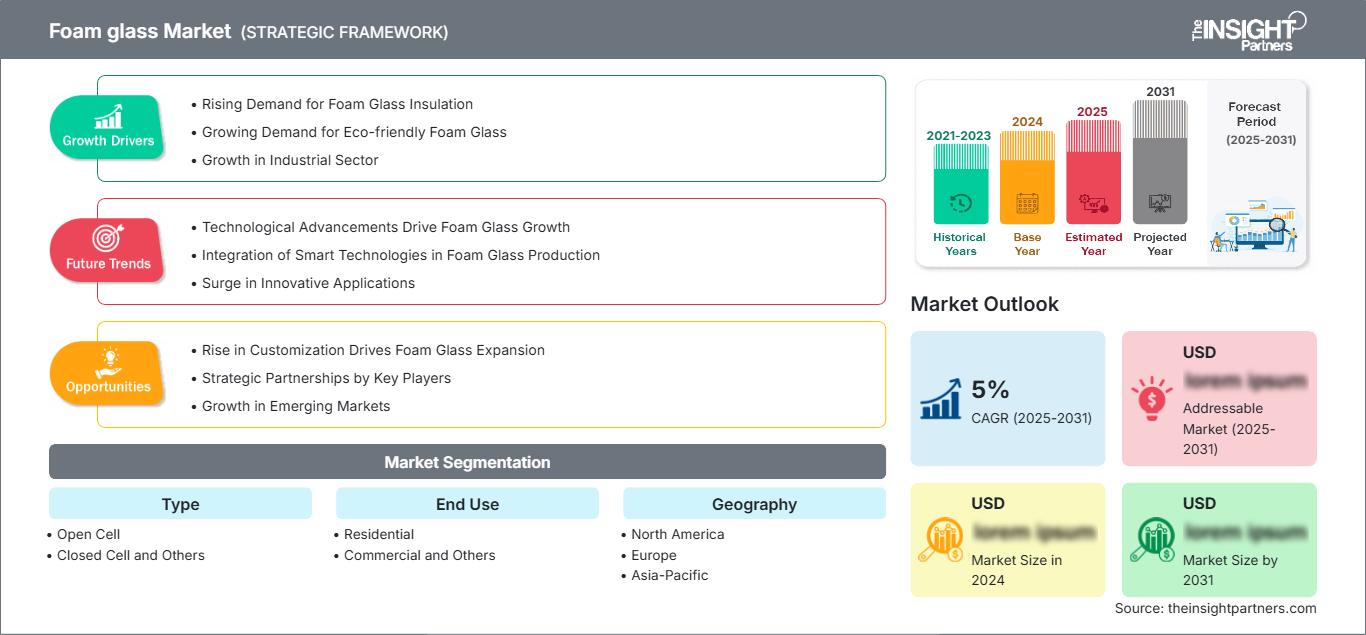
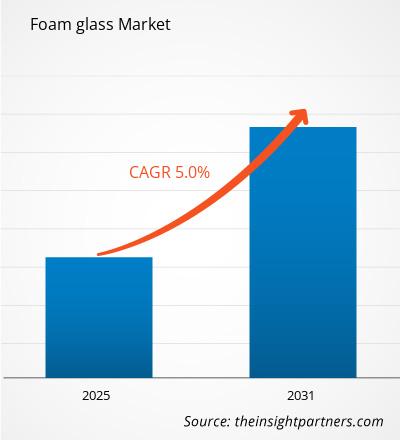
The foam glass market is valued at US$ 2.51 Billion in 2025 and is projected to reach US$ 3.59 Billion by 2034, reflecting a CAGR of 4.06% during 2026–2034. Demand is supported by the need for durable thermal insulation, non-combustible building materials, lightweight construction aggregates, and improved resource efficiency. The market benefits from foam glass's resistance to moisture, dimensional stability, compressive strength, and potential to incorporate recycled glass, although production energy requirements and material costs influence purchasing decisions.
The foam glass market size outlook for North America is shaped by commercial building renovation, industrial insulation requirements, and infrastructure projects seeking lightweight fill materials. The region is estimated to expand at a CAGR of ~4% through 2034, supported by demand for long-life insulation systems and construction materials that reduce maintenance exposure. Established building-product distribution networks and technical specification practices help suppliers reach commercial customers, while competition from mineral wool, cellular plastics, and other insulation materials continues to influence project economics and product selection.
Foam glass Market Assessment and Insights
Regional Outlook
- North America: ~29% of the global Foam Glass Market share in 2025 | ~4% CAGR through 2034. Market position: North America represents a mature demand base supported by building-envelope upgrades, industrial facilities, and infrastructure construction. Established procurement channels and technical performance requirements support adoption, while project costs moderate growth.
- US: ~78% of North American market revenue in 2025 | ~4% CAGR through 2034. Market position: The United States accounts for the largest national demand base within North America. Commercial construction, industrial insulation, and lightweight aggregate applications support purchasing, while specifications, contractor familiarity, and delivered material costs influence adoption.
- Europe: ~27% of the global market in 2025 | ~4% CAGR through 2034. Market position: Europe combines established cellular-glass insulation demand with infrastructure applications for foam glass aggregate. Germany, Finland, and Norway are important production and adoption markets, while energy-efficiency priorities and circular-material strategies support continued commercial relevance.
- Asia Pacific: ~35% of the global market in 2025 | ~6% CAGR through 2034. Market position: Asia Pacific is the largest modeled regional market and the fastest-growing region. Building activity, industrial investment, expanding insulation requirements, and opportunities to process waste glass support demand, particularly in China and India.
Segment Outlook
- Closed Cell: ~58% share in 2025 | ~5% CAGR through 2034. Market position: Closed-cell foam glass benefits from its sealed structure, moisture resistance, dimensional stability, and thermal insulation performance. These properties support use in demanding building-envelope and industrial applications where long service life is important.
- Commercial: ~38% share in 2025 | ~5% CAGR through 2034. Market position: Commercial applications benefit from the need for durable roof, wall, floor, and technical insulation systems. Large projects can justify higher initial material costs when performance, fire resistance, and maintenance considerations support whole-life value.
Competitive Coverage
Aero Aggregates, Earthstone International, Glapor Werk Mitterteich GmbH, Misapor AG, Owens Corning, Polydrons, Refaglass, Uusioaines Oy, Zhejiang Dehe Insulation Technology Co. Ltd., Zhejiang Zhenshen Insulation Technology Corp. Ltd.
Methodology
The Insight Partners follows Data Collection & Secondary Research, Primary Research, Data Analysis, and Data Triangulation & Final Review to validate market estimates and insights.
Source: The Insight Partners' analysis based on proprietary research, government publications, company annual reports, investor presentations, industry databases, and expert interviews.
Foam glass technology has developed into a materials market, from its origins as an insulation niche, for envelope, industrial insulation, and civil engineering applications. Production often consists of preparation of glass-based raw materials, addition of a foaming agent, processing through heat treatment, and cooling of the foamed cellular material. Material and process design affect density, cellular structure, compressive strength, and insulation performance of the product. In terms of product differentiation, the market can be divided into rigid insulation materials which compete in their performance characteristics and aggregate materials which compete in lightweight, drainage and civil engineering characteristics.
The forecast to 2034 is likely to be determined by the ability of manufacturers to successfully combine performance and competitiveness of their cost structures. New construction markets present opportunities to increase use of foam glass in energy efficient building and infrastructure projects, but this will require availability of the product, installer skills and proper engineering specifications. Improved production efficiency, feedstock recycling and logistics may provide commercial viability. Procurement processes which focus on building energy performance, fire safety, resource recovery and environmental impact may create demand, but the effects will differ among countries and applications.
Foam glass Market Report Scope
| Report Attribute | Details |
|---|---|
| Market size in 2025 | US$ 2.51 Billion |
| Market Size by 2034 | US$ 3.59 Billion |
| Global CAGR (2026 - 2034) | 4.06% |
| Historical Data | 2021-2024 |
| Forecast period | 2026-2034 |
Foam glass Market Analysis
The prospects for growth of the foam glass market arise from the need for insulation that delivers effective thermal insulating capabilities along with moisture resistance, non-combustible characteristics and mechanical stability. Building owners will be assessing the performance of an insulation system in terms of cost of installation, durability, fire rating, and implications of degradation due to exposure to moisture. Civil engineering clients will have other concerns such as weight, drainage, load distribution, and easy handling. This distinction in the needs of buyers opens up the possibilities of serving several different applications without relying on a single formulation of the product.
The supply chain starts with the gathering of glass and preparation of the feedstock, processing, foaming, cooling, sizing and quality control as well as transportation. The suppliers will need the feedstock chemistry and size to be consistent since variations can have an effect on the production yield and characteristics of the end-product. Energy will be important in production process whereas transportation costs can be material in aggregate terms since the products are sold on volume and transported to the construction sites.
The foam glass market is characterized by competition that is differentiated into categories of products rather than having a standardized product group. Owens Corning with its subsidiary FOAMGLAS specializes in cellular-glass insulation while companies such as Glapor Werk Mitterteich GmbH, Misapor AG and Aero Aggregates are engaged in niche products associated with insulation or lightweight aggregate applications. Uusioaines Oy contributes to the recycling and foam-glass supply chain in Europe. Other identified companies include those engaged in manufacturing, distribution or specialized products. Manufacturing capability, engineering, certification, feedstock supply and logistics are important factors for competitiveness.
Capacity utilization, energy efficiency, product mix and geographic footprint need to be considered in investment decisions today. Competitiveness of manufacturers may be enhanced through minimizing production losses, optimization of furnace operations and development of products for applications that have clear performance benefits. Collaboration with recyclers and construction materials distributors may enhance feedstock supply and market access. Assessments of capacity expansion need to consider pipeline of projects in the local area and reasonable freight distances rather than general forecasts of construction activity only. For buyers, cost comparison of products in terms of specification and installation costs is more helpful than raw material price comparisons.
● REPORT CUSTOMIZATION
Tailor This Report To Align With Your Specific Business Requirements
This report can be customized to align precisely with your business objectives, scope, and target markets. Customization options include tailored segmentation, geography, competitive analysis, and strategic insights to support informed decision-making.
Customize This Report →WHAT YOU CAN ADJUST
- ● Segmentations
- ● Geography
- ● Competitive Analysis
- ● Language Preferences
Foam glass Market: Strategic Insights
Regional Insights
North America Foam Glass Market
North America is estimated to account for ~29% of global revenue in 2025 and to grow at a CAGR of ~4% through 2034. Demand will be driven by commercial construction, industry facilities, and civil engineering projects where thermal insulating properties, moisture resistance, and dimensional stability over time have to be taken into consideration. The United States is the largest country-specific market for the product within the region, whereas Canada provides opportunities for the use of foam glass insulation for structures subject to difficult climatic conditions. The region's adoption of the product depends on specification requirements and availability of installation contractors.
Commercial demand within the region is highest when foam glass insulation meets some specific technical criteria, rather than being solely competitive on price. Non-combustibility of foam glass insulation may be valued by industrial facilities, and lightweight aggregates by construction projects. Nevertheless, procurement departments always benchmark foam glass against mineral-based insulation, traditional aggregates, and polymers. Manufacturers can increase conversion rates in the region by providing technical expertise in application, product performance, and supply reliability.
U.S. Foam Glass Market
The United States is estimated to represent ~78% of North American foam glass market revenue in 2025, with a modeled CAGR of ~4% through 2034. The commercial buildings, industrial buildings, and infrastructure construction represent separate demand channels. Buyers’ focus may vary based on specific performance, moisture resistance, insulation integrity, or light weight filling depending on use. The factors affecting the demand include building refurbishment, building envelope needs, and economics of upgrading versus rebuilding. Competitive access depends on prior supplier relations, technical data, specification, and distribution network coverage. Owens Corning company represents one of the major players via FOAMGLAS cellular glass insulation range. Specialized suppliers and aggregates manufacturers may become competitors based on their product advantages. The purchasing procedure usually includes architect, consultants, contractor and owner representation; hence, technical education plays crucial role. Even when performance of the product is favorable, there are obstacles related to higher prices, different installation procedures, and lower availability in comparison with traditional products.
Europe Foam Glass Market
Europe is estimated to account for ~27% of global foam glass market revenue in 2025 and to expand at a CAGR of ~4% through 2034. This combination includes existing insulation applications and the need for recycling-based construction materials and lightweight aggregates. Germany represents a promising market for specialist building materials and civil engineering supplies, while Finland and Norway already have their foam-glass production industry well-developed. The environmental characteristics, such as sustainability, durability, fire performance, and energy efficiency, become important in the procurement process in Europe, but they do not ensure that foam glass becomes a least expensive choice.
The German market will receive additional support from the manufacturing capabilities of building materials, infrastructure needs, and possibilities to use recycled glass in building products. In the United Kingdom and France, there will be the demand related to the renovation of commercial buildings and energy-saving construction. Italy and Spain represent regions where there will be the need to work with buildings' renovation, commercial facilities, and infrastructure.
European producers are making moves to build their production capabilities, energy efficiency, and market access. Owens Corning is increasing its capacity at its Klášterec plant in the Czech Republic for 2025, while the Foamit Group has been developing its capacity in the Nordic region and intends to grow its presence in Central Europe. This shows that supply location and logistics are strategic factors. Germany is pointed out here as one of the key European demand and expansion markets, but an accurate revenue ranking by country would need the same sales data.
APAC Foam Glass Market
Asia Pacific is estimated to represent ~35% of global foam glass market revenue in 2025 and to record a CAGR of ~6% through 2034, making it the fastest-growing region in this model. China is the leading country in Asia Pacific by its broad manufacturing and construction base, while India offers additional potential through urban development, commercial buildings, and infrastructure investment. Japan and South Korea contribute through technically demanding industrial and building applications, while Australia provides opportunities in construction and civil engineering.
Growth in the regional foam glass market is predicated on industrial investment, energy-efficient building practices, recycling facilities, and access to products that are made locally. There is already an established eco-system of glass processing in China, and India’s growing built environment could lead to potential demand for insulation and lightweight materials. Japan and South Korea are suitable for specialized applications if there is a clear technological advantage over existing materials that warrants their higher cost. Australia may provide possibilities in the field of lightweight fill and insulation.
Middle East & Africa Foam Glass Market
The Middle East and Africa foam glass market is modeled to expand at a CAGR of ~5% through 2034. Demand opportunities are linked to commercial construction, industrial facilities, infrastructure investment, and the need for durable materials under challenging environmental conditions. Saudi Arabia and the United Arab Emirates are important potential markets because of their construction pipelines and investment in large facilities. South Africa offers opportunities in commercial and industrial construction, while the rest of the region presents a more fragmented outlook.
Heat exposure, moisture management, fire safety, and energy consumption can influence insulation selection across the region. Foam glass may be appropriate for applications requiring a combination of thermal stability, moisture resistance, and durability, but its economics depend on sourcing and transportation. Saudi Arabia is a significant prospective market in the Middle East because of its large-scale development activity, although a reliable regional country-share ranking cannot be established without comparable sales evidence. Local distribution, specification practices, and project-level cost analysis will determine the pace of adoption.
Segmentation Analysis
Type
Type segment in the foam glass market is an important dimension of the foam glass market scope because cellular structure influences moisture behavior, thermal performance, compressive properties, and suitability for different applications. Buyers select products according to engineering requirements, installation conditions, and lifecycle costs rather than insulation performance alone. Product consistency and manufacturing control remain essential to ensuring that the finished material meets the intended specification. The closed-cell subsegment is modeled to record a CAGR of ~5% during 2026–2034, supported by demand for durable insulation systems and moisture-resistant construction materials.
- Open Cell: Open-cell foam glass has a more interconnected pore structure than fully sealed products, influencing its physical properties and suitability for specialized applications. Its commercial relevance depends on application-specific performance, manufacturing consistency, and whether its characteristics match engineering requirements.
- Closed Cell: Closed-cell foam glass contains sealed cellular structures that support moisture resistance, thermal insulation, and mechanical stability. It is relevant where long service life and resistance to water ingress are important purchasing criteria.
- Others: Other product types cover formulations and structures that do not fit neatly into the principal categories. Their market relevance depends on specialized performance requirements, product availability, and the ability to demonstrate consistent properties for intended applications.
End Use
End use determines how foam glass is specified, purchased, installed, and evaluated over its service life. Buyers assess thermal requirements, fire safety, moisture exposure, load-bearing conditions, and installation complexity according to the building or facility involved. The category therefore reflects different procurement processes and technical expectations, with demand influenced by construction activity and the replacement or refurbishment of existing assets. The commercial subsegment is modeled to expand at a CAGR of ~5% during 2026–2034, reflecting opportunities in building-envelope systems and technical insulation.
- Residential: Residential applications include insulation solutions for building envelopes and other components where thermal comfort, durability, and moisture control matter. Adoption depends on construction budgets, local building practices, installer familiarity, and the availability of products that meet relevant performance requirements.
- Commercial: Commercial projects can prioritize roof and wall insulation, fire performance, dimensional stability, and long-term maintenance considerations. Larger project specifications may support adoption when technical performance and lifecycle economics justify the material's initial cost.
- Others: Other end uses include specialized industrial, infrastructure, and engineering applications that fall outside the principal residential and commercial categories. Adoption is project-specific and depends on demonstrated technical suitability, procurement requirements, and delivered cost.
Opportunity Snapshot
| End Use | Revenue Contribution | Trend Tag | Adoption Stage |
| Residential | Medium | Envelope insulation | Scaling |
| Commercial | High | Durable roofing | Mature |
| Others | Medium | Lightweight fill | Scaling |
Foam glass Market Growth Drivers and Impact Analysis
Demand for Durable and Moisture-Resistant Insulation
Building owners and industrial operators increasingly assess insulation as part of a long-term asset-performance decision. Moisture ingress can compromise conventional insulation systems, increase maintenance requirements, and affect surrounding building components. Closed-cell foam glass offers a combination of low water permeability, dimensional stability, and non-combustibility that can be valuable in demanding applications. The market impact is strongest in projects where these properties address a defined technical risk rather than merely providing incremental thermal performance. Architects, engineers, and contractors influence demand through material specifications, while owners evaluate initial cost against anticipated service life. Adoption remains selective because alternative materials can offer lower purchase prices or easier installation. Suppliers that provide clear technical documentation, system compatibility guidance, and reliable installation support are better positioned to translate performance advantages into project approvals.
Infrastructure Demand for Lightweight Construction Materials
Civil engineering projects require materials that satisfy structural, drainage, settlement, and construction-efficiency requirements. Foam glass aggregate can provide lightweight fill in selected road, railway, landscaping, and ground-engineering applications, potentially reducing loads on underlying soils and supporting drainage objectives. These characteristics can be relevant where conventional fill would create greater structural loading or require additional ground treatment. Project engineers assess aggregate properties, placement methods, availability, and delivered cost before specifying a material. The resulting market opportunity is therefore tied to engineering suitability and the scale of applicable projects rather than infrastructure expenditure in general. Suppliers can improve commercial adoption by providing design assistance, consistent grading, and evidence from completed installations. Transport costs and local production capacity remain critical because bulk aggregate economics are particularly sensitive to distance and handling.
Recycled Feedstock and Resource-Efficiency Priorities
Foam glass manufacturing can incorporate recycled glass, creating a route for converting suitable glass waste into construction materials. This can support circular-material objectives where collection systems, feedstock quality, and manufacturing processes are compatible. The market impact depends on whether recovered glass can be processed consistently without undermining product quality or increasing costs excessively. Manufacturers must manage contamination, particle preparation, energy consumption, and product testing to maintain reliable output. Environmental attributes can influence procurement where buyers require documented material sourcing or lifecycle information, but recycled content alone does not establish lower total environmental impact. Producers need credible documentation and efficient operations to demonstrate the value of their products. Stronger coordination between recyclers, manufacturers, and construction distributors can help stabilize feedstock supply and improve the commercial viability of regional production.
Foam glass Market Future Trends
Greater Integration of Product-Level Environmental Data
Foam glass market trends are likely to include more systematic use of environmental product declarations, traceable recycled-content data, and lifecycle assessments in material selection. As project owners compare building products on environmental performance as well as cost and technical specifications, manufacturers may need more consistent documentation of production energy, feedstock composition, transportation, durability, and end-of-life options. This creates an opportunity for suppliers to differentiate products through transparent evidence rather than broad sustainability claims. Environmental data will be most useful when it is comparable across materials and reflects the specific application and building system. Companies that invest in reliable data collection and third-party verification may improve their access to projects with formal sustainability requirements. However, documentation costs and differences in assessment methodology could create challenges for smaller producers.
Manufacturing Optimization and Application-Specific Product Design
Future product development is likely to focus on improving process control and tailoring foam glass properties to defined engineering needs. Manufacturers can pursue more efficient furnace operation, consistent cellular structure, optimized product grading, and formats that reduce waste during installation. Better control over density and mechanical properties may help suppliers serve applications with distinct requirements without compromising reliability. Product development can also address handling, packaging, and compatibility with other construction components. The commercial benefit will depend on measurable improvements in yield, energy use, installation productivity, or performance rather than novelty alone. Suppliers that coordinate manufacturing development with engineering consultants and end users may identify more commercially viable product specifications. Capital requirements, energy prices, and technical validation remain important constraints on the pace of change.
Foam glass Market Opportunities
Expand Regional Production and Feedstock Partnerships
A commercial opportunity exists in regions where construction demand is growing but the delivered cost of foam glass is constrained by limited local supply. Investors and manufacturers can assess regional production or conversion capacity alongside partnerships with glass recyclers, waste processors, and construction-material distributors. A viable business case should account for feedstock availability, contamination rates, energy prices, equipment utilization, transport distances, and the size of the addressable project pipeline. Local production is not automatically economical, particularly where demand is fragmented or product qualification takes time. Partnerships can reduce sourcing risk and improve access to customers, while phased capacity additions can limit exposure to uncertain utilization. The strongest opportunities are likely to be those supported by recurring projects, established engineering specifications, and realistic logistics economics.
Develop Specialized Solutions for High-Requirement Applications
Foam glass market Forecasts point to opportunities for manufacturers that can connect product performance with narrowly defined customer problems. Commercial roofs, moisture-sensitive building assemblies, industrial insulation, and lightweight civil engineering fill offer different value propositions and require distinct technical support. Companies can prioritize applications where non-combustibility, moisture resistance, durability, or low weight materially influence project design. This strategy may involve developing application-specific formats, providing engineering calculations, building installer relationships, and assembling verified case studies. Investment decisions should be based on the cost of qualification, the size of the reachable customer base, and the probability of repeat orders. Collaborations with architects, contractors, and engineering firms can strengthen specification access. Manufacturers should avoid treating all potential applications as interchangeable because product requirements and competitive alternatives differ substantially.
Recent Developments
- October 10, 2025: Foamit Corporation announced a letter of intent with Reiling GmbH & Co. KG to pursue a joint venture involving Veriso GmbH & Co. KG, which manufactures foam glass at two facilities in Germany. The proposed project included plans for additional production capacity and a new factory, with an initial investment of approximately €3 million contemplated for a majority stake. The announcement identified Germany as a potential platform for expansion into Central Europe.
- June 30, 2025: Owens Corning announced a significant investment in its FOAMGLAS® insulation plant located in Klášterec, Czech Republic. This strategic initiative aims to increase production capacity by 50% and further reduce carbon intensity, reinforcing Owens Corning's commitment to sustainability and innovation in the building products markets.
Frequently Asked Questions

- Comprehensive Market Sizing and Forecast Analysis
- Detailed Segmentation Analysis
- In-Depth Market Dynamics Assessment
- Regional and Country-Level Insights
- Competitive Landscape and Company Benchmarking
- Strategic Business Intelligence
Recent Reports
Testimonials

The Insight Partners provided valuable market intelligence that supported our global go-to-market strategy. Their team was professional, responsive, and attentive to our feedback, providing thoughtful analysis and helpful methodological clarifications throughout the project.
Junmo Kim Chief Financial Officer (CFO), Enertech Co., Ltd.
The Insight Partners' SCADA System Market report is comprehensive, with valuable insights on current trends and future forecasts. The team was highly professional, responsive, and supportive throughout. We are very satisfied and highly recommend their services.
RAN KEDEM Partner, Reali Technologies LTDs
I requested a report on a very specific software market and the team produced the report in a few days. The information was very relevant and well presented. I then requested some changes and additions to the report. The team was again very responsive and I got the final report in less than a week.
JEAN-HERVE JENN Chairman, Future Analytica
We worked with The Insight Partners for an important market study and forecast. They gave us clear insights into opportunities and risks, which helped shape our plans. Their research was easy to use and based on solid data. It helped us make smart, confident decisions. We highly recommend them.
PIYUSH NAGPAL Sr. Vice President, High Beam Global
The Insight Partners delivered insightful, well-structured market research with strong domain expertise. Their team was professional and responsive throughout. The user-friendly website made accessing industry reports seamless. We highly recommend them for reliable, high-quality research services
YUKIHIKO ADACHI CEO, Deep Blue, LLC.
This is the first time I have purchased a market report from The Insight Partners.While I was unsure at first, I visited their web site and felt more comfortable to take the risk and purchase a market report.I am completely satisfied with the quality of the report and customer service. I had several questions and comments with the initial report, but after a couple of dialogs over email with their analyst I believe I have a report that I can use as input to our strategic planning process.Thank you so much for taking the extra time and making this a positive experience.I will definitely recommend your service to others and you will be my first call when we need further market data.
JOHN SUZUKI President and Chief Executive Officer, Board Director, BK Technologies
I wish to appreciate your support and the professionalism you displayed in the course of attending to my request for information regarding to infectious disease IVD market in Nigeria. I appreciate your patience, your guidance, and the fact that you were willing to offer a discount, which eventually made it possible for us to close a deal. I look forward to engaging The Insight Partners in the future, all thanks to the impression you have created in me as a result of this first encounter.
DR CHIJIOKE ONYIA MANAGING DIRECTOR, PineCrest Healthcare Ltd.Reason to Buy
- Informed Decision-Making
- Understanding Market Dynamics
- Competitive Analysis
- Identifying Emerging Markets
- Customer Insights
- Market Forecasts
- Risk Mitigation
- Boosting Operational Efficiency
- Strategic Planning
- Investment Justification
- Tracking Industry Innovations
- Aligning with Regulatory Trends





 Get Free Sample for