
Force Sensor Market Trends, Size & Forecast by 2034
Coverage: by Force Type (Compression, Tension, Compression and Tension); Type (Piezoelectric Force Sensor, Capacitive Force Sensor, Magnetic Force Sensor, Load Cell, Strain Gauge, Others); Industry Vertical (Aerospace and Defense, Automotive, Chemicals, Manufacturing, Mining, Pharmaceuticals, Others) , and Geography (North America, Europe, Asia Pacific, and South and Central America)
- Status : Data Released
- Report Code : TIPRE00007641
- Category : Electronics and Semiconductor
- No. of Pages : 150
- Available Report Formats :


- Last update date : August 17, 2026


2025 Market Size
US$ 2.52 Bn
Base year value
2034 Forecast
US$ 7.06 Bn
Projected by 2034
CAGR 2026-2034
12.13 %
Growth rate
Addressable Market
US$ 41.98 Bn
(2026-2034)
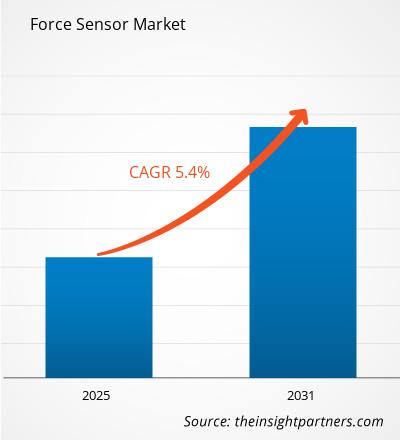
The Force Sensor Market was valued at US$ 2.52 Billion in 2025 and is projected to reach US$ 7.06 Billion by 2034, registering a compound annual growth rate (CAGR) of 12.13% during the forecast period from 2026 to 2034. Force sensors are transducers that convert mechanical force inputs such as compression, tension, torque, and pressure into measurable electrical signals, enabling machines to perceive physical interactions across diverse applications including industrial automation, robotics, automotive systems, and medical devices.
The Force Sensor Market Size in North America is estimated to grow at a CAGR of 8.2% to 8.6% during the forecast period, driven by the increasing adoption of advanced manufacturing technologies and the expansion of aerospace and defense electronics production. The region's strong emphasis on automation upgrades and precision measurement capabilities support sustained demand for high-accuracy force sensing solutions.
Force Sensor Market Assessment and Insights
- North America: Accounts for approximately 27% to 31% of the global Force Sensor Market share in 2025, growing at a CAGR of 8.2%–8.6% from 2026 to 2034. The market is driven by aerospace, defense, medical technology, and automation upgrades across the region.
- US: Holds a dominant position within North America with a market share of 85%–90% in 2025, growing at a CAGR of 8.4%–8.8% during the forecast period, supported by substantial defense electronics production and advanced manufacturing capabilities.
- Europe: Accounts for 22%–26% of the global market share in 2025, growing at a CAGR of 7.8%–8.2% from 2026 to 2034. Leading countries include Germany, the UK, and France, with significant demand from automotive, machinery, and robotics sectors.
- Asia Pacific: Represents the largest regional market with a share of 35%–39% in 2025, growing at a robust CAGR of 9.8%–10.2% during 2026–2034. China, Japan, South Korea, and India are key contributors, driven by extensive electronics manufacturing, robotics adoption, and automotive production.
- Largest Segment: The Load Cell segment dominates the market with a share of 30%–34% in 2025, growing at a CAGR of 10.5%–10.9% during 2026–2034, owing to its widespread use in weighing systems, industrial automation, and material testing applications.
- High Growth Segment: The Strain Gauge segment exhibits the highest growth potential, with a CAGR of 11.0%–11.4% from 2026 to 2034, driven by its versatility, cost-effectiveness, and integration capabilities in force measurement applications.
- Key companies analyzed in detail: Flintec, Gefran, General Electric, Honeywell, Kistler, Sensata Technologies, Siemens, Spectris, TE Connectivity, Tekscan.
Source: The Insight Partners' analysis based on proprietary research, government publications, company annual reports, investor presentations, industry databases, and expert interviews.
The evolution of the Force Sensor Market signifies the dramatic transition from simple analog devices into smart and networked sensing systems capable of implementing functions of signal conditioning, temperature compensation, digital interface, as well as self-diagnosis. Production trends become more and more defined by flexible and thin film types of sensors, used in a range of applications including wearable electronics, bionics, human-machine interface, and collaborative robotics. Miniaturization technologies, combined with new materials for increased durability and accuracy, will help to minimize calibration and maintenance needs in manufacturing industry.
The market outlook points towards the fast growth of the market due to its geographic expansion within the emerging markets of Southeast Asian countries and Latin America, where the industrial automation and manufacturing facilities have been growing. Combination of force sensors with artificial intelligence technology creates new opportunities for prediction and anomaly detection systems. Occupational safety and product quality demands in industries like automotive, medical, and aerospace are positive factors for the future growth of the market. Standards like ISO 13849 and IEC 61508 demand reliable information about performance.
Force Sensor Market Report Scope
| Report Attribute | Details |
|---|---|
| Market size in 2025 | US$ 2.52 Billion |
| Market Size by 2034 | US$ 7.06 Billion |
| Global CAGR (2026 - 2034) | 12.13% |
| Historical Data | 2021-2024 |
| Forecast period | 2026-2034 |
Force Sensor Market Analysis
The market for Force Sensors is essentially dependent on the high demand witnessed from the various end-users sectors that include automotive, aerospace and defense, healthcare and industrial manufacturing. According to the International Federation of Robotics, the world installed base of industrial robots was estimated at more than half a million in 2023, whereas the International Energy Agency stated that the world had nearly 14 million electric cars sales in 2023, which have increased the demand for precise force sensors in robotic gripping, battery manufacturing, brakes and quality control process. The supply chain analysis shows that there is an extensive link between the sensor providers and automation systems suppliers, where some of the dominant firms in this industry include Honeywell, TE Connectivity and Siemens who have diverse product range that include sensing components, signal conditioning electronics and software analysis. The supply chain is impacted by the availability of raw materials including piezoelectric crystals, semiconductor components for signal processing and specialty metals for making strain gauges.
The competitive environment within the Force Sensor Market Report includes both global industry giants and niche technology firms, where large companies hold a considerable part of the global market share. Research and development efforts are centered around improving accuracy, increasing operational temperatures, creating multiple axis sensor technologies, and equipping the products with edge processing capabilities for instant data processing. Companies like Kistler, Flintec, and Gefran are becoming more active in pursuing an application-specific product development strategy, concentrating their efforts on fast-growing sectors such as collaborative robotics, electric vehicle battery production, and force monitoring in medical devices. Competitive advantage lies heavily in product reliability, compliance with automotive, aerospace, and medical standards, and provision of solutions combining hardware with artificial intelligence-based software.
● REPORT CUSTOMIZATION
Tailor This Report To Align With Your Specific Business Requirements
This report can be customized to align precisely with your business objectives, scope, and target markets. Customization options include tailored segmentation, geography, competitive analysis, and strategic insights to support informed decision-making.
Customize This Report →WHAT YOU CAN ADJUST
- ● Segmentations
- ● Geography
- ● Competitive Analysis
- ● Language Preferences
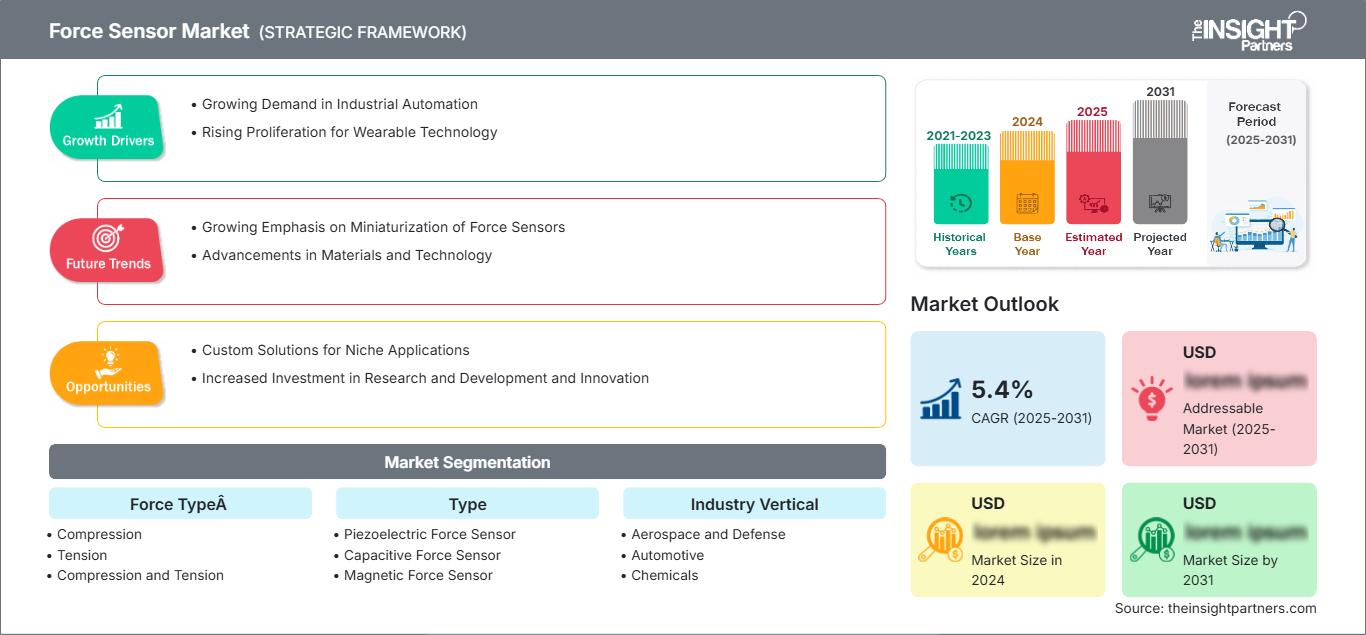
Force Sensor Market: Strategic Insights
Regional Insights
North America Force Sensor Market
The North America Force Sensor Market Share holds a sizable market share of around 27% to 31% of the total global market value in 2025, growing at a CAGR of around 8.2% to 8.6% up to 2034. The North America region's advanced manufacturing base, with heavy investments in aerospace, defense, medical devices, and automation technologies in the United States, Canada, and Mexico drives market growth. High-accuracy sensors, rugged designs, traceable calibrations, and adherence to automotive, aerospace, and medical quality standards are the focus in the region. Key players such as Honeywell, TE Connectivity, Sensata Technologies, and Tekscan drive technological innovations in the region. The production increase in defense electronics in Q1 2026, with the US arms industry increasing production fourfold prior to Operation Epic Fury, increases the need for precise force sensor components in weapon electronics, drones, and missiles.
U.S. Force Sensor Market
The United States Market is one of the most prominent national markets among North American countries, holding nearly 85%-90% of the regional market share in 2025, with the growth rate expected to be 8.4%-8.8% CAGR during the forecast period. The strong industrial infrastructure especially for the aerospace and defense sectors, along with medical devices and semiconductor manufacturing, has been boosting the demand for accurate load cell, torque sensor, and multi-axis force/torque sensors. The 2026 SelectUSA Investment Summit was a catalyst in announcing over USimage.png 2.5 billion in investments made during the summit, helping in increasing the capability of US manufacturing and enabling job creation with higher wages in the industrial segment. Leading players such as Honeywell, TE Connectivity, and General Electric have a major footprint in the U.S., promoting technological innovation and regional market penetration.
Europe Force Sensor Market
The Europe holds about 22%–26% of the market share across the globe in 2025 and is expected to grow at the rate of 7.8%–8.2% CAGR from 2026 to 2034 with Germany, the United Kingdom, France, Italy, and Spain being the major regions contributing to the demand. Germany continues to be pivotal to the demand for force sensors due to the country's industrial automation, manufacturing of automobiles, machinery, and test & measurement equipment. The UK Force Sensors Market is driven by aerospace applications, medical devices, motorsport engineering, and research instrumentation. In France, the demand for force sensors is supported by applications in the field of aerospace, defense, healthcare, and transportation; in Italy, packaging machinery, robotics, and manufacturing equipment; and in Spain, automotive, renewable energy, logistics, and industrial modernization applications. The Europe Market is dominated by regulations on the quality of automotive safety, medical devices, and industrial machinery applications, creating the need for reliable and high-performance sensors.
APAC Force Sensor Market
The Asia Pacific is the largest and fastest-growing regional segment, accounting for approximately 35%–39% of the global market share in 2025, with China, Japan, South Korea, India, and Australia as key contributors. The market is expanding at an estimated CAGR of 9.8%–10.2% during the forecast period, driven by rapid industrialization, extensive electronics manufacturing, robotics adoption, and automotive production across the region. China leads regional demand, supported by its large electronics, electric vehicle, battery, and robotics ecosystem, making it the most influential volume market globally. India is expanding through automotive, electronics manufacturing, medical devices, and public manufacturing initiatives, while Japan remains a technology leader in robotics, precision machinery, automotive, and factory automation. Industrial policy initiatives promoting domestic manufacturing, smart factory adoption, and supply chain diversification are shaping the Market dynamics across the APAC region, creating substantial opportunities for both international and domestic manufacturers.
Middle East & Africa Force Sensor Market
Middle East & Africa is a relatively new regional category that shows considerable growth potential and can be driven by the diversification of industry, development of energy infrastructure, and the implementation of logistics automation projects. Saudi Arabia and the UAE are the dominant national markets due to large-scale investments in industrial diversification projects and smart city projects requiring robust sensors in harsh conditions. The market will show the growth rate of 9.0%–9.4% CAGR in the forecast period due to continued investments in energy infrastructure, mining, agricultural, and utilities applications in the region. South Africa makes a notable contribution to the African segment of the market due to existing mining projects and industrial processing applications. The growing focus on modernization and automation of industries in the countries of the Gulf Cooperation Council opens more prospects for providers of force sensing technology as the demand develops in energy, infrastructure, logistics, and selective manufacturing segments.
Segmentation Analysis
Force Type
The Force Type segment encompasses Compression, Tension, and Compression and Tension sensors. This segment is expected to register a CAGR of 11.0%–11.4% from 2026 to 2034. The selection of force type is critical to ensuring accurate measurement across diverse applications, with compression sensors measuring pushing forces, tension sensors measuring pulling forces, and combination sensors offering dual-mode measurement capabilities for comprehensive force analysis in complex systems.
- Compression: Widely utilized in weighing systems, industrial automation, and manufacturing process control applications where pushing forces need to be accurately measured and monitored. These sensors are essential for quality control and production line optimization.
- Tension: Account for a significant market share as of 2025, specially designed for precise measurement of tensile loads, weights, and forces. Tension sensors offer high fatigue strength, high vibration resistance, and long-term stability, with significant demand from the aerospace industry for extremely challenging environments.
- Compression and Tension: Provide dual-mode measurement capabilities for applications requiring both pushing and pulling force monitoring, including material testing and complex assembly operations. These combination sensors offer versatility and comprehensive measurement capabilities.
Type
The Type segment comprises Piezoelectric Force Sensor, Capacitive Force Sensor, Magnetic Force Sensor, Load Cell, Strain Gauge, and Others. The segment is projected to grow at a CAGR of 10.5%–10.9% from 2026 to 2034. Load cells dominate the market owing to their reliability, accuracy, and wide application range across industrial weighing, material testing, and automation applications. Strain gauges exhibit high growth potential due to their versatility, cost-effectiveness, and integration capabilities in modern sensing systems.
- Piezoelectric Force Sensor: Converts mechanical stress into electrical charge, offering high sensitivity and fast response times suitable for dynamic force measurement in automotive crash testing and impact analysis. These sensors excel in applications requiring high-frequency response.
- Capacitive Force Sensor: Measures force by detecting changes in capacitance between two conductive plates, providing high sensitivity and stability for precision applications. Capacitive sensors offer excellent resolution and temperature stability for demanding measurement scenarios.
- Magnetic Force Sensor: Utilizes magneto-elastic principles to measure force-induced changes in magnetic fields, offering robustness and reliability in harsh industrial environments. These sensors maintain performance in challenging conditions with high shock and vibration.
- Load Cell: Represents the largest subsegment with 30%–34% market share in 2025, widely adopted in weighing systems, industrial automation, and material testing due to their accuracy, reliability, and cost-effectiveness. Load cells are essential for quality control across manufacturing industries.
- Strain Gauge: Exhibits the highest growth potential with a CAGR of 11.0%–11.4%, offering versatility and cost-effective integration into force sensing systems. Strain gauges find extensive use in automotive, aerospace, and structural health monitoring applications.
Industry Vertical
The Industry Vertical segment includes Aerospace and Defense, Automotive, Chemicals, Manufacturing, Mining, Pharmaceuticals, and Others. This segment is projected to grow at a CAGR of 10.8%–11.2% from 2026 to 2034. The automotive sector is a key end-user, driven by evolving government regulations pertaining to emissions monitoring, braking systems, and higher fuel efficiency standards that mandate the use of various sensors to assist drivers and enhance safety. Manufacturing and aerospace and defense sectors also contribute significantly to market demand.
- Aerospace and Defense: Demands high-accuracy, ruggedized force sensors for mission-critical applications including aircraft structural testing, flight control systems, weapons system integration, and missile guidance. This segment benefits from defense electronics production surge and modernization programs.
- Automotive: Represents a major end-user segment, utilizing force sensors in electronic control systems including tire pressure monitoring, oil pressure sensing, engine management, seat occupancy detection, and braking systems. The segment is driven by increasing sensor per vehicle counts due to evolving government regulations.
- Chemicals: Utilizes force sensors for process control, material handling, and safety monitoring applications in chemical manufacturing environments. Corrosion-resistant and explosion-proof variants are critical for ensuring operational safety and compliance.
- Manufacturing: Encompasses diverse applications including automated assembly, quality control, and material testing. The manufacturing segment is driven by Industry 4.0 initiatives and the need for real-time force monitoring in production processes.
- Mining: Adopts force sensors for bulk material handling, equipment monitoring, and safety applications in mining operations. Robust, high-capacity sensors are essential for challenging mining environments requiring durability and reliability.
- Pharmaceuticals: Requires precision force measurement for tablet compression, quality control, and packaging applications. Hygienic designs and FDA-compliant materials are necessary to meet stringent pharmaceutical manufacturing standards.
Opportunity Snapshot
| Industry Vertical Segment | Revenue Contribution | Trend Tag | Adoption Stage |
|---|---|---|---|
| Aerospace and Defense | High | Defense Modernization | Scaling |
| Automotive | High | EV Production | Scaling |
| Chemicals | Medium | Process Control | Mature |
| Manufacturing | High | Smart Factories | Mature |
| Mining | Medium | Equipment Monitoring | Scaling |
| Pharmaceuticals | Medium | Precision Manufacturing | Scaling |
Force Sensor Market Growth Drivers and Impact Analysis
Industrial Robotics and Automation Proliferation
The accelerating adoption of industrial robotics and factory automation is a primary driver for the Force Sensor Market, as collaborative robots and automated systems require precise force feedback to perform tasks safely and efficiently. The International Federation of Robotics reported that global industrial robot installations remained above half a million units in 2023, creating sustained demand for force sensing solutions in robotic gripping, assembly operations, automated quality inspection, and human-robot collaboration applications. The market impact is evident in the growing integration of multi-axis force/torque sensors in robotic arms and end effectors, enabling machines to perform delicate operations such as electronic assembly, polishing, and material handling that previously required human dexterity. Manufacturers such as Kistler and TE Connectivity are developing specialized robot-mounted sensors that provide real-time force feedback, improving process quality and worker safety.
Electric Vehicle and Battery Manufacturing Expansion
The rapid expansion of electric vehicle production and battery manufacturing is a significant driver for the Force Sensor Market, as EV battery assembly requires precise force and torque monitoring to ensure cell alignment, welding quality, and module integrity. The International Energy Agency reported nearly 14 million electric cars sold worldwide in 2023, driving demand for force measurement in battery assembly, braking systems, torque monitoring, and automated quality inspection applications. The market impact includes increased adoption of force sensors across EV production lines for cell stacking, electrode compression, and module assembly processes where accurate force application is critical to battery safety and performance. Supply chain investments in EV manufacturing facilities, particularly in Asia Pacific and North America, are creating sustained demand for specialized force sensing solutions designed for high-volume, high-precision production environments.
Defense Electronics and Aerospace Production Surge
The surge in defense electronics production and aerospace manufacturing is driving significant demand for high-accuracy force sensors used in weapons systems, drone electronics, missile guidance, and aircraft structural testing. Q1 2026 developments, including the Iran-US-Israel conflict, created unusual defense electronics production surges, with the US arms industry having quadrupled production in the three months before Operation Epic Fury, lifting demand across the force sensors market. The deployment of approximately 2,000 Iranian drones and 500+ ballistic missiles, each requiring sophisticated electronic components, proved out the centrality of advanced electronics in modern warfare and drove accelerated procurement investment globally. Aerospace and defense prime contractors accelerated force sensor procurement to support drone, missile, and weapons electronics assembly at expanded production rates, creating sustained demand across safety-critical force measurement applications.
Force Sensor Market Future Trends
Artificial Intelligence Integration for Predictive Analytics
The integration of artificial intelligence with force sensing capabilities is emerging as a transformative Force Sensor Market Trends, with manufacturers developing intelligent sensor systems that combine force, vision, position, and vibration data to enable predictive maintenance, anomaly detection, and adaptive control applications. AI-powered algorithms are being implemented to process sensor streams at the edge, enabling real-time decision-making with lower latency and reduced cloud dependence for applications including robotic grasp control, tool-wear monitoring, and automated quality inspection. Market participants such as Honeywell and Siemens are investing in developing AI-ready force sensing solutions that combine robust hardware with edge intelligence, creating new value propositions for industrial and defense applications.
Miniaturization and Thin-Film Sensor Development
The trend toward sensor miniaturization and thin-film technology development is expanding the application scope of force sensors across emerging sectors including wearables, prosthetics, human-machine interfaces, and collaborative robotics. Advances in flexible electronics, printed sensor technologies, and micro-electromechanical systems are enabling the development of ultra-thin, lightweight force sensors that can be integrated into compact devices and curved surfaces without compromising performance. This trend reflects the growing demand for force sensing solutions in consumer electronics, healthcare monitoring, and soft robotics applications where traditional rigid sensors are unsuitable. Manufacturers are increasingly investing in thin-film sensor technologies that offer high sensitivity, flexibility, and durability, creating new market opportunities across diverse application areas.
Force Sensor Market Opportunities
Healthcare and Medical Device Applications
Significant opportunities exist in the Force Sensor Market Forecast arising from the expansion of healthcare and medical device applications, where precision force measurement is critical for patient safety and treatment efficacy. Force sensors are extensively utilized in medical equipment such as automated pumps for performance monitoring, micro-needle therapy devices, and precise CPR treatment equipment, enabling healthcare professionals to deliver effective care. Investment opportunities include developing specialized force sensors for surgical robotics, rehabilitation devices, and wearable health monitors, establishing partnerships with medical device manufacturers, and creating solutions that meet stringent FDA and ISO 13485 requirements for clinical applications. The growing adoption of connected healthcare technologies and telemedicine is creating additional demand for force sensing solutions that enable remote patient monitoring and rehabilitation.
Supply Chain Resilience and Domestic Manufacturing
The growing emphasis on supply chain resilience and domestic manufacturing presents significant opportunities for the Force Sensor Market, as companies seek to reduce dependence on single-source suppliers and establish regional production capabilities. US and allied-nation electronics supply chain reshoring, accelerated by Q1 2026 supply chain disruption lessons including Hormuz shipping disruption and helium supply constraints, is driving domestic force sensor production investment that creates long-term market structural change. Investment opportunities include expanding manufacturing capacity in strategic regions, developing dual-source supply arrangements for critical components, and establishing partnerships with government programs supporting domestic electronics production. The 2026 SelectUSA Investment Summit, which catalyzed more than US$ 56 billion in investment commitments, demonstrates the growing momentum behind domestic manufacturing initiatives that benefit the force sensor industry.
Recent Developments
- May 2025: Canon announced the integration of its FH-300-20 Force Torque Sensor with Mitsubishi Electric's MELFA FR series FR PLUS industrial robots. The collaboration combines Canon's high-precision six-axis force sensing technology with Mitsubishi Electric's robotic automation platform to enable advanced applications such as precision assembly, polishing, deburring, and insertion tasks. The integrated solution strengthens Canon's position in the force sensor market by expanding the adoption of force-torque sensing in industrial robotics and supporting the growing demand for intelligent factory automation and high-precision manufacturing.
- June 2025: UltraSense Systems launched CapForce Edge, the industry's first fully integrated capacitive force-sensing controller designed to enable precise force detection for consumer electronics, automotive, and industrial applications. The solution integrates sensing, processing, and haptic control into a single chip, reducing system complexity, lowering power consumption, and simplifying product development. This innovation strengthens UltraSense's position in the force sensor market by accelerating the adoption of solid-state capacitive force sensing while enabling thinner, more reliable, and highly responsive human-machine interfaces. (Source: PR Newswire)
- June 2025: ABB expanded its force sensor testing capabilities in the United States by enhancing its calibration and testing infrastructure to support a broader range of force measurement applications. The investment improves ABB's ability to deliver high-accuracy calibration, validation, and testing services for industrial force sensors used across manufacturing, robotics, automotive, and aerospace sectors. This expansion strengthens ABB's position in the force sensor market by improving service capabilities, supporting higher measurement accuracy, and meeting the growing demand for reliable force sensing solutions in advanced industrial automation.
Frequently Asked Questions

- Comprehensive Market Sizing and Forecast Analysis
- Detailed Segmentation Analysis
- In-Depth Market Dynamics Assessment
- Regional and Country-Level Insights
- Competitive Landscape and Company Benchmarking
- Strategic Business Intelligence
Recent Reports
Testimonials

The Insight Partners' SCADA System Market report is comprehensive, with valuable insights on current trends and future forecasts. The team was highly professional, responsive, and supportive throughout. We are very satisfied and highly recommend their services.
RAN KEDEM Partner, Reali Technologies LTDs
I requested a report on a very specific software market and the team produced the report in a few days. The information was very relevant and well presented. I then requested some changes and additions to the report. The team was again very responsive and I got the final report in less than a week.
JEAN-HERVE JENN Chairman, Future Analytica
We worked with The Insight Partners for an important market study and forecast. They gave us clear insights into opportunities and risks, which helped shape our plans. Their research was easy to use and based on solid data. It helped us make smart, confident decisions. We highly recommend them.
PIYUSH NAGPAL Sr. Vice President, High Beam Global
The Insight Partners delivered insightful, well-structured market research with strong domain expertise. Their team was professional and responsive throughout. The user-friendly website made accessing industry reports seamless. We highly recommend them for reliable, high-quality research services
YUKIHIKO ADACHI CEO, Deep Blue, LLC.
This is the first time I have purchased a market report from The Insight Partners.While I was unsure at first, I visited their web site and felt more comfortable to take the risk and purchase a market report.I am completely satisfied with the quality of the report and customer service. I had several questions and comments with the initial report, but after a couple of dialogs over email with their analyst I believe I have a report that I can use as input to our strategic planning process.Thank you so much for taking the extra time and making this a positive experience.I will definitely recommend your service to others and you will be my first call when we need further market data.
JOHN SUZUKI President and Chief Executive Officer, Board Director, BK Technologies
I wish to appreciate your support and the professionalism you displayed in the course of attending to my request for information regarding to infectious disease IVD market in Nigeria. I appreciate your patience, your guidance, and the fact that you were willing to offer a discount, which eventually made it possible for us to close a deal. I look forward to engaging The Insight Partners in the future, all thanks to the impression you have created in me as a result of this first encounter.
DR CHIJIOKE ONYIA MANAGING DIRECTOR, PineCrest Healthcare Ltd.Reason to Buy
- Informed Decision-Making
- Understanding Market Dynamics
- Competitive Analysis
- Identifying Emerging Markets
- Customer Insights
- Market Forecasts
- Risk Mitigation
- Boosting Operational Efficiency
- Strategic Planning
- Investment Justification
- Tracking Industry Innovations
- Aligning with Regulatory Trends





 Get Free Sample for