
Friction Welding Machine Market Size, Growth & Trends by 2034
Coverage: By Type (Rotary Friction Welding, Linear Friction Welding, Friction Stir Welding); Application (Automotive Manufacturing, Tool and Machine Manufacturing, Aviation and Shipbuilding) , and Geography (North America, Europe, Asia Pacific, and South and Central America)
- Status : Data Released
- Report Code : TIPRE00022737
- Category : Manufacturing and Construction
- No. of Pages : 150
- Available Report Formats :


- Last update date : November 09, 2026


2025 Market Size
US$ 3.69 Bn
Base year value
2034 Forecast
US$ 4.97 Bn
Projected by 2034
CAGR 2026-2034
3.36 %
Growth rate
Addressable Market
US$ 39.32 Bn
(2026-2034)
The Friction Welding Machine Market was valued at US$ 3.69 Billion in 2025 and is projected to reach US$ 4.97 Billion by 2034, expanding at a CAGR of 3.36% during 2026–2034. Demand reflects the growing use of solid-state joining for repeatable, high-integrity bonds across automotive manufacturing, tool and machine manufacturing, aviation, and shipbuilding. Equipment suppliers are responding with more automated rotary, linear, and friction stir platforms that improve process control, traceability, and compatibility with lightweight and dissimilar materials.
North America is expected to record an approximately ~3% CAGR through 2034 as vehicle electrification, aerospace modernization, and automated production investment sustain equipment replacement. The Friction Welding Machine Market size in the region is also supported by established machine builders, deep Tier 1 manufacturing capacity, and demand for auditable weld data in safety-critical components. Robotic friction stir cells for battery enclosures and advanced rotary systems for driveline, hydraulic, and turbine parts will remain central to capital spending.
Friction Welding Machine Market Assessment and Insights
Regional Outlook
- North America: ~34% of the global Friction Welding Machine Market share in 2025 | ~3% CAGR through 2034. Market position: The region ranks first, supported by aerospace qualification requirements, high automotive automation intensity, and a large installed base requiring controls, tooling, service, and replacement equipment.
- US: ~78% of North American market revenue in 2025 | ~3% CAGR through 2034. Market position: The country leads North America through aerospace programs, commercial-vehicle production, EV battery manufacturing, and the presence of specialist machine builders and contract welding providers.
- Europe: ~30% of the global market in 2025 | ~3% CAGR through 2034. Market position: A mature engineering base, stringent quality requirements, and strong automotive and aerospace supply chains support demand, with Germany leading and the UK, France, Italy, and Spain contributing specialized applications.
- Asia Pacific: ~29% of the global market in 2025 | ~5% CAGR through 2034. Market position: Asia Pacific is the fastest-growing region as China, Japan, South Korea, and India expand vehicle, battery, rail, shipbuilding, and aerospace production capacity.
Segment Outlook
- Rotary Friction Welding: ~46% Share in 2025 | ~3% CAGR through 2034. Market position: Rotary systems lead because they address high-volume, axisymmetric parts such as shafts, valves, rods, axles, drill pipe, and turbine components with short cycles and proven repeatability.
- Friction Stir Welding: ~31% Share in 2025 | ~5% CAGR through 2034. Market position: Growth is driven by EV battery trays, cooling plates, rail panels, marine structures, and aerospace tanks requiring low-distortion joining of aluminum and other lightweight materials.
Competitive Coverage
Stirweld SAS, Manufacturing Technology, Inc., KUKA AG, ETA Technology Private Limited, RV Machine Tools, U.S. Korea Hotlink, Inc., MTI Welding Technologies Ltd., Tap Master, Inc., Lincoln Electric Holdings, Inc., Acceleration Enterprise
Methodology
The Insight Partners follows Data Collection & Secondary Research, Primary Research, Data Analysis, and Data Triangulation & Final Review to validate market estimates and insights.
Source: The Insight Partners' analysis based on proprietary research, government publications, company annual reports, investor presentations, industry databases, and expert interviews.
From a mechanically driven stand-alone machine, friction welding has evolved into a connected asset with programmable force, speed, displacement, and upset control capabilities. With the help of servo-hydraulics, robotic tool path, closed loop sensing, and digital process data recording, manufacturers can now qualify and produce complex joints at the production level. The rotary system has stayed fixed with shaft and cylindrical parts, whereas linear systems cater to valuable aerospace parts, while friction stir systems cater to long seam, battery enclosure, panel, and tank production. Strategies for production will include application development, tooling, machine installation, and contract welding.
Over the period till 2034, investments will shift from existing manufacturing centers of the US, Germany, Britain, and Japan to new ones across other locations. The localization in Asia Pacific, supply chains for electric vehicles, added capacities in aerospace, and naval and commercial shipbuilding increase the addressable base. The regulatory requirement for lightweight and energy-efficient parts does not call for friction welding; however, it makes the choice of welding aluminum, copper, titanium, and dissimilar alloys without filler metal a stronger choice. The suppliers that provide simulation, trials, operator training, remote diagnosis, and qualification support would be well positioned.
Friction Welding Machine Market Report Scope
| Report Attribute | Details |
|---|---|
| Market size in 2025 | US$ 3.69 Billion |
| Market Size by 2034 | US$ 4.97 Billion |
| Global CAGR (2026 - 2034) | 3.36% |
| Historical Data | 2021-2024 |
| Forecast period | 2026-2034 |
Friction Welding Machine Market Analysis
The Growth of Friction Welding Machine depends upon an identifiable manufacturing process: more use of lightweight and composite assemblies results in more assemblies which are not joined efficiently using traditional fusion welding processes. Automotive customers value cycle time and traceability; aerospace customers value fatigue performance and qualification; marine customers prize low distortion on large plates. The system includes machine manufacturers, robot manufacturers, controls suppliers, tool manufactures, metallurgy labs, integrators, and users. Early feasibility studies decide material suitability and joint design before determining machine sizing, fixturing, and line integration.
The supply chain favors those that can offer process expertise along with reliable service. Long life cycles of machines make it essential for aftermarket replacement parts, upgradings, calibrations, and controls retrofitting. The lead times depend upon large forgings, precision spindles, hydraulics, high load robots, and customized clamps. Standard systems reduce delivery times for traditional rotary systems, while linear friction and large format friction stir machines often need project engineering.
Friction Welding Machine Market report reveals a competitive landscape that is split into global automation players versus jointing specialists. The companies include KUKA AG, which operates robotized friction stir cells and Thompson rotary machines, and Manufacturing Technology, Inc., which operates with rotary, linear, low force and friction stir systems. Stirweld SAS concentrates on affordable friction stir heads and machines, and ETA Technology Private Limited specializes in rotary, linear, stir systems and testing rigs. RV Machine Tools, U.S. Korea Hotlink, Inc., MTI Welding Technologies Ltd., Tap Master, Inc., Lincoln Electric Holdings, Inc., and Acceleration Enterprise also increase regional integration and service capabilities.
Investments are being made in flexible cells that can handle product variants and record welding histories. Positioning thus is based not solely on tonnage, but also on application engineering, control systems design, tooling life, availability, and validation. Cooperation of technology suppliers and regional machine manufacturers may increase production capacity without replicating all manufacturing processes. Vendors, which can prove total cost of ownership, provide contract manufacturing during ramp up period and service geographically scattered facilities, will get a greater share of complex programs.
● REPORT CUSTOMIZATION
Tailor This Report To Align With Your Specific Business Requirements
This report can be customized to align precisely with your business objectives, scope, and target markets. Customization options include tailored segmentation, geography, competitive analysis, and strategic insights to support informed decision-making.
Customize This Report →WHAT YOU CAN ADJUST
- ● Segmentations
- ● Geography
- ● Competitive Analysis
- ● Language Preferences
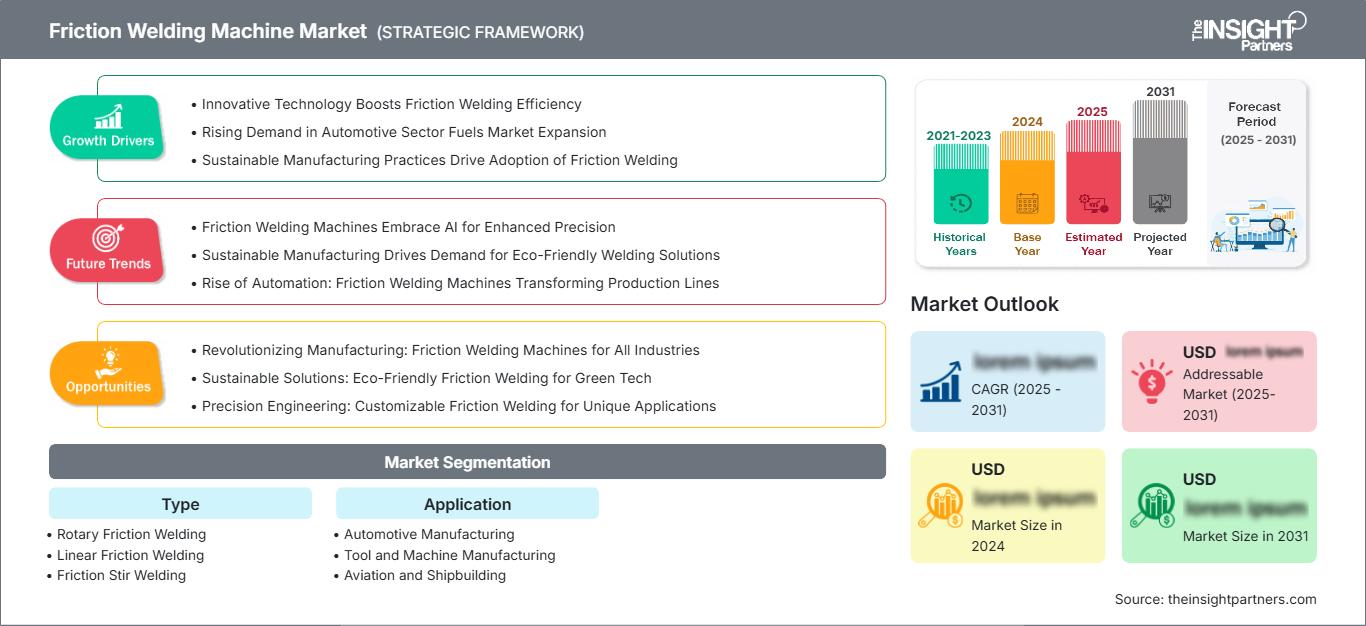
Friction Welding Machine Market: Strategic Insights
Regional Insights
North America Friction Welding Machine Market
North America represents ~34% of global revenue in 2025 and is forecast to expand at ~3% CAGR through 2034. Market share of the Friction Welding Machine is characterized by the presence of a consolidated base of production of aerospace engines, automobiles, commercial vehicles, defense, and industrial equipment. Procurement decisions often include machine-level data acquisition, recipe management, and qualification requirements, thus raising the overall value of the solution above the mechanical frame.
Displacement of older welders, battery casing investments, and dissimilar metal welds drive sales. North America is led by the US, while Canada brings aerospace, railway, and advanced manufacturing applications, and Mexico offers high-capacity automotive solutions. Growth in the region stays moderate due to saturation, but modernization drives demand.
U.S. Friction Welding Machine Market
The US accounts for ~78% of North American revenue in 2025 and is projected to grow at ~3% CAGR. The aerospace propulsion and structural sectors drive both linear and rotary friction welding processes, while automotive and off-highway sectors use rotary systems to join axles, piston rods, valves, and shafts. EV programs contribute further need for robotic friction stir welding of battery cases and cooling jackets.
Manufacturing Technology, Inc., U.S. Korea Hotlink, Inc., Tap Master, Inc., Lincoln Electric Holdings, Inc., among others, supply manufacturing technology, automation solutions, tooling systems, or service offerings. The industry gains from contract welding services that serve as the transition between prototype testing and equipment purchases. The purchasing decision now also factors in remote services, process control, and fast changeover apart from force and speed parameters.
Europe Friction Welding Machine Market
Europe holds ~30% of global revenue in 2025 and is expected to post ~3% CAGR through 2034. Germany represents the dominant country in Europe, thanks to its dominance in automotive engineering, industrial automation, and aerospace production. The installed base and regional centers of applications of KUKA AG promote process development, whereas stringent quality standards favor the development of systems with traceability and reliable control.
The United Kingdom offers capabilities for engines, aerospace, and specialized machinery with the facilities of Thompson and MTI Welding Technologies companies. In France, there is an integration of aerospace, space, railway, and maritime applications, with additional expertise provided by Stirweld SAS company. Italy provides machinery and transport equipment capabilities that allow flexible systems, and Spain provides demand from the automotive, aerospace, and shipbuilding industries. In all those markets, investments go into cells that join lightweight alloys with minimal distortion and subsequent machining.
Growth is constrained by a mature installed base and careful capital cycle, but efforts toward decarbonization promote lightweight construction and efficient joining technology. Retrofit possibilities are substantial where old machinery is missing modern sensors, cybersecurity, and automated inspection. Engineering-intensive European products can be exported to the emerging Asian and Middle Eastern production centers.
APAC Friction Welding Machine Market
Asia Pacific represents ~29% of global revenue in 2025 and is the fastest-growing region at ~5% CAGR through 2034. China is the leading country in Asia Pacific because of its scale in vehicles, batteries, rail equipment, shipbuilding, and general machinery. Japan and South Korea contribute advanced automotive, electronics, aerospace, and shipyard applications.
India benefits from manufacturing localization, defense and space programs, and domestic suppliers such as ETA Technology Private Limited. Australia adds specialized aerospace, defense, rail, and resource-equipment demand. Policy support for local production, expanding engineering capacity, and new aluminum-intensive products should favor both imported systems and regionally built machines.
Middle East & Africa Friction Welding Machine Market
The Middle East & Africa market is forecast to expand at ~4% CAGR through 2034. Saudi Arabia is positioned as the leading country in the Middle East & Africa where industrial localization, energy equipment, defense procurement, and infrastructure investment support advanced joining. The UAE adds aerospace maintenance, space, marine, and precision manufacturing opportunities.
South Africa serves automotive and industrial production, while the Rest of MEA is oriented toward oilfield tools, pipes, repair, and infrastructure components. Adoption depends on application support and service availability because specialized machines require process development and operator training. Partnerships with regional integrators can reduce commissioning risk and improve uptime.
Segmentation Analysis
Type
The Type segment is projected to advance at ~4% CAGR during 2026–2034. The Friction Welding Machine Market scope covers rotary friction welding, linear friction welding, and friction stir welding equipment, each matched to different motion, geometry, and load requirements. Buyers select technology through material trials, joint design, production volume, and quality criteria. Rotary systems retain the broadest installed base, linear platforms remain specialized, and friction stir equipment gains relevance where long, leak-tight, low-distortion seams justify automation.
- Rotary Friction Welding: This sub-segment leads on installed applications and revenue contribution, serving axisymmetric parts in automotive, hydraulic, agricultural, oilfield, and aerospace production. Short cycles, forged-quality joints, and mature process knowledge make it strategically important for high-volume lines.
- Linear Friction Welding: Demand is concentrated in high-value aerospace and advanced engineering components where non-axisymmetric parts, titanium alloys, and near-net-shape assemblies justify specialized equipment. Its strategic value lies in material savings and performance rather than broad unit volume.
- Friction Stir Welding: Adoption is scaling across battery trays, cold plates, rail panels, marine structures, and aerospace tanks. The process offers strong, repeatable seams in aluminum and selected dissimilar combinations while enabling robotic or gantry-based automation.
Application
The Application segment is expected to grow at ~3% CAGR during 2026–2034. Automotive manufacturing provides volume and repeatability, tool and machine manufacturing supports diverse shafts and bimetallic parts, and aviation and shipbuilding reward low distortion and high joint integrity. Purchasing criteria vary accordingly: automotive plants emphasize takt time, automation, and changeover; machine builders prioritize flexibility; aviation and shipbuilding require extensive procedure qualification and traceability. Suppliers capable of translating application requirements into fixtures, controls, and inspection plans can improve conversion rates.
- Automotive Manufacturing: This application contributes the highest equipment demand through driveline, axle, piston rod, valve, battery enclosure, and thermal-management production. Electrification expands friction stir opportunities, while rotary welding remains important for established high-throughput components.
- Tool and Machine Manufacturing: Demand centers on cutting tools, shafts, hydraulic parts, and dissimilar-material blanks that reduce expensive alloy usage. Flexible machine configurations and quick-change tooling are strategically important because product mixes are wider and batch sizes smaller.
- Aviation and Shipbuilding: Aerospace uses rotary, linear, and stir processes for propulsion, structures, tanks, and high-performance alloys. Shipbuilding offers long-term potential for aluminum panels and steel-focused process development, where distortion control and weld integrity support lifecycle economics.
Opportunity Snapshot
| Application | Revenue Contribution | Trend Tag | Adoption Stage |
| Automotive Manufacturing | High | Battery Enclosures | Mature |
| Tool and Machine Manufacturing | Medium | Dissimilar Blanks | Mature |
| Aviation and Shipbuilding | Medium | Lightweight Structures | Scaling |
Friction Welding Machine Market Growth Drivers and Impact Analysis
Lightweight and Dissimilar-Material Manufacturing
Vehicle, aircraft, rail, and marine designers are using aluminum, copper, titanium, magnesium, and advanced steels in combinations that challenge conventional fusion processes. Friction welding forms joints under the melting point of the bulk metal, which results in fewer issues like porosity, solidification cracking, filler use, and thermal distortion. In terms of practical applications, friction welding will have its greatest effect in instances where a joint can replace fastening, facilitate a multipart assembly, or keep the costly alloy in the working tip only. Machine orders will be as much driven by product redesigns as by increases in production.
Electrification and Thermal-Management Production
Applications such as electric vehicles and power electronics need battery trays, cooling jackets, heat sinks, bus bars, and cold plates with good thermal behavior and sealed seams. Friction stir welding is very appropriate for welding long joints in aluminum and can be done using gantries or heavy-duty robots, whereas rotary friction welding applies to certain electrical and cylindrical components made up of copper and aluminum. The effect goes far beyond the automobile manufacturing industry and includes battery makers, thermal system manufacturers, and contract manufacturers. The programs always start from prototypes and then proceed to cells, hence the need for application centers and bridge production.
Traceable Automation for Safety-Critical Parts
Aerospace, automotive, defense, and energy customers increasingly treat weld data as part of the manufactured product record. Modern equipment captures rotational speed, force, displacement, torque, upset, temperature proxies, and cycle signatures so deviations can be identified before downstream assembly. This requirement encourages replacement of mechanically sound but digitally limited legacy machines. It also raises demand for controls retrofits, secure data interfaces, and recipe management. The operational benefit is lower inspection burden when validated process windows reliably separate acceptable and suspect parts. Vendors that integrate sensing, statistical process control, and remote diagnostics can command stronger positions because they address quality assurance, uptime, and compliance together rather than selling only mechanical capacity.
Friction Welding Machine Market Future Trends
Adaptive Control and Digital Process Models
Friction Welding Machine Market trends are moving toward closed-loop adjustment rather than fixed recipes alone. Sensor fusion, machine-learning models, and digital twins can relate force, torque, temperature, vibration, and tool position to weld quality in real time. Early adoption will focus on high-value applications where scrap is expensive and small process shifts matter. Broader commercialization requires standardized data, robust models across machines and materials, and cybersecurity appropriate for factory networks. As these constraints are addressed, adaptive control could shorten parameter development, improve first-pass yield, and support predictive maintenance. Equipment suppliers will increasingly differentiate through validated software and application datasets alongside hardware.
Flexible Robotic Friction Stir Platforms
Robotic friction stir welding will expand where producers need three-dimensional paths, mixed-model lines, and faster reconfiguration than fixed gantries provide. Higher-rigidity robots, force control, improved tool materials, and application-specific fixtures are widening the feasible envelope. Battery enclosures provide a near-term anchor, while rail, aerospace, marine, and large thermal-management assemblies offer adjacent opportunities. The trend will not eliminate dedicated machines because very high forces, precision, or long straight seams can favor purpose-built structures. Instead, buyers will choose between robot, gantry, and hybrid architectures based on path complexity, payload, cycle time, and qualification requirements.
Friction Welding Machine Market Opportunities
Regional Application Centers and Contract Production
Manufacturers often delay equipment purchases because they lack internal friction-welding expertise or cannot justify a dedicated cell before volume is proven. Suppliers can address this gap through regional application centers that offer feasibility studies, prototype joints, qualification support, and contract production. Friction Welding Machine Market Forecasts indicate that emerging Asian and Middle Eastern clusters will require local service as advanced manufacturing capacity expands. Investment should prioritize test capability, metallurgical analysis, representative machines, and field engineers rather than sales offices alone. A contract-to-capital pathway can create recurring revenue, reduce customer risk, and produce application evidence that supports later machine orders.
Retrofit, Controls, and Lifecycle Service Programs
The long operating life of friction welders creates an underdeveloped modernization opportunity. Many installed machines can remain mechanically productive but lack current safety systems, efficient hydraulics, intuitive human-machine interfaces, remote support, or detailed data capture. Vendors can package audits, controls replacement, sensor upgrades, cybersecurity, calibration, and operator training around measurable uptime and quality outcomes. Retrofit programs are especially attractive in mature North American and European markets where greenfield demand grows slowly. A structured lifecycle offering also strengthens spare-parts planning and creates earlier visibility into eventual replacement decisions, improving customer retention without requiring buyers to fund a new machine immediately.
Recent Developments
- July 2025: KUKA AG disclosed a follow-up order for 12 robotic friction stir welding cells for a major US automotive manufacturer, following an earlier order for 23 cells. The systems use KR FORTEC robots and tailored clamping to weld EV battery cases and cooling-water jackets, demonstrating scaled deployment of three-dimensional FSW in flexible vehicle production
- April 2025: MTI and STIRTEC GmbH announced a strategic global partnership to expand friction stir welding machine-build capacity. MTI will build co-branded systems for the Americas, India, Australia, and New Zealand, while STIRTEC continues European and Asian production, combining regional manufacturing reach with application technology for aluminum and bimetallic programs –
Frequently Asked Questions

- Comprehensive Market Sizing and Forecast Analysis
- Detailed Segmentation Analysis
- In-Depth Market Dynamics Assessment
- Regional and Country-Level Insights
- Competitive Landscape and Company Benchmarking
- Strategic Business Intelligence
Recent Reports
Testimonials

The Insight Partners provided valuable market intelligence that supported our global go-to-market strategy. Their team was professional, responsive, and attentive to our feedback, providing thoughtful analysis and helpful methodological clarifications throughout the project.
Junmo Kim Chief Financial Officer (CFO), Enertech Co., Ltd.
The Insight Partners' SCADA System Market report is comprehensive, with valuable insights on current trends and future forecasts. The team was highly professional, responsive, and supportive throughout. We are very satisfied and highly recommend their services.
RAN KEDEM Partner, Reali Technologies LTDs
I requested a report on a very specific software market and the team produced the report in a few days. The information was very relevant and well presented. I then requested some changes and additions to the report. The team was again very responsive and I got the final report in less than a week.
JEAN-HERVE JENN Chairman, Future Analytica
We worked with The Insight Partners for an important market study and forecast. They gave us clear insights into opportunities and risks, which helped shape our plans. Their research was easy to use and based on solid data. It helped us make smart, confident decisions. We highly recommend them.
PIYUSH NAGPAL Sr. Vice President, High Beam Global
The Insight Partners delivered insightful, well-structured market research with strong domain expertise. Their team was professional and responsive throughout. The user-friendly website made accessing industry reports seamless. We highly recommend them for reliable, high-quality research services
YUKIHIKO ADACHI CEO, Deep Blue, LLC.
This is the first time I have purchased a market report from The Insight Partners.While I was unsure at first, I visited their web site and felt more comfortable to take the risk and purchase a market report.I am completely satisfied with the quality of the report and customer service. I had several questions and comments with the initial report, but after a couple of dialogs over email with their analyst I believe I have a report that I can use as input to our strategic planning process.Thank you so much for taking the extra time and making this a positive experience.I will definitely recommend your service to others and you will be my first call when we need further market data.
JOHN SUZUKI President and Chief Executive Officer, Board Director, BK Technologies
I wish to appreciate your support and the professionalism you displayed in the course of attending to my request for information regarding to infectious disease IVD market in Nigeria. I appreciate your patience, your guidance, and the fact that you were willing to offer a discount, which eventually made it possible for us to close a deal. I look forward to engaging The Insight Partners in the future, all thanks to the impression you have created in me as a result of this first encounter.
DR CHIJIOKE ONYIA MANAGING DIRECTOR, PineCrest Healthcare Ltd.Reason to Buy
- Informed Decision-Making
- Understanding Market Dynamics
- Competitive Analysis
- Identifying Emerging Markets
- Customer Insights
- Market Forecasts
- Risk Mitigation
- Boosting Operational Efficiency
- Strategic Planning
- Investment Justification
- Tracking Industry Innovations
- Aligning with Regulatory Trends





 Get Free Sample for