
Hair Removal Products Market Size, Growth & Trends by 2034
Coverage: By Product Type (Creams, Wax Strips, Razors & Blades, Epilators, and Others), End User (Men and Women), and Distribution Channel (Supermarkets & Hypermarkets, Convenience Stores, Online Retail, and Others)
- Status : Data Released
- Report Code : TIPRE00023369
- Category : Consumer Goods
- No. of Pages : 150
- Available Report Formats :


- Last update date : February 19, 2026


2025 Market Size
US$ 11.18 Bn
Base year value
2034 Forecast
US$ 17.64 Bn
Projected by 2034
CAGR 2026-2034
5.2 %
Growth rate
Addressable Market
US$ 130.76 Bn
(2026-2034)
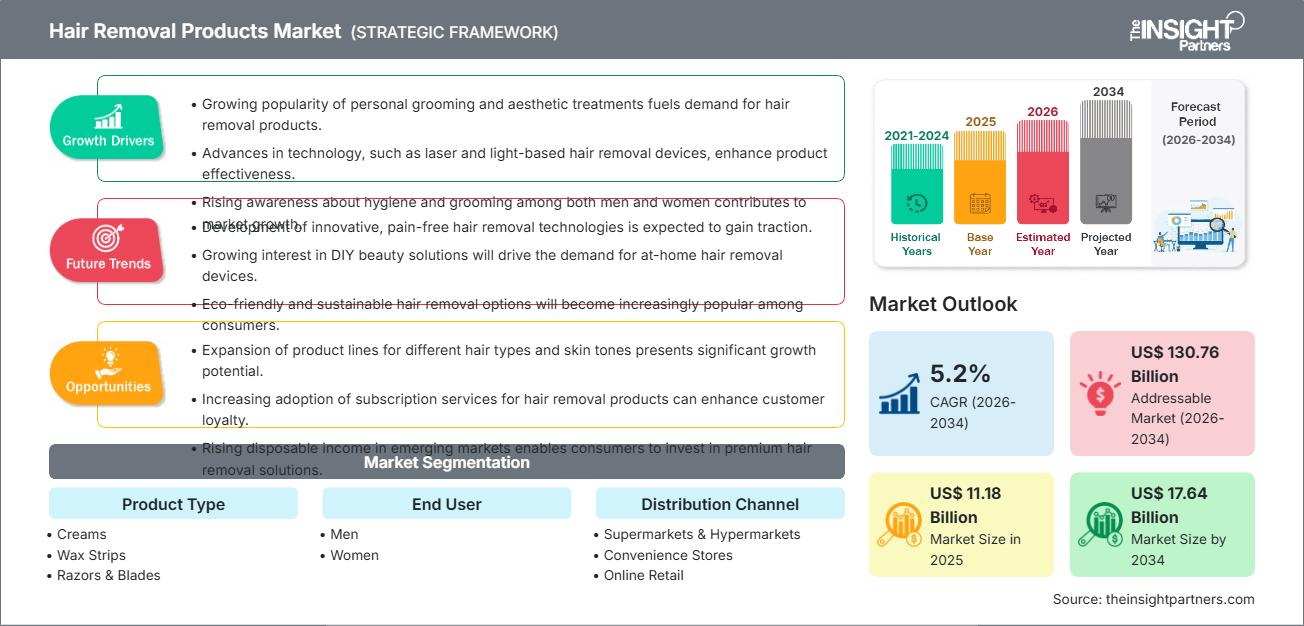
The global Hair Removal Products market size is projected to reach US$ 17.64 billion by 2034 from US$ 11.18 billion in 2025. The market is anticipated to register a CAGR of 5.2% during the forecast period 2026–2034. Key market dynamics include an intensifying global emphasis on personal grooming and aesthetic presentation, fueled by social media influence and evolving fashion trends. Rising consumer preference for at-home, professional-grade grooming solutions is a primary driver, alongside a significant shift toward formulations that prioritize skin health and use natural or hypoallergenic ingredients. Additionally, the market is expected to benefit from the expansion of gender-neutral product lines and the increasing penetration of smart electronic devices like epilators and IPL systems in emerging economies.
Hair Removal Products Market Analysis
The hair removal products market analysis indicates a strategic pivot toward high-convenience, low-pain solutions as consumers move away from traditional, time-consuming salon visits. Market participants are increasingly focusing on customization, developing specialized products for different skin types and sensitive body areas, such as the face and bikini line. Strategic opportunities are emerging in the integration of skincare benefits within hair removal formulations—specifically creams and waxes infused with moisturizing and soothing agents like aloe vera or vitamin E. The analysis also suggests that long-term growth is tethered to supply chain modernization, particularly in the direct-to-consumer (D2C) space, where subscription-based models for razors and blades are enhancing brand loyalty and ensuring recurring revenue streams.
Hair Removal Products Market Overview
Hair removal products are transitioning from a basic hygiene category to a vital component of the global wellness and self-care industry. While manual razors and blades remain the volume leaders due to their affordability and widespread availability, there is a marked surge in the adoption of value-added products like ready-to-use wax strips and sophisticated electronic devices. The industry is characterized by high competitive density, with established multinational brands and agile niche players competing for shelf space in both physical and digital arenas. As grooming routines become more frequent and inclusive across all demographics, manufacturers are leveraging digital marketing and influencer partnerships to reach a broader audience, particularly in urbanized regions where time efficiency is a critical consumer priority. For instance, the market in the US represents a mature yet dynamic landscape characterized by high consumer awareness and a strong preference for premium grooming technologies. Demand is increasingly driven by the popularity of clean beauty standards and the mainstream adoption of at-home laser and IPL devices. Strong retail infrastructure and a robust e-commerce ecosystem facilitate rapid product discovery and consumption.
Market Assessment and Insights
- Global market for Hair Removal Products was valued at US$ 11.18 Billion in 2025
- Annual market size is expected to reach US$ 17.64 Billion by 2034
- Total addressable market (TAM) during 2026-2034 is projected to reach approximately US$ 130.76 Billion
- Market is anticipated to register a CAGR of 5.2% during the forecast period
- The United States represents a key market, supported by Growing popularity of personal grooming and aesthetic treatments fuels demand for hair removal products., Advances in technology, such as laser and light-based hair removal devices, enhance product effectiveness., Rising awareness about hygiene and grooming among both men and women contributes to market growth., as well as evolving industry dynamics
- Market analysis covers North America, Europe, Asia-Pacific, South and Central America, Middle East and Africa, with growth evaluated across the forecast period
- Market opportunities such as Expansion of product lines for different hair types and skin tones presents significant growth potential., Increasing adoption of subscription services for hair removal products can enhance customer loyalty., Rising disposable income in emerging markets enables consumers to invest in premium hair removal solutions. are expected to influence market dynamics and addressable market
- Report profiles industry participants, including Church & Dwight Co., Inc., Reckitt Benckiser Group plc, Oriflame Holding AG, GIGI, American International Inc., Procter & Gamble, Koninklijke Philips N.V., Sally Hansen, Si & D (Aust) (Pty) Ltd, while analyzing competitive strategies and innovation developments
-
Source: The Insight Partners' analysis based on proprietary research, government publications, company annual reports, investor presentations, industry databases, and expert interviews.
● REPORT CUSTOMIZATION
Tailor This Report To Align With Your Specific Business Requirements
This report can be customized to align precisely with your business objectives, scope, and target markets. Customization options include tailored segmentation, geography, competitive analysis, and strategic insights to support informed decision-making.
Customize This Report →WHAT YOU CAN ADJUST
- ● Segmentations
- ● Geography
- ● Competitive Analysis
- ● Language Preferences
Hair Removal Products Market: Strategic Insights
-
Get Top Key Market Trends of this report.This FREE sample will include data analysis, ranging from market trends to estimates and forecasts.
Hair Removal Products Market Drivers and Opportunities
Market Drivers:
- Surge in Personal Grooming Standards: A growing cultural emphasis on aesthetics and hygiene, amplified by digital media and professional workplace standards, is consistently driving the demand for effective hair removal solutions across both genders.
- Technological Advancements in At-Home Devices: The development of safe, user-friendly electronic devices like epilators and IPL systems has revolutionized the market. These innovations offer consumers long-lasting results that were previously only available in clinical or salon settings.
- Shift Toward Painless and Skin-Friendly Formulations: Advances in depilatory chemistry have led to the creation of creams and wax strips that are significantly gentler on the skin, reducing irritation and catering to the rising segment of consumers with sensitive skin.
Market Opportunities:
- Expansion of the Men's Grooming Segment: There is a substantial opportunity to target the male demographic with specialized products designed for coarser hair and specific body areas, moving beyond traditional facial shaving into full-body grooming.
- E-commerce and Subscription-Based Models: The rise of digital retail platforms and the success of shave club subscription models provide a gateway for brands to build direct relationships with consumers and capture steady market share through convenience.
- Sustainable and Eco-Friendly Innovations: As environmental consciousness grows, there is significant potential for products utilizing biodegradable materials, plastic-free packaging, and organic ingredients to appeal to the environmentally aware Gen Z and Millennial cohorts.
Hair Removal Products Market Report Segmentation Analysis
The Hair Removal Products Market share is analyzed across various segments to provide a clearer understanding of its structure, growth potential, and emerging trends. Below is the standard segmentation approach used in most industry reports:
By Product Type:
- Creams: This segment remains highly popular due to its painless application and affordability, particularly for consumers seeking quick and easy at-home solutions.
- Wax Strips: A key segment favored for providing longer-lasting results compared to shaving, with ready-to-use formats driving growth in the convenience category.
- Razors & Blades: The dominant volume driver in the market, supported by traditional usage habits and the widespread availability of both disposable and reusable options.
- Epilators: A high-value segment growing due to technological improvements that offer more efficient hair removal with reduced discomfort.
- Others: Includes specialized solutions such as hair removal sprays, powders, and advanced electronic devices like home-use IPL systems.
By End User:
- Women: Historically, the primary consumer base, women continue to hold the largest market share, driven by diverse beauty standards and a high frequency of product usage.
- Men: The fastest-growing demographic as modern grooming trends encourage men to adopt comprehensive body hair management routines beyond traditional shaving.
By Distribution Channel:
- Supermarkets & Hypermarkets: These remain the primary point of purchase for most consumers, offering a vast array of brands and the advantage of immediate physical product evaluation.
- Convenience Stores: Essential for high-frequency, on-the-go purchases of essential items like razors and small depilatory packs in urban areas.
- Online Retail: A rapidly expanding channel that benefits from the privacy of home shopping, competitive pricing, and the ability to access niche or premium international brands.
- Others: Includes specialty beauty boutiques, pharmacies, and professional salons that sell retail versions of their treatment products.
By Geography:
- North America
- Europe
- Asia Pacific
- South & Central America
- Middle East & Africa
Hair Removal Products Market Report Scope
| Report Attribute | Details |
|---|---|
| Market size in 2025 | US$ 11.18 Billion |
| Market Size by 2034 | US$ 17.64 Billion |
| Global CAGR (2026 - 2034) | 5.2% |
| Historical Data | 2021-2024 |
| Forecast period | 2026-2034 |
| Segments Covered |
By Product Type
|
| Regions and Countries Covered |
North America
|
| Market leaders and key company profiles |
|
Hair Removal Products Market Players Density: Understanding Its Impact on Business Dynamics
The Hair Removal Products Market is growing rapidly, driven by increasing end-user demand due to factors such as evolving consumer preferences, technological advancements, and greater awareness of the product's benefits. As demand rises, businesses are expanding their offerings, innovating to meet consumer needs, and capitalizing on emerging trends, which further fuels market growth.
Hair Removal Products Market Share Analysis by Geography
Asia-Pacific is expected to grow fastest in the coming years. Emerging markets in South & Central America, the Middle East, and Africa also have many untapped opportunities for personal care brands and electronic grooming device manufacturers to expand.
The hair removal products market is undergoing a significant transformation, moving from basic hygiene tools to a sophisticated segment of the global beauty and wellness industry. The rising frequency of at-home grooming drives growth, the expansion of the male grooming sector, and a surge in demand for long-lasting, professional-grade results. Below is a summary of market share and trends by region:
North America
- Market Share: Holds a dominant global position fueled by high consumer spending power and a mature retail landscape.
- Key Drivers:
- Extensive adoption of advanced at-home technologies like IPL (Intense Pulsed Light) and laser devices.
- Robust infrastructure for subscription-based shave clubs and direct-to-consumer (D2C) brands.
- High demand for premium, skin-nourishing depilatory formulations and multi-blade razor systems.
- Trends: Increasing consumer preference for clean beauty standards, leading to a rise in sustainable, plastic-free razors and organic, hypoallergenic wax products.
Europe
- Market Share: Represents the second-largest region, characterized by a sophisticated consumer base with high standards for personal aesthetics.
- Key Drivers:
- Deep-seated cultural emphasis on body grooming and a well-established spa and salon culture.
- Stringent regulatory frameworks (such as CE marking) that ensure high safety and dermatological standards.
- Rapid growth in the male grooming segment, specifically for body hair trimmers and specialized creams.
- Trends: A strategic shift toward eco-friendly packaging and refillable product designs to align with the region's aggressive environmental and sustainability goals.
Asia-Pacific
- Market Share: The fastest-growing region globally, driven by massive population centers and rapid urbanization in China, India, and Southeast Asia.
- Key Drivers:
- Rising disposable incomes and an expanding middle class prioritizing westernized luxury grooming standards.
- Massive influence from social media platforms and K-beauty trends on younger demographics.
- Government support for local manufacturing, making electronic devices and creams more affordable for the mass market.
- Trends: Heavy reliance on mobile e-commerce and live-stream shopping for product discovery, alongside a surge in demand for portable, travel-friendly grooming tools.
South and Central America
- Market Share: An emerging market with a strong traditional focus on hair removal, particularly in countries like Brazil and Argentina.
- Key Drivers:
- Cultural emphasis on body aesthetics and high usage rates of waxing and depilatory products.
- Increasing availability of international brands through modernizing retail channels.
- Growing awareness of the hygiene and skincare benefits of professional-grade at-home solutions.
- Trends: Expansion of farm-to-shelf boutique brands and a rising interest in pain-reducing technologies tailored for sensitive skin types.
Middle East and Africa
- Market Share: A developing market with deep cultural roots in hair removal practices, transitioning toward commercialized production.
- Key Drivers:
- Strong demand for long-lasting solutions like epilators and wax kits in warm, arid climates.
- Strategic investments in luxury retail malls and the expansion of organized pharmacy chains.
- The rising influence of grooming advertisements on the male population, particularly for beard styling and full-body maintenance.
- Trends: Implementation of smart grooming technologies and a growing market for Halal-certified personal care products to meet regional consumer requirements.
High Market Density and Competition
Competition is intensifying due to the presence of established leaders such as Church & Dwight Co., Inc., Reckitt Benckiser Group plc, Oriflame Holding AG, GIGI, American International Inc., Procter & Gamble, Koninklijke Philips N.V., Sally Hansen, and Si & D (Aust) (Pty) Ltd, which also contribute to a diverse and rapidly expanding market landscape.
This competitive environment pushes vendors to differentiate through:
- Premiumization and Functional Branding: Brands are positioning hair removal as a holistic skincare step, emphasizing the inclusion of natural botanicals, vitamins, and hypoallergenic properties to appeal to health-conscious and sensitive-skin demographics.
- Expanded Product Portfolios: Offerings now go beyond traditional razors to include high-tech IPL (Intense Pulsed Light) devices, 2-in-1 exfoliating depilatory creams, and specialized manscaping kits designed specifically for coarser hair.
- Vertical Integration and D2C Models: Many companies are managing the entire customer journey through direct-to-consumer subscription models. This ensures quality control, fosters brand loyalty, and allows for the collection of data to meet ethical, clean-label standards.
- Advanced Processing and Design: New manufacturing technologies, such as modular grooming systems and sapphire cooling technology in electronic devices, help create high-performance products that provide salon-quality results with minimal discomfort.
Opportunities and Strategic Moves
- Partner with high-end retail channels and e-commerce platforms to tap into the surging demand for professional-grade at-home grooming and gender-neutral products in the Asia-Pacific and North American markets.
- Incorporate sustainable manufacturing practices and biodegradable materials to appeal to environmentally conscious Millennials and Gen Z consumers seeking ethical, plastic-free alternatives to traditional disposable razors and wax strips.
Major Companies operating in the Hair Removal Products Market are:
- Church & Dwight Co., Inc.
- Reckitt Benckiser Group plc
- Oriflame Holding AG
- GIGI
- American International Inc.
- Procter & Gamble
- Koninklijke Philips N.V.
- Sally Hansen
- Si & D (Aust) (Pty) Ltd
Disclaimer: The companies listed above are not ranked in any particular order.
Hair Removal Products Market News and Recent Developments
- In December 2025, DermRays successfully launched the V8S Pro, a next-generation laser hair removal device, as part of its expanding line of hair removal products. Building on the momentum of its 2023 multi-functional laser beauty series, the V8S Pro utilized a high-performance 810nm laser—acclaimed for its clinical effectiveness—to provide consumers with a more powerful and efficient at-home solution.
- In January 2024, Cynosure and Hahn & Company (which had recently acquired Lutronic) finalized a definitive merger agreement for the strategic combination of Cynosure and Lutronic. As global providers of energy-based medical aesthetic treatment systems, the merger significantly strengthened their combined portfolio of advanced hair removal products and related technologies, enhancing their competitive position across international markets.
Hair Removal Products Market Report Coverage and Deliverables
The Hair Removal Products Market Size and Forecast (2021–2034) report provides a detailed analysis of the market covering below areas:
- Hair Removal Products Market size and forecast at global, regional, and country levels for all the key market segments covered under the scope
- Hair Removal Products Market trends, as well as market dynamics such as drivers, restraints, and key opportunities
- Detailed PEST and SWOT analysis
- Hair Removal Products Market analysis covering key market trends, global and regional framework, major players, regulations, and recent market developments
- Industry landscape and competition analysis covering market concentration, heat map analysis, prominent players, and recent developments in the Hair Removal Products Market.
- Detailed company profiles
Frequently Asked Questions

- Comprehensive Market Sizing and Forecast Analysis
- Detailed Segmentation Analysis
- In-Depth Market Dynamics Assessment
- Regional and Country-Level Insights
- Competitive Landscape and Company Benchmarking
- Strategic Business Intelligence
Recent Reports
Testimonials

The Insight Partners' SCADA System Market report is comprehensive, with valuable insights on current trends and future forecasts. The team was highly professional, responsive, and supportive throughout. We are very satisfied and highly recommend their services.
RAN KEDEM Partner, Reali Technologies LTDs
I requested a report on a very specific software market and the team produced the report in a few days. The information was very relevant and well presented. I then requested some changes and additions to the report. The team was again very responsive and I got the final report in less than a week.
JEAN-HERVE JENN Chairman, Future Analytica
We worked with The Insight Partners for an important market study and forecast. They gave us clear insights into opportunities and risks, which helped shape our plans. Their research was easy to use and based on solid data. It helped us make smart, confident decisions. We highly recommend them.
PIYUSH NAGPAL Sr. Vice President, High Beam Global
The Insight Partners delivered insightful, well-structured market research with strong domain expertise. Their team was professional and responsive throughout. The user-friendly website made accessing industry reports seamless. We highly recommend them for reliable, high-quality research services
YUKIHIKO ADACHI CEO, Deep Blue, LLC.
This is the first time I have purchased a market report from The Insight Partners.While I was unsure at first, I visited their web site and felt more comfortable to take the risk and purchase a market report.I am completely satisfied with the quality of the report and customer service. I had several questions and comments with the initial report, but after a couple of dialogs over email with their analyst I believe I have a report that I can use as input to our strategic planning process.Thank you so much for taking the extra time and making this a positive experience.I will definitely recommend your service to others and you will be my first call when we need further market data.
JOHN SUZUKI President and Chief Executive Officer, Board Director, BK Technologies
I wish to appreciate your support and the professionalism you displayed in the course of attending to my request for information regarding to infectious disease IVD market in Nigeria. I appreciate your patience, your guidance, and the fact that you were willing to offer a discount, which eventually made it possible for us to close a deal. I look forward to engaging The Insight Partners in the future, all thanks to the impression you have created in me as a result of this first encounter.
DR CHIJIOKE ONYIA MANAGING DIRECTOR, PineCrest Healthcare Ltd.Reason to Buy
- Informed Decision-Making
- Understanding Market Dynamics
- Competitive Analysis
- Identifying Emerging Markets
- Customer Insights
- Market Forecasts
- Risk Mitigation
- Boosting Operational Efficiency
- Strategic Planning
- Investment Justification
- Tracking Industry Innovations
- Aligning with Regulatory Trends





 Get Free Sample for