
Hand Trucks Market Share, Demand & Growth by 2034
Coverage: By Type (Steel Hand Trucks, Aluminum Hand Trucks); Distribution Channel (Offline, Online); Application (Retail and E-commerce, Logistics and Transportation, Commercial, Warehouses, Households, Others), and Geography (North America, Europe, Asia Pacific, and South and Central America)
- Status : Data Released
- Report Code : TIPRE00014560
- Category : Manufacturing and Construction
- No. of Pages : 150
- Available Report Formats :


- Last update date : August 17, 2026


2025 Market Size
US$ 693.60 Mn
Base year value
2034 Forecast
US$ 852.60 Mn
Projected by 2034
CAGR 2026-2034
2.32 %
Growth rate
Addressable Market
US$ 7,013.19 Mn
(2026-2034)
The hand trucks market was valued at US$ 693.60 Million in 2025 and is projected to reach US$ 852.60 Million by 2034; it is expected to register a CAGR of 2.32% during 2026–2034. Demand remains linked to industrial handling, route delivery, warehouse replenishment, retail stock movement, and household mobility needs, where compact equipment supports safe, low-cost movement of cartons, appliances, cylinders, and packaged goods.
Across North America, the hand trucks market size is supported by high parcel density, mature home improvement retailing, and replacement demand from distribution centers. The region is expected to expand at a 2.1–2.5% CAGR during 2026–2034, with adoption shaped by ergonomic safety programs, omnichannel fulfillment, and durable fleet standardization among retailers, beverage distributors, foodservice suppliers, and third-party logistics providers.
Hand Trucks Market Assessment and Insights
- North America accounted for 33–36% share in 2025 and is forecast to grow at a 2.1–2.5% CAGR between 2026–2034, led by replacement cycles, route delivery density, and warehouse safety spending.
- US represented 78–82% of North America in 2025 and is expected to grow at a 2.0–2.4% CAGR between 2026–2034, reflecting broad retail and logistics penetration.
- Europe held 24–27% share in 2025 and should post a 1.8–2.2% CAGR between 2026–2034, with Germany, the UK, France, Italy, and Spain leading structured demand.
- Asia Pacific captured 27–30% share in 2025 and is projected to expand at a 2.8–3.3% CAGR between 2026–2034, supported by China, India, Japan, South Korea, and Australia.
- Largest Segment Steel Hand Trucks generated 84–88% market share in 2025 and is anticipated to record a 2.0–2.3% CAGR during 2026–2034.
- High Growth Segment Online distribution held 22–26% market share in 2025 and is expected to register a 3.4–3.9% CAGR during 2026–2034.
- Key companies analyzed in detail: B&P Manufacturing, BIL Group, Harper Trucks, Inc., Brennan Equipment & Manufacturing, Inc., Magline, Inc., Gleason Industrial Products, Inc., New Age Industrial Corp., Qingdao Huatian Hand Truck Co., Ltd., Wesco Industrial Products, LLC, and COSCO Products.
Source: The Insight Partners' analysis based on proprietary research, government publications, company annual reports, investor presentations, industry databases, and expert interviews.
Product evolution in the hand trucks market is moving from basic welded frames toward engineered designs that combine lighter alloys, convertible platforms, improved wheel assemblies, and safer handle geometry. On the producers' side, there is currently a trade-off between increasing steel resistance to wear and tear and reducing aluminum weight. Meanwhile, more automation and modularity lead to greater consistency. There is a trend among distributors and retailers of switching from single-unit acquisitions to whole fleets as well.
During the forecast period, new warehousing corridors that will develop in the Asia Pacific, the Gulf region, and Eastern Europe will increase demand for these products, and tougher rules against the risk of injury from manual handling will provide a stronger business case for equipment investment. The hand trucks market will therefore remain moderate-growth but resilient, anchored by recurring replacement needs and expanding small-load movement across fragmented end users.
Hand Trucks Market Report Scope
| Report Attribute | Details |
|---|---|
| Market size in 2025 | US$ 693.60 Million |
| Market Size by 2034 | US$ 852.60 Million |
| Global CAGR (2026 - 2034) | 2.32% |
| Historical Data | 2021-2024 |
| Forecast period | 2026-2034 |
Hand Trucks Market Analysis
The hand trucks market growth is driven by steady material movement in retail backrooms, parcel hubs, foodservice routes, and industrial maintenance areas. E-commerce parcel flow, increasing SKU variety, and smaller delivery drops raise demand for maneuverable equipment that reduces lifting strain. The IATA outlook for 2025 regarding the cargo facilities highlights automation, visibility, and safety handling, thus further emphasizing the importance of manual transport solutions within the human-automation work processes.
Dynamics of supplies are driven by the availability of steel tubes, extruded aluminum, wheels, castors, and other components used in the manufacturing process. The automated welding and distribution network ensures large-scale companies’ ability to provide services; however, specialized manufacturers cater to niche markets, such as appliance trucks, cylinder trucks, and convertible trucks. The industry relies on industrial catalogs, home improvement stores, and e-commerce platforms.
The hand trucks market analysis indicates a fragmented competitive landscape where established US and European suppliers compete with Asian manufacturers on durability, customization, and price. While Harper Trucks, Inc. places its emphasis on large-scale production, Magline, Inc. specializes in convertible and ergonomic units, and Wesco Industrial Products, LLC responds to the industrial distribution need. In turn, COSCO Products and New Age Industrial Corp. extend their reach for household, commercial, and foodservice adjacent applications.
Capital expenditure is targeted at tools, distribution channels, and new product designs, but not at capacity changes. Manufacturers seek to emphasize their focus on safety, load rating information, and faster delivery as the purchasing departments look at total lifecycle costs rather than the unit purchase price. Strategic leverage lies in a wide product range, parts supply, distributors, and serving high-volume standard and low-volume special configurations.
● REPORT CUSTOMIZATION
Tailor This Report To Align With Your Specific Business Requirements
This report can be customized to align precisely with your business objectives, scope, and target markets. Customization options include tailored segmentation, geography, competitive analysis, and strategic insights to support informed decision-making.
Customize This Report →WHAT YOU CAN ADJUST
- ● Segmentations
- ● Geography
- ● Competitive Analysis
- ● Language Preferences
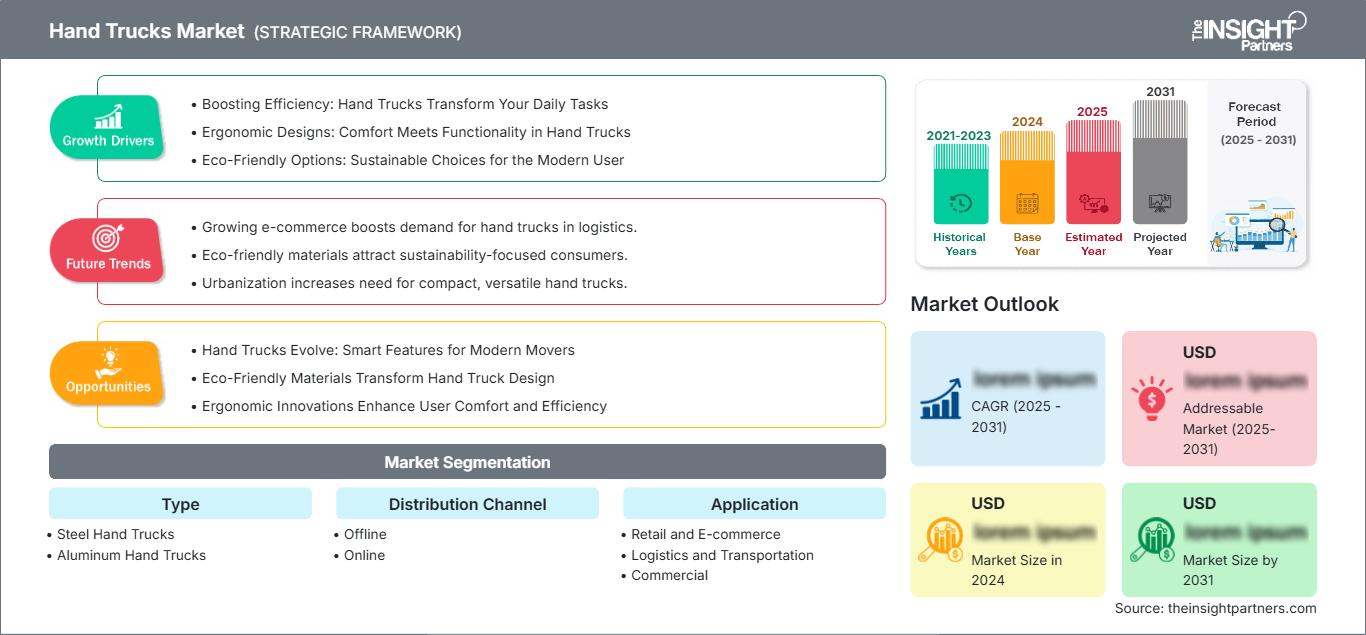
Hand Trucks Market: Strategic Insights
Regional Insights
North America hand trucks market
North America held 33–36% share in 2025 and is expected to grow at a 2.1–2.5% CAGR through 2034. The hand trucks market share is supported by dense distribution networks, replacement purchases at retail chains, and safety-led procurement among logistics operators. Mature industrial supply channels also make standardized models widely available.
Structural demand is strongest in parcel delivery, beverage distribution, grocery, home improvement, and appliance handling. US manufacturers retain brand recognition, while imports compete in entry-level categories. Ergonomic handles, no-flat tires, stair-assist designs, and convertible platforms are gaining visibility as employers target lower injury risk and better route productivity in labor-constrained operations.
U.S. Hand Pallet Truck Market
The US represented 78–82% of the North American hand trucks market in 2025 and is forecast to grow at a 2.0–2.4% CAGR during 2026–2034. Demands are supported by networked packages, replenishment of large retail boxes, foodservice logistics, and contracting. The brands have very good standing in luxury, convertible, and industrial items.
Harper Trucks, Inc., Magline, Inc., Gleason Industrial Products, Inc., Wesco Industrial Products, LLC, and COSCO Products are key to nationwide reach via catalogs, distributors, and online sellers. Trends in usage suggest aluminum trucks for deliveries, steel for warehouse loading, and special appliances for home logistics.
Europe Hand Pallet Truck Market
Europe accounted for 24–27% share of the hand trucks market in 2025 and is projected to expand at a 1.8–2.2% CAGR to 2034. Germany leads regional demand because manufacturing, wholesale, and engineered logistics users value durable equipment. The UK shows stable replacement demand from retail fulfillment, parcel depots, and building trade distribution.
France, Italy, and Spain contribute through foodservice, hospitality supply, light manufacturing, and urban delivery applications. European buyers often prioritize workplace safety compliance, compact storage, noise reduction, and wheel quality. BIL Group and specialist distributors compete with imports by offering differentiated materials, spare parts, and application-specific load ratings for commercial users.
APAC Hand Pallet Truck Market
APAC held 27–30% share in the Hand Trucks Market in 2025 and is expected to register a 2.8–3.3% CAGR during 2026–2034, making it the fastest regional block. China takes the lead in manufacturing and domestic logistics volumes, whereas India generates more demand through warehousing, modern retailing, and the growing third-party logistics sector. The increase in online trading operations, distribution networks, and material handling needs in factories, warehouses, and business establishments will continue to drive growth in the industry.
Japan, South Korea, and Australia generate high-end replacement demand because of their need for reliability, space-saving capabilities, and safe documentation. Industrial estates, export manufacturing, and logistics infrastructure through policy support contribute to equipment adoption. Qingdao Huatian Hand Truck Co., Ltd. enjoys fabrication expertise and export-driven logistics chains within the region.
Middle East & Africa Hand Pallet Truck Market
The Middle East & Africa Hand Trucks Market is forecast to grow at a 2.3–2.8% CAGR during 2026–2034. Saudi Arabia leads incremental demand through large-scale infrastructure development, retail expansion, warehousing investments, and industrial diversification projects. The UAE has a strong advantage due to its function as a regional logistics center, facilitated by increased online shopping, hospitality logistics, FTZs, and cargo services at airports. For the larger region as a whole, the demand for hand trucks is fueled by the need for material handling in logistics centers, retail centers, manufacturing plants, and businesses looking for affordable handling equipment.
The demand from South Africa and the rest of MEA comes from mining services, commercial maintenance, wholesale logistics, and small retail businesses. Heavy-duty hand trucks made from steel would be preferred in energy logistics and construction logistics, whereas corrosion-proof hand trucks are becoming increasingly popular in retail environments.
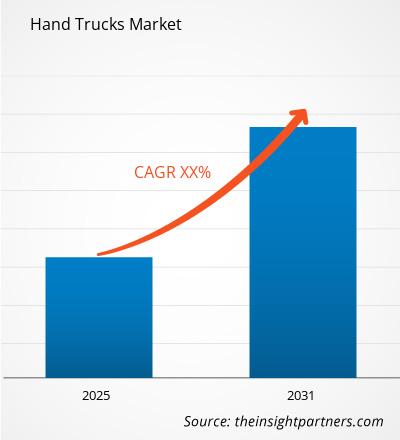
Segmentation Analysis
Type
The Type segment is expected to grow at a 2.1–2.5% CAGR during 2026–2034. The hand trucks market scope remains concentrated in steel and aluminum formats, with steel serving heavy-duty industrial users and aluminum addressing route delivery, retail, and household handling, where lower equipment weight improves productivity and user comfort.
- Steel Hand Trucks dominate industrial, warehouse, and commercial applications because buyers prioritize load capacity, weld strength, and long service life in demanding environments with frequent heavy carton or equipment movement.
- Aluminum Hand Trucks are preferred in route delivery, retail, and household use where lighter frames, corrosion resistance, and easier maneuverability support frequent loading, unloading, and compact storage needs.
Distribution Channel
The Distribution Channel segment of the Hand Trucks Market is projected to grow at a 2.3–2.7% CAGR during 2026–2034. Offline channels continue to lead because industrial buyers often inspect product durability, load capacity, and build quality before purchase, while also relying on distributor expertise, after-sales support, and maintenance services. Online channels are expanding steadily through searchable specifications, easy product comparisons, broader product availability, and faster replenishment options for small businesses, warehouses, retail operators, and household users.
- Offline remains important for industrial accounts, repair shops, contractors, and facility managers who require product demonstrations, negotiated pricing, service support, and confidence in load ratings before purchase.
- Online is gaining relevance among small enterprises and consumers because product filters, reviews, and direct shipment make it easier to compare aluminum, steel, foldable, and convertible models.
Application
The Application segment is forecast to record a 2.4–2.8% CAGR during 2026–2034. Retail and e-commerce, logistics, commercial facilities, warehouses, and households use hand trucks to reduce manual lifting, improve small-load movement, and support safe handling where powered equipment is unnecessary or space-constrained.
- Retail and E-commerce leads usage as stores, parcel points, and fulfillment teams move cartons, returns, displays, and packaged goods through tight aisles, backrooms, and delivery staging zones.
- Logistics and transportation require durable, maneuverable equipment for route delivery, cross-dock transfers, and shipment staging, where speed and reduced lifting strain directly affect labor productivity.
- Commercial demand comes from offices, hospitality, schools, healthcare facilities, and service providers that need compact tools for supplies, maintenance items, furniture, and recurring operational movement.
- Warehouses use hand trucks for low-volume picks, maintenance support, overflow handling, and areas where forklifts are inefficient, unavailable, or unsuitable for narrow movement paths.
- Households adopt lightweight and foldable models for appliance movement, relocation, gardening materials, and occasional heavy lifting, with purchase decisions influenced by price, storage, and ease of use.
Opportunity Snapshot
| Segment Name | Revenue Contribution | Trend Tag | Adoption Stage |
| Retail and E-commerce | High | Parcel Flow | Mature |
| Logistics and Transportation | High | Route Density | Scaling |
| Commercial | Medium | Facility Moves | Mature |
| Warehouses | Medium | Micro Fulfillment | Scaling |
| Households | Low | DIY Handling | Emerging |
Hand Trucks Market Growth Drivers and Impact Analysis
Omnichannel Fulfillment Raises Manual Handling Intensity
Stores are being used by retailers as places to sell, to pick up, to make returns, and as local fulfillment centers, thus creating more internal movement of products in limited space. Hand trucks fill the niche between manually carried goods and mechanically transported goods in situations where the goods are too heavy for humans to carry, but still light enough not to require forklifts. Their effect is most pronounced on the markets of groceries, home improvement, package picking, and specialty retailing because of the repetitive need to replace the carts.
Workplace Safety Programs Support Equipment Standardization
Material handling equipment has been adopted by employers to ease the burden of lifting and repetitive strain injury in the workplace. The use of hand trucks is an appropriate safety intervention because it is affordable and can be easily utilized without disrupting operations in the organization. Instead of purchasing generic equipment, procurement departments are now concerned with load capacity, wheels, handles, and frame design. This enables the suppliers who incorporate the safety attributes and durability of the equipment to have replacement cycles on a premium basis.
Industrial Distribution Channels Improve Product Availability
Comparison and replenishment have become more feasible due to industrial distributors, marketplaces, and catalogs from the manufacturers. Before purchasing, the buyer is able to select between load capacity, types of frames and wheels, and other specific models of hand trucks. The result is a shortened purchasing process for small and medium-sized businesses. Also, increased availability helps decrease equipment downtime in case it breaks down, since it is very important for delivering goods by route and for warehousing. It helps distributors that have a wide range of stock-keeping units and spare parts, since customers want to have a homogeneous fleet.
Hand Trucks Market Future Trends
Ergonomic Convertible Designs Move into Mainstream Fleets
The hand trucks market trends point toward wider adoption of convertible designs that switch between two-wheel and four-wheel operation, reducing the need for multiple tools. New models are expected to come equipped with better grip positioning, enhanced conversion devices, quiet wheels, and accessory attachments for straps or containment. These features will be especially important during deliveries on routes and replenishment of retail locations, where one employee works with different weights of loads in and around their trucks, on sidewalks, in stock rooms, and in customers' locations. Providers who incorporate ergonomics and ruggedness will enjoy greater appeal.
Digital Catalogs Enable Specification-Led Purchasing
Procurement on the Internet will move from merely price-driven searching to specification-driven purchasing due to better filters for material, capacity, wheel types, folded size, and intended use by distributors. Companies with clear technical data sheets, demonstration videos, visible replacement parts, and a consistent nomenclature will have an advantage in this new scenario. Small companies will purchase professional-grade equipment on the Internet after making a comparison of total value over the life cycle, whereas large companies will standardize their equipment through digital catalogs.
Hand Trucks Market Opportunities
Fleet Replacement Programs for Route Delivery Operators
Route delivery operators offer a clear opportunity because equipment reliability directly affects daily productivity, worker safety, and vehicle turnaround. Suppliers can package the hand trucks market forecasts into replacement-cycle planning, helping distributors justify standardized fleets by route type, load profile, and service geography. Value-added programs could include spare wheel kits, maintenance guidance, operator training, and application-specific configurations for beverage, parcel, foodservice, and appliance delivery. Manufacturers that sell through both distributors and direct digital channels can capture recurring orders by aligning product refreshes with fleet audits rather than waiting for failure-driven purchases.
Lightweight Models for Emerging Urban Commerce
Emerging urban commerce creates an investment opportunity for aluminum, foldable, and compact hand trucks suited to small storefronts, delivery partners, and households with limited storage. Growth corridors in India, Southeast Asia, the Gulf, and Latin America have rising parcel volumes but uneven access to powered handling equipment. Suppliers can localize pricing, packaging, and after-sales support for these users while preserving load safety. Partnerships with online marketplaces, building supply retailers, and logistics service providers can accelerate adoption among first-time buyers seeking affordable productivity tools.
Recent Developments
- January 2026: Magline, Inc. released the next-generation Gemini Convertible Hand Truck with bent-back handle, rotating grip, frame end caps, improved latch lock, added cross brace, and higher capacity ratings across Junior, Senior, and XL models. The launch targeted route delivery users seeking safer conversion, better ergonomics, and improved frame integrity.
- September 2025: Jungheinrich is commencing the sale of its new portfolio of vehicles for the entry-level segment under the brand “AntOn by Jungheinrich”. The launch will kick off with the CBH 2.5 and 3.0 electric forklift trucks and the PTL 1.5 pallet truck, all of which guarantee reliable performance and feature modern lithium-ion technology.
Frequently Asked Questions

- Comprehensive Market Sizing and Forecast Analysis
- Detailed Segmentation Analysis
- In-Depth Market Dynamics Assessment
- Regional and Country-Level Insights
- Competitive Landscape and Company Benchmarking
- Strategic Business Intelligence
Recent Reports
Testimonials

The Insight Partners' SCADA System Market report is comprehensive, with valuable insights on current trends and future forecasts. The team was highly professional, responsive, and supportive throughout. We are very satisfied and highly recommend their services.
RAN KEDEM Partner, Reali Technologies LTDs
I requested a report on a very specific software market and the team produced the report in a few days. The information was very relevant and well presented. I then requested some changes and additions to the report. The team was again very responsive and I got the final report in less than a week.
JEAN-HERVE JENN Chairman, Future Analytica
We worked with The Insight Partners for an important market study and forecast. They gave us clear insights into opportunities and risks, which helped shape our plans. Their research was easy to use and based on solid data. It helped us make smart, confident decisions. We highly recommend them.
PIYUSH NAGPAL Sr. Vice President, High Beam Global
The Insight Partners delivered insightful, well-structured market research with strong domain expertise. Their team was professional and responsive throughout. The user-friendly website made accessing industry reports seamless. We highly recommend them for reliable, high-quality research services
YUKIHIKO ADACHI CEO, Deep Blue, LLC.
This is the first time I have purchased a market report from The Insight Partners.While I was unsure at first, I visited their web site and felt more comfortable to take the risk and purchase a market report.I am completely satisfied with the quality of the report and customer service. I had several questions and comments with the initial report, but after a couple of dialogs over email with their analyst I believe I have a report that I can use as input to our strategic planning process.Thank you so much for taking the extra time and making this a positive experience.I will definitely recommend your service to others and you will be my first call when we need further market data.
JOHN SUZUKI President and Chief Executive Officer, Board Director, BK Technologies
I wish to appreciate your support and the professionalism you displayed in the course of attending to my request for information regarding to infectious disease IVD market in Nigeria. I appreciate your patience, your guidance, and the fact that you were willing to offer a discount, which eventually made it possible for us to close a deal. I look forward to engaging The Insight Partners in the future, all thanks to the impression you have created in me as a result of this first encounter.
DR CHIJIOKE ONYIA MANAGING DIRECTOR, PineCrest Healthcare Ltd.Reason to Buy
- Informed Decision-Making
- Understanding Market Dynamics
- Competitive Analysis
- Identifying Emerging Markets
- Customer Insights
- Market Forecasts
- Risk Mitigation
- Boosting Operational Efficiency
- Strategic Planning
- Investment Justification
- Tracking Industry Innovations
- Aligning with Regulatory Trends





 Get Free Sample for