
High Flow Ventilators Market Share, Growth & Demand by 2034
High Flow Ventilators Market Size and Forecasts (2021–2034), Global and Regional Share, Trends, and Growth Opportunity Analysis Report Coverage : by Modality (Portable High Flow Ventilators and Trolley Mounted High Flow Ventilators); End User (Hospitals, Ambulatory Surgical Centers, Other End Users); and Geography (North America, Europe, Asia Pacific, and South and Central America)
- Status : Data Released
- Report Code : TIPRE00040827
- Category : Life Sciences
- No. of Pages : 150
- Available Report Formats :


- Last update date : May 26, 2026


2025 Market Size
US$ 2.69 Bn
Base year value
2034 Forecast
US$ 5.64 Bn
Projected by 2034
CAGR 2026-2034
8.57 %
Growth rate
Addressable Market
US$ 37.35 Bn
(2026-2034)
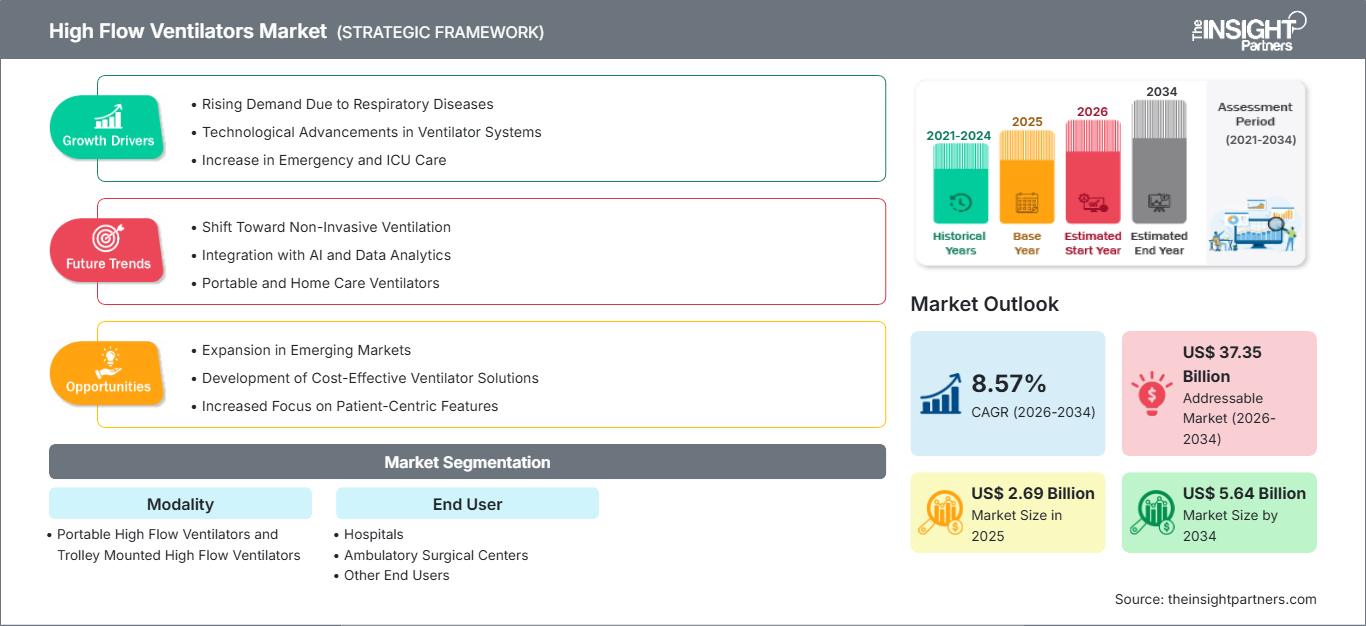
The High Flow Ventilators market was valued at US$ 2.69 billion in 2025 and is expected to reach US$ 5.64 billion by 2034; it is estimated to record a CAGR of 8.57% during 2026-2034.
The report is segmented By Modality (Portable High Flow Ventilators and Trolley Mounted High Flow Ventilators), End User (Hospitals, Ambulatory Surgical Centers, and Other End Users). The global analysis is further broken-down at regional level and major countries. The Report Offers the Value in USD for the above analysis and segments.
Purpose of the Report
The report High Flow Ventilators Market by The Insight Partners aims to describe the present landscape and future growth, top driving factors, challenges, and opportunities. This will provide insights to various business stakeholders, such as:
- Technology Providers/Manufacturers: To understand the evolving market dynamics and know the potential growth opportunities, enabling them to make informed strategic decisions.
- Investors: To conduct a comprehensive trend analysis regarding the market growth rate, market financial projections, and opportunities that exist across the value chain.
- Regulatory bodies: To regulate policies and police activities in the market with the aim of minimizing abuse, preserving investor trust and confidence, and upholding the integrity and stability of the market.
High Flow Ventilators Market Segmentation Modality
- Portable High Flow Ventilators and Trolley Mounted High Flow Ventilators
End User
- Hospitals
- Ambulatory Surgical Centers
- Other End Users
Market Research Highlights
- Global market for High Flow Ventilators was valued at US$ 2.69 Billion in 2025
- Annual market size is expected to reach US$ 5.64 Billion by 2034
- Total addressable market (TAM) during 2026-2034 is projected to reach approximately US$ 37.35 Billion
- Market is anticipated to register a CAGR of 8.57% during the forecast period
- The United States represents a key market, supported by Rising Demand Due to Respiratory Diseases, Technological Advancements in Ventilator Systems, Increase in Emergency and ICU Care, as well as evolving industry dynamics
- Market analysis covers North America, Europe, Asia-Pacific, South and Central America, Middle East and Africa, with growth evaluated across the forecast period
- Market opportunities such as Expansion in Emerging Markets, Development of Cost-Effective Ventilator Solutions, Increased Focus on Patient-Centric Features are expected to influence market dynamics and addressable market
- Report profiles industry participants, including Getinge AB, Hamilton Medical, HERSILL, Koninklijke Philips NV, Medtronic PLC, Movair, VYAIRE, Asahi Kasei (ZOLL Medical Corporation), while analyzing competitive strategies and innovation developments
-
Source: The Insight Partners' analysis based on proprietary research, government publications, company annual reports, investor presentations, industry databases, and expert interviews.
● REPORT CUSTOMIZATION
Tailor This Report To Align With Your Specific Business Requirements
This report can be customized to align precisely with your business objectives, scope, and target markets. Customization options include tailored segmentation, geography, competitive analysis, and strategic insights to support informed decision-making.
Customize This Report →WHAT YOU CAN ADJUST
- ● Segmentations
- ● Geography
- ● Competitive Analysis
- ● Language Preferences
High Flow Ventilators Market: Strategic Insights
-
Get Top Key Market Trends of this report.This FREE sample will include data analysis, ranging from market trends to estimates and forecasts.
High Flow Ventilators Market Growth Drivers
- Rising Demand Due to Respiratory Diseases: The increasing prevalence of respiratory diseases such as COPD, pneumonia, and COVID-19 is a major driver for the high flow ventilators market. These conditions often require advanced respiratory support, and high-flow nasal cannula (HFNC) ventilators have become a critical tool in managing hypoxemia, improving patient outcomes, and reducing the need for invasive ventilation.
- Technological Advancements in Ventilator Systems: Technological innovations in ventilator systems, including enhanced oxygen delivery, improved patient monitoring, and ease of use, are driving the high flow ventilators market. These advancements provide more precise respiratory support, ensuring better outcomes for patients with severe respiratory conditions. The demand for ventilators with integrated real-time monitoring and automatic adjustments is fueling market growth.
- Increase in Emergency and ICU Care: With rising numbers of critical patients requiring emergency respiratory support, the need for high flow ventilators in intensive care units (ICUs) and emergency departments is growing. Hospitals are prioritizing the procurement of advanced ventilator systems to handle increased patient loads, particularly during respiratory surges caused by infections or accidents, which directly impacts the market.
High Flow Ventilators Market Future Trends
- Shift Toward Non-Invasive Ventilation: A growing trend in the high flow ventilator market is the shift towards non-invasive ventilation methods. High-flow nasal cannula systems, which deliver oxygen at higher flow rates without the need for intubation, are gaining popularity. This trend is driven by the desire to minimize complications associated with invasive procedures, promoting patient comfort and reducing healthcare costs.
- Integration with AI and Data Analytics: The integration of artificial intelligence (AI) and data analytics into high flow ventilators is transforming the market. These smart systems offer real-time monitoring and predictive analytics to optimize ventilation settings based on patient condition. By improving accuracy and enabling better decision-making, AI-enabled ventilators are expected to become more prevalent, improving patient outcomes and streamlining clinical workflows.
- Portable and Home Care Ventilators: A significant trend in the market is the development of portable and home care high flow ventilators. These devices allow for better patient management outside of the hospital, particularly for individuals with chronic respiratory conditions. As home healthcare becomes more prevalent, the demand for compact, easy-to-use ventilators that support long-term respiratory therapy is rising.
High Flow Ventilators Market Opportunities
- Expansion in Emerging Markets: Emerging markets, particularly in regions like Asia-Pacific and Latin America, offer significant opportunities for high flow ventilator manufacturers. As healthcare infrastructure improves and demand for advanced medical technologies grows, the adoption of high flow ventilators is increasing. Expansion into these regions can provide new growth opportunities for companies in this market.
- Development of Cost-Effective Ventilator Solutions: There is an opportunity for manufacturers to develop cost-effective high flow ventilator solutions, especially for low- and middle-income countries. By providing affordable, reliable, and efficient ventilators, companies can address the rising demand in underserved regions, where the need for advanced respiratory support is growing but budgets are limited.
- Increased Focus on Patient-Centric Features: As healthcare providers seek to improve patient comfort and outcomes, there is an opportunity to develop high flow ventilators with enhanced patient-centric features. These features could include noise reduction, easy adjustability, better comfort for long-term use, and seamless integration with other patient care systems. This focus on patient experience will create new market opportunities for innovative products.
High Flow Ventilators Market Report Scope
| Report Attribute | Details |
|---|---|
| Market size in 2025 | US$ 2.69 Billion |
| Market Size by 2034 | US$ 5.64 Billion |
| Global CAGR (2026 - 2034) | 8.57% |
| Historical Data | 2021-2024 |
| Forecast period | 2026-2034 |
| Segments Covered |
By Modality
|
| Regions and Countries Covered |
North America
|
| Market leaders and key company profiles |
|
High Flow Ventilators Market Players Density: Understanding Its Impact on Business Dynamics
The High Flow Ventilators Market is growing rapidly, driven by increasing end-user demand due to factors such as evolving consumer preferences, technological advancements, and greater awareness of the product's benefits. As demand rises, businesses are expanding their offerings, innovating to meet consumer needs, and capitalizing on emerging trends, which further fuels market growth.
Key Selling Points
- Comprehensive Coverage: The report comprehensively covers the analysis of products, services, types, and end users of the High Flow Ventilators Market, providing a holistic landscape.
- Expert Analysis: The report is compiled based on the in-depth understanding of industry experts and analysts.
- Up-to-date Information: The report assures business relevance due to its coverage of recent information and data trends.
- Customization Options: This report can be customized to cater to specific client requirements and suit the business strategies aptly.
The research report on the High Flow Ventilators Market can, therefore, help spearhead the trail of decoding and understanding the industry scenario and growth prospects. Although there can be a few valid concerns, the overall benefits of this report tend to outweigh the disadvantages.
Frequently Asked Questions

- Comprehensive Market Sizing and Forecast Analysis
- Detailed Segmentation Analysis
- In-Depth Market Dynamics Assessment
- Regional and Country-Level Insights
- Competitive Landscape and Company Benchmarking
- Strategic Business Intelligence
Recent Reports
Testimonials

The Insight Partners provided valuable market intelligence that supported our global go-to-market strategy. Their team was professional, responsive, and attentive to our feedback, providing thoughtful analysis and helpful methodological clarifications throughout the project.
Junmo Kim Chief Financial Officer (CFO), Enertech Co., Ltd.
The Insight Partners' SCADA System Market report is comprehensive, with valuable insights on current trends and future forecasts. The team was highly professional, responsive, and supportive throughout. We are very satisfied and highly recommend their services.
RAN KEDEM Partner, Reali Technologies LTDs
I requested a report on a very specific software market and the team produced the report in a few days. The information was very relevant and well presented. I then requested some changes and additions to the report. The team was again very responsive and I got the final report in less than a week.
JEAN-HERVE JENN Chairman, Future Analytica
We worked with The Insight Partners for an important market study and forecast. They gave us clear insights into opportunities and risks, which helped shape our plans. Their research was easy to use and based on solid data. It helped us make smart, confident decisions. We highly recommend them.
PIYUSH NAGPAL Sr. Vice President, High Beam Global
The Insight Partners delivered insightful, well-structured market research with strong domain expertise. Their team was professional and responsive throughout. The user-friendly website made accessing industry reports seamless. We highly recommend them for reliable, high-quality research services
YUKIHIKO ADACHI CEO, Deep Blue, LLC.
This is the first time I have purchased a market report from The Insight Partners.While I was unsure at first, I visited their web site and felt more comfortable to take the risk and purchase a market report.I am completely satisfied with the quality of the report and customer service. I had several questions and comments with the initial report, but after a couple of dialogs over email with their analyst I believe I have a report that I can use as input to our strategic planning process.Thank you so much for taking the extra time and making this a positive experience.I will definitely recommend your service to others and you will be my first call when we need further market data.
JOHN SUZUKI President and Chief Executive Officer, Board Director, BK Technologies
I wish to appreciate your support and the professionalism you displayed in the course of attending to my request for information regarding to infectious disease IVD market in Nigeria. I appreciate your patience, your guidance, and the fact that you were willing to offer a discount, which eventually made it possible for us to close a deal. I look forward to engaging The Insight Partners in the future, all thanks to the impression you have created in me as a result of this first encounter.
DR CHIJIOKE ONYIA MANAGING DIRECTOR, PineCrest Healthcare Ltd.Reason to Buy
- Informed Decision-Making
- Understanding Market Dynamics
- Competitive Analysis
- Identifying Emerging Markets
- Customer Insights
- Market Forecasts
- Risk Mitigation
- Boosting Operational Efficiency
- Strategic Planning
- Investment Justification
- Tracking Industry Innovations
- Aligning with Regulatory Trends





 Get Free Sample for