
Hoist Chains Market Trends, Size & Growth by 2034
Coverage: By Type (Surface Hardened, Quenched and Tempered, Others); End-user Industry (Construction, Marine and Port Infrastructure, Manufacturing, Metals and Mining, Others) , and Geography (North America, Europe, Asia Pacific, and South and Central America)
- Status : Data Released
- Report Code : TIPRE00017026
- Category : Manufacturing and Construction
- No. of Pages : 150
- Available Report Formats :


- Last update date : August 17, 2026


2025 Market Size
US$ 2.81 Bn
Base year value
2034 Forecast
US$ 3.97 Bn
Projected by 2034
CAGR 2026-2034
3.92 %
Growth rate
Addressable Market
US$ 30.80 Bn
(2026-2034)
The hoist chains market was valued at US$ 2.81 Billion in 2025 and is projected to reach US$ 3.97 Billion by 2034. The market is expected to register a CAGR of 3.92% during 2026–2034. Demand reflects the essential role of calibrated load chains in lifting systems used across construction, marine and port infrastructure, manufacturing, and metals and mining, where dependable load transfer, dimensional accuracy, and fatigue resistance are fundamental operating requirements.
Within North America, the hoist chains market size is expected to advance at a modelled 3.2–3.8% CAGR through 2034. Replacement demand from aging factory lifting fleets and sustained port, logistics, and public infrastructure investment support consumption. Buyers increasingly specify traceable alloy steel, proof-tested links, and documented inspection regimes, while reshoring-related capital expenditure raises requirements for reliable lifting components in automotive, general manufacturing, metals processing, and warehouse maintenance applications.
Hoist Chains Market Assessment and Insights
- North America: A modelled 22–25% share in 2025 and 3.2–3.8% CAGR during 2026–2034 reflect replacement cycles, reshoring investment, port upgrades, and rigorous lifting-safety practices.
- US: The country represented a modelled 78–82% of North America in 2025 and is projected to grow at 3.3–3.9% through 2034.
- Europe: A modelled 25–28% share in 2025 and 3.0–3.6% CAGR through 2034 are supported by Germany, the UK, France, Italy, and Spain.
- Asia Pacific: A modelled 38–42% share in 2025 and 4.5–5.1% CAGR through 2034 position China, Japan, India, and South Korea at the center of expansion.
- Largest Segment: Manufacturing held a modelled 34–38% market share in 2025 and is expected to register a 3.7–4.3% CAGR during 2026–2034.
- High Growth Segment: Marine and Port Infrastructure held a modelled 16–20% market share in 2025 and is forecast to expand at 4.6–5.2% during 2026–2034.
- Key companies analyzed in detail: Columbus McKinnon Corporation, Gunnebo Industries AB, Pewag International GmbH, RUD Ketten Rieger & Dietz GmbH u. Co. KG, THIELE GmbH & Co. KG, William Hackett Chains Limited, YOKE Industrial Corp., KWB Ketten Austria GmbH, D.I.D Co., Ltd., and Peerless Industrial Group, Inc.
Source: The Insight Partners' analysis based on proprietary research, government publications, company annual reports, investor presentations, industry databases, and expert interviews.
Manufacturing methods have been improved by moving away from traditional batch forging to precise welding, heat-treatment operations, automatic inspection, proof loading, and electronic tracking. Case-hardened materials keep their hard wear-resistant surface layer but a stronger core. Quenched and tempered chains are used for applications where strength is required throughout the chain link. Composition of steel, welding consistency, pitch tolerances, and compatibility with pocket wheels have become more important factors in life-cycle economics than capacity alone. Setup times are being reduced via adaptable production lines capable of producing calibrated sizes and specialized finishes.
Till 2034, expansion will shift towards industrial belts of Asia, logistics centers of the Gulf region, and mining areas of Africa, while advanced economies will focus on replacement and maintenance. Infrastructure projects, port automation and incentives to manufacture locally lead to the need for certification and reliable technical service. Tailwinds will come from regulations on machine safety, proof testing and inspection procedures. Funding will thus prefer companies with metallurgical expertise, calibration experience, regional inventory and quick failure analysis over those solely focused on cost competition.
Hoist Chains Market Report Scope
| Report Attribute | Details |
|---|---|
| Market size in 2025 | US$ 2.81 Billion |
| Market Size by 2034 | US$ 3.97 Billion |
| Global CAGR (2026 - 2034) | 3.92% |
| Historical Data | 2021-2024 |
| Forecast period | 2026-2034 |
Hoist Chains Market Analysis
The hoist chains market growth is anchored in recurring replacement rather than one-time equipment sales. Renewal through inspections is created by the wearing, elongating, corroding, and overloading that occur in the cranes and hoists. The demand goes from the alloy-steel producers to the chain producers, original equipment manufacturers, inspectors, distributors, and ultimately to the end user. Acceptance is based on certified steel, quality welding, calibration of pitch, and proof load tests.
The supply is price-sensitive to special alloy steels, energy consumption in heat treatments, and time to qualify. The small percentage that the component represents in the cost of the lifting system assures that superior quality is maintained, where failure would be very costly. Chain sizes are increasingly matched to the geometry and lubrication needs of the wheels, providing improved interaction and longevity. The distributor provides value by cutting, certification, inspection assistance, and emergency replacement.
The hoist chains market analysis indicates a fragmented specialist field with meaningful barriers in metallurgy, process control, and certification. Columbus McKinnon Corporation and Peerless Industrial Group, Inc. combine chain capability with broader lifting portfolios, while Gunnebo Industries AB, Pewag International GmbH, RUD Ketten Rieger & Dietz GmbH and. Co. KG, and THIELE GmbH & Co. KG emphasize engineered chain systems, traceability, and application expertise.
William Hackett Chains Limited, YOKE Industrial Corp., KWB Ketten Austria GmbH, and D.I.D Co., Ltd. intensify competition through specialized lines and local networks. Key investment areas will be automatic inspections, low-emission heat treatments, electronic parts databases, and stock locations that are close to their customers. Competitive positioning will depend more and more on fatigue resistance performance, compatibility assistance, and quick deliveries. Business portfolio actions also become important; consolidation may expand distribution and cross-selling, whereas divestment may produce chain specialists.
● REPORT CUSTOMIZATION
Tailor This Report To Align With Your Specific Business Requirements
This report can be customized to align precisely with your business objectives, scope, and target markets. Customization options include tailored segmentation, geography, competitive analysis, and strategic insights to support informed decision-making.
Customize This Report →WHAT YOU CAN ADJUST
- ● Segmentations
- ● Geography
- ● Competitive Analysis
- ● Language Preferences
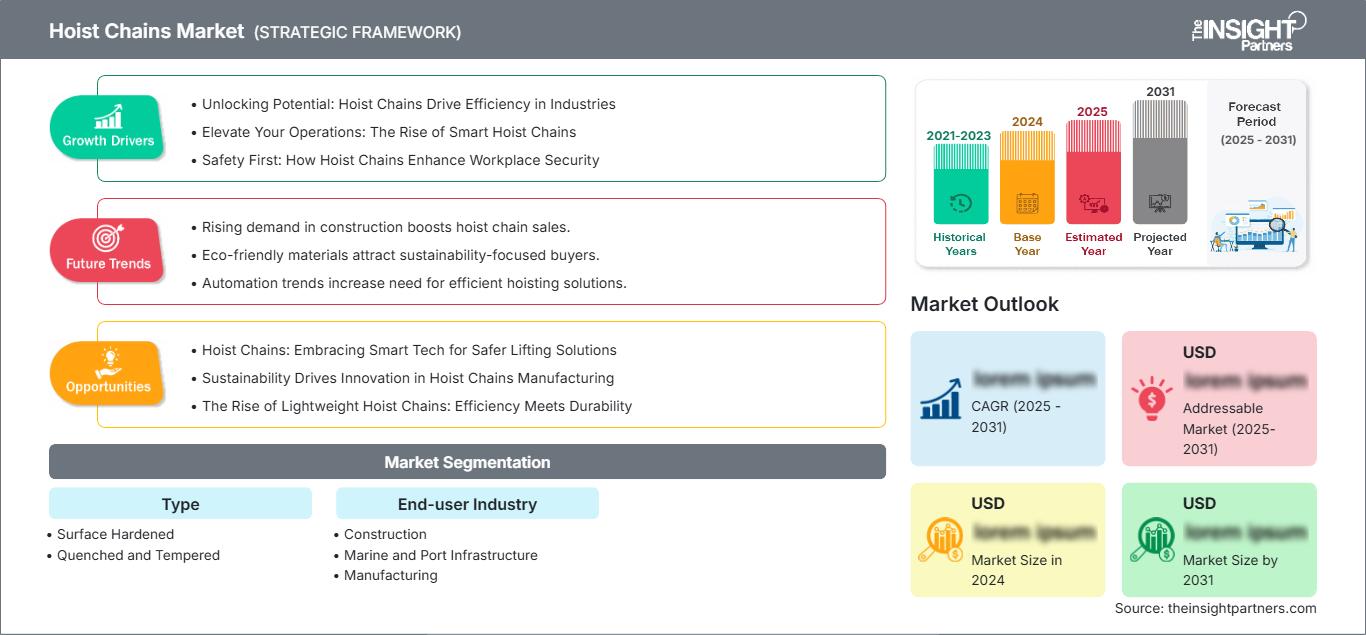
Hoist Chains Market: Strategic Insights
Regional Insights
North America Hoist Chains Market
North America accounted for a modelled 22–25% of the global hoist chains market share in 2025 and is projected to grow at 3.2–3.8% during 2026–2034. This market features a strong existing stock of overhead lifting equipment along with ongoing inspection, maintenance, and replacement programs. Chain purchasers include automotive manufacturers, steel distributors, machinery producers, utilities companies, warehouses, and construction contractors seeking calibrated chains with reliable engagement, proven load-bearing capacity, and quick replacement capability.
Underlying demand is supplemented by manufacturing reshoring, port upgrades, and increased logistics capabilities. The buyer decision-making process now includes considerations such as lifecycle cost, domestic availability, and product traceability beyond initial purchase price. In terms of consumption, the United States ranks first in the region, followed by Canada’s contributions from mining, energy, forestry, and infrastructure applications. Growing auto and industry production in Mexico drives original-equipment and aftermarket purchases. Distributor-trained, inspection-qualified suppliers with fast delivery times are well placed to benefit from both outages and planned replacements without requiring users to stockpile inventory.
U.S. Hoist Chains Market
The United States represented a modelled 78–82% of North American hoist chains market demand in 2025 and is expected to register a 3.3–3.9% CAGR through 2034. The company’s varied installed base includes applications for automotive assembly lines, aerospace, fabricated metals, general industry, warehouses, shipyards, construction, and mining. Decisions to replace are often made on the basis of elongation, damage, corrosion, or a mismatch with load wheels, and hence there is a commercial need for inspection capability and easy access to correctly calibrated chains.
Columbus McKinnon Corporation and Peerless Industrial Group, Inc. offer established domestic brands and channel representation, and foreign competitors offer specialized product lines and distribution channels. Customer requirements are shifting towards automation, maintenance-free hoists, and traceability. Applications at ports and industrial installations seek corrosion protection and fatigue durability. Buyers are rationally justifying the approved vendor list approach, which favors those suppliers who can trace the source of material, testing, dimensions, lubrication, and compatibility with a range of hoists.
Europe Hoist Chains Market
Europe held a modelled 25–28% share of the hoist chains market in 2025 and is forecast to expand at a 3.0–3.6% CAGR during 2026–2034. Germany leads through machinery production, automotive manufacturing, steel processing, and a dense network of lifting specialists. Its users prioritize dimensional accuracy, fatigue life, and conformity documentation, sustaining demand for premium replacement chains even as industrial output fluctuates.
The UK benefits from ports, offshore maintenance, construction, and inspection-led replacement. France combines aerospace, transport equipment, energy, and infrastructure demand. Italy’s machinery and fabrication clusters support specialist distribution, while Spain adds shipbuilding, renewable-energy installation, and logistics activity. Regional suppliers possess deep metallurgical and certification expertise. Energy costs and slower capital spending constrain volumes, but safety-critical replacement, factory automation, and refurbishment of installed hoists provide resilient demand across mature end-user sectors.
APAC Hoist Chains Market
Asia Pacific held a modelled 38–42% share in 2025 and is projected to record a 4.5–5.1% CAGR through 2034. China leads through scale in machinery, metals, shipbuilding, construction, and ports, while Japan and South Korea sustain high-specification replacement demand.
India contributes the strongest incremental opportunity from industrial corridors, infrastructure, mining, and domestic manufacturing incentives. Australia adds mining, ports, and maintenance-intensive applications. Automation policies, export manufacturing, and capacity additions promote demand, although intense local price competition encourages global suppliers to differentiate through certification, consistency, and application support.
Middle East & Africa Hoist Chains Market
The Middle East and Africa are expected to expand at a modelled 4.0–4.6% CAGR through 2034. Saudi Arabia leads in logistics, construction, mining, and industrial diversification projects, which increase lifting requirements. The UAE contributes ports, ship repair, warehousing, and energy services.
South Africa anchors mining and heavy-industry demand, while the rest of the region offers project-led opportunities in ports, power, and extractive industries. Harsh environments elevate corrosion resistance, maintenance support, and stock availability. Distributor capability is decisive because users often need technical selection and rapid replacement across widely dispersed sites.
Segmentation Analysis
Type
Type is projected to advance at a modelled 3.6–4.2% CAGR during 2026–2034. The hoist chains market scope by type centers on controlling the trade-off among surface wear, core toughness, fatigue resistance, and dimensional stability. Power-driven hoists favor calibrated chains engineered for repeated load-wheel engagement, while manual and severe-duty applications may prioritize through-section strength and impact tolerance. Selection increasingly reflects duty class, environment, lubrication, inspection practice, and original-equipment compatibility.
- Surface Hardened: These chains lead wear-intensive powered hoist applications because a hard outer case resists link contact and pocket-wheel wear while a tougher core supports repeated dynamic loading.
- Quenched and Tempered: Through-section mechanical properties suit manual hoists and demanding lifting conditions where toughness, strength consistency, and resistance to shock loading are strategically important.
End-user Industry
End-user Industry is projected to grow at a modelled 3.7–4.3% CAGR during 2026–2034. Manufacturing provides the broadest installed base and recurring replacement pool, while marine and port infrastructure offers faster expansion through terminal modernization and shipyard activity. Construction demand follows project cycles and equipment utilization. Metals and mining require high-strength chains, disciplined inspection, and dependable supply because abrasive conditions, shock loads, and remote operations raise the cost of premature failure.
- Construction: Demand follows infrastructure and commercial project pipelines, with portable lifting, site maintenance, and equipment assembly creating repeat purchases where ruggedness and easy replacement matter.
- Marine and Port Infrastructure: Port modernization, shipbuilding, terminal equipment, and offshore maintenance support higher-value demand for corrosion-aware specifications, traceability, and reliable performance under dynamic loading.
- Manufacturing: The largest installed base spans automotive, machinery, aerospace, fabrication, and warehouses, generating steady replacement demand tied to preventive maintenance, automation, and plant uptime.
- Metals and Mining: Severe abrasion, heat, impact, and remote operating conditions make fatigue strength, inspection discipline, and distributor stock strategically critical to continuity.
Opportunity Snapshot
| End-user Industry | Revenue Contribution | Trend Tag | Adoption Stage |
| Construction | Medium | Site Lifting | Scaling |
| Marine and Port Infrastructure | Medium | Port Automation | Scaling |
| Manufacturing | High | Factory Uptime | Mature |
| Metals and Mining | Medium | Severe Duty | Mature |
Hoist Chains Market Growth Drivers and Impact Analysis
Installed-Base Replacement and Safety-Led Maintenance
Hoist chains are safety consumables subject to wear due to articulation, loading, contamination, and cyclic stresses. An inspection procedure checks elongation, loss of diameter, fractures, rusting, and distortion before usability is impaired. Since a new chain will be cheaper than unexpected lift stoppage or machinery breakdowns, consumers have a compelling reason to replace their safety components at established disposal limits. This generates constant demand even when the hoist sales are slow. This effect works best in industries such as manufacturing plants, steel mills, mines, ports, and repair facilities working around the clock. Traceability, compatibility, inspection advice, and proximity of the chains in stock give the suppliers an edge.
Industrial Automation and Higher Equipment Utilization
Automated production processes and material handling systems involve frequent lifts, greater demands for precision and reliability, and costly downtime. The chain in motorized hoists needs to mesh properly with pocket wheels and be capable of remaining consistent in pitch and resistant to wear throughout the operating cycle. With the implementation of robotic workstations and synchronized manufacturing operations by modern factories, the reliability of the chain is essential to production as opposed to simply being an element of maintenance. This leads to the procurement of calibrated products with proof test and heat treatment data. There are more possibilities of condition monitoring and proactive replacement of chains as well.
Port, Infrastructure, and Mining Capital Expenditure
Infrastructure projects, terminalling projects, shipyard projects, and mining projects generate demand both during installation and through the use of these facilities. Hoist chains aid in assembly, maintenance, shop work, and lifting applications where space limitations and simplicity in design matter. Ports and marine operations bring in corrosion and dynamic loading issues, while mining adds abrasion and shock considerations. In such environments, it makes sense to have high-end requirements and inventory on hand from distributors. Consequently, these project pipelines in Asia, the Gulf, and select African regions expand our target market to include new project installations beyond industrial replacement. Early product qualification by qualified suppliers with contractors, equipment manufacturers, and maintenance firms can provide ongoing aftermarket sales after installation.
Hoist Chains Market Future Trends
Digital Traceability Becomes a Procurement Standard
Among the leading hoist chains market trends, digital identity will move from premium differentiation toward routine procurement. Codes based on the source of the steel, manufacturing conditions, test results, certificates, and inspection history can decrease retrieval times and improve decision-making regarding maintenance. Inclusion in an asset management system could make it possible for users to tie each replacement to a certain hoist, duty category, and date of service. The advantage is not automatic life prediction, but better support for risk-based inspections and vendor control. Vendors would require permanent coding and recordkeeping, whereas distributors would have to retain traceability when cutting the chain to customer specifications.
Lower-Carbon Metallurgy and Energy-Efficient Processing
Chain makers are going to be under increased pressure to measure the emissions connected with alloy steel, welding, heat treating, and transport. The demands for environmental data, along with the mechanical certification, will come from buyers in Europe and from those supply chains designed for exporting. Responses will have to include renewables, furnace efficiency, recycled content steel, closed-loop process control, and lower scrap rate through automatic inspection. There will be engineering limits imposed since the process of decarbonization cannot result in any deviation from hardness, weld quality, fatigue resistance, and dimensional accuracy.
Hoist Chains Market Opportunities
Regional Service Hubs for Fast Replacement
The hoist chains market forecasts support investment in regional stock, cutting capability, certification handling, and application engineering. Customers frequently discover unacceptable wear during scheduled inspection and cannot wait for long international lead times. A hub-and-spoke service model can hold common calibrated sizes centrally while trained distributors provide rapid local fulfillment. Priority locations include industrial corridors in India and Southeast Asia, Gulf ports, Southern African mining centers, and North American manufacturing clusters. Returns depend on disciplined inventory segmentation, not broad stocking. Suppliers should map installed hoist populations, failure-driven demand, and duty-specific specifications, then pair physical availability with technical verification to prevent unsafe or incompatible substitutions.
Engineered Chains for Corrosive and Hygienic Environments
Marine terminals, wastewater treatment plants, food production, pharmaceutical manufacturing, and chemical processing form niches in which the chain may be subjected to corrosion and contamination at an accelerated pace and thus form areas where standard chain would not be a good choice. The emphasis should be on choosing the correct materials, coating, lubricant, and cleaning properties instead of simply looking for a good-looking product. In order to enter the commercial phase, suppliers must work closely with the original equipment manufacturers in order to ensure proper fit and sizing, wheel interaction, and load capacity.
Recent Developments
- March 2026: Pacific Avenue Capital Partners, a Los Angeles-based private equity firm specializing in complex corporate carve-outs and operationally intensive middle-market investments, has completed the acquisition of the U.S.-based power chain hoist and chain business from Columbus McKinnon Corporation. The transaction also includes the company's international sales support operations, strengthening Pacific Avenue's portfolio in the industrial lifting and material handling sector while enabling the acquired business to continue serving global customers under its new ownership.
- November 2025: Kito Crosby, a leading manufacturer of lifting and securement solutions, proudly announces the launch of the Gunnebo Industries® LPE – a next-generation lifting point engineered to replace traditional eye bolts and redefine safety, performance, and versatility in lifting operations
Frequently Asked Questions

- Comprehensive Market Sizing and Forecast Analysis
- Detailed Segmentation Analysis
- In-Depth Market Dynamics Assessment
- Regional and Country-Level Insights
- Competitive Landscape and Company Benchmarking
- Strategic Business Intelligence
Recent Reports
Testimonials

The Insight Partners provided valuable market intelligence that supported our global go-to-market strategy. Their team was professional, responsive, and attentive to our feedback, providing thoughtful analysis and helpful methodological clarifications throughout the project.
Junmo Kim Chief Financial Officer (CFO), Enertech Co., Ltd.
The Insight Partners' SCADA System Market report is comprehensive, with valuable insights on current trends and future forecasts. The team was highly professional, responsive, and supportive throughout. We are very satisfied and highly recommend their services.
RAN KEDEM Partner, Reali Technologies LTDs
I requested a report on a very specific software market and the team produced the report in a few days. The information was very relevant and well presented. I then requested some changes and additions to the report. The team was again very responsive and I got the final report in less than a week.
JEAN-HERVE JENN Chairman, Future Analytica
We worked with The Insight Partners for an important market study and forecast. They gave us clear insights into opportunities and risks, which helped shape our plans. Their research was easy to use and based on solid data. It helped us make smart, confident decisions. We highly recommend them.
PIYUSH NAGPAL Sr. Vice President, High Beam Global
The Insight Partners delivered insightful, well-structured market research with strong domain expertise. Their team was professional and responsive throughout. The user-friendly website made accessing industry reports seamless. We highly recommend them for reliable, high-quality research services
YUKIHIKO ADACHI CEO, Deep Blue, LLC.
This is the first time I have purchased a market report from The Insight Partners.While I was unsure at first, I visited their web site and felt more comfortable to take the risk and purchase a market report.I am completely satisfied with the quality of the report and customer service. I had several questions and comments with the initial report, but after a couple of dialogs over email with their analyst I believe I have a report that I can use as input to our strategic planning process.Thank you so much for taking the extra time and making this a positive experience.I will definitely recommend your service to others and you will be my first call when we need further market data.
JOHN SUZUKI President and Chief Executive Officer, Board Director, BK Technologies
I wish to appreciate your support and the professionalism you displayed in the course of attending to my request for information regarding to infectious disease IVD market in Nigeria. I appreciate your patience, your guidance, and the fact that you were willing to offer a discount, which eventually made it possible for us to close a deal. I look forward to engaging The Insight Partners in the future, all thanks to the impression you have created in me as a result of this first encounter.
DR CHIJIOKE ONYIA MANAGING DIRECTOR, PineCrest Healthcare Ltd.Reason to Buy
- Informed Decision-Making
- Understanding Market Dynamics
- Competitive Analysis
- Identifying Emerging Markets
- Customer Insights
- Market Forecasts
- Risk Mitigation
- Boosting Operational Efficiency
- Strategic Planning
- Investment Justification
- Tracking Industry Innovations
- Aligning with Regulatory Trends





 Get Free Sample for