
Hopper Loaders Market Size, Demand & Growth by 2034
Coverage: by Product (Single Phase Hopper Loaders, 3-Phase Hopper Loaders); End-user (Plastic Processing, Chemical Industries, Food Industries, Others) , and Geography (North America, Europe, Asia Pacific, and South and Central America)
- Status : Data Released
- Report Code : TIPRE00007957
- Category : Manufacturing and Construction
- No. of Pages : 150
- Available Report Formats :


- Last update date : November 09, 2026


2025 Market Size
US$ 2.21 Bn
Base year value
2034 Forecast
US$ 3.67 Bn
Projected by 2034
CAGR 2026-2034
5.79 %
Growth rate
Addressable Market
US$ 26.63 Bn
(2026-2034)
The Hopper Loaders Market was valued at US$ 2.21 Billion in 2025 and is projected to reach US$ 3.67 Billion by 2034, registering a CAGR of 5.79% during 2026–2034. The market covers vacuum-based material-conveying equipment that transfers resins, powders, regrind, and additives from storage containers to processing machines through controlled hoppers.
North America is expected to expand at a CAGR of ~6% through 2034. The Hopper Loaders Market size in the region is supported by high automation penetration in plastics processing, growing use of recycled materials, and demand for compact, energy-efficient conveying systems across injection molding, extrusion, and compounding facilities.
Hopper Loaders Market Assessment and Insights
Regional Outlook
- North America: ~29% of the global Hopper Loaders Market share in 2025 | ~6% CAGR through 2034. Market position: North America is a major regional market, supported by a mature plastics-processing base, widespread automation adoption, growing recycled-resin handling requirements, and replacement demand for efficient single-machine and central conveying systems.
- US: ~76% of North American market revenue in 2025 | ~6% CAGR through 2034. Market position: The US leads North America due to its extensive injection-molding and extrusion network, strong equipment-supplier presence, and rising deployment of automated material handling in packaging, automotive, medical, and consumer-goods manufacturing.
- Europe: ~26% of the global market in 2025 | ~5% CAGR through 2034. Market position: Europe is a mature market characterized by high-quality machinery standards, circular-economy initiatives, and strong plastics, chemicals, and food-processing sectors. Germany is the leading country in Europe, with Italy, the UK, France, and Spain also contributing materially.
- Asia Pacific: ~34% of the global market in 2025 | ~7% CAGR through 2034. Market position: Asia Pacific is the largest and fastest-growing region, driven by plastics manufacturing scale, packaging growth, industrial automation, and expanding food and chemical processing. China is the leading country in Asia Pacific, followed by India, Japan, South Korea, and Australia.
Segment Outlook
- Single Phase Hopper Loaders: ~58% Share in 2025 | ~6% CAGR through 2034. Market position: Single phase units lead because they offer a cost-effective, compact, and easily installed solution for individual machines, making them especially suitable for small and mid-sized plastics processors and decentralized production lines.
- 3-Phase Hopper Loaders: ~42% Share in 2025 | ~7% CAGR through 2034. Market position: 3-phase loaders are the high-growth product segment, supported by higher conveying capacity, greater suitability for continuous operations, and increasing adoption in large molding plants, extrusion facilities, and central material-handling systems.
Competitive Coverage
Jenco Controls and Export Limited, MaguireProducts, Movacolor, NOVATEC, PIOVAN S.p.A., Renmar Plastics Machinery Limited, Shini USA, SIMAR, Summit Systems, XIECHENG
Methodology
The Insight Partners follows Data Collection & Secondary Research, Primary Research, Data Analysis, and Data Triangulation & Final Review to validate market estimates and insights.
Source: The Insight Partners' analysis based on proprietary research, government publications, company annual reports, investor presentations, industry databases, and expert interviews.
The development of the Hopper Loaders Market has seen the evolution of basic vacuum loaders to digitally controlled energy efficient systems for material conveyance. While the former loaders concentrated mainly on transferring granules from bags, bins or silos to machinery, the latter have included brushless motors, load cells, filter check, diagnostic control and compatibility with central conveying system. This is in response to the necessity for minimizing material loss, decreasing changeover time, and keeping up constant feed rate during plastics and food processing activities.
There have been changes in the dynamics of production, including modular loaders and local technical assistance. Loader manufacturers are producing loaders that can be easily installed next to each machine or even to multi-material loaders servicing many processing lines. Increased demand for regrind, masterbatch, powder and hygroscopic resin has resulted in the development of loaders with enhanced sealing, filtration, and material changeover. Manufacturers are also trying to respond to the limitations of labor by producing systems with automated controls.
In terms of future perspectives, the new manufacturing countries will become important sources of demand, as plastic converting, packaging, and food processing capabilities grow. Investments in equipment which features low energy use, fast cleaning, remote monitoring, and compatibility with recycled materials will be more frequent. The regulation of food safety, ergonomics, and energy efficiency will help promote the use of such equipment, especially where closed conveyors decrease contamination risks and material losses.
Hopper Loaders Market Report Scope
| Report Attribute | Details |
|---|---|
| Market size in 2025 | US$ 2.21 Billion |
| Market Size by 2034 | US$ 3.67 Billion |
| Global CAGR (2026 - 2034) | 5.79% |
| Historical Data | 2021-2024 |
| Forecast period | 2026-2034 |
Hopper Loaders Market Analysis
Demand for hopper loaders is driven by the need to deliver raw materials reliably to injection molding machines, extruders, blow-molding equipment, mixers, and packaging lines. The Hopper Loaders Market growth is supported by the expansion of plastics processing, rising use of automated feeding, and the need to handle recycled and engineered resins without contamination or excessive downtime. The value chain includes component suppliers, equipment manufacturers, distributors, system integrators, and end users across plastics, chemicals, food, and other processing industries. Supply dynamics depend on motor and control-component availability, fabrication capacity, filtration technology, and the ability to provide fast installation and after-sales service.
Competitive differentiation by suppliers includes energy efficiency, small footprint size, cleanability, and connectivity. For example, PIOVAN S.p.A. provides both centralized and decentralized conveying systems, Movacolor and MaguireProducts specialize in dosing and material handling integration, NOVATEC, Shini USA, and XIECHENG provide conveying and auxiliary equipment for plastics processors, while Renmar Plastics Machinery Limited, Summit Systems, SIMAR, and Jenco Controls and Export Limited enhance regional distribution, engineering, and support.
The Hopper Loaders Market report indicates that the key factor in competitive advantage is more related to total lifecycle value rather than price of purchase. Investment trends include retrofitting of existing facilities, using central systems for feeding multiple machines, as well as implementing monitoring systems that detect clogging, filter feeding, and material shortage. Positioning strategies tend to evolve towards integrated auxiliary equipment product lines, when loaders are being marketed together with other equipment types, such as dryers, blenders, dosing and heating systems.
● REPORT CUSTOMIZATION
Tailor This Report To Align With Your Specific Business Requirements
This report can be customized to align precisely with your business objectives, scope, and target markets. Customization options include tailored segmentation, geography, competitive analysis, and strategic insights to support informed decision-making.
Customize This Report →WHAT YOU CAN ADJUST
- ● Segmentations
- ● Geography
- ● Competitive Analysis
- ● Language Preferences
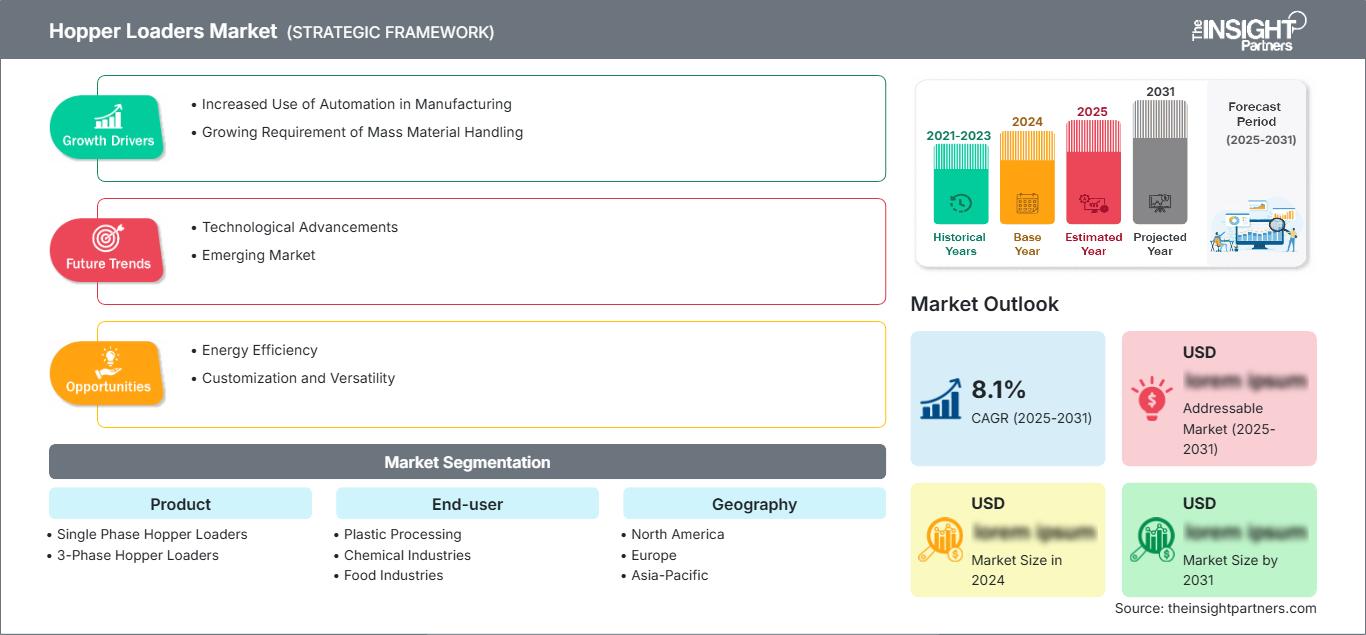
Hopper Loaders Market: Strategic Insights
Regional Insights
North America Hopper Loaders Market
North America held approximately ~29% of global revenue in 2025 and is projected to grow at a CAGR of ~6% through 2034. The region benefits from a large installed base of injection-molding, extrusion, compounding, and packaging operations. Demand is reinforced by automation adoption, labor-cost pressure, and the need to improve material-handling consistency across high-mix production environments.
Growth is also driven by the increasing amount of recycled resin and regrind material usage, which needs reliable conveying and filtration to avoid contamination. Upgrades of existing machines include new motor technology, monitoring systems, and fast-change components for single machine loaders. This helps processors cut waste, increase uptime, and pursue sustainability goals without making big investments.
U.S. Hopper Loaders Market
The US accounted for approximately ~76% of North American revenue in 2025 and is expected to grow at a CAGR of ~6% through 2034. There exists a large number of converters of plastics that cater to the automobile industry, packaging sector, medical applications, construction and consumer products. These systems need reliable systems of transporting pellets, regrinds, additives, and powders to ensure that quality of production is maintained consistently.
NOVATEC, Shini USA, Maguire Products, and PIOVAN S.p.A have established themselves in this market with their equipment range, technical support and distribution channels. Applications of such equipment include the use of small loaders for small injection presses, central systems for multi-line systems and integrated systems where loaders are connected with dryers and blenders. This country has an active market for retrofit and replacement of equipment too.
Europe Hopper Loaders Market
Europe represented approximately ~26% of global revenue in 2025 and is forecast to expand at a CAGR of ~5% through 2034. There exists a developed market for auxiliary equipment due to high-quality standards, engineering capacity, and automation of material handling. Germany is the largest country in Europe, owing to its vast machinery and plastics manufacturing capacities. Italians supply plastics machinery and packaging equipment, while demand is supported in the UK, France, and Spain due to automotive components, food processing, chemicals, and consumer packaging.
Growing requirements of a circular economy and effective processing of secondary materials dictate the European demand. Processors spend on loaders equipped with better filtration, sealed conveyance, and quick-cleaning mechanisms, which deal with regrind and post-consumer resins. Energy efficiency is one more criterion of procurement; therefore, brushless motors, efficient vacuum generation, and intelligent standby modes are preferred. Piovon S.p.A., Movacolor, SIMAR, Renmar Plastics Machinery Limited, and Summit Systems can be highly competitive owing to their engineering networks in the region and plastics industry experience. Expansion of capacities is modest, however, replacements and upgrades will drive demand until 2034.
APAC Hopper Loaders Market
Asia Pacific accounted for approximately ~34% of global revenue in 2025 and is expected to grow at a CAGR of ~7% through 2034, making it both the largest and fastest-growing region. China dominates in Asia-Pacific due to its size in plastics converting, packaging, appliances, automotive parts, and industrial automation. Growth opportunities exist in India with increased packaging and consumer goods manufacturing, whereas Japan and South Korea provide growth through molding and electronics plastics. Food processing and industrial manufacturing are the key contributors from Australia.
Growing industries along with favorable policies related to modernization of manufacturing processes have increased adoption of material handling automation. Newly established plants are opting for central conveying systems, whereas smaller processors are adopting single phase material handling systems. Availability of machinery in the region, along with competitive pricing, is boosting demand.
Middle East & Africa Hopper Loaders Market
The Middle East & Africa is projected to grow at a CAGR of ~7% through 2034. Saudi Arabia leads the region in the Middle East & Africa, being backed up by plastics manufacturing due to petrochemicals, investments in packaging, and diversification efforts in industry. UAE adds its contribution to the region through food processing, building materials, and re-export oriented manufacturing. South Africa helps in boosting the demand in the form of automotive components, packaging, and processing from the mining industry. Rest of MEA is an emerging region with increasing demands for material handling solutions.
There are possibilities of growth in the field of plastics converting and food processing owing to the developments in energy and infrastructure sectors. With the growth of manufacturing industries, processors are using hopper loaders to minimize handling and to have consistent feed.
Segmentation Analysis
Product
The product segment defines the Hopper Loaders Market scope through single phase and 3-phase equipment. These systems differ in power configuration, conveying capacity, installation complexity, and suitability for individual machines or centralized material-handling networks. Demand is influenced by plant scale, material type, throughput requirements, energy costs, and the degree of automation desired.
Single Phase Hopper Loaders hold approximately ~58% share in 2025 and are expected to grow at a CAGR of ~6% through 2034. Their leadership reflects ease of installation, lower upfront cost, compact size, and suitability for machines with limited space or lower material throughput. Adoption remains strong among small and mid-sized plastics processors, laboratories, and facilities requiring flexible machine-level material supply.
- Single Phase Hopper Loaders: Single phase loaders are compact, plug-and-play units designed for individual machines and lower-throughput applications. Their demand is driven by affordability, simple maintenance, rapid installation, and suitability for decentralized production layouts.
- 3-Phase Hopper Loaders: 3-phase loaders provide higher conveying capacity and are better suited to continuous, high-volume operations. Their strategic importance is rising as large molding plants and extrusion facilities centralize material handling across multiple processing lines.
3-Phase Hopper Loaders account for approximately ~42% share in 2025 and are expected to grow at a CAGR of ~7% through 2034. Growth is supported by capacity expansion in plastics processing, increasing use of central conveying systems, and demand for higher reliability in continuous production environments. These loaders are particularly valuable where multiple machines require consistent material supply from shared silos or drying systems.
End-user
The end-user segment reflects the breadth of industries that rely on controlled material transfer. Plastic processing is the dominant demand base, while chemical, food, and other industries use hopper loaders for powders, granules, additives, and regrind. Adoption intensity varies with throughput, hygiene requirements, material characteristics, and the cost of production interruptions.
- Plastic Processing: Plastic processing is the largest end-user segment because injection molding, extrusion, blow molding, and compounding require continuous resin supply. Loaders improve material consistency, reduce spillage, and support the handling of virgin resin, regrind, and masterbatch.
- Chemical Industries: Chemical manufacturers use hopper loaders to transfer powders, granules, and additives in controlled conditions. Demand is supported by the need to reduce dust exposure, prevent cross-contamination, and improve batching accuracy.
- Food Industries: Food processors deploy loaders for ingredients, powders, and granular materials where hygiene and contamination control are critical. Demand is supported by packaged-food expansion, automation, and requirements for enclosed, easy-to-clean conveying paths.
- Others: Other end users include construction materials, pharmaceuticals, agriculture, and general manufacturing. These applications use loaders where bulk material transfer must be automated to improve safety, consistency, and operational efficiency.
Opportunity Snapshot
| End-user | Revenue Contribution | Trend Tag (MAX 2 words, specific) | Adoption Stage (Emerging/Scaling/Mature) |
|---|---|---|---|
| Plastic Processing | High | Recycled Resins | Mature |
| Chemical Industries | Medium | Dust Control | Scaling |
| Food Industries | Medium | Hygienic Conveying | Scaling |
| Others | Low | Industrial Automation | Emerging |
Hopper Loaders Market Growth Drivers and Impact Analysis
Expansion of Plastics Processing and Packaging
The processing of plastics continues to be at the heart of the market drivers of the loaders since molding, extrusion, and compounding operations rely on a continuous material flow. With growing volumes of production of such items as packaging materials, automotive parts, construction materials, and consumer goods, producers need machines capable of delivering pellets and regrind to their machines continuously. Loaders cut the amount of lifting of materials, prevent spilling, and contribute to a smooth operation of machines. Such an effect is especially noticeable in large plants where any breaks in the flow of materials may lead to product losses.
Rising Use of Recycled and Engineered Resins
The growing use of recycled resins, regrind, and engineered compounds is changing material-handling requirements. These materials can vary in shape, moisture content, dust levels, and flow behavior, increasing the risk of bridging, contamination, and filter loading. Hopper loaders equipped with effective filtration, sealed transfer paths, and monitoring capabilities help processors handle such materials without compromising product quality. The market impact is a shift toward more robust and configurable equipment rather than basic commodity loaders. Suppliers that offer quick-clean designs, wear-resistant components, and compatibility with varied material types can capture demand from circular-economy initiatives and sustainability-focused manufacturers.
Automation and Labor Productivity Requirements
Manufacturers across plastics, chemicals, and food processing are facing pressure to improve productivity while managing labor availability and safety risks. Hopper loaders address these challenges by automating material transfer, reducing manual refilling, and enabling operators to focus on higher-value production tasks. Controls that detect material shortages, filter blockages, and conveying faults further reduce unplanned downtime. The result is a growing preference for loaders that can communicate with plant control systems and support centralized monitoring. This driver encourages replacement of manual handling methods and older equipment, particularly in facilities seeking to improve throughput without expanding headcount.
Hopper Loaders Market Future Trends
Connected and Self-Monitoring Conveying Systems
A central element of future Hopper Loaders Market trends is the shift toward connected equipment that provides actionable operational data. Next-generation loaders are expected to offer load-cell-based material measurement, filter-status monitoring, motor diagnostics, and alerts for blockages or supply shortages. These capabilities will allow processors to schedule maintenance based on actual equipment condition rather than fixed intervals. Integration with production-monitoring platforms will also help plants correlate material availability with machine utilization and scrap rates. As connectivity becomes standard, suppliers will need to balance digital functionality with simple interfaces, cybersecurity, and serviceability across small and large processing facilities.
Energy-Efficient and Low-Noise Equipment Design
Energy consumption and workplace comfort are becoming more important selection criteria for auxiliary equipment. Future hopper loaders are likely to use optimized vacuum generation, brushless motor options, intelligent standby modes, and improved sealing to reduce power use and noise. These design improvements are especially relevant for facilities operating many machines or running continuous shifts. Lower energy consumption can reduce operating cost, while quieter equipment supports better working conditions in molding shops and food-processing plants. Over the forecast period, energy-efficient designs are expected to move from premium differentiators to baseline expectations, influencing procurement decisions across mature and emerging markets.
Hopper Loaders Market Opportunities
Central Conveying System Retrofits
A significant opportunity exists in retrofitting older plastics plants with central conveying systems that serve multiple machines from shared material sources. Many facilities still rely on individual loaders, manual refilling, or fragmented material-handling arrangements that create inefficiency and quality risk. Suppliers can pursue this opportunity through modular 3-phase loaders, piping and filtration packages, controls integration, and phased installation plans that limit downtime. The Hopper Loaders Market Forecasts indicate that modernization demand will remain strong as processors seek to improve material traceability, reduce waste, and support higher machine utilization. This creates recurring opportunities in engineering, installation, controls, and lifecycle services.
Hygienic Material Handling for Food and Chemical Processing
Food and chemical processors represent an underpenetrated opportunity for specialized hopper-loader solutions. In food production, enclosed and easy-to-clean conveying systems can reduce contamination risk and support hygiene compliance. In chemical applications, sealed transfer paths, dust control, and abrasion-resistant components can improve operator safety and batching accuracy. Vendors can differentiate by offering material-compatible construction, validated cleaning procedures, and configurations designed for powders and additives. As both industries increase automation, suppliers that combine hygienic or chemical-resistant design with dependable service support can expand beyond the traditional plastics-processing customer base.
Recent Developments
- October 2025: XIECHENG officially opened its Ningbo Operation & Service Center, strengthening local customer support, service response, and technical assistance for plastics-processing auxiliary equipment. The expansion supports the company’s ability to serve regional processors with installation, maintenance, and application support for material-handling and auxiliary systems.
- July 2025: Movacolor announced its participation in K 2025, held from October 8 to 15, 2025 in Düsseldorf, Germany. The company planned to present modular dosing and material-handling technologies aimed at improving efficiency, reducing waste, and enhancing product quality in plastics manufacturing.
- February 2025: PIOVAN S.p.A. presented its S55 single phase hopper loader alongside the DPA10C compressed-air dryer and Ryng production-monitoring solution at Plastimagen 2025 in Mexico City. The display highlighted integrated drying, conveying, and real-time production monitoring for polymer processing applications.
Frequently Asked Questions

- Comprehensive Market Sizing and Forecast Analysis
- Detailed Segmentation Analysis
- In-Depth Market Dynamics Assessment
- Regional and Country-Level Insights
- Competitive Landscape and Company Benchmarking
- Strategic Business Intelligence
Recent Reports
Testimonials

The Insight Partners provided valuable market intelligence that supported our global go-to-market strategy. Their team was professional, responsive, and attentive to our feedback, providing thoughtful analysis and helpful methodological clarifications throughout the project.
Junmo Kim Chief Financial Officer (CFO), Enertech Co., Ltd.
The Insight Partners' SCADA System Market report is comprehensive, with valuable insights on current trends and future forecasts. The team was highly professional, responsive, and supportive throughout. We are very satisfied and highly recommend their services.
RAN KEDEM Partner, Reali Technologies LTDs
I requested a report on a very specific software market and the team produced the report in a few days. The information was very relevant and well presented. I then requested some changes and additions to the report. The team was again very responsive and I got the final report in less than a week.
JEAN-HERVE JENN Chairman, Future Analytica
We worked with The Insight Partners for an important market study and forecast. They gave us clear insights into opportunities and risks, which helped shape our plans. Their research was easy to use and based on solid data. It helped us make smart, confident decisions. We highly recommend them.
PIYUSH NAGPAL Sr. Vice President, High Beam Global
The Insight Partners delivered insightful, well-structured market research with strong domain expertise. Their team was professional and responsive throughout. The user-friendly website made accessing industry reports seamless. We highly recommend them for reliable, high-quality research services
YUKIHIKO ADACHI CEO, Deep Blue, LLC.
This is the first time I have purchased a market report from The Insight Partners.While I was unsure at first, I visited their web site and felt more comfortable to take the risk and purchase a market report.I am completely satisfied with the quality of the report and customer service. I had several questions and comments with the initial report, but after a couple of dialogs over email with their analyst I believe I have a report that I can use as input to our strategic planning process.Thank you so much for taking the extra time and making this a positive experience.I will definitely recommend your service to others and you will be my first call when we need further market data.
JOHN SUZUKI President and Chief Executive Officer, Board Director, BK Technologies
I wish to appreciate your support and the professionalism you displayed in the course of attending to my request for information regarding to infectious disease IVD market in Nigeria. I appreciate your patience, your guidance, and the fact that you were willing to offer a discount, which eventually made it possible for us to close a deal. I look forward to engaging The Insight Partners in the future, all thanks to the impression you have created in me as a result of this first encounter.
DR CHIJIOKE ONYIA MANAGING DIRECTOR, PineCrest Healthcare Ltd.Reason to Buy
- Informed Decision-Making
- Understanding Market Dynamics
- Competitive Analysis
- Identifying Emerging Markets
- Customer Insights
- Market Forecasts
- Risk Mitigation
- Boosting Operational Efficiency
- Strategic Planning
- Investment Justification
- Tracking Industry Innovations
- Aligning with Regulatory Trends





 Get Free Sample for