
Non-Alcoholic Beverages Market Size, Trends & Demand by 2034
Non-Alcoholic Beverages Market Size and Forecast (2021 - 2034), Global and Regional Share, Trend, and Growth Opportunity Analysis Report Coverage: By Type [Carbonated Soft Drinks, Juices & Nectars (Sparkling Fruit Juices and Others), Bottled Water Dairy-Based Beverages, Dairy Alternative Beverages, RTD Tea & Coffee, Non-Alcoholic Beers, Malt Beverages, and Others], Packaging Type (Bottles, Cartons, Cans, and Pouches), Category (Sugar-Free and Conventional), and Distribution Channel (Supermarkets & Hypermarkets, Convenience Stores, Online Retail, and Others)
Historic Data: 2021-2024 | Base Year: 2025 | Forecast Period: 2026-2034- Status : Data Released
- Report Code : TIPRE00029575
- Category : Food and Beverages
- No. of Pages : 150
- Available Report Formats :



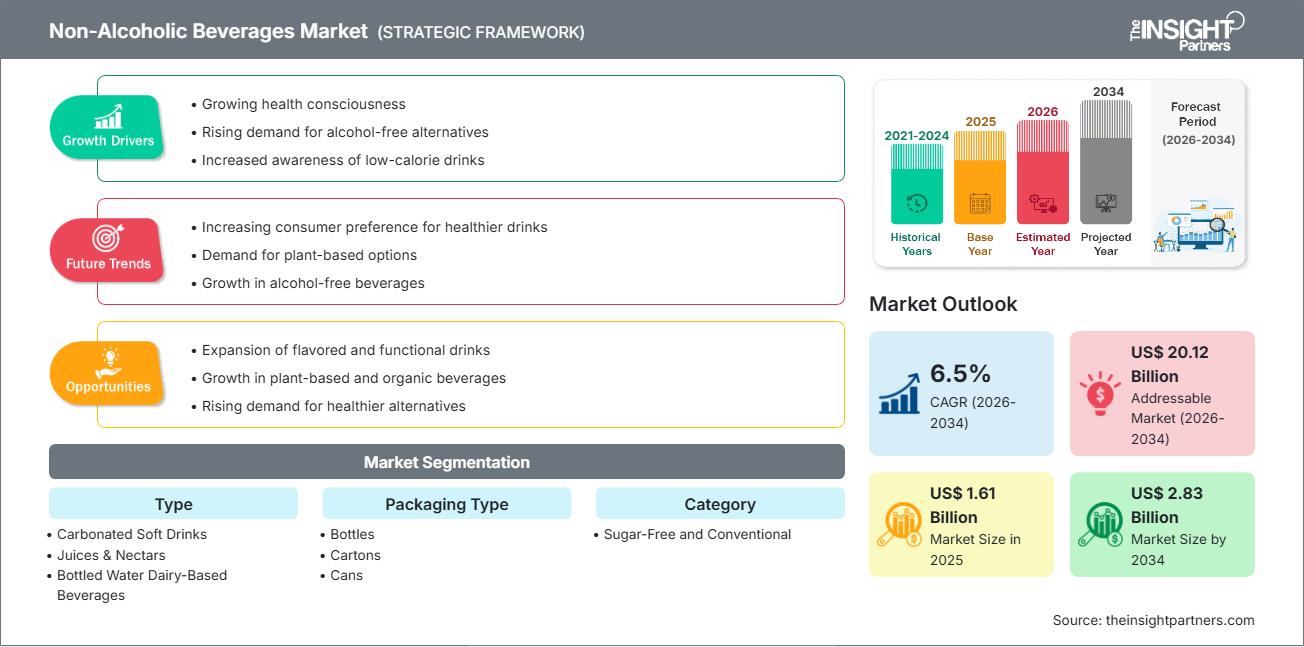
The global Non-Alcoholic Beverages market size is projected to reach US$ 2.83 billion by 2034 from US$ 1.61 billion in 2025. The market is anticipated to register a CAGR of 6.5% during the forecast period 2026–2034.
Key market dynamics include a heightening global focus on health and wellness, rising consumer demand for functional ingredients such as electrolytes and probiotics, and a significant shift toward better-for-you alternatives to high-sugar drinks. Additionally, the market is expected to benefit from the growing popularity of plant-based dairy alternatives, expansion in organized retail channels across emerging economies, and the increasing inclusion of premium non-alcoholic options in high-value gourmet segments like Ready-to-Drink (RTD) botanical teas and craft non-alcoholic beers.
Non-Alcoholic Beverages Market Analysis
The non-alcoholic beverages market analysis indicates a rising focus on premium functional hydration, driven by consumers seeking drinks that deliver both refreshment and measurable nutritional value. The competitive landscape is increasingly defined by the established mass‑market carbonated category and rapidly accelerating clean‑label offerings that emphasize natural sweeteners, organic ingredients, and minimal processing. Strategic opportunities are unfolding at the intersection of beverages and nutritional supplements. Products enhanced with adaptogens, botanical extracts, electrolytes, and essential vitamins are gaining traction, offering manufacturers a strong differentiation advantage over conventional soft drinks. The analysis also underscores that broader market expansion relies on advancements in sustainable packaging—particularly recyclable, biodegradable, and lightweight materials—and on the development of efficient cold‑chain logistics to support the growing demand for premium fresh juices and minimally processed formulations. Brand success now hinges on storytelling that conveys environmental responsibility, reduced sugar content, and transparent ingredient sourcing. This approach enables producers to defend premium price points despite intensifying competition from private-label entrants and long-established beverage brands.
Non-Alcoholic Beverages Market Overview
The non-alcoholic beverages are shifting from basic refreshment to a sophisticated lifestyle choice. While historically dominated by carbonated soft drinks, the market is expanding into value-added products like functional waters, dairy-alternative milks, and specialized energy drinks. Both multinational beverage giants and agile startup brands are part of this market, making use of innovations in natural preservation and sugar substitutes like stevia and monk fruit. More health-conscious consumers in North America and Asia-Pacific are looking for alternatives to traditional alcohol and high-fructose corn syrup, which has helped functional beverages gain popularity as a daily wellness choice. North America remains a powerhouse of innovation, but Asia-Pacific has become a leader in volume growth and digital retail integration. For instance, the market in the US is characterized by a mature consumer base that is increasingly pivoting toward premium bottled waters and RTD coffee. For instance, the market in the US is defined by a sophisticated transition toward functional and premium hydration. Consumers are increasingly swapping traditional sodas for sparkling waters and RTD teas that offer health benefits. The rise of e-commerce and specialty health stores has further accelerated the visibility of niche, craft non-alcoholic brands across the country.
Market Assessment and Insights
- Global market for Non-Alcoholic Beverages was valued at US$ 1.61 Billion in 2025
- Annual market size is expected to reach US$ 2.83 Billion by 2034
- Total addressable market (TAM) during 2026-2034 is projected to reach approximately US$ 20.12 Billion
- Market is anticipated to register a CAGR of 6.5% during the forecast period
- The United States represents a key market, supported by Growing health consciousness, Rising demand for alcohol-free alternatives, Increased awareness of low-calorie drinks, as well as evolving industry dynamics
- Market analysis covers North America, Europe, Asia-Pacific, South and Central America, Middle East and Africa, with growth evaluated across the forecast period
- Market opportunities such as Expansion of flavored and functional drinks, Growth in plant-based and organic beverages, Rising demand for healthier alternatives are expected to influence market dynamics and addressable market
- Report profiles industry participants, including The Coca Cola Company, PepsiCo, Nestle, Red Bull, Suntory Holdings Limited, Danone S.A., Califia Farms LLC, Keurig Dr Pepper Inc, Asahi Group Holdings Limited, Bolthouse Farms Inc., Heineken NV, Coolberg Beverages Pvt Ltd, Goya Foods Inc, Anheuser-Busch InBev NV, Carlsberg AS, while analyzing competitive strategies and innovation developments
Customize This Report To Suit Your Requirement
Get FREE CUSTOMIZATIONNon-Alcoholic Beverages Market: Strategic Insights
-
Get Top Key Market Trends of this report.This FREE sample will include data analysis, ranging from market trends to estimates and forecasts.
Non-Alcoholic Beverages Market Drivers and Opportunities
Market Drivers:
- Growing Health Consciousness and Sugar Reduction: Increasing awareness of lifestyle diseases like obesity and diabetes is driving consumers toward low-calorie and sugar-free beverage options. This shift is compelling manufacturers to reformulate classic recipes and introduce natural, non-glycemic sweeteners to maintain consumer loyalty.
- Surge in Demand for Functional and Fortified Drinks: Modern consumers view beverages as a delivery system for wellness. Demand is rising for drinks enhanced with protein, fiber, vitamins, and minerals. This functionalization of the beverage aisle caters to busy professionals and athletes looking for convenient nutrition on the go.
- Rapid Expansion of RTD and Convenience Formats: The fast-paced urban lifestyle has fueled the demand for Ready-to-Drink (RTD) tea, coffee, and protein shakes. These formats offer portability and instant consumption, benefiting from the growth of convenience stores and grab-and-go sections in major urban centers globally.
Market Opportunities:
- Expansion of the Adult Non-Alcoholic Segment: Beyond standard sodas, there is a significant opportunity in sophisticated mocktails and non-alcoholic spirits. These products target the sober-curious movement, providing complex flavor profiles for social settings without the effects of alcohol.
- Innovation in Sustainable and Biodegradable Packaging: With increasing regulatory pressure on single-use plastics, brands that invest in plant-based bottles, infinitely recyclable aluminum, or compostable cartons can capture a growing segment of environmentally conscious Gen Z and millennial consumers.
- Development of Personalized Nutrition Beverages: Utilizing AI and health-tracking data, there is a burgeoning opportunity for brands to offer personalized beverage solutions tailored to an individual’s specific mineral deficiencies or energy needs, creating a high-margin, tech-integrated niche.
Non-Alcoholic Beverages Market Report Segmentation Analysis
The Non-Alcoholic Beverages Market share is analyzed across various segments to provide a clearer understanding of its structure, growth potential, and emerging trends. Below is the standard segmentation approach used in most industry reports:
By Type:
- Carbonated Soft Drinks: Traditional high-volume products transforming low-sugar variants.
- Juices & Nectars (Sparkling Fruit Juices and Others): Focuses on natural fruit content and premium sparkling blends.
- Bottled Water: A staple segment growing through flavor infusion and functional enhancements.
- Dairy-Based Beverages: Includes flavored milks and drinkable yogurts.
- Dairy Alternative Beverages: Rapidly growing segment featuring almond, oat, and soy-based drinks.
- RTD Tea & Coffee: Driven by the premiumization of caffeine consumption.
- Non-Alcoholic Beers & Malt Beverages: Catering to the health-conscious social consumer.
- Others: Includes energy drinks, sports drinks, and specialty tonics.
By Packaging Type:
- Bottles: The standard for water and soft drinks, shifting toward rPET (recycled plastic).
- Cartons: Widely used for juices and dairy alternatives due to their shelf-stable properties.
- Cans: Gaining popularity in the craft and sparkling water segments for their recyclability.
- Pouches: Growing in the pediatric and on-the-go snack beverage segments.
By Category:
- Sugar-Free: The fastest-growing niche, catering to diabetic-friendly and weight-management diets.
- Conventional: The dominant volume driver, maintaining a strong presence in emerging markets and traditional retail.
By Distribution Channel:
- Supermarkets & Hypermarkets: The primary channel for bulk household purchases and discovery of new product launches.
- Convenience Stores: Essential for high-frequency, single-serve purchases and energy drinks.
- Online Retail: A booming channel for bulk subscription models and niche artisanal brands.
- Others: Includes vending machines, food service outlets, and specialty health stores.
By Geography:
- North America
- Europe
- Asia Pacific
- South & Central America
- Middle East & Africa
Non-Alcoholic Beverages Market Report Scope
| Report Attribute | Details |
|---|---|
| Market size in 2025 | US$ 1.61 Billion |
| Market Size by 2034 | US$ 2.83 Billion |
| Global CAGR (2026 - 2034) | 6.5% |
| Historical Data | 2021-2024 |
| Forecast period | 2026-2034 |
| Segments Covered |
By Type
|
| Regions and Countries Covered |
North America
|
| Market leaders and key company profiles |
|
Non-Alcoholic Beverages Market Players Density: Understanding Its Impact on Business Dynamics
The Non-Alcoholic Beverages Market is growing rapidly, driven by increasing end-user demand due to factors such as evolving consumer preferences, technological advancements, and greater awareness of the product's benefits. As demand rises, businesses are expanding their offerings, innovating to meet consumer needs, and capitalizing on emerging trends, which further fuels market growth.
Non-Alcoholic Beverages Market Share Analysis by Geography
Asia-Pacific is expected to grow fastest in the coming years. Emerging markets in South & Central America, the Middle East, and Africa also have many untapped opportunities for premium beverage producers and functional drink manufacturers to expand.
The non-alcoholic beverages market is undergoing a significant transformation, moving from basic thirst-quenchers to global high-value functional lifestyle products. Growth is driven by the rising prevalence of wellness trends, a surge in demand for plant-based nutrition, and the expansion of the luxury sober-curious sector. Below is a summary of market share and trends by region:
North America
- Market Share: Holds a significant portion of the global market, characterized by high per-capita consumption of bottled water and functional drinks.
- Key Drivers:
- Rising consumer preference for natural energy and focus-enhancing ingredients.
- Mainstreaming of premium alkaline and electrolyte-heavy waters in athletic circles.
- Increased adoption of plant-based dairy alternatives in the coffee-house market.
- Trends: Scaling of subscription-based D2C beverage models and the successful adoption of eco-friendly packaging to appeal to environmentally aware demographics.
Europe
- Market Share: Holds a large share globally, anchored by a strong culture of juice consumption and a rapidly maturing non-alcoholic beer market.
- Key Drivers:
- Strict regulatory environments favoring low-sugar products and sugar taxes in several countries.
- Established infrastructure for high-quality mineral water and organic juices.
- Robust consumer interest in botanical and herbal-infused functional teas.
- Trends: A strategic shift toward Circular Economy packaging solutions and an increasing focus on transparent labeling regarding ingredient provenance.
Asia-Pacific
- Market Share: The fastest-growing region, with China and India acting as primary engines for volume and value growth.
- Key Drivers:
- Massive consumer base seeking westernized lifestyle products and convenient hydration.
- Rising disposable incomes are leading to a preference for premium bottled water and imported juices.
- Government initiatives promoting healthier diets and reducing caloric intake.
- Trends: Heavy reliance on mobile commerce for beverage delivery and a surge in beauty-from-within drinks containing collagen and skin-health nutrients.
South and Central America
- Market Share: Emerging market with a growing market for tropical fruit-based nectars and carbonated alternatives.
- Key Drivers:
- Increasing awareness of health risks associated with high-sugar traditional sodas.
- Modernization of local production facilities to meet international quality standards.
- Rising interest in fortified dairy-based beverages for child nutrition.
- Trends: Growth of local artisanal brands focusing on indigenous superfruits (e.g., Açaí, Acerola) to differentiate from global giants.
Middle East and Africa
- Market Share: Developing market with high potential for shelf-stable UHT products and flavored malt beverages.
- Key Drivers:
- Traditional cultural preference for non-alcoholic malt drinks and fruit juices.
- High demand for safe, packaged bottled water in regions with water scarcity.
- Strategic investments in local bottling plants to reduce logistics costs.
- Trends: Implementation of smart vending technologies in urban hubs and a focus on nutrient-dense beverages to combat regional malnutrition.
High Market Density and Competition
Competition is intensifying due to the presence of established leaders such as The Coca-Cola Company, PepsiCo, Inc., and Nestlé S.A. Regional artisanal experts and niche players like Fever-Tree and Athletic Brewing Company, alongside dairy-alternative innovators such as Oatly and Danone, also contribute to a diverse and rapidly expanding market landscape.
This competitive environment pushes vendors to differentiate through:
- Premiumization and Functional Branding: Positioning non-alcoholic drinks as superior wellness tools by emphasizing antioxidants, vitamins, and natural energy sources.
- Diverse Product Portfolios: Companies are expanding beyond sodas to offer probiotic kombuchas, nitrogen-infused cold brews, and high-end non-alcoholic spirits.
- Supply Chain Control: Producers are increasingly focused on sourcing organic, non-GMO ingredients and securing sustainable water sources to meet ethical clean-label standards.
- Technological Innovation: New processing technologies, like HPP (High-Pressure Processing), help preserve the nutritional integrity and flavor of fresh juices without heat.
Opportunities and Strategic Moves
- Digital Transformation: Partner with rapid-delivery apps and e-commerce giants to tap into the surging demand for home-delivered functional beverages in urban markets.
- Sustainability Leadership: Incorporate plastic-free packaging and carbon-neutral production certifications to appeal to the values of younger, socially conscious consumer cohorts.
Major Companies operating in the Non-Alcoholic Beverages Market are:
- The Coca-Cola Company
- PepsiCo
- Nestlé
- Red Bull
- Suntory Holdings Limited
- Danone S.A.
- Califia Farms LLC
- Keurig Dr. Pepper Inc
- Asahi Group Holdings Limited
- Bolthouse Farms Inc.
- Heineken NV
- Coolberg Beverages Pvt Ltd
- Goya Foods Inc
- Anheuser-Busch InBev NV
Disclaimer: The companies listed above are not ranked in any particular order.
Non-Alcoholic Beverages Market News and Recent Developments
- In October 2024, PepsiCo, Inc. announced that it had entered into a definitive agreement to acquire Garza Food Ventures LLC, doing business as Siete Foods, for $1.2 billion—a strategic move that further expanded its extensive portfolio of Non-Alcoholic Beverages and better-for-you snacks.
- In February 2024, The Coca-Cola Company announced the global rollout of its new Coca-Cola Spiced, a permanent addition to its portfolio of Non-Alcoholic Beverages.
Non-Alcoholic Beverages Market Report Coverage and Deliverables
The Non-Alcoholic Beverages Market Size and Forecast (2021–2034) report provides a detailed analysis of the market covering below areas:
- Non-Alcoholic Beverages Market size and forecast at global, regional, and country levels for all the key market segments covered under the scope
- Non-Alcoholic Beverages Market trends, as well as market dynamics such as drivers, restraints, and key opportunities
- Detailed PEST and SWOT analysis
- Non-Alcoholic Beverages Market analysis covering key market trends, global and regional framework, major players, regulations, and recent market developments
- Industry landscape and competition analysis covering market concentration, heat map analysis, prominent players, and recent developments in the Non-Alcoholic Beverages Market.
- Detailed company profiles
Frequently Asked Questions

- Historical Analysis (2 Years), Base Year, Forecast (7 Years) with CAGR
- PEST and SWOT Analysis
- Market Size Value / Volume - Global, Regional, Country
- Industry and Competitive Landscape
- Excel Dataset
Recent Reports
Testimonials

The Insight Partners' SCADA System Market report is comprehensive, with valuable insights on current trends and future forecasts. The team was highly professional, responsive, and supportive throughout. We are very satisfied and highly recommend their services.
RAN KEDEM Partner, Reali Technologies LTDs
I requested a report on a very specific software market and the team produced the report in a few days. The information was very relevant and well presented. I then requested some changes and additions to the report. The team was again very responsive and I got the final report in less than a week.
JEAN-HERVE JENN Chairman, Future Analytica
We worked with The Insight Partners for an important market study and forecast. They gave us clear insights into opportunities and risks, which helped shape our plans. Their research was easy to use and based on solid data. It helped us make smart, confident decisions. We highly recommend them.
PIYUSH NAGPAL Sr. Vice President, High Beam Global
The Insight Partners delivered insightful, well-structured market research with strong domain expertise. Their team was professional and responsive throughout. The user-friendly website made accessing industry reports seamless. We highly recommend them for reliable, high-quality research services
YUKIHIKO ADACHI CEO, Deep Blue, LLC.
This is the first time I have purchased a market report from The Insight Partners.While I was unsure at first, I visited their web site and felt more comfortable to take the risk and purchase a market report.I am completely satisfied with the quality of the report and customer service. I had several questions and comments with the initial report, but after a couple of dialogs over email with their analyst I believe I have a report that I can use as input to our strategic planning process.Thank you so much for taking the extra time and making this a positive experience.I will definitely recommend your service to others and you will be my first call when we need further market data.
JOHN SUZUKI President and Chief Executive Officer, Board Director, BK Technologies
I wish to appreciate your support and the professionalism you displayed in the course of attending to my request for information regarding to infectious disease IVD market in Nigeria. I appreciate your patience, your guidance, and the fact that you were willing to offer a discount, which eventually made it possible for us to close a deal. I look forward to engaging The Insight Partners in the future, all thanks to the impression you have created in me as a result of this first encounter.
DR CHIJIOKE ONYIA MANAGING DIRECTOR, PineCrest Healthcare Ltd.Reason to Buy
- Informed Decision-Making
- Understanding Market Dynamics
- Competitive Analysis
- Identifying Emerging Markets
- Customer Insights
- Market Forecasts
- Risk Mitigation
- Boosting Operational Efficiency
- Strategic Planning
- Investment Justification
- Tracking Industry Innovations
- Aligning with Regulatory Trends
Unlock Exclusive Report Discounts
Enquire Now




 Get Free Sample For