HVAC Filters Market Size & Overview
The global HVAC Filters market was valued at US$ 6.67 Billion in 2025 and is projected to reach US$ 11.7 Billion by 2034, expanding at a CAGR of 6.44% during 2026–2034. The market is seeing growth due to the demand for reliable particulate removal, increased filtration efficiency and filter design that offers a good balance between clean air and cost to operate. Increasing demands for clean indoor air, energy efficient building systems and reducing damage to equipment and industrial processes is driving this Market.
The North American market benefits from existing heating, ventilation and air-conditioning systems, regular filter change and growing demands for better indoor environments. The projected CAGR for this region is around 6% to 2034. This is due to the mature market with continual maintenance of commercial buildings. Filtration systems are upgrading in Healthcare, education and Industrial markets. Building upgrades are driving demand plus the need to control energy use. Companies offering reliable particle capture, low pressure drop and predictable change out intervals will benefit.
The main driver for the HVAC Filters Market is the regular replacement and increasing use of more advanced filtration systems. HVAC Filters are consumables so there will always be a replacement requirement. The frequency of replacement will be determined by the level of particulate build-up, working hours, environmental factors, filter design and maintenance. Different industries will have different requirements such as healthcare, offices, schools, manufacturing and residential. Choosing the right product will depend on the balance of clean air, pressure drop, service life and cost. The supply chain starts with raw materials such as fibres, synthetic polymers, cellulose, glass microfibre, adsorbents and other media. These are turned into pleated filter cartridges, filter panels, cartridges and bespoke solutions by manufacturers. The key considerations here are availability of media, conversion capability, quality control and meeting the requirements of the application. Manufacturers who can offer consistent quality and reliable delivery will help to ensure good customer retention. However, if there are issues with media availability and fluctuating prices this can create margin pressure and lead to looking elsewhere.
The HVAC Filters Market Report highlights competition from world-leading filtration specialists, diversified industrial companies and those with specific media or industry focus. Parker Hannifin Corporation operate in the engineered filtration and fluid management market. Ahlstrom Oyj produce specialist filtration media. Camfil AB and American Air Filter Company Inc. provide commercial and HEPA air filtration. Donaldson Company Inc., Freudenberg Filtration Technologies and Filtration Group Corporation also provide filtration products. 3M Company and Honeywell International Inc. provide a wider range of technologies. MANN+HUMMEL GmbH provide filtration expertise. Investment is being placed around media development, conversion, testing, differentiation and regional supply. Manufacturers can compete on offering lower pressure drop, higher dust capacity, longer service life and reliable performance. Ahlstrom have focussed on developing their materials and Camfil have launched energy focussed products to help create value selling. Strategic alliances with HVAC equipment manufacturers and service providers can also help improve replacement opportunities. However, claims should be backed up with the correct testing and high-end products should show benefits over their lifetime.
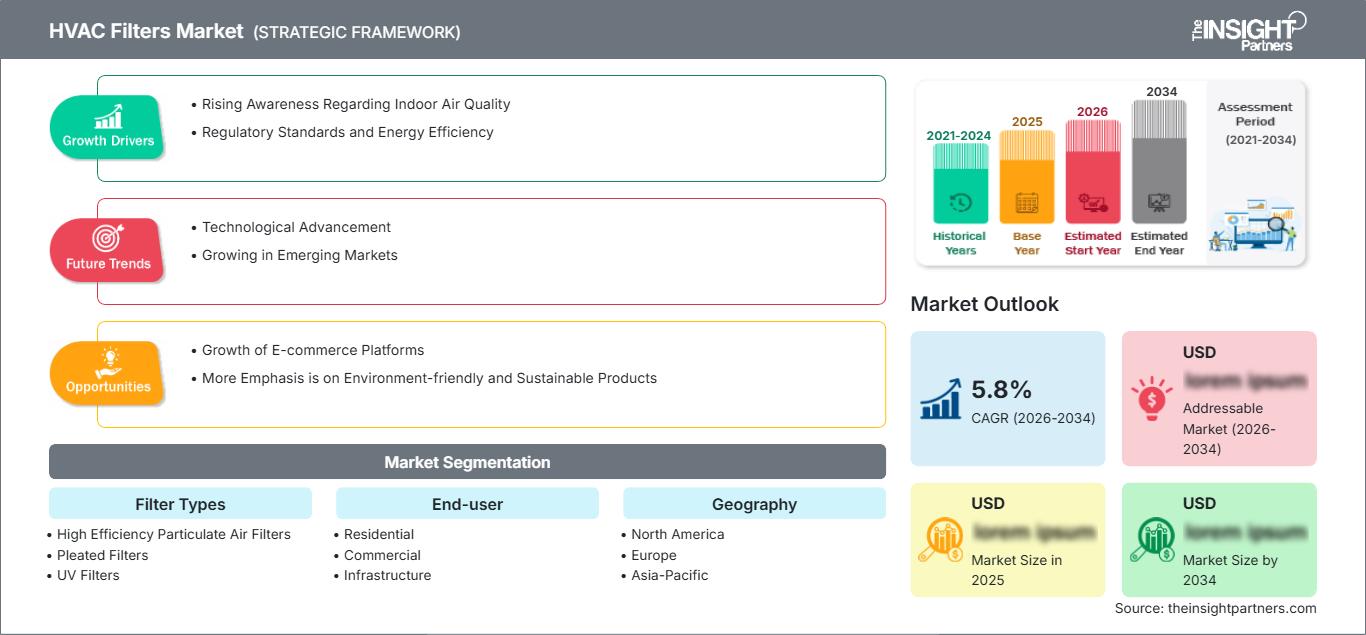
HVAC Filters Market Assessment and Insights
Regional Outlook
- North America: ~31% of the global market in 2025 | ~6% CAGR through 2034. Market position: North America represents a mature demand center, supported by extensive commercial building infrastructure, established replacement channels, healthcare requirements, and industrial air-quality controls. Continued system modernization supports replacement demand and higher-performance product adoption.
- US: ~82% of North American market revenue in 2025 | ~6% CAGR through 2034. Market position: The US accounts for most regional demand because of its large commercial building stock, healthcare facilities, manufacturing base, and established HVAC service network. Demand spans routine residential replacement and specialized filtration for critical indoor environments.
- Europe: ~27% of the global market in 2025 | ~6% CAGR through 2034. Market position: Europe is an established filtration market with demand shaped by energy efficiency, building performance, and industrial process requirements. Germany, the UK, France, Italy, and Spain contribute through commercial infrastructure, manufacturing, healthcare, and building renovation.
- Asia Pacific: ~32% of the global market in 2025 | ~8% CAGR through 2034. Market position: Asia Pacific is the fastest-growing region, supported by urban construction, industrial expansion, healthcare investment, and demand for cleaner indoor environments. China and Japan provide established manufacturing and technology demand, while India and South Korea contribute through infrastructure and industrial development.
Segment Outlook
- Filter Types: ~58% Share in 2025 | ~7% CAGR through 2034. Market position: The filter-type category encompasses multiple filtration technologies serving different particle-removal, airflow, and operating requirements. High-efficiency and pleated products support broad building applications, while specialized designs serve environments requiring enhanced contaminant control.
- End-user: ~42% Share in 2025 | ~8% CAGR through 2034. Market position: End-user demand is supported by infrastructure development, commercial building upgrades, residential replacement, and industrial air-quality requirements. Infrastructure applications have a strong growth outlook as public facilities and large buildings require dependable ventilation and filtration systems.
Competitive Coverage
Parker Hannifin Corporation, Ahlstrom Oyj, Camfil AB, American Air Filter Company Inc., 3M Company, Honeywell International Inc., Donaldson Company Inc., Freudenberg Filtration Technologies SE & Co. KG, MANN+HUMMEL GmbH, Filtration Group Corporation.
Methodology
The Insight Partners follows Data Collection & Secondary Research, Primary Research, Data Analysis, and Data Triangulation & Final Review to validate market estimates and insights.
Source: The Insight Partners' analysis based on proprietary research, government publications, company annual reports, investor presentations, industry databases, and expert interviews.
HVAC Filters Market Trends
Development of Lower-Resistance, Longer-Life Filter Media
Future product development in the HVAC Filters Market trends is likely to emphasize the relationship between filtration efficiency, pressure drop, dust-holding capacity, and service life. Improved fiber structures, optimized pleating, and engineered media layers can help manufacturers address competing requirements within existing filter dimensions. This direction is relevant to building operators seeking to maintain air quality while controlling fan energy and maintenance expenditure. Ahlstrom's Flow2Save filtration media launch in December 2025 illustrates the commercial emphasis on energy performance and extended operating life. Adoption will depend on verified results, compatibility with installed systems, and the economics of replacing incumbent products. Manufacturers may increasingly compete through lifecycle performance evidence rather than relying solely on nominal efficiency classifications. Independent testing and clear maintenance guidance will remain important to converting technical improvements into purchasing decisions.
Integration of Filtration with Connected Building Management
Building operators may increasingly integrate filter maintenance into digital facility-management workflows. Differential-pressure measurements, operating-hour data, and maintenance records can help teams identify when a filter is approaching its practical service limit. Such approaches can support more consistent maintenance across large building portfolios and reduce dependence on fixed replacement schedules that do not reflect actual loading. The opportunity is not limited to connected filters themselves: conventional products can also be managed through sensors and building-management software. Wider adoption will depend on sensor reliability, installation costs, data interoperability, and the ability of maintenance teams to act on alerts. Manufacturers and service providers may differentiate through monitoring-compatible designs, digital documentation, and maintenance support. These developments are likely to complement, rather than immediately displace, established replacement channels.
HVAC Filters Market Growth Factors
Rising Indoor Air Quality Requirements
Greater attention to indoor air quality encourages building owners to evaluate filtration as part of a broader ventilation strategy. Occupants, facility managers, and institutional buyers need solutions suited to the building's purpose, outdoor pollution conditions, occupancy, and ventilation design. Healthcare and selected controlled environments may require high-efficiency filtration, while homes and offices often use conventional or upgraded pleated products. This diversity expands the range of filter specifications demanded from suppliers. The commercial impact is strongest when buyers move beyond initial purchase price and consider consistent performance, replacement availability, and maintenance. Manufacturers can benefit by offering clear product ratings and application guidance, but they must avoid implying that filters alone resolve every indoor air quality problem. Ventilation, source control, correct installation, and ongoing maintenance remain important to system effectiveness.
Energy Efficiency and Lifecycle Cost Management
HVAC systems consume energy to move air through ductwork and filtration media. Filter resistance contributes to the pressure that fans must overcome, so a design with lower initial resistance can reduce operating burden when other system conditions remain comparable. This relationship encourages facility managers to assess lifecycle cost instead of comparing filter prices in isolation. Media engineering, pleat geometry, and dust-holding capacity can influence pressure drop and replacement intervals, although realized savings depend on equipment, loading, airflow, and maintenance practices. The market impact includes opportunities for premium products supported by reliable test data and practical operating evidence. Suppliers can strengthen their position by documenting performance under relevant conditions and helping customers establish replacement schedules. Unsupported energy-saving claims, however, can undermine buyer confidence and complicate technical procurement.
Expansion of Industrial and Institutional Facilities
Industrial production, healthcare construction, education facilities, and large commercial projects create demand for ventilation systems that meet specific operational needs. Manufacturing plants may require air filtration to protect processes or equipment, while hospitals and laboratories can have more stringent requirements for selected spaces. Infrastructure projects also create opportunities for suppliers that can coordinate specifications, delivery schedules, installation support, and replacement supply. These applications can require technical consultation beyond a standard product transaction, giving manufacturers and distributors an opportunity to build longer-term customer relationships. The commercial effect depends on the type of facility, project completion, and ongoing maintenance budgets. Suppliers with application expertise and consistent product quality can compete for recurring business, while limited maintenance resources or delayed construction can postpone purchases even where planned demand is substantial.
HVAC Filters Market Opportunities
Localized Manufacturing and Distribution in High-Growth Economies
Manufacturers in the HVAC Filters Market Forecast can pursue investment opportunities in Asia Pacific by strengthening local converting capacity, regional distribution, and technical support. A larger local presence can shorten replenishment times, improve access to common filter dimensions, and reduce dependence on long international supply chains. Potential investment priorities include partnerships with HVAC equipment manufacturers, distributor training, product testing, and manufacturing processes that accommodate local operating conditions. India and Southeast Asian markets offer varied opportunities across residential, commercial, infrastructure, and industrial applications, but purchasing power and technical requirements differ by customer. Investors should assess local demand, competitor coverage, import exposure, and maintenance capabilities before committing capital. A staged strategy that begins with distribution and application support may help establish demand before expanding production. Product localization should preserve quality and performance consistency.
Specialized Filtration for Critical Environments
Specialized filtration provides an opportunity for suppliers serving pharmaceutical production, laboratories, healthcare facilities, electronics manufacturing, and other environments with demanding cleanliness requirements. These customers may place greater emphasis on validated performance, traceability, product consistency, and technical assistance than on the lowest initial price. Investment can focus on controlled manufacturing processes, testing infrastructure, application engineering, and relationships with equipment integrators. Suppliers also need to understand the distinction between particle filtration, gas-phase treatment, and microbial control, since these functions require different technologies and verification methods. Commercial success depends on meeting precise specifications and supporting customers throughout installation and maintenance. Companies that build credible technical expertise can develop defensible positions in specialized applications, although qualification requirements and longer procurement cycles can increase the cost and time required to enter these markets.
Segmentation Analysis
Filter Types
Filter Types cover multiple technologies designed to meet different particulate-removal and air-treatment requirements. The category has a modeled CAGR of ~7% for 2026–2034. High-efficiency filters serve controlled environments, while pleated filters support widespread ventilation applications through compact construction and accessible replacement. UV and electrostatic technologies address more specialized treatment needs, with suitability depending on system configuration and the contaminants being targeted. Manufacturers compete through performance consistency, media design, pressure drop, service life, and ease of installation.
- High Efficiency Particulate Air Filters: HEPA filters are used where stringent particle removal is required, including selected healthcare, laboratory, pharmaceutical, and controlled manufacturing environments. Their adoption depends on validated filtration performance, housing integrity, airflow requirements, and compatibility with the complete ventilation system.
- Pleated Filters: Pleated filters provide a practical balance between filtration capacity, surface area, cost, and installation convenience. They are widely applicable to residential and commercial HVAC equipment, with purchasing decisions influenced by dimensions, efficiency rating, dust-holding capacity, and replacement availability.
- UV Filters: UV-based air-treatment solutions use ultraviolet radiation to target susceptible microorganisms under appropriate operating conditions. Their performance depends on exposure, system design, maintenance, and installation. They can complement particle filtration but do not replace the need to remove airborne particles.
- Electrostatic filters: Electrostatic filters use electrical effects to capture particles, with performance varying by technology, design, operating conditions, and maintenance. Reusable designs can reduce disposable-media waste, while buyers must consider cleaning requirements, particle-capture consistency, and compatibility with existing systems.
End-user
End-user demand is projected to grow at a modeled CAGR of ~8% for 2026–2034, reflecting expanding infrastructure requirements and the need to maintain indoor environmental quality across diverse facilities. Residential users generally prioritize accessible replacements and affordability, while commercial buyers consider operating expenses, maintenance schedules, and occupant comfort. Infrastructure projects may require coordinated filtration specifications across large facilities, and industrial buyers focus on process protection, equipment reliability, and application-specific air quality.
- Residential: Residential demand is supported by routine replacement, household comfort, and growing interest in indoor air quality. Filter selection depends on HVAC compatibility, affordability, ease of replacement, and the ability to maintain adequate airflow while capturing relevant airborne particles.
- Commercial: Offices, retail buildings, hotels, and other commercial properties require filtration that balances occupant needs with operating costs. Centralized maintenance and procurement can favor standardized products, while facility operators evaluate filter life, pressure drop, supply reliability, and service requirements.
- Infrastructure: Hospitals, educational facilities, transport buildings, public institutions, and other major facilities require dependable ventilation and maintenance planning. Procurement can emphasize documented performance, consistent product availability, and compatibility with large air-handling systems, supporting opportunities for suppliers with technical service capabilities.
- Industrial: Industrial facilities use filters to protect equipment, support process conditions, and manage airborne contaminants. Requirements differ across manufacturing environments, so buyers assess particle-control performance, operating reliability, dust loading, maintenance access, and the consequences of filtration failure.
Opportunity Snapshot
| End Users | Revenue Contribution | Trend Tag | Adoption Stage |
| Residential | High | Indoor Air Quality | Mature |
| Commercial | High | Building Retrofits | Mature |
| Infrastructure | Medium | Public Facilities | Scaling |
| Industrial | High | Process Protection | Scaling |
Regional Insights
North America HVAC Filters Market
North America shows a stable HVAC Filters Market Share. In 2025, it is projected to represent ~31% of global revenues, growing at a CAGR of ~6% until 2034. This is due to a large commercial property base, residential HVAC installations, healthcare and industrial sectors. With a large installation base there is regular demand for replacements. With renovation of properties there are also opportunities to upgrade filter efficiency without full air handling system replacements. This can include residential filters, air handling units (commercial) and high efficiency filters.
The overall growth of the region is dependent on maintenance spend, construction activity, energy costs and air quality requirements. Hospitals, labs, educational areas and manufacturing areas often have more stringent requirements for air quality. This can lead to differentiation between products and professional maintenance. The U.S. will be the main contributor to demand and Canada will see some growth from commercial build, institutional, industry and residential heating. Domestic companies with good distribution, technical support and reliable availability will see growth from scheduled replacements and project based opportunities. Overall, growth will be driven by upgrading and replacements.
U.S. HVAC Filters Market
The U.S. will see ~82% of North American 2025 revenues and will be growing at a CAGR of ~6% until 2034. This is due to a large commercial property base, large residential replacement market, healthcare and varied manufacturing. There is a wide range of demand from low cost disposable filters for residential use, through to high efficiency filters for hospitals, labs, data related and manufacturing. Due to replacement cycles demand will be regular. The frequency of replacement will be dependent on the working conditions.
There will be competition from manufacturers, HVAC suppliers, specialist distributors and white label suppliers. Customers are looking for increased awareness of what different filters can deliver. They will want to understand the efficiency, system compatibility, pressure drop and life expectancy. Commercial maintenance companies can play a role in influencing which product is chosen. Industrial areas may be looking for consistent air quality and protection of equipment, whereas residential customers may look for a balance of price, ease of use and indoor air quality benefits. There will be varied opportunities depending on the sector. Filter claims should be matched to the appropriate testing standard.
Europe HVAC Filters Market
Europe is set to show a ~27% share of global HVAC Filters Market Share in 2025, growing at a CAGR of ~6% until 2034. This is due to a mature services industry, large commercial/ institutional and industrial sectors. Demand will be driven by renovation of buildings, air quality from ventilation systems, cost of running and air quality requirements for sensitive production. Energy efficiency will be a factor as filter pressure drop will impact the fan energy usage. Different standards and classifications will impact how manufacturers promote their products.
Germany will be the largest contributor from a country perspective. This is due to its manufacturing, commercial base and high engineering industrial areas. The UK will have demand from commercial properties, healthcare, education and maintenance. France will benefit from public infrastructure, institutional and commercial property. Italy will have demand from industrial, renovation and services. Spain will see opportunities from commercial, healthcare, tourism and upgrading of ventilation systems.
Companies looking to supply across Europe will need to ensure products meet standards, have good distribution and are specified to suit each application. High efficiency filtering can be a key factor if clean rooms or controlled indoor environments are required. However, cost will be a consideration for many commercial applications. Products with documented filtering performance, low pressure drop and longer service life will help overcome this. Overall, growth will be driven by upgrading, replacement and specific industrial requirements.
APAC HVAC Filters Market
Asia Pacific is estimated to see ~32% of global HVAC Filters Market Share in 2025, growing at a CAGR of ~8% until 2034. This makes it the fastest growing region. China will be the leading country, due to manufacturing, large built up areas and industrial properties. Japan and South Korea will contribute due to advanced manufacturing, electronics, healthcare and high specification building areas. India will see growth due to urbanisation, commercial properties, healthcare and increasing industrial sectors. Australia will benefit from commercial, public and replacement demand.
Industrial growth and investment will play a key role. Where there are ventilation systems to protect staff, equipment or sensitive production there will be demand. Policy can focus on energy efficiency and indoor environments. This will impact specifications, but this can vary between countries. Products will need to be tailored to suit local equipment, climate, cost expectations and maintenance ability. Having an in region manufacturing base and distribution can help reduce lead times and improve service. Growth will be affected by how quickly you can turn installation into repeated replacement and how quickly customers move to higher performing products.
Middle East & Africa HVAC Filters Market
The Middle East & Africa HVAC Filters Market Share will be growing at a CAGR of ~7% until 2034. It will see demand from commercial, healthcare, transport, hospitality and industry. Areas of the middle east will have high cooling requirements so HVAC reliability will be a consideration. Dust build-up and local conditions can affect filter choice and replacement. There will be scheduled and repeated demand. However, there will be variation between countries for purchase and technical support.
Saudi Arabia will be the leading country, due to infrastructure growth, large buildings and investment in commercial and institutional. The UAE will benefit from aero, hospitality, commercial property and large public buildings. South Africa will see demand from commercial buildings, healthcare and industry. The remainder of MEA will vary. Energy costs and reliable equipment can drive interest in filters offering a good balance of capture and pressure drop. However, price sensitivity, reliance on imports and lack of consistent maintenance may slow uptake of premium technologies.
HVAC Filters Market Report Scope
| Report Attribute | Details |
|---|---|
| Market size in 2025 | US$ 6.67 Billion |
| Market Size by 2034 | US$ 11.7 Billion |
| Global CAGR (2026 - 2034) | 6.44% |
| Historical Data | 2021-2024 |
| Forecast period | 2026-2034 |
| Segments Covered | Filter Types, End-user, Geography |
| Region scope | North America, Europe, Asia-Pacific, South and Central America, Middle East and Africa |
Recent Developments
- October 2026: AprilAire introduced its TriPure Technology residential air filter range, available in 1-inch and 3-inch configurations. The company positioned the new products around contaminant capture, airflow performance, and filter life, addressing homeowner and HVAC professional requirements for practical indoor air quality improvements. The launch illustrates continued product development in the residential replacement segment.
- September 2026: American Air Filter Company Inc. (AAF International) introduced the MEGAcel I High Flow HEPA filter, designed to combine high airflow with leak-testing capability. The company highlighted applications in new construction and aftermarket installations, with the product intended to simplify air-handling system design and potentially reduce installation and maintenance costs. This development reflects continued engineering attention to high-efficiency filtration and system-level performance.
- May 2026: Ahlstrom Oyj announced an advanced glass microfiber media offering designed to improve energy efficiency and service life in HVAC systems. The development reflects ongoing materials innovation aimed at balancing filtration performance with operational requirements. Glass microfiber media is relevant to applications that require controlled particle capture, and product differentiation depends on the media's performance in the finished filter under specified operating conditions.
Frequently Asked Questions

Recent Reports






