
HVAC Pump Market Size, Share & Trends by 2034
Coverage: by Type (Single Stage, Multi-stage); Product (Booster Pumps, Circulating Pumps, Boiler Feed Pumps); End-user (Residential, Commercial, Industrial) , and Geography (North America, Europe, Asia Pacific, and South and Central America)
- Status : Data Released
- Report Code : TIPRE00010615
- Category : Manufacturing and Construction
- No. of Pages : 150
- Available Report Formats :


- Last update date : August 17, 2026


2025 Market Size
US$ 9.09 Bn
Base year value
2034 Forecast
US$ 13.90 Bn
Projected by 2034
CAGR 2026-2034
4.83 %
Growth rate
Addressable Market
US$ 104.34 Bn
(2026-2034)
The HVAC pump market is projected to expand from US$ 9.09 Billion in 2025 to US$ 13.90 Billion by 2034, registering a CAGR of 4.83% during 2026–2034. This trajectory reflects sustained replacement of fixed-speed equipment, broader use of hydronic heating and cooling, and continuing construction of commercial and industrial facilities requiring reliable fluid circulation. Demand spans single-stage and multi-stage architectures across booster, circulating, boiler feed, and centrifugal pump categories.
Across North America, the HVAC pump market size is expected to advance at a modeled 4.2–4.8% CAGR, supported by building retrofits, variable-speed drive adoption, and tighter commercial energy codes. A large installed base favors replacement demand, while data centers, hospitals, campuses, and district-energy networks require dependable circulation and redundancy. Utility incentives and lifecycle-cost procurement are also shifting specifications toward electronically controlled, high-efficiency pumps with monitoring capabilities.
HVAC Pump Market Assessment and Insights
- North America: Representing a modeled 20–24% share in 2025, the region grows at 4.2–4.8% CAGR during 2026–2034 as retrofits, data-center construction, and energy-code compliance accelerate controlled-pump replacement.
- US: Accounting for 76–80% of North American revenue in 2025, the country advances at 4.3–4.9% CAGR on commercial modernization and institutional HVAC upgrades.
- Europe: Holding a modeled 18–22% share in 2025, Europe expands at 4.0–4.6% CAGR through 2034, led by Germany, the UK, France, Italy, and Spain.
- Asia Pacific: With a modeled 46–50% share in 2025, Asia Pacific grows at 5.1–5.7% CAGR, underpinned by China, India, Japan, South Korea, and Australia.
- Largest Segment: Commercial end users capture a modeled 48–52% market share in 2025 and progress at 4.8–5.4% CAGR as centralized systems proliferate.
- High Growth Segment: Multi-stage pumps hold a modeled 34–38% market share in 2025 and expand at 5.2–5.8% CAGR with pressure-intensive applications.
- Key companies analyzed in detail: Bard Manufacturing Company, C.R.I. Pumps Private Limited, EBARA CORPORATION, Grundfos Holding A/S, KSB SE & Co. KGaA, Patterson Pump Company, Pentair plc, Torishima Pump Mfg. Co., Ltd., WILO SE, and Xylem Inc.
Source: The Insight Partners' analysis based on proprietary research, government publications, company annual reports, investor presentations, industry databases, and expert interviews.
Pumps have changed over time from being too large and operating at constant speeds to being able to vary their flow rate and integrate with building management systems. The use of permanent magnet motors, drive systems, pressure differentials, and remote diagnostics eliminates unnecessary pumping and facilitates the installation process. Manufacturers are designing their modular systems using standard hydraulic components, making the systems larger and quicker to deliver. On the other hand, the instability of cast iron parts, the availability of electronics, and local efficiency standards make it favorable to source locally.
Through 2034, emerging Asian cities, Gulf district-cooling projects, and aging European building stock should broaden the addressable base for the HVAC Pump Market. The capital investment will be directed towards efficient circulation, low global warming potential refrigerant replacements, and electric heating solutions. Performance-based standards for buildings, as well as carbon reduction initiatives from the public sector, will enhance the financial viability of retrofits, while digital maintenance agreements provide ongoing income streams. Suppliers who can demonstrate savings on energy, cybersecurity, and regional availability of spare parts would have the upper hand.
HVAC Pump Market Report Scope
| Report Attribute | Details |
|---|---|
| Market size in 2025 | US$ 9.09 Billion |
| Market Size by 2034 | US$ 13.90 Billion |
| Global CAGR (2026 - 2034) | 4.83% |
| Historical Data | 2021-2024 |
| Forecast period | 2026-2034 |
HVAC Pump Market Analysis
The HVAC pump market growth is driven by expanding cooled floor area, heat-pump adoption, hydronic retrofits, and rising electricity costs that sharpen lifecycle economics. The value chain connects motor makers and casters, pump producers, control providers, distributors, consulting engineers, mechanical contractors, and plant managers. More and more, specifications are made on system efficiency, not just nameplate efficiency, favoring pumps that will operate efficiently under variable load conditions.
Supply is affected by raw materials such as metal and electronics as well as regional qualification requirements. Producers cope with the situation by using platform strategies, dual sourcing, and regional assembly of their products. Availability of service is important since any failure may affect process cooling or occupant comfort. Consequently, channel partners have a significant impact in replacement business while technical sales prevail in engineered plants.
The HVAC pump market analysis indicates a fragmented competitive field spanning global hydraulic specialists and application-focused manufacturers. Grundfos Holding A/S, WILO SE, Xylem Inc., KSB SE & Co. KGaA, EBARA CORPORATION, and Pentair plc compete through efficient motors, controls, connected services, and broad channels. Engineered reliability is the key feature of Patterson Pump Company and Torishima Pump Mfg. Co., Ltd., whereas regional or applications expertise is that of C.R.I. Pumps Private Limited and Bard Manufacturing Company.
Major investments will be made in intelligent circulators, predictive maintenance, noise reduction, and configurable packaged solutions. Positioning strategies are moving towards a combination of hardware profitability and installation, optimization, and servicing. Local testing capability and fast delivery are the key success factors for retrofit work in situations where the downtime is limited. Partnership with controls and energy-service companies will be helpful in proving efficiency and securing differentiation as pump hardware standardizes.
● REPORT CUSTOMIZATION
Tailor This Report To Align With Your Specific Business Requirements
This report can be customized to align precisely with your business objectives, scope, and target markets. Customization options include tailored segmentation, geography, competitive analysis, and strategic insights to support informed decision-making.
Customize This Report →WHAT YOU CAN ADJUST
- ● Segmentations
- ● Geography
- ● Competitive Analysis
- ● Language Preferences
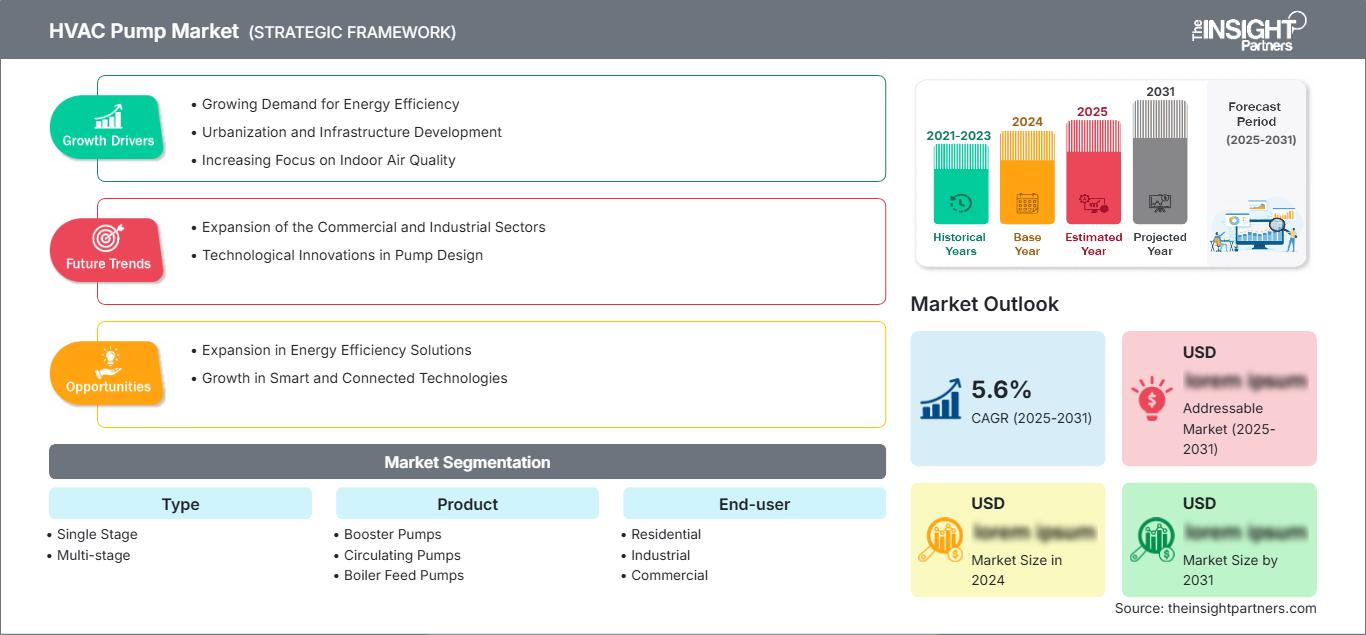
HVAC Pump Market: Strategic Insights
Regional Insights
North America HVAC pump market
North America accounts for a modeled 20–24% of the global HVAC pump market share in 2025 and is forecast to grow at 4.2–4.8% CAGR during 2026–2034. Replacement of aging hydronic equipment anchors demand, while commercial codes increasingly favor variable-flow design. Redundant movement, pressure regulation, and system integration into building automation systems is required for data centers, hospital facilities, universities, and high-rise construction. The use of heat pumps for cold climates facilitates the current water loop configuration.
The United States leads the regional purchases, but Canada contributes through the application of district energy and institutional retrofit, while Mexico contributes through industrial facilities. Purchase decision makers prioritize low installation costs, local servicing, and documentation. Variable speed circulators are preferred due to part-load conditions dominating annual run time periods. Localized supply chains and stock availability help in servicing replacements, while engineered solutions require manufacturers that are capable of designing and simulating system curves and controls.
U.S. HVAC Pump Market
The U.S. HVAC Pump Market represents a modeled 76–80% of North American revenue in 2025 and advances at a 4.3–4.9% CAGR through 2034. Federal efficiency programs, state building codes, and corporate energy targets support the replacement of constant-speed pumps. The leading market applications are commercial with an emphasis on data centers, healthcare facilities, schools, hotels, and offices. In industrial markets, reliability, redundancy, and remote monitoring are crucial for cooling and boiler processes.
The competitive environment is stiff due to Xylem Inc., Grundfos Holding A/S, Pentair plc, Patterson Pump Company, among others, having national distribution channels along with application engineering capabilities. Retrofits will be based on drop-in capability and readily available replacement parts, while new construction projects will be geared towards digital-native products. More and more engineers prefer specifying sensor-less controls, permanent magnet motors, and network connections. But still, security concerns, installation quality, and technician competence hinder adoption.
Europe HVAC Pump Market
Europe holds a modeled 18–22% share in 2025 and grows at 4.0–4.6% CAGR through 2034. Germany achieves leadership by virtue of its industrial capability, district heating, and building efficiency standards. Germany’s boilers and hydronic systems ensure regular replacement, with heat pumps further adding to electronically driven circulator systems. While manufacturers can tap into the network of contractors, they need to be capable of meeting stringent ecodesigns, noise levels, and performance throughout life cycle expectations.
The UK concentrates on building renovations, public properties, and low-carbon heating applications. France takes advantage of both district energy and business property upgrades. Italy and Spain contribute to their markets through hospitality projects, mixed-use developments, and cooling applications. In these countries, integration of controls and variable speed operation are increasingly specified needs. Dispersed building stock impedes project progress, but grants, energy performance contracts, and higher utility prices make it viable to replace pumps and balance systems.
APAC HVAC Pump Market
Asia Pacific leads with a modeled 46–50% share in 2025 and a 5.1–5.7% CAGR through 2034. China continues to be the biggest market, powered by manufacturing capacity, dense urban buildings, and district energy. India brings rapid commercial and residential expansion; Japan and South Korea focus on energy-efficient replacement and smart controls.
Australia’s contribution comes from data centers, healthcare facilities, and high-performance buildings. Regional regulations have begun to correlate the equipment selected with energy intensity and carbon footprint. Cost-effectiveness is achieved through local manufacturing, whereas the quality varies on the basis of hydraulic efficiency, controls interoperability, and services offered.
Middle East & Africa HVAC Pump Market
The Middle East and Africa are modeled to expand at 4.6–5.2% CAGR through 2034. Saudi Arabia stands out as a large-scale urbanization, tourism, and industrial developments, making use of district cooling and reliable water flow. The UAE comes second in terms of the demand for tall buildings, hotels, and data centers, where efficiency equals reduced cost of operation.
In South Africa, the focus is on retrofitted commercial buildings and reliable industries, while the rest of the area relies on projects. Hot climate, water scarcity, and unstable electricity supply make it profitable to have dependable pumps and motors as well as remote control systems. Local partners are crucial to turn pipelines into a steady income stream.
Segmentation Analysis
Type
The type segment is modeled to grow at 4.6–5.2% CAGR during 2026–2034. The HVAC pump market scope spans straightforward circulation duties and pressure-intensive systems requiring staged hydraulics. Selection depends on head, flow variability, redundancy, footprint, and maintenance access. Single-stage units retain broad replacement demand, while multi-stage designs gain where tall buildings, boiler feed loops, and industrial processes require greater pressure and controlled performance.
- Single Stage: Broadly specified for low-to-moderate head circulation, these pumps benefit from simple maintenance, familiar installation practices, competitive pricing, and extensive availability across residential and commercial replacement channels.
- Multi-stage: Pressure-intensive applications support strategic adoption in high-rise buildings, boiler systems, and industrial loops, where compact footprints, efficiency across demanding duty points, and redundancy justify higher engineering complexity.
Product
The product segment is modeled to advance at 4.7–5.3% CAGR during 2026–2034. Demand reflects distinct hydraulic duties across pressure boosting, closed-loop circulation, boiler feed, and general centrifugal service. Digital control increasingly raises value per unit, while standardized dimensions support replacements. Buyers balance first cost against wire-to-water efficiency, noise, serviceability, and controls compatibility, creating opportunities for both premium connected equipment and dependable conventional platforms.
- Booster Pumps: High-rise, municipal-pressure, and mixed-use applications sustain demand for packaged systems offering staged operation, compact layouts, stable pressure, and remote supervision across fluctuating occupancy profiles.
- Circulating Pumps: The category remains central to hydronic heating and cooling, with electronically commutated motors, sensorless control, quiet operation, and retrofit compatibility strengthening strategic importance.
- Boiler Feed Pumps: Industrial plants, hospitals, campuses, and district-energy facilities prioritize dependable feedwater service, temperature tolerance, cavitation management, and maintainability, preserving a specialized engineered-equipment position.
- Centrifugal Pumps: Broad hydraulic coverage, standardized designs, and mature service networks support extensive use across chilled-water and condenser loops, with efficiency gains increasingly tied to drives and controls.
End-user
The end-user segment is modeled to grow at 4.8–5.4% CAGR during 2026–2034. Commercial facilities lead because centralized chilled-water and heating systems serve large, variable loads. Industrial users value process continuity and redundancy, whereas residential demand is linked to multi-family hydronics and premium efficiency upgrades. Across all three groups, procurement is moving toward lifecycle performance, system balancing, remote monitoring, and service support rather than the lowest equipment price.
- Residential: Multi-family buildings and hydronic homes create steady replacement demand, with compact dimensions, low noise, installer familiarity, and energy-saving controls shaping purchasing decisions.
- Industrial: Process cooling, boiler systems, clean manufacturing, and utility loops require durable equipment, engineered materials, redundancy, and predictive maintenance, supporting higher-value specifications and service contracts.
- Commercial: Offices, hospitals, hotels, campuses, retail sites, and data centers generate the largest contribution because centralized systems require continuous circulation, variable-flow control, and lifecycle optimization.
Opportunity Snapshot
| End-user | Revenue Contribution | Trend Tag | Adoption Stage |
|---|---|---|---|
| Residential | Medium | Hydronic Retrofit | Scaling |
| Industrial | Medium | Predictive Uptime | Scaling |
| Commercial | High | Smart Buildings | Mature |
HVAC Pump Market Growth Drivers and Impact Analysis
Building electrification expands hydronic circulation requirements
Electrification moves the heating load away from burners onto heat pumps and low-temperature water systems, which increases the significance of proper pump sizing. Variable flow pumps assist in keeping the occupants comfortable while minimizing the parasitic power consumption, especially during retrofits where the radiators and piping systems were engineered to work at different temperatures. The influence of the market goes beyond just the volume of units, since control and balancing systems are necessary, as well as, in some cases, a buffer tank connection. Suppliers offering technical assistance in the application can decrease risks for contractors and building operators. Adoption is high in cases where electricity carbonization, carbon goals, and renovation incentives coincide, but it all comes down to system design.
Data-center cooling raises reliability and redundancy standards
Data centers need heat removal, accurate flow control, and fast response times in case of faults, meaning that pumps are mission-critical elements and not merely auxiliary equipment. Chilled water, condenser water, and liquid cooling systems may have redundant architectures, thus requiring a higher intensity of equipment per facility. High efficiency is highly appreciated, as pumps consume electricity, but availability is more important than energy savings. For pump vendors, the challenge lies in testing, monitoring, cybersecurity, and local support requirements. Modular skids may be required by large campuses to be commissioned in phases. Pumping companies capable of integrating pumps, drives, sensors, and analytics get the opportunity to generate more value from projects.
Energy codes accelerate variable-speed replacement cycles
Building energy standards are moving toward a whole system performance evaluation, which prompts designers to minimize throttling and size flow based on real load. Variable speed pumping, differential pressure control, and optimized sequencing provide the best efficiency in systems that run a lot of hours at partial load. This motivator opens up replacement options, since controls can help optimize existing facilities without requiring full mechanical replacement. Facility owners benefit from improved diagnostics and energy tracking. The market will be most influenced by commercial portfolios, where a standard retrofit program can be deployed again and again. But savings are dependent on installation and commissioning, so suppliers who offer auditing services and verification will have an advantage.
HVAC Pump Market Future Trends
Autonomous pump optimization
The HVAC pump market trends increasingly point toward self-optimizing equipment that interprets load patterns, adjusts setpoints, and flags abnormal operation without continuous manual intervention. The future will see the coming together of embedded sensors, edge computing, and secured building network interfaces. The economic benefits would be in minimizing the commissioning period, identifying contamination, air entrainment, and avoiding simultaneous operation of duplicate systems. However, initial usage will be in data centers, hospitals, and high-end office blocks because downtime and energy billing would justify the extra cost. However, vendors need to offer transparency on the algorithms used, the ability to override functions, and ongoing support for the software.
Product-as-a-service commercial models
The performance contract model will move some of the buying decision from equipment ownership to flow, availability, or energy guarantees. Connected pumps make the business case possible through the generation of data about the operation, allowing for remote management. Service providers can bundle equipment, installation, monitoring, and maintenance into ongoing contracts, thus linking incentives with efficiency throughout the product’s life cycle. Adoption should start in multiple locations, commercial properties and key industrial operations with a stable operational profile. The business case needs a baseline to be established, cybersecurity considerations, and a service-level agreement definition. The most likely to benefit companies are those with financing and technician coverage.
HVAC Pump Market Opportunities
Portfolio-scale retrofit programs
The HVAC pump market forecasts support investment in repeatable retrofit offerings for hospitals, schools, hotels, retail chains, and office portfolios. Suppliers can package audits, standardized pump selections, controls upgrades, installation support, and measurement into a replicable program. Portfolio aggregation lowers engineering cost per site and enables volume procurement, while verified savings strengthen capital approval. The most attractive targets have long operating hours, oversized legacy pumps, and accessible plant rooms. Partnerships with energy-service companies and mechanical contractors can accelerate customer acquisition. Vendors should prioritize digital baselining, preconfigured controls, and documented commissioning procedures to convert fragmented replacement demand into scalable, higher-margin projects.
District cooling in hot-climate urban corridors
New urban districts across the Gulf and parts of Asia create concentrated opportunities for high-capacity circulation, booster, and condenser water pumps. Developers seek dependable systems that can be phased with occupancy while maintaining energy performance under extreme ambient conditions. Suppliers should pursue early engagement with utilities, consultants, and engineering contractors because hydraulic architecture is established well before equipment procurement. Local assembly, testing, and spare-parts hubs can improve tender competitiveness and lifecycle support. Packaged skids, remote monitoring, and corrosion-resistant configurations offer additional differentiation. Success depends on demonstrating installed references, water-efficiency compatibility, and the ability to service multi-year infrastructure programs.
Recent Developments
- July 2026: Daikin has introduced its new X Series mixed-technology heat pump, a residential climate solution designed to combine air conditioning, space heating and domestic hot water production through a single integrated system. The company said the new platform is aimed at improving year-round comfort while reducing the need for multiple heating and cooling systems in homes
- March 2025: Xylem Inc. – continued expansion of connected building-water technologies through Bell & Gossett solutions that integrate pumps, drives, controls, and monitoring for commercial hydronic systems
- March 2025: LG Electronics (LG) will unveil a new lineup of indoor units (IDUs) for air-to-water heat pump systems at Mostra Convegno Expocomfort (MCE) 2026 in Milan, Italy, from March 24-27. The all-new Combi, Hydro and Control Units expand LG’s heating solution portfolio with cohesive design, flexible installation and improved system integration for residential applications
Frequently Asked Questions

- Comprehensive Market Sizing and Forecast Analysis
- Detailed Segmentation Analysis
- In-Depth Market Dynamics Assessment
- Regional and Country-Level Insights
- Competitive Landscape and Company Benchmarking
- Strategic Business Intelligence
Recent Reports
Testimonials

The Insight Partners' SCADA System Market report is comprehensive, with valuable insights on current trends and future forecasts. The team was highly professional, responsive, and supportive throughout. We are very satisfied and highly recommend their services.
RAN KEDEM Partner, Reali Technologies LTDs
I requested a report on a very specific software market and the team produced the report in a few days. The information was very relevant and well presented. I then requested some changes and additions to the report. The team was again very responsive and I got the final report in less than a week.
JEAN-HERVE JENN Chairman, Future Analytica
We worked with The Insight Partners for an important market study and forecast. They gave us clear insights into opportunities and risks, which helped shape our plans. Their research was easy to use and based on solid data. It helped us make smart, confident decisions. We highly recommend them.
PIYUSH NAGPAL Sr. Vice President, High Beam Global
The Insight Partners delivered insightful, well-structured market research with strong domain expertise. Their team was professional and responsive throughout. The user-friendly website made accessing industry reports seamless. We highly recommend them for reliable, high-quality research services
YUKIHIKO ADACHI CEO, Deep Blue, LLC.
This is the first time I have purchased a market report from The Insight Partners.While I was unsure at first, I visited their web site and felt more comfortable to take the risk and purchase a market report.I am completely satisfied with the quality of the report and customer service. I had several questions and comments with the initial report, but after a couple of dialogs over email with their analyst I believe I have a report that I can use as input to our strategic planning process.Thank you so much for taking the extra time and making this a positive experience.I will definitely recommend your service to others and you will be my first call when we need further market data.
JOHN SUZUKI President and Chief Executive Officer, Board Director, BK Technologies
I wish to appreciate your support and the professionalism you displayed in the course of attending to my request for information regarding to infectious disease IVD market in Nigeria. I appreciate your patience, your guidance, and the fact that you were willing to offer a discount, which eventually made it possible for us to close a deal. I look forward to engaging The Insight Partners in the future, all thanks to the impression you have created in me as a result of this first encounter.
DR CHIJIOKE ONYIA MANAGING DIRECTOR, PineCrest Healthcare Ltd.Reason to Buy
- Informed Decision-Making
- Understanding Market Dynamics
- Competitive Analysis
- Identifying Emerging Markets
- Customer Insights
- Market Forecasts
- Risk Mitigation
- Boosting Operational Efficiency
- Strategic Planning
- Investment Justification
- Tracking Industry Innovations
- Aligning with Regulatory Trends





 Get Free Sample for