
HVAC Silencers Market Trends, Size & Forecast by 2034
Coverage: By Type (Rectangular Silencers, Elbow Silencers, Circular Silencers, Others); Application (Residential, Industrial, Commercial), and Geography (North America, Europe, Asia Pacific, and South and Central America)
- Status : Data Released
- Report Code : TIPRE00014290
- Category : Manufacturing and Construction
- No. of Pages : 150
- Available Report Formats :


- Last update date : November 11, 2026


2025 Market Size
US$ 2.42 Bn
Base year value
2034 Forecast
US$ 4.14 Bn
Projected by 2034
CAGR 2026-2034
6.13 %
Growth rate
Addressable Market
US$ 29.67 Bn
(2026-2034)
The HVAC Silencers Market was valued at US$ 2.42 Billion in 2025 and is projected to reach US$ 4.14 Billion by 2034, expanding at a CAGR of 6.13% during 2026–2034. The market includes engineered sound attenuators installed in heating, ventilation, and air-conditioning air paths to reduce fan, equipment, and cross-talk noise while preserving required airflow and acceptable pressure loss.
Across North America, the HVAC Silencers Market size is supported by an estimated ~6% CAGR through 2034. A large installed base of central air systems sustains replacement demand, while data centers, healthcare facilities, advanced manufacturing plants, and mixed-use developments require higher airflow without compromising acoustic criteria. Retrofit projects increasingly prioritize low-pressure-drop designs because fan energy, occupied-space comfort, and compliance with local noise limits must be managed together.
HVAC Silencers Market Assessment and Insights
Regional Outlook
- North America: ~35% of the global HVAC Silencers Market share in 2025 | ~6% CAGR through 2034. Market position: The region ranks first, supported by mature ducted HVAC infrastructure, rigorous acoustic specifications, extensive retrofit activity, and concentrated investment in data centers, healthcare, manufacturing, and institutional buildings.
- US: ~83% of North American market revenue in 2025 | ~6% CAGR through 2034. Market position: The US leads North America through broad engineering capability, domestic supplier presence, data-center construction, hospital modernization, and industrial projects requiring customized airflow attenuation.
- Europe: ~30% of the global market in 2025 | ~5% CAGR through 2034. Market position: A mature regulatory environment sustains demand for hygienic, tested, energy-conscious attenuation, with Germany leading and the UK, France, Italy, and Spain contributing significant retrofit and new-build requirements.
- Asia Pacific: ~27% of the global market in 2025 | ~8% CAGR through 2034. Market position: Asia Pacific is the fastest-growing region as urban construction, electronics manufacturing, transport infrastructure, and cooling penetration expand, led by China and followed by Japan, South Korea, India, and Australia.
Segment Outlook
- Type: ~61% Share in 2025 | ~6% CAGR through 2034. Market position: Type is the larger main segment because silencers are procured as engineered duct components across nearly every project, with rectangular units fitting conventional commercial and industrial duct layouts.
- Application: ~39% Share in 2025 | ~7% CAGR through 2034. Market position: Application records the higher modeled growth as data centers, manufacturing facilities, healthcare buildings, and dense mixed-use developments tighten operational noise and airflow requirements.
Competitive Coverage
eNoise Control, H.S. Engineers, IAC Acoustics, Kinetics Noise Control, Inc., Oeler Industries, Inc., Ruskin, Systemair AB, TROX SE, VG Engineering Inc., Vibro-Acoustics, a Swegon Group company
Methodology
The Insight Partners follows Data Collection & Secondary Research, Primary Research, Data Analysis, and Data Triangulation & Final Review to validate market estimates and insights.
Source: The Insight Partners' analysis based on proprietary research, government publications, company annual reports, investor presentations, industry databases, and expert interviews.
Product development has shifted from primitive absorptive boxes to attenuation packages that are application-engineered. Today’s suppliers integrate insertion loss, inherent noise, pressure drop, hygiene, fire performance, casing integrity, corrosion resistance, and access for cleaning. Better computer-aided design and standardized acoustic tests enhance specifications, while modular manufacturing facilitates silencer bank assemblies for air handling systems, generator rooms, cooling towers, and process ventilation. Metal-intense production will continue, yet distinctiveness derives from aerodynamic splitting, packless designs, certified acoustic characteristics, and project-specific manufacturing.
For the period up to 2034, demand will extend beyond traditional areas of commercial construction. Construction of infrastructure in Asia Pacific region, urban construction in the Middle East, as well as industrial construction locally, would expand the marketable base. Renovation regulations in Europe would keep up with the replacement construction. Investment capital will target factories with flexibility, digital configurators, and local engineering capability that will enable fast submissions. Regulation will play its indirect role: stricter building energy standards, occupational noise standards, hygiene standards, and community noise standards will make attenuation possible with lower fan power.
HVAC Silencers Market Report Scope
| Report Attribute | Details |
|---|---|
| Market size in 2025 | US$ 2.42 Billion |
| Market Size by 2034 | US$ 4.14 Billion |
| Global CAGR (2026 - 2034) | 6.13% |
| Historical Data | 2021-2024 |
| Forecast period | 2026-2034 |
HVAC Silencers Market Analysis
The HVAC Silencers market relies on an engineering compromise that makes sense: greater ventilation and cooling loads mean greater air volume, but bigger fans and faster velocities in the ducts create more airborne and regenerated noise. Demand thus comes from mechanical consulting engineers, acoustic engineers, equipment manufacturers, contractors, and building owners. The supply chain starts with galvanized or stainless steel, liner materials, acoustic media, sealing, and casing fabrication, then continues through acoustic design, lab test data, project selection, manufacturing, installation, and commissioning.
Market forces work in favor of manufacturers who are able to turn the target octave-bands, flow, available static pressure, cleanliness, and spatial restrictions into manufacturable products. Stock circular and rectangular models are for standard applications, while hospitals, labs, power plants, data centers, and industrial users need custom casing configurations, media protection, a packless design, or weatherproof finish. Reliable lead-times and precise submittal information matter as much as unit costs since the silencer has to fit with ducts, fans, structure, and access openings.
HVAC Silencers Market research points to a fragmented yet highly technological competitive landscape. Companies like IAC Acoustics and Kinetics Noise Control, Inc. focus on the engineering of airflow attenuation. On the other hand, TROX SE and Systemair AB tie silencers into overall ventilation solutions. Ruskin offers duct silencers along with acoustic louvers and eNoise Control focuses on custom industrial and commercial applications. H.S. Engineers, Oeler Industries, Inc., VG Engineering Inc., and Vibro-Acoustics, a Swegon Group company contribute towards more specialized coverage and regional execution.
Investments are moving from low-pressure-drop configurations, configuration software, testing data availability, and sales engineering for high-value verticals. Competitive positioning needs documented performance capabilities and reduction of overall system risk, as opposed to just attenuation performance. Suppliers who incorporate acoustic design into the choice of fans, vibration considerations, louvers, barriers, and even enclosures will have an advantage in project scope. Regional manufacturing and representation are also important factors since oversized equipment is expensive to transport and last-minute design changes may affect the installation schedule.
● REPORT CUSTOMIZATION
Tailor This Report To Align With Your Specific Business Requirements
This report can be customized to align precisely with your business objectives, scope, and target markets. Customization options include tailored segmentation, geography, competitive analysis, and strategic insights to support informed decision-making.
Customize This Report →WHAT YOU CAN ADJUST
- ● Segmentations
- ● Geography
- ● Competitive Analysis
- ● Language Preferences
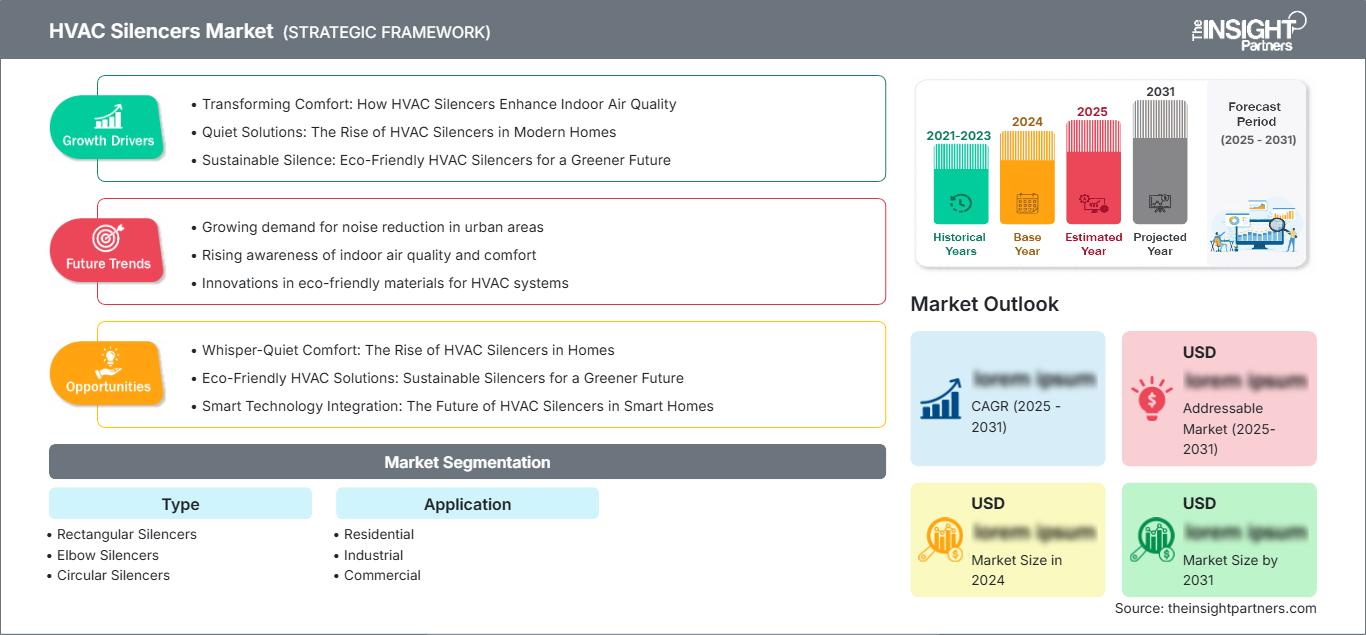
HVAC Silencers Market: Strategic Insights
Regional Insights
North America HVAC Silencers Market
The HVAC Silencers Market share held by North America is modeled at ~35% in 2025, with the region advancing at ~6% CAGR through 2034. This dominance is due to the extensive penetration of central air handling systems, acoustic consulting, and procurement specifications that include insertion loss, as well as pressure drop and self noise. Retrofit projects in existing office buildings, colleges and universities, hospitals, and public facilities ensure a steady stream of sales in addition to new constructions.
The presence of data centers and high tech manufacturing adds the extra requirement of high intensity since fan banks, heat rejection systems, generator ventilation systems, and continuous operation can impact people and neighbors. The demand from Canada comes from institutional and commercial building retrofits, whereas the demand from Mexico is for manufacturing and logistic facilities.
U.S. HVAC Silencers Market
The US represents ~83% of North American revenue in 2025 and is expected to record ~6% CAGR through 2034. The scale is driven by a large amount of ducted HVAC assets, a wide range of non-residential construction, and a dense consultant, contractor, and domestic acoustic product provider base. The commercial market covers offices, hospitals, schools, labs, hospitality establishments, entertainment centers, and mission-critical centers where noise criteria in rooms affect equipment choice.
Industrial projects are getting more strategically significant because semiconductor, battery, electronics, food, pharmaceutical, and general manufacturing projects use large-scale ventilation systems. Relevant domestic companies include IAC Acoustics, Kinetics Noise Control, Inc., Ruskin, eNoise Control, and Oeler Industries, Inc. The buyers ask more often for acoustic data for factories, low-frequency attenuation, low static pressure penalty, and joint solutions for ducts, louvers, barriers, vibration isolation, and equipment enclosures.
Europe HVAC Silencers Market
Europe accounts for an estimated ~30% of global revenue in 2025 and is projected to expand at ~5% CAGR through 2034. The market features a matured installed base alongside strong expectations concerning energy efficiency, indoor environmental quality, hygiene, fire safety, and neighborhood noise control. Retrofit and renovation are particularly significant since a lack of sufficient plantroom space requires designers to address both compactness and sound performance along with limitations on fan energy.
Germany dominates in Europe, thanks to sophisticated ventilation engineering, industry, and suppliers like TROX SE. The UK features highly complicated commercial, healthcare, education, and multi-purpose projects in which acoustic consultants impact the specification of the system. France provides renovation of public buildings, hospitality, and transportation needs, whereas Italy and Spain provide opportunities in tourism, healthcare, manufacturing, and climate cooling.
Acoustic performance, hygiene of material, cleaning properties, leakage of casing, fire class, and aerodynamic efficiency make up the criteria for European product differentiation. Companies like Systemair AB, TROX SE, and other international speciality brands compete with a wide range of products and specifications. The growth should be gradual rather than explosive because the rate of new construction varies in each country, but decarbonization renovation and better ventilation assure consistent replacement rate.
APAC HVAC Silencers Market
Asia Pacific holds ~27% of global revenue in 2025 and is the fastest-growing region, at an estimated ~8% CAGR through 2034. The most advanced nation in Asia Pacific is China due to its industry base, city building assets, transport network, and extensive HVAC manufacturing industry. India brings fast commercial construction and localization of manufacture. Japan and South Korea have complex electronics, health-care, and institutional applications that are technologically advanced.
Australia brings data center, mining, health-care, and commercial construction projects with consideration of environmental noise. Cooling demand is rising as well as densification of cities and industrial capacity expansions, all across Asia Pacific. There is a great opportunity for suppliers with local manufacture and proven designs, as economics of the projects need competitiveness and consultants pay much attention to pressure loss and octave band performance.
Middle East & Africa HVAC Silencers Market
The Middle East & Africa is forecast to grow at ~6% CAGR through 2034. The UAE is presented as a top nation in the Middle East & Africa because of its dense commercial infrastructure, hospitality sector, airports, data centers, and district cooling. The contribution by Saudi Arabia lies in significant urban, tourist, healthcare, transport, and industrial projects where higher cooling demands increase fan and plant noise.
South Africa provides the region's best-known sub-Saharan presence in terms of mining, industry, healthcare, retail, and office space. Meanwhile, the Rest of MEA is a projects-led area. Extreme weather conditions mean the necessity for anti-corrosive materials, media containment with acoustic properties, and design to maintain airflow at high cooling load.
Segmentation Analysis
Type
Type is modeled to expand at ~6% CAGR during 2026–2034. The HVAC Silencers Market scope covers rectangular, elbow, and circular silencers engineered for ducted airflow. Selection depends on duct geometry, available length, target octave-band attenuation, allowable pressure drop, cleanliness, temperature, material, and service access. Modular fabrication supports standard building systems, whereas industrial and mission-critical projects frequently require custom casing thickness, splitter geometry, media protection, or packless designs.
- Rectangular Silencers: These units hold the strongest position in conventional commercial and industrial ductwork because they align with rectangular air-handling layouts, accommodate multiple splitter configurations, and scale efficiently into large banks for high-volume airflow.
- Elbow Silencers: Elbow configurations address installations where straight duct length is constrained. They combine directional change with attenuation, making them strategically important in congested plantrooms, retrofit shafts, and projects that must limit added system footprint.
- Circular Silencers: Circular designs serve spiral duct, axial-fan, exhaust, and smaller-diameter systems. Their pressure-tight geometry, streamlined core options, and straightforward connection make them important for standardized ventilation, industrial exhaust, and equipment-specific noise control.
Application
Application is expected to grow at ~7% CAGR during 2026–2034. Adoption differs by occupancy, airflow intensity, acoustic criteria, operating hours, and proximity to receptors. Commercial projects generate broad specification volume, industrial facilities demand rugged and customized products, and residential use is concentrated in multifamily towers, premium housing, centralized ventilation, and mechanical-room interfaces. Across applications, lifecycle value increasingly depends on achieving target sound levels without raising fan energy or maintenance burden.
- Residential: Demand centers on multifamily buildings, luxury residences, assisted living, and mixed-use developments using centralized ventilation. Compact dimensions, low regenerated noise, and cross-talk control matter where mechanical systems sit close to bedrooms and living areas.
- Industrial: Industrial facilities require robust attenuation for process fans, dust collection, compressors, generators, test cells, and high-capacity ventilation. Custom materials, temperature resistance, cleanability, structural strength, and low-frequency performance increase project value and engineering complexity.
- Commercial: Commercial applications form the broadest demand pool across offices, hospitals, schools, hotels, laboratories, data centers, airports, and entertainment venues. Acoustic comfort, privacy, hygiene, and energy-efficient airflow make silencers integral to many mechanical specifications.
Opportunity Snapshot
| Application | Revenue Contribution | Trend Tag | Adoption Stage |
| Residential | Low | Quiet Living | Scaling |
| Industrial | High | Process Ventilation | Scaling |
| Commercial | High | Acoustic Comfort | Mature |
HVAC Silencers Market Growth Drivers and Impact Analysis
Higher Airflow in Data Centers and Critical Facilities
Data Centers, laboratories, hospitals, battery manufacturing plants, and semiconductors generate very large volumes of airflow non-stop, resulting in fan noise and plant noise becoming key parameters for acoustic design. Silencers become mandatory in the air handlers, generator halls, cooling systems, air intakes/exhausts, and pressure relief points. It is more than just the unit volume consideration as larger quantities are often demanded, as well as low-frequency noise reduction, redundancy, durability, and low-pressure drop certification. Since re-design and re-tooling is expensive, buyers appreciate early acoustic simulation and coordinated submittals. As a result, it makes for higher tech content and order value, while benefiting manufacturers who can build to size and demonstrate performance.
Building Renovation and Indoor Acoustic Comfort
Existing commercial and institutional buildings are upgrading their fans, air handling units and control systems to enhance their ventilation, comfort and energy efficiency. These new systems can create new issues with respect to sound power levels, duct velocity and operation schedules, and uncover issues that have been previously ignored or accepted as necessary. Retrofitted silencers are a good solution when rebuilding walls, shafts and plantrooms is not an option. Hospitals, educational facilities, office buildings, hotels and apartments are becoming increasingly conscious about the need for speech privacy, sound sleep, concentration and healing. This results in ongoing opportunities for compact rectangular, elbow and round products along with related engineering services.
Industrial Noise Compliance and Community Constraints
Industrial ventilation, dust collection, combustion air, process exhaust, cooling towers, and backup generation can create persistent tonal or broadband noise. Facilities must protect workers, satisfy project acoustic criteria, and manage sound at property boundaries, especially as industrial and residential land uses move closer together. HVAC silencers offer source-path control without enclosing every machine, but designs must withstand temperature, moisture, contaminants, corrosion, and high velocities. This driver expands demand for stainless construction, media protection, packless units, heavy-gauge casings, and combined silencer-louver-barrier systems. It also supports aftermarket assessment and replacement where changing production loads or new neighbors expose previously acceptable installations.
HVAC Silencers Market Future Trends
Low-Pressure-Drop Acoustic Design Becomes a Procurement Standard
HVAC Silencers Market trends are moving toward performance optimization across acoustics and energy rather than maximum attenuation in isolation. Designers will increasingly compare insertion loss, regenerated noise, system effect, footprint, and fan-power consequences at the selection stage. Aerodynamic noses, tuned splitter spacing, improved transitions, and application-specific flow orientation will gain importance. Digital selection tools should make trade-offs more transparent and allow earlier coordination with fan curves and building-energy models. Suppliers able to provide credible test data and whole-system recommendations will be better positioned, while products that impose excessive resistance may lose favor even when their laboratory attenuation appears strong.
Cleanable, Packless, and Material-Conscious Configurations Expand
Healthcare, life sciences, food processing, electronics, and other controlled environments will push silencer construction toward cleanability and lower contamination risk. Packless designs, protected media, smooth internal surfaces, drainable assemblies, stainless options, and documented hygiene characteristics will expand beyond niche use. Material choices will also receive closer scrutiny for fire behavior, fiber erosion, moisture resistance, durability, and environmental reporting. The change will not eliminate conventional absorptive products, which remain cost-effective, but it will widen the premium tier and increase application engineering. Manufacturers that modularize clean configurations without sacrificing pressure-drop performance can reduce lead times and broaden adoption.
HVAC Silencers Market Opportunities
Localize Engineering and Fabrication in Asia Pacific
Asia Pacific offers a scalable opening for regional fabrication tied to industrial parks, metro systems, hospitals, commercial towers, and data-center campuses. HVAC Silencers Market Forecasts support investment in application engineering, acoustic testing partnerships, and configurable manufacturing close to demand centers. Local operations can reduce freight cost for bulky products, shorten revision cycles, and accommodate country-specific duct conventions and materials. A practical entry model combines standardized circular and rectangular platforms with custom splitter spacing, casing, and connections. Partnerships with consultants, air-handling-unit makers, contractors, and fan suppliers can improve specification access while building confidence in documented performance.
Bundle Retrofit Diagnosis with Guaranteed System Outcomes
Many retrofit buyers know that a facility is noisy but lack reliable source-path diagnosis or available-pressure data. Suppliers can capture more value by offering site measurement, acoustic modeling, fan-system review, product selection, installation coordination, and post-installation verification as one managed package. The model is particularly relevant to hospitals, universities, hotels, factories, data centers, and mixed-use properties where operational disruption must be controlled. Commercially, outcome-based services differentiate specialists from fabricators selling on dimensions alone. They also create pull-through for silencers, barriers, louvers, vibration isolation, and enclosures while reducing the owner’s risk of solving one noise path and overlooking another.
Recent Developments
- August 2026: Ruskin introduced the ACL1245V, a 12-inch-deep stationary acoustical louver for exterior-wall intake and exhaust applications. The design combines insulated mineral-wool-filled blades at a 45-degree angle with airflow, weather protection, and sound attenuation, extending the company’s noise-control offering for demanding building envelopes.
- August 2025: IAC Acoustics appointed Kyle Johnson to lead its national HVAC sales division, working with representatives and OEM partners across HVAC-related solutions. The appointment indicates increased commercial focus on silencers, acoustic louvers, and engineered airflow-noise control in the US market.
- August 2025: Systemair AB completed the acquisition of NADI Airtechnics Ltd., an India-based manufacturer of engineered industrial fans. The transaction adds industrial-fan competence and a complementary product range while strengthening Systemair’s position in India and infrastructure applications, expanding potential channels for coordinated fan and attenuation solutions.
Frequently Asked Questions

- Comprehensive Market Sizing and Forecast Analysis
- Detailed Segmentation Analysis
- In-Depth Market Dynamics Assessment
- Regional and Country-Level Insights
- Competitive Landscape and Company Benchmarking
- Strategic Business Intelligence
Recent Reports
Testimonials

The Insight Partners provided valuable market intelligence that supported our global go-to-market strategy. Their team was professional, responsive, and attentive to our feedback, providing thoughtful analysis and helpful methodological clarifications throughout the project.
Junmo Kim Chief Financial Officer (CFO), Enertech Co., Ltd.
The Insight Partners' SCADA System Market report is comprehensive, with valuable insights on current trends and future forecasts. The team was highly professional, responsive, and supportive throughout. We are very satisfied and highly recommend their services.
RAN KEDEM Partner, Reali Technologies LTDs
I requested a report on a very specific software market and the team produced the report in a few days. The information was very relevant and well presented. I then requested some changes and additions to the report. The team was again very responsive and I got the final report in less than a week.
JEAN-HERVE JENN Chairman, Future Analytica
We worked with The Insight Partners for an important market study and forecast. They gave us clear insights into opportunities and risks, which helped shape our plans. Their research was easy to use and based on solid data. It helped us make smart, confident decisions. We highly recommend them.
PIYUSH NAGPAL Sr. Vice President, High Beam Global
The Insight Partners delivered insightful, well-structured market research with strong domain expertise. Their team was professional and responsive throughout. The user-friendly website made accessing industry reports seamless. We highly recommend them for reliable, high-quality research services
YUKIHIKO ADACHI CEO, Deep Blue, LLC.
This is the first time I have purchased a market report from The Insight Partners.While I was unsure at first, I visited their web site and felt more comfortable to take the risk and purchase a market report.I am completely satisfied with the quality of the report and customer service. I had several questions and comments with the initial report, but after a couple of dialogs over email with their analyst I believe I have a report that I can use as input to our strategic planning process.Thank you so much for taking the extra time and making this a positive experience.I will definitely recommend your service to others and you will be my first call when we need further market data.
JOHN SUZUKI President and Chief Executive Officer, Board Director, BK Technologies
I wish to appreciate your support and the professionalism you displayed in the course of attending to my request for information regarding to infectious disease IVD market in Nigeria. I appreciate your patience, your guidance, and the fact that you were willing to offer a discount, which eventually made it possible for us to close a deal. I look forward to engaging The Insight Partners in the future, all thanks to the impression you have created in me as a result of this first encounter.
DR CHIJIOKE ONYIA MANAGING DIRECTOR, PineCrest Healthcare Ltd.Reason to Buy
- Informed Decision-Making
- Understanding Market Dynamics
- Competitive Analysis
- Identifying Emerging Markets
- Customer Insights
- Market Forecasts
- Risk Mitigation
- Boosting Operational Efficiency
- Strategic Planning
- Investment Justification
- Tracking Industry Innovations
- Aligning with Regulatory Trends





 Get Free Sample for