
Hybrid Additive Manufacturing Machine Market Share, Growth & Demand by 2034
Coverage: by Product (Metal forming, Biomaterial forming, Non-material forming); Application (Repair, Prototype, Production); End-Use (Automotive, Medical, Electronics, Energy and power, Aerospace and defense, Others) , and Geography (North America, Europe, Asia Pacific, and South and Central America)
- Status : Data Released
- Report Code : TIPRE00008272
- Category : Manufacturing and Construction
- No. of Pages : 150
- Available Report Formats :


- Last update date : November 11, 2026


2025 Market Size
US$ 1,152.23 Mn
Base year value
2034 Forecast
US$ 3,982.49 Mn
Projected by 2034
CAGR 2026-2034
14.77 %
Growth rate
Addressable Market
US$ 21,981.08 Mn
(2026-2034)
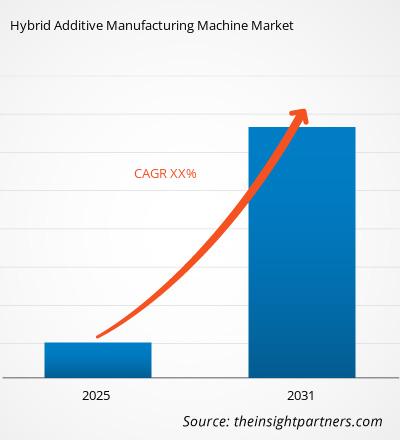
The Hybrid Additive Manufacturing Machine Market was valued at US$ 1,152.23 Million in 2025 and is projected to reach US$ 3,982.49 Million by 2034, expanding at a CAGR of 14.77% during 2026–2034. The market includes equipment that combines additive processes, such as directed energy deposition or powder-bed fusion, with subtractive operations including milling, turning, and grinding.
North America is expected to grow at a CAGR of ~15% through 2034. The Hybrid Additive Manufacturing Machine Market size in the region is supported by aerospace and defense procurement, medical-device innovation, and increasing adoption of repair-oriented metal deposition systems across high-value industrial applications.
Hybrid Additive Manufacturing Machine Market Assessment and Insights
Regional Outlook
- North America: ~34% of the global Hybrid Additive Manufacturing Machine Market share in 2025 | ~15% CAGR through 2034. Market position: North America is the largest regional market, supported by advanced aerospace and defense manufacturing, strong medical-device innovation, high industrial R&D spending, and growing use of hybrid systems for repair, low-volume production, and complex metal components.
- US: ~79% of North American market revenue in 2025 | ~15% CAGR through 2034. Market position: The US leads North America due to its concentration of aerospace primes, defense suppliers, medical-device manufacturers, and additive-software developers. Demand is reinforced by repair applications, certified production parts, and investment in digital manufacturing infrastructure.
- Europe: ~28% of the global market in 2025 | ~14% CAGR through 2034. Market position: Europe is a technologically mature region with strong machine-tool, metrology, and metal-additive expertise. Germany is the leading country in Europe, while the UK, France, Italy, and Spain contribute through aerospace, automotive, medical, and industrial-engineering applications.
- Asia Pacific: ~29% of the global market in 2025 | ~16% CAGR through 2034. Market position: Asia Pacific is the fastest-growing region, driven by industrial automation, electronics manufacturing, aerospace localization, and government-backed advanced-manufacturing programs. China is the leading country in Asia Pacific, followed by Japan, South Korea, India, and Australia.
Segment Outlook
- Metal forming: ~62% Share in 2025 | ~15% CAGR through 2034. Market position: Metal forming leads because hybrid machines are most widely used to manufacture and repair high-value metal components, combining deposition with machining to achieve near-net-shape geometry and finished surface quality.
- Biomaterial forming: ~18% Share in 2025 | ~17% CAGR through 2034. Market position: Biomaterial forming is the high-growth product segment, supported by patient-specific implants, surgical guides, tissue-engineering research, and demand for biocompatible structures with controlled porosity and complex internal geometry.
Competitive Coverage
3D Systems, Inc., DMG MORI, GENERAL ELECTRIC, Matsuura Machinery Corporation, Mazak Corporation, Optomec, Inc., Renishaw plc, Siemens Industry Software Inc., SLM SOLUTIONS GROUP AG, Stratasys Ltd.
Methodology
The Insight Partners follows Data Collection & Secondary Research, Primary Research, Data Analysis, and Data Triangulation & Final Review to validate market estimates and insights.
Source: The Insight Partners' analysis based on proprietary research, government publications, company annual reports, investor presentations, industry databases, and expert interviews.
The Hybrid Additive Manufacturing Machine market has evolved from experimental systems combining deposition and machining to production-based systems with emphasis on repeatability, traceability, and quality of parts made. While earlier systems produced parts that would require further finishing operations, the present systems have laser directed energy deposition, powder-bed technology, milling, turning, grinding, pre-heating, and in-process scanning as their components in a single process. This not only decreases set up times but also ensures that manufacturers are able to manufacture complex geometries with improved tolerances.
Changing dynamics in the production of hybrid additive manufacturing machines include integration of software, sensors, and closed loop control to the systems. Real time measurement of melt-pool parameters, geometry, temperatures, and tool wear is expected to decrease defects and improve repeatability of the process. At the same time, manufacturers of hybrid additive manufacturing machines are introducing modularity in their designs, allowing manufacturers to configure machines to suit specific applications such as repair, prototyping, or series production.
In the future, new economies of manufacturing are forecast to use hybrid technology as they develop local facilities to manufacture aerospace, medical products, and energy sources. Investments will focus on equipment that helps with reducing waste, machining hard materials, and interfacing with digital twins and quality management software. Regulations in place with regard to traceability in aerospace and medical manufacturing will make such platforms more appealing.
Hybrid Additive Manufacturing Machine Market Report Scope
| Report Attribute | Details |
|---|---|
| Market size in 2025 | US$ 1,152.23 Million |
| Market Size by 2034 | US$ 3,982.49 Million |
| Global CAGR (2026 - 2034) | 14.77% |
| Historical Data | 2021-2024 |
| Forecast period | 2026-2034 |
Hybrid Additive Manufacturing Machine Market Analysis
The need to create complicated high-end products while minimizing material wastage, tooling costs, and time is fueling demand for hybrid additive manufacturing machinery. The factors driving growth in the global market for the Hybrid Additive Manufacturing Machine Market include the repairs of expensive turbine blades, molds, and other structural parts along with the rise in the use of additive manufacturing for prototypes and small volume production. Some of the key elements of the value chain include laser makers, motion control providers, suppliers of materials such as powders and wire, manufacturers of the equipment, software vendors, certifiers, and end-users from aerospace, automotive, medical, electronics, and energy industries.
Competitiveness through ecosystems of hardware and software integration, process development services, and qualification for the specific industries. In that regard, DMG MORI and Mazak Corporation provide additive deposition and advanced machining machines; Optomec, Inc. provides directed energy deposition and repair services; Renishaw plc provides metrology and metal additive machines; 3D Systems, Inc. and Stratasys Ltd. offer additive portfolio; and GENERAL ELECTRIC assists in industry adoption through aerospace applications. Siemens Industry Software Inc. provides digital process integration, while SLM SOLUTIONS GROUP AG and Matsuura Machinery Corporation provide metal powder bed and precision machining machines.
In the case of analysis of the market of the hybrid additive manufacturing machine, it should be noted that competitive differentiation is moving from the specifications of the machine to validated production processes. Investments are made in the areas of process qualification, in-line inspection, cybersecurity, and software capable of managing build parameters, machine health and part traceability.
● REPORT CUSTOMIZATION
Tailor This Report To Align With Your Specific Business Requirements
This report can be customized to align precisely with your business objectives, scope, and target markets. Customization options include tailored segmentation, geography, competitive analysis, and strategic insights to support informed decision-making.
Customize This Report →WHAT YOU CAN ADJUST
- ● Segmentations
- ● Geography
- ● Competitive Analysis
- ● Language Preferences
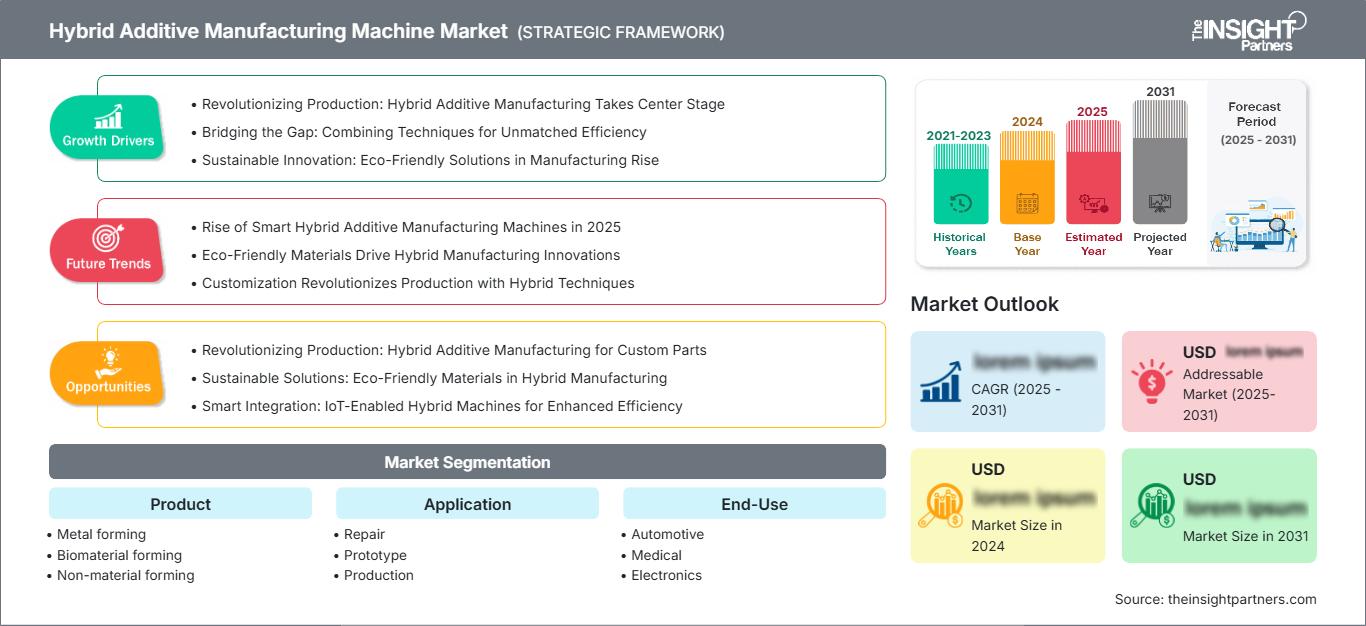
Hybrid Additive Manufacturing Machine Market: Strategic Insights
Regional Insights
North America Hybrid Additive Manufacturing Machine Market
North America accounted for approximately ~34% of global revenue in 2025 and is projected to grow at a CAGR of ~15% through 2034. Leadership within the region is due to advanced aerospace and defense manufacturing, thriving medical device industry and investments in digital production solutions. The use of hybrid machines is becoming more common not only for the restoration of parts like turbines, molds and structures, but also for the production of complicated geometries not possible with traditional machining.
The other reason behind the increasing demand comes from the desire to speed up the development and limit reliance on extended supply chain. Hybrid systems are being utilized in order to minimize the number of processes related to additive deposition, finishing and inspection. Such a strategy is especially beneficial for projects that involve high mix-low volume production.
U.S. Hybrid Additive Manufacturing Machine Market
The US represented approximately ~79% of North American revenue in 2025 and is expected to grow at a CAGR of ~15% through 2034. The country benefits from a dense network of aerospace primes, defense suppliers, medical-device companies, research institutions, and additive-manufacturing software providers. These stakeholders are driving adoption of hybrid systems for repair, rapid prototyping, and certified production components.
Companies such as 3D Systems, Inc., Optomec, Inc., GENERAL ELECTRIC, and Siemens Industry Software Inc. have considerable representation through additive manufacturing systems, deposition technology, industrial usage, and digital manufacturing software. Some of the trends seen in this application include laser-based directed energy deposition for repairing components, hybrid machining of titanium and nickel alloys, and light-weight aircraft structures. This is an area where the United States is also very important due to the need for qualification.
Europe Hybrid Additive Manufacturing Machine Market
Europe held approximately ~28% of global revenue in 2025 and is forecast to expand at a CAGR of ~14% through 2034. It features a high level of engineering in machine tools, metrology technologies, and a developed metal additive environment. Germany is the leading nation in Europe due to its capabilities in machine tools, automotive industry, and industrial research facilities. The United Kingdom has contributions to European adoption due to aerospace, propulsion, and medical industries, whereas France provides demand due to aerospace and defense programs. Italy and Spain provide demand due to the development of automotive parts, industrial machinery, and aerospace.
The demand in Europe is more influenced by the necessity to produce lightweight structures, minimize material waste, and produce critical components locally. Hybrid machines have been introduced to combine additive deposition with precision machining to provide a shortened process chain for metal components. Renishaw plc, DMG MORI, SLM SOLUTIONS GROUP AG, and Siemens Industry Software Inc. are some companies active in this region due to their engineering capabilities and industrial software.
APAC Hybrid Additive Manufacturing Machine Market
Asia Pacific accounted for approximately ~29% of global revenue in 2025 and is expected to grow at a CAGR of ~16% through 2034, making it the fastest-growing region. China is the leading country in Asia Pacific, supported by aerospace localization, industrial automation, electronics manufacturing, and state-backed advanced-manufacturing initiatives. Japan and South Korea contribute through precision machining, automotive, electronics, and medical-device capabilities, while India offers growth potential from aerospace, defense, and industrial localization. Australia supports adoption through mining equipment, energy infrastructure, and research-led manufacturing.
Industrial policy and investment in domestic production capability are accelerating adoption. Manufacturers are deploying hybrid systems to reduce reliance on imported components, repair high-value assets, and produce complex parts closer to end use. The region’s expanding electronics and automotive sectors also create demand for rapid prototyping and tooling applications.
Middle East & Africa Hybrid Additive Manufacturing Machine Market
The Hybrid Additive Manufacturing Machine market report shows that Middle East & Africa is projected to grow at a CAGR of ~16% through 2034. Saudi Arabia is the leading country in the Middle East & Africa, supported by industrial diversification, energy-sector investment, and initiatives to localize advanced manufacturing. The UAE contributes through aerospace services, medical infrastructure, and industrial innovation programs, while South Africa supports demand through mining equipment, automotive components, and research institutions. The Rest of MEA remains an emerging market with growing interest in repair and localized production.
Energy and infrastructure development are central to regional adoption. Hybrid systems can support the repair of turbines, pumps, valves, and drilling-related equipment, reducing lead times for critical spare parts. As countries invest in local manufacturing capability, demand is expected to shift from basic prototyping toward repair and production applications.
Segmentation Analysis
Product
The product segment defines the Hybrid Additive Manufacturing Machine Market scope through metal forming, biomaterial forming, and non-material forming systems. These categories differ in material compatibility, process control requirements, regulatory exposure, and end-use maturity. Demand is shaped by the need to combine additive geometry creation with machining accuracy, surface finish, and process repeatability.
- Metal forming holds approximately ~62% share in 2025 and is expected to grow at a CAGR of ~15% through 2034. Metal systems lead because they address high-value applications in aerospace, energy, automotive, and industrial machinery. Their adoption is supported by the ability to process titanium, nickel alloys, tool steels, and other materials while integrating finishing operations on the same platform.
- Biomaterial forming accounts for approximately ~18% share in 2025 and is expected to grow at a CAGR of ~17% through 2034. Growth is supported by personalized implants, surgical guides, dental applications, and research in regenerative medicine. The segment benefits from increasing demand for porous structures, anatomical customization, and materials that can support biological integration.
- Non-material forming is expected to grow at a CAGR of ~14% through 2034. Demand is tied to rapid tooling, molds, patterns, and specialized industrial components where hybrid processes can shorten development cycles. Adoption is expected to broaden as manufacturers seek faster iteration and lower tooling costs.
Application
The application segment reflects the principal commercial uses of hybrid additive systems. Repair is a major near-term revenue source because it extends the life of expensive components, while prototype and production applications are expanding as process control and qualification capabilities improve.
- Repair is expected to grow at a CAGR of ~15% through 2034. The segment remains central to adoption because hybrid machines can rebuild damaged high-value components and restore critical dimensions without complete replacement. This capability is particularly valuable for turbine blades, molds, dies, and industrial machinery operating in demanding environments.
- Prototype is expected to grow at a CAGR of ~13% through 2034. Demand is supported by product-development cycles in automotive, electronics, medical, and aerospace applications. Hybrid platforms allow engineers to test complex geometries while achieving functional surfaces and precise features in a single workflow.
- Production is expected to grow at a CAGR of ~16% through 2034. Growth reflects improving process repeatability, in-process monitoring, and the ability to document build parameters for regulated applications. As qualification frameworks mature, more manufacturers are moving hybrid systems from development labs into serial-production environments.
End-Use
The end-use segment captures demand across automotive, medical, electronics, energy and power, and aerospace and defense. Aerospace and defense remain the most mature high-value adopters, while medical, energy, and automotive applications are expanding as hybrid processes become more production-ready.
- Automotive is expected to grow at a CAGR of ~14% through 2034. Demand is supported by rapid tooling, lightweight-component development, and the transition toward electric-vehicle architectures. Hybrid systems help manufacturers iterate designs quickly while producing functional metal components and precision tooling.
- Medical is expected to grow at a CAGR of ~16% through 2034. Growth is driven by personalized implants, surgical planning, dental applications, and demand for complex geometries that conventional manufacturing cannot efficiently produce. Process control and material qualification remain important adoption requirements.
- Electronics is expected to grow at a CAGR of ~15% through 2034. Demand is linked to thermal-management components, specialized enclosures, and rapid prototyping of precision parts. Hybrid systems are increasingly relevant where electronic devices require both complex geometry and tight dimensional control.
- Energy and power is expected to grow at a CAGR of ~15% through 2034. Adoption is supported by repair of turbines, pumps, valves, and drilling equipment, as well as production of components for conventional and renewable-energy systems. Reduced lead times for critical spares are a major economic benefit.
- Aerospace and defense is expected to grow at a CAGR of ~15% through 2034. The segment remains the largest demand base due to high component value, complex geometry, and strict performance requirements. Hybrid systems support both repair of engine and structural parts and production of lightweight, high-strength components.
Opportunity Snapshot
| End-Use | Revenue Contribution | Trend Tag (MAX 2 words, specific) | Adoption Stage (Emerging/Scaling/Mature) |
|---|---|---|---|
| Automotive | Medium | EV Tooling | Scaling |
| Medical | Medium | Patient-Specific Implants | Scaling |
| Electronics | Low | Thermal Management | Emerging |
| Energy and power | Medium | Asset Repair | Scaling |
| Aerospace and defense | High | Certified Production | Mature |
Hybrid Additive Manufacturing Machine Market Growth Drivers and Impact Analysis
Need for Complex Metal Components
Aerospace, energy, medical, and automotive manufacturers increasingly require components with internal channels, lightweight lattices, thin walls, and complex geometries. Conventional subtractive manufacturing can be inefficient for such parts because it removes large volumes of expensive material and may require multiple setups. Hybrid additive machines address this challenge by building near-net-shape geometry and then machining critical surfaces to final tolerance. The impact is shorter process chains, reduced material waste, and greater design freedom. This capability is particularly valuable for titanium and nickel-based components, where raw-material cost and machining difficulty make conventional approaches costly and time-consuming.
Repair and Life Extension of High-Value Assets
Operators of turbines, industrial machinery, molds, and aerospace components face high replacement costs and long lead times for critical spares. Hybrid additive systems can rebuild worn or damaged areas using compatible metal deposition, followed by machining to restore dimensional accuracy. This enables repair strategies that preserve expensive substrates while avoiding full-component replacement. The market impact is strong in energy, aerospace, and industrial maintenance, where downtime carries substantial financial consequences. As more operators qualify repair procedures, demand is shifting from emergency repairs toward planned life-extension programs that improve asset availability and reduce inventory requirements.
Software, Monitoring, and Process Qualification
Hybrid additive manufacturing requires precise coordination between deposition, thermal conditions, tool paths, and finishing operations. Advances in simulation, in-process scanning, closed-loop control, and manufacturing-execution software are making these systems more repeatable and auditable. This is critical for aerospace, medical, and energy applications, where part qualification and traceability determine commercial viability. The market impact is a move from machine-centric purchases toward qualified production cells. Suppliers that provide validated process recipes, digital twins, inspection data, and lifecycle documentation can reduce adoption risk and accelerate customer migration from prototyping to production.
Hybrid Additive Manufacturing Machine Market Future Trends
AI-Enabled Process Control and Quality Assurance
A defining element of future Hybrid Additive Manufacturing Machine Market trends is the use of artificial intelligence to improve process stability and part quality. Machine data from melt-pool monitoring, laser performance, vibration, temperature, and geometry scans can be used to detect anomalies and adjust process parameters in real time. AI-based tools are also expected to support build preparation, defect prediction, and post-build inspection. Over the forecast period, these capabilities are likely to reduce trial-and-error in process development and make hybrid systems more viable for certified production. The commercial implication is faster qualification, lower scrap rates, and stronger confidence in complex metal and biomaterial components.
Convergence of Additive and Subtractive Production Cells
Hybrid manufacturing is expected to evolve from standalone machines toward connected production cells that combine additive deposition, machining, inspection, and post-processing. Future systems are likely to feature automated material handling, robotic loading, in-line metrology, and software that manages the complete workflow from design to finished part. This convergence will be especially important for high-mix, low-volume manufacturing, where setup reduction and process traceability determine profitability. As production cells become more automated, manufacturers will be able to produce qualified components with fewer manual interventions, improving consistency and enabling more flexible responses to changing demand.
Hybrid Additive Manufacturing Machine Market Opportunities
Qualified Repair Networks for Critical Equipment
A major opportunity lies in establishing qualified repair networks for turbines, industrial machinery, aerospace components, and energy-sector assets. Many operators still replace expensive components because repair procedures are not certified or locally available. Equipment suppliers, service providers, and industrial operators can invest in hybrid repair cells, process qualification, material libraries, and digital records that demonstrate repeatability. The Hybrid Additive Manufacturing Machine Market Forecasts suggest that repair will remain a commercially attractive entry point because it delivers immediate cost and lead-time benefits. Providers that develop certified repair workflows can build recurring service revenue while expanding machine placements.
Localized Production of Regulated Components
Another opportunity is the localized production of aerospace, medical, and energy components that currently depend on long global supply chains. Hybrid systems can enable regional manufacturers to produce complex parts closer to demand, reducing logistics risk and inventory requirements. Success will depend on building qualified material supplies, process documentation, inspection capability, and skilled applications teams. Vendors can pursue this opportunity through turnkey production cells, training programs, and software platforms that support traceability. As governments prioritize industrial resilience and supply-chain security, localized hybrid-manufacturing capacity is likely to attract public and private investment.
Recent Developments
- November 2025: Renishaw plc — Renishaw announced new additive-manufacturing technologies and production workflows for Formnext 2025, including advanced software and filtration systems. The company highlighted end-to-end production workflows for aerospace and propulsion applications, reinforcing the role of metal additive systems in qualified, production-oriented manufacturing environments.
- October 2025: DMG MORI — DMG MORI announced that it would demonstrate LASERTEC DED hybrid and LASERTEC SLM technologies at Formnext 2025 for series production of metallic components. Its DED hybrid systems integrate preheating, powder-nozzle additive manufacturing, 3D scanning, milling, turning, and grinding within a six-in-one process.
- September 2025: 3D Systems, Inc. — 3D Systems announced an updated software strategy focused on advancing its 3D Sprint polymer solution and applying artificial intelligence to improve part quality, accelerate design, and optimize additive-manufacturing workflows. The initiative supports more efficient production planning and process control across industrial additive applications.
Frequently Asked Questions

- Comprehensive Market Sizing and Forecast Analysis
- Detailed Segmentation Analysis
- In-Depth Market Dynamics Assessment
- Regional and Country-Level Insights
- Competitive Landscape and Company Benchmarking
- Strategic Business Intelligence
Recent Reports
Testimonials

The Insight Partners provided valuable market intelligence that supported our global go-to-market strategy. Their team was professional, responsive, and attentive to our feedback, providing thoughtful analysis and helpful methodological clarifications throughout the project.
Junmo Kim Chief Financial Officer (CFO), Enertech Co., Ltd.
The Insight Partners' SCADA System Market report is comprehensive, with valuable insights on current trends and future forecasts. The team was highly professional, responsive, and supportive throughout. We are very satisfied and highly recommend their services.
RAN KEDEM Partner, Reali Technologies LTDs
I requested a report on a very specific software market and the team produced the report in a few days. The information was very relevant and well presented. I then requested some changes and additions to the report. The team was again very responsive and I got the final report in less than a week.
JEAN-HERVE JENN Chairman, Future Analytica
We worked with The Insight Partners for an important market study and forecast. They gave us clear insights into opportunities and risks, which helped shape our plans. Their research was easy to use and based on solid data. It helped us make smart, confident decisions. We highly recommend them.
PIYUSH NAGPAL Sr. Vice President, High Beam Global
The Insight Partners delivered insightful, well-structured market research with strong domain expertise. Their team was professional and responsive throughout. The user-friendly website made accessing industry reports seamless. We highly recommend them for reliable, high-quality research services
YUKIHIKO ADACHI CEO, Deep Blue, LLC.
This is the first time I have purchased a market report from The Insight Partners.While I was unsure at first, I visited their web site and felt more comfortable to take the risk and purchase a market report.I am completely satisfied with the quality of the report and customer service. I had several questions and comments with the initial report, but after a couple of dialogs over email with their analyst I believe I have a report that I can use as input to our strategic planning process.Thank you so much for taking the extra time and making this a positive experience.I will definitely recommend your service to others and you will be my first call when we need further market data.
JOHN SUZUKI President and Chief Executive Officer, Board Director, BK Technologies
I wish to appreciate your support and the professionalism you displayed in the course of attending to my request for information regarding to infectious disease IVD market in Nigeria. I appreciate your patience, your guidance, and the fact that you were willing to offer a discount, which eventually made it possible for us to close a deal. I look forward to engaging The Insight Partners in the future, all thanks to the impression you have created in me as a result of this first encounter.
DR CHIJIOKE ONYIA MANAGING DIRECTOR, PineCrest Healthcare Ltd.Reason to Buy
- Informed Decision-Making
- Understanding Market Dynamics
- Competitive Analysis
- Identifying Emerging Markets
- Customer Insights
- Market Forecasts
- Risk Mitigation
- Boosting Operational Efficiency
- Strategic Planning
- Investment Justification
- Tracking Industry Innovations
- Aligning with Regulatory Trends





 Get Free Sample for