
Hydraulic Press Machines Market Size, Share & Forecast by 2034
Coverage: By Type (C-Frame Hydraulic Press, H-Frame Hydraulic Press, Others); Application (Forging, Molding, Punching, Stamping, Laminating, Others); Industry Verticals (Manufacturing, Automobile, Aerospace, Ceramic, Others), and Geography (North America, Europe, Asia Pacific, and South and Central America)
- Status : Data Released
- Report Code : TIPRE00015731
- Category : Manufacturing and Construction
- No. of Pages : 150
- Available Report Formats :


- Last update date : November 11, 2026


2025 Market Size
US$ 24.67 Bn
Base year value
2034 Forecast
US$ 36.34 Bn
Projected by 2034
CAGR 2026-2034
4.40 %
Growth rate
Addressable Market
US$ 277.07 Bn
(2026-2034)
The Hydraulic Press Machines Market is valued at US$ 24.67 Billion in 2025 and is projected to reach US$ 36.34 Billion by 2034, expanding at a CAGR of 4.40% during 2026–2034. The market covers C-frame and H-frame equipment used for forging, molding, punching, stamping, and laminating across manufacturing, automobile, aerospace, and ceramic operations. Demand reflects the continuing need for controllable force, repeatable forming quality, and adaptable production assets.
North America provides a substantial installed base, and the regional Hydraulic Press Machines Market size is projected to advance at a modeled ~4% CAGR through 2034. Replacement of aging presses, reshoring of strategic manufacturing, and investment in aerospace, defense, automotive, and general metalworking capacity support purchases. Buyers are also prioritizing automated handling, modern controls, energy management, and retrofit-ready equipment that can extend asset life while improving process traceability.
Hydraulic Press Machines Market Assessment and Insights
Regional Outlook
- North America: ~25% of the global market in 2025 | ~4% CAGR through 2034. Market position: The region ranks third, supported by a mature installed base, localized aerospace and automotive investment, and sustained demand for press modernization, safety upgrades, and high-value custom systems.
- US: ~80% of North American market revenue in 2025 | ~4% CAGR through 2034. Market position: The US leads North America through broad fabrication capacity, defense and aerospace programs, automotive supply chains, and a strong specialist ecosystem serving forming, molding, maintenance, and rebuild applications.
- Europe: ~28% of the global market in 2025 | ~4% CAGR through 2034. Market position: Europe is a mature engineering market led by Germany, with Italy, France, the UK, and Spain contributing through automotive tooling, forging, ceramics, aerospace, and industrial machinery production.
- Asia Pacific: ~39% of the global market in 2025 | ~6% CAGR through 2034. Market position: Asia Pacific is the largest and fastest-growing region, led by China and supported by Japan, South Korea, India, and Australia as manufacturing localization and capacity upgrades accelerate.
Segment Outlook
- Industry Verticals: ~100% share in 2025 | ~4% CAGR through 2034. Market position: This complete demand lens leads by definition and captures purchases across manufacturing, automobile, aerospace, and ceramic users, whose production volumes and qualification requirements determine equipment configuration.
- Application: ~100% share in 2025 | ~5% CAGR through 2034. Market position: The application lens records every machine deployment and offers the higher modeled growth outlook as forging, molding, punching, stamping, and laminating processes adopt automation and tighter controls.
Competitive Coverage
Beckwood Press Company, Betenbender Manufacturing, Inc., DORST Technologies GmbH & Co. KG, Enerpac Tool Group Corp., The French Oil Mill Machinery Company, Fujian Haiyuan Composites Technology Co., Ltd., Greenerd Press & Machine Company, Inc., Japan Automatic Machine Co., Ltd., P.J. Hare Limited, Schuler AG
Methodology
The Insight Partners follows Data Collection & Secondary Research, Primary Research, Data Analysis, and Data Triangulation & Final Review to validate market estimates and insights.
Source: The Insight Partners' analysis based on proprietary research, government publications, company annual reports, investor presentations, industry databases, and expert interviews.
The hydraulic press industry has evolved and now provides integrated production cells utilising PLCs, proportional hydraulics, sensors, automated feeders, die handlers and recipe systems. This has been enabled by servo hydraulic technology, providing better precision in ram positioning, pressure and dwell time. Variable speed pumps help reduce energy consumption when not in motion. With the increasing demands of production, there is a move towards hydraulic presses offering more flexibility. This allows manufacturers to produce smaller batches, with flexibility to change materials and shape complex shapes. As well as this, retrofitting is becoming a key factor. Hydraulic presses have strong frames meaning new controls, pumps, guarding and monitoring systems can be fitted without needing to invest in a whole new machine.
Over the next few years until 2034, investment will be driven by localisation of capacity in the Asia Pacific region, partial re-shoring within North America and Europe and qualification focussed aerospace and defence. With the environmental and safety requirements, low leakage, quiet power packs, safety features and energy efficient drive packages are becoming more important. The automotive sector will be looking at upgrading existing presses making it a mature market which will see a focus on upgrading and service throughout its lifetime. However, areas such as India, China and Southeast Asia will be more likely to look at new presses and localising their supply chain. Vendors who can offer commissioning, validation, training and reliable spares will be more favourable.
Hydraulic Press Machines Market Report Scope
| Report Attribute | Details |
|---|---|
| Market size in 2025 | US$ 24.67 Billion |
| Market Size by 2034 | US$ 36.34 Billion |
| Global CAGR (2026 - 2034) | 4.40% |
| Historical Data | 2021-2024 |
| Forecast period | 2026-2034 |
Hydraulic Press Machines Market Analysis
The hydraulic press machine market will be driven by the volume of production downstream and the requirement to form high strength materials including metals, composites, powders, rubbers and ceramics. Different industries will require different pressures, including the automotive industry where lightweighting is required, aerospace where titanium and composites are formed, replacement of equipment within industry and compaction of ceramics. There is an increased demand for closed loop control, programmable cycles, automated feeding and data capture. This is due to the savings achieved by reducing waste and variation can justify higher investment.
The value chain covers a wide range of companies including steel fabrication, cylinder/pump manufacture, control systems, safety components, tooling, integration and service providers. Due to long lead times and bespoke designs, there can be limitations with supply. High tonnage presses will require large weldments meaning they take up more space within the factory for testing. It is important to have a local service provider as downtime, hydraulic contamination, seal failure and outdated controls can really impact the lifetime cost.
The Hydraulic Press Machines Market Report is fragmented. It covers a wide range of global forming systems and application specific companies. Schuler AG compete with fully integrated press lines and automotive processes. Beckwood Press Company and Greenerd Press & Machine Company, Inc. have a focus on engineered systems and lifetime service. DORST Technologies GmbH & Co. KG cater for powders and ceramics and The French Oil Mill Machinery Company are focused on moulding, laminating and composites.
There is a shift in focus to flexible equipment, rebuilds and service. Enerpac Tool Group Corp. have equipment for industrial hydraulic tools and presses. Betenbender Manufacturing, Inc. and P.J. Hare Limited offer practical solutions for fabrication. Fujian Haiyuan Composites Technology Co., Ltd. and Japan Automatic Machine Co., Ltd. provide additional local engineering knowledge. Strategic placement is becoming more important with trial of applications, integration of controls, energy efficiency, quick commissioning and long term parts availability.
● REPORT CUSTOMIZATION
Tailor This Report To Align With Your Specific Business Requirements
This report can be customized to align precisely with your business objectives, scope, and target markets. Customization options include tailored segmentation, geography, competitive analysis, and strategic insights to support informed decision-making.
Customize This Report →WHAT YOU CAN ADJUST
- ● Segmentations
- ● Geography
- ● Competitive Analysis
- ● Language Preferences
Hydraulic Press Machines Market: Strategic Insights
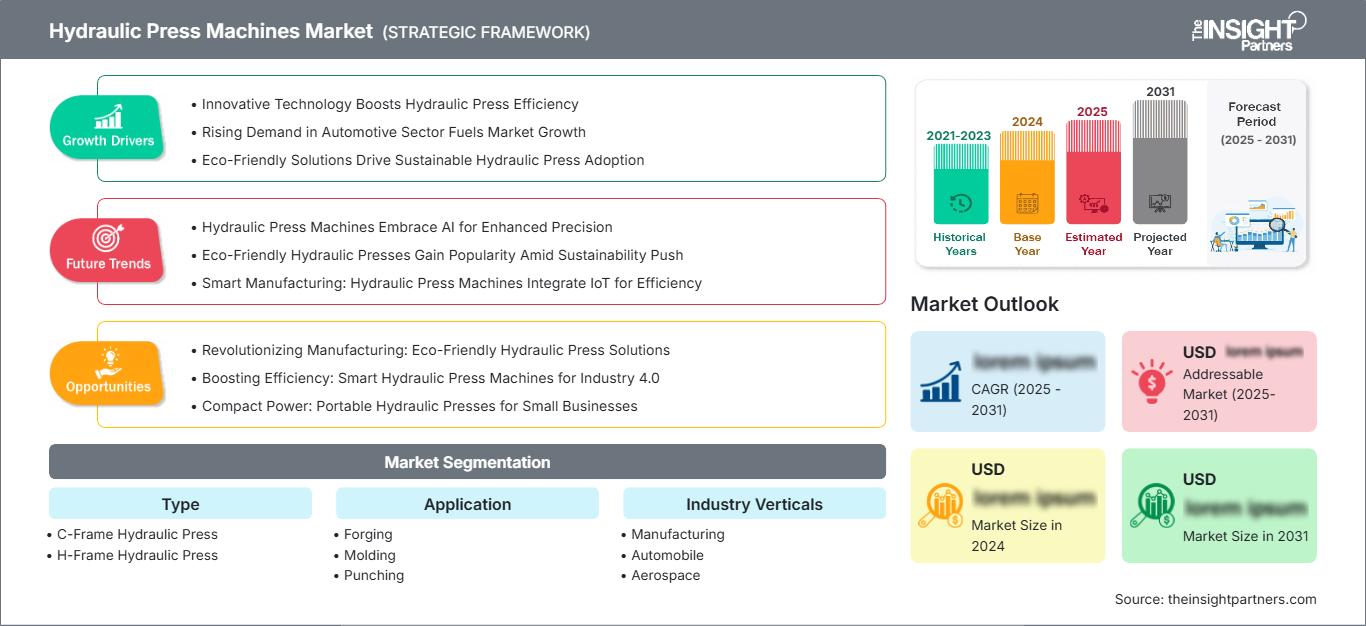
Regional Insights
North America Hydraulic Press Machines Market
North America makes up ~25% of the market in 2025, with an expected growth rate of ~4% between 2025-2034. The Hydraulic Press Machines market share has developed in areas like automotive, aerospace, defence, appliances and general fabrication. However, there is an emphasis on renovation and retrofitting and bespoke machines which have added value. Customers are looking for more dependable controls, safety features, diagnostics and less hydraulic waste.
Canada has some good contributors in sectors like aerospace, transport equipment, energy, metal fabrication. Mexico benefit from automotive and appliances. There is an increasing trend to source locally as customers look to ensure they have a quick service time, local content and compatibility with robotics/material handling. This will benefit companies who can help update current equipment.
U.S. Hydraulic Press Machines Market
The U.S. makes up ~80% of North Americas Hydraulic Press Machines Market share in 2025 and is expected to grow at a rate of ~4%. The market is driven by aerospace components, Defence, automotive, industrial equipment and repair. Heated platen presses, forging, shop presses and automated cells are required. Investment in local manufacturing means new equipment and upgrades to current equipment.
Beckwood Press Company, Greenerd Press & Machine Company, Inc., The French Oil Mill Machinery Company, Betenbender Manufacturing, Inc., Enerpac Tool Group Corp. all provide local solutions for engineering and standard requirements. Applications are growing in Titanium Hot Forming, Composite Moulding, Deep Drawing, Straightening and Pressing. Customers require greater traceability of pressure and position, ease of use and longer term service.
Europe Hydraulic Press Machines Market
Europe makes up ~28% of the global Hydraulic Press Machines Market share in 2025 and is expected to grow by ~4%. Germany is leading the European region due to automotive engineering, press systems, industrial equipment, powder equipment and a strong supply chain. Companies such as Schuler AG and DORST Technologies GmbH & Co. KG show how the region can provide fully integrated forming systems and specialised compaction solutions. Precision, safety, energy efficiency and upgrading existing long life equipment are driving demand.
Italy provides machine tool solutions, automotive, ceramics and metalworking. France provides a mix of aerospace, transport, Defence and general manufacturing. The country also requires qualified systems so bespoke equipment is required. The UK market benefits from aerospace and specialist metal forming. Spain also benefits from automotive assembly and parts. Customers are looking to upgrade equipment, comparing new equipment to upgrades to controls, hydraulic rebuilds and automation.
The market is competitive from companies providing knowledge of processes and fully integrated cells rather than just the frame. Due to regulations on energy consumption and safety, companies are providing variable speed drive systems, better safety, reduced leaks and monitoring. Growth is slow due to the maturity of the market however, there is still opportunity to upgrade equipment due to a high amount of replacement and processing advanced materials. This is leading to more versatile, accurate presses.
APAC Hydraulic Press Machines Market
Asia Pacific makes up ~39% of the global market in 2025 and shows the highest growth rate at ~6%. China is leading the Asia Pacific region due to a large amount of automotive, equipment, electronics, ceramics and metal processing. Equipment is being manufactured locally and investment in automation means equipment will be upgraded and replaced.
Japan focuses on high precision and reliable equipment. South Korea provides solutions for automotive, shipbuilding and advanced manufacturing. India benefits from localised equipment within the vehicle, Defence, rail and capital goods industries. Australia provides selective demand from maintenance, mining and fabrication. Policies around local manufacturing and upgrading equipment means equipment requires smart controls, automated handling and local service.
Middle East & Africa Hydraulic Press Machines Market
The Middle East & Africa region is expected to grow by ~5%. Saudi Arabia is leading the region and has a growing industrial base, local fabrication, Defence localisation and energy related manufacturing. The UAE provides metal working, aerospace services and industrial zones. South Africa provides automotive assembly, mining equipment and general engineering.
The rest of MEA is project orientated and sensitive to cost of imported equipment, technical knowledge and service. Workshop presses, heavy fabrication, piping, energy equipment, repair and some moulding are opportunities. Vendors need durable designs, training, spares and local service partners to counter issues of low utilisation and maintenance.
Segmentation Analysis
Type
Type segment in the Hydraulic Press Machines Market is projected to grow at ~4% CAGR during 2026–2034. Frame selection balances access, rigidity, tonnage, bed dimensions, deflection, and loading method. C-frame machines suit accessible, compact work, while H-frame systems serve heavier and more distributed loads. Procurement increasingly adds programmable controls, safety packages, and automation interfaces, but structural fitness remains the primary determinant of accuracy and service life.
- C-Frame Hydraulic Press: Three-sided access supports punching, assembly, straightening, and lower-to-medium-tonnage work. Compact footprints and straightforward loading make the format strategically important for workshops, cells, and applications requiring frequent tool access.
- H-Frame Hydraulic Press: High rigidity and balanced load paths support heavier forming, forging, and maintenance operations. The configuration is favored where larger beds, higher force, reduced deflection, and integration with handling systems are essential.
Application
Application is projected to expand at ~5% CAGR during 2026–2034. The Hydraulic Press Machines Market scope spans processes requiring controllable force, dwell, speed, temperature, and position. Growth follows advanced-material forming, automated component production, and process conversion from manual equipment. Application-specific tooling, heating, cushions, feeders, and data acquisition increasingly determine system value, making process engineering as important as nominal press capacity.
- Forging: Hydraulic control enables sustained force through the stroke for large or complex parts. Demand centers on aerospace, energy, transportation, and heavy machinery components requiring repeatability, metallurgical integrity, and high-tonnage capability.
- Molding: Heated platens and controlled pressure support rubber, composites, polymers, and engineered materials. Growth follows lightweight structures and consolidated parts, with temperature uniformity, vacuum capability, and cycle consistency shaping equipment selection.
- Punching: C-frame accessibility and programmable force suit hole-making and trimming across fabrication environments. Strategic value lies in flexible production, rapid tool changes, and integration into compact cells serving varied component geometries.
- Stamping: Hydraulic presses provide adjustable stroke and pressure for deep drawing and lower-speed forming. Automotive, appliance, and industrial component makers use them where material flow control and flexibility outweigh mechanical-press speed.
- Laminating: Uniform pressure and thermal control are critical for bonded panels, composites, electrical materials, and decorative products. Adoption depends on platen flatness, temperature distribution, process recipes, and reliable handling of large workpieces.
Industry Verticals
Industry Verticals segment in the Hydraulic Press Machines Market is projected to grow at ~4% CAGR during 2026–2034. End-use requirements determine machine force, precision, cycle frequency, qualification, and automation intensity. General manufacturing provides broad replacement demand, automobile plants prioritize throughput and material flexibility, aerospace requires validated high-value processes, and ceramic producers need precise compaction. Suppliers therefore differentiate through application engineering, tooling integration, and lifecycle support.
- Manufacturing: The broadest user base spans fabricated products, machinery, appliances, maintenance, and contract production. Demand favors versatile equipment, dependable service, straightforward tooling, and retrofits that improve safety and control without replacing sound structures.
- Automobile: Presses form body, chassis, suspension, drivetrain, and electric-vehicle components. Lightweight metals, battery enclosures, and flexible model mixes increase requirements for programmable cycles, automated handling, die protection, and traceability.
- Aerospace: High-value titanium, aluminum, superalloy, and composite parts require controlled pressure, temperature, and alignment. Qualification intensity supports custom hot-forming, molding, straightening, and forging systems with comprehensive process data.
- Ceramic: Powder and tile compaction depends on uniform force, controlled density, and repeatable ejection. Equipment strategy centers on precision, tooling durability, automation, and reducing defects in technical ceramics and high-volume products.
Opportunity Snapshot
| Industry Vertical | Revenue Contribution | Trend Tag | Adoption Stage |
| Manufacturing | High | Factory Modernization | Mature |
| Automobile | High | EV Forming | Scaling |
| Aerospace | Medium | Hot Forming | Scaling |
| Ceramic | Medium | Precision Compaction | Mature |
Hydraulic Press Machines Market Growth Drivers and Impact Analysis
Manufacturing Capacity Renewal and Localization
Manufacturers are renewing press capacity to address control obsolescence, safety gaps, unplanned downtime, and changing component designs. Localization programs in automotive, defense, rail, energy, and industrial equipment add demand where domestic suppliers must qualify new parts or increase throughput. Hydraulic systems remain relevant because programmable force and dwell accommodate varied materials and batch sizes. The market impact extends beyond new machines: structurally sound presses can receive new power units, controllers, guarding, sensors, and automated loading. This creates parallel revenue streams for original equipment, retrofits, rebuilds, commissioning, and service. Suppliers with local engineering and spare-parts capability can reduce project risk for buyers whose production schedules cannot tolerate prolonged installation or maintenance delays.
Lightweight Materials and Complex Component Forming
Automobile and aerospace producers increasingly process aluminum, high-strength steel, titanium, composites, and engineered polymers to balance weight, performance, and durability. These materials often require controlled ram speed, pressure profiles, dwell time, heating, cooling, or multi-stage cycles that favor programmable hydraulic equipment. Battery enclosures, structural panels, composite parts, and high-value aerospace components also demand repeatability and traceable process conditions. The commercial impact is a shift from generic tonnage purchasing toward application-engineered systems integrating tooling, thermal management, cushions, handling, and data acquisition. Vendors that demonstrate part-level outcomes can command greater strategic relevance, while buyers must evaluate scrap reduction, qualification effort, cycle time, and maintenance alongside acquisition cost.
Automation, Safety, and Process Traceability
Labor constraints and quality requirements are encouraging integration of robots, feeders, shuttle tables, die handling, light curtains, interlocks, and programmable controls. Automated loading limits exposure to the working area and can improve cycle consistency, while digital records support troubleshooting and regulated production. Market demand therefore increasingly includes the complete cell rather than the press alone. Impact varies by application: high-volume automotive plants prioritize synchronized throughput, aerospace users emphasize validated pressure and temperature histories, and general manufacturers seek flexible recipes with manageable setup time. Integration capability becomes a competitive differentiator because poorly matched automation can constrain output. Suppliers must combine machine design, controls expertise, risk assessment, and operator training to deliver dependable productivity gains.
Hydraulic Press Machines Market Future Trends
Connected Controls and Condition-Based Service
Hydraulic Press Machines Market trends are moving toward connected controllers, pressure and position sensing, oil-condition monitoring, and remote service tools. Future systems will increasingly record cycle signatures and compare them with expected operating envelopes, helping teams identify drift in pumps, valves, seals, guides, or tooling before quality declines. The value will come from actionable diagnostics rather than connectivity alone. Vendors can use service data to plan maintenance, shorten troubleshooting, and improve spare-parts availability, while customers gain clearer evidence for asset utilization and process stability. Adoption will depend on cybersecurity, data ownership, compatibility with factory systems, and the ability to retrofit older equipment without disrupting validated processes.
Energy-Optimized and Hybrid Press Architectures
Future designs will reduce the energy penalties associated with continuously running hydraulic power units. Variable-speed pump drives, pressure accumulators, regenerative circuits, efficient cooling, and intelligent standby modes can align power consumption more closely with the forming cycle. Hybrid configurations may combine hydraulic force density with electric actuation or servo control where precision and rapid auxiliary movement are required. This direction responds to operating-cost pressure and corporate energy targets while preserving hydraulic advantages for high-force and dwell-intensive processes. Commercial adoption will be strongest where utilization is high enough to quantify savings, although retrofit packages could broaden access by upgrading power units and controls on structurally sound installed presses.
Hydraulic Press Machines Market Opportunities
Modernizing the Installed Base with Modular Retrofit Packages
A large installed base creates an actionable opportunity in controls replacement, safety upgrades, pump modernization, sensor integration, and automated handling. Hydraulic Press Machines Market Forecasts indicate that many buyers will favor phased capital programs when frames and cylinders remain serviceable. Vendors can package audits, engineering, installation, validation, and maintenance into repeatable offerings tailored to common controller or power-unit obsolescence. Financing and scheduled shutdown execution can improve conversion by reducing operational disruption. The strongest opportunities lie where a retrofit delivers measurable improvements in uptime, energy use, process repeatability, or compliance. Suppliers should avoid one-size-fits-all offers and screen frame condition, fatigue history, hydraulic cleanliness, tooling compatibility, and future production requirements before recommending modernization.
Application Centers for Advanced Materials
Suppliers can invest in demonstration and application centers that allow customers to test titanium, aluminum, composites, rubber, powders, and ceramics before specifying full-scale equipment. Such facilities reduce technical uncertainty around pressure profiles, temperature uniformity, tooling, cycle time, and material behavior. Partnerships with tooling companies, universities, material suppliers, and automation integrators can broaden expertise without requiring every capability in-house. The commercial model can combine paid trials, process development, equipment sales, and long-term service. Regional centers in Asia Pacific and North America would help local manufacturers qualify new parts while shortening commissioning risk. Success depends on protecting customer intellectual property and translating laboratory results into scalable, maintainable production systems.
Recent Developments
- July 2026: GIKEN LTD. announced the launch of the hydraulic pile press-in and extraction machine SILENT PILER HA400SX, the second product in the SX series aimed at solving issues in the construction industry. SILENT PILER HA400SX is a multi-functional press-in machine compatible with 400-mm width U sheet piles and has been available since 1 July. Equipped with a pile auger, it can use the Hard Ground Press-in Method that couples pile press-in and auger drilling. It improves press-in efficiency on moderately hard ground, which sees high demand, it also has better mobility due to being lighter and more compact. In addition to autonomous operation and operation support functions, artificial intelligence (AI) can be used by connecting to an app, making it a product for next-generation press-in construction.
- December 2025: GIKEN LTD. is launching the new SX series to solve issues in the construction industry. The construction industry is facing the aggravating issue of aging technicians and a shortage of labour, requiring the creation of environments where people with little experience can also be involved in construction without worries. This series offers next-generation press-in construction combining press-in technology with digital technology by linking to various types of apps based on the cloud data platform G-Lab provided by GIKEN. Equipped with an autonomous operation function and an operation assistance function using construction data of technicians accumulated over the years, the SX series achieves stable construction quality and operator workload reduction. A function that uses artificial intelligence (AI) to propose the most appropriate autonomous operations for each site is also scheduled to be added to the apps next summer. Through automation and labour saving, the series accelerates transformation into construction sites where anyone can play an active role and sets a new standard that enhances the sustainability of the construction industry. https://beckwoodpress.com/news/aerospace-retrofit-500-ton-hot-form-press/
- February 2025: MAXXMAK released a new model press of 2025. The new machine adopts deep energy recovery technology DERC, which makes the machine save 30-60% electric consumption and improve efficiency by 25-40% on the basis of the original servo machine.
Frequently Asked Questions

- Comprehensive Market Sizing and Forecast Analysis
- Detailed Segmentation Analysis
- In-Depth Market Dynamics Assessment
- Regional and Country-Level Insights
- Competitive Landscape and Company Benchmarking
- Strategic Business Intelligence
Recent Reports
Testimonials

The Insight Partners provided valuable market intelligence that supported our global go-to-market strategy. Their team was professional, responsive, and attentive to our feedback, providing thoughtful analysis and helpful methodological clarifications throughout the project.
Junmo Kim Chief Financial Officer (CFO), Enertech Co., Ltd.
The Insight Partners' SCADA System Market report is comprehensive, with valuable insights on current trends and future forecasts. The team was highly professional, responsive, and supportive throughout. We are very satisfied and highly recommend their services.
RAN KEDEM Partner, Reali Technologies LTDs
I requested a report on a very specific software market and the team produced the report in a few days. The information was very relevant and well presented. I then requested some changes and additions to the report. The team was again very responsive and I got the final report in less than a week.
JEAN-HERVE JENN Chairman, Future Analytica
We worked with The Insight Partners for an important market study and forecast. They gave us clear insights into opportunities and risks, which helped shape our plans. Their research was easy to use and based on solid data. It helped us make smart, confident decisions. We highly recommend them.
PIYUSH NAGPAL Sr. Vice President, High Beam Global
The Insight Partners delivered insightful, well-structured market research with strong domain expertise. Their team was professional and responsive throughout. The user-friendly website made accessing industry reports seamless. We highly recommend them for reliable, high-quality research services
YUKIHIKO ADACHI CEO, Deep Blue, LLC.
This is the first time I have purchased a market report from The Insight Partners.While I was unsure at first, I visited their web site and felt more comfortable to take the risk and purchase a market report.I am completely satisfied with the quality of the report and customer service. I had several questions and comments with the initial report, but after a couple of dialogs over email with their analyst I believe I have a report that I can use as input to our strategic planning process.Thank you so much for taking the extra time and making this a positive experience.I will definitely recommend your service to others and you will be my first call when we need further market data.
JOHN SUZUKI President and Chief Executive Officer, Board Director, BK Technologies
I wish to appreciate your support and the professionalism you displayed in the course of attending to my request for information regarding to infectious disease IVD market in Nigeria. I appreciate your patience, your guidance, and the fact that you were willing to offer a discount, which eventually made it possible for us to close a deal. I look forward to engaging The Insight Partners in the future, all thanks to the impression you have created in me as a result of this first encounter.
DR CHIJIOKE ONYIA MANAGING DIRECTOR, PineCrest Healthcare Ltd.Reason to Buy
- Informed Decision-Making
- Understanding Market Dynamics
- Competitive Analysis
- Identifying Emerging Markets
- Customer Insights
- Market Forecasts
- Risk Mitigation
- Boosting Operational Efficiency
- Strategic Planning
- Investment Justification
- Tracking Industry Innovations
- Aligning with Regulatory Trends





 Get Free Sample for