Hydronic Underfloor Heating Market Size & Overview
The Hydronic Underfloor Heating Market was valued at US$ 4.93 Billion in 2025 and is projected to reach US$ 10.9 Billion by 2034. It is expected to register a CAGR of 9.21% during 2026–2034. The market includes water based radiant heating solutions for retrofit and new build residential and commercial applications, including piping, manifold, control systems, insulation panels and installation.
The Hydronic Underfloor Heating Market Size is projected to grow at a CAGR of ~8% across North America through 2034. Electrification schemes within buildings are improving the value proposition for low temperature distribution with air-to-water or ground-source heat pump technology. Retrofit investment is driving demand for low profile solutions to save floor height and eliminate build constraints. Demand is highest in areas with colder temperatures, high comfort requirements and energy regulations that justify upfront costs.
The Hydronic Underfloor Heating Market is growing due to demand for even heating, efficient low temperature heating and reducing need for visible radiators. Within residential developments, radiant floors are being used to increase usable wall space and improve heating per room. Commercial clients enjoy the silent heating. The market includes polymer and metal suppliers, pipe and manifold producers, control manufacturers, heat pump and boiler suppliers, designers, distributors, plumbers and commissioning. Quality will depend on the quality of the oxygen barrier pipe, hydraulic design, insulation, balancing and suitable control systems. There is a limitation due to contractor capability with spacing, flow, screed and commissioning issues affecting performance.
Competition highlighted within the Hydronic Underfloor Heating Market Report is moving from single components to fully documented systems. Danfoss A/S and Eberle Controls GmbH compete with control systems. Uponor Corporation, REHAU Industries SE & Co. KG and Warmup plc focus on fully integrated floor systems. Mitsubishi Electric Corporation and Robert Bosch GmbH integrate hydronic into heat pump systems. Amuheat Pty Limited, H2O Heating Engineers Ltd and Hunt Heating offer regional design and installation. Investment is going into slimline panels, automated balancing, digital design and pre-assembled manifolds. This means that strategic positions should be taken in ensuring systems are compatible, installer friendly, locally stocked, clear warranties and realistic heat loss calculations. Those able to integrate heating sources, distribution temps, zoning and flooring will have a stronger argument for value. Partnerships with architects, housing developers, mechanical contractors and energy retrofitters are becoming key for specification.
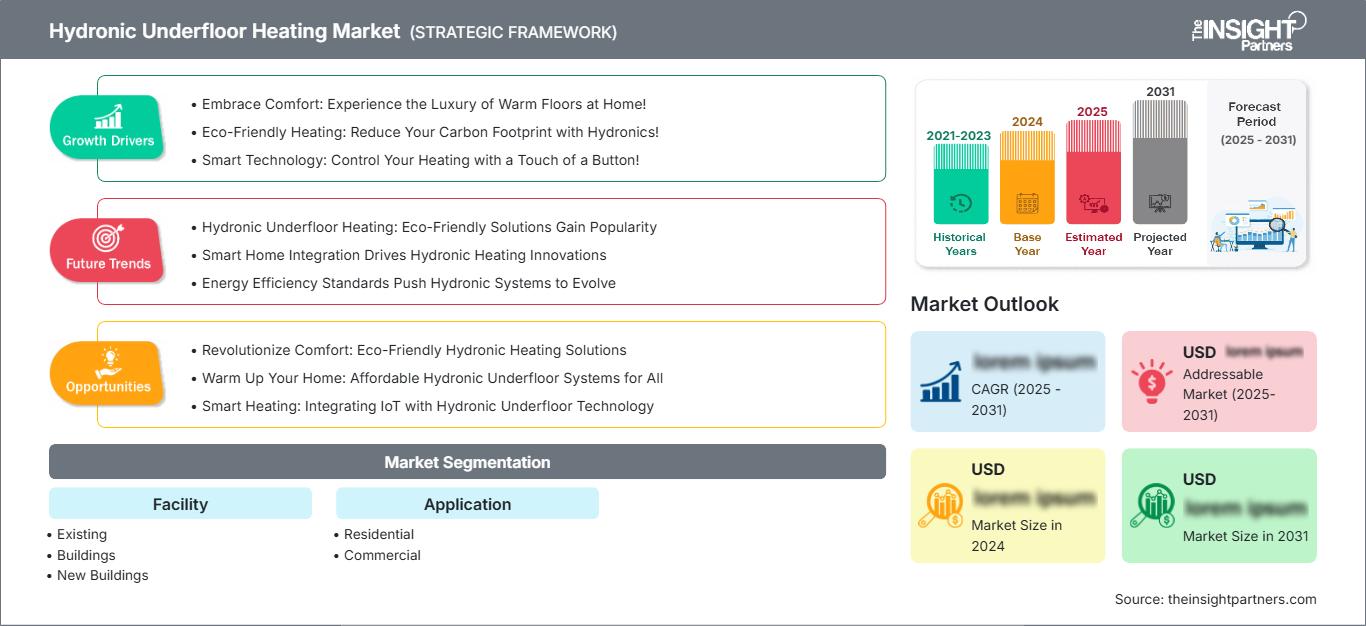
Hydronic Underfloor Heating Market Assessment and Insights
Regional Outlook
- North America: ~24% of the global market in 2025 | ~8% CAGR through 2034. Market position: North America ranks behind Europe and Asia Pacific, supported by cold-climate construction, premium residential demand, building electrification, and retrofit incentives.
- US: ~78% of North American market revenue in 2025 | ~8% CAGR through 2034. Market position: The US leads North America through heat-pump investment, high-value housing renovation, smart controls, and radiant systems in homes, multifamily properties, healthcare facilities, and hospitality assets.
- Europe: ~39% of the global market in 2025 | ~9% CAGR through 2034. Market position: Europe is the largest, mature regional market. Germany leads within Europe, while the UK, France, Italy, and Spain contribute through renovation, heat-pump adoption, and tighter building-performance requirements.
- Asia Pacific: ~29% of the global market in 2025 | ~11% CAGR through 2034. Market position: Asia Pacific is the fastest-growing region. China leads within Asia Pacific, with Japan and South Korea adding established radiant-heating demand and India and Australia supporting selective expansion.
Segment Outlook
- New Buildings: ~68% Share in 2025 | ~10% CAGR through 2034. Market position: New buildings lead because pipe loops, insulation, manifolds, and controls can be embedded during construction, lowering installation complexity and enabling whole-building zoning.
- Residential: ~62% Share in 2025 | ~10% CAGR through 2034. Market position: Residential applications combine large addressable floor area, homeowner comfort demand, heat-pump compatibility, and stronger uptake in single-family and premium multifamily projects.
Competitive Coverage
Amuheat Pty Limited, Danfoss A/S, Eberle Controls GmbH, H2O Heating Engineers Ltd, Hunt Heating, Mitsubishi Electric Corporation, REHAU Industries SE & Co. KG, Robert Bosch GmbH, Uponor Corporation, Warmup plc
Methodology
The Insight Partners follows Data Collection & Secondary Research, Primary Research, Data Analysis, and Data Triangulation & Final Review to validate market estimates and insights.
Source: The Insight Partners' analysis based on proprietary research, government publications, company annual reports, investor presentations, industry databases, and expert interviews.
Hydronic Underfloor Heating Market Trends
Predictive Control and Grid-Responsive Thermal Storage
Hydronic Underfloor Heating Market trends will increasingly connect room-level control with weather forecasts, occupancy, energy tariffs, and heat-pump operating conditions. Concrete slabs can store thermal energy, allowing controllers to shift some heating activity away from expensive or carbon-intensive periods without materially reducing comfort. Future systems are likely to coordinate manifold actuators, supply temperature, heat-source capacity, and domestic hot-water priorities through interoperable platforms. The opportunity is operational rather than purely hardware-based: analytics can identify hydraulic imbalance, abnormal response, or unnecessary cycling before performance deteriorates. Adoption will depend on cybersecurity, open interfaces, commissioning quality, and measurable savings. Simple controls will remain appropriate for small projects, while larger homes and commercial buildings will justify more advanced optimization.
Industrialized, Low-Profile Installation Systems
Product development will move toward lighter panels, direct-flooring assemblies, prefabricated circuit modules, and digitally planned pipe layouts. The objective is to reduce wet trades, drying periods, skilled labor hours, and uncertainty at interfaces between heating, screed, and flooring contractors. These systems are particularly important for renovation, modular construction, and projects with compressed schedules. Manufacturers will differentiate through verified thermal performance, recycled or lower-impact materials, and compatibility across varied floor finishes. Prefabrication can also improve quality by moving repetitive assembly into controlled environments. However, standardized modules must preserve design flexibility for irregular rooms, load variations, and manifold positioning. Suppliers that combine modular hardware with project-specific calculations are likely to gain specification advantages.
Hydronic Underfloor Heating Market Growth Factors
Heat-Pump-Compatible Low-Temperature Distribution
Heat pumps perform most effectively when buildings can be heated with lower water temperatures, making broad radiant floor surfaces strategically relevant. Underfloor loops distribute heat across a large area, allowing designers to reduce flow temperatures while maintaining comfort in well-insulated spaces. This connection turns hydronic flooring from a premium comfort option into part of an electrification architecture. The impact extends through the value chain: heat-pump manufacturers need compatible hydraulic interfaces, controls suppliers must coordinate weather compensation and zoning, and installers must balance loops accurately. Projects still require correct heat-loss calculations because low-temperature operation cannot compensate for poor envelopes or undersized floor area. Where design conditions align, the combination supports lower peak loads, stable room temperatures, and improved heat-source efficiency.
Building Renovation and Emitter Replacement
Existing buildings represent a growing addressable opportunity as owners replace aging boilers, radiators, and control systems. Traditional wet underfloor installations can be disruptive, but thin dry panels, grooved insulation boards, and compact pipe formats reduce added height, drying time, and structural load. These advances allow renovation contractors to target individual rooms, occupied homes, and weight-sensitive buildings that were previously unsuitable. Market impact depends on coordination with floor coverings, door thresholds, stairs, and insulation upgrades. Suppliers that provide complete build-ups, verified thermal outputs, and installer training can reduce specification risk. Renovation also creates demand for mixed-emitter controls because properties may retain radiators in some zones while adding radiant floors elsewhere. This expands revenue beyond pipework to manifolds, actuators, sensors, and commissioning services.
Comfort, Zoning, and High-Performance Buildings
Hydronic floors deliver even radiant temperatures without occupying wall space, supporting architectural flexibility and quiet operation. These attributes matter in premium housing, hotels, healthcare settings, schools, and offices where comfort complaints, noise, and furniture layouts affect asset quality. Multi-zone controls further improve value by aligning heat delivery with room use rather than treating a building as one thermal zone. The commercial impact is strongest when designers integrate insulation, thermal mass, occupancy schedules, and controls from the outset. Inappropriate setbacks or oversized slabs can produce slow response, so control strategy must reflect the building’s physics. Vendors that combine design software, automatic balancing, and clear handover documentation can improve outcomes and reduce callbacks, strengthening confidence among developers and mechanical consultants.
Hydronic Underfloor Heating Market Opportunities
Retrofit Packages for Heat-Pump Conversions
Hydronic Underfloor Heating Market Forecasts point to a practical opportunity in packaged retrofit solutions that combine low-profile floor panels, manifolds, controls, hydraulic accessories, and heat-pump integration guidance. Investors and manufacturers can target aging homes and small commercial properties where emitter temperatures otherwise limit electrification. A viable offer should include survey tools, heat-loss calculations, floor-height options, installer certification, and predictable bills of materials. Distribution partnerships with renovation contractors and heat-pump installers can reduce customer acquisition costs and improve accountability. Financing or staged installation may widen access because floor heating carries higher upfront expense than simple emitter replacement. Commercial success will depend on demonstrated installation speed, compatible floor finishes, and documented output at low water temperatures.
Specification Platforms and Installer Services
A second opportunity lies in reducing design and commissioning friction. Suppliers can invest in digital specification platforms that convert room geometry, construction layers, heat loads, and source temperatures into pipe layouts, circuit lengths, manifold settings, and material schedules. Coupling these tools with prefabrication, on-site verification, and remote commissioning creates service revenue while protecting product performance. Training is equally important because installer shortages can restrict growth even when end-user demand is present. Manufacturers that establish accredited networks, regional technical centers, and rapid replacement-part support can become preferred partners for developers and mechanical consultants. The model is especially relevant in emerging hydronic markets where contractors understand boilers or heat pumps but have limited radiant-floor design experience.
Segmentation Analysis
Facility
The Facility segment is projected to expand at ~9% CAGR during 2026–2034. Hydronic Underfloor Heating Market scope spans installation in existing buildings and new buildings, with design choices governed by floor construction, heat loss, available buildup, heat-source temperature, and project sequencing. New construction supports embedded wet systems and leads revenue, while renovation increasingly uses lightweight dry panels and thin screed assemblies. Specification quality is critical because installed pipework is expected to operate for decades beneath finished floors.
- Existing Buildings: Renovation demand centers on replacing inefficient emitters, improving comfort, and preparing properties for heat pumps. Low-height panels, dry construction, and rapid-response controls reduce disruption, but floor transitions, structural loading, and envelope upgrades require careful design.
- Buildings: This category represents broader building programs where hydronic floor heating is specified across mixed portfolios or project types. Demand depends on central heat-source strategy, standardized components, installer availability, and the ability to commission multiple zones consistently.
- New Buildings: New projects provide the strongest installation economics because insulation, pipe loops, manifolds, controls, and screed can be coordinated before finishes. Whole-building deployment supports predictable zoning, lower flow temperatures, and reduced rework compared with late-stage retrofits.
Application
The Application segment is expected to grow at ~9% CAGR during 2026–2034. Residential use remains the largest revenue contributor because houses and apartments offer extensive heated floor area and strong demand for quiet, invisible comfort. Commercial adoption is selective but valuable in hospitality, healthcare, education, offices, and public buildings. Buyers compare installation cost with lifecycle energy, maintenance, acoustic performance, indoor comfort, and compatibility with heat pumps or district-energy systems.
- Residential: Single-family homes, apartments, and premium renovations adopt hydronic floors for even temperatures, zoning, architectural freedom, and lower-temperature operation. Demand is strongest when systems are designed with efficient envelopes, suitable floor finishes, and heat-pump-compatible controls.
- Commercial: Hotels, hospitals, schools, offices, and institutional facilities value quiet heating and reduced wall-mounted equipment. Large floor areas improve distribution economics, although controls, commissioning, occupancy schedules, floor loading, and maintenance access require disciplined mechanical design.
Opportunity Snapshot
| Application | Revenue Contribution | Trend Tag | Adoption Stage |
| Residential | High | Heat Pumps | Scaling |
| Commercial | Medium | Smart Zoning | Scaling |
Regional Insights
North America Hydronic Underfloor Heating Market
North America is projected to demonstrate a CAGR of ~8% through 2034. The adoption of hydronic underfloor heating is driven by cold climate states/provinces, high end residential, basement renovations, & heating zoned areas. The market in North America is benefiting from air to water and geothermal heat pump applications which need highly efficient low temperature emitters.
Renovations are an important factor as many buildings have traditional heating systems in place such as forced air, baseboard & traditional boilers. Low profile dry systems & enhanced controls reduce disruption. However issues with build-up, building envelope and installers can present issues. Canada has a good climate for using hydronic underfloor heating, however the majority of revenue is coming from the US with a wide range of products.
U.S Hydronic Underfloor Heating Market
The U.S makes up ~78% of revenue from North America in 2025 and is projected to grow at a CAGR of ~8% through 2034. The growth is being driven by cold climate residential, bespoke, multi-family housing, bathrooms, basements, healthcare, hospitality, and institutional projects. The systems are being adopted due to the comfort and silent nature of the heating.
Heat sources are well supported by Mitsubishi Electric Corporation and Robert Bosch GmbH who offer air to water systems. Distribution & control is provided by Uponor Corporation, REHAU Industries SE & Co. KG, Danfoss A/S and Warmup plc. Electricity initiatives in the states and high performance building standards are driving low temperature systems. However there are variable factors that can impact the economics of the projects including electricity cost, insulation, floor coverings & installers.
Europe Hydronic Underfloor Heating Market
The Hydronic Underfloor Heating Market Share in Europe was valued at a modelled ~39% globally in 2025 and is expected to grow at ~9% through 2034. The market leads in water based heating, with a large supply chain, surface heating knowledge and building regulations favouring efficient heating. Germany is the leading country in Europe. This is due to a large heating market, engineering industry and a move towards heat pump systems.
The UK has great potential for renovations with an increase in heat pump usage. France has a large heat pump presence and low carbon electricity. Italy has good knowledge of hydronic heating and is seeing renovations take place. Spain has a smaller heating market however energy efficient buildings, high end residential & select cooling compatible radiant heating systems are providing opportunities.
There are variable factors affecting the market. Steady incentives, good economics from electricity to gas and skilled installers mean projects are being implemented quickly. However, uncertainty in policy and poor ROI for consumers can slow this down. Danfoss A/S, Uponor Corporation, REHAU Industries SE & Co. KG, Eberle Controls GmbH, and Robert Bosch GmbH provide competition in the market. Low profile retro systems are increasing the potential product base.
Asia Pacific Hydronic Underfloor Heating Market
The Asia Pacific market made up ~29% of the market in 2025 and is forecast to grow at ~11%, the fastest growing region. China is the leading country in this region due to high volumes of construction, heating in the north, heat pump manufacturing and clean heating initiatives. Japan & South Korea have a strong presence due to a preference for zoned heating on floors and energy efficient homes.
India is still quite a select market with heating in colder areas & high end projects. Australia is growing with high efficiency homes. Specialist companies like Amuheat Pty Limited & Hunt Heating are providing products. Urban developments, electrification & localisation are helping to drive growth. However there are issues with warm climates and varying installers.
Middle East & Africa Hydronic Underfloor Heating Market
The market is forecast to grow at a modelled ~7% CAGR through 2034 in the Hydronic Underfloor Heating Market Share. Saudi Arabia is the leading country in this region. There is a select market due to high end residential, hospitality & mixed use. The UAE is also showing growth with luxury developments and high specification commercial buildings. Often these projects are focused on comfort.
South Africa provides a niche market, with colder areas inland & high end residential. The rest of MEA is project led with mild climates, high initial costs & limited installers. Opportunities are in hotels, healthcare, villas & developments. Centralised hydronic heating or renewable heat sources can improve the lifetime economics of the project.
Hydronic Underfloor Heating Market Report Scope
| Report Attribute | Details |
|---|---|
| Market size in 2025 | US$ 4.93 Billion |
| Market Size by 2034 | US$ 10.9 Billion |
| Global CAGR (2026 - 2034) | 9.21% |
| Historical Data | 2021-2024 |
| Forecast period | 2026-2034 |
| Segments Covered | Facility, Application |
| Region scope | North America, Europe, Asia-Pacific, South and Central America, Middle East and Africa |
Recent Developments
- July 2026: The X Series is Daikin’s first residential system to combine air-to-air technology for heating and cooling, and air-to-water technology for hydronic heating and domestic hot water. All from a single outdoor unit. Daikin announces the launch of the X Series, a next-generation mixed heat pump system designed to deliver complete comfort year-round.
- June 2026: Rheem is expanding its presence in the hydronics market with a powerful lineup of new products designed to deliver greater capacity, efficiency, and flexibility across residential and light commercial applications. This launch represents a strategic line extension of both the Rheem FT Series boilers and Rheem Indirect tanks, introducing higher-capacity solutions tailored for “large residential” and “light commercial” needs. It reinforces Rheem’s ongoing commitment to growing in the hydronic space and delivering solutions for a broader range of applications.
- July 2025: Panasonic has introduced a hydronic heating solution that uses a single system to heat and cool the home and produce hot water. This solution is suitable for new homes or retrofitting projects. Panasonic’s Air to Water Heat Pump is space saving, with no indoor unit inside the house. As only hydraulic piping is required, it is relatively simple to install. It can be used for new underfloor heating, radiators or fan coil units, or to replace gas or oil boilers.
Frequently Asked Questions

Recent Reports






