
In-Memory Computing Market Share, Demand & Growth by 2034
Coverage: By Component (Solution, Services); Application (Risk Management and Fraud Detection, Sentiment Analysis, Geospatial/GIS Processing, Sales and Marketing Optimization, Predictive Analysis, Supply Chain Management, Others); Enterprise Size (SMEs, Large Enterprises); Vertical (BFSI, IT and Telecom, Retail and eCommerce, Healthcare and Life Sciences, Transportation and Logistics, Government and Defense, Energy and Utilities, Others), and Geography (North America, Europe, Asia Pacific, and South and Central America)
- Status : Data Released
- Report Code : TIPRE00017050
- Category : Technology, Media and Telecommunications
- No. of Pages : 150
- Available Report Formats :


- Last update date : March 23, 2026


2025 Market Size
US$ 18.62 Bn
Base year value
2034 Forecast
US$ 72.11 Bn
Projected by 2034
CAGR 2026-2034
16.23 %
Growth rate
Addressable Market
US$ 382.88 Bn
(2026-2034)
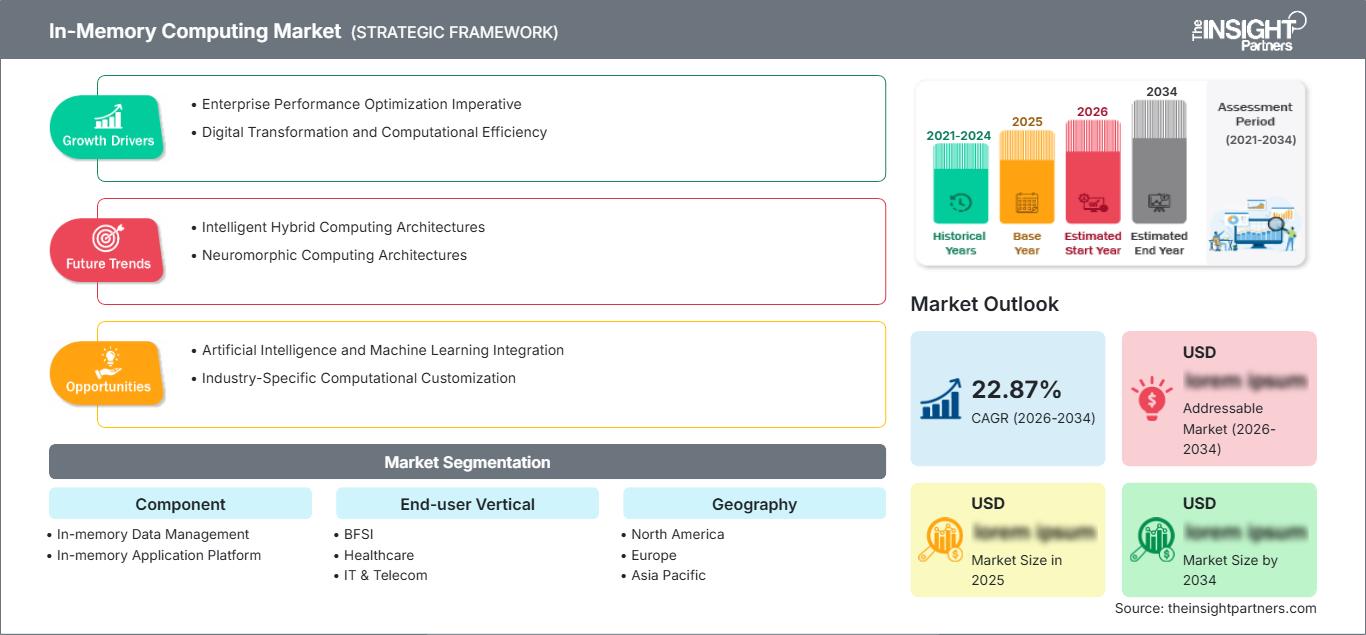
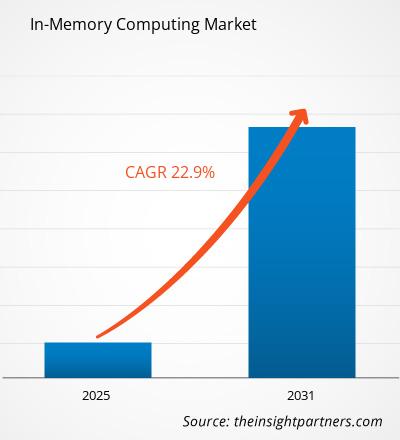
The global In-Memory Computing market was valued at US$ 18.62 billion in 2025 and is expected to reach US$ 72.11 billion by 2034; it is estimated to record a CAGR of 16.23% during 2026-2034.
Key market dynamics include the exponential pace of global data generation, the widespread adoption of artificial intelligence (AI) and machine learning (ML), and the urgent organizational need for real-time data access to drive smarter operations. Additionally, the market is expected to benefit from the growing popularity of hybrid and multi-cloud strategies, the rapid expansion of IoT devices requiring low-latency processing, and the increasing inclusion of in-memory architectures in high-value segments like predictive analytics and autonomous systems.
In-Memory Computing Market Analysis
The in-memory computing market analysis shows a strategic pivot toward high-performance data architectures as enterprises prioritize immediate insights over traditional disk-based batch processing. Procurement trends indicate the market is bifurcating into standardized cloud-based in-memory database services and specialized, high-concurrency solutions for edge computing and AI inference. Strategic opportunities are emerging in the integration of Compute-in-Memory (CIM) and Processing-in-Memory (PIM) technologies, which offer a clear competitive advantage by overcoming the traditional memory wall bottleneck. The analysis also notes that market expansion depends on the decreasing cost of RAM and the security integrity of data residing in volatile memory. Competitive differentiation now stands out through the development of unified platforms that combine analytical and transactional processing (HTAP), enabling businesses to act on data the moment it is created.
In-Memory Computing Market Overview
In-memory computing is shifting from a niche high-performance requirement to a foundational pillar of modern digital infrastructure. While historically focused on high-frequency trading and specialized financial risk modeling, in-memory computing (IMC) is expanding into mainstream value-added services like real-time sentiment analysis, geospatial processing, and personalized retail recommendations. Both global technology giants and specialized startups are part of this market, leveraging technologies like In-Memory Data Grids (IMDG) and In-Memory Databases (IMDB). Increasing digital transformation across North America and Asia-Pacific is driving the search for alternatives to slow relational databases, helping IMC gain popularity as a critical enabler of the real-time enterprise. Europe remains a significant hub for industrial IMC applications, but North America leads in innovation and hyperscale cloud deployments. For instance, the market in the US represents a mature yet dynamic landscape for in-memory computing, driven by a high concentration of data-intensive industries and leading technology providers. Domestic adoption is fueled by a robust appetite for real-time analytics in financial services and the integration of advanced memory architectures within sprawling hyperscale data centers across the country.
Market Assessment and Insights
- Global market for In-Memory Computing was valued at US$ 18.62 Billion in 2025
- Annual market size is expected to reach US$ 72.11 Billion by 2034
- Total addressable market (TAM) during 2026-2034 is projected to reach approximately US$ 361.66 Billion
- Market is anticipated to register a CAGR of 15.12% during the forecast period
- The United States represents a key market, supported by Enterprise Performance Optimization Imperative, Digital Transformation and Computational Efficiency, as well as evolving industry dynamics
- Market analysis covers North America, Europe, Asia-Pacific, South and Central America, Middle East and Africa, with growth evaluated across the forecast period
- Market opportunities such as Artificial Intelligence and Machine Learning Integration, Industry-Specific Computational Customization are expected to influence market dynamics and addressable market
- Report profiles industry participants, including SAP SE, Oracle Corporation, Altibase Corporation, GridGain Systems inc., Software AG, TBCO Software Inc., Gigaspaces Technologies Inc., SAS Institute, Hazelcast Inc., IBM Corporation, while analyzing competitive strategies and innovation developments
-
Source: The Insight Partners' analysis based on proprietary research, government publications, company annual reports, investor presentations, industry databases, and expert interviews.
● REPORT CUSTOMIZATION
Tailor This Report To Align With Your Specific Business Requirements
This report can be customized to align precisely with your business objectives, scope, and target markets. Customization options include tailored segmentation, geography, competitive analysis, and strategic insights to support informed decision-making.
Customize This Report →WHAT YOU CAN ADJUST
- ● Segmentations
- ● Geography
- ● Competitive Analysis
- ● Language Preferences
In-Memory Computing Market: Strategic Insights
-
Get Top Key Market Trends of this report.This FREE sample will include data analysis, ranging from market trends to estimates and forecasts.
In-Memory Computing Market Drivers and Opportunities
Market Drivers:
- Explosive Growth of Big Data and Real-Time Analytics: As the volume, velocity, and variety of data continue to surge, traditional disk-based systems struggle with latency. In-memory computing allows organizations to store data in RAM, drastically reducing input/output bottlenecks and enabling machine-driven decision-making in milliseconds.
- Mainstreaming of AI and Machine Learning Workloads: The training and inference of large-scale AI models require massive computational bandwidth. In-memory architectures provide the necessary speed and throughput for deep neural networks, making them indispensable for modern AI-driven enterprise applications.
- Rapid Expansion of IoT and Edge Computing: The proliferation of connected devices in smart cities and industrial automation necessitates processing data close to the source. In-memory solutions at the edge allow for immediate localized processing, which is vital for safety-critical applications like autonomous vehicles and robotics.
Market Opportunities:
- Integration into Sports and Consumer Wearables: Beyond enterprise data centers, there is a significant opportunity to embed in-memory computing chips into power-constrained wearable devices for real-time health monitoring and sophisticated biometric analysis.
- Growth in High-Margin Emerging Verticals: Forming strategic partnerships in industries like Healthcare and Life Sciences can facilitate access to segments requiring rapid genomic sequencing and real-time patient monitoring, where low-latency computing is a life-saving requirement.
- Transition to Next-Generation Memory Standards: There is a growing opportunity for vendors to lead the market by adopting emerging non-volatile memory technologies like MRAM and PCM, which offer the speed of RAM with the persistence of traditional storage.
In-Memory Computing Market Report Segmentation Analysis
The In-Memory Computing Market share is analyzed across various segments to provide a clearer understanding of its structure, growth potential, and emerging trends. Below is the standard segmentation approach used in most industry reports:
By Component:
- Solution: The dominant segment comprises in-memory databases, data grids, and application platforms that provide the core infrastructure for real-time processing.
- Services: The fastest-growing niche, involving consulting, system integration, and support services as enterprises seek expertise to migrate traditional workloads to memory-centric architectures.
By Application:
- Risk Management and Fraud Detection: A primary use case in finance where the ability to analyze transactions in real-time is essential for security.
- Predictive Analysis: Increasingly used across sectors to forecast trends and behaviors using live data streams.
- Sales and Marketing Optimization: Enables real-time personalization and customer journey mapping in digital environments.
- Others: Includes Geospatial/GIS Processing, Sentiment Analysis, and Supply Chain Management.
By Enterprise Size:
- Large Enterprises: The primary adopters due to high data volumes and the financial capacity to invest in high-performance hardware.
- SMEs: A rapidly expanding segment benefiting from affordable cloud-based in-memory solutions that lower the barrier to entry.
By Vertical:
- BFSI: The leading vertical, utilizing IMC for high-frequency trading and regulatory compliance.
- IT and Telecom: Heavily reliant on IMC for network optimization and managing massive subscriber data.
- Retail and eCommerce: Utilizing real-time processing for inventory management and personalized shopping experiences.
- Others: Healthcare, Transportation, Government and Defense, and Energy and Utilities.
By Geography:
- North America
- Europe
- Asia Pacific
- South & Central America
- Middle East & Africa
In-Memory Computing Market Report Scope
| Report Attribute | Details |
|---|---|
| Market size in 2025 | US$ 18.62 Billion |
| Market Size by 2034 | US$ 72.11 Billion |
| Global CAGR (2026 - 2034) | 16.23% |
| Historical Data | 2021-2024 |
| Forecast period | 2026-2034 |
| Segments Covered |
By Component
|
| Regions and Countries Covered |
North America
|
| Market leaders and key company profiles |
|
In-Memory Computing Market Players Density: Understanding Its Impact on Business Dynamics
The In-Memory Computing Market is growing rapidly, driven by increasing end-user demand due to factors such as evolving consumer preferences, technological advancements, and greater awareness of the product's benefits. As demand rises, businesses are expanding their offerings, innovating to meet consumer needs, and capitalizing on emerging trends, which further fuels market growth.
In-Memory Computing Market Share Analysis by Geography
Asia-Pacific is expected to grow fastest in the coming years. Emerging markets in South & Central America, the Middle East, and Africa also have many untapped opportunities for real-time analytics providers and semiconductor manufacturers to expand.
The in-memory computing market is undergoing a significant transformation, moving from a niche high-performance tool to a global high-value functional necessity. Growth is driven by the rising prevalence of real-time data requirements, a surge in AI adoption, and the expansion of the cloud-native ecosystem. Below is a summary of market share and trends by region:
North America
- Market Share: Holds the largest share globally, anchored by the presence of major technology vendors and a high density of hyperscale data centers.
- Key Drivers:
- Early adoption of advanced AI and ML-driven enterprise applications.
- Strong investment in R&D for next-generation memory controllers and chips.
- Massive demand for real-time fraud detection in the highly developed financial market.
- Trends: Scaling of cloud-native in-memory databases and the successful adoption of Memory-as-a-Service models to appeal to a broad range of enterprise clients.
Europe
- Market Share: A significant market characterized by strong industrial automation and strict data sovereignty regulations.
- Key Drivers:
- High domestic demand for real-time supply chain analytics in the manufacturing heartlands of Germany and France.
- Established processing infrastructure and research initiatives in neuromorphic computing.
- Robust government support for digital transformation and smart city projects.
- Trends: A strategic shift toward prioritizing energy-efficient in-memory architectures to meet sustainability goals. There is also an increasing focus on edge computing to reduce data transit to centralized clouds.
Asia-Pacific
- Market Share: The fastest-growing region, with China, South Korea, and India acting as primary engines for semiconductor manufacturing and digital service adoption.
- Key Drivers:
- Massive consumer base in Southeast Asia seeking real-time personalized mobile and e-commerce experiences.
- Government-supported initiatives for domestic semiconductor self-sufficiency and high-tech manufacturing.
- Rapid urbanization and the rollout of 5G networks are facilitating high-velocity data environments.
- Trends: Heavy reliance on mobile-first in-memory applications and B2B contracts for high-end IMC chips used in the automotive and robotics industries.
South and Central America
- Market Share: Emerging market with a growing fintech and digital retail sector in countries like Brazil and Argentina.
- Key Drivers:
- Increasing awareness of the operational efficiencies gained through real-time inventory and logistics tracking.
- Modernization of traditional banking systems into digital-first platforms requires low-latency processing.
- Rising interest in data-driven agricultural technologies (AgTech) among middle-to-high income segments.
- Trends: Growth of localized cloud service providers offering in-memory solutions and the introduction of artisanal-scale data centers to serve urban centers.
Middle East and Africa
- Market Share: Developing market with deep strategic investments in smart city infrastructure and digital transformation.
- Key Drivers:
- High demand for real-time monitoring in the oil and gas industry to optimize extraction and safety.
- Strategic investments in Smart Agriculture and food security projects require real-time sensor data analysis.
- Government initiatives to build regional digital hubs and reduce reliance on imported IT infrastructure.
- Trends: Implementation of modern data center technologies in arid climates, coupled with a focus on high-performance computing for national security and defense.
High Market Density and Competition
Competition is intensifying due to the presence of established leaders such as SAP SE, Oracle Corporation, and Microsoft Corporation. Regional specialists and niche players like GridGain Systems (US) and Exasol (Germany), alongside cloud innovators such as Amazon Web Services and Google LLC, also contribute to a diverse and rapidly expanding market landscape.
This competitive environment pushes vendors to differentiate through:
- Performance and Functional Branding: Positioning in-memory solutions as a superior alternative to traditional databases by emphasizing nanosecond latency, high concurrency, and AI-ready architectures.
- Diversified Product Portfolios: Companies offer more than just basic databases; they provide full-stack platforms including in-memory data grids, streaming analytics, and managed semantic caching for AI.
- Supply Chain Control: Leading players are increasingly designing their own memory-optimized silicon and controllers to ensure quality, transparency, and high performance.
- Technological Innovation: New processing technologies, like 3D NAND and resistive RAM (RRAM), help create high-density memory modules used in mission-critical data centers worldwide.
Opportunities and Strategic Moves
- Partner with Hyperscale Cloud Providers: Tap into the surging demand for cloud-native in-memory services in Asia-Pacific and North American markets through strategic marketplace integrations.
- Incorporate Sustainable Hardware Standards: Adopt energy-efficient computing-in-memory architectures to appeal to environmentally conscious organizations and meet global ESG (Environmental, Social, and Governance) targets.
Major Companies operating in the In-Memory Computing Market are:
- SAP SE
- Oracle Corporation
- Altibase Corporation
- GridGain Systems Inc.
- Software AG
- TBCO Software Inc.
- Gigaspaces Technologies Inc.
- SAS Institute
- Hazelcast Inc.
- IBM Corporation
Disclaimer: The companies listed above are not ranked in any particular order.
In-Memory Computing Market News and Recent Developments
- In October 2025, Exasol and MariaDB plc announced a joint strategic partnership that redefined value in the enterprise data landscape. The collaboration integrated Exasol’s powerful analytics engine with the MariaDB Enterprise Platform to enhance In-Memory Computing capabilities across their shared infrastructure. The joint solution, MariaDB Exa, ensured customers were able to add high-performance analytics to their transactional applications while leveraging the MariaDB unified database platform.
- In September 2025, Redis announced its intention to acquire Decodable, a real-time data platform that allowed organizations to quickly build, process, and manage streaming pipelines. The company expressed significant enthusiasm regarding the addition to its portfolio, highlighting both the specialized technology intended for tight integration into its In-Memory Computing platform and the talented personnel joining the organization from Decodable.
In-Memory Computing Market Report Coverage and Deliverables
The In-Memory Computing Market Size and Forecast (2021–2034) report provides a detailed analysis of the market covering below areas:
- In-Memory Computing Market size and forecast at global, regional, and country levels for all the key market segments covered under the scope
- In-Memory Computing Market trends, as well as market dynamics such as drivers, restraints, and key opportunities
- Detailed PEST and SWOT analysis
- In-Memory Computing Market analysis covering key market trends, global and regional framework, major players, regulations, and recent market developments
- Industry landscape and competition analysis covering market concentration, heat map analysis, prominent players, and recent developments in the In-Memory Computing Market.
- Detailed company profiles
Frequently Asked Questions

- Comprehensive Market Sizing and Forecast Analysis
- Detailed Segmentation Analysis
- In-Depth Market Dynamics Assessment
- Regional and Country-Level Insights
- Competitive Landscape and Company Benchmarking
- Strategic Business Intelligence
Recent Reports
Testimonials

The Insight Partners' SCADA System Market report is comprehensive, with valuable insights on current trends and future forecasts. The team was highly professional, responsive, and supportive throughout. We are very satisfied and highly recommend their services.
RAN KEDEM Partner, Reali Technologies LTDs
I requested a report on a very specific software market and the team produced the report in a few days. The information was very relevant and well presented. I then requested some changes and additions to the report. The team was again very responsive and I got the final report in less than a week.
JEAN-HERVE JENN Chairman, Future Analytica
We worked with The Insight Partners for an important market study and forecast. They gave us clear insights into opportunities and risks, which helped shape our plans. Their research was easy to use and based on solid data. It helped us make smart, confident decisions. We highly recommend them.
PIYUSH NAGPAL Sr. Vice President, High Beam Global
The Insight Partners delivered insightful, well-structured market research with strong domain expertise. Their team was professional and responsive throughout. The user-friendly website made accessing industry reports seamless. We highly recommend them for reliable, high-quality research services
YUKIHIKO ADACHI CEO, Deep Blue, LLC.
This is the first time I have purchased a market report from The Insight Partners.While I was unsure at first, I visited their web site and felt more comfortable to take the risk and purchase a market report.I am completely satisfied with the quality of the report and customer service. I had several questions and comments with the initial report, but after a couple of dialogs over email with their analyst I believe I have a report that I can use as input to our strategic planning process.Thank you so much for taking the extra time and making this a positive experience.I will definitely recommend your service to others and you will be my first call when we need further market data.
JOHN SUZUKI President and Chief Executive Officer, Board Director, BK Technologies
I wish to appreciate your support and the professionalism you displayed in the course of attending to my request for information regarding to infectious disease IVD market in Nigeria. I appreciate your patience, your guidance, and the fact that you were willing to offer a discount, which eventually made it possible for us to close a deal. I look forward to engaging The Insight Partners in the future, all thanks to the impression you have created in me as a result of this first encounter.
DR CHIJIOKE ONYIA MANAGING DIRECTOR, PineCrest Healthcare Ltd.Reason to Buy
- Informed Decision-Making
- Understanding Market Dynamics
- Competitive Analysis
- Identifying Emerging Markets
- Customer Insights
- Market Forecasts
- Risk Mitigation
- Boosting Operational Efficiency
- Strategic Planning
- Investment Justification
- Tracking Industry Innovations
- Aligning with Regulatory Trends





 Get Free Sample for