
Industrial Alcohol Market Growth, Demand & Size by 2034
Coverage: by Type (Ethyl Alcohol, Methyl Alcohol, Isopropyl Alcohol, Isobutyl Alcohol, Benzyl Alcohol, Others); Source (Fossil Fuels, Sugar and Molasses, Corn, Grains, Others); Application (Fuel, Pharmaceuticals, Personal Care Products, Food Ingredients, Chemical Intermediates and Solvent, Others); and Geography (North America, Europe, Asia Pacific, and South and Central America)
- Status : Data Released
- Report Code : TIPRE00007831
- Category : Chemicals and Materials
- No. of Pages : 150
- Available Report Formats :


- Last update date : September 01, 2026


2025 Market Size
US$ 217.74 Bn
Base year value
2034 Forecast
US$ 436.98 Bn
Projected by 2034
CAGR 2026-2034
8.05 %
Growth rate
Addressable Market
US$ 2,944.06 Bn
(2026-2034)
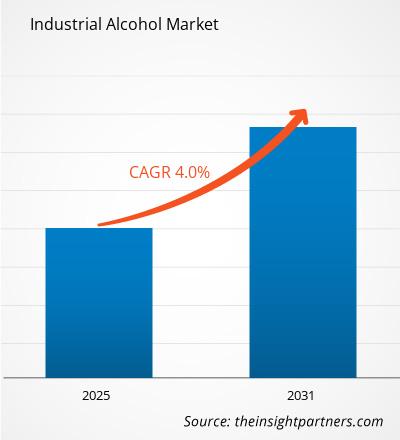
The industrial alcohol market was valued at US$ 217.74 Billion in 2025 and is projected to reach US$ 436.98 Billion by 2034, registering a CAGR of 8.05% during 2026–2034. The market encompasses ethyl alcohol, methyl alcohol, and isopropyl alcohol produced from agricultural and fossil-based feedstocks for fuel, chemical, pharmaceutical, personal care, and other industrial applications.
North America remains a strategically important production and consumption center, supported by established grain-processing infrastructure, renewable fuel programs, and demand for high-purity chemical inputs. The industrial alcohol market size in the region is expected to expand at an estimated 6.5–7.5% CAGR during 2026–2034, with the US benefiting from large corn-based ethanol capacity and increasing requirements for pharmaceutical, electronics, and specialty solvent grades.
Industrial Alcohol Market Assessment and Insights
- North America: North America accounted for an estimated 24–28% industrial alcohol market share in 2025 and is expected to grow at a 6.5–7.5% CAGR between 2026–2034, supported by renewable fuel consumption, established grain-processing capacity, and rising demand for high-purity alcohols in pharmaceuticals, electronics, and chemical processing.
- US: The US represented approximately 78–82% of North American demand in 2025 and is projected to expand at a 6.5–7.5% CAGR between 2026–2034, supported by ethanol infrastructure, domestic manufacturing, and specialty solvent applications.
- Europe: Europe held an estimated 21–25% share in 2025 and is anticipated to grow at a 5.5–6.5% CAGR between 2026–2034, led by Germany, France, the UK, Italy, and Spain, where renewable fuels and advanced chemical manufacturing support consumption.
- Asia Pacific: Asia Pacific accounted for approximately 36–40% in 2025 and is projected to register an 8.5–9.5% CAGR between 2026–2034. China, India, Japan, South Korea, and Australia drive demand through manufacturing expansion, fuel programs, and chemical processing.
- Largest Segment: Ethyl Alcohol represented an estimated 48–52% market share in 2025 and is expected to grow at a 7.5–8.5% CAGR during 2026–2034, supported by its broad use in fuel blending, solvents, pharmaceuticals, and personal care formulations.
- High Growth Segment: Fuel accounted for approximately 38–42% market share in 2025 and is projected to expand at an 8.5–9.5% CAGR during 2026–2034, supported by biofuel mandates, decarbonization programs, and expanding blending infrastructure.
- Key companies analyzed in detail: Balrampur Chini Mills Limited, Cargill, Incorporated, Cristalco SAS, Flint Hills Resources, LP, Grain Processing Corporation, Green Plains Inc., Greenfield Global Inc., MGP Ingredients, Inc., Merck KGaA, and The Andersons, Inc.
Source: The Insight Partners' analysis based on proprietary research, government publications, company annual reports, investor presentations, industry databases, and expert interviews.
The current trend in production technologies includes transitioning from traditional commodity-based production processes to an integrated system where feedstock processing, alcohol production, co-product recovery, purifying, and carbon management all occur in one process. Fermentation will continue to be key for producing renewable ethanol, while syntheses will remain significant for producing methanol and isopropanol. It means that the future of the industrial alcohol market will depend on flexibility of feedstock, energy efficiency, purity, and the capability of producers to supply multiple downstream industries from a single production platform.
In the coming years, capacity additions in the industrial alcohol market will most probably be centered in areas that have competitive agricultural feedstocks, advanced refining facilities, or cheap low-carbon energy sources. Increasing investments in high purity products, circular feedstock, and technologies with improved yields will also play a key role. Support from the regulatory framework in the area of renewable fuels and industrial decarbonization will contribute to growing demand, while producers will pay attention to regional supply security and value-added applications.
Industrial Alcohol Market Report Scope
| Report Attribute | Details |
|---|---|
| Market size in 2025 | US$ 217.74 Billion |
| Market Size by 2034 | US$ 436.98 Billion |
| Global CAGR (2026 - 2034) | 8.05% |
| Historical Data | 2021-2024 |
| Forecast period | 2026-2034 |
Industrial Alcohol Market Analysis
The demand in the industrial alcohol market depends on the presence of several inter-related value chains. Ethanol is used as the renewable fuel and industrial solvent; methanol is used as an essential chemical compound; and isopropyl alcohol is employed wherever high quality of cleaning process is required. It means that the industrial alcohol growth perspective is related to the processes of transportation decarbonization, production of chemicals, pharmaceuticals, and needs for special industrial cleaning and processing materials.
The supply environment in the industrial alcohol market is quite different depending on the characteristics of the product chemistry and availability of the raw materials. Sugarcane and molasses are available in the regions with strong sugar industry; grains are still the main source of ethanol production in agricultural countries. The fossil-based raw material is the basis for methanol and other artificial alcohol value chains. It makes rather complicated ecosystem when crop prices, availability of the natural gas, electricity, logistics facilities, and environmental legislation may significantly influence the profitability of producers.
Competitive positioning of the industrial alcohol market is based on integration, feedstock security, product purity, and downstream customer access. Balrampur Chini Mills Limited enjoys the integration of its company with India's sugar value chain, whereas Cargill, Incorporated and The Andersons, Inc. are integrated into agriculture processing ecosystems. Green Plains Inc. and Greenfield Global Inc. have strong capabilities in renewable and specialty alcohol products, which increases their exposure to fuel and industrial applications.
Product specialization is another factor of the strategic positioning of the industrial alcohol market. Grain Processing Corporation and MGP Ingredients, Inc. specialize in grain-based processing and unique alcohol products, whereas Merck KGaA is active in the high specification chemicals and laboratory supply chain. Cristalco SAS specializes in Europe's sugar feedstock systems, whereas Flint Hills Resources, LP is engaged in both refining and logistics as well as production of alcohol products. Recent investments in this market are oriented towards process optimization, low carbon production, purification technologies, and higher value applications.
● REPORT CUSTOMIZATION
Tailor This Report To Align With Your Specific Business Requirements
This report can be customized to align precisely with your business objectives, scope, and target markets. Customization options include tailored segmentation, geography, competitive analysis, and strategic insights to support informed decision-making.
Customize This Report →WHAT YOU CAN ADJUST
- ● Segmentations
- ● Geography
- ● Competitive Analysis
- ● Language Preferences
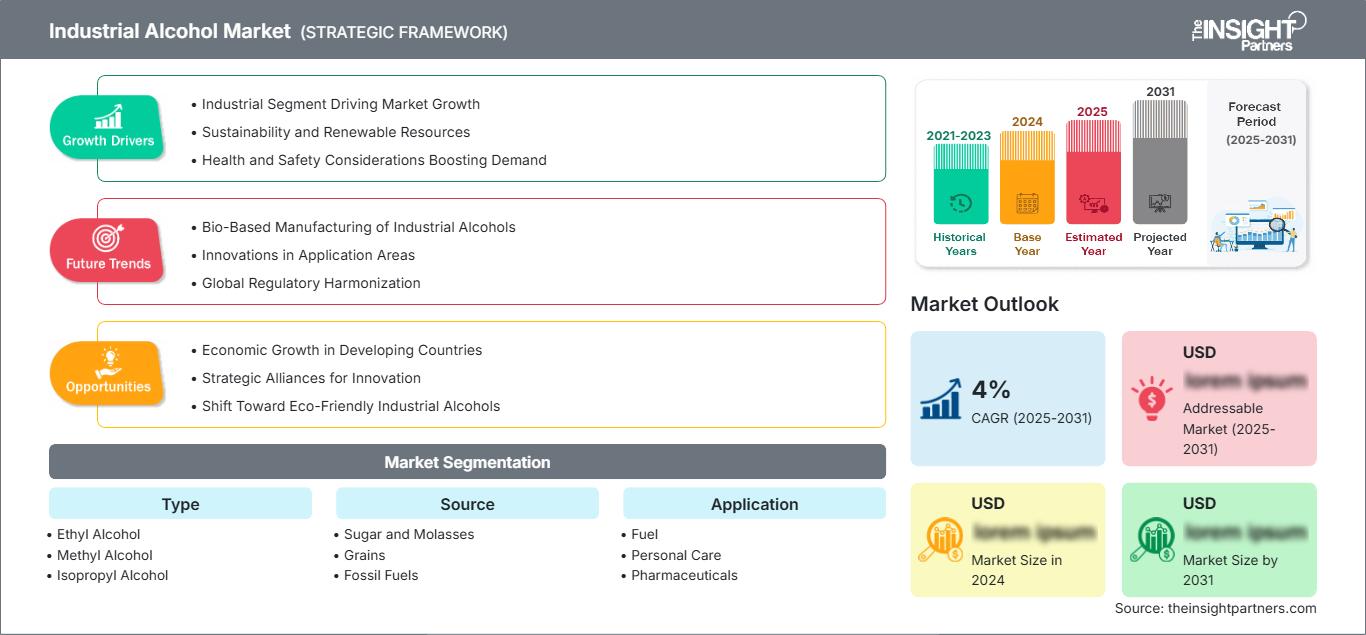
Industrial Alcohol Market: Strategic Insights
Regional Insights
North America industrial alcohol market
North America accounted for an estimated 24–28% share in 2025 and is expected to grow at a 6.5–7.5% CAGR during 2026–2034. The availability of grain, established ethanol plants, and broad distribution facilities contribute to the region's production potential. The United States is the major manufacturer, while Canada is the contributor through renewable fuel policies and demand from the chemical, pharmaceutical, and consumer goods industries.
The structural demand is becoming increasingly driven by security of supply and increased purity requirements. The producers are looking at process efficiencies and differentiation to cater to more than just fuel applications. Growth in the semiconductor industry will also add to the demand for specific solvents. For instance, ExxonMobil has planned to begin production of 99.999% pure isopropyl alcohol in Baton Rouge in 2027.
U.S. industrial alcohol Market
The US represented approximately 78–82% of North American demand in 2025 and is projected to expand at a 6.5–7.5% CAGR during 2026–2034. It is further bolstered by abundant corn processing capabilities, existing renewable fuel technology infrastructure, and widespread industrial use. It is also fortunate to have firms like Cargill, Incorporated; Flint Hills Resources, LP; Green Plains Inc.; Grain Processing Corporation; and The Andersons, Inc.
Application uses are becoming more diverse. The use in fuels continues to be an important market, but pharmaceutical production, industrial cleaning, electronics, and specialty chemicals all need certain specifications as well as a steady domestic source. The production capabilities in the United States also offer the possibilities of coproduct optimization and carbon reduction technologies. The investment in high purity isopropyl alcohol production exemplifies how producers are responding to value chain needs.
Europe industrial alcohol market
Europe accounted for an estimated 21–25% share in 2025 and is forecast to expand at a 5.5–6.5% CAGR during 2026–2034. Growth in this region is driven by renewable energy targets, mature chemical industry, and demand for pharmaceutical and personal care ingredients. While Germany is an important industrial hub, the UK, France, Italy, and Spain also generate demand through manufacturing, refining, food processing, and production of consumer goods.
The UK market is driven by pharmaceutical production, specialty chemicals, laboratory needs, and industrial cleaning. In recent times, there has been a preference towards quality and supply chain transparency, making it easier to develop differentiated products rather than just volume sales. Germany is still the most important European industrial market due to its developed chemical, automotive, pharmaceutical, and manufacturing industry.
The French market is driven by access to sugar and agricultural feedstock, which are supplied by manufacturers like Cristalco SAS. The Italian and Spanish markets are driven by chemical processing, pharmaceuticals, personal care, and biofuel usage. Overall, environmental regulation drives increased interest in feedstock sourcing and efficiency in production. Such an environment facilitates a gradual move towards renewables and low-carbon alcohol production.
APAC industrial alcohol market
Asia Pacific accounted for approximately 36–40% share in 2025 and is expected to register an 8.5–9.5% CAGR during 2026–2034. China is the leading regional market, supported by its extensive chemical manufacturing base. India benefits from expanding ethanol programs and agricultural feedstock availability, while Japan, South Korea, and Australia provide demand from advanced manufacturing, pharmaceuticals, and specialty chemicals.
Industrial expansion and policy support for renewable fuels are reinforcing regional consumption. India's ethanol ecosystem continues to attract investment, including collaborations targeting bioenergy and future sustainable fuel production.
Middle East & Africa industrial alcohol market
The Middle East & Africa is expected to grow at a 7.5–8.5% CAGR during 2026–2034. Saudi Arabia and the UAE benefit from integrated petrochemical infrastructure, while South Africa provides an established industrial and agricultural processing base. Fossil-derived feedstocks remain strategically important across several regional markets.
Infrastructure development and industrial diversification are creating additional consumption opportunities. Saudi Arabia is expected to remain the leading market because of its petrochemical ecosystem, while the UAE's logistics position supports regional trade. Emerging bio-based production and infrastructure investment could gradually diversify supply patterns across the Rest of MEA.
Segmentation Analysis
Type
The type segment is expected to expand at a 7.5–8.5% CAGR during 2026–2034. The industrial alcohol market scope across ethanol, methanol, and isopropyl alcohol reflects fundamentally different production technologies and end-use profiles. Ethanol benefits from renewable fuel and solvent demand, methanol remains central to chemical synthesis, and isopropyl alcohol is increasingly important in cleaning and high-purity industrial applications.
- Ethyl Alcohol: The largest type, supported by extensive use in fuel blending, industrial solvents, pharmaceutical processing, personal care formulations, and chemical production. Feedstock diversity and renewable production pathways strengthen its strategic importance.
- Methyl Alcohol: Demand is closely linked to chemical synthesis, energy applications, and downstream derivative production. Natural gas availability, production integration, and emerging low-carbon methanol pathways influence its competitive positioning.
- Isopropyl Alcohol: High-value demand is supported by disinfectants, pharmaceutical processing, electronics, laboratory operations, and precision cleaning. Increasing purity requirements enhance the strategic importance of specialized production and purification capabilities.
Source
The source segment is projected to register a 7.0–8.0% CAGR during 2026–2034. Feedstock economics are a central determinant of production costs, geographic competitiveness, and lifecycle emissions. Producers increasingly seek flexibility across agricultural and conventional inputs to reduce exposure to commodity cycles, weather-related supply disruptions, and energy-price volatility.
- Sugar and Molasses: These feedstocks are strategically important in sugar-producing economies, supporting ethanol production and integration with existing milling operations. Their competitiveness depends on crop availability, sugar cycles, processing efficiency, and government policies.
- Grains: Grain-based production underpins major ethanol industries, particularly where corn-processing infrastructure is extensive. Coproduct revenues and access to reliable agricultural supply strengthen the economics of integrated production facilities.
- Fossil Fuels: Fossil-based routes remain essential for methanol and several synthetic alcohol value chains. Competitive natural gas and petrochemical feedstocks support scale, although decarbonization requirements are increasing interest in lower-emission alternatives.
Application
The application segment is anticipated to grow at an 8.5–9.5% CAGR during 2026–2034. Demand patterns are becoming more diversified as producers balance large-volume fuel markets with higher-margin pharmaceutical, personal care, and chemical applications. This segmentation provides a practical framework for evaluating how changes in regulation, consumer manufacturing, industrial investment, and decarbonization strategies influence product demand.
- Fuel: The most significant application, supported by blending mandates, renewable energy strategies, and the need to reduce lifecycle emissions from transportation and selected industrial energy systems.
- Personal Care: Alcohol is widely used in fragrances, cosmetics, hygiene products, and formulation processes. Demand is influenced by premium product development, regulatory standards, and manufacturers' requirements for consistent purity.
- Pharmaceuticals: High-purity alcohol grades are important in manufacturing, extraction, sanitation, and laboratory processes. Strict quality specifications and supply reliability make this application strategically attractive to specialized producers.
- Chemical Intermediate: Methanol, ethanol, and other alcohols serve as feedstocks for derivatives and synthesis processes. Growth depends on downstream chemical capacity, industrial investment, and regional access to competitive feedstocks.
Opportunity Snapshot
| Application | Revenue Contribution | Trend Tag | Adoption Stage |
|---|---|---|---|
| Fuel | High | Biofuel Blending | Mature |
| Personal Care | Medium | Clean Formulations | Mature |
| Pharmaceuticals | Medium | High Purity | Scaling |
| Chemical Intermediate | High | Chemical Feedstocks | Mature |
Industrial Alcohol Market Growth Drivers and Impact Analysis
Biofuel Mandates and Transport Decarbonization
Renewable fuel promotion programs from government bodies are driving an increase in demand for ethanol throughout the value chain in transport and energy sectors. The blending mandate helps ensure relatively consistent avenues for consumption along with investment in feedstock sourcing, distillation, storage, and distribution. The effect goes beyond producers of ethanol since grain processing, sugar mills, logistics firms, and even technological companies are all part of the wider industry. Other countries that aim to have reduced carbon emissions within their transportation sector have been looking at producing domestic biofuels as a means of reducing dependency on imports. This factor works well for integrated producers who can source their feedstock and sell off any by-products.
Expansion of High-Purity Industrial Manufacturing
There is growing demand for alcohol products that have purity, traceability, and contamination levels that need to be managed to stringent standards because of advanced manufacturing processes used in the production of semiconductors, pharmaceutical products, laboratory work, and special industrial cleaning. This presents new chances for margin expansion in relation to differentiating product lines and developing long-term customer relationships. The market implications of this are very strong in locations that are building up their own capacity in terms of semiconductors and pharmaceuticals production. For example, the production of 99.999% isopropyl alcohol by ExxonMobil in the US shows how this trend is emerging.
Feedstock Diversification and Integrated Processing
Producers are increasingly integrating alcohol manufacturing with agricultural processing, refining, coproduct recovery, and energy management to improve resilience. Access to multiple feedstock sources can reduce vulnerability to individual crop cycles or commodity-price fluctuations. Sugar and molasses, grains, and fossil-derived inputs each provide different cost and supply advantages, encouraging region-specific production strategies. Integration also enables companies to capture value from animal feed coproducts, carbon dioxide, energy recovery, and other process streams. This approach can improve asset utilization while supporting lower production costs. For emerging producers, the ability to design facilities around locally available feedstocks is becoming an important investment consideration, particularly where governments support domestic renewable energy and industrial development.
Industrial Alcohol Market Future Trends
Low-Carbon Alcohol Production Pathways
The industrial alcohol market trends are increasingly shaped by efforts to reduce the carbon intensity of production. Producers are expected to combine renewable electricity, carbon capture, waste-based feedstocks, and improved process efficiency with established fermentation and synthetic technologies. Lifecycle emissions will become a more important purchasing criterion for industrial customers and policymakers. Low-carbon methanol and renewable ethanol are likely to receive particular attention as industries pursue measurable decarbonization targets. Production facilities may also become more integrated with renewable power and circular resource systems. This transition will favor companies capable of documenting feedstock origin, process emissions, and product carbon intensity.
Shift Toward Multiproduct Alcohol Platforms
Future investment is likely to favor flexible facilities capable of serving fuel, chemical, pharmaceutical, and specialty applications rather than relying on a single outlet. Producers will increasingly evaluate purification capacity and product switching as tools for responding to changing price relationships. Digital process monitoring can improve yield consistency, reduce energy consumption, and support stricter quality control. Multiproduct platforms may also improve resilience during periods of oversupply in individual alcohol categories. Strategic partnerships between agricultural processors, chemical companies, and downstream manufacturers could become more common. The resulting industry structure is expected to reward operational flexibility and customer-specific product development over undifferentiated volume expansion.
Industrial Alcohol Market Opportunities
Investment in High-Purity Specialty Capacity
Investment in high-purity ethanol and isopropyl alcohol capacity offers an opportunity to address expanding pharmaceutical, electronics, laboratory, and precision-manufacturing requirements. Rather than competing solely on commodity volumes, producers can invest in advanced distillation, filtration, packaging, and quality-control infrastructure. The industrial alcohol market Forecasts support increasing attention to specialized grades because industrial customers require secure supply chains and consistent specifications. New facilities can also be located near emerging semiconductor and pharmaceutical manufacturing clusters to reduce logistics risks. Partnerships with downstream customers may improve capacity planning and qualification processes. Investors should evaluate certification requirements, contamination-control standards, energy intensity, and customer concentration before committing capital to these specialized markets.
Regional Bio-Based Production Hubs
Developing bio-based production hubs in agricultural regions can create opportunities to connect local feedstocks with domestic fuel and industrial demand. Integrated projects can combine ethanol production with coproduct processing, renewable power, biogas, carbon capture, and distribution infrastructure. India, parts of Southeast Asia, Latin America, and selected African markets offer potential where agricultural resources and energy-transition policies intersect. Successful projects will require careful evaluation of feedstock seasonality, competing uses, water availability, and logistics economics. Investors can reduce risk by establishing long-term supply agreements and diversified end-use portfolios. Opportunities are strongest where domestic consumption can absorb output before producers pursue export markets exposed to changing trade conditions.
Recent Developments
- November 2025: Sumitomo Corporation agreed to acquire a stake in TruAlt Gas Private Limited and enter a strategic collaboration with TruAlt Bioenergy. The partnership includes plans involving bioethanol and sustainable aviation fuel, while targeting construction of 16 compressed biomethane facilities in India over three years.
- April 2025: ExxonMobil Corporation announced plans to begin producing 99.999% high-purity isopropyl alcohol at its Baton Rouge facility in 2027. The investment is intended to support increasing US semiconductor manufacturing requirements and strengthen domestic supply of ultra-high-purity solvent products for advanced technology applications.
Frequently Asked Questions

- Comprehensive Market Sizing and Forecast Analysis
- Detailed Segmentation Analysis
- In-Depth Market Dynamics Assessment
- Regional and Country-Level Insights
- Competitive Landscape and Company Benchmarking
- Strategic Business Intelligence
Recent Reports
Testimonials

The Insight Partners' SCADA System Market report is comprehensive, with valuable insights on current trends and future forecasts. The team was highly professional, responsive, and supportive throughout. We are very satisfied and highly recommend their services.
RAN KEDEM Partner, Reali Technologies LTDs
I requested a report on a very specific software market and the team produced the report in a few days. The information was very relevant and well presented. I then requested some changes and additions to the report. The team was again very responsive and I got the final report in less than a week.
JEAN-HERVE JENN Chairman, Future Analytica
We worked with The Insight Partners for an important market study and forecast. They gave us clear insights into opportunities and risks, which helped shape our plans. Their research was easy to use and based on solid data. It helped us make smart, confident decisions. We highly recommend them.
PIYUSH NAGPAL Sr. Vice President, High Beam Global
The Insight Partners delivered insightful, well-structured market research with strong domain expertise. Their team was professional and responsive throughout. The user-friendly website made accessing industry reports seamless. We highly recommend them for reliable, high-quality research services
YUKIHIKO ADACHI CEO, Deep Blue, LLC.
This is the first time I have purchased a market report from The Insight Partners.While I was unsure at first, I visited their web site and felt more comfortable to take the risk and purchase a market report.I am completely satisfied with the quality of the report and customer service. I had several questions and comments with the initial report, but after a couple of dialogs over email with their analyst I believe I have a report that I can use as input to our strategic planning process.Thank you so much for taking the extra time and making this a positive experience.I will definitely recommend your service to others and you will be my first call when we need further market data.
JOHN SUZUKI President and Chief Executive Officer, Board Director, BK Technologies
I wish to appreciate your support and the professionalism you displayed in the course of attending to my request for information regarding to infectious disease IVD market in Nigeria. I appreciate your patience, your guidance, and the fact that you were willing to offer a discount, which eventually made it possible for us to close a deal. I look forward to engaging The Insight Partners in the future, all thanks to the impression you have created in me as a result of this first encounter.
DR CHIJIOKE ONYIA MANAGING DIRECTOR, PineCrest Healthcare Ltd.Reason to Buy
- Informed Decision-Making
- Understanding Market Dynamics
- Competitive Analysis
- Identifying Emerging Markets
- Customer Insights
- Market Forecasts
- Risk Mitigation
- Boosting Operational Efficiency
- Strategic Planning
- Investment Justification
- Tracking Industry Innovations
- Aligning with Regulatory Trends





 Get Free Sample for