
Industrial Ball Valves Market Size, Share & Demand by 2034
Coverage: By Type (Fully Welded, Top Entry, and Side Entry), Size (Upto 5 Inches, 6–15 Inches,16–24 Inches, and Above 25 Inches), Class (150, 300, 400, 600, 800, 900,1500, and 2500), and Industry (Oil and Gas, LNG, Water Treatment, Power and Energy, Chemical and Petrochemical, and Others)
- Status : Published
- Report Code : TIPRE00043110
- Category : Manufacturing and Construction
- No. of Pages : 308
- Available Report Formats :


- Last update date : April 17, 2026


2025 Market Size
US$ 14.94 Bn
Base year value
2034 Forecast
US$ 20.08 Bn
Projected by 2034
CAGR 2025-2034
3.3 %
Growth rate
Addressable Market
US$ 158.72 Bn
(2025-2034)
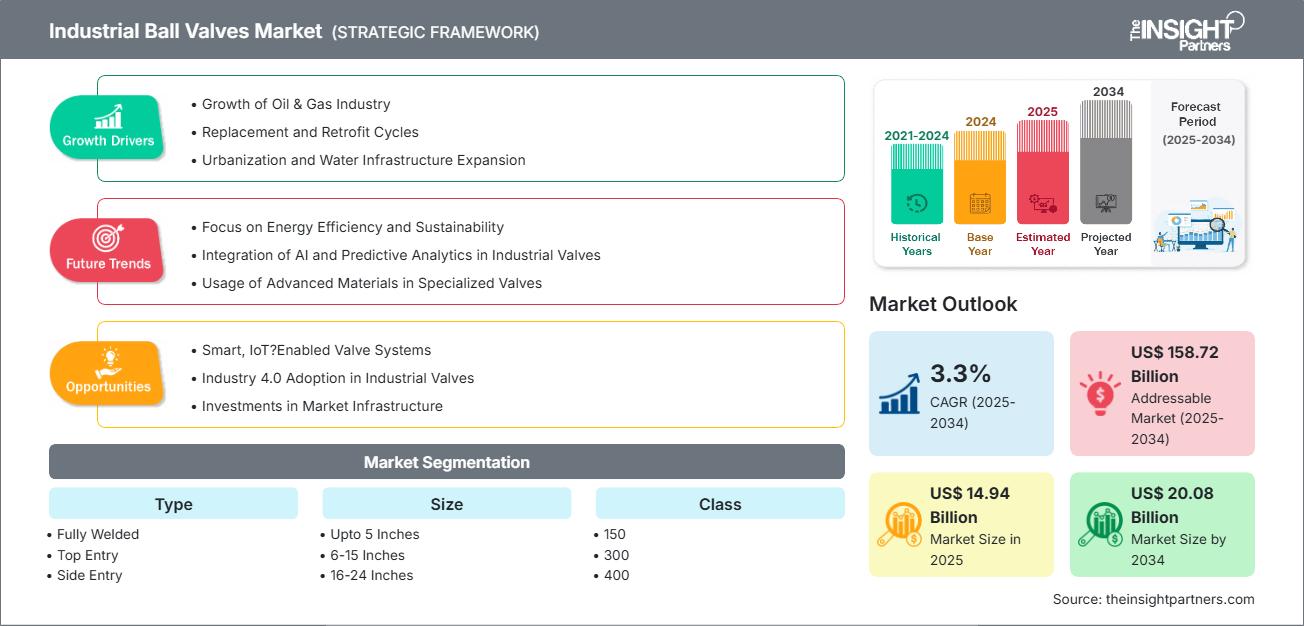
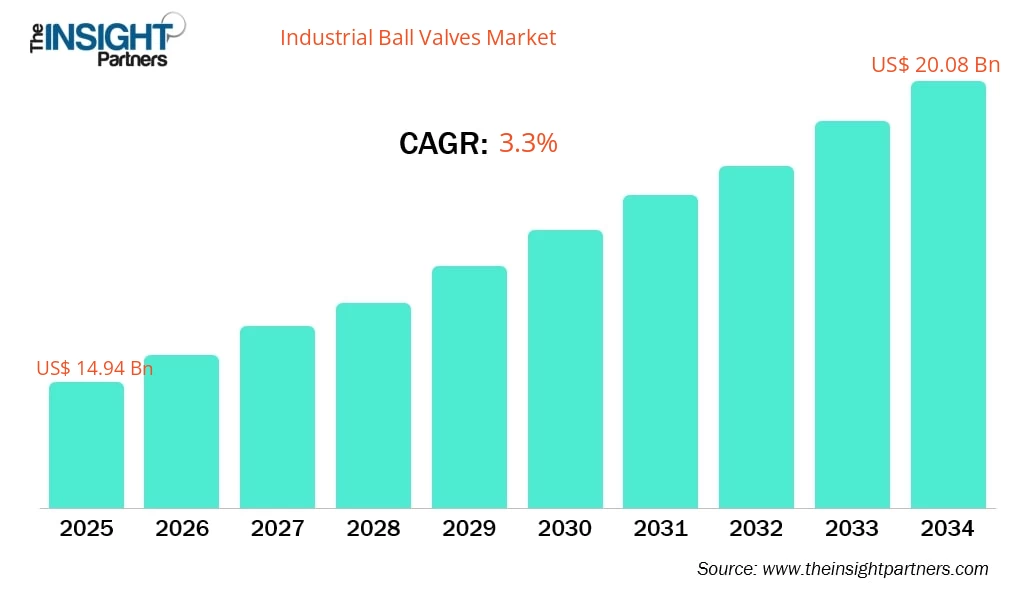
The industrial ball valves market size is projected to reach US$ 20.08 billion by 2034, from US$ 14.94 billion in 2025. The market is expected to register a CAGR of 3.3% during 2026–2034.
Industrial Ball Valves Market Analysis
In developing countries, industrialization and the expansion of infrastructure are taking place at a rapid pace. These factors create a necessity for more effective methods for controlling fluid flow. Large investments in the oil, gas, and petrochemical industries are driving valve sales. The trend toward an increase in automation in the industrial sector contributes to the increased demand for automated ball valves. Another major driver for ball valve sales has been the introduction of new environmental regulations by many countries around the world aimed at preventing leaks and improving system efficiencies. Advances in material development have also helped to drive the adoption of ball valves into applications such as those that involve exposure to corrosive conditions or extreme pressure levels. The increasing need for industries to provide greater efficiencies in their energy consumption, safety in their processes, and reliable control of their production processes will continue to contribute to the market growth.
Industrial Ball Valves Market Overview
An industrial ball valve controls the flow of liquid through a pipe by moving a ball valve assembly—consisting of a ball, a seat, and a stem—inside the valve body. The valve has a circular opening in the center through which liquid flows when the ball is in line with the opening. However, when the ball is rotated 90 degrees or more from the line of flow, fluid does not flow through the valve anymore. There are several industries where industrial ball valves are utilized, including the oil and gas, chemical, water treatment, and power generation industries. Industrial ball valves mainly serve as a means of isolation of fluid flow in a pipeline. They are used to regulate the delivery of high-pressure or high-temperature fluids. An important function of industrial ball valves is to help provide a reliable method of shutting down critical systems. The ability of an industrial ball valve to create a tight seal decreases the amount of leakage from the valve, thus enabling long-term operational success. Industrial ball valves require little to no maintenance and can also be automated.
Market Research Highlights
- Asia Pacific dominated the market with 40.1% share in 2025.
- Asia Pacific is poised to grow at a CAGR of 4% over the forecast period.
- United States market is projected to grow at a CAGR of 3.2% over the forecast period.
- By Type, the Side Entry segment accounted for the largest market share of 54.4% in 2025.
- By Size, the 6-15 Inches segment is anticipated to witness the fastest growth, registering a CAGR of 4% over the forecast period
- By Class, the 150 segment accounted for the largest market share of 29.5% in 2025.
- By Industry, the Water Treatment segment is anticipated to witness the fastest growth, registering a CAGR of 4.8% over the forecast period
- The report profiles key industry players such as Emerson Electric Co, SLB Limited, Spirax Group plc, Circor International Inc, Flowserve Corp, Velan Inc, The Weir Group PLC, Crane Co, Neway Valve (Suzhou) Co.,Ltd, KITZ Corporation, while also analyzing key developments in novel ideas, disruptive products, and innovative services that could reshape the future market and reveal emerging themes across the industry.
Source: The Insight Partners' analysis based on proprietary research, government publications, company annual reports, investor presentations, industry databases, and expert interviews.
● REPORT CUSTOMIZATION
Tailor This Report To Align With Your Specific Business Requirements
This report can be customized to align precisely with your business objectives, scope, and target markets. Customization options include tailored segmentation, geography, competitive analysis, and strategic insights to support informed decision-making.
Customize This Report →WHAT YOU CAN ADJUST
- ● Segmentations
- ● Geography
- ● Competitive Analysis
- ● Language Preferences
Industrial Ball Valves Market: Strategic Insights
-
Get Top Key Market Trends of this report.This FREE sample will include data analysis, ranging from market trends to estimates and forecasts.
Industrial Ball Valves Market Drivers and Opportunities
Market Drivers:
- Growth of the Oil and Gas Industry: Growing oil and gas exploration and production activities require ball valves to handle high-pressure and high-temperature environments.
- Replacement and Retrofit Cycles: Replacement and retrofit cycles are influenced by the growing integration of digital technologies, such as smart sensors and automated control systems, which require newer valve designs capable of supporting predictive maintenance and real-time monitoring.
- Urbanization and Water Infrastructure Expansion: As cities expand both vertically and horizontally, the demand for reliable and efficient industrial ball valves rises significantly.
- Industrial Automation Adoption: Automation across industries boosts demand for smart and automated ball valves to enhance operational efficiency and reduce manual intervention.
- Increased Demand From the Energy And Power Sector: Power plants, renewables, and LNG projects require reliable valves for high-pressure and temperature applications, fueling sustained market growth.
Market Opportunities:
- Smart and IoT‑Enabled Valve Systems: The advent of smart, IoT-enabled valve systems is creating numerous opportunities by enhancing efficiency, safety, and data-driven decision-making.
- Industry 4.0 Adoption in Industrial Valves: Industry 4.0 technologies—such as the Industrial Internet of Things (IIoT), artificial intelligence (AI), and smart sensors—enable manufacturers to monitor ball valve performance in real time, enhancing operational efficiency and reducing downtime.
- Emerging Market Infrastructure Investment: As countries in Southeast Asia, Latin America, and Africa expand their industrial base, they increasingly focus on upgrading energy, water treatment, and chemical processing facilities. Industrial ball valves—essential for controlling fluid flow in pipelines—are directly impacted by these developments.
- Increased Demand For Corrosion-Resistant Materials: Industries increasingly require specialized materials such as duplex steel for durability in aggressive chemical and offshore environments.
- Expansion In Chemical And Process Industries: Growth in the chemical processing and manufacturing sectors opens opportunities for customized valves designed for complex fluid handling requirements.
Industrial Ball Valves Market Report Segmentation Analysis
The industrial ball valves market is segmented into distinct categories to provide a detailed understanding of its type, size, class, and industry specifications:
By Type:
- Fully Welded: Fully welded ball valves are robust valves with welded bodies, eliminating leak paths. Their adoption rises due to high pressure tolerance, zero leakage performance, durability, and low maintenance in industries.
- Top Entry: Top entry ball valves allow maintenance from the top without pipeline removal. Industries adopt them for easy servicing, reduced downtime, design, reliability, and suitability in offshore, refining, and critical applications.
- Side Entry: Side-entry ball valves are assembled from the sides and enable manufacturing and cost efficiency. Their adoption is growing due to ease of assembly, scalability, maintenance access, availability, and performance across industrial applications.
By Size:
- Upto 5 Inches
- 6-15 Inches
- 16-24 Inches
- Above 25 Inches
By Class:
- 150
- 300
- 400
- 600
- 800
- 900
- 1500
- 2500
By Industry:
- Oil and Gas
- LNG
- Water Treatment
- Power and Energy
- Chemical and Petrochemical
- Others
By Geography:
- North America
- Europe
- Asia Pacific
- Latin America
- Middle East & Africa
Industrial Ball Valves Market Report Scope
| Report Attribute | Details |
|---|---|
| Market size in 2025 | US$ 14.94 Billion |
| Market Size by 2034 | US$ 20.08 Billion |
| Global CAGR (2025 - 2034) | 3.3% |
| Historical Data | 2021-2024 |
| Forecast period | 2025-2034 |
| Segments Covered |
By Type
|
| Regions and Countries Covered |
North America
|
| Market leaders and key company profiles |
|
Industrial Ball Valves Market Players Density: Understanding Its Impact on Business Dynamics
The Industrial Ball Valves Market is growing rapidly, driven by increasing end-user demand due to factors such as evolving consumer preferences, technological advancements, and greater awareness of the product's benefits. As demand rises, businesses are expanding their offerings, innovating to meet consumer needs, and capitalizing on emerging trends, which further fuels market growth.
Industrial Ball Valves Market Share Analysis by Geography
Asia Pacific, being an automotive manufacturing hub, is witnessing the fastest market growth. Emerging markets in Latin America, the Middle East, and Africa offer numerous untapped opportunities for industrial valve providers.
The industrial ball valves market experiences varying growth rates across different regions. Below is a summary of market share and trends by region:
1. North America
- Resurgence in oil and gas, shale exploration, LNG terminals, and pipeline modernization drives demand, alongside aging water infrastructure upgrades, strict emission regulations, and increasing adoption of automation and smart valve technologies.
- Integration of IoT-enabled smart valves, predictive maintenance systems, and digital monitoring, coupled with infrastructure refurbishment cycles and focus on low-emission, high-performance valves, is shaping advanced industrial valve adoption trends.
2. Europe
- Stringent environmental regulations, energy transition toward renewables, hydrogen infrastructure investments, and modernization of aging industrial systems drive demand, supported by strong chemical, pharmaceutical, and water treatment industries across Europe.
- Shift toward sustainable materials, energy-efficient actuation, hydrogen-compatible valves, and Industry 4.0 integration drives innovation, alongside rising demand for cryogenic, corrosion-resistant, and modular valve solutions across advanced industrial applications.
3. Asia Pacific
- Rapid industrialization, urbanization, expanding manufacturing base, and large-scale investments in energy, water, and infrastructure projects across China, India, and Southeast Asia significantly drive the industrial ball valves market growth.
- Increasing LNG trade, refinery expansions, localization of production, and adoption of automation and digital technologies, combined with environmental compliance focus, are shaping innovation and large-scale deployment of advanced ball valves.
4. South and Central America
- Growth in oil and gas production, mining activities, and investments in water and wastewater infrastructure drives demand, supported by industrial expansion and the increasing need for reliable flow control systems.
- Increased focus on infrastructure modernization, gradual adoption of automation technologies, and growing investments in energy and water projects are shaping market trends, alongside demand for cost-effective and durable valve solutions.
5. Middle East and Africa
- Expanding oil and gas exploration, refinery projects, and rising investments in desalination and water treatment infrastructure drive demand for industrial ball valves across Gulf countries and emerging African economies.
- Growing desalination capacity, adoption of corrosion-resistant valves, and increasing focus on energy efficiency and infrastructure diversification are shaping regional trends, alongside the gradual adoption of automation technologies in industrial operations.
High Market Density and Competition
Competition is strong due to the presence of established players such as Emerson Electric Co (US), Flowserve Corp (US), and SLB Limited (US). Regional and niche providers such as Crane Co (US) and KITZ Corporation (Japan) also add to the competitive landscape across different regions.
A highly competitive environment drives companies to offer unique products and services, including:
- Vertical integration and scale
- Technological partnership
- Geographic footprint
Opportunities and Strategic Moves
- Consolidation through mergers and acquisitions
- Investing in automation
- Diversifying into high-growth verticals
- Sustainability and eco-friendly solutions
Major Companies operating in the Industrial Ball Valves Market are:
- Emerson Electric Co (US)
- Flowserve Corp (US)
- SLB Limited (US)
- Crane Co (US)
- KITZ Corporation (Japan)
- Velan Inc (Canada)
- Spirax Group plc (UK)
- The Weir Group PLC (Scotland)
- Circor International Inc (US)
- Neway Valve (Suzhou) Co.,Ltd (China)
Other companies analyzed during the course of research:
- KSB SE & Co. KGaA
- AVK Holdings
- The Lee Company
- RED-WHITE VALVE CORP.
- Alsco Industrial Products
- JLX VALVE
- Curtiss-Wright
- LUMACO SANITARY VALVES
- IPEX Group of Companies
- Xylem, Inc.
- Motion Industries, Inc.
- Schenck Process Holding GmbH
- Alfa Laval Inc.
- EBARA Technologies, Inc.
- Pentair
- Stäubli International AG
- Barnes Group Inc.
- TRIVACO Tristate Valves & Controls, Inc
- Bi-Torq Valve Automation
- PARKER HANNIFIN CORP
Disclaimer: The companies listed above are not ranked in any particular order.
Industrial Ball Valves Market News and Recent Developments
- Crane Fluid Systems Supports the Redevelopment of 7 Millbank in London: In December 2025, Crane Fluid Systems supported the redevelopment of 7 Millbank in London, supplying Skanska UK with a comprehensive range of valves and engineered solutions for the project.
- Emerson Introduces the Anderson Greenwood Type 84 Pressure Relief Valve (PRV): In February 2025, Emerson Electric Co introduced the Anderson Greenwood Type 84 Pressure Relief Valve (PRV), specially designed to protect tanks and vessels used in hydrogen and other high-pressure gas applications. With Arlon 3000XT thermoplastic seating and ASME SA-479 Type S21800 stainless steel spindle material, the Type 84 PRV delivers exceptional leaktight performance, resistance to embrittlement, optimum seat tightness, high reliability, and long service life.
Industrial Ball Valves Market Report Coverage and Deliverables
The "Industrial Ball Valves Market Size and Forecast (2021–2034)" report provides a detailed analysis of the market covering below areas:
- Industrial ball valves market size and forecast at global, regional, and country levels for all the segments covered under the scope
- Industrial ball valves market trends, as well as dynamics such as drivers, restraints, and key opportunities
- Detailed PEST and SWOT analysis
- Industrial ball valves market analysis covering key trends, global and regional framework, major players, regulations, and recent market developments
- Industry landscape and competition analysis covering market concentration, heat map analysis, prominent players, and recent developments for the industrial ball valves market
- Detailed company profiles
Frequently Asked Questions

- Comprehensive Market Sizing and Forecast Analysis
- Detailed Segmentation Analysis
- In-Depth Market Dynamics Assessment
- Regional and Country-Level Insights
- Competitive Landscape and Company Benchmarking
- Strategic Business Intelligence
Recent Reports
Testimonials

The Insight Partners' SCADA System Market report is comprehensive, with valuable insights on current trends and future forecasts. The team was highly professional, responsive, and supportive throughout. We are very satisfied and highly recommend their services.
RAN KEDEM Partner, Reali Technologies LTDs
I requested a report on a very specific software market and the team produced the report in a few days. The information was very relevant and well presented. I then requested some changes and additions to the report. The team was again very responsive and I got the final report in less than a week.
JEAN-HERVE JENN Chairman, Future Analytica
We worked with The Insight Partners for an important market study and forecast. They gave us clear insights into opportunities and risks, which helped shape our plans. Their research was easy to use and based on solid data. It helped us make smart, confident decisions. We highly recommend them.
PIYUSH NAGPAL Sr. Vice President, High Beam Global
The Insight Partners delivered insightful, well-structured market research with strong domain expertise. Their team was professional and responsive throughout. The user-friendly website made accessing industry reports seamless. We highly recommend them for reliable, high-quality research services
YUKIHIKO ADACHI CEO, Deep Blue, LLC.
This is the first time I have purchased a market report from The Insight Partners.While I was unsure at first, I visited their web site and felt more comfortable to take the risk and purchase a market report.I am completely satisfied with the quality of the report and customer service. I had several questions and comments with the initial report, but after a couple of dialogs over email with their analyst I believe I have a report that I can use as input to our strategic planning process.Thank you so much for taking the extra time and making this a positive experience.I will definitely recommend your service to others and you will be my first call when we need further market data.
JOHN SUZUKI President and Chief Executive Officer, Board Director, BK Technologies
I wish to appreciate your support and the professionalism you displayed in the course of attending to my request for information regarding to infectious disease IVD market in Nigeria. I appreciate your patience, your guidance, and the fact that you were willing to offer a discount, which eventually made it possible for us to close a deal. I look forward to engaging The Insight Partners in the future, all thanks to the impression you have created in me as a result of this first encounter.
DR CHIJIOKE ONYIA MANAGING DIRECTOR, PineCrest Healthcare Ltd.Reason to Buy
- Informed Decision-Making
- Understanding Market Dynamics
- Competitive Analysis
- Identifying Emerging Markets
- Customer Insights
- Market Forecasts
- Risk Mitigation
- Boosting Operational Efficiency
- Strategic Planning
- Investment Justification
- Tracking Industry Innovations
- Aligning with Regulatory Trends





 Get Free Sample for