
Industrial Gas Regulators Market Share, Growth & Forecast by 2034
Coverage: by Regulator Type (Single Stage, and Dual Stage), Gas Type (Inert Gas, Toxic Gas, Corrosive Gas), Materials Used (Brass, Stainless Steel, and Others), End-user Industry (Oil & Gas, Chemical, Healthcare & Pharmaceutical, Food & Beverage, and Others), and Geography (North America, Europe, Asia Pacific, and South and Central America)
- Status : Data Released
- Report Code : TIPMC00002745
- Category : Manufacturing and Construction
- No. of Pages : 150
- Available Report Formats :


- Last update date : November 13, 2026


2025 Market Size
US$ 15.68 Bn
Base year value
2034 Forecast
US$ 24.88 Bn
Projected by 2034
CAGR 2026-2034
5.26 %
Growth rate
Addressable Market
US$ 183.95 Bn
(2026-2034)
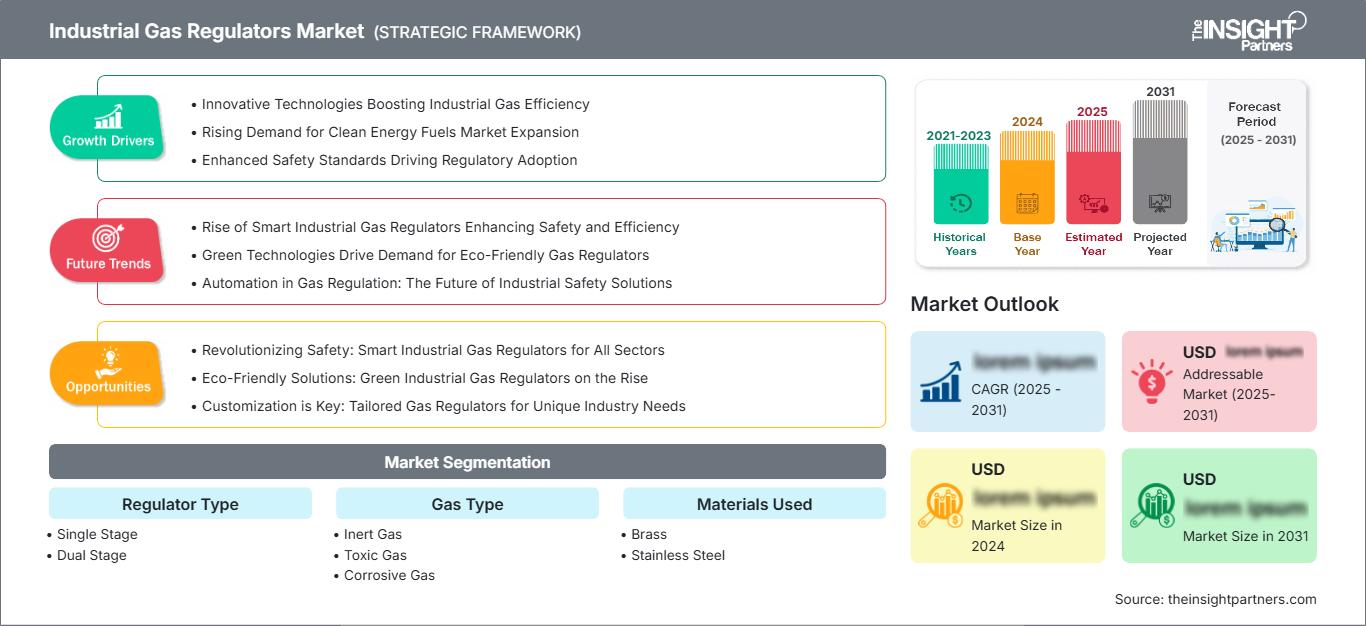
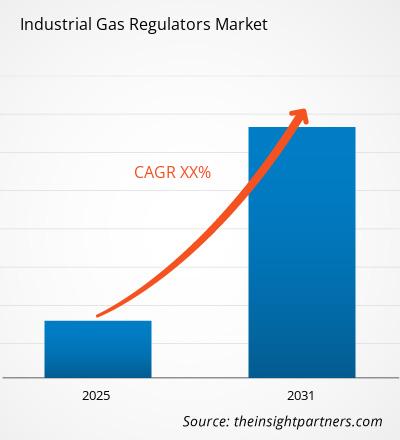
The Industrial Gas Regulators Market was valued at US$ 15.68 Billion in 2025 and is projected to reach US$ 24.88 Billion by 2034, expanding at a CAGR of 5.26% during 2026–2034. The market covers pressure-control equipment used to reduce, stabilize, and manage industrial gas delivery across cylinders, manifolds, process lines, distribution systems, and point-of-use installations serving safety-critical and precision-dependent applications.
The Industrial Gas Regulators Market size in North America is supported by an estimated ~5% CAGR through 2034. Replacement of aging gas-distribution equipment, expansion of LNG and hydrogen-related infrastructure, and sustained demand from healthcare, chemical processing, food production, and advanced manufacturing reinforce recurring purchases of reliable, standards-compliant pressure-control devices.
Industrial Gas Regulators Market Assessment and Insights
Regional Outlook
- North America: ~34% of the global market in 2025 | ~5% CAGR through 2034. Market position: The region leads through a mature installed base, stringent safety practices, broad packaged-gas distribution, and continuing investment in energy, healthcare, chemicals, and high-specification manufacturing.
- US: ~81% of North American market revenue in 2025 | ~5% CAGR through 2034. Market position: The country anchors regional demand through dense industrial infrastructure, extensive regulator replacement needs, advanced fabrication, medical gas systems, and supplier-led development of low-emission pressure-control equipment.
- Europe: ~27% of the global market in 2025 | ~4% CAGR through 2034. Market position: A mature compliance environment supports replacement demand, with Germany leading Europe and the UK, France, Italy, and Spain sustaining diversified industrial applications.
- Asia Pacific: ~29% of the global market in 2025 | ~7% CAGR through 2034. Market position: Asia Pacific is the fastest-growing region as China, Japan, South Korea, India, and Australia expand industrial capacity, electronics, healthcare, and cleaner gas infrastructure.
Segment Outlook
- End-user Industry: ~39% Share in 2025 | ~6% CAGR through 2034. Market position: This main segment leads because regulator purchasing is concentrated in process-intensive industries where safety, uptime, gas purity, and repeatable pressure directly affect operating economics.
- Materials Used: ~22% Share in 2025 | ~6% CAGR through 2034. Market position: Growth reflects rising specification of stainless steel for corrosive, toxic, high-purity, and hygienic services requiring durability and contamination control.
Competitive Coverage
Emerson Electric Co., Linde plc, Air Liquide S.A., Air Products and Chemicals, Inc., GCE Group, Cavagna Group S.p.A., Honeywell International Inc., Itron, Inc.
Methodology
The Insight Partners follows Data Collection & Secondary Research, Primary Research, Data Analysis, and Data Triangulation & Final Review to validate market estimates and insights.
Source: The Insight Partners' analysis based on proprietary research, government publications, company annual reports, investor presentations, industry databases, and expert interviews.
The pressure regulators sector has increasingly moved from single products to engineered solutions which help provide consistent downstream pressures and offer protection against shutoff, flow monitoring and reduced emissions. There is increased focus on ensuring material compatibility is proven, clean, and trackable. Manufacturers have developed standardised products with bespoke sealing, diaphragms, bodies and inlet connections for different gases. Distributors have also increased support around commissioning, inspection and spares planning. This means the Industrial Gas Regulators Market is now focused on providing reliable solutions across the lifetime of the product.
The market is expected to grow between now and 2034 as manufacturing in Asia, energy projects in the Gulf, medical gas, specialist chemicals and food processing increase. The focus around regulatory compliance will mean there is an increase in demand for certified products with application engineering capabilities. Local assembly and stock within regions will be more important due to project timelines, import risks and bespoke inlet connections.
Industrial Gas Regulators Market Report Scope
| Report Attribute | Details |
|---|---|
| Market size in 2025 | US$ 15.68 Billion |
| Market Size by 2034 | US$ 24.88 Billion |
| Global CAGR (2026 - 2034) | 5.26% |
| Historical Data | 2021-2024 |
| Forecast period | 2026-2034 |
Industrial Gas Regulators Market Analysis
The drivers behind growth within the Industrial Gas Regulators Market are the requirement for pressure to be regulated from varying cylinder/pipeline pressures to a consistent usable pressure. Initial demand comes from gas producers and equipment manufacturers. This then flows through to valve, seal, gauge and machined body suppliers. Replacement provides a consistent base of demand. New plant will increase demand by adding new units to headers, manifolds, skids etc.
Availability of brass and stainless steel, precision machining, elastomeric and diaphragm qualification, testing facilities and local inlet connections mean there is an increase in demand for high purity and corrosive products. These require greater application engineering. Having configurable product ranges will help reduce lead times whilst maintaining gas compatibility, accurate pressure and certified products.
Within the Industrial Gas Regulators Market Report there are many players competing. A variety of automation providers, industrial gas companies, metering specialists and dedicated gas control companies. Emerson Electric Co. provide a wide range of pressure management capabilities. GCE Group and Cavagna Group S.p.A. have focused their offerings to provide application specific industrial and specialist gas products. Linde plc, Air Liquide S.A. and Air Products and Chemicals, Inc. will influence equipment specification due to their knowledge of gas provision.
There is increased investment in low/no bleed products, slam shut protection, high purity ranges, digital selection and local service. Honeywell International Inc. and Itron, Inc. provide additional benefits in automation, metering and utilities. Having clear performance data, a wide range of connections, trained distributors, continued spares and the ability to support regulated applications from specification to maintenance is key.
● REPORT CUSTOMIZATION
Tailor This Report To Align With Your Specific Business Requirements
This report can be customized to align precisely with your business objectives, scope, and target markets. Customization options include tailored segmentation, geography, competitive analysis, and strategic insights to support informed decision-making.
Customize This Report →WHAT YOU CAN ADJUST
- ● Segmentations
- ● Geography
- ● Competitive Analysis
- ● Language Preferences
Industrial Gas Regulators Market: Strategic Insights
Regional Insights
North America Industrial Gas Regulators Market
North America represents ~34% of the global market in 2025 and will grow at ~5% CAGR up to 2034. Oil & Gas processing, chemicals, hospitals, laboratory, metalworking and food and utility sectors offer a large market base. Regular maintenance and replacements provide strong demand.
LNG, renewables, hydrogen blending and reduced emissions from pressure control stations help provide market growth. Customers are increasingly looking for complete overpressure protection, low noise, ease of maintenance and traceability. Canada offers a strong energy and medical gas market and Mexico has good local manufacturing.
U.S. Industrial Gas Regulators Market
The United States of America represents ~81% of revenue in North America in 2025 and is forecast to grow around ~5% CAGR up to 2034. The United States has many different requirements due to the vast gas distribution network, refineries, chemicals, hospitals, food processing, laboratories and welding intensive industries. Replacements are important in the market with customers looking for accurate set point control, easy access to service kits and compliant with site safety.
With a strong network of providers including Emerson Electric Co., Honeywell International Inc., Itron, Inc. and local providers of global gas companies there are many options available. Natural gas non-bleed regulators, overpressure protection, packaged fuel gas skids and stainless steel regulators are all seeing increased usage. LNG and data centre power projects are also providing new opportunities for reliable fuel gas conditioning.
Europe Industrial Gas Regulators Market
Europe represents ~27% of global Industrial Gas Regulators Market Share in 2025 and is forecast to grow at ~4% CAGR up to 2034. The developed industrial base, strict equipment compliance, decarbonisation and strong speciality gas usage are all providing replacement demand. Germany has the largest market with a wide array of chemicals, engineering, automotive, metal working and laboratory industries.
The UK has a varied selection of healthcare, life sciences, food and energy transition projects. France has lots of industrial gas expertise with strong pharmaceutical, aerospace and food sectors. Italy has good demand from its machinery and fabrication industries and Cavagna Group S.p.A have a strong local manufacturing presence. Spain also has opportunities from refining, chemicals, food and renewable energy. Stainless steel is becoming more popular with customers from these countries due to its cleanliness or resistance to corrosion. Double stage regulators are also being specified more.
There is a wider range of seal types, materials, leak rates and certification due to hydrogen demonstrators and biomethane integration. However, long replacement cycles and a well established market base mean demand won’t increase rapidly. Companies are competing on engineering drawings, local service, compliance and products for old systems and new low carbon gases.
Asia Pacific Industrial Gas Regulators Market
Asia Pacific represents ~29% of global Industrial Gas Regulators Market Share in 2025 and will be the fastest growing region growing at ~7% CAGR up to 2034. China has the largest market in Asia Pacific due to its large chemical, metal, electronics, healthcare and industrial gas distribution sectors. India has good capacity increases alongside increased hospitals and food processing.
Japan and South Korea have a strong requirement for high purity regulators in the electronics, high performance materials and precision sectors. Australia has opportunities from mining, LNG, healthcare and hydrogen. Local production of components, new cylinder systems, investment in infrastructure and strict safety requirements means regulators are being adopted. There is a good range of products available from cost effective brass regulators to stainless steel regulators for corrosive and ultra clean gases.
Middle East & Africa Industrial Gas Regulators Market
Middle East & Africa is forecast to grow at ~6% CAGR up to 2034. Saudi Arabia has the largest market due to its hydrocarbon processing, petrochemicals, diversified industry, healthcare buildings and new hydrogen projects. UAE has opportunities from refining, logistics, healthcare and food.
South Africa has a strong mining, metalworking, healthcare and packaged gas market in sub-Saharan Africa. The rest of MEA has a project driven market and rely on distributors. Rugged regulators, reliable spares and materials for harsh environments are in demand. Larger energy and infrastructure projects mean there are opportunities for higher value products however technical service provision can be inconsistent which can cause longer procurement cycles.
Segmentation Analysis
Regulator Type
Regulator Type is expected to record ~5% CAGR during 2026–2034. Selection depends on inlet-pressure variation, required outlet stability, flow rate, gas characteristics, and acceptable maintenance complexity. The Industrial Gas Regulators Market scope includes both compact single-stage devices for routine control and dual-stage configurations used where cylinder pressure decline or demanding processes could otherwise disturb delivery pressure.
- Single Stage: These regulators serve cost-sensitive, general-purpose applications with moderate inlet variation. Their compact design, fewer components, and straightforward maintenance support broad use in fabrication, maintenance shops, laboratory utilities, and intermittent industrial-gas delivery.
- Dual Stage: Two-step pressure reduction improves outlet stability as cylinder pressure changes. The design is strategically important in analytical, high-purity, medical, specialty-gas, and continuous-process applications where pressure drift can affect safety or product quality.
Gas Type
Gas Type is forecast to grow at ~5% CAGR during 2026–2034. Material selection, sealing technology, cleanliness, venting arrangements, and failure protection vary materially by gas hazard. Demand is broadest for inert gases, while toxic and corrosive services generate higher specification intensity and stronger requirements for leak integrity, purge capability, and documented compatibility.
- Inert Gas: Nitrogen, argon, and related gases support purging, blanketing, welding, packaging, laboratories, and electronics. Wide application breadth makes inert-gas regulation a volume foundation, with buyers balancing pressure stability, flow capacity, and total ownership cost.
- Toxic Gas: Toxic services require tightly controlled leakage, compatible seals, secure connections, and often cabinet-based delivery. Semiconductor, chemical, and laboratory users prioritize traceability, purge arrangements, and fail-safe operation over initial equipment price.
- Corrosive Gas: Corrosive gases place severe demands on wetted materials and diaphragm integrity. Stainless-steel bodies, specialized alloys, surface finishing, and preventive replacement are important where contamination, corrosion products, or leakage could disrupt high-value processes.
Materials Used
Materials Used is projected to expand at ~6% CAGR during 2026–2034 and represents ~22% of 2025 revenue in the assessment framework. Material choice governs corrosion resistance, cleanliness, pressure rating, machinability, and cost. Higher purity requirements and more aggressive gases are shifting incremental value toward stainless steel, while brass remains essential for general industrial service.
- Brass: Brass offers economical manufacturability and dependable performance for many noncorrosive gases. It remains important in welding, fabrication, maintenance, beverage, and general cylinder applications where standard configurations and distributor availability influence purchasing.
- Stainless Steel: Stainless steel supports corrosive, toxic, ultra-high-purity, hygienic, and laboratory services. Its resistance to contamination and chemical attack makes it strategically important for semiconductors, pharmaceuticals, specialty chemicals, hydrogen, and demanding process systems.
End-user Industry
End-user Industry accounts for ~39% of 2025 revenue and is projected to register ~6% CAGR during 2026–2034. Application diversity creates the largest main-segment opportunity because regulators are deployed from bulk-gas interfaces to individual process tools. Growth follows industrial investment, compliance upgrades, facility expansion, and replacement of equipment that no longer meets accuracy, emissions, or material-compatibility expectations.
- Oil & Gas: Refineries, LNG facilities, pipelines, terminals, and gas-fired assets require pressure control for fuel, purge, calibration, and process gases. Reliability, high flow, overpressure protection, and maintainable skid integration shape procurement.
- Chemical: Chemical plants use regulators for reaction control, inerting, analytical gases, and hazardous services. Gas compatibility, corrosion resistance, leak integrity, and documentation make this a high-value application with demanding qualification requirements.
- Healthcare & Pharmaceutical: Hospitals, laboratories, biopharma plants, and pharmaceutical production need stable, clean gas delivery. Medical-device compliance, oxygen compatibility, redundancy, and stainless-steel high-purity systems create differentiated demand.
- Food & Beverage: Producers use gases for carbonation, modified-atmosphere packaging, freezing, chilling, inerting, and dispensing. Hygienic operation, repeatable flow, accessible service, and expanding packaged-food output support adoption.
Opportunity Snapshot
| End-user Industry | Revenue Contribution | Trend Tag | Adoption Stage |
|---|---|---|---|
| Oil & Gas | High | Low Bleed | Mature |
| Chemical | High | Corrosion Control | Mature |
| Healthcare & Pharmaceutical | Medium | Clean Delivery | Scaling |
| Food & Beverage | Medium | Modified Atmosphere | Scaling |
Industrial Gas Regulators Market Growth Drivers and Impact Analysis
Expansion of Safety-Critical Gas Infrastructure
Industrial facilities cannot use high-pressure stored or pipeline gas safely without controlled pressure reduction and overpressure protection. Expansion of LNG terminals, chemical plants, hospital gas networks, laboratory facilities, and packaged-gas distribution therefore creates direct equipment demand. The impact extends beyond greenfield projects because aging regulators, seals, gauges, and relief devices require periodic inspection and replacement. Purchasers increasingly assess failure consequence, spare-part continuity, and serviceability alongside flow capacity. This mechanism supports recurring revenue for standardized devices and higher-value engineered assemblies. It also rewards suppliers that can match inlet standards, pressure classes, gas compatibility, and local certification without lengthening commissioning schedules.
Rising Purity and Material-Compatibility Requirements
Semiconductor fabrication, pharmaceuticals, specialty chemicals, analytical laboratories, and high-quality food processing require gas delivery that avoids contamination and unwanted reactions. These users specify cleaner internal surfaces, metal diaphragms, compatible seals, controlled dead volume, and stainless-steel wetted parts. As process tolerances tighten, a regulator becomes part of the quality system rather than a commodity accessory. The market impact is a shift toward premium products, validated cleaning, traceable materials, and application-specific engineering. Suppliers with credible documentation and configurable high-purity platforms can capture greater value, while low-cost products remain concentrated in general inert-gas or workshop applications where contamination risk is lower.
Replacement for Lower Emissions and Better Reliability
Operators are reviewing pressure-control stations for fugitive emissions, venting, maintenance burden, and unplanned downtime. No-bleed designs, integrated slam-shut devices, improved seat materials, diagnostic support, and compact skid integration can address these operating priorities. Replacement is especially relevant in natural-gas distribution, fuel-gas systems, and remote installations where technician visits are costly. The commercial impact is gradual but durable because upgrades can be planned around maintenance windows and asset-integrity programs. Vendors that quantify leakage reduction, simplify inspection, and provide retrofit-compatible footprints are positioned to convert environmental and reliability objectives into equipment orders without requiring complete system replacement.
Industrial Gas Regulators Market Future Trends
Integrated Pressure Control and Condition Visibility
Industrial Gas Regulators Market trends are moving toward assemblies that combine regulation, isolation, relief, filtration, measurement, and status visibility. Mechanical regulation will remain fundamental, but users will increasingly pair it with sensors or connected monitoring at critical stations. The objective is not automation for its own sake; it is earlier detection of pressure drift, abnormal consumption, icing, contamination, or maintenance need. Adoption should begin in high-consequence and remote assets where downtime or gas loss justifies instrumentation. Standard data interfaces and retrofit-friendly architectures will determine whether connected products scale beyond bespoke projects.
Gas-Ready Designs for Hydrogen and New Process Mixtures
Hydrogen, biomethane, carbon dioxide handling, and evolving specialty-gas mixtures will broaden material and performance requirements through 2034. Suppliers will need to address permeability, embrittlement risk, ignition control, leakage, pressure cycling, and compatibility with existing infrastructure. The transition is likely to favor modular product platforms that can be qualified for defined gas compositions rather than a single universal device. Engineering support will become more valuable as users compare retrofit, blending, and dedicated-network options. Certification pathways and field evidence will influence the pace at which new gas-ready designs move from demonstration projects into repeat procurement.
Industrial Gas Regulators Market Opportunities
Localized High-Purity and Corrosive-Gas Portfolios
Asia Pacific and selected Middle Eastern markets offer room for suppliers to localize stainless-steel regulators, purge assemblies, panels, and service kits for electronics, chemicals, laboratories, and healthcare. Industrial Gas Regulators Market Forecasts support investment in regional machining, cleaning, testing, and inventory capabilities that shorten lead times while preserving global quality systems. A practical entry strategy combines a configurable core platform with locally compliant inlet connections and trained distributors. Partnerships with system integrators can improve specification access, while documented material traceability and cleanliness create differentiation where buyers cannot accept contamination or corrosion failures.
Retrofit Programs for Installed Pressure-Control Assets
A large installed base creates an actionable opportunity for audit-led replacement rather than dependence on new construction. Suppliers can develop programs that classify assets by gas service, age, leakage risk, spare-part availability, and failure consequence, then prioritize compatible replacements. Bundling surveys, regulator sizing, commissioning, technician training, and maintenance kits can convert fragmented aftermarket demand into repeatable service revenue. The approach is particularly relevant for hospitals, food plants, utilities, laboratories, and multi-site manufacturers. Success depends on clear retrofit documentation, channel capability, and products that minimize piping changes and shutdown duration.
Recent Developments
- May 2024: Launch of the Gas Valves and Regulators Association (GVARA), a new trade body for gas valve and regulator manufacturers worldwide and other interested parties. It was formed in spring 2024 as GVARA Ltd, a UK not-for-profit company limited by guarantee. Doug Thornton, retired former CEO of the British Compressed Gases Association (BCGA), is inaugural President, and former GCE executive Tony Peers is CEO. The formation followed several exploratory meetings that showed enough appetite for a dedicated association.
- March 2025: Shenzhen Jewellok Technology Co., Ltd, a China-based maker of ultra high purity (UHP) gas pressure regulators and control valves, announced an expansion of its gas delivery offering for semiconductor, biotech and specialty gas applications. The range includes single-stage and two-stage regulators, diaphragm valves and specialty gas regulators. Jewellok says they are built for minimal leakage, high stability, durability, compact construction and high flow capacity. It also offers customized solutions, and the company says its products are used in pharmaceuticals, aerospace and chemical processing.
Frequently Asked Questions

- Comprehensive Market Sizing and Forecast Analysis
- Detailed Segmentation Analysis
- In-Depth Market Dynamics Assessment
- Regional and Country-Level Insights
- Competitive Landscape and Company Benchmarking
- Strategic Business Intelligence
Recent Reports
Testimonials

The Insight Partners provided valuable market intelligence that supported our global go-to-market strategy. Their team was professional, responsive, and attentive to our feedback, providing thoughtful analysis and helpful methodological clarifications throughout the project.
Junmo Kim Chief Financial Officer (CFO), Enertech Co., Ltd.
The Insight Partners' SCADA System Market report is comprehensive, with valuable insights on current trends and future forecasts. The team was highly professional, responsive, and supportive throughout. We are very satisfied and highly recommend their services.
RAN KEDEM Partner, Reali Technologies LTDs
I requested a report on a very specific software market and the team produced the report in a few days. The information was very relevant and well presented. I then requested some changes and additions to the report. The team was again very responsive and I got the final report in less than a week.
JEAN-HERVE JENN Chairman, Future Analytica
We worked with The Insight Partners for an important market study and forecast. They gave us clear insights into opportunities and risks, which helped shape our plans. Their research was easy to use and based on solid data. It helped us make smart, confident decisions. We highly recommend them.
PIYUSH NAGPAL Sr. Vice President, High Beam Global
The Insight Partners delivered insightful, well-structured market research with strong domain expertise. Their team was professional and responsive throughout. The user-friendly website made accessing industry reports seamless. We highly recommend them for reliable, high-quality research services
YUKIHIKO ADACHI CEO, Deep Blue, LLC.
This is the first time I have purchased a market report from The Insight Partners.While I was unsure at first, I visited their web site and felt more comfortable to take the risk and purchase a market report.I am completely satisfied with the quality of the report and customer service. I had several questions and comments with the initial report, but after a couple of dialogs over email with their analyst I believe I have a report that I can use as input to our strategic planning process.Thank you so much for taking the extra time and making this a positive experience.I will definitely recommend your service to others and you will be my first call when we need further market data.
JOHN SUZUKI President and Chief Executive Officer, Board Director, BK Technologies
I wish to appreciate your support and the professionalism you displayed in the course of attending to my request for information regarding to infectious disease IVD market in Nigeria. I appreciate your patience, your guidance, and the fact that you were willing to offer a discount, which eventually made it possible for us to close a deal. I look forward to engaging The Insight Partners in the future, all thanks to the impression you have created in me as a result of this first encounter.
DR CHIJIOKE ONYIA MANAGING DIRECTOR, PineCrest Healthcare Ltd.Reason to Buy
- Informed Decision-Making
- Understanding Market Dynamics
- Competitive Analysis
- Identifying Emerging Markets
- Customer Insights
- Market Forecasts
- Risk Mitigation
- Boosting Operational Efficiency
- Strategic Planning
- Investment Justification
- Tracking Industry Innovations
- Aligning with Regulatory Trends





 Get Free Sample for