
Industrial Grade Kaolin Market Share, Trends & Demand Outlook 2035
Coverage: By Type (Hydrous, Calcined, and Specialty), Application (Paper and Paperboard, Ceramics and Sanitaryware, Paints and Coatings, Plastics, Rubber, Fiberglass, Refractories, Cement and Concrete, Adhesives and Sealants, and Others) and Geography (North America, Europe, Asia Pacific, Middle East & Africa, and South & Central America)
- Status : Published
- Report Code : TIPRE00044135
- Category : Chemicals and Materials
- No. of Pages : 425
- Available Report Formats :


- Last update date : November 25, 2026


2026 Market Size
US$ 7,245.84 Mn
Base year value
2035 Forecast
US$ 11,668.71 Mn
Projected by 2035
CAGR 2027-2035
5.4 %
Growth rate
Addressable Market
US$ 85,611.26 Mn
(2027-2035)
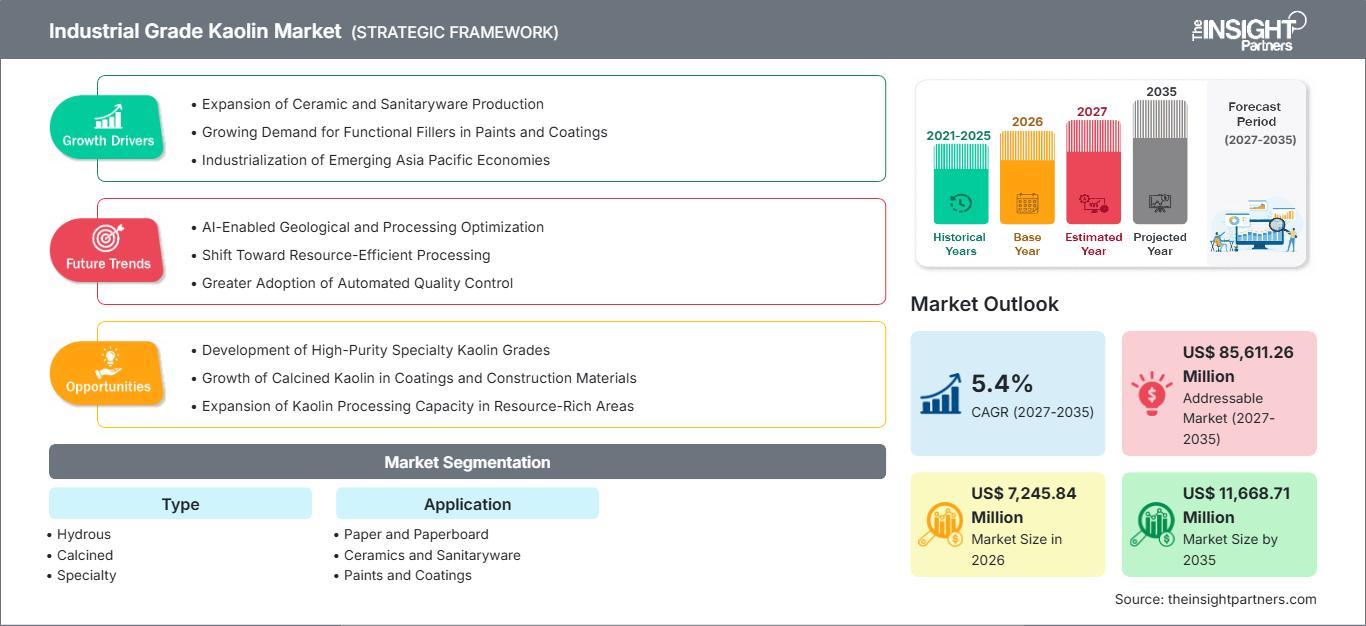
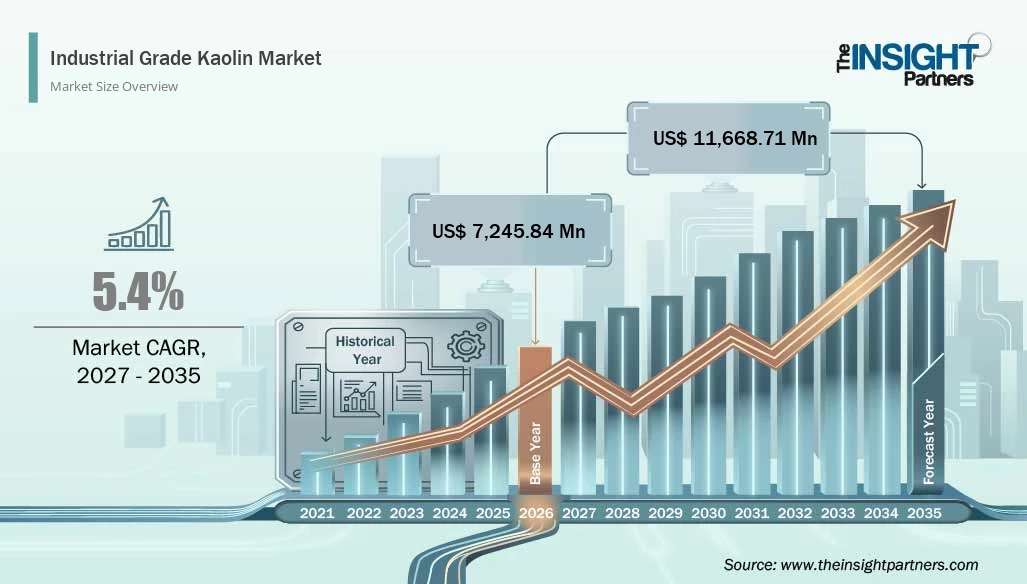
The Industrial Grade Kaolin Market was valued at US$ 7,245.84 Million in 2026 and is projected to reach US$ 11,668.71 Million by 2035, registering a CAGR of 5.4% from 2027 to 2035. Increasing consumption of kaolin in ceramics, paints and coatings, paper manufacturing, plastics, and rubber is supporting market expansion. Improvements in mineral processing, particle-size engineering, calcination, and product consistency are also influencing purchasing decisions, particularly among industrial manufacturers seeking materials with predictable brightness, whiteness, opacity, and functional performance.
The Industrial Grade Kaolin Market size reflects the expanding industrial requirement for processed mineral inputs across established manufacturing economies and developing production centers. North America remains an important demand center, supported by established paper, construction materials, coatings, and specialty chemical industries. Its projected CAGR of ~4% through 2035 reflects relatively mature consumption patterns, ongoing replacement demand, and continued investment in higher-performance mineral formulations. Demand is increasingly influenced by application-specific specifications, supplier reliability, and the economics of substituting kaolin for alternative functional fillers.
Industrial Grade Kaolin Market Assessment and Insights
Regional Outlook
- North America: ~24% of the global market in 2026 | ~4% CAGR through 2035. North America represents a major established consumption center. Its position reflects a developed industrial minerals supply chain, established coatings and ceramics manufacturing, and continuing demand for functional mineral fillers.
- US: ~75% of North American market revenue in 2026 | ~4% CAGR through 2035. The US dominates regional consumption through its extensive industrial manufacturing base. Paper, coatings, plastics, ceramics, and fiberglass producers support recurring demand for application-specific kaolin grades.
- Europe: ~25% of the global market in 2026 | ~4% CAGR through 2035. Europe maintains a substantial market position through established ceramics, coatings, paper, and construction industries. Germany, France, the UK, Italy, and Spain contribute through differentiated manufacturing capabilities.
- Asia Pacific: ~40% of the global market in 2026 | ~7% CAGR through 2035. Asia Pacific is the largest and fastest-growing regional market. China's manufacturing scale, India's expanding industrial base, and sustained ceramics and coatings demand support its position.
- Middle East & Africa: ~7% of the global market in 2026 | ~5% CAGR through 2035. Infrastructure development, construction materials manufacturing, ceramics production, and industrial diversification are supporting regional consumption, particularly in Saudi Arabia, the UAE, and South Africa.
Segment Outlook
- Hydrous: ~55% Share in 2026 | ~5% CAGR through 2035. Hydrous kaolin represents the largest sub-segment within the type category because of its established industrial applications, accessible processing routes, and broad acceptance among manufacturers seeking functional mineral fillers and extenders.
- Ceramics and Sanitaryware: ~16% Share in 2026 | ~7% CAGR through 2035. Market position: Increasing ceramic manufacturing capacity, urban construction, sanitaryware demand, and requirements for controlled firing characteristics support this application's comparatively strong growth outlook.
Competitive Coverage
Artemyn Minerals, Shanxi Hengyuan Kaolin Co., Ltd., WOLKEM INDIA LTD, 20 Microns Limited, Andromeda Metals, Chhanga China Clay, Chinchana China Clay Co., Ltd., Ashapura Minechem Limited, EICL Limited, Expolica Ceramics, Fengchen Group Co., Ltd., Imerys SA, Inner Mongolia Sanxin Kaolin Company Limited, Prosopis Inc, Jinyu Kaolin Technology Jiangsu Co., Ltd., K. K. Microns, Shijiazhuang Fengersheng Mining Co., Ltd., SCR-Sibelco NV, Uma Clay Industries, WA Kaolin Limited, Kaolin (Malaysia) Sdn. Bhd., and MRC Industries Sdn Bhd.
Methodology
The Insight Partners follows Data Collection & Secondary Research, Primary Research, Data Analysis, and Data Triangulation & Final Review to validate market estimates and insights.
Source: The Insight Partners' analysis based on proprietary research, government publications, company annual reports, investor presentations, industry databases, and expert interviews.
Industrial kaolin has developed from a conventional mineral filler into an engineered industrial input whose commercial value depends on mineral purity, particle morphology, brightness, particle-size distribution, and processing characteristics. Manufacturers increasingly differentiate products according to application requirements rather than relying exclusively on raw mineral availability. Refining, classification, washing, drying, and calcination determine the suitability of kaolin for particular manufacturing processes. Supply dynamics are also influenced by deposit quality, beneficiation infrastructure, transport economics, and access to industrial customers. These factors have encouraged producers to invest in processing capabilities that support consistent product specifications and specialized customer requirements.
Through 2035, the industrial landscape is expected to reflect greater differentiation between commodity-grade supply and application-engineered products. Emerging manufacturing locations in Asia Pacific and selected Middle Eastern economies offer opportunities for producers with access to suitable deposits and established logistics. Investment decisions are likely to prioritize processing efficiency, quality assurance, environmental compliance, and proximity to downstream customers. Manufacturers that can establish reliable technical support and demonstrate consistent performance in customer production processes may achieve stronger commercial relationships. The changing product mix also creates opportunities for suppliers to diversify beyond conventional mineral sales.
Industrial Grade Kaolin Market Report Scope
| Report Attribute | Details |
|---|---|
| Market size in 2026 | US$ 7,245.84 Million |
| Market Size by 2035 | US$ 11,668.71 Million |
| Global CAGR (2027 - 2035) | 5.4% |
| Historical Data | 2021-2025 |
| Forecast period | 2027-2035 |
Industrial Grade Kaolin Market Analysis
The Industrial Grade Kaolin Market growth is supported by the mineral's versatility across manufacturing processes where whiteness, chemical stability, particle characteristics, and cost-performance balance influence material selection. Industrial buyers use kaolin to improve product properties, control formulations, and achieve consistent manufacturing outcomes. Demand is generated by established industrial applications as well as expanding manufacturing capacity in emerging economies. The increasing technical requirements of downstream industries encourage suppliers to develop differentiated grades, while customers increasingly assess kaolin through total formulation economics rather than purchase price alone.
The value chain begins with mineral exploration and extraction, followed by beneficiation, refining, drying, classification, and, where required, calcination. Processors then supply manufacturers directly or through industrial mineral distributors. Product qualification is important because changes in particle size, impurities, or moisture can affect production efficiency and finished-product quality. Consequently, suppliers with integrated mining and processing operations can exercise greater control over quality and delivery schedules. However, energy consumption, transportation expenses, processing yields, and environmental requirements remain important supply-side considerations.
Industrial Grade Kaolin Market analysis also indicates a competitive environment shaped by resource quality, geographical coverage, processing technology, and customer relationships. Established suppliers compete with regional specialists that benefit from local deposits and comparatively accessible manufacturing networks. Imerys SA, SCR-Sibelco NV, Ashapura Minechem Limited, and 20 Microns Limited participate in differentiated industrial mineral markets, while specialist producers such as WA Kaolin Limited, Andromeda Metals, and EICL Limited emphasize resource development, product quality, or application-specific positioning. Competition is not determined by production volume alone because technical qualification and consistency can influence long-term procurement decisions.
Investment strategies increasingly focus on production reliability, beneficiation improvements, product development, and downstream market access. Suppliers are assessing opportunities to expand higher-value product portfolios while managing exposure to energy prices and cyclical end-use industries. Regional producers may benefit from shorter delivery distances and established relationships with local ceramic, construction, and coatings manufacturers. Larger companies can use diversified operations and technical capabilities to serve multinational customers. Across the industry, the ability to translate mineral characteristics into measurable customer benefits remains an important determinant of commercial positioning.
● REPORT CUSTOMIZATION
Tailor This Report To Align With Your Specific Business Requirements
This report can be customized to align precisely with your business objectives, scope, and target markets. Customization options include tailored segmentation, geography, competitive analysis, and strategic insights to support informed decision-making.
Customize This Report →WHAT YOU CAN ADJUST
- ● Segmentations
- ● Geography
- ● Competitive Analysis
- ● Language Preferences
Industrial Grade Kaolin Market: Strategic Insights
Regional Insights
North America Industrial Grade Kaolin Market
North America accounts for ~24% of the Industrial Grade Kaolin Market in 2026 and is projected to register a CAGR of ~4% through 2035. The region benefits from established industrial mineral extraction, processing infrastructure, and diversified downstream manufacturing. The US represents the principal consumption center, supported by ceramics, paints and coatings, paper, plastics, and fiberglass applications. Canada contributes through mineral production, industrial processing, and cross-border supply relationships, while Mexico benefits from its manufacturing connections with the wider North American industrial economy.
Demand characteristics reflect the region's relatively mature industrial structure. Manufacturers increasingly prioritize reliable supply, product consistency, and technical compatibility with established production equipment. US industrial mineral consumption also benefits from domestic resources and established logistics. The 2026 USGS mineral commodity assessment identifies domestic kaolin production as an established component of the country's clay industry, reinforcing the importance of domestic extraction and processing. Opportunities are associated with specialty mineral grades, improved processing efficiency, and applications requiring consistent functional performance. Suppliers must nevertheless manage competition from imported material and the cost implications of energy-intensive processing.
U.S. Industrial Grade Kaolin Market
The US represents ~75% of North American Industrial Grade Kaolin Market revenue in 2026 and is expected to record a CAGR of ~4% through 2035. Its position reflects the scale of its manufacturing economy and the availability of domestic mineral resources. The country's established ceramics, paper, coatings, rubber, plastics, and fiberglass industries create a diversified demand base. Domestic producers also benefit from developed mining infrastructure and established distribution relationships with industrial customers.
Application requirements vary considerably across the country. Coatings manufacturers require controlled particle characteristics and formulation compatibility, while ceramic manufacturers prioritize processing behavior and finished-product consistency. Paper and packaging applications remain relevant despite structural changes in conventional printing-paper consumption. Producers such as 20 Microns Limited, Ashapura Minechem Limited, and global mineral suppliers participate in the broader supply environment through differentiated products and international distribution. Procurement decisions increasingly consider technical support, dependable deliveries, and the ability to maintain specifications across production batches. These considerations favor suppliers capable of combining mineral processing expertise with established customer qualification procedures.
Europe Industrial Grade Kaolin Market
Europe represents ~25% of the Industrial Grade Kaolin Market in 2026 and is projected to expand at a CAGR of ~4% through 2035. Its market position is supported by a mature industrial base, advanced ceramics manufacturing, established coatings producers, and a developed industrial minerals processing ecosystem. Germany is the leading country in Europe in terms of industrial demand and manufacturing importance, supported by its engineering, automotive materials, ceramics, and specialty manufacturing sectors.
The UK contributes through industrial mineral processing, ceramics, paper-related applications, and established specialty materials supply chains. France benefits from its diversified chemicals, coatings, construction materials, and industrial manufacturing industries. Italy maintains an important position through its ceramic tile and sanitaryware manufacturing clusters, which create demand for controlled mineral specifications and reliable raw-material supply. Spain also contributes through its established ceramic tile industry and associated construction materials ecosystem.
European purchasing decisions increasingly reflect requirements for consistent material quality, production efficiency, and environmental compliance. Suppliers must account for energy costs, transportation, industrial permitting, and customer expectations concerning traceability and resource management. The region's mature manufacturing base limits the scope for purely volume-driven expansion, but differentiated grades can support commercial opportunities. Manufacturers supplying technical ceramics, specialty coatings, and advanced industrial formulations may create additional demand for refined products. Competition is influenced by established international suppliers and regional producers with access to suitable deposits and processing facilities.
APAC Industrial Grade Kaolin Market
Asia Pacific accounts for ~40% of the Industrial Grade Kaolin Market in 2026 and is expected to register a CAGR of ~7% through 2035, making it the largest and fastest-growing regional market. China is the leading country in Asia Pacific, supported by extensive ceramics manufacturing, industrial mineral processing, coatings production, and a broad domestic customer base. India is another important demand center as manufacturing capacity expands across ceramics, paints, plastics, and construction materials.
Japan and South Korea contribute through technically demanding industrial applications, including advanced ceramics and specialty materials. Australia participates through mineral resource development and export-oriented supply opportunities. Regional industrialization, infrastructure investment, urbanization, and manufacturing localization support consumption. China's established mineral processing ecosystem and India's expanding industrial production provide complementary growth mechanisms. However, differences in deposit quality, processing technology, and logistics influence supplier competitiveness. Regional producers with reliable quality assurance and access to major manufacturing clusters are positioned to serve both domestic buyers and international customers.
Middle East & Africa Industrial Grade Kaolin Market
The Middle East and Africa region is expected to register a CAGR of ~5% through 2035. Saudi Arabia represents an important regional demand center, supported by construction investment, industrial diversification, and efforts to expand domestic manufacturing. The UAE contributes through construction materials, coatings, ceramics distribution, and its role as a regional trading and logistics hub. South Africa maintains demand through established mineral processing, ceramics, and industrial manufacturing activities.
Infrastructure development and industrial investment influence the regional consumption outlook. Construction projects create demand for ceramic products, coatings, cement-related materials, and other mineral-intensive manufacturing applications. Energy availability and operating costs remain important considerations for processing facilities, particularly where calcination and other thermal operations are involved. Rest of MEA markets present opportunities through emerging manufacturing clusters and infrastructure expansion, although local processing capabilities and transportation networks vary. Suppliers must evaluate the economics of imports, local mineral availability, and customer qualification requirements before committing to regional capacity expansion.
Segmentation Analysis
Type
The type category represents the physical and processing characteristics that determine kaolin's suitability for industrial applications. Buyers evaluate mineral composition, brightness, particle morphology, thermal behavior, and consistency when selecting products. Demand varies according to the degree of processing required and the performance specifications of the finished product. Hydrous products maintain the broadest established commercial base, while specialized processing supports opportunities in applications requiring enhanced functional properties. Hydrous kaolin is expected to register a CAGR of ~5% from 2026 to 2035.
- Hydrous: Hydrous kaolin is widely used as an industrial filler, extender, and functional mineral because of its natural mineral characteristics and established processing routes. Its commercial relevance extends across several manufacturing industries where whiteness and particle properties influence formulation performance.
- Calcined: Calcined kaolin undergoes thermal treatment to modify its physical properties and improve performance in selected applications. Its demand is associated with manufacturers seeking enhanced opacity, brightness, and functional characteristics in technically demanding formulations.
- Specialty: Specialty kaolin comprises differentiated products developed for specific industrial performance requirements. Product engineering, controlled particle-size distribution, mineral purity, and application testing influence adoption among customers seeking materials that meet precise manufacturing specifications.
Application
The application category reflects the breadth of industrial processes in which kaolin contributes to product performance, formulation efficiency, and material functionality. Its commercial importance depends on the compatibility between mineral characteristics and end-product requirements. Manufacturers assess processing behavior, consistency, whiteness, and cost efficiency when selecting suppliers. Demand is supported by established industrial consumption and expanding manufacturing capacity in developing economies. Ceramics and sanitaryware are expected to register a CAGR of ~7% from 2026 to 2035, supported by manufacturing investment and construction-related demand.
- Paper and Paperboard: Kaolin is applied as a coating and fill material to affect the surface finish, printing characteristics, brightness, and opacity of the product. The demand for the product in this industry is driven by packaging applications and the quality of paper and changes in consumption of conventional printing and communication papers.
- Ceramics and Sanitaryware: The ceramic industry uses kaolin as one of the raw materials affecting plasticity, forming and firing properties, and the quality of the finished product. Sanitaryware and tiles producers pay much attention to consistent properties of the mineral.
- Paints and Coatings: Kaolin serves as an extender and performance enhancing mineral in paints and coatings formulations. Particle properties can affect opacity, rheology, surface characteristics, and cost of formulations. Thus, product consistency is crucial for the industry.
- Plastics: In plastics manufacturing industry, kaolin is applied as a mineral filler affecting dimensional stability, surface characteristics, and some mechanical properties of the finished product. Its use is related to formulation changes.
- Rubber: The rubber industry applies kaolin as a mineral in selected compounds influencing processing characteristics, reinforcement properties, and formulation costs. The demand in this industry is related to industrial rubber goods, molded products, and other products.
- Fiberglass: Kaolin is a mineral component used in fiberglass manufacturing, and the consistency and thermal properties play an important role in determining the suitability of the process. Demand is tied to composite materials, insulation materials, and reinforcement materials that are used in construction and industrial manufacturing.
- Refractories: Refractory applications require mineral raw materials that are able to function under harsh conditions. Kaolin provides aluminosilicate mineral raw materials for selected formulations in order to be used in manufacturing industrial components for high temperature processing.
- Cement and Concrete: Kaolin and kaolin-based materials can be used in selected cementitious formulations and construction materials. Usage of such material depends on the composition, processing requirements, availability and desired performance of the final construction material.
- Adhesives and Sealants: Kaolin is used as an extender in selected adhesives and sealant formulations. The properties of viscosity regulation, formulation stability and cost management make this mineral relevant for the bonding applications and construction materials.
- Others: Other applications include selected agricultural, chemical, filtration and industrial formulations. Demand for kaolin in such uses depends on specific mineral characteristics and application requirements, while purchasing decision is based on technical suitability and availability of alternative mineral raw materials.
Opportunity Snapshot
| Application | Revenue Contribution | Trend Tag | Adoption Stage |
| Paper and Paperboard | High | Packaging Grades | Mature |
| Ceramics and Sanitaryware | High | Ceramic Expansion | Scaling |
| Paints and Coatings | High | Functional Fillers | Mature |
| Plastics | Medium | Polymer Fillers | Scaling |
| Rubber | Medium | Compound Optimization | Mature |
| Fiberglass | Medium | Composite Materials | Scaling |
| Refractories | Medium | Thermal Materials | Mature |
| Cement and Concrete | Medium | Construction Materials | Scaling |
| Adhesives and Sealants | Low | Formulation Efficiency | Scaling |
| Others | Low | Specialty Applications | Emerging |
Industrial Grade Kaolin Market Growth Drivers and Impact Analysis
Expansion of Ceramic and Construction Materials Manufacturing
Construction work and the growth of ceramic manufacturing plants are some of the major driving factors in the market for industrial kaolin. There is a need for raw materials with consistent properties in terms of forming, firing, and the final quality of the product on the part of ceramic manufacturers. Higher production levels for tiles, sanitaryware, and technical ceramics components result in demand for consistent mineral feedstocks. Urban construction and infrastructure developments contribute to the demand for ceramic products that are used in residential, commercial, and infrastructure projects. This provides opportunities for suppliers to build up their supply chains with ceramic manufacturing clusters. At the same time, manufacturers have to balance their raw material quality with costs because differences in mineral properties may cause higher losses in production.
Increasing Use of Functional Mineral Fillers in Industrial Formulations
The selection criteria for industrial use of mineral fillers is increasingly shifting towards performance of the mineral filler in enhancing product performance, not just its function as an inexpensive filler. Kaolin possesses features that can affect the opacity, surface properties, dimensional performance, and cost-effectiveness of formulations. This opens possibilities for the use of kaolin in paints & coatings, plastics, rubbers, adhesives, and specific applications in paper industry. The advantage of using mineral fillers lies in the ability of mineral components to enhance product performance without necessitating significant changes to process and formulation systems. The business implication for kaolin producers is that there will be increased focus on product differentiation, particle size distribution, and cooperation with customers.
Industrial Processing Improvements and Greater Product Consistency
The advancements made in beneficiation, classification, drying, and calcining are enhancing the capability of the producers to provide industry customers with specialized grades of materials. The efficiency of processing impacts the mineral recovery, consistency of the product, costs of production, and service of customers with varying requirements. Enhanced process control will also help to limit variance among batches of production. Manufacturers who invest in processing equipment and quality control will be able to retain the customers while increasing the range of applications to which they cater. However, the addition to capacity should be accompanied by dependable sources of minerals and adequate demand. Overinvestment without customer validation may prove costly.
Industrial Grade Kaolin Market Future Trends
Greater Product Differentiation Through Advanced Mineral Processing
Market trends for Industrial Grade Kaolin are gradually shifting towards the differentiation on account of particle engineering, purity of minerals, and process tailoring to specific applications. Instead of relying only on their control over sources of raw material, producers would be well advised to stress upon developing grades as per specifications of the customers. The process improvements in the areas of separation, classification, surface modification, and calcination can increase the adaptability of kaolin for more sophisticated industrial formulations. There might also be improvements in consistency between production lots owing to digital process monitoring and laboratory analysis. Such changes might alter the fundamentals of competition where qualification and consistent performance during manufacture are valued higher than the cost of material.
Increasing Focus on Resource Efficiency and Lower-Impact Processing
Environmental performance will be one of the factors that will play a critical role in mineral mining in the future. Miners and processors will have to find ways to address the water usage, energy needs, waste production, land restoration, and emission during mining and processing of minerals. This is an especially important factor in terms of calcined minerals since heat process consumes energy. The producers will have to consider energy-efficient kilns, better water recycling, mineral recovery, and other configurations of processing. The buyers who have sustainable sourcing policies will put much emphasis on traceability and environmental management.
Industrial Grade Kaolin Market Opportunities
Developing Application-Specific Processing and Technical Support Capabilities
There is a large business opportunity in producing value-added kaolins for those customers who have special formulation needs. Suppliers can improve their market access through mineral processing combined with laboratory testing, customer trials, and technical service. This is especially true when it comes to coatings, plastics, fiberglass, adhesives, and specialty ceramics production, where even small particle differences can affect the outcome of the process. Customer qualification investments may also help to establish a longer-term procurement relationship and better understand future demand. Commercial feasibility is ensured when there are clusters of customers close to mineral deposits, as well as effective distribution networks. The goal is to add value to each unit of mineral processed, and not just increase the volume of extraction.
Building Regional Processing and Supply Networks in Emerging Economies
Industrial growth in the Asia Pacific region and certain countries of the Middle East provides possibilities for suppliers to develop their processing facilities nearer to the manufacturing consumers. Regional facilities would enable the minimization of risks related to transportation, greater flexibility in deliveries, as well as customization of the products. India is especially important due to its developed ceramics and manufacturing industry, while Southeast Asia holds potential linked to construction materials, coatings, and manufacturing supplies. Possible investment scenarios include processing arrangements, mining, distribution, and dedicated production for customers. Prior to investing money, it is necessary to analyze deposit quality, logistics, availability of energy sources, environmental permits, and business potential of the customers.
Recent Developments
- September 2026: WA Kaolin Limited announced the introduction of Kaosil, a coarse technical-grade product that combines silica with coarser kaolin, expanding its product portfolio for industrial applications.
- September 2026: Imerys announced an expanded distribution agreement with Azelis covering Central and Eastern Europe and the Balkans. The expanded partnership covers Imerys mineral products for plastics, adhesives and sealants, and paints and coatings, extending the company's distribution network across Poland, Czech Republic, Slovakia, Romania, Moldova, Bulgaria, Serbia, North Macedonia, Croatia, Slovenia, and Bosnia-Herzegovina. These are important application areas for specialty mineral fillers, including kaolin-based solutions.
- September 2025: WA Kaolin Limited announced the commencement of in-house mining operations at its Wickepin Kaolin Project, giving the company greater control over ore quality while reducing extraction costs.
Frequently Asked Questions

- Comprehensive Market Sizing and Forecast Analysis
- Detailed Segmentation Analysis
- In-Depth Market Dynamics Assessment
- Regional and Country-Level Insights
- Competitive Landscape and Company Benchmarking
- Strategic Business Intelligence
Recent Reports
Testimonials

The Insight Partners provided valuable market intelligence that supported our global go-to-market strategy. Their team was professional, responsive, and attentive to our feedback, providing thoughtful analysis and helpful methodological clarifications throughout the project.
Junmo Kim Chief Financial Officer (CFO), Enertech Co., Ltd.
The Insight Partners' SCADA System Market report is comprehensive, with valuable insights on current trends and future forecasts. The team was highly professional, responsive, and supportive throughout. We are very satisfied and highly recommend their services.
RAN KEDEM Partner, Reali Technologies LTDs
I requested a report on a very specific software market and the team produced the report in a few days. The information was very relevant and well presented. I then requested some changes and additions to the report. The team was again very responsive and I got the final report in less than a week.
JEAN-HERVE JENN Chairman, Future Analytica
We worked with The Insight Partners for an important market study and forecast. They gave us clear insights into opportunities and risks, which helped shape our plans. Their research was easy to use and based on solid data. It helped us make smart, confident decisions. We highly recommend them.
PIYUSH NAGPAL Sr. Vice President, High Beam Global
The Insight Partners delivered insightful, well-structured market research with strong domain expertise. Their team was professional and responsive throughout. The user-friendly website made accessing industry reports seamless. We highly recommend them for reliable, high-quality research services
YUKIHIKO ADACHI CEO, Deep Blue, LLC.
This is the first time I have purchased a market report from The Insight Partners.While I was unsure at first, I visited their web site and felt more comfortable to take the risk and purchase a market report.I am completely satisfied with the quality of the report and customer service. I had several questions and comments with the initial report, but after a couple of dialogs over email with their analyst I believe I have a report that I can use as input to our strategic planning process.Thank you so much for taking the extra time and making this a positive experience.I will definitely recommend your service to others and you will be my first call when we need further market data.
JOHN SUZUKI President and Chief Executive Officer, Board Director, BK Technologies
I wish to appreciate your support and the professionalism you displayed in the course of attending to my request for information regarding to infectious disease IVD market in Nigeria. I appreciate your patience, your guidance, and the fact that you were willing to offer a discount, which eventually made it possible for us to close a deal. I look forward to engaging The Insight Partners in the future, all thanks to the impression you have created in me as a result of this first encounter.
DR CHIJIOKE ONYIA MANAGING DIRECTOR, PineCrest Healthcare Ltd.Reason to Buy
- Informed Decision-Making
- Understanding Market Dynamics
- Competitive Analysis
- Identifying Emerging Markets
- Customer Insights
- Market Forecasts
- Risk Mitigation
- Boosting Operational Efficiency
- Strategic Planning
- Investment Justification
- Tracking Industry Innovations
- Aligning with Regulatory Trends





 Get Free Sample for