
Infrastructure Solution Integration Service Market Growth, Share & Trends by 2034
Infrastructure Solution Integration Service Market Size and Forecasts (2021–2034), Global and Regional Share, Trends, and Growth Opportunity Analysis Report Coverage : By Component (Solution and Service), Type of Deployment (On-premise and Cloud), End-User Industry (BFSI, IT and Telecommunication, Retail, Manufacturing, Aerospace, Transportation and Logistics)
- Status : Data Released
- Report Code : TIPRE00039483
- Category : Technology, Media and Telecommunications
- No. of Pages : 150
- Available Report Formats :


- Last update date : July 30, 2026


2025 Market Size
US$ 29.5 Bn
Base year value
2034 Forecast
US$ 82.6 Bn
Projected by 2034
CAGR 2026-2034
13.70 %
Growth rate
Addressable Market
US$ 532.68 Bn
(2026-2034)
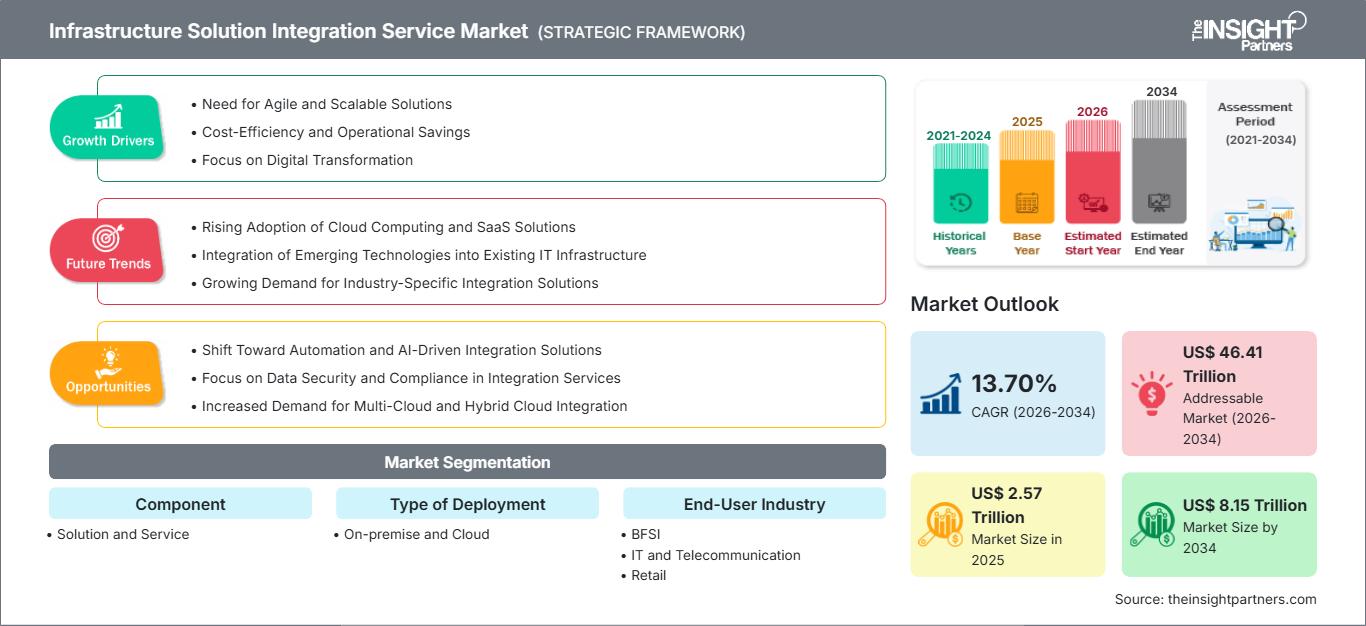
The Infrastructure Solution Integration Service Market was valued at US$ 29.5 Billion in 2025 and is projected to reach US$ 82.6 Billion by 2034, registering a CAGR of 13.70% during 2026–2034. The market is experiencing sustained expansion as enterprises modernize digital infrastructure, integrate hybrid cloud environments, and strengthen operational resilience through unified technology platforms. Growth is also supported by enterprise-wide digital transformation, increasing multi-cloud adoption, and the rising need for interoperable IT ecosystems across industries.
Across North America, enterprises continue to prioritize integrated infrastructure services that improve cybersecurity, application performance, and operational agility. The Infrastructure Solution Integration Service Market size is expanding steadily as organizations accelerate cloud migration, AI-enabled infrastructure management, and edge computing deployments. The region is projected to grow at an estimated CAGR of 12.8–13.5% through 2034, supported by strong enterprise IT spending, mature digital infrastructure, and favorable investments in intelligent network modernization.
Infrastructure Solution Integration Service Market Assessment and Insights
- North America: North America remained the leading regional market in 2025, accounting for 36–40% share in 2025, supported by extensive enterprise cloud adoption, hyperscale data center investments, and advanced digital transformation initiatives. The region is anticipated to expand at a CAGR between 12.8–13.5% during 2026–2034.
- US: The United States represented the largest national market with robust investments in hybrid infrastructure, cybersecurity integration, and AI-enabled IT operations. It accounted for 74–78% of North American revenue in 2025 and is expected to register a CAGR between 12.7–13.4% during 2026–2034.
- Europe: Europe captured 25–29% share in 2025, supported by enterprise digitalization, sovereign cloud initiatives, and industrial automation programs across Germany, the United Kingdom, and France. The regional market is projected to grow at a CAGR between 12.2–12.9% during 2026–2034.
- Asia Pacific: Asia Pacific accounted for 24–28% share in 2025, driven by rapid cloud infrastructure deployment, smart manufacturing investments, and expanding digital economies in China, Japan, India, and South Korea. The region is forecast to grow at a CAGR between 15.2–16.0% during 2026–2034.
- Largest Segment: Service represented the leading component, contributing 56–60% market share in 2025, reflecting increasing demand for consulting, deployment, migration, integration, and managed services. The segment is expected to grow at a CAGR between 13.6–14.1% during 2026–2034.
- High Growth Segment: Cloud deployment is projected to record the fastest expansion, accounting for 43–47% share in 2025 while advancing at a CAGR between 15.8–16.5% during 2026–2034, supported by hybrid cloud strategies and enterprise workload modernization.
- Key companies analyzed in detail: Oracle Corporation, Microsoft Corporation, International Business Machines Corporation (IBM), SAP SE, Amazon Web Services, Inc., Google LLC, VMware LLC, Adobe Inc., Dell Technologies Inc., Nutanix, Inc., HostedBizz Inc.
Source: The Insight Partners' analysis based on proprietary research, government publications, company annual reports, investor presentations, industry databases, and expert interviews.
Rapid advances in hybrid cloud architecture, software-defined infrastructure, artificial intelligence, and automation have fundamentally reshaped enterprise integration strategies during the past decade. Organizations increasingly require unified environments capable of connecting legacy systems with modern cloud-native applications while ensuring security, governance, and operational continuity. Service providers have consequently expanded consulting, implementation, orchestration, migration, and lifecycle management capabilities to address increasingly complex digital ecosystems. Growing investment in edge computing, data centers, intelligent networking, and API-driven platforms continues to strengthen enterprise demand for integrated infrastructure solutions across both developed and emerging economies, reinforcing long-term Infrastructure Solution Integration Service Market growth.
Looking ahead, sustained investments in digital public infrastructure, industrial modernization, and sovereign cloud initiatives are expected to diversify demand across Southeast Asia, the Middle East, and Latin America, supporting growth in the Infrastructure Solution Integration Service Market. Governments and enterprises continue introducing cybersecurity regulations, data localization requirements, and sustainability targets that encourage comprehensive infrastructure modernization. Vendors capable of combining cloud integration, automation, AI-enabled operations, and industry-specific implementation expertise are expected to strengthen competitive positioning while creating new revenue opportunities across highly regulated sectors and rapidly expanding digital economies.
Infrastructure Solution Integration Service Market Report Scope
| Report Attribute | Details |
|---|---|
| Market size in 2025 | US$ 29.5 Billion |
| Market Size by 2034 | US$ 82.6 Billion |
| Global CAGR (2026 - 2034) | 13.70% |
| Historical Data | 2021-2024 |
| Forecast period | 2026-2034 |
Infrastructure Solution Integration Service Market Analysis
Digital transformation remains the primary catalyst influencing enterprise investment decisions across the technology value chain. Organizations increasingly seek integrated platforms capable of connecting cloud services, enterprise applications, network infrastructure, cybersecurity solutions, and data management systems into a unified operating environment. This Infrastructure Solution Integration Service Market analysis reflects rising enterprise preference for scalable, vendor-neutral integration frameworks that reduce operational complexity while improving performance, compliance, and business continuity. The increasing adoption of multi-cloud strategy, automation, and software-defined infrastructure drives additional demand for specialized services in consulting, implementation, and integration.
As far as the overall industry ecosystem is concerned, there is a synergy of forces that work together to make the cloud technology ecosystem highly collaborative. Modernization initiatives have moved from hardware deployment into orchestration, workload management, applications modernization, and AI-based monitoring. With an emphasis on creating resilient digital ecosystems, integration partners capable of providing complete lifecycle support services become strategically important in BFSI, manufacturing, retail, telecommunications, transportation, and aerospace industries.
Competition continues to intensify in the Infrastructure Solution Integration Service Market as leading technology companies broaden integrated infrastructure portfolios through cloud-native services, acquisitions, strategic alliances, and industry-focused solution development. Oracle Corporation, Microsoft Corporation, International Business Machines Corporation (IBM), SAP SE, Amazon Web Services, Inc., and Google LLC are continuously investing in the development of artificial intelligence-powered infrastructure management, hybrid cloud integration, and enterprise automation solutions aimed at developing long-term relations with customers. Companies' efforts concentrate on developing unified platforms that make deployment simpler and increase interoperability of solutions within enterprises.
Simultaneously, VMware LLC, Adobe Inc., Dell Technologies Inc., Nutanix, Inc., and HostedBizz Inc. are continuously establishing their position in the market by using virtualization technologies, cloud infrastructure management, managed services, and flexible deployment models in accordance with the modernization needs of enterprises. The establishment of strategic partnerships with telecom companies, cybersecurity vendors, software providers, and regional systems integrators gains increasing importance as the need for comprehensive digital transformation solutions grows. Further investments in automation, artificial intelligence-powered operations, edge computing, and integration services will enhance companies' competitiveness on the global market.
● REPORT CUSTOMIZATION
Tailor This Report To Align With Your Specific Business Requirements
This report can be customized to align precisely with your business objectives, scope, and target markets. Customization options include tailored segmentation, geography, competitive analysis, and strategic insights to support informed decision-making.
Customize This Report →WHAT YOU CAN ADJUST
- ● Segmentations
- ● Geography
- ● Competitive Analysis
- ● Language Preferences
Infrastructure Solution Integration Service Market: Strategic Insights
Regional Insights
North America Infrastructure Solution Integration Service Market
North America accounted for 36–40% of the global market share in 2025, maintaining its leadership through widespread enterprise digital transformation, strong cloud adoption, and continued investments in intelligent IT infrastructure. Large organizations are increasingly integrating artificial intelligence, cybersecurity, and hybrid cloud platforms into unified operational environments. The Infrastructure Solution Integration Service Market share in the region continues to benefit from mature technology ecosystems, advanced hyperscale data centers, and favorable enterprise spending. The regional market is projected to expand at a CAGR of 12.8–13.5% during 2026–2034, supported by continuous modernization initiatives.
Technology providers and system integrators are improving their regional presence through strategic alliances, AI-driven automation solutions, and infrastructure management services. Sectors such as BFSI, healthcare, manufacturing, telecoms, and retail continue their investments in robust digital infrastructures in order to increase efficiency and compliance. Increasing requirements for edge computing, software-defined networking, and multi-cloud orchestration are expected to support growth in the long run and motivate businesses to implement a holistic approach to integration.
U.S. Infrastructure Solution Integration Service Market
The United States represented 74–78% of North American revenue in the Infrastructure Solution Integration Service Market in 2025, supported by a mature enterprise technology landscape, rapid cloud migration, and extensive adoption of AI-powered infrastructure management platforms. Technology companies such as Microsoft Corporation, Amazon Web Services Inc., Oracle Corporation, Google LLC, Dell Technologies Inc., and International Business Machines Corporation (IBM) are consistently increasing their cloud infrastructure and enterprise integration offerings. The U.S. market is estimated to witness a CAGR of 12.7-13.4% in the period 2026-2034.
The demand is especially high among financial institutions, telecommunications companies, healthcare organizations, manufacturers, and governments looking for digital ecosystems that will increase scalability, security, and resiliency. Companies are becoming more interested in integrated infrastructure that will support hybrid workforces, AI-based processes, and real-time analytics in line with cybersecurity requirements. Innovation in cloud-native technologies, intelligent automation, and edge infrastructure is expected to strengthen the country’s position during the forecast period.
Europe Infrastructure Solution Integration Service Market
Europe accounted for 25–29% of the global Infrastructure Solution Integration Service Market in 2025 and is projected to expand at a CAGR of 12.2–12.9% during 2026–2034. Germany is still the dominant player in this respect, owing to initiatives such as Industry 4.0, advanced manufacturing capabilities, and enterprise investments in cloud modernization. Meanwhile, the UK further develops its digital transformation with financial services modernization, government clouds, and enhanced cybersecurity investments.
France, Italy, and Spain constitute an important growth cluster powered by industrial automation, digitization of the public sector, and increased use of integrated enterprise systems. Enterprises in these countries modernize their legacy infrastructure and utilize AI-driven operations, secure hybrid clouds, and software-defined networking. In addition, Europe's digital market profits from the regulation favoring data protection, digital sovereignty, and sustainable IT infrastructure, which spurs enterprises to invest in integration services.
APAC Infrastructure Solution Integration Service Market
Asia Pacific captured 24–28% of the global Infrastructure Solution Integration Service Market in 2025 and is expected to register the fastest regional expansion with a CAGR of 15.2–16.0% during 2026–2034. China leads regional demand through extensive investments in cloud infrastructure, digital manufacturing, and smart city initiatives, while Japan and South Korea continue accelerating enterprise automation and intelligent infrastructure deployment.
India and Australia are emerging as strategic growth markets due to expanding digital economies, government-led digital infrastructure programs, and rising enterprise cloud adoption. Increasing investments in hyperscale data centers, AI applications, and industrial digitalization are expected to strengthen regional demand for integrated infrastructure solutions throughout the forecast period.
Middle East & Africa Infrastructure Solution Integration Service Market
The Middle East & Africa Infrastructure Solution Integration Service Market is projected to record a CAGR of 13.8–14.6% during 2026–2034, supported by accelerating investments in digital government initiatives, cloud computing, and smart infrastructure. Saudi Arabia and the United Arab Emirates continue leading regional adoption through ambitious economic diversification strategies, while South Africa remains an important technology hub for enterprise modernization.
Energy sector digitalization, smart city projects, and expanding telecommunications infrastructure are creating favorable opportunities for infrastructure integration providers across the region. Growing enterprise demand for secure cloud environments, resilient network architectures, and AI-enabled operations is expected to support sustained market expansion as organizations modernize legacy systems and improve digital service delivery.
Segmentation Analysis
Component
The Component segment plays a fundamental role in enterprise digital transformation by enabling organizations to combine technology platforms with specialized implementation expertise. The Infrastructure Solution Integration Service Market scope continues to expand as enterprises prioritize seamless interoperability between legacy systems, cloud infrastructure, cybersecurity platforms, and enterprise applications. Growing adoption of hybrid IT environments and AI-enabled infrastructure management is strengthening demand across both offerings. The overall Component segment is projected to register a CAGR of 13.7–14.3% during 2026–2034.
- Solution: Solution offerings enable organizations to integrate networking, computing, storage, cybersecurity, automation, and cloud environments into unified platforms. Demand is supported by enterprise modernization initiatives, operational efficiency objectives, and increasing adoption of software-defined infrastructure across multiple industries.
- Service: Services include consulting, implementation, migration, deployment, integration, optimization, training, and managed support. Enterprises increasingly rely on specialized service providers to accelerate digital transformation while reducing implementation risks, operational disruptions, and infrastructure complexity.
Type of Deployment
Deployment strategies continue evolving as organizations balance security, compliance, scalability, and operational flexibility within the Infrastructure Solution Integration Service Market. Hybrid architectures combining on-premise infrastructure with public and private cloud environments are becoming increasingly common across regulated industries. Continuous investment in automation, workload optimization, and cloud-native applications supports sustained adoption. The overall Type of Deployment segment is anticipated to grow at a CAGR of 14.0–14.7% during 2026–2034.
- On-premise: On-premise deployments remain strategically important for organizations requiring greater control over mission-critical applications, sensitive data, and regulatory compliance. Large enterprises in financial services, government, and manufacturing continue investing in integrated on-site infrastructure.
- Cloud: Cloud deployment supports scalable infrastructure modernization through flexible computing resources, automated management, rapid application deployment, and seamless multi-cloud integration. Organizations increasingly adopt cloud-based integration services to improve agility, optimize operating costs, and accelerate enterprise innovation.
End-User Industry
Enterprise demand continues to expand across industries seeking resilient digital ecosystems capable of supporting automation, cybersecurity, cloud-native operations, and intelligent data management. Integration service providers increasingly deliver industry-specific solutions that address operational requirements, regulatory obligations, and business continuity objectives. The End-User Industry segment is forecast to record a CAGR of 14.5–15.2% during 2026–2034, making it one of the most strategically significant segments throughout the forecast period.
- BFSI: Financial institutions prioritize integrated digital infrastructure to strengthen cybersecurity, support digital banking, enhance regulatory compliance, and improve customer experience through secure, scalable enterprise platforms.
- IT and Telecommunication: Technology companies and telecom operators invest extensively in cloud-native infrastructure, software-defined networking, AI-enabled operations, and edge computing to improve service delivery, network performance, and operational efficiency.
- Retail: Retail organizations integrate omnichannel commerce platforms, inventory management, customer analytics, payment infrastructure, and cloud-based applications to deliver seamless shopping experiences while improving operational visibility.
- Manufacturing: Manufacturers increasingly deploy integrated industrial infrastructure supporting smart factories, predictive maintenance, Industrial Internet of Things deployments, digital twins, and real-time production monitoring across global facilities.
- Aerospace: Aerospace organizations require highly secure, compliant, and resilient infrastructure integration for engineering applications, mission-critical communications, predictive maintenance systems, and digital manufacturing initiatives.
- Transportation and Logistics: Logistics providers implement integrated infrastructure supporting fleet management, warehouse automation, intelligent routing, supply chain visibility, and real-time analytics to improve operational efficiency and customer responsiveness.
Opportunity Snapshot
| End-User Industry | Revenue Contribution | Trend Tag | Adoption Stage |
| BFSI | High | Zero Trust | Mature |
| IT and Telecommunication | High | Edge Cloud | Mature |
| Retail | Medium | Omnichannel | Scaling |
| Manufacturing | High | Smart Factory | Scaling |
| Aerospace | Medium | Digital Twin | Scaling |
| Transportation and Logistics | Medium | Intelligent Logistics | Emerging |
Infrastructure Solution Integration Service Market Growth Drivers and Impact Analysis
Accelerating Enterprise Adoption of Hybrid and Multi-Cloud Infrastructure
Multi-cloud and hybrid cloud approaches are being adopted by companies in many sectors due to greater flexibility in operations, cost optimization, and business continuity. As companies migrate workloads from public clouds, private clouds, and on-premise infrastructures, the demand for complex integration solutions keeps on growing. IT service providers are assisting firms to create an integrated management platform, enable automation in workload orchestration, and increase interoperability of legacy and cloud-based applications. The trend becomes especially relevant for BFSI, manufacturing, telecommunications, and healthcare industries, where the smooth operation of processes is necessary. Investments into cloud migration, containerization, software-defined infrastructure, and intelligent workload management make enterprises more inclined to utilize integration solutions. Such changes in the industry structure become the key growth drivers.
Increasing Investments in Artificial Intelligence and Infrastructure Automation
AI is revolutionizing enterprise infrastructure management through the provision of predictive monitoring, automatic resource allocation, intelligent security management, and performance optimization in real time. Enterprise organizations are implementing AI-based operations management tools in order to minimize downtime, increase incident response speeds, and maximize infrastructure utilization within distributed computing architectures. Service providers of integration are integrating automation features into their services for deployment, migration, monitoring, and management of the lifecycle to ensure operational gains. With the increase in complexity of enterprise IT environments, AI-based orchestration helps in coordinating cloud services, network infrastructure, cybersecurity, and enterprise applications. The use of intelligent automation helps to reduce operational costs and increase reliability.
Growing Cybersecurity and Regulatory Compliance Requirements
The growing cyberthreats, changing privacy policies, and increasing reliance on digital systems are driving companies to upgrade their infrastructures by using integrated security-focused architectures. Organizations need integration platforms that will help them manage identities, adopt zero-trust models, perform continuous monitoring, encrypt information, implement disaster recovery measures, and ensure safe cloud connections in one integrated environment. The financial sector, government bodies, healthcare organizations, and critical infrastructure owners keep enhancing their digital resilience using integrated projects aimed at improving governance and compliance. Meanwhile, data sovereignty regulations, cloud security laws, and operational resilience policies push firms to integrate and centrally manage their infrastructure instead of having a number of scattered elements.
Infrastructure Solution Integration Service Market Future Trends
Expansion of AI-Native Infrastructure Management Platforms
Artificial intelligence is expected to become a foundational capability across enterprise infrastructure management during the coming decade. The Infrastructure Solution Integration Service Market trends indicate increasing adoption of AI-native platforms capable of automating provisioning, workload optimization, predictive maintenance, cybersecurity monitoring, and resource allocation through advanced analytics. Organizations are expected to integrate generative AI with infrastructure operations to improve decision-making while reducing manual intervention. Vendors are investing in intelligent orchestration technologies that connect networking, storage, cloud environments, enterprise applications, and cybersecurity systems into unified operational platforms. These innovations are expected to enhance operational resilience, accelerate deployment timelines, and improve enterprise productivity while supporting increasingly distributed digital ecosystems.
Rise of Industry-Specific Integration Ecosystems
In the future, market growth will be accompanied by an increasing focus on industry-specific integration solutions aimed at meeting particular needs for operation within a certain sector. Companies will be seeking integrated architectures of IT infrastructure that will enable automation of manufacturing, digital banking, smart logistics, healthcare, and retail processes. Technology vendors have started to offer cloud platforms, cybersecurity solutions, analysis tools, and managed services that correspond to vertical business processes. Increasing use of edge computing, Industrial Internet of Things solutions, digital twins, and real-time analysis will lead to further demand for customized integration solutions. This kind of industry ecosystem is expected to reduce time to delivery and bring more business value.
Infrastructure Solution Integration Service Market Opportunities
Expanding Enterprise Modernization Across Emerging Digital Economies
Rapid digital transformation across emerging economies presents substantial investment opportunities for infrastructure integration providers. The Infrastructure Solution Integration Service Market Forecasts indicate increasing enterprise expenditure on cloud computing, intelligent networking, cybersecurity, and data center modernization throughout Asia Pacific, the Middle East, Africa, and Latin America. Economic policies for the digital economy, smart city projects, and industrial automation launched by the government are driving enterprises to adopt scalable and integrated platforms as a replacement for legacy environments. Vendors that can offer localized expertise, managed services, hybrid cloud capabilities, and compliance solutions will have a good chance of developing a long-term relationship with customers. Investments in regional delivery facilities, partner ecosystems, AI-driven automation, and service offerings based on industries are believed to drive market penetration and revenue growth.
Growth Potential in Industry-Specific Managed Integration Services
The need for specific managed integration services will remain high, as more enterprises will be interested in getting operational support after the initial deployment of the infrastructure. In particular, financial firms, manufacturers, telecommunications operators, retailers, transportation companies, and aerospace firms will become increasingly interested in continuous monitoring, life cycle optimization, cybersecurity management, and governance of cloud infrastructures. Subscription-oriented managed integration services, artificial intelligence solutions for optimizing the infrastructure, predictive maintenance, and compliance management will generate recurring revenues and help service providers retain their customers. The establishment of strategic partnerships with hyperscale cloud firms, enterprise software companies, cybersecurity specialists, and technology partners in specific regions will help service providers meet changing customer needs.
Frequently Asked Questions

- Comprehensive Market Sizing and Forecast Analysis
- Detailed Segmentation Analysis
- In-Depth Market Dynamics Assessment
- Regional and Country-Level Insights
- Competitive Landscape and Company Benchmarking
- Strategic Business Intelligence
Recent Reports
Testimonials

The Insight Partners' SCADA System Market report is comprehensive, with valuable insights on current trends and future forecasts. The team was highly professional, responsive, and supportive throughout. We are very satisfied and highly recommend their services.
RAN KEDEM Partner, Reali Technologies LTDs
I requested a report on a very specific software market and the team produced the report in a few days. The information was very relevant and well presented. I then requested some changes and additions to the report. The team was again very responsive and I got the final report in less than a week.
JEAN-HERVE JENN Chairman, Future Analytica
We worked with The Insight Partners for an important market study and forecast. They gave us clear insights into opportunities and risks, which helped shape our plans. Their research was easy to use and based on solid data. It helped us make smart, confident decisions. We highly recommend them.
PIYUSH NAGPAL Sr. Vice President, High Beam Global
The Insight Partners delivered insightful, well-structured market research with strong domain expertise. Their team was professional and responsive throughout. The user-friendly website made accessing industry reports seamless. We highly recommend them for reliable, high-quality research services
YUKIHIKO ADACHI CEO, Deep Blue, LLC.
This is the first time I have purchased a market report from The Insight Partners.While I was unsure at first, I visited their web site and felt more comfortable to take the risk and purchase a market report.I am completely satisfied with the quality of the report and customer service. I had several questions and comments with the initial report, but after a couple of dialogs over email with their analyst I believe I have a report that I can use as input to our strategic planning process.Thank you so much for taking the extra time and making this a positive experience.I will definitely recommend your service to others and you will be my first call when we need further market data.
JOHN SUZUKI President and Chief Executive Officer, Board Director, BK Technologies
I wish to appreciate your support and the professionalism you displayed in the course of attending to my request for information regarding to infectious disease IVD market in Nigeria. I appreciate your patience, your guidance, and the fact that you were willing to offer a discount, which eventually made it possible for us to close a deal. I look forward to engaging The Insight Partners in the future, all thanks to the impression you have created in me as a result of this first encounter.
DR CHIJIOKE ONYIA MANAGING DIRECTOR, PineCrest Healthcare Ltd.Reason to Buy
- Informed Decision-Making
- Understanding Market Dynamics
- Competitive Analysis
- Identifying Emerging Markets
- Customer Insights
- Market Forecasts
- Risk Mitigation
- Boosting Operational Efficiency
- Strategic Planning
- Investment Justification
- Tracking Industry Innovations
- Aligning with Regulatory Trends





 Get Free Sample for