
Insoluble Sulfur Market Growth, Demand & Size by 2034
Coverage: By Grade (High dispersion, High stability, Regular grade); Application (Tire manufacturing, Industrial application, Footwear, Others), and Geography (North America, Europe, Asia Pacific, and South and Central America)
- Status : Data Released
- Report Code : TIPRE00016536
- Category : Chemicals and Materials
- No. of Pages : 150
- Available Report Formats :


- Last update date : August 19, 2026


2025 Market Size
US$ 1.13 Bn
Base year value
2034 Forecast
US$ 2.05 Bn
Projected by 2034
CAGR 2026-2034
6.84 %
Growth rate
Addressable Market
US$ 14.37 Bn
(2026-2034)
The insoluble sulfur market is valued at US$ 1.13 Billion in 2025 and is projected to reach US$ 2.05 Billion by 2034, expanding at a CAGR of 6.84% during 2026–2034. Demand is anchored by tire manufacturing, where insoluble sulfur supports uniform vulcanization, limits sulfur migration, and improves compound stability. Increasing radial tire production, technical rubber requirements, and wider adoption of performance-oriented grades are expected to sustain market expansion across major manufacturing economies.
North America is expected to maintain a steady growth trajectory, supported by replacement tire demand, domestic rubber-product manufacturing, and investments in specialty chemical supply chains. The region also benefits from stringent performance expectations for tire compounds, encouraging manufacturers to use higher-stability vulcanizing agents. The growth of the insoluble sulfur market size is additionally supported by reshoring initiatives, supplier diversification, and continued demand from automotive, industrial rubber, conveyor, hose, and engineered rubber applications.
Insoluble Sulfur Market Assessment and Insights
- North America: North America is estimated to account for 18–22% share in 2025 and grow at a 5.8–6.5% CAGR between 2026–2034, supported by replacement tires, technical rubber products, and specialty chemical demand.
- US: The US represents approximately 82–86% of North America's 2025 market, with a 5.7–6.4% CAGR between 2026–2034, driven by tire replacement and industrial rubber applications.
- Europe: Europe is estimated at 20–24% share in 2025 and is projected to grow at 5.2–6.0% CAGR between 2026–2034, led by Germany, France, Italy, and Poland.
- Asia Pacific: Asia Pacific represents approximately 47–51% share in 2025 and is expected to expand at 7.4–8.2% CAGR between 2026–2034, led by China, Japan, India, and South Korea.
- Largest Segment: Tire manufacturing holds a 68–72% market share in 2025 and is expected to grow at 6.8–7.5% CAGR during 2026–2034, reflecting its dominant consumption base.
- High Growth Segment: High stability is estimated at 20–24% share in 2025 and is projected to grow at 7.4–8.2% CAGR during 2026–2034, supported by performance-focused tire compounds.
- Key companies analyzed in detail: Shandong Sunsine Chemical Co., Ltd.; Grupa Azoty Kopalnie i Zakłady Chemiczne Siarki Siarkopol S.A.; Henan Kailun Chemical Co., Ltd.; Lions Industries s.r.o.; Oriental Carbon & Chemicals Limited; Shikoku Chemicals Corporation; Schill + Seilacher “Struktol” GmbH; Shandong Yanggu Huatai Chemical Co., Ltd.; Dongying Xinglong New Material Technology Co., Ltd.; Global Rubber Industries (Pvt.) Ltd.
Source: The Insight Partners' analysis based on proprietary research, government publications, company annual reports, investor presentations, industry databases, and expert interviews.
Markets have shifted from commodities-based uses of sulfur in rubber formulations to more controlled use of polymers of sulfur specifically developed for challenging rubbers. Process control, better dispersibility, oil-treated grades, and increased thermal stability have helped improve consistency in processing. In addition, manufacturers will increase automation of processes to minimize variability. The new capacities reflect the above trend, with China Sunsine continuing to hold 60,000 tonnes of annual capacity for insoluble sulfur and Shikoku setting up new manufacturing capacities.
In future, the key considerations for the manufacturers will be to develop grades of high stability, build regional supply chain resilience, and lower energy consumption during manufacturing. The region most crucial for investments in capacities will be the Asia-Pacific region. North America and Europe will need to focus on supply chain security and technological differentiation. Environmental considerations will play a significant role in upgrading facilities through energy efficiency, waste minimization, and clean process technology.
Insoluble Sulfur Market Report Scope
| Report Attribute | Details |
|---|---|
| Market size in 2025 | US$ 1.13 Billion |
| Market Size by 2034 | US$ 2.05 Billion |
| Global CAGR (2026 - 2034) | 6.84% |
| Historical Data | 2021-2024 |
| Forecast period | 2026-2034 |
Insoluble Sulfur Market Analysis
The demand for the product is mainly driven by the tire industry due to its role in avoiding blooming, preventing migration of rubber, and controlled vulcanization in the insoluble sulfur market. Radial tires continue to be an essential application as the quality of the compound and the adhesion of various components affect the tires' life and effectiveness. The industrial rubber items include conveyor belts, hoses, seals, and molds. This is a secondary source of demand.
The supply of this product depends on manufacturing expertise, feedstock availability, heat processes, and the ability to qualify the customers. The process of producing insoluble sulfur includes controlled polymerization and stabilization, which makes it harder than manufacturing other sulfur products. The competition is driven by the following elements such as consistency, dispersion features, stability, customization, and delivery reliability. The regional stocking is becoming a key factor as tire manufacturing requires stable and reliable chemical delivery.
Competition in the insoluble sulfur market report includes large scale Asian manufacturers and specialized European and Japanese suppliers. The Shandong Sunsine Chemical Co., Ltd. enjoys advantages of having an integration of rubber chemicals manufacturing and large scale manufacturing while the Shandong Yanggu Huatai Chemical Co., Ltd. combines insoluble sulfur with other rubber additives technologies. The Shikoku Chemicals Corporation focuses on radial tires and specialized grades while Oriental Carbon & Chemicals Limited has focused on customized insoluble sulfur products.
In terms of investment, the focus of the industry is on efficiency of capacity, product quality, and environment performance and not just capacity. The Shikoku Chemicals Corporation has increased capacity for manufacturing insoluble sulfur while China Sunsine has automated production and increased continuous production process. The geographical advantage, specialized products, and customer relationship is the strength of the European suppliers Grupa Azoty Kopalnie i Zakłady Chemiczne Siarki Siarkopol S.A., Lions Industries s.r.o., and Schill + Seilacher “Struktol” GmbH.
● REPORT CUSTOMIZATION
Tailor This Report To Align With Your Specific Business Requirements
This report can be customized to align precisely with your business objectives, scope, and target markets. Customization options include tailored segmentation, geography, competitive analysis, and strategic insights to support informed decision-making.
Customize This Report →WHAT YOU CAN ADJUST
- ● Segmentations
- ● Geography
- ● Competitive Analysis
- ● Language Preferences
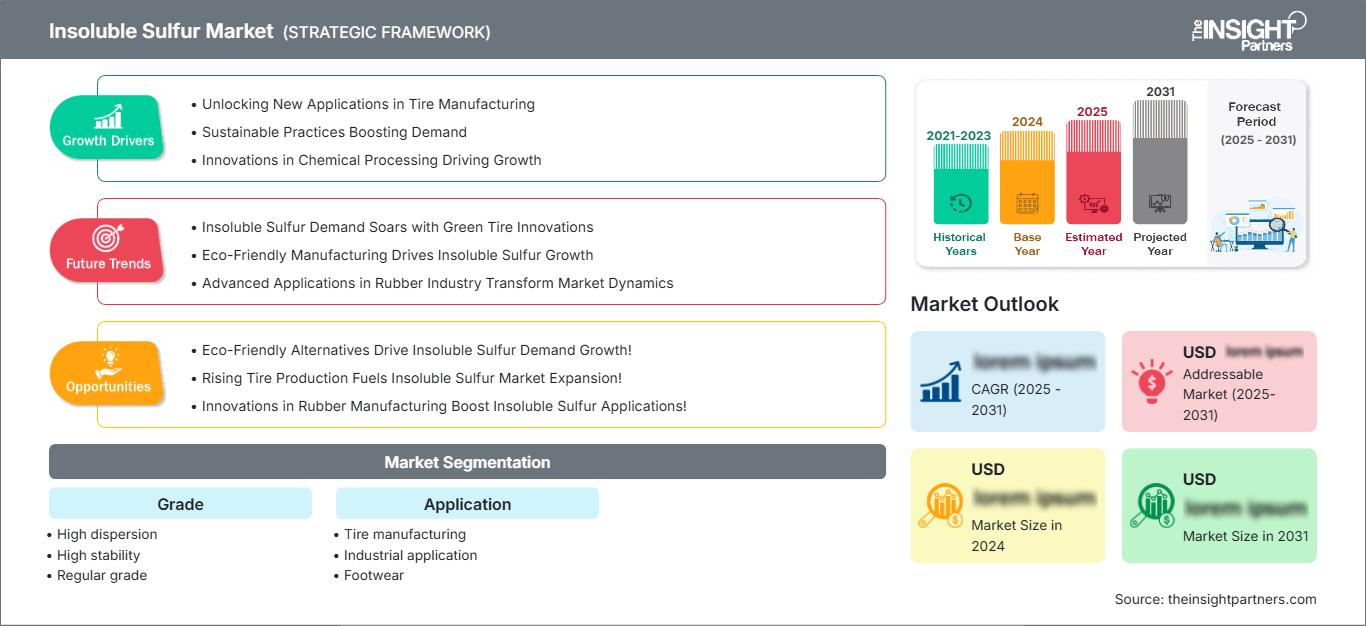
Insoluble Sulfur Market: Strategic Insights
Regional Insights
North America Insoluble Sulfur Market
The North American insoluble sulfur market share is estimated to account for 18%–22% of worldwide demand in 2025 and is expected to grow at a 5.8%–6.5% CAGR till 2034. The US accounts for the major share of regional consumption owing to its large inventory of replacement tires, automotive industry, conveyor belts, hoses, seals, and other technical applications of rubber. Canada benefits from its automobile and industrial manufacturing sectors, whereas Mexico helps bolster the regional demand for rubber chemicals owing to its growing production of tires and rubber. The regional consumers have a preference for reliability of grade performance, supply, and adherence to specific formulation needs.
Supply chain diversification and more emphasis on the use of local or nearer sources is also one of the factors for regional growth. Today, tire makers consider suppliers who can offer consistency of specifications, problem-solving, and good logistics services. Growth will be moderate and not volume-driven, while the premium and high stability grades will gain in importance. Specialty rubber uses will create an additional demand due to the need for better process control and blooming reduction. Competition in the region will probably be based on the suppliers, including Asian makers, distributors, and North American specialty chemical players.
U.S. Insoluble Sulfur Market
The US represents 82-86% of North American 2025 consumption and is anticipated to grow at a 5.7-6.4% CAGR until 2034. Tire manufacturing is the leading application area, driven by demand for replacements and well-developed automotive aftermarket in the region. Industrial applications related to conveyor belts, hoses, seals, and molded rubber parts add to consumption. Customers tend to consider stability, dispersion, packaging, technical information, and shipping reliability rather than rely on price only. Hence, qualified suppliers and those having application experience are in advantageous positions.
Moreover, the US is the region where producers have invested into robust chemicals logistics and manufacturing infrastructure. Manufacturers and distributors are going to keep inventories near to centers of tire and rubber manufacturing to minimize risks related to international transport delays. High stability and high dispersion compounds will get larger shares as compounders try to get more process stability. Application development cooperation with tire manufacturers will help in establishing closer supplier relations as formulations changes usually imply testing and production qualifications.
Europe Insoluble Sulfur Market
Europe is expected to have a share of 20-24% of the world's total consumption in 2025 and will continue growing at a CAGR of 5.2-6.0% till 2034. Germany leads in this region with France, Italy, UK, Spain and other manufacturing economies in Central Europe being the others. An existing base of tires and technical rubber along with the environmental standards and requirements for energy efficiency will help drive growth while increasing pressure on manufacturers to enhance their processes. European customers are more concerned about documentation, traceability and regulatory compliance.
The contribution from the UK is in the form of rubber manufacturing for automotive and industrial purposes whereas the contributions from Germany are because of the presence of automobile, tire and engineering industry there. Contributions from France and Italy come from the manufacture of tires, automotive components and industrial rubber. The established tire manufacturing base along with the automotive ecosystem in Spain will drive demand. Europe is expected to continue preferring high performance and stability grades as companies become more efficient in the use of compounds.
APAC Insoluble Sulfur Market
APAC accounts for approximately 47-51% of the world’s demand in 2025 and has a forecasted growth rate of 7.4-8.2% CAGR until 2034. China is the leading country due to a developed production of tires and specialty rubber chemicals. Japan, South Korea, India, and Australia are contributors via automotive and industrial rubber as well as specialty chemical use.
China’s fully developed production base allows enjoying some cost and scale benefits, while Japan focuses on premium grades and performance. India can offer strong growth prospects due to developing production of tires and automobiles. South Korea relies on developed tire manufacturers, while Australia makes its contribution via industrial rubber.
Middle East & Africa Insoluble Sulfur Market
MEA is forecasted to have CAGR growth of around 5.0-5.8% up to 2034. Saudi Arabia and the UAE have benefited from industrial diversification, integration of the petrochemical industry, and infrastructure investments, whereas South Africa is noted for having the strongest industrial and automotive rubber presence in the region. The RoMEA market is less significant, but it is bolstered by construction, mining, transport, and maintenance rubber goods.
Saudi Arabia will be the biggest contributor to the region’s growth due to downstream manufacturing, while the UAE will gain from logistics and distribution infrastructure. South Africa continues to play an important role in tire production, mining belts, hoses, and industrial rubber products. The regional market will continue to be dependent on infrastructure investments, vehicles, industry, and availability of imported specialty chemicals.
Segmentation Analysis
Grade
Grade selection in the insoluble sulfur market is determined by rubber formulation requirements, processing conditions, storage stability, dispersion behavior, and finished-product performance. Regular grades remain essential for cost-sensitive applications, while high-dispersion products support uniform incorporation into complex compounds. High-stability grades are gaining strategic importance because tire and technical rubber manufacturers increasingly seek consistent processing behavior, reduced blooming, and dependable vulcanization. The grade segment is expected to expand at a 6.4–7.1% CAGR during 2026–2034, with premium grades supporting value growth.
- High dispersion: High-dispersion grades are positioned for formulations requiring uniform sulfur distribution and controlled compound processing. Their importance increases where compound complexity, productivity, and finished-product consistency justify greater emphasis on dispersion performance.
- High stability: High-stability grades address demanding storage and processing conditions, particularly in tire compounds. Their strategic role is strengthening as manufacturers seek predictable vulcanization behavior, reduced sulfur migration, and stable product characteristics.
- Regular grade: Regular grades remain widely used where established formulations and cost efficiency are priorities. Their broad compatibility with conventional rubber compounds supports dependable baseline demand across tire and industrial applications.
Application
Application demand is dominated by tire manufacturing because radial tire compounds require controlled sulfur behavior and resistance to blooming. Industrial applications create a diversified secondary base across conveyor belts, hoses, seals, cables, and molded products. Footwear remains a smaller but established outlet where rubber compounds require controlled vulcanization. The application segment in the insoluble sulfur market is projected to grow at a 6.7–7.4% CAGR during 2026–2034, supported by replacement tires and technical rubber demand.
- Tire manufacturing: Tire manufacturing is the core consumption base, with insoluble sulfur supporting compound stability, adhesion, and controlled vulcanization. Radial tire production particularly benefits from reduced sulfur migration between adjacent rubber layers.
- Industrial application: Industrial rubber applications include belts, hoses, seals, wires, cables, and molded components. Demand is diversified across manufacturing sectors and benefits from requirements for durability, consistent processing, and resistance to aging.
- Footwear: Footwear applications use insoluble sulfur where controlled vulcanization and compound consistency are required. Demand is concentrated in rubber footwear and specialized products, making the segment smaller but technically relevant.
Opportunity Snapshot
| Application | Revenue Contribution | Trend Tag | Adoption Stage |
|---|---|---|---|
| Tire manufacturing | High | Radial Tires | Mature |
| Industrial application | Medium | Technical Rubber | Scaling |
| Footwear | Low | Rubber Soles | Mature |
Insoluble Sulfur Market Growth Drivers and Impact Analysis
Expansion of Radial and Performance Tire Production
The strongest structural driver is the continuing requirement for controlled sulfur behavior in radial and performance-oriented tires. Insoluble sulfur reduces blooming and migration, allowing compounders to maintain more consistent sulfur distribution across adjacent rubber layers. This becomes increasingly relevant as tire designs incorporate multiple specialized compounds for tread, sidewall, belt, and inner components. Higher performance expectations also encourage manufacturers to use grades with tighter specifications and better stability. The market impact extends beyond tire volumes because premium formulations can increase the technical value of each kilogram consumed. Producers capable of supplying consistent grades across international tire plants can therefore strengthen customer retention. The effect is particularly significant in Asia Pacific, where large tire manufacturing clusters provide scale, while mature markets increasingly support replacement and premium tire demand.
Rising Demand for Consistent Rubber Compound Processing
Manufacturers of technical rubber products increasingly prioritize repeatable processing, predictable vulcanization, and reduced formulation variability. Insoluble sulfur supports these objectives by remaining dispersed within compounds and reducing the migration associated with conventional sulfur. The impact is visible across conveyor belts, hoses, seals, molded components, and other products where dimensional stability and durability are important. As industrial customers adopt more automated mixing and production systems, raw-material consistency becomes increasingly important because variation can create quality losses or production interruptions. This trend creates opportunities for suppliers offering controlled particle characteristics, oil-treated products, high-dispersion grades, and technical assistance. The resulting demand is less dependent on passenger vehicle production alone, providing a diversified growth base. Suppliers with application laboratories and customer-specific formulation support are positioned to capture higher-value industrial business.
Investment in Continuous and Cleaner Production Technologies
Investment in continuous manufacturing, process automation, energy efficiency, and environmental controls is becoming an important competitive factor. Insoluble sulfur production requires precise control of reaction, quenching, stabilization, and finishing stages, meaning process improvements can influence product consistency as well as operating economics. Producers are increasingly upgrading facilities to reduce energy consumption, waste, and variability while maintaining high output reliability. Such investment can lower unit costs over time and strengthen the ability to manufacture specialized grades. It can also support customer qualification because tire producers typically require stable specifications across repeated deliveries. The impact is therefore broader than production efficiency alone. Technology-focused suppliers can improve margins, expand premium-grade portfolios, and respond faster to changing compound requirements. Continuous-production capability should remain particularly important among large Asian manufacturers competing for global tire accounts.
Insoluble Sulfur Market Future Trends
Greater Penetration of High-Stability Formulations
High-stability formulations are likely to gain importance as tire and rubber manufacturers seek longer storage windows and more predictable compound behavior. Future product development should increasingly focus on controlling thermal stability, dispersion, particle characteristics, and oil treatment. These improvements can reduce processing losses and help compounders maintain consistent sulfur activity across different production environments. Suppliers are also likely to develop grades tailored to specific rubber systems rather than relying exclusively on broad product families. Technical collaboration with tire manufacturers may become more important because qualification requirements can differ by compound architecture and manufacturing process. Over time, premium grades should capture a larger portion of incremental value even where regular grades continue to represent substantial physical demand. The insoluble sulfur market trends could gradually move competitive positioning away from basic price competition toward documented technical performance, customized specifications, and application engineering.
Regionalization of Specialty Chemical Supply Chains
Supply-chain regionalization is expected to become more prominent as tire manufacturers seek to reduce exposure to freight disruptions, geopolitical uncertainty, and long international lead times. Regional warehouses, dual sourcing, and supplier qualification across multiple production locations can improve resilience without requiring complete relocation of chemical production. Asian manufacturers will remain important global suppliers because of their scale and integrated production capabilities, but European and North American customers are likely to place greater emphasis on dependable local distribution and technical support. This trend can encourage producers to establish regional inventory points, strengthen distributor networks, and maintain strategically positioned safety stocks. It may also create opportunities for suppliers that can qualify equivalent grades across different plants. In the insoluble sulfur market forecast, commercial competitiveness should increasingly combine product economics with delivery reliability, technical responsiveness, and supply continuity.
Insoluble Sulfur Market Opportunities
Premium Grade Development for Advanced Tire Compounds
An attractive opportunity exists in developing premium insoluble sulfur grades for advanced tire compounds that require tighter dispersion, higher thermal stability, and more predictable vulcanization. Tire architecture is becoming increasingly complex, with different compounds performing specialized functions within a single product. This creates demand for sulfur systems that can operate reliably under varied processing conditions. Producers can capture additional value by developing customized grades, supporting laboratory trials, and providing technical data that simplifies customer qualification. The opportunity is strongest among established suppliers with process expertise and customer access because new formulations typically require testing before commercial adoption. Partnerships with tire compounders, technical centers, and rubber additive distributors can accelerate qualification. Over time, premium-grade development can improve supplier differentiation and reduce exposure to purely price-driven competition in standard product categories.
Expansion of Localized Supply and Technical Service Networks
Localized supply networks offer another opportunity because customers increasingly value shorter lead times, stable inventory, and rapid technical support. Producers can establish regional distribution hubs near tire manufacturing clusters while maintaining centralized production economics. Inventory localization can reduce the operational impact of shipping delays and provide customers with greater flexibility during demand fluctuations. Technical service teams can complement these networks by assisting with grade selection, formulation optimization, storage practices, and troubleshooting. This model is particularly relevant in North America and Europe, where customers may prioritize supply security alongside product performance. In Asia Pacific, localized service can help suppliers penetrate emerging tire and industrial rubber manufacturing clusters. Companies that combine dependable logistics with technical application support can strengthen customer relationships and increase the likelihood of multi-site qualifications.
Recent Developments
- April 2026: Flexsys announced that it has received the Chemical and Compounding Innovation of the Year Award, as part of the Tire Technology International Awards for Innovation and Excellence, recognizing its work to develop a 6PPD alternative for use in tires.
Frequently Asked Questions

- Comprehensive Market Sizing and Forecast Analysis
- Detailed Segmentation Analysis
- In-Depth Market Dynamics Assessment
- Regional and Country-Level Insights
- Competitive Landscape and Company Benchmarking
- Strategic Business Intelligence
Recent Reports
Testimonials

The Insight Partners' SCADA System Market report is comprehensive, with valuable insights on current trends and future forecasts. The team was highly professional, responsive, and supportive throughout. We are very satisfied and highly recommend their services.
RAN KEDEM Partner, Reali Technologies LTDs
I requested a report on a very specific software market and the team produced the report in a few days. The information was very relevant and well presented. I then requested some changes and additions to the report. The team was again very responsive and I got the final report in less than a week.
JEAN-HERVE JENN Chairman, Future Analytica
We worked with The Insight Partners for an important market study and forecast. They gave us clear insights into opportunities and risks, which helped shape our plans. Their research was easy to use and based on solid data. It helped us make smart, confident decisions. We highly recommend them.
PIYUSH NAGPAL Sr. Vice President, High Beam Global
The Insight Partners delivered insightful, well-structured market research with strong domain expertise. Their team was professional and responsive throughout. The user-friendly website made accessing industry reports seamless. We highly recommend them for reliable, high-quality research services
YUKIHIKO ADACHI CEO, Deep Blue, LLC.
This is the first time I have purchased a market report from The Insight Partners.While I was unsure at first, I visited their web site and felt more comfortable to take the risk and purchase a market report.I am completely satisfied with the quality of the report and customer service. I had several questions and comments with the initial report, but after a couple of dialogs over email with their analyst I believe I have a report that I can use as input to our strategic planning process.Thank you so much for taking the extra time and making this a positive experience.I will definitely recommend your service to others and you will be my first call when we need further market data.
JOHN SUZUKI President and Chief Executive Officer, Board Director, BK Technologies
I wish to appreciate your support and the professionalism you displayed in the course of attending to my request for information regarding to infectious disease IVD market in Nigeria. I appreciate your patience, your guidance, and the fact that you were willing to offer a discount, which eventually made it possible for us to close a deal. I look forward to engaging The Insight Partners in the future, all thanks to the impression you have created in me as a result of this first encounter.
DR CHIJIOKE ONYIA MANAGING DIRECTOR, PineCrest Healthcare Ltd.Reason to Buy
- Informed Decision-Making
- Understanding Market Dynamics
- Competitive Analysis
- Identifying Emerging Markets
- Customer Insights
- Market Forecasts
- Risk Mitigation
- Boosting Operational Efficiency
- Strategic Planning
- Investment Justification
- Tracking Industry Innovations
- Aligning with Regulatory Trends





 Get Free Sample for