
Insulation Monitoring Devices Market Share, Size & Demand by 2034
Coverage: by Response Time (Up to 5 Second, and 5 Seconds & Above); Mounting Support (Enclosure, DIN Rail, Cubical, Panel, and Other); End-users (Power Utilities, Healthcare, Manufacturing, Mining, Transportation, and Others), and Geography (North America, Europe, Asia Pacific, and South and Central America)
- Status : Data Released
- Report Code : TIPMC00002751
- Category : Manufacturing and Construction
- No. of Pages : 150
- Available Report Formats :


- Last update date : July 13, 2026


2025 Market Size
US$ 893.29 Mn
Base year value
2034 Forecast
US$ 1,701.69 Mn
Projected by 2034
CAGR 2026-2034
7.42 %
Growth rate
Addressable Market
US$ 11,696.38 Mn
(2026-2034)
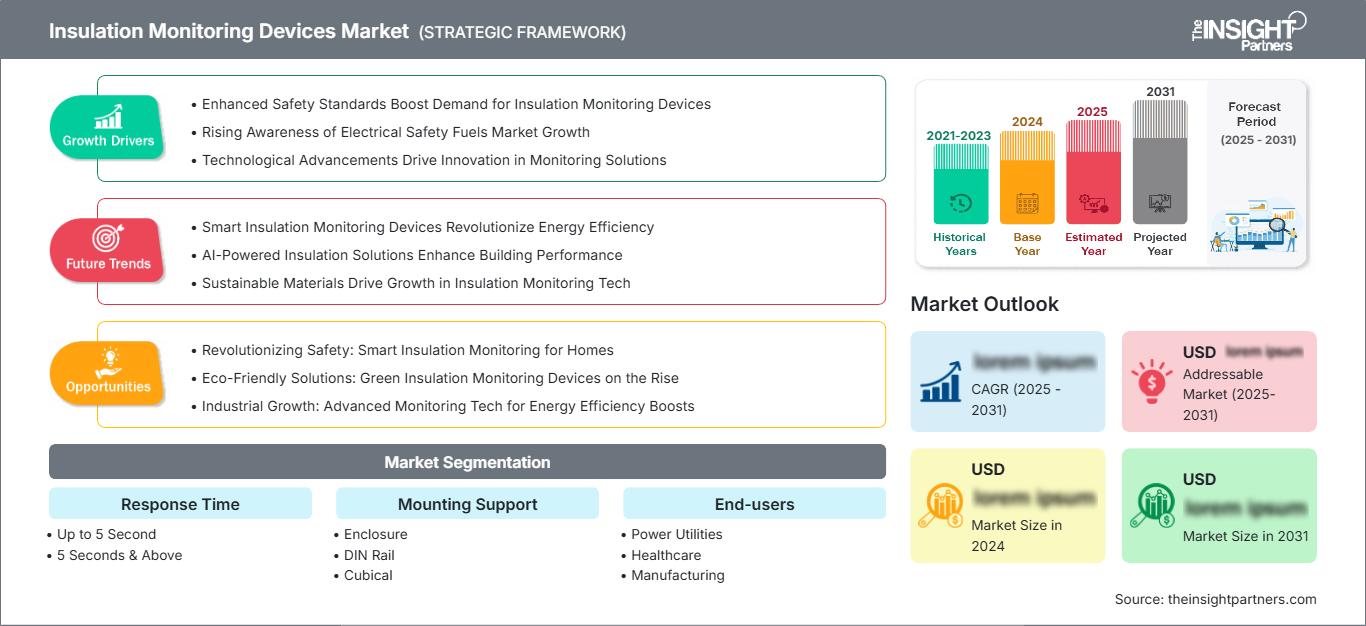
The insulation monitoring devices market size was valued at US$ 893.29 Million in 2025 and is projected to reach US$ 1,701.69 Million by 2034; it is expected to register a CAGR of 7.42% during 2026–2034. The market demonstrates the growing adoption in unearthed power systems, key medical facilities, manufacturing plants, mining equipment, and transportation electrification that allows early detection of insulation fault for reliability and safety.
North America is forecast to grow at a CAGR of 6.8 to 7.4% from 2024 through 2034 due to the improvements in hospital electrical safety, grid hardening, and industrial automation. The demand will be bolstered by the increasing adoption of isolated power systems in operating rooms, resilient power distribution in utilities, and predictive maintenance in transportation and manufacturing. The region remains important for the insulation monitoring devices market report because buyers prioritize reliability, compliance, and lifecycle risk reduction.
Insulation Monitoring Devices Market Assessment and Insights
- North America: The region accounted for 29–32% share in 2025 and is projected to grow at a 6.8–7.4% CAGR between 2026–2034, led by healthcare power safety, utility reliability, and data-rich industrial maintenance.
- US: The US represented 78–82% of North America in 2025 and is expected to grow at a 6.9–7.5% CAGR between 2026–2034, supported by hospitals, utilities, and advanced manufacturing.
- Europe: Europe held 24–27% share in 2025 and is projected to expand at a 6.5–7.1% CAGR between 2026–2034, with Germany, the UK, France, Italy, and Spain leading specification-driven adoption.
- Asia Pacific: Asia Pacific captured 31–34% insulation monitoring devices market share in 2025 and is forecast to grow at an 8.0–8.8% CAGR between 2026–2034, led by China, Japan, South Korea, India, and Australia.
- Largest Segment: Power utilities held 28–31% market share in 2025 and are expected to grow at a 7.1–7.7% CAGR between 2026–2034, reflecting grid uptime and renewable integration priorities.
- High Growth Segment: Transportation held 12–15% insulation monitoring devices market share in 2025 and is projected to grow at an 8.5–9.3% CAGR between 2026–2034, driven by electrified rail, marine, and charging infrastructure.
- Key companies analyzed in detail: Littelfuse, Inc.; Schneider Electric SE; Mitsubishi Electric Corporation; Siemens Aktiengesellschaft; Viper Innovations Ltd.; Bender GmbH & Co. KG; Eaton Corporation plc; ABB Ltd.; E. Dold & Söhne GmbH & Co. KG; and CIRPROTEC, S.L.U.
Source: The Insight Partners' analysis based on proprietary research, government publications, company annual reports, investor presentations, industry databases, and expert interviews.
The Insulation Monitoring Devices Market has moved from discrete alarm hardware toward intelligent protection modules that combine resistance measurement, event logging, communication interfaces, and predictive diagnostics. Production dynamics increasingly favor compact DIN rail and panel-mounted units that comply with IEC 61557-8 for IT systems up to 1,000 V AC and 1,500 V DC. Suppliers are differentiating through faster response time, improved immunity to harmonics, and integration with energy management software across hospitals, utilities, and automated plants.
Forward demand will be shaped by renewable power electronics, battery-backed facilities, electric mobility depots, and higher safety expectations in medical and industrial environments. Emerging economies are expanding ungrounded and hybrid distribution architectures where downtime costs justify continuous monitoring. Regulatory alignment, insurance-driven risk controls, and capital spending on resilient infrastructure are expected to widen the Insulation Monitoring Devices Market scope beyond compliance toward asset intelligence, remote serviceability, and lifecycle cost optimization.
Insulation Monitoring Devices Market Report Scope
| Report Attribute | Details |
|---|---|
| Market size in 2025 | US$ 893.29 Million |
| Market Size by 2034 | US$ 1,701.69 Million |
| Global CAGR (2026 - 2034) | 7.42% |
| Historical Data | 2021-2024 |
| Forecast period | 2026-2034 |
Insulation Monitoring Devices Market Analysis
The insulation monitoring devices market is tied to uninterrupted power needs in IT earthing systems, where the first insulation fault must be identified before it becomes a shutdown event. Power utilities use monitoring to protect auxiliary DC systems, substations, and renewable inverters, while healthcare facilities rely on isolated power panels in operating rooms and intensive care areas.
The value chain comprises sensing components, firmware, enclosures, panel builders, system integrators, distribution, and maintenance service suppliers. The supply environment supports players with certified product platforms, localized technical assistance, and interoperability with supervisory control systems. The Insulation Monitoring Devices market trend shows an increasing need for insulation monitoring devices featuring fault location capability, digital outputs, and mounting options.
Moderately fragmented is the competitive environment, where major players are represented by global electrification and protection solution providers. Schneider Electric SE, Siemens Aktiengesellschaft, ABB Ltd., Eaton Corporation plc, and Mitsubishi Electric Corporation rely on diversified electrical portfolio, whereas Bender GmbH & Co. KG, Littelfuse, Inc., Viper Innovations Ltd., E. Dold & Söhne GmbH & Co. KG, and CIRPROTEC, S.L.U. focus on deep application expertise.
Investment is directed toward communications-enabled devices, modular architectures, and broader voltage coverage for DC-heavy networks. Strategic positioning increasingly depends on compliance documentation, cybersecurity-aware connectivity, and channel access to hospitals, utilities, and industrial OEMs. The Insulation Monitoring Devices Market analysis shows that differentiation is shifting from basic alarm thresholds to actionable diagnostics and remote maintenance efficiency.
● REPORT CUSTOMIZATION
Tailor This Report To Align With Your Specific Business Requirements
This report can be customized to align precisely with your business objectives, scope, and target markets. Customization options include tailored segmentation, geography, competitive analysis, and strategic insights to support informed decision-making.
Customize This Report →WHAT YOU CAN ADJUST
- ● Segmentations
- ● Geography
- ● Competitive Analysis
- ● Language Preferences
Insulation Monitoring Devices Market: Strategic Insights
Regional Insights
North America Insulation Monitoring Devices
North America represented 29–32% of the Insulation Monitoring Devices Market share in 2025 and is projected to grow at a 6.8–7.4% CAGR during 2026–2034. Demand is anchored in hospitals, utilities, mining operations, and manufacturing plants where the cost of unplanned electrical interruption is higher than preventive monitoring investment. Regional deployment is facilitated by standard-based purchasing, large installed base of stand-alone power supplies, and investments in smart grid. Utilities install monitoring in substations and redundant DC power, whereas hospitals focus on continuity in patient areas. Industrial users are connecting equipment to maintenance systems to better identify faults and faster service response times.
U.S. Insulation Monitoring Devices Market
The US accounted for 78–82% of North America insulation monitoring devices market in 2025 and is expected to expand at a 6.9–7.5% CAGR through 2034. The country’s adoption profile is shaped by large hospital networks, semiconductor fabs, renewable interconnections, and transportation electrification programs requiring continuous supervision of critical circuits. The company’s product offering is extensive, with Littelfuse, Inc., Schneider Electric SE, Siemens Aktiengesellschaft, Eaton Corporation plc, ABB Ltd., and Bender GmbH & Co. KG offering their products via OEMs, panel builders, and distributors. The market trends are oriented towards rapid reaction products, DIN rail mounting, and interfacing with building management and industrial control systems.
Europe Insulation Monitoring Devices Market
Share in Europe was estimated to be 24-27% in 2025 and it will grow at a rate of 6.5-7.1% CAGR from 2026-2034. Drivers in the UK include estate improvement in hospitals, railway electrification, and industrial safety modifications with users preferring certified instruments which make compliance documentation easy. Germany leads in Europe due to high demand for precise monitoring from industries involved in the manufacture of machinery, automation, renewable energy and electrical engineering in the country, and hence adoption of portable devices capable of communicating, locating faults and high immunity to electromagnetic interference. Other countries in Europe contributing volumes include France, Italy and Spain through renovations in healthcare facilities, photovoltaics, marine systems and infrastructural investments. South European renewable energy growth boosts DC monitoring demand and France healthcare and transportation networks boost replacement demand. Europe’s Insulation Monitoring Devices Market forecast remains specification-led rather than price-led.
APAC Insulation Monitoring Devices Market
APAC accounted for 31–34% share in 2025 and is projected to grow at an 8.0–8.8% CAGR through 2034. China leads regional demand through industrial automation, renewable capacity, and high-speed rail electrical systems. For Japan and South Korea, emphasis on reliability is important in semiconductor production, healthcare applications, shipbuilding and batteries. Their customers prefer small and noiseless equipment that allow for predictive maintenance and availability of their machinery. For India and Australia, growth will be driven by investments in power grid improvement, mining electrification, metro rails, and renewable energy integration. Growth in policy-driven infrastructure projects and safety will increase the scope of the Insulation Monitoring Devices Market.
Middle East & Africa Insulation Monitoring Devices Market
The Middle East & Africa insulation monitoring devices market is expected to grow at a 6.2–6.9% CAGR during 2026–2034. Saudi Arabia leads demand as energy diversification, petrochemical reliability, and healthcare construction expand monitored electrical networks. UAE is implementing devices in hospital, data center, airport, and district infrastructure applications where power reliability influences quality of service. Project specifications are now demanding certification of monitoring systems for critical and isolated circuits. South Africa and Rest of MEA represent retrofit-based demand from mining, utility, and industrial sectors. Power reliability and asset protection are driving factors behind monitoring application demand in these regions.
Segmentation Analysis
Response Time
The response time segment is projected to grow at a 7.2–7.8% CAGR between 2026–2034 as users match device speed with risk severity, circuit criticality, and maintenance philosophy. Fast detection is essential in healthcare and transportation, while longer response thresholds remain acceptable in less dynamic industrial circuits where nuisance alarms must be minimized.
- Up to 5 Second devices serve critical circuits where rapid alarm initiation helps maintenance teams isolate faults before process interruption or patient-area safety risks escalate.
- 5 Seconds & Above devices remain relevant in stable installations, supporting cost-efficient monitoring where slower insulation deterioration, lower switching frequency, and reduced false-alarm sensitivity are operational priorities.
Mounting Support
Mounting support is expected to register a 7.0–7.6% CAGR during 2026–2034 because installation format influences panel design, retrofit feasibility, and maintenance access. DIN rail and panel formats are gaining traction in modular control cabinets, while enclosure and cubical solutions remain important where harsh environments or integrated switchgear layouts demand protection.
- Enclosure-mounted devices are selected for rugged industrial, mining, and outdoor electrical systems where environmental protection, service access, and wiring security influence equipment specification.
- DIN Rail products support compact control panels and fast installation, making them strategically important for OEMs, panel builders, and retrofit programs requiring standardized cabinet layouts.
- Cubical mounting is common in switchgear and distribution assemblies where monitoring is embedded into larger electrical protection systems for utilities and heavy industry.
- Panel-mounted devices remain visible to operators and maintenance teams, supporting direct alarm acknowledgement, local diagnostics, and practical use in healthcare and manufacturing facilities.
End-users
End-users are projected to grow at a 7.4–8.0% CAGR between 2026–2034, reflecting broader adoption across critical infrastructure and asset-intensive industries. Power utilities remain the largest revenue contributor, while transportation is the fastest-growing use case as electrified fleets, rail systems, ports, and charging facilities require reliable insulation supervision in AC and DC networks.
- Power Utilities prioritize substation, renewable, and auxiliary power reliability, making insulation monitoring central to continuity planning and protection of high-value electrical assets.
- Healthcare facilities require continuous supervision in isolated power systems, operating rooms, and intensive care areas where electrical safety and service continuity are non-negotiable operating requirements.
- Manufacturing users deploy devices to reduce downtime on automated lines, protect drives and control circuits, and support condition-based maintenance across high-throughput facilities.
- Mining applications value rugged monitoring for mobile equipment, ventilation, hoists, and underground distribution, where early fault detection improves worker safety and asset availability.
- Transportation adoption is rising in rail, marine, electric buses, depots, and charging systems where DC architectures and high-utilization assets require proactive insulation fault visibility.
Opportunity Snapshot
| End-users | Revenue Contribution | Trend Tag | Adoption Stage |
| Power Utilities | High | Grid Resilience | Mature |
| Healthcare | Medium | Isolated Power | Scaling |
| Manufacturing | High | Predictive Maintenance | Scaling |
| Mining | Medium | Rugged Safety | Scaling |
| Transportation | Medium | Fleet Electrification | Emerging |
Insulation Monitoring Devices Market Growth Drivers and Impact Analysis
Critical Power Continuity Requirements
Continuous insulation monitoring costs at hospitals, utilities, mining, and automated manufacturing facilities have risen due to the increasing relationship between electrical faults and safety risk, productivity loss, and non-compliance with regulations. IEC 61557-8 outlines the requirements for insulation monitoring of unearthed AC and DC IT systems, thereby providing the technical basis for procurement decisions. With an increase in back-up power sources, drives, inverters, and distributed generation, it becomes difficult to identify any insulation degradation based on periodic monitoring alone.
Electrification of Transport and Industrial Assets
The use of electrified railways, waterborne vessels, electric buses, automated storage and retrieval systems, and battery-powered industrial machinery is likely to result in the proliferation of DC and hybrid AC-DC systems needing to be monitored for insulation. Such applications tend to run under demanding conditions such as high utilization, vibration, humidity, and switching stresses, and thus early diagnosis of any faults will have commercial importance. The 12% to 15% market share held by transportation sector in 2025, and 8.5% to 9.3% compound annual growth rate until 2034, imply a shift towards mainstream application.
Digital Maintenance and Remote Diagnostics
Asset owners have been shifting their focus from alarm-based systems to systems capable of transferring information about insulation into supervisory controls and building management systems. The benefits of this development include better preparedness through observation of the progress of the fault, comparison of different circuits, and scheduling of actions prior to equipment failure. Another benefit of such a shift is that it allows for better use of remote assets since specialized electrical engineers may not be available at all times.
Insulation Monitoring Devices Market Future Trends
Convergence with Predictive Electrical Health Platforms
The next generation of devices will incorporate more information about resistance, leakage, loading, temperature, and events within an ever-widening concept of electrical health. This development will enable owners to recognize whether there is a transient issue or real insulation damage and allocate their maintenance budgets accordingly. Companies that can provide open interfaces and secure connectivity will gain an advantage as enterprises adopt enterprise maintenance systems. In the coming years, this will increase the demand for intelligence built into devices, beyond simple regulatory compliance.
Higher Adoption in DC Microgrids and Storage Systems
DC microgrids, photovoltaic arrays, battery energy storage, and fast-charging infrastructure will broaden the application base for insulation monitoring. These systems operate with power electronics, fluctuating loads, and evolving fault profiles that are less suited to traditional periodic checks. As infrastructure owners seek higher uptime and safer operation, monitoring devices will be specified earlier in project design. The trend will create demand for wider voltage ranges, faster response, improved filtering, and compatibility with energy management systems used in distributed power networks.
Insulation Monitoring Devices Market Opportunities
Retrofit Programs for Aging Critical Facilities
The potential for retrofits at old hospitals, substations, industries, and transportation stations is huge as most installations are based on manual testing, obsolete alarms, or unrecorded electrical panels. There will be great potential for suppliers who provide retrofit kits, commissioning services, and documentation kits. The importance of channel partners such as panel makers and maintenance service providers will also be very high as retrofit customers will require practical installation paths. This will especially be true for areas that have high downtime costs but low budgets for system replacement.
Application-Specific Product Bundles
Vendors can improve conversion by packaging devices, fault locators, communication modules, and configuration templates around specific applications such as operating rooms, substations, mining feeders, rail depots, and battery systems. Buyers increasingly prefer validated combinations that reduce engineering time and simplify compliance review. Application bundles also create recurring revenue through training, calibration, and remote diagnostics. This opportunity rewards suppliers that understand end-user workflows, not only component specifications, and can translate technical performance into faster commissioning and measurable maintenance efficiency.
Recent Developments
- June 2026: Blue Jay Technology announces the launch of the BIM-CH2 Dual Channel Insulation Monitoring Relay. This is an industrial-grade protective relay designed specifically for high-voltage, multi-circuit IT systems such as Battery Energy Storage Systems (BESS) and high-power DC charging piles, providing leakage and insulation safety monitoring.
- February 2026: Vitrek offers the 95X Series hipot tester with 100 pico-amp leakage current resolution for detecting micro-level insulation defects in safety-critical industries. Designed for medical devices, aerospace avionics, and high-reliability electronics, the Vitrek 95X Series ensures that early-stage insulation degradation is detected before catastrophic failures occur.
- March 2025: Sensata Technologies announced the launch of the SIM200 Insulation Monitoring Device (IMD), designed to enhance safety in the next generation of the electric vehicle ecosystem. Sensata’s SIM200 (IMD) is designed for continuous active monitoring of unearthed (Isolated Terra) DC systems including charging stations, electric vehicles, and other systems operating above 60 VDC.
Frequently Asked Questions

- Comprehensive Market Sizing and Forecast Analysis
- Detailed Segmentation Analysis
- In-Depth Market Dynamics Assessment
- Regional and Country-Level Insights
- Competitive Landscape and Company Benchmarking
- Strategic Business Intelligence
Recent Reports
Testimonials

The Insight Partners' SCADA System Market report is comprehensive, with valuable insights on current trends and future forecasts. The team was highly professional, responsive, and supportive throughout. We are very satisfied and highly recommend their services.
RAN KEDEM Partner, Reali Technologies LTDs
I requested a report on a very specific software market and the team produced the report in a few days. The information was very relevant and well presented. I then requested some changes and additions to the report. The team was again very responsive and I got the final report in less than a week.
JEAN-HERVE JENN Chairman, Future Analytica
We worked with The Insight Partners for an important market study and forecast. They gave us clear insights into opportunities and risks, which helped shape our plans. Their research was easy to use and based on solid data. It helped us make smart, confident decisions. We highly recommend them.
PIYUSH NAGPAL Sr. Vice President, High Beam Global
The Insight Partners delivered insightful, well-structured market research with strong domain expertise. Their team was professional and responsive throughout. The user-friendly website made accessing industry reports seamless. We highly recommend them for reliable, high-quality research services
YUKIHIKO ADACHI CEO, Deep Blue, LLC.
This is the first time I have purchased a market report from The Insight Partners.While I was unsure at first, I visited their web site and felt more comfortable to take the risk and purchase a market report.I am completely satisfied with the quality of the report and customer service. I had several questions and comments with the initial report, but after a couple of dialogs over email with their analyst I believe I have a report that I can use as input to our strategic planning process.Thank you so much for taking the extra time and making this a positive experience.I will definitely recommend your service to others and you will be my first call when we need further market data.
JOHN SUZUKI President and Chief Executive Officer, Board Director, BK Technologies
I wish to appreciate your support and the professionalism you displayed in the course of attending to my request for information regarding to infectious disease IVD market in Nigeria. I appreciate your patience, your guidance, and the fact that you were willing to offer a discount, which eventually made it possible for us to close a deal. I look forward to engaging The Insight Partners in the future, all thanks to the impression you have created in me as a result of this first encounter.
DR CHIJIOKE ONYIA MANAGING DIRECTOR, PineCrest Healthcare Ltd.Reason to Buy
- Informed Decision-Making
- Understanding Market Dynamics
- Competitive Analysis
- Identifying Emerging Markets
- Customer Insights
- Market Forecasts
- Risk Mitigation
- Boosting Operational Efficiency
- Strategic Planning
- Investment Justification
- Tracking Industry Innovations
- Aligning with Regulatory Trends





 Get Free Sample for