
Knee Reconstruction Market Trends, Size & Growth by 2034
Coverage: By Procedure (Primary, Revision, Partial, Patello-Femoral), Technique (Joint Replacement, Resurfacing, Osteotomy, and Others), End User (Hospitals, Orthopedic Clinics, Ambulatory Surgical Centers, and Others), and Geography (North America, Europe, Asia Pacific, Middle East and Africa, and South and Central America)
- Status : Published
- Report Code : TIPRE00043095
- Category : Life Sciences
- No. of Pages : 251
- Available Report Formats :


- Last update date : April 20, 2026


2025 Market Size
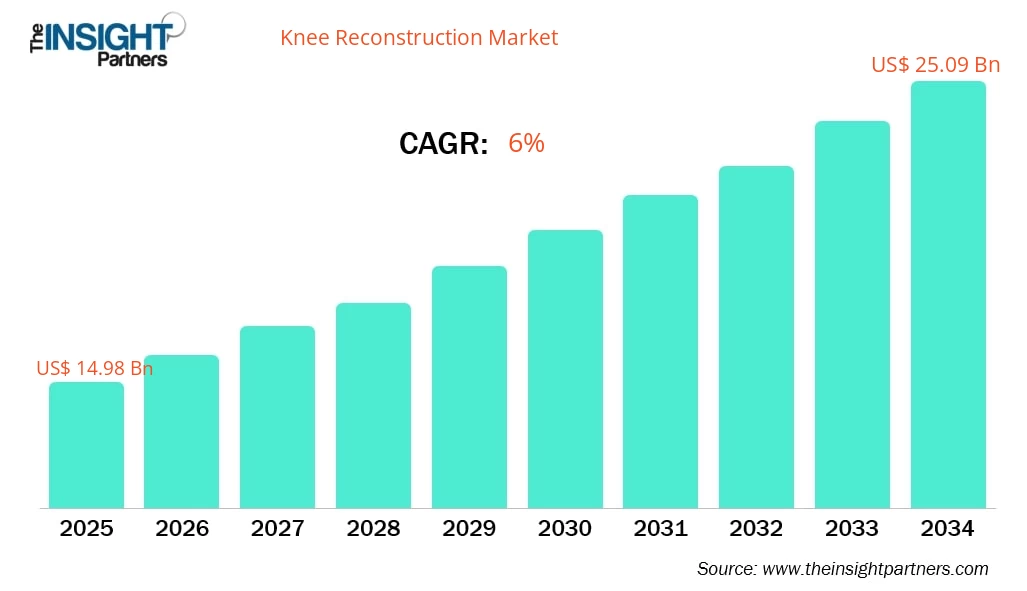
US$ 14.98 Bn
Base year value
2034 Forecast
US$ 25.09 Bn
Projected by 2034
CAGR 2026-2034
6.0 %
Growth rate
Addressable Market
US$ 182.47 Bn
(2026-2034)
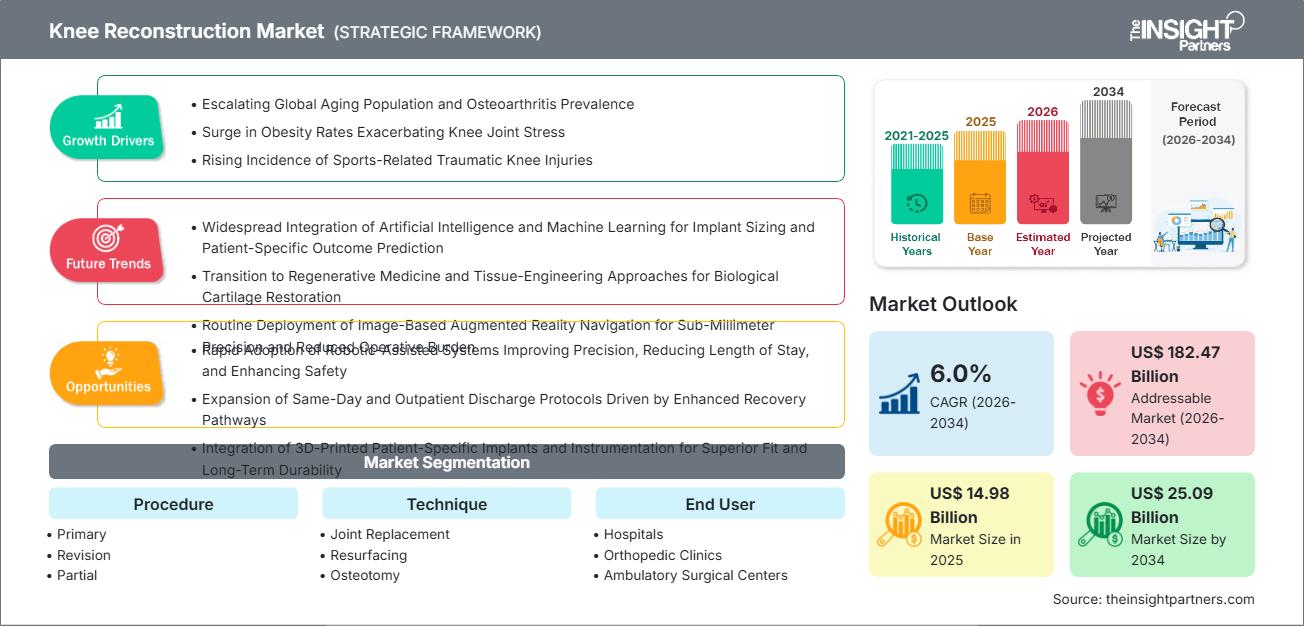
The knee reconstruction market size is projected to reach US$ 25.09 billion by 2034 from US$ 14.98 billion in 2025. The market is expected to register a CAGR of 6.0% during 2026–2034.
Knee Reconstruction Market Analysis
Market growth is driven by an increasing global aging population and osteoarthritis prevalence, and a worldwide surge in obesity rates, exacerbating knee joint stress. Rapid adoption of robotic-assisted systems, improving precision, reducing length of stay, and enhancing safety and expansion of same-day and outpatient discharge protocols driven by enhanced recovery pathways, are expected to create ample opportunities.
Knee Reconstruction Market Overview
Knee reconstruction procedures are increasing due to the growing number of people suffering from osteoarthritis, sports injuries, and the aging of the population. A growing number of procedures are being performed due to changes in technology. In developing nations, there is increased access to healthcare and greater awareness of the benefits of this surgery. Manufacturers are continuing to invest in innovation and will do so in the future. The trend of outpatient surgeries and the use of faster recovery solutions fuel the growth of this market.
Market Research Highlights
- North America dominated the market with 44.6% share in 2025.
- Asia Pacific is poised to grow at a CAGR of 6.5% over the forecast period.
- United States market is projected to grow at a CAGR of 6.4% over the forecast period.
- By Procedure, the Primary segment accounted for the largest market share of 83.5% in 2025.
- By Technique, the Joint Replacement segment is anticipated to witness the fastest growth, registering a CAGR of 6.2% over the forecast period
- By End User, the Hospitals segment accounted for the largest market share of 57.5% in 2025.
- The report profiles key industry players such as B Braun SE, MicroPort Scientific Corp, Stryker Corp, Johnson & Johnson, Zimmer Biomet Holdings Inc, Smith & Nephew Plc, Conmed Corp, Exactech Inc, Globus Medical Inc, Enovis Corp, while also analyzing key developments in novel ideas, disruptive products, and innovative services that could reshape the future market and reveal emerging themes across the industry.
Source: The Insight Partners' analysis based on proprietary research, government publications, company annual reports, investor presentations, industry databases, and expert interviews.
● REPORT CUSTOMIZATION
Tailor This Report To Align With Your Specific Business Requirements
This report can be customized to align precisely with your business objectives, scope, and target markets. Customization options include tailored segmentation, geography, competitive analysis, and strategic insights to support informed decision-making.
Customize This Report →WHAT YOU CAN ADJUST
- ● Segmentations
- ● Geography
- ● Competitive Analysis
- ● Language Preferences
Knee Reconstruction Market: Strategic Insights
-
Get Top Key Market Trends of this report.This FREE sample will include data analysis, ranging from market trends to estimates and forecasts.
Knee Reconstruction Market Drivers and Opportunities
Market Drivers:
- Escalating Global Aging Population and Osteoarthritis Prevalence: The increasing geriatric population and more people diagnosed with healthy joints are leading to increased degeneration of the knee, driving the need for reconstructive surgeries, particularly total joint replacement, as more older individuals seek to improve their quality of life, relieve joint pain, and restore mobility.
- Worldwide Surge in Obesity Rates Exacerbating Knee Joint Stress: The rise in obesity leads to greater mechanical pressure and inflammation of the knee joints, which speeds up the development of osteoarthritis and results in more surgeries for joint reconstruction.
- Rising Incidence of Sports-Related Traumatic Knee Injuries: More people engaging in high-impact sports contributes to a rise in ACL and other ligament injuries. As a consequence, the requirement for knee reconstruction will go up, especially among young sportsmen.
Market Opportunities:
- Rapid Adoption of Robotic-Assisted Systems Improving Precision, Reducing Length of Stay, and Enhancing Safety: Implant location during robotic-assisted total knee replacement surgery is enhanced by robotic technology but not associated with the increased risk of complications, boosted by surgeon confidence, improved surgical efficiency, and increased procedure volume across all healthcare systems.
- Expansion of Same-Day and Outpatient Discharge Protocols Driven by Enhanced Recovery Pathways: Reduction in costs, increased hospital capacity, ease of access, and continuing to be able to perform same-day discharges and outpatient total knee replacement surgery as a result of enhanced recovery protocols have allowed for greater patient throughput, without the need for additional infrastructure.
- Integration of 3D-Printed Patient-Specific Implants and Instrumentation for Superior Fit and Long-Term Durability: 3D printed implants are specifically designed to fit an individual’s anatomy, improve surgical precision, reduce complications, and extend the longevity of the implant, particularly in complex cases. This advancement has led to the development of personalized total knee reconstruction and additional treatment options of treatment to serve a variety of patients.
Knee Reconstruction Market Report Segmentation Analysis
The knee reconstruction market is divided into different segments to give a clearer view of how it works, its growth potential, and the latest trends. Below is the standard segmentation approach used in most industry reports:
By Procedure:
- Primary: A knee that has not undergone prior treatment may require total knee arthroplasty (TKA) to manage advanced osteoarthritis or severe joint damage. The procedure aims to restore range of motion, reduce pain, and accounts for a substantial proportion of surgical volume worldwide.
- Revision: A revision surgery involves replacing a worn, loosened, or infected implant. These procedures are more complex, require specialized implants, and are becoming more common due to the growing number of primary knee replacements performed worldwide.
- Partial: Partial knee arthroplasty replaces only the damaged compartment of the knee and preserves healthy bone and ligaments, so recovery is faster, and function is improved. Partial knee arthroplasty is used by people who have localized osteoarthritis and other appropriate conditions of the knee.
- Patello-Femoral: Patello-femoral reconstruction replaces the damaged area between the patella and femur and treats either isolated arthritis or cartilage that has worn out. This surgery is a less invasive option than total knee arthroplasty, which will restore mobility and decrease pain in certain patients.
By Technique:
- Joint Replacement
- Resurfacing
- Osteotomy
- Others
By End User:
- Hospitals
- Orthopedic Clinics
- Ambulatory Surgical Centers
- Others
By Geography:
- North America
- Europe
- Asia Pacific
- Latin America
- Middle East and Africa
Knee Reconstruction Market Report Scope
| Report Attribute | Details |
|---|---|
| Market size in 2025 | US$ 14.98 Billion |
| Market Size by 2034 | US$ 25.09 Billion |
| Global CAGR (2026 - 2034) | 6.0% |
| Historical Data | 2021-2024 |
| Forecast period | 2026-2034 |
| Segments Covered |
By Procedure
|
| Regions and Countries Covered |
North America
|
| Market leaders and key company profiles |
|
Knee Reconstruction Market Players Density: Understanding Its Impact on Business Dynamics
The Knee Reconstruction Market is growing rapidly, driven by increasing end-user demand due to factors such as evolving consumer preferences, technological advancements, and greater awareness of the product's benefits. As demand rises, businesses are expanding their offerings, innovating to meet consumer needs, and capitalizing on emerging trends, which further fuels market growth.
Knee Reconstruction Market Share Analysis by Geography
The knee reconstructions market in APAC is witnessing the fastest growth. Rapidly aging demographics, urban–rural healthcare disparities, and advancements in digital health drive the market. Emerging markets in Latin America, the Middle East, and Africa have untapped market opportunities.
The hospital-at-home market grows differently across regions, driven by economic growth and rising healthcare expenditure. Below is a summary of market share and trends by region:
1. North America
- Market Share: Holds a significant portion of the global market
- Key Drivers:
- High rates of osteoarthritis, advanced healthcare infrastructures, and quickly adopting robotic-assisted and outpatient knee procedures
- Trends: The increasing adoption of robots, AI-based surgical planning, and value-based care will create an increasing number of knee reconstruction procedures
2. Europe
- Market Share: Substantial share due to early adoption of hospital-at-home models
- Key Drivers:
- Increasing demand for knee reconstruction procedures comes from its aging population, friendly reimbursement systems, and the increasing number of surgeons performing minimally invasive and robotic knee reconstruction surgeries.
- Trends: An increasing focus on minimally invasive or 'peri-operative' techniques; development of more environmentally friendly or sustainable implant materials.
3. Asia Pacific
- Market Share: Fastest-growing region with an annually rising market share
- Key Drivers:
- Increase in knee reconstruction surgery due to access to healthcare, an aging population, and more people traveling for medical reasons.
- Trends: The rapid growth of healthcare facilities and infrastructure, combined with the utilization of low-cost advanced technology
4. South and Central America
- Market Share: Steadily progressing market share
- Key Drivers:
- Enhancement in healthcare systems and an increase in awareness of joint replacement surgery.
- Trends: Increasing modernization of hospitals and collaboration between manufacturers and local hospital systems
5. Middle East and Africa
- Market Share: Small market share, growing at a rapid pace
- Key Drivers:
- Investments in improving the healthcare system, medical tourism, and rising numbers of patients suffering from lifestyle-related diseases.
- Trends: Increase in healthcare investment and number of surgical centers, along with an increase in patient awareness
High Market Density and Competition
Competition is strong due to the presence of established players, such as Stryker Corp, Smith & Nephew Plc, and Globus Medical Inc.
This high level of competition urges companies to stand out by offering:
- Advanced security features
- Value-added services such as predictive maintenance, real‑time operational analytics, and free installation
- Competitive pricing models
- Strong customer support and easy integration
Opportunities and Strategic Moves
- With the increasing use of stem cells, platelet-rich plasma (PRP), and bioengineered scaffolding as treatment options for cartilage regeneration, a new method of regeneration is available rather than relying solely on traditional methods. These techniques have the potential to become new revenue streams for companies by offering new ways to generate income from the treatment of cartilage through regeneration, utilizing various types of surgical products.
- Robotics and artificial intelligence (AI) assist in providing more accurate surgical planning and performing procedures. This trend has created opportunities for the production and sale of custom, premium implants and has increased the number of procedures performed with advanced products.
- The creation of next-generation custom (e.g., personalized), 3D-printed, and cementless implants will improve clinical outcomes and enhance the differentiation of the company's product lines. Leading manufacturers are establishing new manufacturing facilities and developing relationships in emerging markets to strengthen their global supply chain and global footprint. The customization of custom implants and associated surgical planning tools is quickly becoming an important competitive strategy for companies to drive patient satisfaction and minimize revision surgeries.
Other companies analyzed during the course of research:
- Medacta Group
- Conformis
- Corin Group
- United Orthopedic Corporation
- Meril Life Sciences
- Arthrex
- Orthofix Medical
- RTI Surgical
- LimaCorporate
- Beijing Chunlizhengda Medical Instruments
- AK Medical Holdings
- Shandong Weigao Orthopedic Device
- Shanghai MicroPort Orthopedics
- Elite Surgical
- GPC Medical
- Siora Surgicals
- Narayan Medical
- Ortho Development
- Amplitude Surgical
- Think Surgical
- OMNIlife Science
- Kinamed
- JointMedica
- Mathys AG
- Implantcast
- Adler Ortho
- Bioimpianti
- FH Orthopedics
- Baumer
- Surgival
- Samumed
- CartiHeal
- Anika Therapeutics
- Flexion Therapeutics
- Bioventus
- OrthoSensor
Knee Reconstruction Market News and Recent Developments
- In November 2025, Zimmer Biomet Holdings, Inc. received US Food and Drug Administration (FDA) 510(k) clearance of ROSA Knee with OptimiZe, an enhanced version of its ROSA Knee System that offers a more customized experience for surgeons to help deliver accurate and reproducible outcomes in robotic-assisted total knee replacement surgery.
- In January 2025, JUST Medical introduced its breakthrough AUSK Cementless Unicompartmental Knee System at the “2024 Joint Preservation Conference.” As China’s first cementless UKA featuring a cementless tibial tray, this innovative product delivers immediate and long-term stability to offer surgeons and patients a safer, more effective, and comprehensive solution for partial Knee Replacement.
Knee Reconstruction Market Report Coverage and Deliverables
The "Knee Reconstruction Market Size and Forecast (2021–2034)" report provides a detailed analysis of the market covering below areas:
- Knee Reconstruction Market size and forecast at global, regional, and country levels for all the key market segments covered under the scope
- Knee Reconstruction Market trends, as well as market dynamics such as drivers, restraints, and key opportunities
- Detailed PEST and SWOT analysis
- Knee Reconstruction Market analysis covering key market trends, global and regional framework, major players, regulations, and recent market developments
- Industry landscape and competition analysis covering market concentration, heat map analysis, prominent players, and recent developments for the Knee Reconstruction Market
- Detailed company profiles
Frequently Asked Questions

- Comprehensive Market Sizing and Forecast Analysis
- Detailed Segmentation Analysis
- In-Depth Market Dynamics Assessment
- Regional and Country-Level Insights
- Competitive Landscape and Company Benchmarking
- Strategic Business Intelligence
Recent Reports
Testimonials

The Insight Partners' SCADA System Market report is comprehensive, with valuable insights on current trends and future forecasts. The team was highly professional, responsive, and supportive throughout. We are very satisfied and highly recommend their services.
RAN KEDEM Partner, Reali Technologies LTDs
I requested a report on a very specific software market and the team produced the report in a few days. The information was very relevant and well presented. I then requested some changes and additions to the report. The team was again very responsive and I got the final report in less than a week.
JEAN-HERVE JENN Chairman, Future Analytica
We worked with The Insight Partners for an important market study and forecast. They gave us clear insights into opportunities and risks, which helped shape our plans. Their research was easy to use and based on solid data. It helped us make smart, confident decisions. We highly recommend them.
PIYUSH NAGPAL Sr. Vice President, High Beam Global
The Insight Partners delivered insightful, well-structured market research with strong domain expertise. Their team was professional and responsive throughout. The user-friendly website made accessing industry reports seamless. We highly recommend them for reliable, high-quality research services
YUKIHIKO ADACHI CEO, Deep Blue, LLC.
This is the first time I have purchased a market report from The Insight Partners.While I was unsure at first, I visited their web site and felt more comfortable to take the risk and purchase a market report.I am completely satisfied with the quality of the report and customer service. I had several questions and comments with the initial report, but after a couple of dialogs over email with their analyst I believe I have a report that I can use as input to our strategic planning process.Thank you so much for taking the extra time and making this a positive experience.I will definitely recommend your service to others and you will be my first call when we need further market data.
JOHN SUZUKI President and Chief Executive Officer, Board Director, BK Technologies
I wish to appreciate your support and the professionalism you displayed in the course of attending to my request for information regarding to infectious disease IVD market in Nigeria. I appreciate your patience, your guidance, and the fact that you were willing to offer a discount, which eventually made it possible for us to close a deal. I look forward to engaging The Insight Partners in the future, all thanks to the impression you have created in me as a result of this first encounter.
DR CHIJIOKE ONYIA MANAGING DIRECTOR, PineCrest Healthcare Ltd.Reason to Buy
- Informed Decision-Making
- Understanding Market Dynamics
- Competitive Analysis
- Identifying Emerging Markets
- Customer Insights
- Market Forecasts
- Risk Mitigation
- Boosting Operational Efficiency
- Strategic Planning
- Investment Justification
- Tracking Industry Innovations
- Aligning with Regulatory Trends





 Get Free Sample for