
Laser Displacement Sensor Market Demand, Trends & Forecast by 2034
Coverage: By Range (Less than 100 mm, 100mm to 300 mm, More than 300mm); End-User (Automotive, Industrial, Aerospace and Defense, Others) , and Geography (North America, Europe, Asia Pacific, and South and Central America)
- Status : Data Released
- Report Code : TIPRE00012543
- Category : Electronics and Semiconductor
- No. of Pages : 150
- Available Report Formats :


- Last update date : September 22, 2026


2025 Market Size
US$ 6.32 Bn
Base year value
2034 Forecast
US$ 8.61 Bn
Projected by 2034
CAGR 2026-2034
3.93 %
Growth rate
Addressable Market
US$ 69.31 Bn
(2026-2034)
The Laser Displacement Sensor Market was valued at US$ 6.32 Billion in 2025 and is projected to reach US$ 8.61 Billion by 2034, registering a CAGR of 3.93% during 2026–2034. Market includes non-contact optical measuring instruments that are employed for measuring displacement, distance, thickness, height, position, and surface. Market adoption is largely driven by automated manufacturing settings wherein repeatable measurements and instant feedback are crucial to achieve quality and production consistency.
The North American market is characterized as a mature yet technically advanced one, driven by automated automobile manufacturing, aerospace manufacturing, robotics, and industrial inspection. The Laser Displacement Sensor Market size of Laser Displacement Sensor in North America is forecasted to grow at around 3.4% to 3.9% CAGR from 2026 to 2034.
Laser Displacement Sensor Market Assessment and Insights
- North America: The region is estimated to hold a 29–33% share in 2025 and expand at a CAGR of 3.4–3.9% between 2026–2034, supported by aerospace, automotive automation, precision engineering, and established sensor integration ecosystems.
- US: The US is estimated to represent 68–72% of North America's 2025 revenue and grow at a CAGR of 3.2–3.7% between 2026–2034, driven by factory automation and advanced manufacturing.
- Europe: Europe is estimated to account for 25–29% share in 2025 and grow at 3.6–4.1% CAGR during 2026–2034, with Germany, the UK, France, Italy, and Spain supporting demand through automotive, machinery, aerospace, and industrial modernization.
- Asia Pacific: Asia Pacific is estimated to represent 30–34% share in 2025 and register 4.5–5.0% CAGR through 2034, led by China, Japan, South Korea, and India, where electronics, automotive production, robotics, and factory automation remain important demand centers.
- Largest Segment: More than 300 mm is estimated to hold a 43–47% market share in 2025, with a 4.2–4.7% CAGR between 2026–2034, reflecting broad long-distance inspection requirements.
- High Growth Segment: Automotive is estimated at a 34–38% market share in 2025 and a 4.4–4.9% CAGR during 2026–2034, supported by automated dimensional and assembly inspection.
- Key companies analyzed in detail: Banner Engineering Corp., Cognex Corporation, KEYENCE Corporation, OPTEX FA Co., Ltd., Mechanical Technology, Incorporated, MICRO-EPSILON, OMRON Corporation, Panasonic Corporation, SICK AG, and TURCK GmbH & Co. KG.
Source: The Insight Partners' analysis based on proprietary research, government publications, company annual reports, investor presentations, industry databases, and expert interviews.
The Laser Displacement Sensor Market has moved beyond simple distance measurement to include advanced inspection systems which utilize laser triangulation, signal processing, and digital communication. Future product development will continue to focus on the challenges of rough surfaces, varying reflectance, vibration, light, and small form factor installations. Suppliers are also including the ability for sensors to interface with programmable controllers, industrial network interfaces, and machine vision systems to enable online measurement.
In the future, investments in the market will probably include intelligent sensing, compact design, and networkability at new manufacturing locations. China, India, Southeast Asia, and Eastern Europe will become relevant geographic markets as manufacturers implement inspection automation and lower manual quality control procedures. Regulations which emphasize safety, traceability, and repeatability in manufacturing will drive sensor suppliers to offer certified products.
Laser Displacement Sensor Market Report Scope
| Report Attribute | Details |
|---|---|
| Market size in 2025 | US$ 6.32 Billion |
| Market Size by 2034 | US$ 8.61 Billion |
| Global CAGR (2026 - 2034) | 3.93% |
| Historical Data | 2021-2024 |
| Forecast period | 2026-2034 |
Laser Displacement Sensor Market Analysis
Growth of the Laser Displacement Sensor Market is caused by the increasing demand in such industries as factory automation, precise assembly, dimensional measurements, robotics, and automated inspection. Sources of demand are equipment producers, automotive industry suppliers, aerospace companies, machine makers, electronics companies, and system integrators. Value chain comprises semiconductor and optical component producers, sensors manufacturers, automation distributors, engineering integration, and end users utilizing measurement systems for machinery.
The variables that affect supply include optical components, laser source, detectors, processing, precise housing, communications, and calibration services. Currently, manufacturers started to differentiate not only according to the detection abilities, but also to the stability of the measurement. Measurement should be stable for metallic, dark, reflective, curved, and rough surfaces. It implies that companies with good application engineering and calibration capabilities have a great chance. Connectivity standardization is another variable important for this market, because end-users need sensors to communicate directly with PLCs, industrial networks, and monitoring systems.
Competitive positioning in Laser Displacement Sensor Market Report is a mix of optical knowledge, accuracy, application development, product range, and integration capability. Optical knowledge is provided by such firms as KEYENCE Corporation and OMRON Corporation, whereas sensor integration and industrial connectivity characterize SICK AG, Banner Engineering Corp., and TURCK GmbH & Co. KG. Machine vision is supported by Cognex Corporation, whereas precision measurement is the strong point of MICRO-EPSILON.
Development efforts are focused on higher sampling speeds, algorithm improvements, small-size sensors heads, and interface capabilities. Panasonic Corporation is still developing its integrated measurement systems, whereas OPTEX FA Co., Ltd. retains specialization in sensing technologies. Mechanical Technology, Incorporated provides specialist measurement technology. Competitive advantage becomes more and more dependent on integration of sensors and software, connectivity, and application engineering rather than just low pricing per unit.
● REPORT CUSTOMIZATION
Tailor This Report To Align With Your Specific Business Requirements
This report can be customized to align precisely with your business objectives, scope, and target markets. Customization options include tailored segmentation, geography, competitive analysis, and strategic insights to support informed decision-making.
Customize This Report →WHAT YOU CAN ADJUST
- ● Segmentations
- ● Geography
- ● Competitive Analysis
- ● Language Preferences
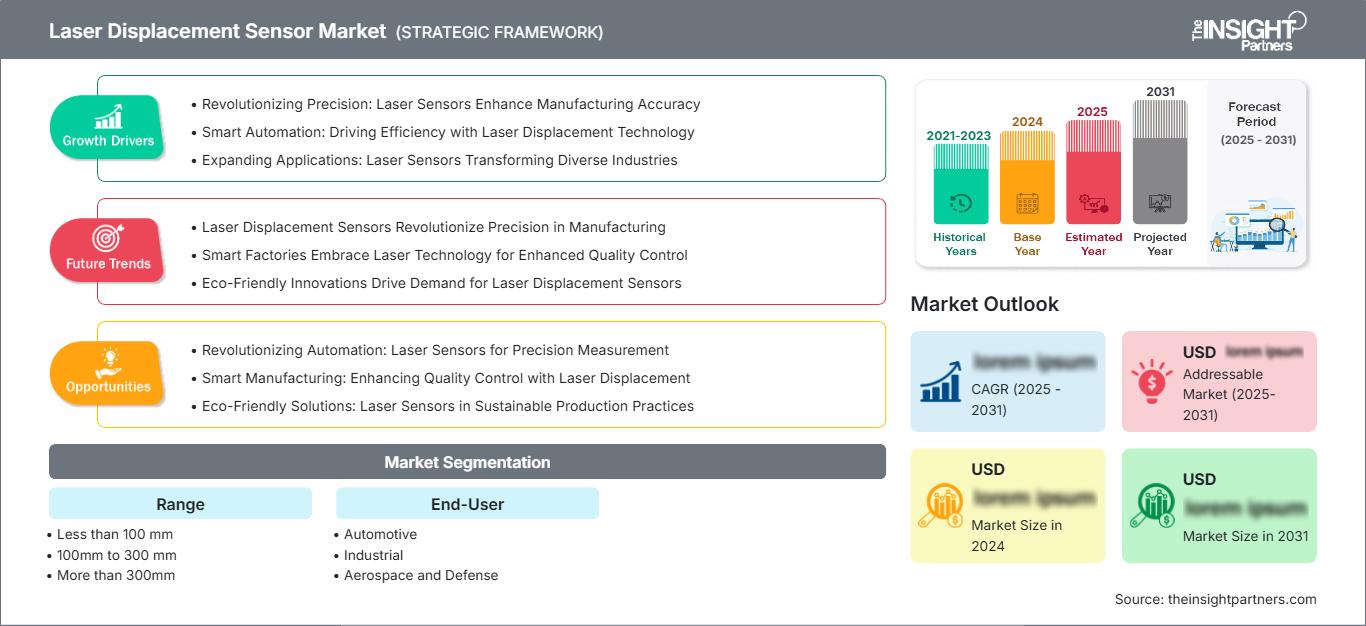
Laser Displacement Sensor Market: Strategic Insights
Regional Insights
North America Laser Displacement Sensor Market
The North American region is expected to hold a Laser Displacement Sensor Market share of 29-33% in 2025 and grow at a rate of 3.4-3.9% CAGR up until 2034. The US holds the leading position in terms of demand, fueled by the availability of advanced automotive factories, aerospace manufacturing, semiconductor equipment, robotics, and industrial inspection equipment.
The growing demand for laser displacement sensors is fueled by the rising number of manufacturers who wish to use non-contact measurement in the process of dimensional verification, alignment, thickness measurement, and surface inspection. Aerospace manufacturers need laser sensors that can provide them with a highly precise repeatable measurement. The automotive factories use laser displacement sensors throughout the body, powertrain, battery, and assembly operations. Modernization of industries drives the adoption of non-contact sensors in place of contact ones.
U.S. Laser Displacement Sensor Market
It is projected that the US will account for 68-72% of North America’s 2025 market and exhibit a 3.2-3.7% CAGR till 2034. The driving factors behind demand include aerospace, automotive, electronics, robotics, and precision machinery industries, where automation of inspection and process monitoring is a priority.
Organizations such as Cognex Corporation, KEYENCE Corporation, Banner Engineering Corp., SICK AG, and OMRON Corporation have developed their capabilities in industrial applications in the country. Adoption ranges from traditional dimensional measurement applications to battery production, robot alignment, weld validation, semiconductor systems, and automated assembly. Connectivity through Ethernet and IO-Link is favored by industrial customers because it makes sensor setup, diagnostics, parameterization, and integration easier.
Europe Laser Displacement Sensor Market
Europe will represent a market share of 25-29% and grow at a CAGR of 3.6-4.1% until 2034. Germany is the major player in Europe, owing to its automotive manufacturing, machine tools, industrial robots, and factory automation. Other European nations such as the United Kingdom will be driven by their aerospace, electronics, and engineering segments.
Germany is especially significant due to the increasing use of optical measurement in automated cells, body measuring, part measuring, and machinery. In addition, France will support the market owing to its aerospace and automotive manufacturing applications, whereas Italy will be favored by its machinery, packaging, and industrial equipment manufacturing. Similarly, Spain will benefit from its automotive and industrial manufacturing applications.
APAC Laser Displacement Sensor Market
The share of APAC in 2025 is estimated at 30-34%, and the annual growth rate from 2025 to 2034 will be about 4.5-5.0%. The largest markets are China, Japan, South Korea, India, and Australia. Electronics manufacturing, car assembly, robotics, and semiconductor manufacturing drive demand.
Both China and Japan have strong ecosystems of automation, while South Korea is characterized by the electronics and semiconductor industry that requires precision inspection. India is seeing an increase in sensors' consumption due to the development of industrial automation; meanwhile, Australia's contribution comes from machinery and resource industries. Smart factory policies and advanced manufacturing initiatives should favor the use of connected measurement systems.
Middle East & Africa Laser Displacement Sensor Market
The Middle East and Africa region is set to grow at a 4.0-4.5% CAGR till 2034. Saudi Arabia leads the market with diversification of industries, infrastructural and manufacturing development. UAE adds to the market with logistics, superior infrastructures, and industrial automation.
South Africa continues to be an essential application region for automotive, mining, and industrial manufacturing, whereas the rest of MEA provides avenues for processing, infrastructural, and energy projects. Adoption rates continue to lag behind manufacturing regions; however, developments in automated facilities and digital industrial infrastructure create avenues for applications. Tough operating environments further add to the demand for robust sensors with reliable performances and appropriate protection.
Segmentation Analysis
Range
The range segment defines sensor suitability according to the distance between the sensing head and target. The segment is influenced by measurement accuracy, installation geometry, target size, surface characteristics, and production-line configuration. More than 300 mm represents the largest category, while compact ranges remain important for close-proximity inspection. The Laser Displacement Sensor Market scope across range categories is therefore shaped by application-specific engineering requirements. The range segment is modeled to grow at a 3.8–4.3% CAGR during 2026–2034.
- Less than 100 mm: This range serves compact inspection points requiring close-distance measurement, particularly small components, precision assemblies, electronics, and applications where limited installation space favors compact sensing heads.
- 100mm to 300 mm: This range provides a balance between working distance and measurement precision, supporting dimensional inspection, component positioning, thickness measurement, and automated quality control across diverse production equipment.
- More than 300mm: Longer-range sensors address large components, robotic inspection, automotive structures, machinery, and applications requiring greater stand-off distances, making this category strategically important for flexible automated measurement.
End-User
End-user demand varies according to production complexity, tolerance requirements, operating conditions, and automation intensity. Automotive applications generate substantial demand because measurement is embedded across assembly and component inspection processes. Industrial users provide broad application diversity, while aerospace and defense emphasize precision, reliability, and traceability. The end-user segment is modeled to grow at a 4.0–4.5% CAGR during 2026–2034.
- Automotive: Vehicle manufacturers and suppliers use displacement sensing for dimensional verification, assembly alignment, welding inspection, battery production, and component quality control, creating recurring demand for high-speed automated measurement.
- Industrial: Industrial applications span machinery, metals, electronics, packaging, robotics, and general manufacturing, with sensors supporting thickness, position, height, profile, alignment, and process-control requirements.
- Aerospace and Defense: These users prioritize precise, repeatable, and non-contact measurement for complex components and assemblies, where inspection accuracy, process traceability, and compatibility with sophisticated production systems are critical.
Opportunity Snapshot
| End-User | Revenue Contribution | Trend Tag | Adoption Stage |
|---|---|---|---|
| Automotive | High | Battery Inspection | Scaling |
| Industrial | High | Inline Inspection | Mature |
| Aerospace and Defense | Medium | Precision Metrology | Scaling |
Laser Displacement Sensor Market Growth Drivers and Impact Analysis
Expansion of Automated Quality Inspection
Manufacturers are increasing automated inspection to improve repeatability, reduce manual measurement dependency, and identify dimensional deviations earlier in production. Laser displacement sensing supports this transition because it measures targets without physical contact and can operate continuously within production equipment. Automotive, electronics, machinery, and metal-processing manufacturers can incorporate sensors directly into inspection stations, robotic cells, and conveyor systems. The commercial impact is strongest where inspection frequency is high and tolerance requirements are demanding. As production lines become more automated, sensor suppliers gain opportunities to provide complete measurement solutions rather than standalone components. Integration with PLCs and industrial communication networks further improves the value proposition by allowing measurement data to feed directly into process-control systems and quality databases.
Growing Requirement for Non-Contact Precision Measurement
Non-contact measurement is increasingly important where physical probes can damage surfaces, introduce mechanical wear, or limit measurement speed. Laser-based sensing addresses these constraints across moving, fragile, hot, reflective, or difficult-to-access targets. Automotive body panels, battery components, semiconductor equipment, precision machinery, and aerospace parts can require repeated measurements without interrupting production. Improvements in optical algorithms and signal processing are also helping sensors handle surfaces with varying reflectivity. The market impact extends beyond new installations because existing plants can replace slower or maintenance-intensive measurement methods with compact optical systems. Suppliers that combine stable sensing with configurable software, environmental protection, and flexible mounting options can address a wider range of production conditions and improve adoption among industrial users.
Integration of Sensors With Connected Factory Architectures
Industrial connectivity is changing how displacement measurements are collected, interpreted, and maintained. Instead of operating as isolated devices, modern sensors can transmit measurement information to controllers, inspection software, and manufacturing execution environments. Interfaces such as IO-Link and industrial Ethernet simplify parameterization, diagnostics, and replacement procedures. This development supports predictive maintenance and improves visibility into recurring process deviations. For equipment builders, connected sensors can reduce commissioning effort and standardize architectures across multiple production lines. For end users, network integration can improve traceability and facilitate centralized monitoring. The commercial effect is a shift toward higher-value sensor systems, where communication capability, software usability, and diagnostic functions influence purchasing decisions alongside optical accuracy and measurement range.
Laser Displacement Sensor Market Future Trends
Embedded Intelligence for Adaptive Measurement
Future Laser Displacement Sensor Market trends will increasingly involve embedded intelligence that automatically adapts measurement parameters to changing surfaces, reflectivity, ambient conditions, and target movement. Algorithms can dynamically optimize exposure, filtering, and signal interpretation without requiring frequent manual adjustment. This capability should become important in production lines handling multiple component variants, where fixed sensor configurations can create downtime during changeovers. Embedded diagnostics may also identify abnormal signal behavior and provide early warnings about contamination, alignment, or target changes. Suppliers are likely to differentiate through software capabilities that make sophisticated measurement easier for production engineers. Over time, intelligent sensing could reduce dependence on specialized optical expertise and make high-performance measurement more accessible across medium-sized manufacturing operations.
Convergence of Displacement Sensing and Machine Vision
A second development will be greater convergence between laser displacement measurement, three-dimensional profiling, and machine vision. Instead of treating dimensional measurement and visual inspection as separate processes, manufacturers can combine geometric data with defect, position, and surface information. This architecture can reduce equipment duplication and support more comprehensive inspection within the same production cycle. Sensor manufacturers are likely to expand software interoperability so displacement data can be processed alongside camera images and machine-learning outputs. The approach is particularly relevant to automotive components, electronics, robotics, and complex assemblies where geometry and visual quality must be evaluated together. The resulting systems can provide richer inspection data while maintaining the speed required for automated manufacturing environments.
Laser Displacement Sensor Market Opportunities
Expansion Into Battery and Electric Vehicle Manufacturing
Battery and electric vehicle production provides an attractive opportunity for suppliers of precision measurement equipment. Cell, module, pack, and electric motor manufacturing require dimensional consistency across multiple process stages. Laser displacement sensors can support alignment, thickness verification, component positioning, adhesive inspection, and assembly checks without contacting sensitive surfaces. Suppliers can target equipment builders that design dedicated battery production lines as well as established automotive plants undergoing electrification upgrades. Opportunity creation is strongest for companies able to provide application-specific sensing, compact integration, fast sampling, and stable operation across reflective metallic components. Developing configurable platforms that can be adapted to different battery formats may also improve equipment standardization and reduce engineering requirements for manufacturers.
High-Precision Solutions for Emerging Automated Manufacturing Hubs
The Laser Displacement Sensor Market Forecasts indicate opportunities in countries where manufacturers are expanding automated production capacity while developing local supplier ecosystems. India, Southeast Asia, Eastern Europe, and selected Middle Eastern economies offer potential as automotive, electronics, machinery, and industrial projects increase automation intensity. Suppliers can strengthen market access through local distributors, application laboratories, technical training, and engineering support. Products designed for straightforward commissioning may gain traction where specialized metrology expertise is less readily available. Partnerships with machine builders can also embed sensors into production equipment before systems reach end users. A regional strategy combining standardized hardware with localized engineering services can therefore improve adoption while reducing the complexity associated with deploying precision measurement technologies in new manufacturing environments.
Recent Developments
- June 2026: Mouser Electronics, Inc., the authorized global distributor with the newest electronic components and industrial automation products, is now shipping the new ZP-L laser displacement sensors from Omron Industrial Automation. The ZP-L Series is a laser displacement sensor positioned between photoelectric sensors and high-end measurement systems for automotive and digital quality control, calibration, surface inspection, and dimensional analysis applications.
- May 2026: SinceVision has expanded its SD33 series with two new long-range laser displacement sensors: SD33-300 and SD33-600. These models push the total detection distance to 1000 mm and a measurement span of up to 800 mm.Designed for lithium battery, automotive, and consumer electronics manufacturing, they deliver non-contact distance measurement from a safe standoff position. System integrators and quality teams gain reliable dimensional data without risking collisions with large workpieces or moving equipment.
- June 2025: Sony Semiconductor Solutions Corporation (SSS) announced the upcoming release of the IMX479 stacked, direct Time of Flight (dToF) SPAD depth sensor for automotive LiDAR systems, delivering both high-resolution and high-speed performance. The new sensor product employs a dToF pixel unit composed of 3×3 (horizontal × vertical) SPAD pixels as a minimum element to enhance measurement accuracy using a line scan methodology. In addition, SSSs proprietary device structure enables a frame rate of up to 20 fps, which is the fastest for such a high-resolution SPAD depth sensor having 520 dToF pixels.
Frequently Asked Questions

- Comprehensive Market Sizing and Forecast Analysis
- Detailed Segmentation Analysis
- In-Depth Market Dynamics Assessment
- Regional and Country-Level Insights
- Competitive Landscape and Company Benchmarking
- Strategic Business Intelligence
Recent Reports
Testimonials

The Insight Partners' SCADA System Market report is comprehensive, with valuable insights on current trends and future forecasts. The team was highly professional, responsive, and supportive throughout. We are very satisfied and highly recommend their services.
RAN KEDEM Partner, Reali Technologies LTDs
I requested a report on a very specific software market and the team produced the report in a few days. The information was very relevant and well presented. I then requested some changes and additions to the report. The team was again very responsive and I got the final report in less than a week.
JEAN-HERVE JENN Chairman, Future Analytica
We worked with The Insight Partners for an important market study and forecast. They gave us clear insights into opportunities and risks, which helped shape our plans. Their research was easy to use and based on solid data. It helped us make smart, confident decisions. We highly recommend them.
PIYUSH NAGPAL Sr. Vice President, High Beam Global
The Insight Partners delivered insightful, well-structured market research with strong domain expertise. Their team was professional and responsive throughout. The user-friendly website made accessing industry reports seamless. We highly recommend them for reliable, high-quality research services
YUKIHIKO ADACHI CEO, Deep Blue, LLC.
This is the first time I have purchased a market report from The Insight Partners.While I was unsure at first, I visited their web site and felt more comfortable to take the risk and purchase a market report.I am completely satisfied with the quality of the report and customer service. I had several questions and comments with the initial report, but after a couple of dialogs over email with their analyst I believe I have a report that I can use as input to our strategic planning process.Thank you so much for taking the extra time and making this a positive experience.I will definitely recommend your service to others and you will be my first call when we need further market data.
JOHN SUZUKI President and Chief Executive Officer, Board Director, BK Technologies
I wish to appreciate your support and the professionalism you displayed in the course of attending to my request for information regarding to infectious disease IVD market in Nigeria. I appreciate your patience, your guidance, and the fact that you were willing to offer a discount, which eventually made it possible for us to close a deal. I look forward to engaging The Insight Partners in the future, all thanks to the impression you have created in me as a result of this first encounter.
DR CHIJIOKE ONYIA MANAGING DIRECTOR, PineCrest Healthcare Ltd.Reason to Buy
- Informed Decision-Making
- Understanding Market Dynamics
- Competitive Analysis
- Identifying Emerging Markets
- Customer Insights
- Market Forecasts
- Risk Mitigation
- Boosting Operational Efficiency
- Strategic Planning
- Investment Justification
- Tracking Industry Innovations
- Aligning with Regulatory Trends





 Get Free Sample for