
Laser Engraving Machine Market Size, Trends & Growth by 2034
Coverage: by Product (CO2 Laser Engraving Machine, Fiber Laser Engraving Machine, Diode Laser Engraving Machine, ND:YAG Laser Engraving Machine, Others); Application (Advertising Decoration, Printing and Packaging, Leather and Apparel, Model Making, Arts and Crafts, Others) , and Geography (North America, Europe, Asia Pacific, and South and Central America)
- Status : Data Released
- Report Code : TIPRE00010786
- Category : Manufacturing and Construction
- No. of Pages : 150
- Available Report Formats :


- Last update date : July 13, 2026


2025 Market Size
US$ 2.63 Bn
Base year value
2034 Forecast
US$ 4.1 Bn
Projected by 2034
CAGR 2026-2034
5.70 %
Growth rate
Addressable Market
US$ 31.55 Bn
(2026-2034)
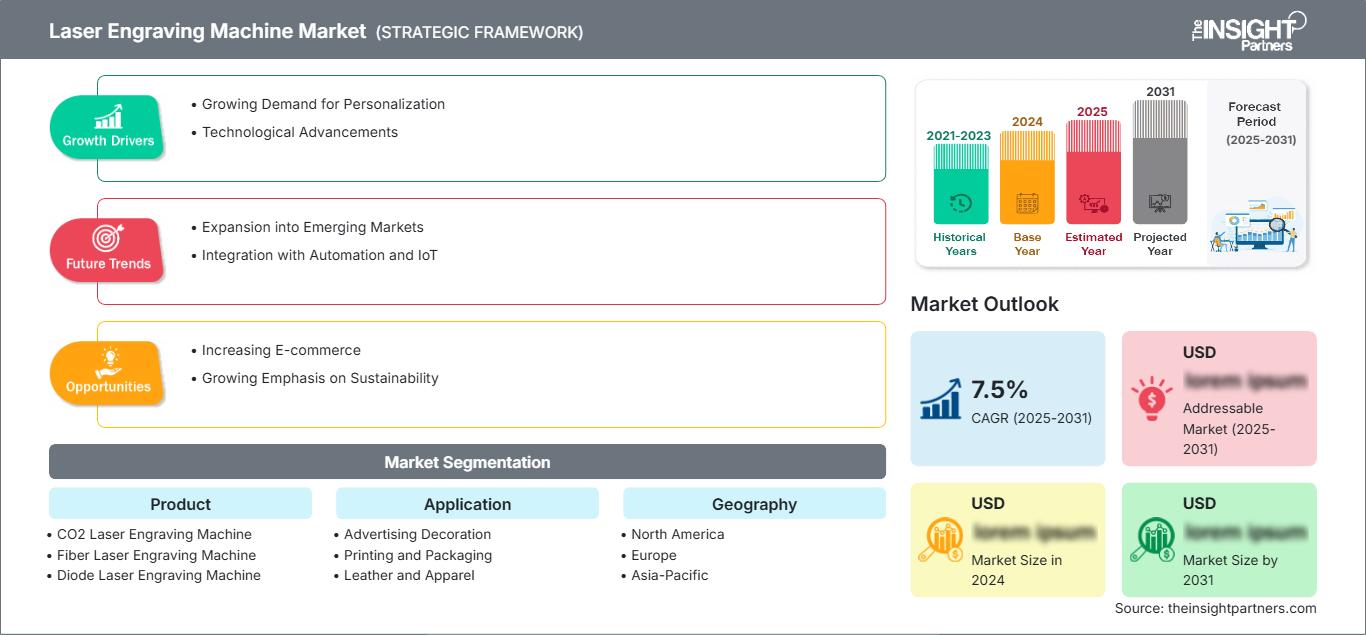
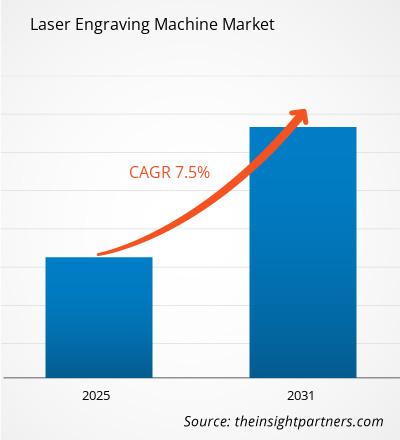
The laser engraving machine market size was valued at US$ 2.63 Billion in 2025 and is projected to reach US$ 4.1 Billion by 2034; it is expected to register a CAGR of 5.70% during 2026–2034. The market is growing because of the use of software-controlled engraving machines by industries for applications like durable marking, customization, packaging, leather decoration, model making, and artistic production on metals, plastics, woods, glass, textiles, and composite materials.
The growth rate in North America for 2026–2034 is estimated to be 5.1–5.6%. Growth is driven by renewed efforts in advanced manufacturing and investments in digital fabrication. Growth is further bolstered by the need for packaging serialization, part identification in the aerospace sector, personalized small-batch production, and strong machine tool spending in the U.S. The installed base in North America has a preference for replacements and software upgrades as well as hybrid CO2-fiber machines.
Laser Engraving Machine Market Assessment and Insights
- North America: The region accounted for 28–31% share in 2025 and is growing at a CAGR of 5.1–5.6% between 2026–2034, led by packaging, aerospace marking, and distributed customization demand.
- US: The U.S. represented 74–78% of North America laser engraving machine market in 2025 and is growing at a CAGR of 5.2–5.7% between 2026–2034, supported by industrial part marking and maker-business adoption.
- Europe: Europe held 24–27% share in 2025 and is growing at a CAGR of 4.8–5.3% between 2026–2034, with Germany, the UK, France, Italy, and Spain leading machinery replacement and compliance marking.
- Asia Pacific: APAC captured 34–38% share in 2025 and is growing at a CAGR of 6.1–6.6% between 2026–2034, led by China, Japan, South Korea, India, and Australia across electronics, signage, and apparel.
- Largest Segment: CO2 Laser Engraving Machine held 39–43% laser engraving machine market share in 2025 and is growing at a CAGR of 4.9–5.4% between 2026–2034, supported by non-metal processing breadth.
- High Growth Segment: Fiber Laser Engraving Machine held 26–30% market share in 2025 and is growing at a CAGR of 6.4–6.9% between 2026–2034, driven by metal marking and traceability.
- Key companies analyzed in detail: ALLTEC GmbH, Epilog Laser, GCC, Kern Laser Systems, LaserStar Technologies Corporation, RMI Laser, Trotec Laser GmbH, Universal Laser Systems, Inc., Vytek Laser Systems, Wisely Laser Machinery Limited, Gravotech Marking SAS, and Han’s Laser Technology Industry Group Co., Ltd.
Source: The Insight Partners' analysis based on proprietary research, government publications, company annual reports, investor presentations, industry databases, and expert interviews.
Adoption of technology has advanced from independent engraving workstations to networked systems equipped with cameras that facilitate quick setups and repetitive output. CO2 laser machines continue to form a critical part of the processes of acrylics, woods, papers, leathers, and textiles, whereas fiber lasers are increasingly becoming useful in the engraving of metals, electronic boxes, tools, and medical parts. Machine manufacturers are also developing machines with enclosure architecture, user-friendly software, smaller sizes, and low-maintenance laser systems.
During the forecast period, newly developed manufacturing bases in Asia Pacific and selected regions of the Middle East are anticipated to receive investment into digitally controlled marking technologies. The increasing need for product marking for regulatory requirements, e-commerce customization, and cheaper diode-based machines is pushing the market size estimates of Laser Engraving Machines beyond typical signage customers. Users are increasingly focusing on throughput, material capability, serviceability, and software integration in their equipment selection process.
Laser Engraving Machine Market Report Scope
| Report Attribute | Details |
|---|---|
| Market size in 2025 | US$ 2.63 Billion |
| Market Size by 2034 | US$ 4.1 Billion |
| Global CAGR (2026 - 2034) | 5.70% |
| Historical Data | 2021-2024 |
| Forecast period | 2026-2034 |
Laser Engraving Machine Market Analysis
Demand is shaped by manufacturers’ need for permanent, legible, and repeatable marks without consumable-heavy mechanical tooling. Packaging converters use engraving and laser marking for batch identity, decorative finishing, and anti-counterfeit graphics, while leather, apparel, and craft users value fast design changes. This supports Laser Engraving Machine market forecast among small enterprises and production facilities that require flexible output across short runs.
The supply chain comprises companies manufacturing the lasers, motion control systems, optical components, software, integrators, distributors, and support services. The supply chain dynamics are becoming more favorable with standardization of diode modules, fiber lasers, and CNC parts; however, quality equipment will continue to need accurate optical components, enclosed units, fumes handling capability, and good support services. The Laser Engraving Machine market report indicates buyers prioritize uptime and application testing over initial price alone.
Competition is dispersed among branded equipment companies, regional system integrators, and affordable Asian machine producers. Epilog Laser, Trotec Laser GmbH, Universal Laser Systems, Inc., GCC, Kern Laser Systems, and Gravotech Marking SAS compete based on software, speed, and service capabilities. RMI Laser, LaserStar Technologies Corporation, ALLTEC GmbH, and Han’s Laser Technology Industry Group Co., Ltd. enhance their position in industrial laser marking using dedicated solutions for different industries.
The investments are directed to dual source machines, small desktop systems, automated material handling, and service-oriented marketing. The suppliers are positioning themselves based on software solutions, camera alignment, open material databases, and training programs as the buyer compares productivity instead of power output. The Laser Engraving Machine market trend of replacement purchases is rising as older CO2 platforms are upgraded for faster engraving speeds and broader substrate compatibility.
● REPORT CUSTOMIZATION
Tailor This Report To Align With Your Specific Business Requirements
This report can be customized to align precisely with your business objectives, scope, and target markets. Customization options include tailored segmentation, geography, competitive analysis, and strategic insights to support informed decision-making.
Customize This Report →WHAT YOU CAN ADJUST
- ● Segmentations
- ● Geography
- ● Competitive Analysis
- ● Language Preferences
Laser Engraving Machine Market: Strategic Insights
Regional Insights
North America Laser Engraving Machine
North America accounted for 28–31% of the global laser engraving machine market in 2025 and is projected to expand at a CAGR of 5.1–5.6% through 2034. Demand is concentrated in the U.S. and Canada, where packaging, aerospace, electronics repair, education labs, and promotional product businesses use engraving systems for traceability and custom output. Advantages that are enjoyed by this area include an extensive distribution channel, high customer service standards, and existing experience with industry safety standards. Large customers are moving towards enclosed equipment, extraction ready stations, and machine alignment with cameras. Small businesses are embracing small machines to enable customization.
U.S. Laser Engraving Machine Market
The U.S. represented 74–78% of North America laser engraving machine market in 2025 and is forecast to grow at a CAGR of 5.2–5.7% during 2026–2034. Industrial marking, packaging prototyping, awards, signage, and educational fabrication labs sustain a broad installed base. Company presence from Epilog Laser, Universal Laser Systems, Inc., Kern Laser Systems, RMI Laser, and LaserStar Technologies Corporation reinforces domestic service availability. The trends vary according to the user category. Job shops prefer fast set-up of artwork and multi material cutting. Manufacturers need permanent markings on their tools, labels, enclosures, and parts. In the United States, entrepreneurial spirit in customized products is another advantage, since small CO2 and diode laser units can be used for commercial purposes.
Europe Laser Engraving Machine Market
Europe held 24–27% laser engraving machine market share in 2025 and is expected to grow at a CAGR of 4.8–5.3% during 2026–2034. There is continuous growth within the UK market for the use of signage, craft fabrication, and package design studio industries, where smaller machines can aid in making the design process faster while ensuring premium levels of customization. Germany is still the number one country because of the high level of engineering involved in the manufacturing processes and auto industry, along with its requirement for industrial marking. Trotec Laser GmbH, ALLTEC GmbH, and Gravotech Marking SAS help meet this market’s demand for reliable machines and laser safety standards along with their service-provided purchase. France, Italy, and Spain contribute by way of luxurious packaging, leather goods, textile decorations, woodworking, and industrial marking. The buyers from these countries care about energy efficiency, employee training, and compliance standards, requiring reliable machines with consistent performance and quality engraving. .
APAC Laser Engraving Machine Market
APAC accounted for 34–38% laser engraving machine market share in 2025 and is projected to grow at a CAGR of 6.1–6.6% through 2034. China leads through electronics, packaging, tools, and low-cost equipment manufacturing, while Japan and South Korea emphasize precision marking for components and consumer electronics. India adopts the technology via signs, clothes, packaging, and manufacturing companies run by makers due to growing digital manufacturing services. Australia provides the specialized demand from education, fabrication, architectural models, and some industrial companies. The policy support of local manufacturing, electronics value chain, and export-oriented manufacturing increases the equipment demand regionally. The APAC buyers usually consider the affordability, support availability, software usability, and throughput before upgrading.
Middle East & Africa Laser Engraving Machine Market
The Middle East and Africa laser engraving machine market is forecast to expand at a CAGR of 4.6–5.1% during 2026–2034, with Saudi Arabia and the UAE leading adoption. Infrastructure, construction materials, retail personalization, and industrial maintenance support engraving demand. South Africa helps through the use of signage, packaging, training, and light manufacturing. Demand from the rest of MEA comes from projects involving distribution channels and technical service availability. Projects in energy, logistics, and infrastructure generate demands for tool, panel, tag, and component identification. The buyers prefer long-lasting solutions that include training due to operating conditions affecting availability and maintenance.
Segmentation Analysis
Product
The product segment is expected to grow at a CAGR of 5.4–5.9% during 2026–2034, reflecting balanced adoption across CO2, fiber, diode, and solid-state machines. Buyers select systems by substrate, marking depth, production volume, and software workflow. The Laser Engraving Machine market trends favor hybrid capability, compact footprints, and lower maintenance sources that reduce operator dependency.
- CO2 Laser Engraving Machine remains the largest product category because it handles wood, acrylic, paper, glass, fabric, and leather with reliable edge quality and broad creative-industry acceptance.
- Fiber Laser Engraving Machine is strategically important for metal marking, electronics housings, tooling, and durable product identification where high contrast, speed, and low maintenance are procurement priorities.
- Diode Laser Engraving Machine serves entry-level, education, hobbyist, and microbusiness users, offering affordability and compact design while gradually improving power, safety enclosures, and software usability.
- ND:YAG Laser Engraving Machine retains relevance in specialized industrial and jewelry applications requiring precise marking on metals, ceramics, and hard materials where legacy expertise supports continued use.
Application
The application segment is expected to grow at a CAGR of 5.5–6.0% during 2026–2034 as users expand engraving from decoration to identification, prototyping, and value-added finishing. Advertising decoration leads volume demand, while printing and packaging gain strategic importance from serialization and brand protection. Leather, apparel, model making, and arts-based uses strengthen recurring small-batch utilization.
- Advertising Decoration generates steady demand from signage, awards, display graphics, and branded merchandise, where fast artwork changes and multi-material capability help providers manage custom orders.
- Printing and Packaging uses engraving for decorative effects, dies, identification marks, and short-run prototypes, making it important for converters seeking flexible finishing and anti-counterfeit support.
- Leather and Apparel adoption is driven by personalization, texture creation, labels, patches, and premium detailing, particularly where brands need repeatable designs without mechanical tooling.
- Model Making benefits from accurate cutting and engraving on acrylic, wood, board, and paper materials, supporting architecture, education, industrial design, and prototyping workflows.
- Arts and Crafts remains a resilient demand pocket because creators, studios, and small businesses use compact systems to convert digital designs into customized products.
Opportunity Snapshot
| Application | Revenue Contribution | Trend Tag | Adoption Stage |
| Advertising Decoration | High | Custom Signage | Mature |
| Printing and Packaging | High | Smart Labels | Scaling |
| Leather and Apparel | Medium | Premium Texture | Scaling |
| Model Making | Medium | Rapid Models | Mature |
| Arts and Crafts | Medium | Creator Commerce | Scaling |
| Others | Low | Niche Jobs | Emerging |
Laser Engraving Machine Market Growth Drivers and Impact Analysis
Rising Need for Permanent Product Identification
The trend towards greater usage of permanent marking for the purpose of serial numbering, batch coding, warning labels, and component traceability is being observed among manufacturers. Marking by laser systems provides high contrast marking without the need for any ink, label, or wear on the tool; therefore, it is ideal for metal components, enclosures of electronic devices, packaging, and durable products. This trend is most significant in situations where the system of quality requires that the mark be legible even after washing, handling, or outdoor exposure. With the growing digitization of manufacturing, engraving equipment is getting linked to job files and databases.
Expansion of Customization-Based Business Models
Personalization continues to be an attainable area of expansion since laser engraving is capable of providing one-to-one and small-run capabilities economically. Merchants, e-commerce companies, awards firms, crafts studios, and clothing decorators utilize engraving to provide a unique product without having to keep huge stockpiles of pre-made products. The machine itself is made into a money-making tool instead of just a production tool. Names, logos, texture, and localized designs can be provided based on individual need.
Shift Toward Cleaner and Flexible Material Processing
Laser engraving reduces reliance on physical tooling, cutting dies, chemical etching, and contact-based marking for many applications. Users gain cleaner edges, lower material distortion, and faster design changes, which are important in packaging prototypes, signage, model making, and premium decorative goods. Flexibility also matters when one machine must process several substrates during the same shift. The market impact is visible in procurement decisions that value software-controlled workflows, enclosed operation, and repeatable quality. As sustainability audits become more common, reduced consumable use strengthens the business case for laser-based engraving.
Laser Engraving Machine Market Future Trends
Hybrid CO2-Fiber Platforms Become More Common
Future equipment portfolios are expected to include more hybrid systems that combine CO2 and fiber sources within a single workflow. This trend addresses a clear user problem: many job shops process wood, acrylic, leather, coated metals, plastics, and bare metals but do not want separate machines for each material category. Hybrid platforms can reduce floor space, simplify training, and improve scheduling flexibility. Suppliers that combine dual-source architecture with reliable software presets and camera positioning are likely to gain stronger acceptance among professional users seeking higher asset utilization.
Software-Led Workflow Automation Gains Importance
The next phase of competition will increasingly depend on software rather than only laser power. Users want material presets, job libraries, camera alignment, print-to-laser tools, remote diagnostics, and simplified file preparation. These features reduce operator variability and make machines accessible to education labs, small businesses, and multi-shift production users. Over time, suppliers may use workflow platforms to create recurring service relationships through training, support, and application updates. This shift could raise switching costs and strengthen brand loyalty in a market where hardware differences are narrowing.
Laser Engraving Machine Market Opportunities
Packaging Serialization and Premium Finishing
Packaging offers an attractive opportunity because converters and brand owners need both functional identification and differentiated visual effects. Laser engraving can support batch information, decorative textures, short-run personalization, and anti-counterfeit markings on paperboard, labels, films, wood, and coated materials. Suppliers can capture value by offering application testing, fume-management guidance, and integration support for packaging workflows. The opportunity is strongest for machines that combine speed, fine detail, and easy job switching, particularly among premium food, beverage, cosmetics, and specialty retail packaging users.
Industrial Training, Education, and Maker Infrastructure
Education labs, vocational institutes, engineering colleges, and maker spaces represent a long-term adoption channel because they introduce users to digital fabrication early. Institutions require safe, enclosed, easy-to-teach machines that handle acrylic, wood, paper, rubber, and textiles. Vendors can build durable demand by packaging hardware with curriculum support, training, maintenance plans, and material guidance. This opportunity also creates future commercial buyers, as students, designers, and entrepreneurs transfer laser skills into studios, small manufacturing units, and prototyping businesses after graduation.
Recent Developments
- May 2026: Trotec proudly launches the E Line, a reliable and professional laser cutter designed for users who want robust performance, intuitive operation, and an attractive entry into the Trotec ecosystem. With a strong focus on stable day‑to‑day operation and an efficient Ruby‑based workflow, the E340 delivers everything essential for productive laser cutting.
- April 2025: Laser Photonics Corporation and its subsidiary, Control Micro Systems, Inc. (CMS Laser), announce the launch of their Tumbler Laser Engraving Machines. This technology empowers businesses to accept and process large custom orders in record time, transforming ordinary drinkware into impactful brand statements with personalized text, striking logos, and intricate designs. By enabling high-volume customization with speed and precision, the system helps companies strengthen brand visibility and foster deeper customer engagement.
- September 2025: OBA Laser Marking + Engraving is launching a new generation of fiber lasers onto the market with the Y-Series. With its unique features such as dynamic multi-Level Marking, it offers flexible application options and maximum process reliability.
Frequently Asked Questions

- Comprehensive Market Sizing and Forecast Analysis
- Detailed Segmentation Analysis
- In-Depth Market Dynamics Assessment
- Regional and Country-Level Insights
- Competitive Landscape and Company Benchmarking
- Strategic Business Intelligence
Recent Reports
Testimonials

The Insight Partners' SCADA System Market report is comprehensive, with valuable insights on current trends and future forecasts. The team was highly professional, responsive, and supportive throughout. We are very satisfied and highly recommend their services.
RAN KEDEM Partner, Reali Technologies LTDs
I requested a report on a very specific software market and the team produced the report in a few days. The information was very relevant and well presented. I then requested some changes and additions to the report. The team was again very responsive and I got the final report in less than a week.
JEAN-HERVE JENN Chairman, Future Analytica
We worked with The Insight Partners for an important market study and forecast. They gave us clear insights into opportunities and risks, which helped shape our plans. Their research was easy to use and based on solid data. It helped us make smart, confident decisions. We highly recommend them.
PIYUSH NAGPAL Sr. Vice President, High Beam Global
The Insight Partners delivered insightful, well-structured market research with strong domain expertise. Their team was professional and responsive throughout. The user-friendly website made accessing industry reports seamless. We highly recommend them for reliable, high-quality research services
YUKIHIKO ADACHI CEO, Deep Blue, LLC.
This is the first time I have purchased a market report from The Insight Partners.While I was unsure at first, I visited their web site and felt more comfortable to take the risk and purchase a market report.I am completely satisfied with the quality of the report and customer service. I had several questions and comments with the initial report, but after a couple of dialogs over email with their analyst I believe I have a report that I can use as input to our strategic planning process.Thank you so much for taking the extra time and making this a positive experience.I will definitely recommend your service to others and you will be my first call when we need further market data.
JOHN SUZUKI President and Chief Executive Officer, Board Director, BK Technologies
I wish to appreciate your support and the professionalism you displayed in the course of attending to my request for information regarding to infectious disease IVD market in Nigeria. I appreciate your patience, your guidance, and the fact that you were willing to offer a discount, which eventually made it possible for us to close a deal. I look forward to engaging The Insight Partners in the future, all thanks to the impression you have created in me as a result of this first encounter.
DR CHIJIOKE ONYIA MANAGING DIRECTOR, PineCrest Healthcare Ltd.Reason to Buy
- Informed Decision-Making
- Understanding Market Dynamics
- Competitive Analysis
- Identifying Emerging Markets
- Customer Insights
- Market Forecasts
- Risk Mitigation
- Boosting Operational Efficiency
- Strategic Planning
- Investment Justification
- Tracking Industry Innovations
- Aligning with Regulatory Trends





 Get Free Sample for