
Bio-based Leather Market Size, Demand & Growth by 2034
Bio-based Leather Market Size and Forecasts (2021–2034), Global and Regional Share, Trends, and Growth Opportunity Analysis Report Coverage : by Source (Mushroom, Pineapple, Apple, Cactus, Tree Bark, Leaftover Fruits); End-Use Indiustry (Footwear, Garments and Accessories); and Geography (North America, Europe, Asia Pacific, and South and Central America)
- Status : Data Released
- Report Code : TIPRE00040397
- Category : Chemicals and Materials
- No. of Pages : 150
- Available Report Formats :


- Last update date : August 27, 2026


2025 Market Size
US$ 142.76 Mn
Base year value
2034 Forecast
US$ 397.68 Mn
Projected by 2034
CAGR 2026-2034
12.06 %
Growth rate
Addressable Market
US$ 2,369.78 Mn
(2026-2034)
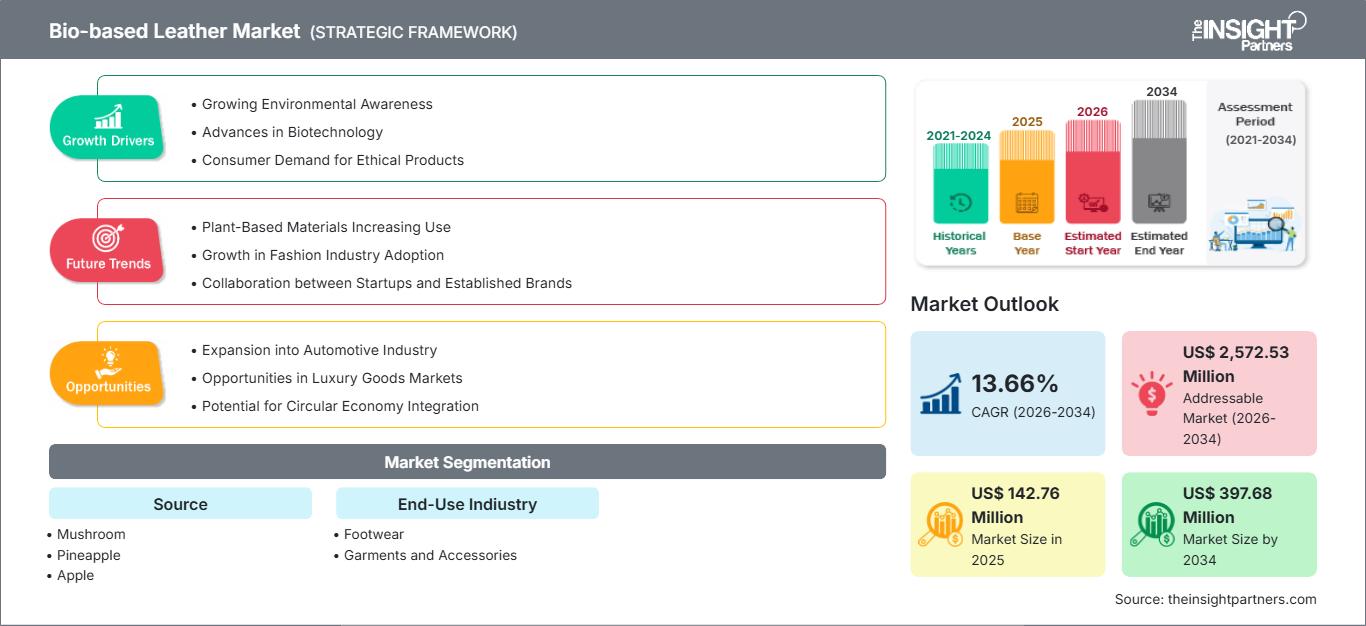
The Bio-based Leather market was valued at US$ 142.76 million in 2025 and is expected to reach US$ 397.68 million by 2034; it is estimated to record a CAGR of 12.06% during 2026-2034.
Bio-based Leather Market Assessment and Insights
- North America: North America is estimated to hold a 29–33% share in 2025 and expand at a 12–14% CAGR between 2026–2034, supported by biomaterial innovation, footwear applications, investment activity, and expanding commercialization of mycelium and plant-derived materials.
- U.S.: The U.S. represents 70–74% of North America's 2025 market and is projected to grow at a 13–15% CAGR during 2026–2034, supported by technology developers and footwear applications.
- Europe: Europe is estimated to account for a 31–35% share in 2025 and grow at a 12–14% CAGR during 2026–2034, with Italy, Germany, France, the UK, and Spain supporting fashion, footwear, automotive, and circular-material adoption.
- Asia Pacific: Asia Pacific is estimated to represent a 23–27% share in 2025 and expand at a 15–17% CAGR through 2034, led by China, Japan, South Korea, and India through manufacturing scale, agricultural resources, and material innovation.
- Largest Segment: Mushroom-based materials account for an estimated 31–35% market share in 2025 and are modeled to grow at a 14–16% CAGR, supported by controlled mycelium production and commercial development.
- High Growth Segment: Pineapple-based materials represent an estimated 14–16% market share in 2025 and are modeled to expand at a 15–17% CAGR through 2034, supported by footwear and accessory applications.
- Key companies analyzed in detail: Natural Fiber Welding, Inc., Ananas Anam Ltd., MycoWorks, Inc., Bolt Threads, Inc., Modern Meadow, Adriano Di Marti S.p.A., Ultrafabrics Holdings Co., Ltd., Beyond Leather Materials ApS, Fruitleather Rotterdam, VEGEA S.r.l.
Source: The Insight Partners' analysis based on proprietary research, government publications, company annual reports, investor presentations, industry databases, and expert interviews.
From experiments with biomaterials to actual engineering of material is what this industry is evolving towards. It’s becoming possible to grow mycelium, treat agriculture waste, strengthen fibers, use biological adhesives, and even apply new coatings. More and more attention is paid to thickness, tensile strength, wear resistance, elasticity, even color and coating. These requirements will affect the competition by making it more about performance and manufacturability than sustainability.
The trends are driven by investments in new biomaterials, cooperation with footwear and apparel brands, and increasing attention to local biomass sources. The developments in circular economy projects in Europe and biotechnology solutions in North America may speed up commercialization, and Asian manufacturing capacities can help produce large quantities. Increasing regulatory pressure on green claims may result in better documentation of renewable material contents, chemical composition, sources, and disposal options.
Bio-based Leather Market Report Scope
| Report Attribute | Details |
|---|---|
| Market size in 2025 | US$ 142.76 Million |
| Market Size by 2034 | US$ 397.68 Million |
| Global CAGR (2026 - 2034) | 12.06% |
| Historical Data | 2021-2024 |
| Forecast period | 2026-2034 |
Bio-based Leather Market Analysis
The demand for materials is increasingly driven by companies looking for renewable, waste-based, and non-animal alternatives. The ecosystem of the Bio-Based Leather Market consists of agriculturalists, biomass processors, biomaterial producers, coating experts, textile converters, footwear makers, accessory makers, and retailers. Biomass from pineapple leaves, fruit waste, cactus, tree bark, and mushrooms offer different avenues of feedstock but successful development is contingent upon proper feedstock logistics, processing of the feedstock, yields, and quality.
The value chain integrates agriculture with biotech and chemistry to develop materials which need to be converted into rolls of material that conform to manufacturing requirements. Thus, the economic aspect of supplies relies upon feedstock logistics, energy consumption, binders, coatings, yields, labor costs, and plant capacity. Those who have developed both their own feedstock and supply chains may have an advantage as production volumes grow.
The Competitive Analysis of the Bio-Based Leather Market Report reveals the presence of specialized biomaterial players along with traditional materials players in the market. MycoWorks specializes in engineered mycelium, Ananas Anam is selling Piñatex made out of pineapple leaf fibers, VEGEA is developing biomaterials made out of grapes and Ultrafabrics Holdings Co., Ltd. engages in advanced material solutions. The competition in the market becomes focused on testing, availability, scalability, IP, feedstock security and qualification of customers rather than sustainability.
The strategic positioning depends on the technology platform as well as on the target application. Thus, MycoWorks stresses engineered mycelium and Ananas Anam has created a proven agricultural residue technology platform. VEGEA uses the winery waste to create material, showing the possibilities of industrial symbiosis. Companies try to establish partnerships with footwear, luxury goods, car, furniture, and accessories manufacturers. Investors evaluate manufacturing readiness, unit economics, technical validation, customer pipeline and ability to transition from pilot production to commercial production.
● REPORT CUSTOMIZATION
Tailor This Report To Align With Your Specific Business Requirements
This report can be customized to align precisely with your business objectives, scope, and target markets. Customization options include tailored segmentation, geography, competitive analysis, and strategic insights to support informed decision-making.
Customize This Report →WHAT YOU CAN ADJUST
- ● Segmentations
- ● Geography
- ● Competitive Analysis
- ● Language Preferences
Bio-based Leather Market: Strategic Insights
Regional Insights
North America Bio-Based Leather Market
North America is estimated to account for a 29–33% Bio-Based Leather market share in 2025 and is modeled to expand at a 12–14% CAGR through 2034. The U.S. dominates regional activity because of biomaterials startups, biotechnology capabilities, footwear innovation, and established relationships between material developers and consumer brands. Canada contributes through sustainable-material research and specialty manufacturing, although its commercial base remains smaller than that of the U.S.
The area has been taking advantage of the availability of investments, advanced research facilities, and raw materials such as agricultural residue. Mycelium products have relevance here because the process of engineering material structures can be achieved by controlling biological growth. There is a growing trend of using these products not only for footwear but also in the manufacture of bags, furniture, car interiors, and many other uses.
U.S. Bio-Based Leather Market
The United States accounts for about 70–74% of the market for North America in 2025, and is expected to grow at a CAGR of 13–15% from 2025 to 2034. The strong infrastructure for biotechnology, material companies with venture backing, footwear brands, and advanced product development capabilities contribute to the commercialization efforts. Developers have become less interested in marketing their products on the basis of environmental benefits alone, and are more keen on validating product performance.
MycoWorks possesses Fine Mycelium technology, whereas Natural Fiber Welding invented MIRUM, which is a plant-based material platform. Some applications for these materials include footwear uppers, accessories, automotive interior, and furniture. The material testing criteria include resistance to flex, abrasion, tensile strength, finish adhesion, dimensional stability, and color fastness.
Europe Bio-Based Leather Market
Europe is expected to have an estimated market share of 31-35% by 2025, growing at a CAGR of 12-14% through 2034. The key market here is represented by Italy due to its expertise in leather processing, footwear manufacture, fashion, and material innovation. Germany, France, the UK, and Spain contribute through innovations in advanced manufacturing, luxury goods, textiles, and circular economy concepts.
The UK is active in innovations in sustainable textiles and fashion materials. Germany is focused on innovations in industrial materials engineering and advanced manufacturing technologies. France leverages the advantages of its luxury goods and fashion, where aesthetics matter. Italy utilizes its leather processing experience along with the expertise in footwear and accessories manufacturing, providing high commercialization potential. Spain contributes through innovation in textile manufacturing and fashion applications. Europe, thus, balances its environmental ambitions with technical and aesthetic ones.
APAC Bio-Based Leather Market
APAC accounts for a share of 23–27% in 2025 and is projected to grow at a 15–17% CAGR. China excels in manufacturing, Japan and South Korea excel in advanced materials, India in agricultural residue and shoe manufacturing, and Australia in biomaterials and sustainable materials.
Manufacturing capabilities, resource availability, and efficiency policies drive the use of such bio-materials regionally. China is likely to be the largest market due to the presence of an efficient manufacturing network. India can leverage the presence of pineapples and agricultural residues and fruits. Japan and South Korea excel in advanced material engineering, and Australia in research.
Middle East & Africa Bio-Based Leather Market
The Middle East and Africa are an emerging market and are modeled to grow at a 10–12% CAGR through 2034. Saudi Arabia and the UAE provide industrial investment opportunities, while South Africa combines agricultural resources with textile and manufacturing capabilities. The Rest of MEA remains fragmented but provides opportunities for localized biomass utilization and specialty material production.
The factors that have an impact on adoption include availability of energy, industry-related facilities, diversification efforts, and agriculture. While Saudi Arabia and the UAE will be able to invest in advanced manufacturing operations, South Africa can use its agricultural waste.
Segmentation Analysis
Source
The Bio-Based Leather Market scope across mushroom, pineapple, apple, cactus, tree bark, and leftover-fruit sources reflects differences in feedstock availability, processing requirements, material performance, and commercialization maturity. Mushroom-based technologies have established a strong position because controlled mycelium cultivation can support engineered material structures. Plant-derived alternatives remain important because agricultural residues provide potentially scalable feedstock pathways for footwear, garments, and accessories.
- Mushroom: Mycelium-based materials hold a leading position because controlled cultivation can produce engineered structures with targeted physical characteristics. Commercial applications include footwear, luxury accessories, furniture, interiors, and fashion products.
- Pineapple: Pineapple materials use leaf fibers that can otherwise have limited commercial value. Their established fiber-processing pathway supports footwear, handbags, accessories, and fashion products requiring a natural-fiber appearance.
- Apple: Apple-derived materials utilize residues from food processing. Their strategic importance comes from waste valorization, providing an opportunity to convert food-industry by-products into inputs for coated material production.
- Cactus: Cactus-based materials benefit from interest in plant-derived inputs and drought-tolerant biomass. Developers target footwear, accessories, and lifestyle applications requiring distinctive plant-based material characteristics.
- Tree Bark: Tree-bark materials provide another biomass pathway incorporating naturally occurring structural components. Commercial development depends on reliable sourcing, efficient processing, consistency, and the ability to meet durability requirements.
- Leaftover Fruits: Leftover fruit biomass can provide fibers and other components for material development. Its strategic importance lies in converting low-value agricultural residues into higher-value inputs for fashion and accessory manufacturing.
End-Use Indiustry
The end-use segment is shaped by differences in abrasion resistance, flexibility, tensile strength, appearance, thickness, finishing, and stitching requirements. Footwear provides a major commercialization pathway because manufacturers can introduce alternative materials into selected product components before expanding applications. Garments and accessories provide additional opportunities where tactile properties, surface appearance, drape, and brand positioning influence product development.
- Footwear: Footwear is a major application because manufacturers evaluate alternative uppers, trims, linings, and components. Materials must satisfy demanding flex, abrasion, tear, finish, and dimensional-stability requirements.
- Garments and Accessories: Garments and accessories include handbags, wallets, belts, apparel components, and small leather goods. Adoption depends on aesthetics, drape, stitching performance, tactile properties, finishing, and durability.
Opportunity Snapshot
| End-Use Industry | Revenue Contribution | Trend Tag | Adoption Stage |
|---|---|---|---|
| Footwear | High | Bio Uppers | Scaling |
| Garments and Accessories | Medium | Luxury Materials | Scaling |
Bio-based Leather Market Growth Drivers and Impact Analysis
Growing demand for renewable and waste-derived material inputs
Brands are increasingly evaluating renewable feedstocks as alternatives to animal hides and fossil-derived synthetic materials. Agricultural residues can create additional value from existing food and crop-processing systems while providing differentiated material characteristics. Pineapple leaves, fruit residues, grape waste, and other biomass streams can become useful industrial inputs when collection and preprocessing systems are established. The commercial impact extends across both materials and agricultural value chains. However, developers must demonstrate consistent feedstock quality, adequate availability, stable processing yields, and commercially viable logistics. Companies that integrate sourcing, preprocessing, material engineering, and finishing can potentially reduce supply variability. These capabilities are particularly relevant as customers transition from small product trials toward larger commercial orders requiring predictable specifications and reliable supply continuity.
Advances in mycelium and plant-based material engineering
Technological advances are improving the ability of developers to control material structure and performance. MycoWorks has demonstrated this direction through Fine Mycelium, which enables engineered mycelial structures for targeted applications. In 2025, the company reported third-party performance testing covering flexibility, abrasion resistance, colorfastness, aging, and finish adhesion for Reishi. These developments address a major commercialization barrier because footwear, fashion, and luxury manufacturers require predictable performance across production batches. Improved cultivation methods, fiber processing, binders, coatings, and finishing technologies can further expand applications. The impact is especially important for premium products where material failure can generate high replacement costs. As testing becomes more rigorous, suppliers capable of demonstrating measurable performance alongside renewable material content are likely to gain stronger qualification opportunities.
Expansion of circular material strategies across consumer industries
Circularity is becoming increasingly relevant as manufacturers evaluate resource efficiency, waste reduction, renewable inputs, and end-of-life considerations together. Biomaterial developers can participate in this transition by converting agricultural residues into higher-value materials while reducing reliance on fossil-derived inputs. VEGEA provides an example through its use of grape residues and agricultural resources for material development. Circular sourcing can create commercial links between food processors, farmers, biomaterial producers, and fashion manufacturers. The impact is strongest where companies can document feedstock origin, processing methods, renewable content, and material composition. Traceability can improve procurement decisions and support environmental reporting. Over time, closer integration between agricultural and material-processing industries could create localized supply networks and increase the commercial value of underutilized biological resources.
Bio-based Leather Market Future Trends
Bio-based materials moving toward performance-led qualification
Future Bio-Based Leather Market trends are expected to shift from sustainability-led positioning toward measurable technical qualification. Buyers are likely to compare abrasion resistance, tensile strength, flex performance, colorfastness, surface durability, finish adhesion, and dimensional stability against conventional materials. This shift favors companies capable of providing standardized testing and reproducible specifications across commercial batches. MycoWorks' performance disclosures illustrate this direction by demonstrating testing across multiple technical parameters. Material suppliers are also likely to develop application-specific grades rather than one universal construction for all markets. Footwear, automotive interiors, accessories, and garments require different combinations of strength, flexibility, appearance, and finishing behavior. As technical specifications become more important, partnerships among biomaterial developers, textile processors, footwear manufacturers, testing laboratories, and brands should become increasingly structured.
Greater integration of agricultural residue valorization
The industry is likely to increasingly connect biomaterial manufacturing with agricultural and food-processing waste streams. Rather than treating biomass as a single raw material, producers can establish integrated systems that collect, clean, fractionate, and convert residues into fibers, fillers, oils, or polymer components. Pineapple leaves, grape residues, apple waste, and other fruit-processing by-products illustrate the potential. Such systems can improve resource utilization while providing additional revenue opportunities for agricultural processors. Localized feedstock networks could reduce transportation distances and improve traceability, while decentralized preprocessing facilities may support more efficient biomass handling. Developers who establish direct partnerships with agricultural cooperatives, food processors, wineries, and crop producers can potentially improve raw-material security. This approach also strengthens the connection between circular-economy objectives and commercial material production.
Bio-based Leather Market Opportunities
Expansion into automotive and interior material applications
Automotive interiors offer an important opportunity for material developers capable of meeting requirements related to abrasion, heat exposure, dimensional stability, fire behavior, color consistency, and long-term durability. The application can provide larger material volumes than many fashion categories, potentially improving production utilization once qualification is achieved. Companies can pursue this opportunity through dedicated automotive grades developed with specialized coatings and reinforcement systems. Partnerships with automotive suppliers, upholstery manufacturers, and interior designers can accelerate testing and qualification. Agricultural-residue-derived materials may be attractive where manufacturers seek renewable content alongside technical performance. The opportunity is strongest for producers capable of demonstrating stable commercial output, consistent specifications, reliable supply, and competitive production economics. Successful automotive qualification could create adjacent opportunities in furniture, transportation interiors, and other durable coated-material applications.
Development of traceable feedstock-to-material supply chains
A further opportunity exists in developing transparent supply chains that connect biomass producers with biomaterial manufacturers. Traceability can document feedstock origin, renewable content, processing stages, chemical inputs, manufacturing locations, and product batches. This information can strengthen procurement decisions while supporting environmental claims and reducing uncertainty surrounding raw-material availability. Developers can establish partnerships with pineapple growers, wineries, fruit processors, agricultural cooperatives, and food manufacturers to secure consistent residue streams. Digital tracking systems can connect incoming biomass with production batches and finished-material specifications. The Bio-Based Leather Market Forecasts opportunity therefore extends beyond material production into feedstock aggregation, preprocessing, logistics, certification, and supply-chain data management. Integrated networks can potentially improve production reliability while creating differentiated commercial propositions for brands seeking documented renewable-material sourcing.
Recent Developments
- April 2025: Lab-Grown Leather Ltd. unveiled the world's first product made from T. rex leather, a one-of-a-kind luxury handbag created with Enfin Levé. The material was developed with VML and The Organoid Company using reconstructed prehistoric protein sequences and advanced tissue engineering. The initiative demonstrates how engineered biology is expanding alternative leather into high-end luxury applications.
- November 2025: Bharat Biomaterials launched Terratan, a plant-based material produced from agricultural residues, including sugarcane bagasse, wheat husk, millet straw, rice straw, and cactus. The company uses a roll-to-roll manufacturing approach intended to improve consistency and scalability while converting agricultural waste into material for fashion, footwear, automotive, and upholstery applications.
- August 2025: Hyundai Motor Company announced that Hyundai CRADLE partnered with UNCAGED Innovations to develop grain-based, animal-free leather alternatives for vehicle interiors. Hyundai reported that the material could reduce greenhouse-gas emissions by 95%, water use by 89%, and energy consumption by 71% compared with traditional leather.
Frequently Asked Questions

- Comprehensive Market Sizing and Forecast Analysis
- Detailed Segmentation Analysis
- In-Depth Market Dynamics Assessment
- Regional and Country-Level Insights
- Competitive Landscape and Company Benchmarking
- Strategic Business Intelligence
Recent Reports
Testimonials

The Insight Partners' SCADA System Market report is comprehensive, with valuable insights on current trends and future forecasts. The team was highly professional, responsive, and supportive throughout. We are very satisfied and highly recommend their services.
RAN KEDEM Partner, Reali Technologies LTDs
I requested a report on a very specific software market and the team produced the report in a few days. The information was very relevant and well presented. I then requested some changes and additions to the report. The team was again very responsive and I got the final report in less than a week.
JEAN-HERVE JENN Chairman, Future Analytica
We worked with The Insight Partners for an important market study and forecast. They gave us clear insights into opportunities and risks, which helped shape our plans. Their research was easy to use and based on solid data. It helped us make smart, confident decisions. We highly recommend them.
PIYUSH NAGPAL Sr. Vice President, High Beam Global
The Insight Partners delivered insightful, well-structured market research with strong domain expertise. Their team was professional and responsive throughout. The user-friendly website made accessing industry reports seamless. We highly recommend them for reliable, high-quality research services
YUKIHIKO ADACHI CEO, Deep Blue, LLC.
This is the first time I have purchased a market report from The Insight Partners.While I was unsure at first, I visited their web site and felt more comfortable to take the risk and purchase a market report.I am completely satisfied with the quality of the report and customer service. I had several questions and comments with the initial report, but after a couple of dialogs over email with their analyst I believe I have a report that I can use as input to our strategic planning process.Thank you so much for taking the extra time and making this a positive experience.I will definitely recommend your service to others and you will be my first call when we need further market data.
JOHN SUZUKI President and Chief Executive Officer, Board Director, BK Technologies
I wish to appreciate your support and the professionalism you displayed in the course of attending to my request for information regarding to infectious disease IVD market in Nigeria. I appreciate your patience, your guidance, and the fact that you were willing to offer a discount, which eventually made it possible for us to close a deal. I look forward to engaging The Insight Partners in the future, all thanks to the impression you have created in me as a result of this first encounter.
DR CHIJIOKE ONYIA MANAGING DIRECTOR, PineCrest Healthcare Ltd.Reason to Buy
- Informed Decision-Making
- Understanding Market Dynamics
- Competitive Analysis
- Identifying Emerging Markets
- Customer Insights
- Market Forecasts
- Risk Mitigation
- Boosting Operational Efficiency
- Strategic Planning
- Investment Justification
- Tracking Industry Innovations
- Aligning with Regulatory Trends





 Get Free Sample for